Reforms to the Coronavirus Job Retention Scheme announced

[et_pb_section fb_built=”1″ _builder_version=”3.0.100″ background_image=”http://davidk423.sg-host.com/wp-content/uploads/2017/09/bdbf_final-stages-1-4-1.jpg” custom_padding=”|||” global_module=”2165″ saved_tabs=”all”][et_pb_row _builder_version=”3.25″ custom_padding=”|||”][et_pb_column type=”4_4″ _builder_version=”3.25″ custom_padding=”|||” custom_padding__hover=”|||”][et_pb_text _builder_version=”3.27.4″ background_layout=”dark” custom_margin=”0px|||” custom_padding=”0px|||”]

Employment Law News

[/et_pb_text][/et_pb_column][/et_pb_row][/et_pb_section][et_pb_section fb_built=”1″ admin_label=”section” _builder_version=”3.22.3″][et_pb_row admin_label=”row” _builder_version=”3.25″ background_size=”initial” background_position=”top_left” background_repeat=”repeat”][et_pb_column type=”4_4″ _builder_version=”3.25″ custom_padding=”|||” custom_padding__hover=”|||”][et_pb_text _builder_version=”4.2.2″ text_orientation=”justified” hover_enabled=”0″ use_border_color=”off”]

 Reforms to the Coronavirus Job Retention Scheme announced 

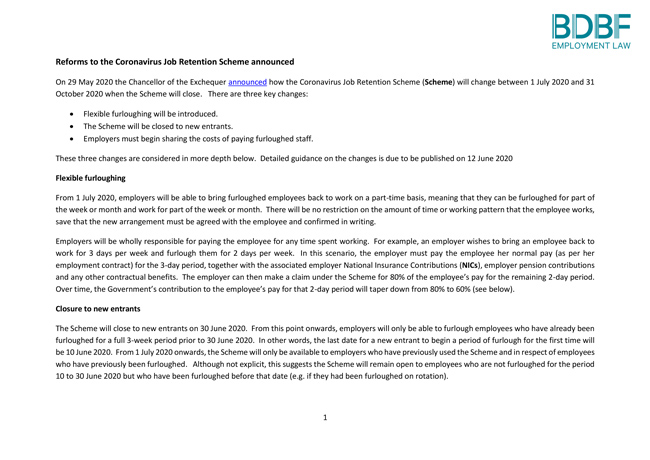
On 29 May 2020 the Chancellor of the Exchequer announced how the Coronavirus Job Retention Scheme (Scheme) will change between 1 July 2020 and 31 October 2020 when the Scheme will close. There are three key changes: 

  • Flexible furloughing will be introduced. 
  • The Scheme will be closed to new entrants. 
  • Employers must begin sharing the costs of paying furloughed staff. 

These three changes are considered in more depth below. Detailed guidance on the changes is due to be published on 12 June 2020 

Please click on the image below to view the PDF:

[/et_pb_text][et_pb_image src=”http://davidk423.sg-host.com/wp-content/uploads/2020/06/Reforms-to-the-furlough-scheme-1.jpg” url=”http://davidk423.sg-host.com/wp-content/uploads/2020/06/Reforms-to-the-furlough-scheme.pdf” align=”center” _builder_version=”4.2.2″ border_radii=”on|1px|1px|1px|1px” border_width_all=”1px” border_color_all=”#009b9b”][/et_pb_image][et_pb_text _builder_version=”4.2.2″ text_orientation=”justified” use_border_color=”off”]

BDBF is currently advising many employers and employees on the challenges presented by the coronavirus. If you or your business needs advice on furlough or other coronavirus-related matter please contact Amanda Steadman (amandasteadman@bdbf.co.uk) or your usual BDBF contact. 

[/et_pb_text][/et_pb_column][/et_pb_row][/et_pb_section][et_pb_section fb_built=”1″ _builder_version=”3.26.6″][et_pb_row _builder_version=”3.26.6″][et_pb_column type=”4_4″ _builder_version=”3.26.6″][/et_pb_column][/et_pb_row][/et_pb_section]


TUPE: beneficial contractual changes were void because they were by reason of the transfer

[et_pb_section fb_built=”1″ _builder_version=”3.0.100″ background_image=”http://davidk423.sg-host.com/wp-content/uploads/2017/09/bdbf_final-stages-1-4-1.jpg” custom_padding=”|||” global_module=”2165″ saved_tabs=”all”][et_pb_row _builder_version=”3.25″ custom_padding=”|||”][et_pb_column type=”4_4″ _builder_version=”3.25″ custom_padding=”|||” custom_padding__hover=”|||”][et_pb_text _builder_version=”3.27.4″ background_layout=”dark” custom_margin=”0px|||” custom_padding=”0px|||”]

Employment Law News


[/et_pb_text][/et_pb_column][/et_pb_row][/et_pb_section][et_pb_section fb_built=”1″ admin_label=”section” _builder_version=”3.22.3″][et_pb_row admin_label=”row” _builder_version=”3.25″ background_size=”initial” background_position=”top_left” background_repeat=”repeat”][et_pb_column type=”4_4″ _builder_version=”3.25″ custom_padding=”|||” custom_padding__hover=”|||”][et_pb_text _builder_version=”4.2.2″ text_orientation=”justified” hover_enabled=”0″ use_border_color=”off”]

TUPE: beneficial contractual changes were void because they were by reason of the transfer

In this case, the EAT considered whether four company directors were entitled to rely on contractual terms which had been put in place shortly before a TUPE transfer and were designed to significantly improve their position post-transfer. 

What does the law say?

Where an employer inherits employees following a TUPE transfer, it is unable to change their contractual terms where the transfer is the sole or principal reason for the change.  An attempt to do so will be void.

However, in the 2007 case of Power v Regent Security Services Ltd the Court of Appeal held that the incoming employer was bound by more favourable contractual terms that it had agreed with the transferring employees.   This decision has been understood to mean that employees should be able to rely on positive changes to their contracts, even if they are transfer-related.   Non-binding Government guidance also suggests that contractual changes which are “entirely positive” for the employee are allowed.

What happened in this case?

Mr Ferguson and three fellow claimants (the Claimants) were directors of Lancer Property Asset Management (Lancer).  Lancer provided estate management services to a single client, Berkeley Square Estate, in respect of a portfolio of 140 properties worth £5.5 billion owned by the Royal Family of Abu Dhabi.

Berkeley Square Estate terminated the contract with Lancer and moved its business to Astrea Asset Management Ltd (Astrea).  This amounted to a service provision change under TUPE.  Two months before the transfer took place, the Claimants made a series of extremely favourable changes to their own terms and conditions, including introducing rights to generous pay rises, guaranteed bonuses and termination payments, as well as increasing their notice periods.

Two of the Claimants were not accepted by Astrea.  The remaining two transferred to Astrea but were dismissed shortly afterwards.  All four brought claims against Astrea, including for the contractual termination payments introduced just before the transfer took place.  The Employment Tribunal rejected the claim on the basis that the pre-transfer changes were abusive because the Claimants had sought to take advantage of the effect of TUPE to award themselves additional compensation.  The Claimants appealed to the EAT.

What was decided?

The EAT dismissed the Claimants’ appeal on two grounds.

First, the Claimants had sought to argue that the restriction on transfer-related variations only concerned changes which were unfavourable to the employee.   The EAT rejected this argument, referring to the fact that the underlying purpose of the TUPE legislation is to safeguard the rights of transferring employees, not to improve them.  The Powercase was distinguished on the basis that, amongst other things, the contractual variation in that case had occurred after the transfer.  The EAT concluded that TUPE prevented any purported variation by reason of the transfer, regardless of how favourable it is to the employee.

Second, the EAT agreed with the Employment Tribunal that the Claimants’ actions had amounted to an abuse of the TUPE legislation.  The pre-transfer variations had been designed to improve the Claimants’ position and obtain an improper advantage, rather than to safeguard rights.

What are the learning points?

In a business sale situation, a buyer will usually require a seller to agree not to change employees’ terms and conditions in a specified window before the transfer without the buyer’s consent.  Outsourcing situations are more complicated, since the incoming contractor has no direct contractual relationship with the outgoing contractor.  For this reason, the outsourcing agreement between the client and the contractor usually includes a similar restriction on the contractor changing terms pre-transfer.   If it does not, it’s possible that the incoming contractor will seek indemnity protection from the client to cover any losses suffered as a result of any such changes.  This latest decision is helpful in that it provides that, even without such contractual protection, any changes made by reason of the transfer will not be enforceable.

Ferguson and others v Astrea Asset Management Ltd

If you would like to discuss any of the issues raised in this article please contact Amanda Steadman (amandasteadman@bdbf.co.uk) or your usual BDBF contact.

[/et_pb_text][/et_pb_column][/et_pb_row][/et_pb_section][et_pb_section fb_built=”1″ _builder_version=”3.26.6″][et_pb_row _builder_version=”3.26.6″][et_pb_column type=”4_4″ _builder_version=”3.26.6″][/et_pb_column][/et_pb_row][/et_pb_section]


Employee’s breach of a confidentiality clause in a COT3 agreement did not release employer from obligation to pay further settlement monies

[et_pb_section fb_built=”1″ _builder_version=”3.0.100″ background_image=”http://davidk423.sg-host.com/wp-content/uploads/2017/09/bdbf_final-stages-1-4-1.jpg” custom_padding=”|||” global_module=”2165″ saved_tabs=”all”][et_pb_row _builder_version=”3.25″ custom_padding=”|||”][et_pb_column type=”4_4″ _builder_version=”3.25″ custom_padding=”|||” custom_padding__hover=”|||”][et_pb_text _builder_version=”3.27.4″ background_layout=”dark” custom_margin=”0px|||” custom_padding=”0px|||”]

Employment Law News


[/et_pb_text][/et_pb_column][/et_pb_row][/et_pb_section][et_pb_section fb_built=”1″ admin_label=”section” _builder_version=”3.22.3″][et_pb_row admin_label=”row” _builder_version=”3.25″ background_size=”initial” background_position=”top_left” background_repeat=”repeat”][et_pb_column type=”4_4″ _builder_version=”3.25″ custom_padding=”|||” custom_padding__hover=”|||”][et_pb_text _builder_version=”4.2.2″ text_orientation=”justified” hover_enabled=”0″ use_border_color=”off”]

Employee’s breach of a confidentiality clause in a COT3 agreement did not release employer from obligation to pay further settlement monies

If an employee breaches a confidentiality clause contained in a COT3 agreement or, more commonly, a Settlement Agreement, what are the employer’s options? The answer is that it will depend on the importance of the clause or the severity of the employee’s breach.  A recent High Court decision offers a salutary lesson on the need to draft settlement documents carefully to ensure the employer has the best possible protection.

What does the law say?

If the confidentiality clause is of vital importance, such that it is regarded as a “condition” of the contract, then the employee’s breach entitles an employer to treat the contract as “repudiated” (thereby releasing it from any future obligations under the contract, such as the payment of further settlement monies).  Additionally, the employer could sue for damages for breach of contract.

However, if the confidentiality clause is not of vital importance, such that it is regarded as an “intermediate” term of the contract, then the employer’s remedy depends on the nature of the employee’s breach.  If the employee’s breach is serious enough to deprive the employer of the whole of the benefit of the contract then it will be regarded as a “repudiatory breach”, which would allow the employer to treat the contract as repudiated and also claim damages for loss.  If the breach is not a repudiatory breach, the employer will remain bound by contract and its only remedy would be to sue for damages for breach of contract.

What happened in this case?

The employee, Mr Steels, settled an employment dispute with his former employer, Duchy Farms Kennels Ltd (DFK), in exchange for a settlement payment of £15,500 to be paid in 47 weekly instalments.  The dispute was settled by way of a COT3 agreement which contained a boilerplate confidentiality clause.  That clause required Mr Steels to keep the fact and terms of the settlement confidential.  Later, DFK discovered that Mr Steels had disclosed the fact and amount of the settlement to one of DFK’s former employees. 

DFK stopped paying the weekly settlement payments on the grounds that Mr Steels had breached the COT3 and it was, therefore, released from its side of the bargain.  Mr Steels applied to the County Court to enforce the COT3.  DFK responded by seeking a declaration that the breach of the confidentiality clause meant that the remaining settlement monies were no longer payable. 

The County Court held that the confidentiality clause was not a condition of the COT3 agreement, but was, instead, an intermediate term.  As it could not be said that Mr Steels had committed a repudiatory breach, this meant that DFK remained bound by the contract and had to continue paying the weekly settlement payments.  DFK appealed to the High Court.

What was decided?

The High Court agreed with the County Court and dismissed DFK’s appeal.  The High Court said the confidentiality clause was a boilerplate clause.  It had not been expressed to be a condition of the agreement and nor was there any indication that confidentiality was of vital importance to the employer.  Importantly, the Court reached this conclusion despite the fact that the COT3 had been drafted by lawyers and referred to keeping the agreement “strictly confidential” and not just “confidential”. 

Having decided the confidentiality clause was as an intermediate term, the Court turned to whether Mr Steels’ actions amounted to a repudiatory breach. The Court said the test was whether a reasonable person would have regarded Mr Steels as having “clearly shown an intention to abandon and altogether refuse to perform the contract”.  This was not the case here.  The breach did not, and was not likely to, cause commercial harm to DFK and the risk of unmeritorious copycat claims was remote.  In any event, anyone who had known that Mr Steels and DFK had been in a dispute would have been able to deduce that there has been a settlement even without a breach of the confidentiality clause.

What are the learning points for employers?

When drafting settlements, it would be wise for employers to:

  • expressly state that the confidentiality clause is a condition of the agreement;
  • state the importance of the confidentiality obligation to the employer;
  • stipulate that payment of any monies (and performance of any other of the employer’s obligations) is conditional upon the employee’s strict compliance with the clause; and
  • make specific provision about what happens if there is a breach (e.g. repayment of any monies paid to date and that no further payments will be payable).

In this way, the confidentiality clause is more likely to be regarded as a condition of the agreement entitling the employer to repudiate the contract in the event of a breach, should it wish to do so. 

Duchy Farms Kennels Ltd v Steels

If you would like to discuss any of the issues raised in this article or how BDBF can help to review your template Settlement Agreement,  then please contact Amanda Steadman (amandasteadman@bdbf.co.uk) or your usual BDBF contact.

[/et_pb_text][/et_pb_column][/et_pb_row][/et_pb_section][et_pb_section fb_built=”1″ _builder_version=”3.26.6″][et_pb_row _builder_version=”3.26.6″][et_pb_column type=”4_4″ _builder_version=”3.26.6″][/et_pb_column][/et_pb_row][/et_pb_section]