BDBF’S 2021 employment law tracker

[et_pb_section fb_built=”1″ _builder_version=”3.0.100″ background_image=”http://davidk423.sg-host.com/wp-content/uploads/2017/09/bdbf_final-stages-1-4-1.jpg” custom_padding=”|||” global_module=”2165″ saved_tabs=”all”][et_pb_row _builder_version=”4.7.4″ min_height=”66.4px” custom_padding=”50px||||false|false”][et_pb_column type=”4_4″ _builder_version=”3.25″ custom_padding=”|||” custom_padding__hover=”|||”][et_pb_text _builder_version=”4.7.4″ _dynamic_attributes=”content” text_font=”|700|||||||” text_font_size=”27px” background_layout=”dark” custom_margin=”0px|||” custom_padding=”0px|||”]@ET-DC@eyJkeW5hbWljIjp0cnVlLCJjb250ZW50IjoicG9zdF90aXRsZSIsInNldHRpbmdzIjp7ImJlZm9yZSI6IiIsImFmdGVyIjoiIn19@[/et_pb_text][et_pb_text _builder_version=”4.7.4″ _dynamic_attributes=”content” _module_preset=”default” background_layout=”dark”]@ET-DC@eyJkeW5hbWljIjp0cnVlLCJjb250ZW50IjoicG9zdF9kYXRlIiwic2V0dGluZ3MiOnsiYmVmb3JlIjoiIiwiYWZ0ZXIiOiIiLCJkYXRlX2Zvcm1hdCI6ImRlZmF1bHQiLCJjdXN0b21fZGF0ZV9mb3JtYXQiOiIifX0=@[/et_pb_text][/et_pb_column][/et_pb_row][/et_pb_section][et_pb_section fb_built=”1″ admin_label=”section” _builder_version=”3.22.3″][et_pb_row admin_label=”row” _builder_version=”3.25″ background_size=”initial” background_position=”top_left” background_repeat=”repeat”][et_pb_column type=”4_4″ _builder_version=”3.25″ custom_padding=”|||” custom_padding__hover=”|||”][et_pb_text _builder_version=”4.7.4″ text_orientation=”justified” use_border_color=”off”]

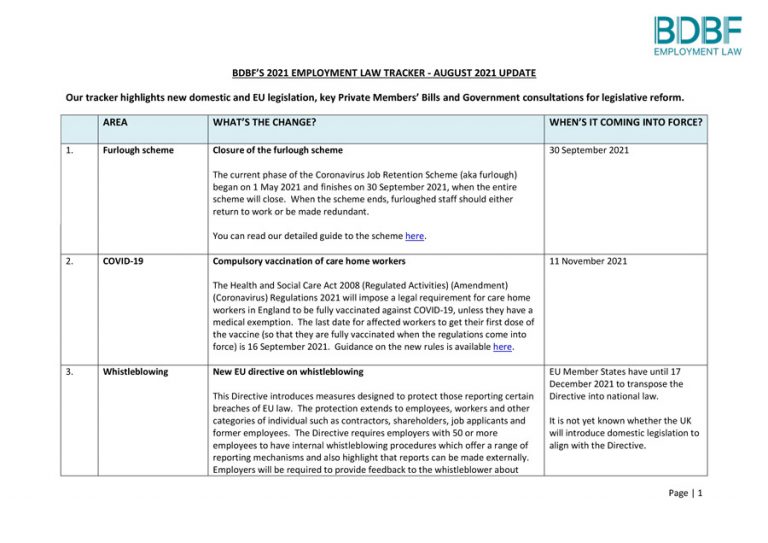
Summer’s over and that ‘back to school’ feeling is upon us.  You can make sure you are top of the HR class by reading BDBF’s updated 2021 employment law tracker.  The tracker will bring you up to date on all the key pieces of UK and EU employment legislation on the horizon, as well as relevant Government consultations.

Please click on the image below to open the PDF guide:

[/et_pb_text][et_pb_image src=”http://davidk423.sg-host.com/wp-content/uploads/2021/08/August-Newsletter-2021-Employment-Law-Tracker-updated-August-2021-1.jpg” title_text=”August-Newsletter-2021-Employment-Law-Tracker-(updated-August-2021)-1″ url=”http://davidk423.sg-host.com/wp-content/uploads/2021/08/August-Newsletter-2021-Employment-Law-Tracker-updated-August-2021.pdf” align=”center” _builder_version=”4.7.4″ _module_preset=”default” border_width_all=”2px” border_color_all=”#1D7078″][/et_pb_image][et_pb_text _builder_version=”4.7.4″ text_orientation=”justified” use_border_color=”off”]

If you or your business needs advice please contact Amanda Steadman (amandasteadman@bdbf.co.uk) or your usual BDBF contact.

[/et_pb_text][/et_pb_column][/et_pb_row][/et_pb_section][et_pb_section fb_built=”1″ _builder_version=”3.26.6″][et_pb_row _builder_version=”3.26.6″][et_pb_column type=”4_4″ _builder_version=”3.26.6″][/et_pb_column][/et_pb_row][/et_pb_section]


Final warning for poor performance and the impact on the fairness of dismissal

[et_pb_section fb_built=”1″ _builder_version=”3.0.100″ background_image=”http://davidk423.sg-host.com/wp-content/uploads/2017/09/bdbf_final-stages-1-4-1.jpg” custom_padding=”|||” global_module=”2165″ saved_tabs=”all”][et_pb_row _builder_version=”4.7.4″ min_height=”66.4px” custom_padding=”50px||||false|false”][et_pb_column type=”4_4″ _builder_version=”3.25″ custom_padding=”|||” custom_padding__hover=”|||”][et_pb_text _builder_version=”4.7.4″ _dynamic_attributes=”content” text_font=”|700|||||||” text_font_size=”27px” background_layout=”dark” custom_margin=”0px|||” custom_padding=”0px|||”]@ET-DC@eyJkeW5hbWljIjp0cnVlLCJjb250ZW50IjoicG9zdF90aXRsZSIsInNldHRpbmdzIjp7ImJlZm9yZSI6IiIsImFmdGVyIjoiIn19@[/et_pb_text][et_pb_text _builder_version=”4.7.4″ _dynamic_attributes=”content” _module_preset=”default” background_layout=”dark”]@ET-DC@eyJkeW5hbWljIjp0cnVlLCJjb250ZW50IjoicG9zdF9kYXRlIiwic2V0dGluZ3MiOnsiYmVmb3JlIjoiIiwiYWZ0ZXIiOiIiLCJkYXRlX2Zvcm1hdCI6ImRlZmF1bHQiLCJjdXN0b21fZGF0ZV9mb3JtYXQiOiIifX0=@[/et_pb_text][/et_pb_column][/et_pb_row][/et_pb_section][et_pb_section fb_built=”1″ admin_label=”section” _builder_version=”3.22.3″][et_pb_row admin_label=”row” _builder_version=”4.7.4″ background_size=”initial” background_position=”top_left” background_repeat=”repeat”][et_pb_column type=”4_4″ _builder_version=”3.25″ custom_padding=”|||” custom_padding__hover=”|||”][et_pb_text _builder_version=”4.7.4″ text_orientation=”justified” hover_enabled=”0″ use_border_color=”off” sticky_enabled=”0″]

In Fallahi v TWI Limited, the EAT held that in performance dismissal cases, Tribunals may only look behind final written warnings where they are “manifestly inappropriate”.  However, warnings may carry less weight in performance dismissal decisions, with the result that they do not undermine the fairness of any later dismissal. 

What does the law say?

In order to dismiss an employee fairly, an employer needs to identify a fair reason for dismissal.  One such reason is capability (which covers both poor performance and ill health).   Where a fair reason exists, the Tribunal must decide whether, in the circumstances, the employer acted reasonably in treating that reason as sufficient to dismiss. 

This test applies equally to cases where the employee has previously been given a final warning.  In the case of Davies v Sandwell MBC the Court of Appeal said that in such cases it is not the function of the Tribunal to: “…reopen the final warning and rule on…whether the final warning should, or should not, have been issued and whether it was a legally valid warning or a ‘nullity’.”  In other words, the Tribunal should not try to unpick whether it was right or wrong for the warning to have been issued.  

Instead, the job of the Tribunal is to decide whether the final warning was something which a reasonable employer could reasonably take into account when deciding to dismiss.  This requires the Tribunal to consider whether it was “manifestly inappropriate” to have given the warning.  This is a high threshold for claimants to overcome and requires them to show that that it plainly ought not to have been imposed (e.g. if a warning was issued for gross misconduct where it was clear that the conduct in question did not amount to this).  

Where a final warning is found to be manifestly inappropriate, and the employer had attached significant weight to it when deciding to dismiss, then it is likely that the subsequent dismissal decision will be found to be unreasonable and unfair.

What happened in this case?

Mr Fallahi began working for TWI Limited as a Senior Project Leader in June 2014.  Concerns with his performance were raised at three separate appraisals which took place over the course of a year.   In January 2016 an informal performance management process was initiated.  Objectives were set, with six targets to be assessed over an eight-month period (one in June 2016, one in October 2016 and the remaining four in January 2017).

Before those deadlines arrived, Mr Fallahi’s line manager became concerned with the lack of progress towards the targets which had been set.  In May 2016, Mr Fallahi, was invited to a capability hearing and warned that the outcome could be a first or final written warning.  The outcome of the hearing was that there had been consistent underperformance over a considerable period of time.  A final written warning was issued, and further objectives were set for a three-month review period from June to August 2016.   Mr Fallahi did not appeal the decision to issue the final written warning.

By the end of July 2016, however, it was clear that Mr Fallahi would not achieve the further objectives he had been set.  His manager gave him the option of continuing with the final month of the review period or leaving immediately with one month’s pay.  Mr Fallahi agreed to leave, and settlement negotiations began.   However, the negotiations broke down and he went off sick.  He failed to attend a further capability hearing, despite an occupational health assessment stating that he was well enough to attend.  In light of the continued poor performance, Mr Fallahi was dismissed on the grounds of capability. 

Mr Fallahi brought a claim for unfair dismissal in the Employment Tribunal.  The Tribunal dismissed the claim, concluding that the warning was within the range of reasonable responses and had not been manifestly inappropriate.

What was decided?

Mr Fallahi appealed to the Employment Appeal Tribunal (EAT).  He contended that the “manifestly inappropriate” test was not applicable to warnings issued as part of a capability process.  In such cases, he argued, Tribunals should be free to consider the impact of any flaws in the warning process without needing to surmount this high threshold.  Alternatively, if the manifestly inappropriate test was applicable, then the warning was manifestly inappropriate and unreasonable in light of a number of procedural failings.

The EAT dismissed the appeal, holding that the “manifestly inappropriate” test applies to types of all dismissal cases – including capability dismissals – when a Tribunal is considering whether it can look behind a warning.  However, the EAT noted that the question of going behind a warning may be of less importance in capability dismissals, where the true significance of a warning is to notify the employee of the need to take positive steps to improve over a period of time.  By contrast, the validity of a final warning will be of the utmost importance in misconduct cases where, for example, a warning leaves an employee “hanging by a thread”.  In those case, the employer will attach significant weight to the prior warning when deciding to dismiss for a further act of misconduct.

The EAT also held that that Tribunal had been entitled to find that the use of the final warning was appropriate in this case.  The Tribunal had found that the final warning was the starting point for the further review period.  The position was made clear to Mr Fallahi and he knew what he had to do to demonstrate the necessary improvement.   In particular, it was reasonable for the employer to have sought to cut short the review period by one month given the lack of progress towards the objectives (and, in any event, he was given the option to continue with the review period if he wished).  The warning was one factor which had been taken into account when deciding to dismiss, but what really mattered was the poor performance and failure to improve. 

What does this decision mean for employers?

This decision confirms that Tribunals will not usually interrogate warnings given in a performance management process prior to a dismissal.  An employee who wishes to challenge a performance dismissal on the basis of an earlier warning, will need to surmount the high hurdle of showing that it was “manifestly inappropriate”.  

Even where a warning in a capability process is manifestly inappropriate, this will not always mean that the ultimate dismissal is unfair.  This is because the employer may not have attached significant weight to the warning when deciding to dismiss.  Rather, the decision to dismiss will be based on the post-warning failure to improve. 

Nevertheless, it would be wise for employers to ensure that warnings are only issued in appropriate cases and that internal capability procedures are followed.   In this case the employer lost patience with the employee’s failure to improve and ended up cutting short both the informal and formal review processes.  A better strategy would have been to have grasped the nettle commencing a formal performance management process much earlier in the employment relationship.  This would have allowed the employer more breathing space to follow their internal procedure to the letter and may also have meant that dismissal took place before the employee acquired unfair dismissal protection.

Fallahi v TWI Limited

If you would like to discuss any issues arising out of this decision please contact Amanda Steadman (amandasteadman@bdbf.co.uk) or your usual BDBF contact.

[/et_pb_text][/et_pb_column][/et_pb_row][/et_pb_section][et_pb_section fb_built=”1″ _builder_version=”3.26.6″][et_pb_row _builder_version=”3.26.6″][et_pb_column type=”4_4″ _builder_version=”3.26.6″][/et_pb_column][/et_pb_row][/et_pb_section]


Dismissal of senior male employees following publication of high gender pay gap figures was sex discrimination

[et_pb_section fb_built=”1″ _builder_version=”3.0.100″ background_image=”http://davidk423.sg-host.com/wp-content/uploads/2017/09/bdbf_final-stages-1-4-1.jpg” custom_padding=”|||” global_module=”2165″ saved_tabs=”all”][et_pb_row _builder_version=”4.7.4″ min_height=”66.4px” custom_padding=”50px||||false|false”][et_pb_column type=”4_4″ _builder_version=”3.25″ custom_padding=”|||” custom_padding__hover=”|||”][et_pb_text _builder_version=”4.7.4″ _dynamic_attributes=”content” text_font=”|700|||||||” text_font_size=”27px” background_layout=”dark” custom_margin=”0px|||” custom_padding=”0px|||”]@ET-DC@eyJkeW5hbWljIjp0cnVlLCJjb250ZW50IjoicG9zdF90aXRsZSIsInNldHRpbmdzIjp7ImJlZm9yZSI6IiIsImFmdGVyIjoiIn19@[/et_pb_text][et_pb_text _builder_version=”4.7.4″ _dynamic_attributes=”content” _module_preset=”default” background_layout=”dark”]@ET-DC@eyJkeW5hbWljIjp0cnVlLCJjb250ZW50IjoicG9zdF9kYXRlIiwic2V0dGluZ3MiOnsiYmVmb3JlIjoiIiwiYWZ0ZXIiOiIiLCJkYXRlX2Zvcm1hdCI6ImRlZmF1bHQiLCJjdXN0b21fZGF0ZV9mb3JtYXQiOiIifX0=@[/et_pb_text][/et_pb_column][/et_pb_row][/et_pb_section][et_pb_section fb_built=”1″ admin_label=”section” _builder_version=”3.22.3″][et_pb_row admin_label=”row” _builder_version=”4.7.4″ background_size=”initial” background_position=”top_left” background_repeat=”repeat”][et_pb_column type=”4_4″ _builder_version=”3.25″ custom_padding=”|||” custom_padding__hover=”|||”][et_pb_text _builder_version=”4.7.4″ text_orientation=”justified” hover_enabled=”0″ use_border_color=”off” sticky_enabled=”0″]

An Employment Tribunal has recently decided that the dismissal of two senior male employees amounted to sex discrimination, where the dismissals had followed the announcement of the employer’s gender pay gap figures and a radical new approach to diversity within the business.

What does the law say?

The Equality Act 2010 protects workers from discrimination on the grounds of certain protected characteristics, such as sex, race and disability.  Although it is typically workers from minority groups who assert their legal rights in this respect, the protections are available to all workers.

The gender pay gap reporting rules came into force in 2017, requiring employers with 250 or more employees to publish gender pay information on an annual basis from 4 April 2018.  Analysis of reports published in 2018 and 2019 reveal that men tend to occupy the most senior and highly paid roles, indicating that the gender pay gap can be understood, primarily, as a gender representation gap.  Although there is no legal obligation on employers to take steps to close their gender pay gap, many choose to do so in order to advance their reputation as an “employer of choice”.

What happened in this case?

Mr Bayfield and Mr Jenner (the Claimants) are both advertising professionals who had worked as a team for many years.  Both are white British, heterosexual, middle aged men.  They began working for J Walter Thompson (JWT) on 4 January 2016.  Their work was highly regarded, and they were both promoted to the role of Creative Director in July 2017.  Yet by the end of that year, cracks had begun to appear in the relationship.  Their manager, Lucas Peon, expressed concerns that they were overly attached to “traditional” forms of media advertising and urged them to expand their digital output.  Feedback obtained from colleagues echoed those concerns and highlighted that the pair lacked enthusiasm and could be indecisive.

In April 2018, JWT published its gender pay gap report for 2017, revealing a median gender pay gap of 44.7%, the highest figure across the advertising industry in that year.  The report noted that “There is an acute problem of female representation in creative – a majority of senior jobs in that department are held by men, not just at [JWT] but also in our industry.”

The following month, Mr Peon and another of JWT’s Creative Directors, Jo Wallace, gave a presentation at the “Creative Equals Conference”.  The presentation was intended to explain how JWT planned to address their gender pay gap figures.  The presentation referred to the fact that JWT was recruiting new female talent, and that they had to “…do what it takes to ensure these women remain in the business and rise to the top”.  More controversially, the presentation contained a slide with the following words scored out with a black line: “WHITE, BRITISH, PRIVILEGED, STRAIGHT, MEN CREATING TRADITIONAL ABOVE THE LINE ADVERTISING”.  Ms Wallace went on to say that: “…the reputation JWT once earnt as being full of white, British, privileged, straight men creating traditional above the line advertising has to be obliterated.”

The Claimants raised concerns about the presentation, highlighting that there were a lot of “worried people” in the Creative Department.  They were called to a meeting with Mr Peon and Ms Hoyle, JWT’s HR Director.  The discussion at the meeting was tense, with Mr Peon and Ms Hoyle arguing that the intention was to obliterate JWT’s poor reputation, not obliterate staff who matched the description used in the presentation.   Ms Hoyle later described the conversation as “horrible” and as the “lowest point” she experienced during her time working for JWT.

Around this time, JWT decided to commence a redundancy exercise within the Creative Department.  In the evidence before the subsequent Employment Tribunal hearing, none of the company’s witnesses were able to recall the date of the meeting when this decision was taken (i.e. whether it was before or after the heated discussion). Witnesses also testified that no papers or notes were made regarding the proposals in order to stop the news getting out.  This was in contrast to the approach taken in previous redundancy exercises.  The Claimants (as well as three Senior Creatives who had also complained about the presentation at the Creative Equals Conference) were made redundant.  

In 2019, JWT merged with Wunderman to form Wunderman Thompson (UK) Ltd.  The Claimants brought claims against Wunderman Thompson (UK) Ltd in the Employment Tribunal for:

  • direct sex, age, sexual orientation and race discrimination;
  • harassment related to sex, age, sexual orientation and race;
  • victimisation;
  • automatic unfair dismissal and detriment for having blown the whistle; and
  • unfair dismissal.

What was decided?

The Tribunal upheld the claims of direct sex discrimination, harassment related to sex, victimisation and unfair dismissal and dismissed all of the other claims.

Direct sex discrimination and harassment related to sex

The Tribunal concluded that the treatment the Claimants experienced during the heated discussion with Mr Peon and Ms Hoyle, and the scores and comments they received during the redundancy process, were acts of direct sex discrimination during the course of employment.   Alternatively, they were acts of harassment related to sex. 

Further, sex was a significant reason for their dismissals.  Two hypothetical female comparators would have been treated differently.  A similar challenge raised by such women would not have been viewed as a threat to the company’s wish to change its reputation.  Moreover, the company would have not been motivated to remove two female Creative Directors.  By contrast, removing the Claimants would have an impact, both in terms of the gender pay gap figures and through opening up senior positions to female candidates.  Alternatively, the dismissals were harassment related to sex.

Victimisation

The Tribunal held that the raising of concerns about the wording used in the presentation, and the comments made in the discussion that followed, were protected acts.  The emails were sent in direct response to what they considered the presentation inevitably meant in practice (i.e. that JWT was preparing to dismiss creatives who were white, British, male, straight and middle class and who created traditional-style advertising).  As such, the emails were directly referring to issues of unfair treatment based on the protected characteristics of sex, sexual orientation and race (there was no mention of age). 

The Tribunal concluded that:

  • the treatment the Claimants experienced during the heated discussion;
  • the scores and comments the Claimants received during the redundancy process; and
  • the handling of a subsequent grievance process and grievance decision;

were all acts of victimisation during the course of employment. 

Further, the decision to dismiss the Claimants was taken because they were seen to have “overstepped the mark”with the comments made in their emails and in the meeting that followed.  This decision was made before any redundancy process had begun and the redundancy scoring exercise that followed was simply “retrofitted” to fit this decision.   Therefore, the dismissals also amounted to unlawful victimisation. 

Unfair dismissal

Finally, the Tribunal decided that the dismissals were ordinarily unfair. The real reason for the dismissals was that the Claimants had raised complaints and because they were seen as an impediment to the company’s agenda on gender diversity and the gender pay gap. 

The redundancy dismissal process was also unfair.  There was no consultation prior to the selection for redundancy and the redundancy scoring was a sham designed to ensure the predetermined decision to dismiss could be justified.  There was also a failure to consider alternatives to redundancy, such as voluntary redundancies, and the appeal process was unreasonable and unfair.

Wunderman Thompson (UK) Ltd has said it intends to appeal the Tribunal’s decision.

What does this decision mean for employers?

Employers with large gender pay gaps will often wish to take steps to correct the underrepresentation of woman at senior level, thereby improving their gender pay gap figures.   However, this case shows that employers also need to tread the line between being bold and being antagonistic.   Public statements of the kind used by JWT clearly have the capacity to upset workers and provoke complaints.  Employers need to hold in mind that this group of workers is protected from discriminatory treatment in the same way as minority groups possessing the same protected characteristics. 

Manoeuvring staff out of the business to advance a diversity agenda opens up the risk of discrimination complaints.  Given that employers are not yet compelled to take steps to close their gender pay gaps, this seems like an unnecessary risk to take, no matter how great the desire to be regarded as an employer of choice.  Rather, a longer-term strategy, comprised of different measures, is preferable.  The Government Equalities Office has published guidance on evidence-based actions for employers to close the gender pay gap and improve gender equality.  The Equalities and Human Rights Commission has also published its own guidance on how to close the gender pay gap. 

This case also highlights the need for managers to be trained on how to recognise protected acts and respond to complaints which sit contrary to a wider diversity agenda.

Bayfield and Jenner v Wunderman Thompson (UK) Ltd and others

If you would like to discuss any issues arising out of this decision please contact Amanda Steadman (amandasteadman@bdbf.co.uk) or your usual BDBF contact.

[/et_pb_text][/et_pb_column][/et_pb_row][/et_pb_section][et_pb_section fb_built=”1″ _builder_version=”3.26.6″][et_pb_row _builder_version=”3.26.6″][et_pb_column type=”4_4″ _builder_version=”3.26.6″][/et_pb_column][/et_pb_row][/et_pb_section]


Two Parliamentary inquiries launched into menopause and the workplace

[et_pb_section fb_built=”1″ _builder_version=”3.0.100″ background_image=”http://davidk423.sg-host.com/wp-content/uploads/2017/09/bdbf_final-stages-1-4-1.jpg” custom_padding=”|||” global_module=”2165″ saved_tabs=”all”][et_pb_row _builder_version=”4.7.4″ min_height=”66.4px” custom_padding=”50px||||false|false”][et_pb_column type=”4_4″ _builder_version=”3.25″ custom_padding=”|||” custom_padding__hover=”|||”][et_pb_text _builder_version=”4.7.4″ _dynamic_attributes=”content” text_font=”|700|||||||” text_font_size=”27px” background_layout=”dark” custom_margin=”0px|||” custom_padding=”0px|||”]@ET-DC@eyJkeW5hbWljIjp0cnVlLCJjb250ZW50IjoicG9zdF90aXRsZSIsInNldHRpbmdzIjp7ImJlZm9yZSI6IiIsImFmdGVyIjoiIn19@[/et_pb_text][et_pb_text _builder_version=”4.7.4″ _dynamic_attributes=”content” _module_preset=”default” background_layout=”dark”]@ET-DC@eyJkeW5hbWljIjp0cnVlLCJjb250ZW50IjoicG9zdF9kYXRlIiwic2V0dGluZ3MiOnsiYmVmb3JlIjoiIiwiYWZ0ZXIiOiIiLCJkYXRlX2Zvcm1hdCI6ImRlZmF1bHQiLCJjdXN0b21fZGF0ZV9mb3JtYXQiOiIifX0=@[/et_pb_text][/et_pb_column][/et_pb_row][/et_pb_section][et_pb_section fb_built=”1″ admin_label=”section” _builder_version=”3.22.3″][et_pb_row admin_label=”row” _builder_version=”4.7.4″ background_size=”initial” background_position=”top_left” background_repeat=”repeat”][et_pb_column type=”4_4″ _builder_version=”3.25″ custom_padding=”|||” custom_padding__hover=”|||”][et_pb_text _builder_version=”4.7.4″ text_orientation=”justified” hover_enabled=”0″ use_border_color=”off” sticky_enabled=”0″]

Davina McCall’s recent high-profile documentary, Sex Myths and the Menopause, helped normalise conversations about the menopause in our living rooms.  Since then, the movement to bring the menopause out into the open – including in the workplace – has gathered momentum, with two new Parliamentary inquiries launched in the last few weeks.   In this briefing we explain what the inquiries are about and how you can submit your views.

Women and Equalities Committee – Inquiry into menopause and the workplace

On 23 July 2021, the House of Commons Women and Equalities Committee opened an inquiry into the impact of the menopause in the workplace.  Essentially, the purpose of the inquiry is to receive evidence on current workplace practices and views on whether existing discrimination legislation protects workers going through the menopause, or whether more needs to be done.

Currently, discrimination against workers going through the menopause is only covered by the Equality Act 2010 if it is connected to one of the existing protected characteristics such as age, sex and disability.  The Chair of the Committee, Caroline Nokes MP, has not ruled out the possibility of recommending that the law be changed to make menopause a standalone protected characteristic.  The inquiry will also look at whether employers should be compelled to put in place workplace menopause policies.

The specific questions raised in the inquiry are as follows:

  • What is the nature and the extent of discrimination faced by women experiencing the menopause?  How does this impact wider society?
  • What is the economic impact of menopause discrimination?
  • How can businesses factor in the needs of employees going through the menopause?
  • How can practices addressing workplace discrimination relating to menopause be implemented? For example, through guidance, advice, adjustments, or enforcement.  What are examples of best or most inclusive practices?
  • How should people who experience the menopause but do not identify as women be supported in relation to menopause and the workplace?
  • How well does current legislation protect women from discrimination in the workplace associated with the menopause? Should current legislation be amended?
  • What further legislation is required to enable employers to put in place a workplace menopause policy to protect people going through the menopause whilst at work?
  • How effective has Government action been at addressing workplace discrimination related to the menopause, and what more can the Government do to address this issue?
  • How effectively is the Government Equalities Office working across Government to embed a strategic approach to addressing the impact of menopause in the workplace?

The inquiry closes on 17 September 2021.  The Committee will present their findings and recommendations to the Government, with a view to shaping policies addressing gender equality and women’s health.

You can contribute to the inquiry directly via this link.   Alternatively, Amanda Steadman, Principal Knowledge Lawyer at BDBF, is a member of the Employment Lawyers Association Working Party responding to this inquiry.  If you prefer, you can feedback your views to her by 2 September 2021.

Women and Equalities Committee – Menopause and the Workplace Inquiry

All-Party Parliamentary Group on Menopause – Inquiry into the impacts of the menopause and the case for reform

The All-Party Parliamentary Group on Menopause (Menopause APPG) is a politically neutral cross-party group of Parliamentarians concerned about the menopause and is chaired by Carolyn Harris MP.   The Menopause APPG has regular meetings within Parliament to discuss the challenges and impact of menopause, as well as listening to the thoughts of anybody with experience and interest on the issue.

On 6 July 2021, the Menopause APPG opened an inquiry into the impacts of menopause on women and families and the case for policy reform. This inquiry will examine a wide range of issues surrounding menopause and seeks written submissions on the following issues:

  • Evidence on current workplace attitudes, policy or initiatives towards menopause and detail on further workplace action that should be taken.
  • Information on current menopause education in schools – how it works in practice and what more could be done to educate people on menopause.
  • Information on how medical professionals and the NHS deal with menopause in terms of treatment and the development of treatment. What specific policy change would better help the NHS treat women going through menopause?
  • Detail on personal experiences of menopause, the impact this may have had on daily activity and wider family impacts.
  • Information on current products that are available for women going through menopause and information on this market.
  • Any further detail or suggested policy recommendations that the Menopause APPG should consider around menopause.

As part of its inquiry, the Menopause APPG will also be undertaking a number of live evidence sessions.  On 23 September 2021, the group will hold a session to hear evidence on menopause and the workplace, looking specifically at what employers can do and what legislative changes are required.

The inquiry closes on 30 September 2021.  The evidence collected will contribute to the Menopause APPG’s final recommendations for policy change which will be presented to the Government.

You can contribute to the inquiry directly by emailing: sarina.kiayani@interelgroup.com.

Menopause APPG – Inquiry into the impacts of the menopause and the case for reform

If you would like to know more about the menopause and the workplace, and the steps employers can take to help workers, you can read our briefing from March 2021 which looked at these issues.

If you would like to discuss how your organisation can support staff though the menopause, please contact Amanda Steadman (amandasteadman@bdbf.co.uk) or your usual BDBF contact.


[/et_pb_text][/et_pb_column][/et_pb_row][/et_pb_section][et_pb_section fb_built=”1″ _builder_version=”3.26.6″][et_pb_row _builder_version=”3.26.6″][et_pb_column type=”4_4″ _builder_version=”3.26.6″][/et_pb_column][/et_pb_row][/et_pb_section]


Changes to the rules on self-isolation: points for employers to note

[et_pb_section fb_built=”1″ _builder_version=”3.0.100″ background_image=”http://davidk423.sg-host.com/wp-content/uploads/2017/09/bdbf_final-stages-1-4-1.jpg” custom_padding=”|||” global_module=”2165″ saved_tabs=”all”][et_pb_row _builder_version=”4.7.4″ min_height=”66.4px” custom_padding=”50px||||false|false”][et_pb_column type=”4_4″ _builder_version=”3.25″ custom_padding=”|||” custom_padding__hover=”|||”][et_pb_text _builder_version=”4.7.4″ _dynamic_attributes=”content” text_font=”|700|||||||” text_font_size=”27px” background_layout=”dark” custom_margin=”0px|||” custom_padding=”0px|||”]@ET-DC@eyJkeW5hbWljIjp0cnVlLCJjb250ZW50IjoicG9zdF90aXRsZSIsInNldHRpbmdzIjp7ImJlZm9yZSI6IiIsImFmdGVyIjoiIn19@[/et_pb_text][et_pb_text _builder_version=”4.7.4″ _dynamic_attributes=”content” _module_preset=”default” background_layout=”dark”]@ET-DC@eyJkeW5hbWljIjp0cnVlLCJjb250ZW50IjoicG9zdF9kYXRlIiwic2V0dGluZ3MiOnsiYmVmb3JlIjoiIiwiYWZ0ZXIiOiIiLCJkYXRlX2Zvcm1hdCI6ImRlZmF1bHQiLCJjdXN0b21fZGF0ZV9mb3JtYXQiOiIifX0=@[/et_pb_text][/et_pb_column][/et_pb_row][/et_pb_section][et_pb_section fb_built=”1″ admin_label=”section” _builder_version=”3.22.3″][et_pb_row admin_label=”row” _builder_version=”4.7.4″ background_size=”initial” background_position=”top_left” background_repeat=”repeat”][et_pb_column type=”4_4″ _builder_version=”3.25″ custom_padding=”|||” custom_padding__hover=”|||”][et_pb_text _builder_version=”4.7.4″ text_orientation=”justified” hover_enabled=”0″ use_border_color=”off” sticky_enabled=”0″]

As summer draws to a close, employers are looking forward to a smooth return of staff to the workplace for at least part of the working week.  In readiness for this, the Government has updated its NHS Test and Trace in the Workplace guidance to exempt certain groups from the requirement to self-isolate in certain circumstances.  Our briefing explains the changes and what they mean for employers.

What do workers need to tell their employers about self-isolation?

Workers who are told to self-isolate by NHS Test and Trace are legally obliged to notify their employer of that fact before they are due to attend work.  A failure by the worker to do so means they could face a £50 fine.  In turn, it is an offence for employers to require or allow workers to attend the workplace if they know that a worker has been told by NHS Test and Trace to self-isolate.   A failure to do so may result in a fine for the employer starting at £1,000.

However, the new NHS Test and Trace in the Workplace guidance provides that workers are not legally obliged to tell their employers that:

  • they have been told by NHS Test and Trace that they are a contact of a positive case of COVID-19 where they are exempt from self-isolation (see below for details of who is exempt); or
  • they have been “pinged” by the NHS COVID-19 app and advised (but not required) to self-isolate.

Workers falling into either of these groups are not legally obliged to self-isolate and may attend the workplace. However, the guidance says employers are “strongly encouraged” to support the workers who are pinged by the NHS COVID-19 app to self-isolate.

Who is exempt from self-isolation and when?

The new guidance states that from 16 August 2021 certain groups of people will not be required to self-isolate where they have been in contact with a positive case of COVID-19.  This covers situations where a person has been told by either NHS Test and Trace or the NHS COVID-19 app that they are a contact of a positive case.

The following groups are exempt from self-isolation in these circumstances:

  • those who are fully vaccinated against COVID-19 (i.e. at least 14 days have passed since the individual received all of the recommended doses of the vaccine);
  • those aged below the age of 18 years and six months;
  • those who have taken part or are currently part of an approved COVID-19 vaccine trial; or
  • those who are unable to be vaccinated for medical reasons.

Although exempt from self-isolation, anyone in these groups will be advised (but not required) to take a PCR test.  If they choose to do so, they will not be required to self-isolate while they wait for the results.  They will also be advised to take the following precautions in the ten days after their contact with the positive case:

  • limiting close contact with people outside their household, especially in enclosed spaces;
  • wearing a face covering in enclosed spaces and where they are unable to maintain social distancing;
  • limiting contact with anyone who is clinically extremely vulnerable; and
  • taking part in regular lateral flow testing.

Are there any circumstances in which someone in an exempt group would have to self-isolate?

It is important to remember that the exemption from self-isolation does not apply in all circumstances.  Anyone who falls into the exempt groups will still be required to self-isolate if they:

  • test positive for COVID-19; or
  • show any symptoms of COVID-19 (in which case they should take a PCR test as soon as possible).

The self-isolation period is ten days from the day after the day of the positive test (if the worker had no symptoms) or ten days after the symptoms began.  If the worker is unable to work from home during the self-isolation period, then the absence should be treated as sick leave and paid accordingly.

What do these changes mean for employers?

Given that approximately 76% of over 16s are now fully vaccinated, the relaxation of the self-isolation rules should go some way to limiting disruption as workers return to the workplace.

Regardless of the strict legal position, employers may wish to introduce an internal rule asking staff in exempt groups to tell them if they have been notified by NHS Test and Trace that they are a contact of a positive case of COVID-19.  This information will help an employer discharge its duty to assess health and safety risks and ensure the health, safety and welfare of staff and third parties so far as reasonably possible.

For example, the employer may wish to adopt some, or all, of the precautionary measures recommended in the guidance.  In practice, this could mean ensuring that the worker in question is able to socially distance from others within the workplace or allowing them to work from home for ten days.  It could also mean that the worker is asked to reduce or cease contact with any clinically extremely vulnerable workers in the workplace for the same period of time.

Similarly, an employer may also ask staff to tell them if they have been pinged by the NHS COVID-19 app.  In appropriate cases, the employer may be able to support the worker to work from home, but where that is not possible this information will help the employer assess risk and take additional safety measures deemed necessary (such as those discussed above).

BDBF is currently advising many employers and employees on the challenges presented by the coronavirus pandemic, including preparing for the return to the workplace.  If you or your business needs advice on any coronavirus-related matter please contact Amanda Steadman (amandasteadman@bdbf.co.uk) or your usual BDBF contact.

NHS Test and Trace in the Workplace

[/et_pb_text][/et_pb_column][/et_pb_row][/et_pb_section][et_pb_section fb_built=”1″ _builder_version=”3.26.6″][et_pb_row _builder_version=”3.26.6″][et_pb_column type=”4_4″ _builder_version=”3.26.6″][/et_pb_column][/et_pb_row][/et_pb_section]