What do employers need to know about in 2022?

[et_pb_section fb_built=”1″ _builder_version=”3.0.100″ background_image=”http://davidk423.sg-host.com/wp-content/uploads/2017/09/bdbf_final-stages-1-4-1.jpg” custom_padding=”|||” global_module=”2165″ saved_tabs=”all” global_colors_info=”{}”][et_pb_row _builder_version=”4.7.4″ min_height=”66.4px” custom_padding=”50px||||false|false” global_colors_info=”{}”][et_pb_column type=”4_4″ _builder_version=”3.25″ custom_padding=”|||” global_colors_info=”{}” custom_padding__hover=”|||”][et_pb_text _builder_version=”4.7.4″ _dynamic_attributes=”content” text_font=”|700|||||||” text_font_size=”27px” background_layout=”dark” custom_margin=”0px|||” custom_padding=”0px|||” global_colors_info=”{}”]@ET-DC@eyJkeW5hbWljIjp0cnVlLCJjb250ZW50IjoicG9zdF90aXRsZSIsInNldHRpbmdzIjp7ImJlZm9yZSI6IiIsImFmdGVyIjoiIn19@[/et_pb_text][et_pb_text _builder_version=”4.7.4″ _dynamic_attributes=”content” _module_preset=”default” background_layout=”dark” global_colors_info=”{}”]@ET-DC@eyJkeW5hbWljIjp0cnVlLCJjb250ZW50IjoicG9zdF9kYXRlIiwic2V0dGluZ3MiOnsiYmVmb3JlIjoiIiwiYWZ0ZXIiOiIiLCJkYXRlX2Zvcm1hdCI6ImRlZmF1bHQiLCJjdXN0b21fZGF0ZV9mb3JtYXQiOiIifX0=@[/et_pb_text][/et_pb_column][/et_pb_row][/et_pb_section][et_pb_section fb_built=”1″ admin_label=”section” _builder_version=”3.22.3″ global_colors_info=”{}”][et_pb_row admin_label=”row” _builder_version=”4.7.4″ background_size=”initial” background_position=”top_left” background_repeat=”repeat” global_colors_info=”{}”][et_pb_column type=”4_4″ _builder_version=”3.25″ custom_padding=”|||” global_colors_info=”{}” custom_padding__hover=”|||”][et_pb_text _builder_version=”4.14.2″ text_orientation=”justified” use_border_color=”off” global_colors_info=”{}”]

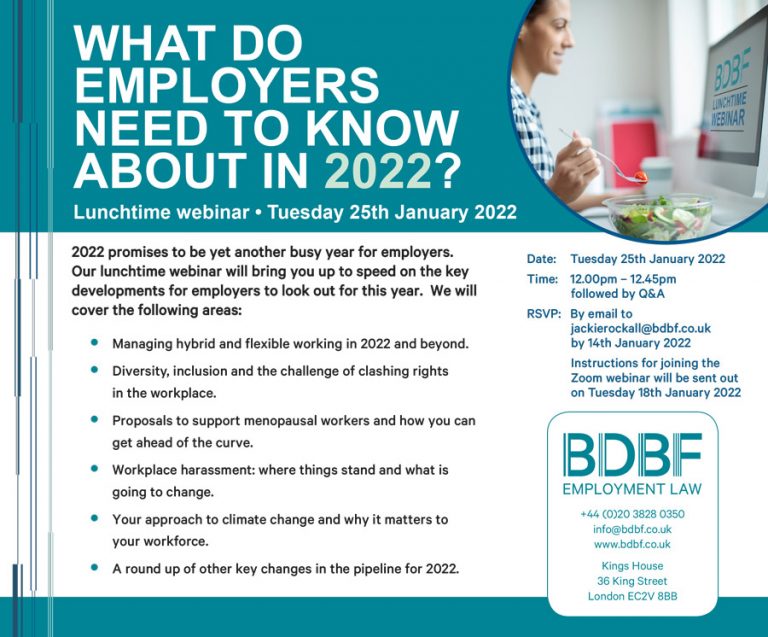
Join our lunchtime webinar on 25 January 2022 when we will survey the key issues for employers in 2022.

Click on the link below for full details of the agenda. If you’d like to sign up please email Jackie Rockall at jackierockall@bdbf.co.uk.

[/et_pb_text][et_pb_image src=”http://davidk423.sg-host.com/wp-content/uploads/2021/12/BDBF-Lunchtime-Webinar-25-January-2022.jpg” title_text=”BDBF-Lunchtime-Webinar-25-January-2022″ url=”http://davidk423.sg-host.com/wp-content/uploads/2021/12/BDBF-Lunchtime-Webinar-25-January-2022.pdf” admin_label=”Image” _builder_version=”4.14.2″ _module_preset=”default” border_width_all=”1px” border_color_all=”#118e71″ global_colors_info=”{}”][/et_pb_image][/et_pb_column][/et_pb_row][/et_pb_section][et_pb_section fb_built=”1″ _builder_version=”3.26.6″ global_colors_info=”{}”][et_pb_row _builder_version=”3.26.6″ global_colors_info=”{}”][et_pb_column type=”4_4″ _builder_version=”3.26.6″ global_colors_info=”{}”][/et_pb_column][/et_pb_row][/et_pb_section]


What does Plan B mean for office-based employers?

[et_pb_section fb_built=”1″ _builder_version=”3.0.100″ background_image=”http://davidk423.sg-host.com/wp-content/uploads/2017/09/bdbf_final-stages-1-4-1.jpg” custom_padding=”|||” global_module=”2165″ saved_tabs=”all” global_colors_info=”{}”][et_pb_row _builder_version=”4.7.4″ min_height=”66.4px” custom_padding=”50px||||false|false” global_colors_info=”{}”][et_pb_column type=”4_4″ _builder_version=”3.25″ custom_padding=”|||” global_colors_info=”{}” custom_padding__hover=”|||”][et_pb_text _builder_version=”4.7.4″ _dynamic_attributes=”content” text_font=”|700|||||||” text_font_size=”27px” background_layout=”dark” custom_margin=”0px|||” custom_padding=”0px|||” global_colors_info=”{}”]@ET-DC@eyJkeW5hbWljIjp0cnVlLCJjb250ZW50IjoicG9zdF90aXRsZSIsInNldHRpbmdzIjp7ImJlZm9yZSI6IiIsImFmdGVyIjoiIn19@[/et_pb_text][et_pb_text _builder_version=”4.7.4″ _dynamic_attributes=”content” _module_preset=”default” background_layout=”dark” global_colors_info=”{}”]@ET-DC@eyJkeW5hbWljIjp0cnVlLCJjb250ZW50IjoicG9zdF9kYXRlIiwic2V0dGluZ3MiOnsiYmVmb3JlIjoiIiwiYWZ0ZXIiOiIiLCJkYXRlX2Zvcm1hdCI6ImRlZmF1bHQiLCJjdXN0b21fZGF0ZV9mb3JtYXQiOiIifX0=@[/et_pb_text][/et_pb_column][/et_pb_row][/et_pb_section][et_pb_section fb_built=”1″ admin_label=”section” _builder_version=”3.22.3″ global_colors_info=”{}”][et_pb_row admin_label=”row” _builder_version=”4.7.4″ background_size=”initial” background_position=”top_left” background_repeat=”repeat” global_colors_info=”{}”][et_pb_column type=”4_4″ _builder_version=”3.25″ custom_padding=”|||” global_colors_info=”{}” custom_padding__hover=”|||”][et_pb_text _builder_version=”4.14.2″ text_orientation=”justified” hover_enabled=”0″ use_border_color=”off” global_colors_info=”{}” sticky_enabled=”0″]

In this briefing we round up the Plan B contingency measures to be adopted in the fight against the Omicron variant and assess what the latest “work from home” guidance really means for office-based employers.

What are the Plan B restrictions and when do they come into force?

The Government’s Autumn and Winter plan set out the measures needed to manage COVID through the Autumn and Winter months, including contingency measures – a “Plan B” – to be followed in the event of unsustainable pressure on the NHS.  On 8 December 2021, the Prime Minister announced that these Plan B measures were to be triggered in the light of the growing number of Omicron variant infections (you can read more about the Omicron variant in our briefing here).  The Plan B restrictions are summarised below.

  • Face coverings: From Friday, 10 December 2021, face coverings were required by law in some public indoor settings, such as theatres and cinemas, but not in hospitality settings.  This was in addition to the existing requirement to wear them in shops, cinemas premises that provide close contact services, transport hubs and on public transport.  There is no requirement to wear them in office settings, although the Working Safely during Coronavirus Guidelines for offices, factories and labs (the Guidelines) encourages the use of them in congested areas (e.g. corridors / lifts etc). 
  • Working from home: from Monday, 13 December 2021, office workers who can work were asked to do so.  However, this is guidance only, not law – it will not be unlawful to leave home to attend work.  For a full discussion of the latest working from home guidance, please see below.
  • Changes to self-isolation rules: new rules introduced in August had exempted certain groups of people (the double vaccinated and others) from the requirement to self-isolate where they had been in contact with a positive case of COVID.  However, these rules were changed in response to the Omicron variant, requiring anyone who was a contact of a suspected or confirmed Omicron variant case to self-isolate for ten days, even if they fell into one of the exempt categories.  However, from Tuesday, 14 December 2021, the rules changed again.  From this date, anyone falling into an exempted group who was a contact of someone with COVID (whether Omicron or otherwise) will not need to self-isolate. Instead, they should take lateral flow tests daily for seven days. You can read more about the new rules here.
  • Covid pass: from 6am on Wednesday 15 December, certain businesses and events (nightclubs and large venues) were required by law to check the COVID status of workers and customers using the NHS COVID pass or a negative lateral flow test.  This should not affect office-based employers.

Do the Plan B restrictions mean that all office workers must now work at home?

No.  The guidance for office-based employers on working from home has evolved subtly throughout the pandemic.   Before considering the latest position, it is helpful to reflect on how the position has changed over the last two years.

  • Spring – Autumn 2020: At the outset of the pandemic, the advice was that everyone should work from home save where it was not possible to do so. By August 2020, the Guidelines had been softened slightly to allow employers greater discretion to return workers to the office, provided it was possible to do so safely. 
  • Autumn 2020 – Spring 2021: When the second wave of the pandemic hit in October 2020, the guidance was tightened up to say that those office workers who could “work effectively” from home should do so over the Winter of 2020.  However, anyone who could not do so was permitted to attend the office, provided that it was safe to do so. This iteration of the guidance was flexible enough to leave it to the worker to decide what “working effectively” meant for them (within reason).
  • Spring – Summer 2021: By Spring 2021, the Guidelines were moderated to provide that workers could return to the office when Step 4 of the unlock roadmap was reached (which eventually took place on 29 July 2021). However, the guidance said that workers could attend the office before Step 4 was reached if they could not work effectively from home, it was appropriate in the light of a worker’s mental or physical health difficulties or it was appropriate in the light of a worker’s “particularly challenging” home working environment.
  • Summer – Winter 2021: All COVID restrictions were lifted on 29 July 2021 and the guidance was updated to allow employers the freedom to return all workers to the office on a gradual basis over the Summer. Most employers did this over the late Summer and Autumn months, although many opted to retain a degree of hybrid working.

The new Guidelines applied from 13 December 2021.  They provide that office workers should work from home “if they can”.  There is no qualification to say that they should do this only where they cannot work “effectively” from home.  However, the guidance goes on to say that anyone who cannot work from home may continue to go into work, for example, where they need to access equipment which is necessary for their role, or where their role mustbe completed in-person.  It also states that employers should consider whether home working is appropriate for workers facing mental or physical health challenges, or those with a particularly challenging home environment. 

Therefore, the Guidelines are similar to those in place throughout Spring and Summer 2021, save that the absence of the word “effectively”, and the emphasis on attending where “necessary” or if they “must”, suggests a slightly more restrictive approach.   In our view, the end result is that employers should not ask workers to attend the office for non-essential reasons (and nor should workers elect to do so).

However, there remains leeway for workers to attend the office where they face mental or physical health difficulties.  For example, if a worker finds that homeworking causes or exacerbates depression or anxiety then they may attend the office.  In addition, if the worker has a “particularly challenging” home working environment it may be appropriate for them to attend the office.  The Guidelines do not expand on what counts as “particularly challenging”, but it is reasonable to conclude that it has to be something more than being bored of working from home or wanting to socialise with colleagues.  It is likely to cover things like:

  • poor internet access;
  • disruption caused by a house move or building works;
  • inability to concentrate due to a noisy environment;
  • cramped working conditions; and/or
  • lack of privacy.

The Guidelines state that where a worker does attend the workplace, they should consider taking regular lateral flow tests to manage the risk.

It’s also worth noting that the Guidelines urge caution in relation to people who are at higher risk of infection from COVID and/or an adverse outcome if infected.  These groups are not specified but will include those who are considered clinically extremely vulnerable, some disabled workers, pregnant workers and, potentially, any unvaccinated workers.  At the same time, employers must take care not to discriminate against a worker because of a protected characteristic.

Next steps?

Office-based employers should now take the following steps:

  • consult with workers and decide who needs to come into the workplace and who can work from home (bearing in mind the special needs of “at risk” workers and those with protected characteristics);
  • update their health and safety risk assessment in light of Omicron and implement any measures;
  • communicate the latest guidance to staff and ensure they understand that they should only attend the office in appropriate circumstances; and
  • stay alert to changes to the restrictions – a review of the current position is expected in the early January 2022.

BDBF is currently advising many employers on the challenges presented by the coronavirus.  If you or your business needs advice on any coronavirus-related matter please contact Amanda Steadman (amandasteadman@bdbf.co.uk) or your usual BDBF contact.

[/et_pb_text][/et_pb_column][/et_pb_row][/et_pb_section][et_pb_section fb_built=”1″ _builder_version=”3.26.6″ global_colors_info=”{}”][et_pb_row _builder_version=”3.26.6″ global_colors_info=”{}”][et_pb_column type=”4_4″ _builder_version=”3.26.6″ global_colors_info=”{}”][/et_pb_column][/et_pb_row][/et_pb_section]


A cautionary tale for all those dealing with flexible working requests

[et_pb_section fb_built=”1″ _builder_version=”3.0.100″ background_image=”http://davidk423.sg-host.com/wp-content/uploads/2017/09/bdbf_final-stages-1-4-1.jpg” custom_padding=”|||” global_module=”2165″ saved_tabs=”all” global_colors_info=”{}”][et_pb_row _builder_version=”4.7.4″ min_height=”66.4px” custom_padding=”50px||||false|false” global_colors_info=”{}”][et_pb_column type=”4_4″ _builder_version=”3.25″ custom_padding=”|||” global_colors_info=”{}” custom_padding__hover=”|||”][et_pb_text _builder_version=”4.7.4″ _dynamic_attributes=”content” text_font=”|700|||||||” text_font_size=”27px” background_layout=”dark” custom_margin=”0px|||” custom_padding=”0px|||” global_colors_info=”{}”]@ET-DC@eyJkeW5hbWljIjp0cnVlLCJjb250ZW50IjoicG9zdF90aXRsZSIsInNldHRpbmdzIjp7ImJlZm9yZSI6IiIsImFmdGVyIjoiIn19@[/et_pb_text][et_pb_text _builder_version=”4.7.4″ _dynamic_attributes=”content” _module_preset=”default” background_layout=”dark” global_colors_info=”{}”]@ET-DC@eyJkeW5hbWljIjp0cnVlLCJjb250ZW50IjoicG9zdF9kYXRlIiwic2V0dGluZ3MiOnsiYmVmb3JlIjoiIiwiYWZ0ZXIiOiIiLCJkYXRlX2Zvcm1hdCI6ImRlZmF1bHQiLCJjdXN0b21fZGF0ZV9mb3JtYXQiOiIifX0=@[/et_pb_text][/et_pb_column][/et_pb_row][/et_pb_section][et_pb_section fb_built=”1″ admin_label=”section” _builder_version=”3.22.3″ global_colors_info=”{}”][et_pb_row admin_label=”row” _builder_version=”4.7.4″ background_size=”initial” background_position=”top_left” background_repeat=”repeat” global_colors_info=”{}”][et_pb_column type=”4_4″ _builder_version=”3.25″ custom_padding=”|||” global_colors_info=”{}” custom_padding__hover=”|||”][et_pb_text _builder_version=”4.14.2″ text_orientation=”justified” hover_enabled=”0″ use_border_color=”off” global_colors_info=”{}” sticky_enabled=”0″]

A delay in hearing an appeal against a refusal to permit an employee to work flexibly left an employer facing an Employment Tribunal claim.  Find out what happened and learn how not to make the same mistakes.

What happened in this case?

The claimant worked for Network Rail.  He submitted a flexible working request on 11 February 2019.  This meant that Network Rail had until 10 May 2019 to decide whether to accept or reject the request.  This “decision period” includes the completion of any appeal process.  The claimant’s request was rejected on 7 March 2019 and an appeal was submitted on 13 March 2019.   Through no fault of either party, there was a delay in fixing the appeal hearing and it did not take place before the end of the decision period.  

On 24 June 2019 the claimant agreed that the appeal hearing should go ahead on 1 July 2019.  However, the next day, he launched a Tribunal claim alleging various breaches of the flexible working legislation, including that the process had not been completed before the expiry of the decision period.  The internal appeal hearing went ahead on 1 July 2019, and the appeal was dismissed on the same day.

The Employment Tribunal dismissed the claimant’s claims on the basis that they had been made prematurely.  The Tribunal said the claimant’s agreement to hold the appeal hearing on 1 July 2019 meant he had also agreed to extend the decision period itself.   Here, the logic was that an appeal has to take place within the decision period, therefore, agreeing an appeal hearing date outside the decision period equates to an agreement that the decision period be extended until at least the same date (and possibly for a reasonable period time afterwards to allow for a decision to be reached).  They said it would have been open to the claimant to have reserved his position on this point, but he had not done so. 

The result was that the claim had been submitted before the expiry of the decision period and was premature, meaning the Tribunal did not have jurisdiction to hear the claims.  The claimant appealed to the Employment Appeal Tribunal.

What was decided?

The key issue was whether the Tribunal had been correct to say that an agreement to attend an appeal hearing after the end of the decision period amounted to an agreement that the decision period itself should be extended. 

The EAT held that an agreement to extend the decision period could be express or implied.  However, it must be clear that there is such an agreement.  Importantly, there was nothing implicit in an employee’s agreement to attend an appeal hearing that meant that he must have agreed to an extension of the decision period. 

The EAT rejected Network Rail’s argument that there would be no point in attending an appeal hearing if the decision period was not also extended.  Holding an appeal hearing outside of the decision period might resolve the parties’ differences and avoid a Tribunal hearing or, at least, narrow the issues in dispute.  If it did not resolve matters, then the claimant was entitled to pursue a claim for compensation for breach of the flexible working rules.

The EAT decided there had been no agreement to extend the decision period and, therefore, the claim was not premature and could proceed.

What does this decision mean for employers?

Strictly speaking, there is no obligation to offer a right of appeal in relation to a flexible working request decision.  However, if you do offer one, then you are obliged to notify the employee of your decision on the appeal within the three-month decision period for concluding the process.  Therefore, one simple way of avoiding the mess that the employer got itself into here could be not to offer a right of appeal at all.  However, in practice, many employers choose to offer an appeal because they consider this the fair thing to do.  Further, an appeal stage is recommended by the Acas Statutory Code of Practice on how to handle flexible working requests in a reasonable manner (which is taken into account by Employment Tribunals where relevant).

Where you do offer an appeal, then it is vital that the person in charge of that process diarises the expiry date of the decision period and works to complete the process by that point.  Yet in the real world, it is not always possible to meet every HR deadline.  This is a particular issue for employers at the moment who are juggling the challenges of COVID-19, sick and isolating staff and managing home working arrangements.  If it becomes clear that the process won’t be completed by the deadline, then you need to seek the employee’s agreement to extend the decision period itself, ideally in writing.  This agreement will be needed where the appeal hearing hasn’t taken place (as in this case), but also where it has taken place, but the decision has not yet been notified to employee.

With a bit of careful planning, you can avoid ending up in the situation that Network Rail have found themselves in.

Walsh v Network Rail Infrastructure Limited. 

[/et_pb_text][/et_pb_column][/et_pb_row][/et_pb_section][et_pb_section fb_built=”1″ _builder_version=”3.26.6″ global_colors_info=”{}”][et_pb_row _builder_version=”3.26.6″ global_colors_info=”{}”][et_pb_column type=”4_4″ _builder_version=”3.26.6″ global_colors_info=”{}”][/et_pb_column][/et_pb_row][/et_pb_section]


Beware, beware, whatever you share… as you might end up with more than a red face!

[et_pb_section fb_built=”1″ _builder_version=”3.0.100″ background_image=”http://davidk423.sg-host.com/wp-content/uploads/2017/09/bdbf_final-stages-1-4-1.jpg” custom_padding=”|||” global_module=”2165″ saved_tabs=”all” global_colors_info=”{}”][et_pb_row _builder_version=”4.7.4″ min_height=”66.4px” custom_padding=”50px||||false|false” global_colors_info=”{}”][et_pb_column type=”4_4″ _builder_version=”3.25″ custom_padding=”|||” global_colors_info=”{}” custom_padding__hover=”|||”][et_pb_text _builder_version=”4.7.4″ _dynamic_attributes=”content” text_font=”|700|||||||” text_font_size=”27px” background_layout=”dark” custom_margin=”0px|||” custom_padding=”0px|||” global_colors_info=”{}”]@ET-DC@eyJkeW5hbWljIjp0cnVlLCJjb250ZW50IjoicG9zdF90aXRsZSIsInNldHRpbmdzIjp7ImJlZm9yZSI6IiIsImFmdGVyIjoiIn19@[/et_pb_text][et_pb_text _builder_version=”4.7.4″ _dynamic_attributes=”content” _module_preset=”default” background_layout=”dark” global_colors_info=”{}”]@ET-DC@eyJkeW5hbWljIjp0cnVlLCJjb250ZW50IjoicG9zdF9kYXRlIiwic2V0dGluZ3MiOnsiYmVmb3JlIjoiIiwiYWZ0ZXIiOiIiLCJkYXRlX2Zvcm1hdCI6ImRlZmF1bHQiLCJjdXN0b21fZGF0ZV9mb3JtYXQiOiIifX0=@[/et_pb_text][/et_pb_column][/et_pb_row][/et_pb_section][et_pb_section fb_built=”1″ admin_label=”section” _builder_version=”3.22.3″ global_colors_info=”{}”][et_pb_row admin_label=”row” _builder_version=”4.7.4″ background_size=”initial” background_position=”top_left” background_repeat=”repeat” global_colors_info=”{}”][et_pb_column type=”4_4″ _builder_version=”3.25″ custom_padding=”|||” global_colors_info=”{}” custom_padding__hover=”|||”][et_pb_text _builder_version=”4.14.2″ text_orientation=”justified” use_border_color=”off” global_colors_info=”{}”]

As we approach what we hope is the final Christmas cursed by COVID-chaos and enforced homeworking, Associate, James Hockley takes a light-hearted look back over the last two years and remembers some of the Zoom stories that grabbed our attention for all the wrong reasons. These stories variously caused shock, laughter and nationwide acts of communal face-palming, yet they all shared the same lesson – by careful what you do, say or show on camera, as it may come back to haunt you!

Jackie Weaver: You have no authority

The start of 2021 witnessed the sudden rise to stardom of Jackie Weaver. “You have no authority, Jackie Weaver” became emblazoned on t-shirts, pumped out across the radio waves, and the talking point in many Zoom coffees. Leaving aside any employment or data protection issues when disseminating recordings of private meetings generally, I, for one, am glad this verbal dual made its way into our living rooms. What better way to get us through the cold, dark winter months than to witness a modern-day Gladiatorial battle set in none other than the Handforth Parish Council. (Did images of Geraldine Grainger, Alice Tinker, Hugo Horton and Jim Trotter spring to anybody else’s mind as they watched the drama unfold?).  Lesson? If you have (rightful) control over the Zoom eject button then don’t be afraid to use it – especially if a colleague has the temerity to question your authority.

The oversharing Spanish showerer

Not to be outdone by a British council in the year that Brexit happened, Torrelavega municipal council in Spain showed that Spanish councils, too, can get down and dirty… or, rather, up and clean. In a bid to kill two birds with one stone, councillor Bernardo Bustillo dropped his pantalones and jumped in the shower whilst listening in to a council meeting that was being livestreamed. The problem for Bernardo was that he had failed to turn off his video and, in so doing, became the real butt of the joke. Whilst his colleagues looked on in horror and tried to alert him via calls and messages to his phone, this wave of panic was drowned out by splashes of water behind a partially frosted pane of glass. After finishing cleaning behind his ears, real horror struck as Bernardo climbed out in full view. All jokes aside, poor Bernardo was left offering to tender his resignation following Shower-gate. Lesson? Always check and double check that the video is turned off and the microphone muted when showering by stealth.

The Texan kitty

Then, there was the wide-eyed, perplexed looking kitten, otherwise known as Rod Ponton, who stole our hearts from across the pond in a way no other Texan State Prosecutor has done before or since. Judge Roy Ferguson of Texas’s 394th judicial district managed to control his laughter when Ponton attempted to make his submissions through his feline-faced friend. “I believe you have a filter turned on in the video settings. You might want to…” said the judge, at which point the desperate looking kitten interjected: “Can you hear me, judge?”. In case any doubt remained, Ponton went on to exclaim most seriously: “I’m here live. I’m not a cat”. Lesson? Do be careful when using filters and be sure to get the judge’s acknowledgement that, despite appearances, you are, indeed, not a cat!

Mrs Potato Head

Lizet Ocampo provided a further tale of filter-failure in the early stages of the pandemic as she appeared as a potato head for the duration of her Zoom meeting with colleagues. In much the same way as the Texan Kitty, the potato head was surprisingly good at capturing Lizet’s emotions much to her colleagues’ amusement. She had downloaded some funny filters for virtual happy hours she attended the weekend before.  What was appropriate for a Saturday afternoon social was not necessarily right for a Monday morning meeting with work colleagues, however. Fortunately, everyone saw the funny side and one of Lizet’s team went on to share the image on Twitter. Not surprisingly, the tweet went viral leaving Lizet to tackle the root of the issue head on by tweeting: “I yam potato boss”.  Lesson? If using your Zoom account for work and leisure purposes, always make sure you know how to change your settings back so that you do not come unstuck; nobody wants to talk to a (sack of) spud(s) on a Monday morning!

Thoughts for the year ahead…

We hope this glance back at a few of the funny yet embarrassing Zoom stories from the last two years provides you with an element of light-hearted relief as we go off on our Christmas breaks. Whilst these stories are real life examples of what, with distance, can be seen as moments of comic gold, they do remind us of the need to be careful not to do, say or show anything that we would not do, say or show if we were physically present in a meeting room.

For all the great benefits that technology has afforded us during the pandemic years, we hope that in 2022 we can meet many more of you again in person rather than via a computer screen. We will leave it to your judgement as to whether you wish to come dressed as a cat or a potato!

[/et_pb_text][/et_pb_column][/et_pb_row][/et_pb_section][et_pb_section fb_built=”1″ _builder_version=”3.26.6″ global_colors_info=”{}”][et_pb_row _builder_version=”3.26.6″ global_colors_info=”{}”][et_pb_column type=”4_4″ _builder_version=”3.26.6″ global_colors_info=”{}”][/et_pb_column][/et_pb_row][/et_pb_section]