The COVID-19 Job Retention Scheme from 1 July 2020 onwards – a guide for employers

[et_pb_section fb_built=”1″ _builder_version=”3.0.100″ background_image=”http://davidk423.sg-host.com/wp-content/uploads/2017/09/bdbf_final-stages-1-4-1.jpg” custom_padding=”|||” global_module=”2165″ saved_tabs=”all”][et_pb_row _builder_version=”3.25″ custom_padding=”|||”][et_pb_column type=”4_4″ _builder_version=”3.25″ custom_padding=”|||” custom_padding__hover=”|||”][et_pb_text _builder_version=”3.27.4″ background_layout=”dark” custom_margin=”0px|||” custom_padding=”0px|||”]

Employment Law News


[/et_pb_text][/et_pb_column][/et_pb_row][/et_pb_section][et_pb_section fb_built=”1″ admin_label=”section” _builder_version=”3.22.3″][et_pb_row admin_label=”row” _builder_version=”3.25″ background_size=”initial” background_position=”top_left” background_repeat=”repeat”][et_pb_column type=”4_4″ _builder_version=”3.25″ custom_padding=”|||” custom_padding__hover=”|||”][et_pb_text _builder_version=”4.2.2″ text_orientation=”justified” hover_enabled=”0″ use_border_color=”off”]

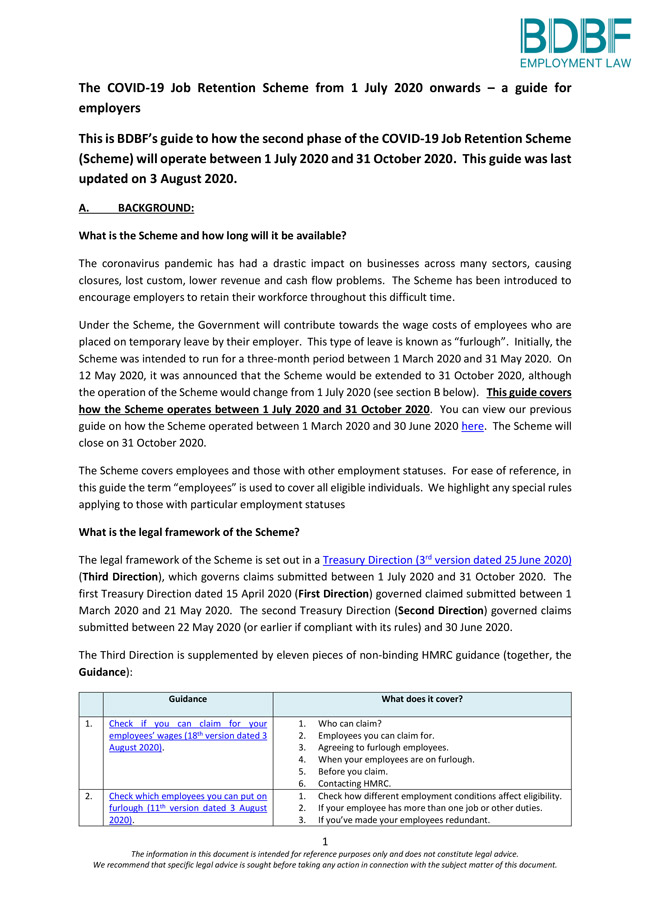
 The COVID-19 Job Retention Scheme from 1 July 2020 onwards – a guide for employers 

This is BDBF’s guide to how the second phase of the COVID-19 Job Retention Scheme (Scheme) will operate between 1 July 2020 and 31 October 2020. This guide was last updated on 3 August 2020. 

Please click on the information below to download the PDF:

[/et_pb_text][et_pb_image src=”http://davidk423.sg-host.com/wp-content/uploads/2020/07/Guide-to-the-COVID-19-Job-Retention-Scheme-from-1-July-2020-3-August-2020-1.jpg” url=”http://davidk423.sg-host.com/wp-content/uploads/2020/07/Guide-to-the-COVID-19-Job-Retention-Scheme-from-1-July-2020-3-August-2020.pdf” align=”center” _builder_version=”4.2.2″ hover_enabled=”0″ border_radii=”on|1px|1px|1px|1px” border_width_all=”1px” border_color_all=”#009b9b”][/et_pb_image][et_pb_text _builder_version=”4.2.2″ text_orientation=”justified” use_border_color=”off”]

BDBF is currently advising many employers and employees on the challenges presented by the coronavirus. If you or your business needs advice on furlough or other coronavirus-related matter please contact Amanda Steadman (amandasteadman@bdbf.co.uk) or your usual BDBF contact. 

[/et_pb_text][/et_pb_column][/et_pb_row][/et_pb_section][et_pb_section fb_built=”1″ _builder_version=”3.26.6″][et_pb_row _builder_version=”3.26.6″][et_pb_column type=”4_4″ _builder_version=”3.26.6″][/et_pb_column][/et_pb_row][/et_pb_section]
Racial stereotypes were discriminatory and justified dismissal without notice

[et_pb_section fb_built=”1″ _builder_version=”3.0.100″ background_image=”http://davidk423.sg-host.com/wp-content/uploads/2017/09/bdbf_final-stages-1-4-1.jpg” custom_padding=”|||” global_module=”2165″ saved_tabs=”all”][et_pb_row _builder_version=”3.25″ custom_padding=”|||”][et_pb_column type=”4_4″ _builder_version=”3.25″ custom_padding=”|||” custom_padding__hover=”|||”][et_pb_text _builder_version=”3.27.4″ background_layout=”dark” custom_margin=”0px|||” custom_padding=”0px|||”]

Employment Law News


[/et_pb_text][/et_pb_column][/et_pb_row][/et_pb_section][et_pb_section fb_built=”1″ admin_label=”section” _builder_version=”3.22.3″][et_pb_row admin_label=”row” _builder_version=”3.25″ background_size=”initial” background_position=”top_left” background_repeat=”repeat”][et_pb_column type=”4_4″ _builder_version=”3.25″ custom_padding=”|||” custom_padding__hover=”|||”][et_pb_text _builder_version=”4.2.2″ text_orientation=”justified” use_border_color=”off”]

Racial stereotypes were discriminatory and justified dismissal without notice

In Lamonby v Solent University the Employment Tribunal had to consider whether it was fair to dismiss an employee who had made remarks which betrayed a tendency to stereotype according to race, even where such stereotypes were sometimes positive.

What does the law say?

Misconduct is a potentially fair reason for dismissal.  In order to show that it has dismissed fairly for misconduct, an employer must show that:

  • it believed the employee to be guilty of misconduct;
  • it had reasonable grounds for believing the employee was guilty of misconduct; and
  • in forming such a belief on reasonable grounds, it carried out as much investigation as was reasonable in all the circumstances.

Most employers will stipulate within their disciplinary rules that discriminatory acts will be treated as gross misconduct warranting dismissal without notice.  Typically, separate internal policies (e.g. equal opportunities / anti-harassment) set out what constitutes discrimination, and this will include discriminatory remarks.

What happened in this case?

Mr Lamonby was a 73-year old part-time lecturer in engineering at Solent University (the University).  During a meeting with his course leader, Dr Bonar, it was alleged that Mr Lamonby made the following remarks:

  • Black people “…didn’t have the heritage in their DNA to be able to do engineering” but that he had a “soft spot” for young black men because they are “underprivileged and many without fathers” and “need all the help they can get”;
  • People from Africa and Lithuania “…had no basics in engineering. No family involved and no practice”;
  • Jewish people were “…the cleverest people in the world” and that they had a “…particular gift” for physics;and
  • Germans were “good at engineering” as they were “exposed to a high level of industry from an early stage in their lives”.

He also asked Dr Bonar if she was Jewish because of her ability in maths and physics.

Dr Bonar raised a complaint, stating that she had found the comments personally offensive and that she was concerned that students were being taught by someone with racist views.  The University instituted disciplinary proceedings on the basis that Mr Lamonby had breached the University’s Behaviour at Work Policy and the Solent Values Policy.

Mr Lamonby accepted he had made the remarks, save for the remark concerning DNA.  He apologised and said that he had not intended to be racist or upset Dr Bonar.  Yet, during the investigation and disciplinary process he continued to make inappropriate comments about racial and ethnic groups, including that black males “need extra help” and that Jews had “a special mind” and had “neurological differences”.

The University found that Mr Lamonby was guilty of gross misconduct and he was dismissed without notice.  Mr Lamonby brought claims of unfair dismissal and breach of contract in respect of the notice period.

What was decided?

Firstly, Mr Lamonby argued that the comments made to Dr Bonar were made in a casual, public environment (i.e. the canteen) and not within the workplace.  This was rejected outright by the Judge, who considered that a professional meeting on University premises clearly amounted to a workplace conversation.

Secondly, Mr Lamonby argued that his comments were sympathetic towards or positive about the groups mentioned and were not racist or offensive, meaning his dismissal was unfair.  However, the Judge concluded that ascribing certain abilities or talents (or the opposite of them) to a group by virtue of their nationality, race, ethnic or religious group was potentially racist and offensive.   For example, a Jewish person might feel such positive stereotypes demeaned their personal intellectual ability and hard work.  The Judge added that “…as with any such group, talents or abilities will vary wildly from individual to individual”.

The Employment Tribunal found that the dismissal was within the range of reasonable responses and dismissed the claims.

What does this mean for employers?

This decision serves as a helpful reminder that discrimination can occur even where the perpetrator has not intended to cause offence and/or does not believe they have behaved in a discriminatory manner.  In this case, despite having a clean disciplinary record, Mr Lamonby’s failure to recognise his wrongdoing meant that the University lost confidence in his ability to change (e.g. through training).   The decision also highlights that even positive racial stereotyping can be viewed as racist and offensive.

It’s worth noting that the University was assisted by the fact that it had clear anti-discrimination policies in place which had been well-publicised to staff.  This meant that Mr Lamonby understood the standard of behaviour expected of him, even though he hadn’t, in fact, read them.

Employers should ensure that their policies are clear (e.g. highlighting that positive racial stereotyping is discriminatory) and are circulated to employees on a regular basis.  Ideally, employees should be asked to acknowledge that they have read them and should also attend regular dignity at work training.

Lamonby v Solent University (Southampton)

If you would like to discuss any of the issues raised in this article please contact Amanda Steadman (amandasteadman@bdbf.co.uk) or your usual BDBF contact.

[/et_pb_text][/et_pb_column][/et_pb_row][/et_pb_section][et_pb_section fb_built=”1″ _builder_version=”3.26.6″][et_pb_row _builder_version=”3.26.6″][et_pb_column type=”4_4″ _builder_version=”3.26.6″][/et_pb_column][/et_pb_row][/et_pb_section]


Employer discriminated against depressed employee by failing to guarantee that she would not have to work with alleged harassers again

[et_pb_section fb_built=”1″ _builder_version=”3.0.100″ background_image=”http://davidk423.sg-host.com/wp-content/uploads/2017/09/bdbf_final-stages-1-4-1.jpg” custom_padding=”|||” global_module=”2165″ saved_tabs=”all”][et_pb_row _builder_version=”3.25″ custom_padding=”|||”][et_pb_column type=”4_4″ _builder_version=”3.25″ custom_padding=”|||” custom_padding__hover=”|||”][et_pb_text _builder_version=”3.27.4″ background_layout=”dark” custom_margin=”0px|||” custom_padding=”0px|||”]

Employment Law News


[/et_pb_text][/et_pb_column][/et_pb_row][/et_pb_section][et_pb_section fb_built=”1″ admin_label=”section” _builder_version=”3.22.3″][et_pb_row admin_label=”row” _builder_version=”3.25″ background_size=”initial” background_position=”top_left” background_repeat=”repeat”][et_pb_column type=”4_4″ _builder_version=”3.25″ custom_padding=”|||” custom_padding__hover=”|||”][et_pb_text _builder_version=”4.2.2″ text_orientation=”justified” use_border_color=”off”]

Employer discriminated against depressed employee by failing to guarantee that she would not have to work with alleged harassers again

In this case, the EAT considered whether it would be a reasonable adjustment for an employer to provide an undertaking to a disabled employee guaranteeing a severance package in the event that it could not maintain certain working arrangements. 

What does the law say?

Where an employer’s provision, criterion or practice (PCP) places a disabled employee at a substantial disadvantage compared to non-disabled employees, the duty to make reasonable adjustments will arise.  Employers must consider whether an adjustment would lessen the disadvantage and, if it would, whether it is a reasonable step to take in the all the circumstances.  Reasonable adjustments can cover a wide range of possible actions, from adjustments to physical premises (e.g. widening a doorway to allow wheelchair access) to changes to company rules and/or practices (e.g. standard working hours or sickness absence policies).

Where an employer fails to make reasonable adjustments, the employee is able to bring a claim seeking compensation and/or a recommendation that the employer takes appropriate steps to alleviate the disadvantage.

What happened in this case?

The Claimant was employed by Lloyds Bank.  She alleged that she had been bullied and harassed by her line manager, M, and M’s line manager, B.  She went off sick with stress and depression for 16 months and raised a grievance, which was not upheld.  When she eventually returned to work, she made it clear that she did not wish to work with M or B ever again.  Although she was not, in fact, working with M or B (who were based at different offices to her), she asked the Bank to give her an undertaking that:

  • it would not rearrange duties or roles with the result that she would have to work with, or report to, M or B in future; and
  • if that could not be achieved, it would offer her a severance package equivalent to what she would have received had she been redundant.

The Bank said that it would aim to avoid her working with M or B again, but this could not be guaranteed, nor was it willing to offer the alternative of a severance package.

The Claimant claimed that the Bank’s position represented a failure to make reasonable adjustments.  She argued that she was placed at a substantial disadvantage to a non-disabled person (her disability being reactive depression), because the fear of working with M or B again aggravated symptoms such as hair loss, panic attacks, exhaustion and feelings of dread and hopelessness.

What was decided?

The Employment Tribunal upheld the claim. They awarded £7,500 for injury to feelings and made a recommendation requiring the Bank to provide the undertaking requested by the Claimant.  However, the recommendation was set aside upon reconsideration.  The Bank appealed against the decision, including the original recommendation.  The Claimant appealed against the later decision to set aside the recommendation.

The Employment Appeal Tribunal (EAT) decided that the Bank’s unwillingness to give an undertaking was not a one-off decision, but was a “practice” susceptible to adjustments, and it could be reasonable to give an undertaking providing a disabled employee with special financial benefits in certain circumstances.  Although the purpose of making reasonable adjustments is to keep disabled employees in work, rather than to deal with exit terms, the underlying purpose of the proposed undertaking was to allow the Claimant to work without fear and so remain in work.

The EAT concluded that the Bank had failed to make reasonable adjustments and that the recommendation to provide the undertaking was an appropriate remedy.  It rejected the Bank’s objections that recommendations should not have potential financial implications or last indefinitely.  However, it accepted that the original recommendation made by the Tribunal was inadequate in several respects and it was right to have set it aside.  The EAT remitted the question of precisely what form of recommendation should be made.

What does this mean for employers?

This decision shows how wide-ranging the duty to make reasonable adjustments can be.  Here, the employee’s grievance had been rejected, she was not working with the alleged perpetrators and the Bank had said it would do its best to keep them apart in future.  However, this did not remove the need to also make reasonable adjustments: the Claimant was still fearful, this fear exacerbated her condition and caused her to suffer a substantial disadvantage.

Employers should also remember that the duty to identify appropriate reasonable adjustments lies with them and not with the employee.  Accordingly, employers must proactively consider whether committing to working arrangements (and to severance terms if such arrangements cannot continue) would amount to a reasonable adjustment in any particular case.

Hill v Lloyds Bank plc

If you would like to discuss any of the issues raised in this article please contact Amanda Steadman (amandasteadman@bdbf.co.uk) or your usual BDBF contact.

[/et_pb_text][/et_pb_column][/et_pb_row][/et_pb_section][et_pb_section fb_built=”1″ _builder_version=”3.26.6″][et_pb_row _builder_version=”3.26.6″][et_pb_column type=”4_4″ _builder_version=”3.26.6″][/et_pb_column][/et_pb_row][/et_pb_section]


Revised COVID-19 health and safety guidelines for offices and contact centres published

[et_pb_section fb_built=”1″ _builder_version=”3.0.100″ background_image=”http://davidk423.sg-host.com/wp-content/uploads/2017/09/bdbf_final-stages-1-4-1.jpg” custom_padding=”|||” global_module=”2165″ saved_tabs=”all”][et_pb_row _builder_version=”3.25″ custom_padding=”|||”][et_pb_column type=”4_4″ _builder_version=”3.25″ custom_padding=”|||” custom_padding__hover=”|||”][et_pb_text _builder_version=”3.27.4″ background_layout=”dark” custom_margin=”0px|||” custom_padding=”0px|||”]

Employment Law News


[/et_pb_text][/et_pb_column][/et_pb_row][/et_pb_section][et_pb_section fb_built=”1″ admin_label=”section” _builder_version=”3.22.3″][et_pb_row admin_label=”row” _builder_version=”3.25″ background_size=”initial” background_position=”top_left” background_repeat=”repeat”][et_pb_column type=”4_4″ _builder_version=”3.25″ custom_padding=”|||” custom_padding__hover=”|||”][et_pb_text _builder_version=”4.2.2″ text_orientation=”justified” hover_enabled=”0″ use_border_color=”off”]

Revised COVID-19 health and safety guidelines for offices and contact centres published

Back in May 2020 the Government published COVID-19 secure guidelines setting out the health and safety measures to be adopted in different types of workplaces.  Following the Prime Minister’s announcement that, from 1 August 2020, employers will have more discretion about whether to return workers to the office, the guidelines governing offices and contact centres (Guidelines) have been updated.  In this briefing, we highlight the latest core objectives for office-based employers contained in the updated Guidelines published on 23 July 2020. 

Introduction

The detailed Guidelines are designed to provide a practical framework for employers to think about what they need to do to continue, or restart, office or contact centre operations.  Each business will need to translate the Guidelines into a set of specific actions to take.  These actions will, to some extent, turn on the nature, size and type of the business and how it is organised, operated, managed and regulated.

The Guidelines highlight that businesses should make every reasonable effort to ensure their employees can work safely and that staff are not obliged to work in an unsafe environment.  From 1 August 2020, this may be working from home, or within the workplace if the Guidelines are followed closely.

The Guidelines are non-statutory and supplement binding legal obligations on employers regarding health and safety and employment.  Where relevant, they should be considered alongside any additional guidance issued by the devolved administrations in Wales, Scotland and Northern Ireland.

Thinking about and managing risk

  • Conduct an assessment of the risks posed by COVID-19 as soon as possible, having particular regard to whether any staff are especially vulnerable to COVID-19.
  • Consult with employee or trade union health and safety representatives about workplace risks.
  • Respond to advice or notices issued by the enforcing authorities within any prescribed timescale and follow all instructions from authorities in the event of new local restrictions.
  • Share the results of the risk assessment with the workforce and consider publishing it on your website (all employers with over 50 employees should do this).
  • Take action to reduce identified risks to the lowest reasonably practicable level by taking preventative measures in order of priority.
  • Display an official notice in the workplace to demonstrate compliance with these guidelines.

Who should go to work?

  • Ensure workplaces are safe, whilst also enabling working from home.
  • Consult with employees to determine who can come into the workplace from 1 August 2020, taking into account the following factors:
    • use of public transport;
    • childcare responsibilities;
    • protected characteristics; and
    • other individual circumstances.
  • Protect clinically vulnerable and clinically extremely vulnerable employees. In both cases, such employees should usually work from home. If a clinically vulnerable worker cannot work from home (in their role or an alternative role) then they should be offered the safest available role in the workplace.
  • Treat everyone in the workplace equally and be mindful of the particular needs of different groups of workers (e.g. disabled or pregnant workers or those who live with a clinically extremely vulnerable person).
  • Ensure that those who need to self-isolate do not attend work. This includes those who:
    • have COVID-19 symptoms;
    • live in a household with someone who has COVID-19 symptoms;
    • are in a “support bubble” with someone who has COVID-19 symptoms; and
    • are advised to self-isolate as part of the Government’s “test and trace” programme.
  • Keep in touch with homeworkers and monitor their wellbeing.

Social distancing at work

  • Maintain 2 metre social distancing wherever possible, including upon arrival and departure from work and ensure handwashing upon arrival at work (or provide access to hand sanitiser if not possible).
  • Maintain 2 metre social distancing between individuals wherever possible when they are moving around the workplace, at their workstations and using common areas such as lifts and corridors.
  • Avoid face-to-face meetings wherever possible and maintain social distancing in essential meetings.
  • Where 2 metre social distancing is not viable, consider whether the activity can be redesigned to maintain either 2 metre distancing or 1 metre distancing with added “risk mitigation” steps such as:
    • increasing handwashing and surface cleaning;
    • keeping the activity time involved as short as possible;
    • using screens or barriers to separate people from each other;
    • using back-to-back or side-to-side working whenever possible; and/or
    • reducing the number of people each person has contact with by using fixed teams or partnering.
  • Where social distancing guidelines cannot be followed (even through redesigning the activity), consider whether that activity needs to continue for the business to operate. If it does, then the business should “take all the mitigating actions possible” to reduce the risk to staff.
  • Do not maintain social distancing if there is an emergency such as an accident or fire.

Managing customers, visitors and contractors

  • Minimise the number of unnecessary visitors to the office.
  • Make sure visitors understand what they need to do to maintain safety (e.g. by using signs in the premises and providing information by email and/or on your website).
  • Business are permitted to host groups of more than 30 people either indoors or outdoors, providing a risk assessment has been conducted and steps are taken to reduce the risk of transmission.

Cleaning the workplace

  • Before reopening make sure that any site that has been closed, or partially operated, is clean and ready to restart.
  • Keep the workplace clean, especially surfaces which are touched by multiple people.
  • Help everyone keep good hygiene throughout the working day (e.g. by encouraging frequent handwashing and providing hand sanitiser in multiple locations).
  • Minimise the risk of transmission in changing rooms and showers (if any).
  • Reduce transmission through contact with objects and/or vehicles entering the workplace from outside.

PPE and face coverings

  • Do not encourage the precautionary use of PPE outside of clinical settings.
  • If a risk assessment shows that PPE is required, then this must be provided free of charge to workers who need it.
  • Wearing a simple face covering is optional and not required by law. However, if a worker chooses to wear one, provide advice on how to use them safely.

Workforce management

  • Change the way work is organised to create distinct groups and reduce the number of contacts each worker has.
  • Keep a temporary record of staff shift patterns for 21 days to assist the Government’s “test and trace” service.
  • Provide guidance in the event of a COVID-19 outbreak in the workplace.
  • Avoid unnecessary work travel and keep people safe if they need to travel between locations.
  • Help workers making deliveries outside the workplace maintain social distancing and hygiene practices.
  • Make sure all workers understand the COVID-19 related safety procedures through consultation with representatives, written communications and training prior to their return to work.
  • Make sure all workers are kept up to date with how safety measures are being implemented or changed.

Inbound and outbound goods

  • Maintain social distancing and avoid surface transmission when goods enter and leave the workplace.

BDBF is currently advising many employers on the challenges presented by the coronavirus.  If you or your business needs advice on any coronavirus-related matter please contact Amanda Steadman (amandasteadman@bdbf.co.uk) or your usual BDBF contact.

[/et_pb_text][/et_pb_column][/et_pb_row][/et_pb_section][et_pb_section fb_built=”1″ _builder_version=”3.26.6″][et_pb_row _builder_version=”3.26.6″][et_pb_column type=”4_4″ _builder_version=”3.26.6″][/et_pb_column][/et_pb_row][/et_pb_section]


The state of whistleblowing in the financial services sector

[et_pb_section fb_built=”1″ _builder_version=”3.0.100″ background_image=”http://davidk423.sg-host.com/wp-content/uploads/2017/09/bdbf_final-stages-1-4-1.jpg” custom_padding=”|||” global_module=”2165″ saved_tabs=”all”][et_pb_row _builder_version=”3.25″ custom_padding=”|||”][et_pb_column type=”4_4″ _builder_version=”3.25″ custom_padding=”|||” custom_padding__hover=”|||”][et_pb_text _builder_version=”3.27.4″ background_layout=”dark” custom_margin=”0px|||” custom_padding=”0px|||”]

Employment Law News


[/et_pb_text][/et_pb_column][/et_pb_row][/et_pb_section][et_pb_section fb_built=”1″ admin_label=”section” _builder_version=”3.22.3″][et_pb_row admin_label=”row” _builder_version=”3.25″ background_size=”initial” background_position=”top_left” background_repeat=”repeat”][et_pb_column type=”4_4″ _builder_version=”3.25″ custom_padding=”|||” custom_padding__hover=”|||”][et_pb_text _builder_version=”4.2.2″ text_orientation=”justified” hover_enabled=”0″ use_border_color=”off”]

The state of whistleblowing in the financial services sector

Protect, the whistleblowers’ charity, has published a new report looking at the recent experiences of whistleblowers in the financial services sector.  We discuss the key findings and the learning points for employers in the sector.

The Silence in the City report was first published back in 2012 (SITC1), when Protect sought to probe why whistleblowers hadn’t raised concerns over the financial crash and Libor scandal.  The Silence in the City 2 report(SITC2) looks at how the experience of financial services whistleblowers has changed since the introduction of the FCA Whistleblowing Rules in 2016.  The findings are based upon analysis of 352 cases of individuals from the financial services sector who contacted Protect’s legal advice helpline between 1 January 2017 and 31 December 2019.

Who are the financial services whistleblowers?

  • Where do they work? 73% worked in banking, finance or insurance, representing a 12% increase from SITC1.  These organisations are all subject to the FCA Whistleblowing Rules, meaning they will have been required to communicate whistleblowing policies to staff and roll out a comprehensive training programme. These steps are likely to have contributed to a greater awareness amongst staff on how to blow the whistle.
  • How long have they worked for their employer? 47% had under 2 years’ service, which is slightly lower than the level recorded in SITC1 (53%), but still relatively high. One explanation for this is that newer staff are more likely to have fresh perspective and notice wrongdoing which has become normalised to longer serving employees.
  • What roles do they perform? 39% occupy senior roles with managerial responsibilities (i.e. director, executive, partner or manager level roles) which was similar to the level recorded in SITC1.  The figures were much lower for junior or technical-based roles.  Protect’s view is that the sector faces the challenge of empowering junior staff to raise concerns.
  • What is their employment status? About two thirds were raising concerns about a current employer’s practices and about a third about a former employer’s practices. These levels were similar to those seen in SITC1.  It’s important to remember that employees who blow the whistle after they have left employment still acquire whistleblower protection (see Onyango v Berkeley Solicitors Ltd) and so care should be taken not to subject such employees to any form of post-employment detriment.

What types of wrongdoing do the whistleblowers witness?

  • What types of wrongdoing form the subject of whistleblowing complaints? The top six areas were:
    • Breach of legal or regulatory obligations – 19%
    • Fraudulent or criminal activity – 11%
    • Incorrect reporting to a client or third party – 9%
    • Breaches in data protection or client confidentiality – 7%
    • Competence or conduct of staff – 5%
    • Discrimination or harassment – 5%
  • The rise of discrimination and harassment: notably, discrimination and harassment did not feature as one of the top forms of wrongdoing in SITC1. Its elevation may be due to the heightened attention on such issues as a result of the global #MeToo movement.  Protect notes that whistleblowers raising concerns about discrimination and harassment are identifying a wider cultural problem in their place of work, rather than a personal grievance.  They say: “…it may be more effective for a whistleblower, even if they are also a victim of harassment or bullying, to use whistleblowing arrangements because it has this wider public interest significance”.
  • Did reports tend to concern one-off or recurrent issues? 78% raised concerns about recurring issues rather than one-off incidents. Employers should analyse whether the whistleblower’s colleagues also reported concerns (as they would likely have been aware of a recurrent problem).  Further, over 57% of the concerns raised were characterised as “organisation-wide” issues, which, again, suggests that they would be recurrent and widely known about.

Where do whistleblowers raise their concerns?

  • Are whistleblowing raising concerns internally? The good news is there is a greater level of trust amongst whistleblowers to use internal whistleblowing arrangements. This rose from 78% in the SITC1 to 93% in the SITC2.  This suggests that the introduction of the FCA Whistleblowing Rules have promoted greater awareness and use of internal procedures.
  • Who are the most popular recipients? The top seven recipients of concerns changed depending on the number of times the whistleblower had raised the concern (see table below). These results show that whistleblowers initially have confidence in their managers to resolve the matter, with 52% reporting either to their line manager or a director in the first instance and only 7% reporting externally to the FCA or PRA.


1st time 2nd time 3rd time
Line manager (28%) Director (22%) FCA/PRA (33%)
Director (24%) FCA/PRA (22%) Compliance / legal (21%)
Whistleblowing champion or equivalent (11%) Compliance / legal (12%) Director (18%)
HR (10%) HR (11%) Whistleblowing champion or equivalent (13%)
Compliance / legal (9%) Whistleblowing champion or equivalent (9%) HR (13%)
Senior manager (8%) Senior manager (9%) Senior manager (10%)
FCA/PRA (7%) Line manager (6%) Line manager (5%)


  • Are whistleblowers persistent? Whistleblowers are becoming more persistent. In 2012 only one in five was willing to raise a concern for a second time.  That figure has increased to almost one in three which is a marked improvement, again, suggesting greater trust in the system.  Interestingly, the figures for those willing to raise it a third time were the same for 2012 and 2019, at around one in ten.
  • When are whistleblowers likely to go to the FCA or PRA? By the time concerns are raised for a second and third time, confidence in the line manager drops to just 6% and then to 5%.  By contrast, the willingness to go to the FCA or PRA jumps to 22% and then to 33%.  This underlines the importance of training managers on how to identify and respond to whistleblowing complaints.
  • How useful are whistleblowing hotlines? Interestingly, the report also showed that whistleblowing hotlines were not at all popular with whistleblowers. No-one raised their concerns with a hotline in the first instance and only 1% did so in the second instance (down from 8% in SITC1).  Again, this suggests that whistleblowers have more confidence in the face-to-face internal channels available for reporting.  Whilst hotlines are a useful part of a whistleblowing strategy, it’s clear they should not be the central focus for employers.

What treatment did the whistleblower face?

  • What are the outcomes for whistleblowers? The reported outcomes for whistleblowers were overwhelmingly negative. Whistleblowers reported the following outcomes:
    • Victimised or disciplined by management – 31% (representing a 9% increase since 2012)
    • No action taken – 30%
    • Dismissed – 22%
    • Resigned – 12%
    • Victimised by co-workers – 4%
    • Suspended – 1%
    • Thanked – 0% 
  • The prevalence of victimisation: an astonishing 35% of whistleblowers reported having been victimised by management or co-workers. The research also shows that when the victimisation was reported to the employer, over half took no action (58%) and almost a quarter rejected the complaint (24%).
  • Failure to comply with the FCA Whistleblowing Rules: these figures suggest a failure by some firms to give full effect to the FCA Whistleblowing Rules, which require a proactive approach to tackling victimisation. Indeed, in November 2018, the FCA reviewed how the rules were bedding in and noted that a number of firms still needed to develop or enhance their arrangements regarding protecting whistleblowers from victimisation, especially educating employees by way of training.  Protect calls for the FCA to take a more robust approach and hold both firms and senior managers to account where whistleblowers have been victimised.

What action was taken on their concerns?

  • Are firms taking action? 33% said that their concerns were ignored by the firm.  14% of concerns were denied.  Only 15% were either admitted by the firm or otherwise resolved.  In the remaining cases the investigation was ongoing, or the firm’s actions were unknown.  Linked to this is the fact that 75% of whistleblowers said they had received no feedback at all on the concerns they had raised.  This represents a failure by firms to embrace the spirit of the FCA Whistleblowing Rules, which require firms to provide feedback “whenever feasible and appropriate”.  Firms need to review their approach here to make sure complaints are not being ignored and that whistleblowers are provided with appropriate feedback and are not frozen out.

Conclusion

So, what are the top five practical take-aways for employers operating in the financial services sector?

  1. Analyse the seniority of those raising concerns through internal channels and consider whether further communications and/or training should be targeted towards junior level staff to empower them to raise their concerns.
  2. Be mindful that employees are increasingly likely to use whistleblowing channels to report concerns about discrimination and harassment. Employers should ensure that HR teams and managers are trained in whistleblowing and are able to spot when (i) an employee raises issues which amount to both a personal grievance and a wider whistleblowing complaint and/or (ii) there is a pattern of similar complaints which indicates an underlying cultural problem.
  3. Analyse reports concerning recurrent or organisation-wide issues and try to understand why others did not also blow the whistle. Is there a lack of awareness of the internal process?  Or a lack of trust in the process?  Either way, seek to address the issue.
  4. Focus on how you will protect whistleblowers from victimisation. Consider putting in place a system of regular check ins with the whistleblower for up to 18 months after the report has been raised to check that they are not being victimised.  Ensure that all-staff training programmes clearly explain what victimisation is and how perpetrators will be dealt with.
  5. Regularly benchmark your internal procedures against the FCA Whistleblowing Rules and ensure complaints are not ignored and feedback is provided to whistleblowers were possible.

If you would like to discuss any of the issues raised in this article, then please contact Amanda Steadman (amandasteadman@bdbf.co.uk) or your usual BDBF contact.

[/et_pb_text][/et_pb_column][/et_pb_row][/et_pb_section][et_pb_section fb_built=”1″ _builder_version=”3.26.6″][et_pb_row _builder_version=”3.26.6″][et_pb_column type=”4_4″ _builder_version=”3.26.6″][/et_pb_column][/et_pb_row][/et_pb_section]


Black livelihoods matter

[et_pb_section fb_built=”1″ _builder_version=”3.0.100″ background_image=”http://davidk423.sg-host.com/wp-content/uploads/2017/09/bdbf_final-stages-1-4-1.jpg” custom_padding=”|||” global_module=”2165″ saved_tabs=”all”][et_pb_row _builder_version=”3.25″ custom_padding=”|||”][et_pb_column type=”4_4″ _builder_version=”3.25″ custom_padding=”|||” custom_padding__hover=”|||”][et_pb_text _builder_version=”3.27.4″ background_layout=”dark” custom_margin=”0px|||” custom_padding=”0px|||”]

Employment Law News


[/et_pb_text][/et_pb_column][/et_pb_row][/et_pb_section][et_pb_section fb_built=”1″ admin_label=”section” _builder_version=”3.22.3″][et_pb_row admin_label=”row” _builder_version=”3.25″ background_size=”initial” background_position=”top_left” background_repeat=”repeat”][et_pb_column type=”4_4″ _builder_version=”3.25″ custom_padding=”|||” custom_padding__hover=”|||”][et_pb_text _builder_version=”4.2.2″ text_orientation=”justified” hover_enabled=”0″ use_border_color=”off”]

Black livelihoods matter

At a time when racial inequality is at the forefront of everyone’s minds, new figures revealing the continuing underrepresentation of black people in senior positions in the UK have led to calls for action to secure more diverse workforces.

New figures published by Business in the Community have shown that despite making up over 3% of the population of England and Wales, black people held only 1.5% of the 3.7 million director and manager level roles across the public and private sectors in 2019.  This represents a meagre 0.1% increase in the 6 years since the Race at the Top report was last published in 2014.   In contrast, white people held 89.6% of such positions in 2019, which exceeds the white population figure of around 86%.  These figures have led to calls for change.

Sandra Kerr CBE, race director at Business in the Community, said: “Black livelihoods matter and employers need to take urgent action to ensure that their organisation is inclusive and a place where people of any ethnic background can thrive and succeed.”

At the same time, 29 senior business leaders co-signed a letter to The Sunday Times calling for greater diversity at senior levels within British businesses.  Senior leaders from businesses such as BT, Tesco, Sainsbury’s, ITV and John Lewis said that firms needed to address “systemic racism”.  The 29 signatories also committed to setting diversity targets for candidate slates for every vacancy within their business.

What can employers do to address the representation gap?

Business in the Community has devised a Race at Work charter calling for signatories to take the following five steps:

  • Appoint an executive sponsor for race within the business to provide visible leadership and drive key actions: this approach has been adopted with some success in the context of improving gender equality within the workplace. For example, annual gender pay gap reports must be signed off by a director or equivalent within the business, and many reports now open with a statement by that person, outlining the company’s values and progress in that arena.
  • Gather and report data: gathering ethnicity data from the employee population is essential to be able to monitor and report progress over time. This data will also be necessary if, and when, businesses are required to report on their ethnicity pay gap (see below).  However, there are many hurdles around collecting, analysing and reporting ethnicity data.  For example, employees are not legally obliged to disclose their ethnicity to their employer and research shows that self-declaration can be as low as 50%, meaning data sets will be incomplete.  Employers need to think carefully how they can encourage self-declaration (e.g. by demonstrating that the data will be kept secure) and ensure that it is collected at different points (e.g. at the recruitment stage and then again at the onboarding stage) and at regular enough intervals to enable progress to be monitored effectively.
  • Zero tolerance of harassment and bullying: 25% of black and ethnic minority employees report having witnessed or experienced racial harassment or bullying from managers. Board level commitment should be secured to stamp this out.  In addition, appropriate training should be delivered across the workforce, clear policies must be put in place and a consistent approach taken towards any offending behaviour.
  • Make supporting equality in the workplace the responsibility of all leaders and managers: for example, performance objectives could be tied to such responsibilities. Again, this is something we have seen used to good effect in gender equality arena.  In December 2019, senior executives at TSB had their bonuses cut for failing to meet gender equality targets.
  • Take action that supports ethnic minority career progression: taking positive action has the potential to make the biggest impact on representation rates. Many employers will have embraced (or be prepared to embrace) soft forms of positive action, such as deploying targeted advertising and outreach work and offering mentoring, training and networking opportunities.  However, few employers within the private sector will have used positive action at the point of recruitment, largely for fear of “reverse discrimination” claims. BDBF have published a detailed paper and presentation on Positive Action in the Workplace, which aims to demystify this area of the law.

What about pay inequality for black and ethnic minority workers?

As well as tackling representation gaps, employers are also now being urged to tackle ethnicity pay gaps.  One of the recommendations coming out of the 2017 McGregor-Smith Race in the Workplace report was that large employers should be required to publish ethnicity pay information as a means of improving workforce diversity.  In October 2018, Theresa May’s Government opened a consultation on introducing a system of mandatory ethnicity pay reporting, similar to the gender pay gap reporting regime. That consultation closed in January 2019 and the Government has yet to respond to it or take any action to introduce legislation.

Fast forward 18 months and a petition signed by over 100,000 members of the public has triggered a debate in Parliament on the issue, The Government’s response to the petition is that it is “still analysing” the responses to the consultation that closed in January 2019.  An 18-month window for producing a response seems like ample time (even allowing for Brexit and COVID-19) making it hard not to draw the conclusion that the proposal had been kicked into the long grass – until now.

The date for the Parliamentary debate has not yet been set and it remains to be seen whether this proposal will be resurrected.  With the figures reported by Business in the Community, and the powerful impact of the Black Lives Matter movement, it’s probably a case of “if not now, then when?”

If you would like to discuss any of the issues raised in this article or how BDBF can help your business navigate race at work issues,  then please contact Amanda Steadman (amandasteadman@bdbf.co.uk) or your usual BDBF contact.

[/et_pb_text][/et_pb_column][/et_pb_row][/et_pb_section][et_pb_section fb_built=”1″ _builder_version=”3.26.6″][et_pb_row _builder_version=”3.26.6″][et_pb_column type=”4_4″ _builder_version=”3.26.6″][/et_pb_column][/et_pb_row][/et_pb_section]


Can an employer require a potentially redundant employee to go through a competitive interview process for an alternative role?

[et_pb_section fb_built=”1″ _builder_version=”3.0.100″ background_image=”http://davidk423.sg-host.com/wp-content/uploads/2017/09/bdbf_final-stages-1-4-1.jpg” custom_padding=”|||” global_module=”2165″ saved_tabs=”all”][et_pb_row _builder_version=”3.25″ custom_padding=”|||”][et_pb_column type=”4_4″ _builder_version=”3.25″ custom_padding=”|||” custom_padding__hover=”|||”][et_pb_text _builder_version=”3.27.4″ background_layout=”dark” custom_margin=”0px|||” custom_padding=”0px|||”]

Employment Law News


[/et_pb_text][/et_pb_column][/et_pb_row][/et_pb_section][et_pb_section fb_built=”1″ admin_label=”section” _builder_version=”3.22.3″][et_pb_row admin_label=”row” _builder_version=”3.25″ background_size=”initial” background_position=”top_left” background_repeat=”repeat”][et_pb_column type=”4_4″ _builder_version=”3.25″ custom_padding=”|||” custom_padding__hover=”|||”][et_pb_text _builder_version=”4.2.2″ text_orientation=”justified” hover_enabled=”0″ use_border_color=”off”]

Can an employer require a potentially redundant employee to go through a competitive interview process for an alternative role?

In the wake of the coronavirus pandemic, some employers will be facing the prospect of reorganising their businesses and making redundancies.  Employers in this position should take note of this recent decision by the EAT which highlights the risks of getting the process wrong.

What does the law say?

In the case of Williams v Compair Maxam, the EAT laid down the general redundancy process to be followed by employers who recognised trade unions.  In summary, such employers should:

  • provide as much warning as possible of impending redundancies and consider alternative solutions such as alternative employment (either within the specific undertaking or elsewhere);
  • consult with the trade union and agree the criteria to be applied for selecting which employees from a pool would be made redundant. The selection criteria should be objective, capable of independent verification and applied fairly; and
  • consider offering alternative employment.

When it comes to selecting which employees from the pool should be offered alternative employment, subsequent cases have confirmed that a rigorously objective selection process is not required (in the way that it is required when selecting who to make redundant).  A degree of subjectivity is permitted.

Where a brand new role has been created, the appointment to that role is likely to require something more like a competitive interview process, in order to test the skills and competencies of the employees against the requirements of the new role.  Indeed, in the case of Morgan v Welsh Rugby Union (Morgan), it was accepted that the approach of applying selection criteria to a pool of potentially redundant employees will not necessarily be appropriate where a brand new role has been created.

What happened in this case?

The two Claimants were teachers who were employed by the Council to work at secondary school (School 1).  Following a reorganisation of education provision in the area, the Council decided to close School 1 and replace it with a school for children aged between 3 to 18 years of age (School 2).   School 1 was to close at the end of the Summer term in 2017 and the School 2 was due to open in September 2017.

The Council did not consult with the Claimants (or their trade union) about the redundancy procedure at School 1 or the recruitment procedure at School 2.   Instead, it invited the Claimants to apply for new roles within School 2.  However, the “new” roles were substantially similar to their old roles at School 1.  The Claimants were interviewed for the positions but were unsuccessful.  In May 2017, the Council gave them notice of dismissal by reason of redundancy, with a termination date of 31 August 2017.  The Claimants were not offered the opportunity to appeal their dismissals.

The Claimants succeeded in their claims for unfair dismissal.  The Employment Tribunal held that the Council’s procedure had been unfair for a number of reasons, including the lack of consultation and appeal, but also the fact that the Claimants had been required to “apply for either an identical job or substantially similar job”.  In other words, this was not a Morgan-type situation and the use of a competitive interview process was unreasonable.  The Council appealed.

What was decided?

The EAT dismissed the Council’s appeal, holding that the Employment Tribunal had applied the law correctly.  Notably, the EAT drew a distinction between the process to be used where:

  • the previous role is no longer needed and a newly created alternative role available; and
  • there has been a reduction in the overall number of roles needed but some roles (or substantially similar roles) remain available.

In the first scenario, which the EAT described as “forward looking”, it would be reasonable to use a competitive interview process to identify the candidate best suited to fill the new post.  However, in the second scenario, the right approach would be to place all of the “at risk” employees in a redundancy pool and score them according to objective criteria.

In this case, the roles in School 2 had been identical or substantially similar to the roles in School 1 and so a competitive interview process was not appropriate.

What are the learning points for employers?

It remains reasonable for employers to use a competitive interview process to decide who to appoint to a newly created role following a reorganisation.  However, there are limitations on when this approach can be used.  Where the alternative role is the same or very similar to one performed by the redundant employees, then the fair approach is to apply selection criteria to the employees in the pool.  Employers should give careful thought to which approach is right for their situation before proceeding.

It’s also important to remember that even where a competitive interview process is legitimate, this will not necessarily remove the need for consultation with the affected employees about the process.  Indeed, in this case, the EAT noted that consultation “may remain relevant” depending on the facts of the particular case.

Gwynedd Council v Barrett

If you would like to discuss any of the issues raised in this article or how BDBF can help your business navigate a redundancy process,  then please contact Amanda Steadman (amandasteadman@bdbf.co.uk) or your usual BDBF contact.

[/et_pb_text][/et_pb_column][/et_pb_row][/et_pb_section][et_pb_section fb_built=”1″ _builder_version=”3.26.6″][et_pb_row _builder_version=”3.26.6″][et_pb_column type=”4_4″ _builder_version=”3.26.6″][/et_pb_column][/et_pb_row][/et_pb_section]


Flexible furloughing begins on 1 July 2020 – key points to note

[et_pb_section fb_built=”1″ _builder_version=”3.0.100″ background_image=”http://davidk423.sg-host.com/wp-content/uploads/2017/09/bdbf_final-stages-1-4-1.jpg” custom_padding=”|||” global_module=”2165″ saved_tabs=”all”][et_pb_row _builder_version=”3.25″ custom_padding=”|||”][et_pb_column type=”4_4″ _builder_version=”3.25″ custom_padding=”|||” custom_padding__hover=”|||”][et_pb_text _builder_version=”3.27.4″ background_layout=”dark” custom_margin=”0px|||” custom_padding=”0px|||”]

Employment Law News


[/et_pb_text][/et_pb_column][/et_pb_row][/et_pb_section][et_pb_section fb_built=”1″ admin_label=”section” _builder_version=”3.22.3″][et_pb_row admin_label=”row” _builder_version=”3.25″ background_size=”initial” background_position=”top_left” background_repeat=”repeat”][et_pb_column type=”4_4″ _builder_version=”3.25″ custom_padding=”|||” custom_padding__hover=”|||”][et_pb_text _builder_version=”4.2.2″ text_orientation=”justified” hover_enabled=”0″ use_border_color=”off”]

Flexible furloughing begins on 1 July 2020 – key points to note

The second phase of the COVID-19 Job Retention Scheme (Scheme) begins on 1 July 2020 and will allow employers to bring furloughed employees back to work on a part-time basis.  The Government contributions to the wage costs of furloughed employees will also gradually decrease until the Scheme closes on 31 October 2020. 

A raft of new guidance has recently been published, together with a new Treasury Direction, which sets out the legal framework for the second phase of the scheme.  This briefing highlights the key points for employers to note.  Our full guidance note for employers covers the second phase of the Scheme in detail and is available here.

What is flexible furlough?

  • From 1 July 2020, an employer can agree with a furloughed employee that they will be furloughed on a part-time basis and carry out some work on a part-time basis. It is open to the employer and employee to agree whatever working pattern they wish, but it must be less than the employee’s usual working hours.
  • Alternatively, employees can continue to be fully furloughed. Employees can also be rotated between periods of full furlough and part furlough.  Employees will be described as “flexibly furloughed” whether they are furloughed on full or part-time basis.
  • From 1 July 2020, employees can be furloughed for any length of time – there will no longer be a minimum 3-week furlough period (although the minimum claim period will be 7 consecutive days).
  • Whilst on furlough, it remains the case that the employee is unable to carry out any work for the employer. The rules on this area haven’t changed.

Who can be flexibly furloughed?

  • The rules governing which members of the workforce are eligible to be furloughed haven’t changed. However, the last possible date to furlough new entrants to the Scheme was 10 June 2020 (in order for the minimum 3-week furlough period to have been completed by 30 June 2020).   The only exceptions to this rule are:
      • employees returning from various forms of paid statutory parental leave after 10 June 2020; and
      • armed forced reservist employees returning from service after 10 June 2020.
  • Where an employee has previously been furloughed for at least 3 weeks at any time between 1 March 2020 and 30 June 2020, they will still be eligible to be furloughed after 1 July 2020 (i.e. it’s not necessary to have actually been on furlough on 30 June 2020).  Where such an employee has been rotated between periods of furlough and work, and started a new period of furlough after 10 June 2020, then at least 3 weeks must elapse before they can be regarded as flexibly furloughed.
  • From 1 July 2020, the maximum number of employees that an employer can include in a claim must not exceed the highest number of employees that it had furloughed in any period before 30 June 2020 (save that those who were absent on from various forms of paid statutory parental leave and armed forces reservists absent on service may also be counted).

Will a new furlough agreement be needed?

  • In most cases, a furlough agreement (or written confirmation confirming the agreement) will have been put in place to cover the pre-1 July 2020 furlough arrangements.
  • Where an employee is to move on to a part furlough arrangement, such agreements will need to varied to reflect that the employee agrees to be part-furloughed and to outline the proposed working pattern. Even where the employee is to remain fully furloughed, it’s possible that agreements will need to be varied (e.g. to extend the period of time that the employee will be furloughed or to reflect other changes such as the reduction or removal of benefits).
  • The Treasury Direction confirms that furlough agreements must be in place before the relevant claim period but can be varied at a later date to reflect agreed variations. Accordingly, it should not be necessary to prepare brand new furlough agreements to cover the post-1 July 2020 arrangements.  Instead, employers will need to agree any changes with the employee (this could be done by a way of a phone call) and then confirm the agreement by way of a letter or email which varies the original furlough agreement.  However, this should be done prior to the relevant claim period.
  • There remains no requirement for the employee to confirm their agree in writing, although this will typically be sought in practice.  All written communications should be retained until 30 June 2025. In addition, where an employee is on a part furlough arrangement there are additional record-keeping obligations.  The employer must retain details of the usual and actual hours worked for 6 years.

What must be paid to the employee?

  • Employers must pay the employee their normal rate of pay (i.e. 100%) for any hours worked under a flexible furlough arrangement. The employer will not be able to recover any contribution towards this cost from the Government.
  • Employees remain entitled to be paid 80% of their pay for any time spent on furlough (up to a maximum of £2,500 per month, although this cap will be pro-rated to reflect any periods of work).

What can employers claim from the Government?

  • Employers can continue to claim under the Scheme for any hours that employees spend on furlough.  If the employee is part furloughed, this is calculated based on the employee’s usual working hours minus the hours they have actually worked.
  • However, the Government’s contribution towards the furloughed employee’s wage costs will reduce each month as follows:
      • From 1 July 2020 employers will be able to recover 80% of the employee’s pay for the furloughed hours (capped at £2,500 per month), together with the costs of the employer’s NICs or employer’s pension contributions associated with the furloughed hours.
      • From 1 August 2020 employers will only be able to recover 80% of the employee’s pay for the furloughed hours (capped at £2,500 per month).  They will no longer be able to recover the costs of the employer’s NICs or employer’s pension contributions associated with the furloughed hours.
      • From 1 September 2020 employers will only be able to recover 70% of the employee’s pay for the furloughed hours (capped at £2,187.50 per month).  The employer must pay the other 10% (meaning the employee still receives 80%).
      • From 1 October 2020 employers will only be able to recover 60% of the employee’s pay for furloughed hours (capped at £1,875 per month).  The employer must pay the other 20% (meaning the employee still receives 80%).
      • The Scheme will close on 31 October 2020 and no claims will be possible for wage costs incurred after this date.
  • The cap on the maximum amount that can be claimed will be pro-rated so that it is proportional to the number of hours spent on furlough.
  • When claiming for part furlough periods, employers are advised to wait until they have certainty over the actual hours the employee will work before they submit a claim (to avoid over or under payments).
  • No claim can be made in respect of any period of unpaid leave taken between 1 July 2020 and 31 October 2020.

Can an employee be furloughed during a redundancy consultation and/or their notice period?

  • The Scheme guidance suggest that employers may furlough employees who will ultimately be made redundant.
  • However, the Treasury Direction states (at paragraph 2.2) that it is “integral” to the purpose of the Scheme that the amounts are used by the employer to “continue the employment of employees in respect of whom the CJRS claim is made”. One reading of this is that claims cannot be made for employees who are to be made redundant or who are serving notice, because their employment is not going to continue.  Clarification has been sought from HMRC as to the intended meaning of this wording.  In the meantime, employers should seek specific legal advice on this point where relevant.

BDBF is currently advising many employers and employees on the challenges presented by the coronavirus.  If you or your business needs advice on furlough or other coronavirus-related matter please contact Amanda Steadman (amandasteadman@bdbf.co.uk) or your usual BDBF contact.

[/et_pb_text][/et_pb_column][/et_pb_row][/et_pb_section][et_pb_section fb_built=”1″ _builder_version=”3.26.6″][et_pb_row _builder_version=”3.26.6″][et_pb_column type=”4_4″ _builder_version=”3.26.6″][/et_pb_column][/et_pb_row][/et_pb_section]


Reforms to the Coronavirus Job Retention Scheme announced

[et_pb_section fb_built=”1″ _builder_version=”3.0.100″ background_image=”http://davidk423.sg-host.com/wp-content/uploads/2017/09/bdbf_final-stages-1-4-1.jpg” custom_padding=”|||” global_module=”2165″ saved_tabs=”all”][et_pb_row _builder_version=”3.25″ custom_padding=”|||”][et_pb_column type=”4_4″ _builder_version=”3.25″ custom_padding=”|||” custom_padding__hover=”|||”][et_pb_text _builder_version=”3.27.4″ background_layout=”dark” custom_margin=”0px|||” custom_padding=”0px|||”]

Employment Law News

[/et_pb_text][/et_pb_column][/et_pb_row][/et_pb_section][et_pb_section fb_built=”1″ admin_label=”section” _builder_version=”3.22.3″][et_pb_row admin_label=”row” _builder_version=”3.25″ background_size=”initial” background_position=”top_left” background_repeat=”repeat”][et_pb_column type=”4_4″ _builder_version=”3.25″ custom_padding=”|||” custom_padding__hover=”|||”][et_pb_text _builder_version=”4.2.2″ text_orientation=”justified” hover_enabled=”0″ use_border_color=”off”]

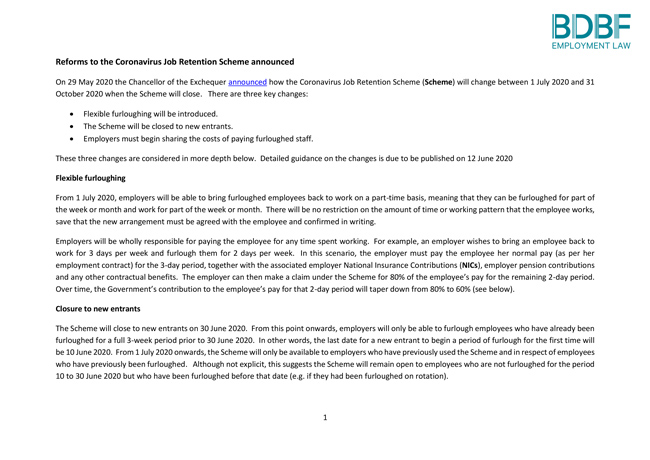
 Reforms to the Coronavirus Job Retention Scheme announced 

On 29 May 2020 the Chancellor of the Exchequer announced how the Coronavirus Job Retention Scheme (Scheme) will change between 1 July 2020 and 31 October 2020 when the Scheme will close. There are three key changes: 

  • Flexible furloughing will be introduced. 
  • The Scheme will be closed to new entrants. 
  • Employers must begin sharing the costs of paying furloughed staff. 

These three changes are considered in more depth below. Detailed guidance on the changes is due to be published on 12 June 2020 

Please click on the image below to view the PDF:

[/et_pb_text][et_pb_image src=”http://davidk423.sg-host.com/wp-content/uploads/2020/06/Reforms-to-the-furlough-scheme-1.jpg” url=”http://davidk423.sg-host.com/wp-content/uploads/2020/06/Reforms-to-the-furlough-scheme.pdf” align=”center” _builder_version=”4.2.2″ border_radii=”on|1px|1px|1px|1px” border_width_all=”1px” border_color_all=”#009b9b”][/et_pb_image][et_pb_text _builder_version=”4.2.2″ text_orientation=”justified” use_border_color=”off”]

BDBF is currently advising many employers and employees on the challenges presented by the coronavirus. If you or your business needs advice on furlough or other coronavirus-related matter please contact Amanda Steadman (amandasteadman@bdbf.co.uk) or your usual BDBF contact. 

[/et_pb_text][/et_pb_column][/et_pb_row][/et_pb_section][et_pb_section fb_built=”1″ _builder_version=”3.26.6″][et_pb_row _builder_version=”3.26.6″][et_pb_column type=”4_4″ _builder_version=”3.26.6″][/et_pb_column][/et_pb_row][/et_pb_section]


TUPE: beneficial contractual changes were void because they were by reason of the transfer

[et_pb_section fb_built=”1″ _builder_version=”3.0.100″ background_image=”http://davidk423.sg-host.com/wp-content/uploads/2017/09/bdbf_final-stages-1-4-1.jpg” custom_padding=”|||” global_module=”2165″ saved_tabs=”all”][et_pb_row _builder_version=”3.25″ custom_padding=”|||”][et_pb_column type=”4_4″ _builder_version=”3.25″ custom_padding=”|||” custom_padding__hover=”|||”][et_pb_text _builder_version=”3.27.4″ background_layout=”dark” custom_margin=”0px|||” custom_padding=”0px|||”]

Employment Law News


[/et_pb_text][/et_pb_column][/et_pb_row][/et_pb_section][et_pb_section fb_built=”1″ admin_label=”section” _builder_version=”3.22.3″][et_pb_row admin_label=”row” _builder_version=”3.25″ background_size=”initial” background_position=”top_left” background_repeat=”repeat”][et_pb_column type=”4_4″ _builder_version=”3.25″ custom_padding=”|||” custom_padding__hover=”|||”][et_pb_text _builder_version=”4.2.2″ text_orientation=”justified” hover_enabled=”0″ use_border_color=”off”]

TUPE: beneficial contractual changes were void because they were by reason of the transfer

In this case, the EAT considered whether four company directors were entitled to rely on contractual terms which had been put in place shortly before a TUPE transfer and were designed to significantly improve their position post-transfer. 

What does the law say?

Where an employer inherits employees following a TUPE transfer, it is unable to change their contractual terms where the transfer is the sole or principal reason for the change.  An attempt to do so will be void.

However, in the 2007 case of Power v Regent Security Services Ltd the Court of Appeal held that the incoming employer was bound by more favourable contractual terms that it had agreed with the transferring employees.   This decision has been understood to mean that employees should be able to rely on positive changes to their contracts, even if they are transfer-related.   Non-binding Government guidance also suggests that contractual changes which are “entirely positive” for the employee are allowed.

What happened in this case?

Mr Ferguson and three fellow claimants (the Claimants) were directors of Lancer Property Asset Management (Lancer).  Lancer provided estate management services to a single client, Berkeley Square Estate, in respect of a portfolio of 140 properties worth £5.5 billion owned by the Royal Family of Abu Dhabi.

Berkeley Square Estate terminated the contract with Lancer and moved its business to Astrea Asset Management Ltd (Astrea).  This amounted to a service provision change under TUPE.  Two months before the transfer took place, the Claimants made a series of extremely favourable changes to their own terms and conditions, including introducing rights to generous pay rises, guaranteed bonuses and termination payments, as well as increasing their notice periods.

Two of the Claimants were not accepted by Astrea.  The remaining two transferred to Astrea but were dismissed shortly afterwards.  All four brought claims against Astrea, including for the contractual termination payments introduced just before the transfer took place.  The Employment Tribunal rejected the claim on the basis that the pre-transfer changes were abusive because the Claimants had sought to take advantage of the effect of TUPE to award themselves additional compensation.  The Claimants appealed to the EAT.

What was decided?

The EAT dismissed the Claimants’ appeal on two grounds.

First, the Claimants had sought to argue that the restriction on transfer-related variations only concerned changes which were unfavourable to the employee.   The EAT rejected this argument, referring to the fact that the underlying purpose of the TUPE legislation is to safeguard the rights of transferring employees, not to improve them.  The Powercase was distinguished on the basis that, amongst other things, the contractual variation in that case had occurred after the transfer.  The EAT concluded that TUPE prevented any purported variation by reason of the transfer, regardless of how favourable it is to the employee.

Second, the EAT agreed with the Employment Tribunal that the Claimants’ actions had amounted to an abuse of the TUPE legislation.  The pre-transfer variations had been designed to improve the Claimants’ position and obtain an improper advantage, rather than to safeguard rights.

What are the learning points?

In a business sale situation, a buyer will usually require a seller to agree not to change employees’ terms and conditions in a specified window before the transfer without the buyer’s consent.  Outsourcing situations are more complicated, since the incoming contractor has no direct contractual relationship with the outgoing contractor.  For this reason, the outsourcing agreement between the client and the contractor usually includes a similar restriction on the contractor changing terms pre-transfer.   If it does not, it’s possible that the incoming contractor will seek indemnity protection from the client to cover any losses suffered as a result of any such changes.  This latest decision is helpful in that it provides that, even without such contractual protection, any changes made by reason of the transfer will not be enforceable.

Ferguson and others v Astrea Asset Management Ltd

If you would like to discuss any of the issues raised in this article please contact Amanda Steadman (amandasteadman@bdbf.co.uk) or your usual BDBF contact.

[/et_pb_text][/et_pb_column][/et_pb_row][/et_pb_section][et_pb_section fb_built=”1″ _builder_version=”3.26.6″][et_pb_row _builder_version=”3.26.6″][et_pb_column type=”4_4″ _builder_version=”3.26.6″][/et_pb_column][/et_pb_row][/et_pb_section]


Employee’s breach of a confidentiality clause in a COT3 agreement did not release employer from obligation to pay further settlement monies

[et_pb_section fb_built=”1″ _builder_version=”3.0.100″ background_image=”http://davidk423.sg-host.com/wp-content/uploads/2017/09/bdbf_final-stages-1-4-1.jpg” custom_padding=”|||” global_module=”2165″ saved_tabs=”all”][et_pb_row _builder_version=”3.25″ custom_padding=”|||”][et_pb_column type=”4_4″ _builder_version=”3.25″ custom_padding=”|||” custom_padding__hover=”|||”][et_pb_text _builder_version=”3.27.4″ background_layout=”dark” custom_margin=”0px|||” custom_padding=”0px|||”]

Employment Law News


[/et_pb_text][/et_pb_column][/et_pb_row][/et_pb_section][et_pb_section fb_built=”1″ admin_label=”section” _builder_version=”3.22.3″][et_pb_row admin_label=”row” _builder_version=”3.25″ background_size=”initial” background_position=”top_left” background_repeat=”repeat”][et_pb_column type=”4_4″ _builder_version=”3.25″ custom_padding=”|||” custom_padding__hover=”|||”][et_pb_text _builder_version=”4.2.2″ text_orientation=”justified” hover_enabled=”0″ use_border_color=”off”]

Employee’s breach of a confidentiality clause in a COT3 agreement did not release employer from obligation to pay further settlement monies

If an employee breaches a confidentiality clause contained in a COT3 agreement or, more commonly, a Settlement Agreement, what are the employer’s options? The answer is that it will depend on the importance of the clause or the severity of the employee’s breach.  A recent High Court decision offers a salutary lesson on the need to draft settlement documents carefully to ensure the employer has the best possible protection.

What does the law say?

If the confidentiality clause is of vital importance, such that it is regarded as a “condition” of the contract, then the employee’s breach entitles an employer to treat the contract as “repudiated” (thereby releasing it from any future obligations under the contract, such as the payment of further settlement monies).  Additionally, the employer could sue for damages for breach of contract.

However, if the confidentiality clause is not of vital importance, such that it is regarded as an “intermediate” term of the contract, then the employer’s remedy depends on the nature of the employee’s breach.  If the employee’s breach is serious enough to deprive the employer of the whole of the benefit of the contract then it will be regarded as a “repudiatory breach”, which would allow the employer to treat the contract as repudiated and also claim damages for loss.  If the breach is not a repudiatory breach, the employer will remain bound by contract and its only remedy would be to sue for damages for breach of contract.

What happened in this case?

The employee, Mr Steels, settled an employment dispute with his former employer, Duchy Farms Kennels Ltd (DFK), in exchange for a settlement payment of £15,500 to be paid in 47 weekly instalments.  The dispute was settled by way of a COT3 agreement which contained a boilerplate confidentiality clause.  That clause required Mr Steels to keep the fact and terms of the settlement confidential.  Later, DFK discovered that Mr Steels had disclosed the fact and amount of the settlement to one of DFK’s former employees. 

DFK stopped paying the weekly settlement payments on the grounds that Mr Steels had breached the COT3 and it was, therefore, released from its side of the bargain.  Mr Steels applied to the County Court to enforce the COT3.  DFK responded by seeking a declaration that the breach of the confidentiality clause meant that the remaining settlement monies were no longer payable. 

The County Court held that the confidentiality clause was not a condition of the COT3 agreement, but was, instead, an intermediate term.  As it could not be said that Mr Steels had committed a repudiatory breach, this meant that DFK remained bound by the contract and had to continue paying the weekly settlement payments.  DFK appealed to the High Court.

What was decided?

The High Court agreed with the County Court and dismissed DFK’s appeal.  The High Court said the confidentiality clause was a boilerplate clause.  It had not been expressed to be a condition of the agreement and nor was there any indication that confidentiality was of vital importance to the employer.  Importantly, the Court reached this conclusion despite the fact that the COT3 had been drafted by lawyers and referred to keeping the agreement “strictly confidential” and not just “confidential”. 

Having decided the confidentiality clause was as an intermediate term, the Court turned to whether Mr Steels’ actions amounted to a repudiatory breach. The Court said the test was whether a reasonable person would have regarded Mr Steels as having “clearly shown an intention to abandon and altogether refuse to perform the contract”.  This was not the case here.  The breach did not, and was not likely to, cause commercial harm to DFK and the risk of unmeritorious copycat claims was remote.  In any event, anyone who had known that Mr Steels and DFK had been in a dispute would have been able to deduce that there has been a settlement even without a breach of the confidentiality clause.

What are the learning points for employers?

When drafting settlements, it would be wise for employers to:

  • expressly state that the confidentiality clause is a condition of the agreement;
  • state the importance of the confidentiality obligation to the employer;
  • stipulate that payment of any monies (and performance of any other of the employer’s obligations) is conditional upon the employee’s strict compliance with the clause; and
  • make specific provision about what happens if there is a breach (e.g. repayment of any monies paid to date and that no further payments will be payable).

In this way, the confidentiality clause is more likely to be regarded as a condition of the agreement entitling the employer to repudiate the contract in the event of a breach, should it wish to do so. 

Duchy Farms Kennels Ltd v Steels

If you would like to discuss any of the issues raised in this article or how BDBF can help to review your template Settlement Agreement,  then please contact Amanda Steadman (amandasteadman@bdbf.co.uk) or your usual BDBF contact.

[/et_pb_text][/et_pb_column][/et_pb_row][/et_pb_section][et_pb_section fb_built=”1″ _builder_version=”3.26.6″][et_pb_row _builder_version=”3.26.6″][et_pb_column type=”4_4″ _builder_version=”3.26.6″][/et_pb_column][/et_pb_row][/et_pb_section]


Key points for employers in the UK Government’s COVID-19 Recovery Strategy

[et_pb_section fb_built=”1″ _builder_version=”3.0.100″ background_image=”http://davidk423.sg-host.com/wp-content/uploads/2017/09/bdbf_final-stages-1-4-1.jpg” custom_padding=”|||” global_module=”2165″ saved_tabs=”all”][et_pb_row _builder_version=”3.25″ custom_padding=”|||”][et_pb_column type=”4_4″ _builder_version=”3.25″ custom_padding=”|||” custom_padding__hover=”|||”][et_pb_text _builder_version=”3.27.4″ background_layout=”dark” custom_margin=”0px|||” custom_padding=”0px|||”]

Employment Law News

[/et_pb_text][/et_pb_column][/et_pb_row][/et_pb_section][et_pb_section fb_built=”1″ admin_label=”section” _builder_version=”3.22.3″][et_pb_row admin_label=”row” _builder_version=”3.25″ background_size=”initial” background_position=”top_left” background_repeat=”repeat”][et_pb_column type=”4_4″ _builder_version=”3.25″ custom_padding=”|||” custom_padding__hover=”|||”][et_pb_text _builder_version=”4.2.2″ text_orientation=”justified” hover_enabled=”0″ use_border_color=”off”]

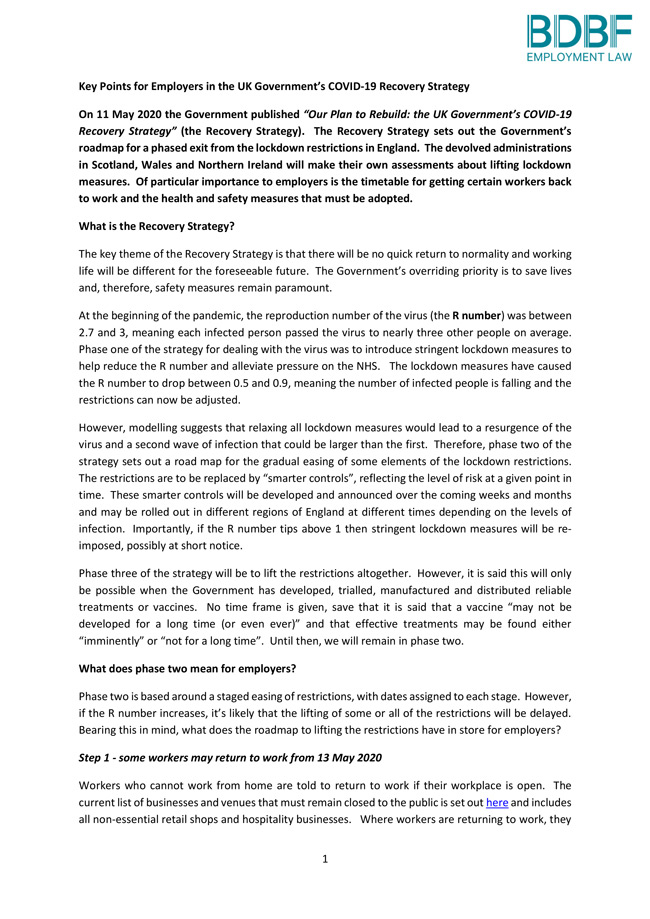
Key Points for Employers in the UK Government’s COVID-19 Recovery Strategy 

On 11 May 2020 the Government published “Our Plan to Rebuild: the UK Government’s COVID-19 Recovery Strategy” (the Recovery Strategy). The Recovery Strategy sets out the Government’s roadmap for a phased exit from the lockdown restrictions in England. The devolved administrations in Scotland, Wales and Northern Ireland will make their own assessments about lifting lockdown measures. Of particular importance to employers is the timetable for getting certain workers back to work and the health and safety measures that must be adopted. 

Please click on the image below to view the PDF:

[/et_pb_text][et_pb_image src=”http://davidk423.sg-host.com/wp-content/uploads/2020/05/Briefing-on-the-COVID-19-Recovery-Strategy-1.jpg” url=”http://davidk423.sg-host.com/wp-content/uploads/2020/05/Briefing-on-the-COVID-19-Recovery-Strategy-.pdf” align=”center” _builder_version=”4.2.2″ border_radii=”on|1px|1px|1px|1px” border_width_all=”1px” border_color_all=”#009b9b”][/et_pb_image][et_pb_text _builder_version=”4.2.2″ text_orientation=”justified” use_border_color=”off”]

BDBF is currently advising many employers and employees on the challenges presented by the coronavirus. If you or your business needs advice on furlough or other coronavirus-related matter please contact Amanda Steadman (amandasteadman@bdbf.co.uk) or your usual BDBF contact. 

[/et_pb_text][/et_pb_column][/et_pb_row][/et_pb_section][et_pb_section fb_built=”1″ _builder_version=”3.26.6″][et_pb_row _builder_version=”3.26.6″][et_pb_column type=”4_4″ _builder_version=”3.26.6″][/et_pb_column][/et_pb_row][/et_pb_section]