Non-Compete Clauses Consultation – BDBF Response

Employment Law News

Non-Compete Clauses Consultation – BDBF Response

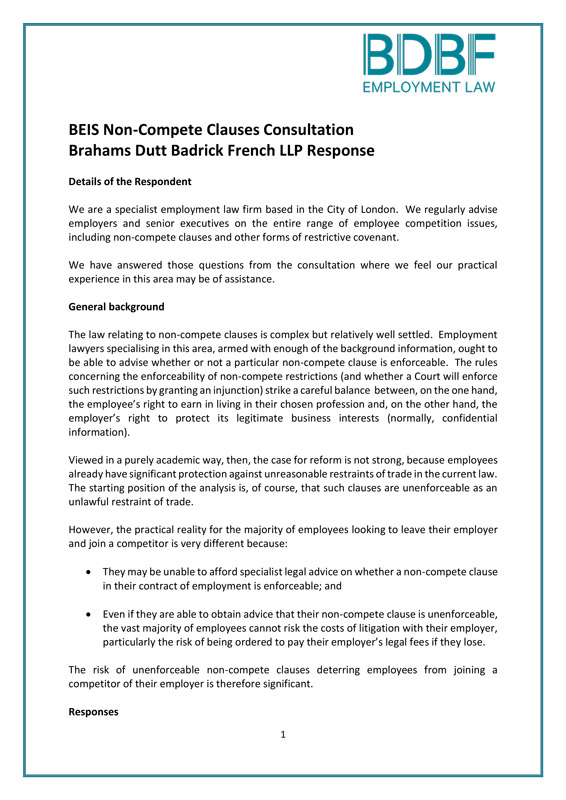
As mentioned at our recent webinar, the government has launched a consultation about regulating the use of non-compete restrictions in employment contracts.  Views are being sought on requiring employers to pay compensation for the duration of non-compete restrictions, or banning their use altogether.  As recognised experts in this field, BDBF has responded to the consultation.  In short, our view is that a requirement to pay compensation is a fair way of deterring inappropriate use of non-compete clauses, but that an outright ban is a step too far.  You can read our full response below.

Please view the PDF by clicking the image below:

If you or your business needs advice on non-compete clauses or other restrictive covenants please contact Tom McLaughlin (tommclaughlin@bdbf.co.uk) or your usual BDBF contact.


Discrimination: worker’s complaint about discrimination did not engage protection from victimisation

[et_pb_section fb_built=”1″ _builder_version=”3.0.100″ background_image=”http://davidk423.sg-host.com/wp-content/uploads/2017/09/bdbf_final-stages-1-4-1.jpg” custom_padding=”|||” global_module=”2165″ saved_tabs=”all”][et_pb_row _builder_version=”3.25″ custom_padding=”|||”][et_pb_column type=”4_4″ _builder_version=”3.25″ custom_padding=”|||” custom_padding__hover=”|||”][et_pb_text _builder_version=”3.27.4″ background_layout=”dark” custom_margin=”0px|||” custom_padding=”0px|||”]

Employment Law News


[/et_pb_text][/et_pb_column][/et_pb_row][/et_pb_section][et_pb_section fb_built=”1″ admin_label=”section” _builder_version=”3.22.3″][et_pb_row admin_label=”row” _builder_version=”3.25″ background_size=”initial” background_position=”top_left” background_repeat=”repeat”][et_pb_column type=”4_4″ _builder_version=”3.25″ custom_padding=”|||” custom_padding__hover=”|||”][et_pb_text _builder_version=”4.7.4″ text_orientation=”justified” hover_enabled=”0″ use_border_color=”off” sticky_enabled=”0″]

Discrimination: worker’s complaint about discrimination did not engage protection from victimisation

In Chalmers v Airpoint Ltd & Ors the Scottish EAT had to decide whether an articulate HR professional was protected from victimisation after she had made a vague allegation of discrimination in an email to her manager.

What does the law say?

Workers are protected from retaliatory action – known as victimisation – by their employer or colleagues because they have committed a “protected act”, or it is believed that they have done so or may do so.  The following are “protected acts”:

  • bringing a claim under the Equality Act 2010 (the Act);
  • giving evidence or information in connection with such a claim, regardless of who brought it;
  • doing any other thing for the purposes of, of in connection with, the Act; and/or
  • alleging that the employer or another person has breached the Act.

In order for an allegation to attract protection it doesn’t have to be factually correct, but it must be made in good faith.  Although no specific form of words is required, the allegation must be clear, and the overall context should indicate a relevant complaint.  The knowledge and experience of the complainant will be taken into account.

What happened in this case?

Mrs Chalmers worked for Airpoint Ltd as a Business Support Manager with responsibility for human resources functions.  In December 2016, Airpoint arranged a Christmas party.  Mrs Chalmers and the only other female member of staff were unable to attend.  In January 2017, Mrs Chalmers sent an email to her line manager complaining about her exclusion from the Christmas party and also from an office hardware refresh.  She said both of these matters “may be discriminatory”, but she did not specify upon what grounds.

Mrs Chalmers brought claims for sex discrimination, harassment and victimisation.  The allegation made in the January 2017 email was identified as the “protected act” for the purposes of the victimisation claim.  Despite the use of the word “discriminatory”, the Employment Tribunal held it was not clear that Mrs Chalmers was alleging that the Act had been breached.  It took into account the fact that she was articulate and experienced in HR matters.  Mrs Chalmers appealed to the Employment Appeal Tribunal (EAT).

What was decided?

Mrs Chalmers sought to argue that she had deliberately adopted a cautious tone because it was not her place to determine whether discrimination had occurred – that was for a Tribunal.  The EAT acknowledged that that use of the words “may be discriminatory” could, in some cases, amount to an allegation of unlawful discrimination.  However, this would turn on the overall context.

Here, Mrs Chalmers was an articulate and experienced HR professional, who was able to take a considered view on whether there had been discrimination on the grounds of sex.    The cautious tone and the absence of the words “on the grounds of sex” was a deliberate choice.  This was reinforced by the fact that other complaints in the grievance letter had been written in clear terms.   The EAT concluded that had Mrs Chalmers intended to allege sex discrimination, she would have done so.

The EAT also went on to consider the factual background of the case.  The Tribunal had found that Airpoint had not, in fact, discriminated against Mrs Chalmers in relation to the Christmas party.  Rather, it was just bad luck that she and the other female employees were unable to attend on the selected date.  By the time this had become clear, it was too late to rearrange things.

The EAT dismissed the appeal, holding that the Tribunal was entitled to find the words used in the January 2017 email did not qualify as a protected act.

What are the learning points for employers?

This decision shows that acquiring victimisation protection is not a certainty just because the word “discrimination” has been uttered.  However, employers should not read this decision as setting down a hard and fast rule about the language that a worker must use to make a protected act.  In different circumstances looser wording may be sufficient to get over the hurdle of having made an allegation of discrimination.  A less articulate worker, without experience of HR matters, is likely to be given more leeway by a Tribunal.

In the real world, it’s a high-risk strategy for employers to second guess whether such a complaint will count as a protected act or not.  Getting it wrong carries with it the danger of a costly victimisation claim.  For this reason, the prudent course of action is to treat any allegation of discrimination, no matter how vague, as a protected act.  As well as investigating the allegation in a timely fashion, employers should ensure that the worker is ringfenced from any action that could be viewed as detrimental.

Chalmers v Airpoint Ltd & Ors

If you would like to discuss any issues raised in this post please get in touch with Amanda Steadman (amandasteadaman@bdbf.co.uk) or your usual BDBF contact.

[/et_pb_text][/et_pb_column][/et_pb_row][/et_pb_section][et_pb_section fb_built=”1″ _builder_version=”3.26.6″][et_pb_row _builder_version=”3.26.6″][et_pb_column type=”4_4″ _builder_version=”3.26.6″][/et_pb_column][/et_pb_row][/et_pb_section]

Vaccines in the workplace part 1: unpicking the key legal issues

[et_pb_section fb_built=”1″ _builder_version=”3.0.100″ background_image=”http://davidk423.sg-host.com/wp-content/uploads/2017/09/bdbf_final-stages-1-4-1.jpg” custom_padding=”|||” global_module=”2165″ saved_tabs=”all”][et_pb_row _builder_version=”3.25″ custom_padding=”|||”][et_pb_column type=”4_4″ _builder_version=”3.25″ custom_padding=”|||” custom_padding__hover=”|||”][et_pb_text _builder_version=”3.27.4″ background_layout=”dark” custom_margin=”0px|||” custom_padding=”0px|||”]

Employment Law News


[/et_pb_text][/et_pb_column][/et_pb_row][/et_pb_section][et_pb_section fb_built=”1″ admin_label=”section” _builder_version=”3.22.3″][et_pb_row admin_label=”row” _builder_version=”3.25″ background_size=”initial” background_position=”top_left” background_repeat=”repeat”][et_pb_column type=”4_4″ _builder_version=”3.25″ custom_padding=”|||” custom_padding__hover=”|||”][et_pb_text _builder_version=”4.7.4″ text_orientation=”justified” hover_enabled=”0″ use_border_color=”off” sticky_enabled=”0″]

Vaccines in the workplace part 1: unpicking the key legal issues

In the first of two articles examining the hot topic of vaccines in the workplace, we bring you up to speed with the UK’s COVID-19 vaccination programme, and explore the key legal issues faced by employers wishing to mandate vaccines for staff.  In our second article on the topic, we will consider how employers should manage practical issues such as managing disclosure of employees’ vaccination status and what should go into a staff vaccination policy.

What is the UK Government’s COVID-19 vaccination programme?

There are currently two COVID-19 vaccines in use in the UK, namely the vaccines produced by Pfizer/BioNTech and Oxford/AstraZeneca.  A third vaccine produced by Moderna has been licenced for use and should be available in the UK in Spring 2021.  Further vaccines may be available in due course.  The Joint Committee on Vaccination and Immunisation (JCVI) has advised that the UK’s vaccination programme is delivered in phases.

Phase 1 covers approximately 32 million people and includes all adults aged 50 or over, plus anyone aged under 70 who is classified as “clinically extremely vulnerable” and anyone aged under 65 who is classified as “at risk”.   The Government is currently on track to complete phase 1 by 15 April 2021.

Phase 2 of the programme covers the remainder of the UK adult population (i.e. those aged between 18 and 49), comprising approximately 21 million people.  On 26 February 2021, the JCVI advised against vaccination by occupational groups.  Instead, the vaccine will be offered to all adults in descending age bands.  The Government’s target is to complete phase 2 by 31 July 2021.

Vaccination is not mandatory in the UK, meaning that individuals are free to refuse the vaccine.

Is everyone able to have the vaccine?

No, there are some groups who will not be routinely offered the vaccine or for who it may not be suitable.  These are:

  • Under 18s: as the vaccines have not been trialled on younger people, the programme does not cover children and the under 18s. However, this may change in future.
  • Pregnant women: the vaccines have not yet been tested in pregnancy, so until more information is available, those who are pregnant will not routinely be offered the vaccine. However, the JCVI recognises the potential benefits of vaccination are particularly important for some pregnant women.  Women in that cohort are advised to discuss the vaccination with their doctor to decide whether to receive the vaccine or not.
  • Breastfeeding mothers: although there is no data on the safety of COVID-19 vaccines in breastfeeding or on the breastfed child, COVID-19 vaccines are not thought to be a risk to the child. The JCVI has recommended that the vaccine may be received whilst breastfeeding, however, it is acknowledged that some mothers may prefer to wait until they have finished breastfeeding.
  • People suffering from long COVID symptoms: guidance states that the vaccine should be deferred for those who have contracted COVID-19 in the past and are suffering from ongoing symptoms.
  • People who are immunosuppressed: guidance states that people who have suppressed immunity may not develop a full immune response following vaccination, meaning the vaccine will not be as effective for them as it is for others. Therefore, they can have the vaccine, but they may remain exposed to COVID-19.
  • People with an allergy to products within certain of the vaccines: a small minority of people are allergic to some products found in the Pfizer/BioNTech and Moderna vaccines. However, such products are not present in the Oxford/AstraZeneca vaccine and so anyone in this position will still be able to be vaccinated (subject to availability).

Why do employers need to be concerned with whether their employees are vaccinated?

Employers have legal duties to protect the health and safety of their employees and third parties who come into contact with their staff.  The principal statutory duties are set out in the health and safety legislation set out below.  If an employer fails to comply with these obligations, it may be subject to enforcement action by the Health and Safety Executive.

  • The Health and Safety at Work Act 1974: this is the primary piece of legislation covering occupational health and safety in Great Britain. It imposes a general duty on employers to ensure, so far as is reasonably practicable, the health, safety and welfare at work of all their employees and third parties who are affected by work-related activities.
  • The Management of Health and Safety at Work Regulations 1999: these regulations require employers to assess the risks of work-related activities and identify and implement measures to control such risks. Employers must also develop a coherent overall risk prevention policy and issue appropriate instructions to employees.
  • The Control of Substances Hazardous to Health Regulations 2002: these regulations govern the control of occupational exposure to “biological agents”. This includes micro-organisms which may cause infection, including COVID-19. Employers must take steps adequately to control exposure to biological agents.

In addition to these statutory duties, employers also have a common law duty to take reasonable care of the health and safety of employees and third parties.  A breach of this duty may give rise to a claim for personal injury.  Further, employers may be exposed to Employment Tribunal claims from employees who feel the employer has not taken sufficient protective steps.  Employees are protected from detriment and dismissal for blowing the whistle about health and safety dangers or taking certain actions in relation to health and safety matters.

Given these obligations and risks, employers must assess the risk of allowing unvaccinated employees into the workplace and consider what, if any, measures should be taken to control that risk.

Can employers require employees to have the vaccine?

As mentioned above, the COVID-19 vaccine is not mandatory in the UK: an individual must consent to receiving it.  Guidance published by Acas provides that employers should “support” staff to have the vaccine.  It’s likely that a voluntary approach will be preferable for many employers, with staff strongly encouraged, but not required, to have the vaccine.

However, there may be some limited cases where an employer decides it’s necessary to require that some or all staff are vaccinated.  This will most commonly occur where, after assessing the risks, it’s considered necessary in order to discharge the duty to protect the health and safety of staff and third parties.  For example, the care home operator, Barchester Healthcare, has introduced such a requirement in order to “deliver on its duty to protect…residents, patients and staff”.   This is most likely to arise in the health and social care sector and it will be more difficult for employers operating in lower risk environments (such as offices) to justify such a requirement.

There may also be cases where it’s necessary for specific employees to be vaccinated in order to perform their role, for example where they need to travel to countries which require visitors to be vaccinated.

It’s advisable for employers to consult with staff about their preferred approach and address any questions or concerns before taking a final decision.  It’s also a good idea to communicate the chosen approach in a staff Vaccine Policy.

Can employers discipline or dismiss employees who do not comply with a requirement to have the vaccine?

If an employer introduces a requirement to have the vaccine, what can it do when faced with an employee who does not comply?  As discussed above, there will be some employees who are unable to have the vaccine at all.  Further, many working age people will not be vaccinated until phase 2 of the roll out is completed.  No action should be taken against anyone who falls into one of these groups, since the decision to have the vaccine is out of their hands.

However, there are likely to be some employees who could have the vaccine but simply refuse to have it.  Can an employer discipline or dismiss a vaccine-refusing employee?  This is a difficult and novel issue and employers in this situation should always seek legal advice before taking action.

Employees are subject to an implied duty to comply with reasonable management instructions.  Here, the employer would say the requirement to have the vaccine is a reasonable management instruction and a refusal to comply amounts to misconduct justifying disciplinary action up to dismissal.  The Acas Guidance suggests that a refusal to be vaccinated may justify disciplinary action where:

  • vaccination was required by the employer’s policy;
  • vaccination was necessary for an employee to do their job; and
  • the action was not discriminatory (this is discussed further below).

Dismissal would expose the employer to an unfair dismissal claim where the employee has 2 years’ service or more.   Therefore, an employer would need to show there was a fair reason for dismissal and that they acted reasonably in treating that reason as sufficient to dismiss.   Here, the reason for dismissal would be misconduct (or possibly “some other substantial reason”).  The battleground will be whether the employer has acted reasonably in the circumstances.  The employee’s reason for refusing to comply with the instruction will be highly relevant here: it will be risky to dismiss an employee who can show that they had a good reason for refusing to comply.

The presence of a clear policy and the ability to demonstrate the necessity of vaccination will be important.  In the recent case of Kubilius v Kent Foods Limited, an Employment Tribunal held that a lorry driver was fairly dismissed for refusing to wear a face mask on a client’s premises.  This was in breach of the employer’s policy requiring compliance with instructions relating to health and safety and PPE.

Could a requirement to have the vaccine be discriminatory?

On the face of it, a requirement for staff to have the vaccine is neutral, but it could put individuals with certain protected characteristics at a particular disadvantage compared to others.  The “disadvantage” would be having a vaccine that they do not wish to have or face disciplinary action.  This could give rise to a claim for indirect discrimination.

A number of protected groups are less likely to have the vaccine and might be able to say that they have suffered a particular disadvantage.  For example:

  • Disability: employees with certain mental impairments (e.g. anxiety) may be especially fearful of having the vaccine.
  • Age: research shows that there is greater vaccine hesitancy amongst 18 to 29-year olds.
  • Race: statistics show that take up of the vaccine is lower amongst black and Asian people due to a variety of factors, including low confidence in the vaccine and mistrust.
  • Religion or belief: most mainstream religions support vaccination, however, employees with certain philosophical beliefs might reject the vaccine. For example, ethical vegans may refuse to have the vaccine because it has been tested on animals.  Alternatively, subscribers to naturopathy may refuse the vaccine on the basis that it is not a natural intervention.   However, it’s unlikely that anti-vaxxer or conspiracy theory beliefs would be protected.

Employers are able to justify indirect discrimination where they can show that there is a “legitimate aim” and the requirement is a “proportionate” means of achieving that aim.  In most cases where an employer is introducing a vaccine requirement, the aim would be the protection of the health and safety of staff and third parties.  This is likely to be a legitimate aim.  The challenge for employers will be showing that they have acted proportionately.

Adopting a blanket approach, without considering less discriminatory measures will not be proportionate.  For example, could alternative health and safety measures be put in place to mitigate the risks posed by, and to, unvaccinated staff (e.g. social distancing, mask wearing, regular hand washing or segregation in the workplace)?  If not, could unvaccinated staff be redeployed to a lower risk environment or allowed to work from home indefinitely?  Ultimately, these alternatives may not be feasible, but it will be necessary for the employer to show that it has, at least, considered them.

Even where alternatives can be discounted, it is important that the requirement is kept under review as the situation changes.  If COVID-19 recedes to negligible levels, then it may become more difficult to justify a requirement to have the vaccine.

If you would like to discuss your approach to staff vaccination please get in touch with Amanda Steadman (amandasteadaman@bdbf.co.uk) or your usual BDBF contact.

[/et_pb_text][/et_pb_column][/et_pb_row][/et_pb_section][et_pb_section fb_built=”1″ _builder_version=”3.26.6″][et_pb_row _builder_version=”3.26.6″][et_pb_column type=”4_4″ _builder_version=”3.26.6″][/et_pb_column][/et_pb_row][/et_pb_section]


Supreme Court decides that Uber drivers are workers

[et_pb_section fb_built=”1″ _builder_version=”3.0.100″ background_image=”http://davidk423.sg-host.com/wp-content/uploads/2017/09/bdbf_final-stages-1-4-1.jpg” custom_padding=”|||” global_module=”2165″ saved_tabs=”all”][et_pb_row _builder_version=”3.25″ custom_padding=”|||”][et_pb_column type=”4_4″ _builder_version=”3.25″ custom_padding=”|||” custom_padding__hover=”|||”][et_pb_text _builder_version=”3.27.4″ background_layout=”dark” custom_margin=”0px|||” custom_padding=”0px|||”]

Employment Law News


[/et_pb_text][/et_pb_column][/et_pb_row][/et_pb_section][et_pb_section fb_built=”1″ admin_label=”section” _builder_version=”3.22.3″][et_pb_row admin_label=”row” _builder_version=”3.25″ background_size=”initial” background_position=”top_left” background_repeat=”repeat”][et_pb_column type=”4_4″ _builder_version=”3.25″ custom_padding=”|||” custom_padding__hover=”|||”][et_pb_text _builder_version=”4.7.4″ text_orientation=”justified” hover_enabled=”0″ use_border_color=”off” sticky_enabled=”0″]

Supreme Court decides that Uber drivers are workers

The Supreme Court has upheld a Tribunal’s decision that drivers working for Uber were workers and not self-employed contractors.  This decision is important for employers engaging contractors as it highlights the continued willingness of the Courts and Tribunals to scrutinise the way a relationship works in practice, regardless of contractual labels.

What does the law say?

Certain important employment rights are granted to those who qualify as “workers”, even where they do not qualify as “employees”.  For example, workers have the right to:

  • be paid in line with the National Minimum Wage;
  • to take paid annual leave and have rest breaks;
  • to be paid statutory sick pay when sick;
  • be auto enrolled into a pension scheme (if an eligible jobholder);
  • protection from discrimination;
  • protection if they blow the whistle; and
  • protection from unlawful deductions from pay.

A worker is defined as an individual who has entered into, or works under a contract of employment or any other contract where the individual performs personally any work or services for another person who is not a client or customer of that individual’s profession or business undertaking.

In the last few years, there have been a steady stream of cases (often brought against businesses operating in the gig economy) looking at whether individuals held out as self-employed contractors are, in fact, workers.  When considering these cases, the Courts and Tribunals have consistently demonstrated a willingness to examine the reality of the relationship despite what the contractual documentation says.

What happened in this case?

As most people will know, Uber operates via a smartphone application (the app) by which customers order taxis and make payments for journeys. Uber’s position is that it is not in the business of providing taxi services, but merely facilitates the provision of such services by linking self-employed taxi drivers with prospective passengers.  Uber say they act as the drivers’ agent via the app, but the contract is between the driver and passenger for each journey.

In 2016, a number of Uber drivers brought claims for unlawful deductions from wages (relating to a failure to pay in line with the National Minimum Wage) and for a failure to provide paid annual leave.  As stated above, these are rights afforded to workers (and employees).  Accordingly, the drivers had to get over the hurdle of showing that they were workers.

The Employment Tribunal held that the drivers were workers, concluding that the contractual documentation did not reflect the reality of the relationship.  Rather, Uber had constructed fictions and used “twisted language” which misrepresented the way things really worked.  The suggestion that Uber was acting as an agent for 30,000 separate small businesses linked by the app was said to be “faintly ridiculous”.

The reality was the other way around.  Uber exercised a high degree of control over their drivers in a number of ways, which meant they could not be viewed as genuinely self-employed.  The Tribunal decided that the drivers were working under a worker contract when they were:

  • in the territory in which they were authorised to work;
  • signed into the app; and
  • ready and willing to accept fares.

The Tribunal’s decision was upheld by both the Employment Appeal Tribunal and by a majority of the Court of Appeal.  Uber appealed again to the Supreme Court arguing that the Tribunal had been wrong to disregard the clear terms of the contractual documentation.  Uber maintained that the drivers were not workers but, if they were, then their working time was limited to when they were driving passengers to their destinations.

What was decided?

The Supreme Court ruled unanimously that the Uber drivers are workers.

The Court said that in the employment context, the first step is to look at the underlying purpose of the relevant employment legislation (in this case, the national minimum wage and working time legislation).  The purpose of such laws is to protect individuals in a subordinate position to the organisation which controls their work.  The task for the Courts and Tribunals was to determine whether a claimant fell within the definition of “worker” so as to qualify for those rights.  To take the contractual documentation at face value (where the facts suggested more than one possible legal classification) would allow the employer to decide whether or not employment legislation applied.

Here, the Court said there was no factual basis for asserting that Uber acted as agents for the drivers.  The correct position was that Uber contracted with the passengers and engaged drivers to carry out those bookings. The nature of the relationship between Uber and the drivers had to be inferred from the parties’ conduct.

The Court held the Tribunal had been justified in finding that the drivers were workers.  Although the drivers were free to decide when and where they worked, once they were working, they were workers.  In reaching this conclusion, the Court highlighted the following five key aspects of the relationship:

  1. Of major importance was the fact that Uber dictated the remuneration paid to the drivers. Uber set the passenger fares (which, in turn, determined the drivers’ pay).  The drivers were not permitted to charge higher fares.  They were free to charge lower fares, but they had to absorb the full cost of any reduction.
  1. Uber imposed the contractual terms on the drivers. The Court noted that there was “no practical possibility of [the drivers] negotiating different terms”.
  1. Once logged onto the Uber app, the drivers’ freedom to accept fares was constrained by Uber. Uber controlled the passenger information provided to the drivers and also monitored the drivers’ acceptance of fares.  Uber penalised drivers for not accepting rides by automatically logging them off the app.  The Court said this plainly placed the drivers in a position of subordination to Uber.
  1. Uber exercised significant control over how the drivers delivered their services. It vetted the drivers’ vehicles.  It owned and controlled the technology at the heart of the service.  It operated a rating system for drivers.  Any driver who failed to maintain average ratings was issued with a warning and, ultimately, could have their contract terminated.  The Court said this was “a classic form of subordination that is characteristic of employment relationships”.
  1. Uber restricted communications between drivers and passengers and took steps to prevent an ongoing relationship being established, for example, neither had access to the other’s mobile telephone number.

Together, this meant that the taxi service was tightly defined and controlled by Uber.  The drivers were subordinate to Uber and had no ability act in an entrepreneurial fashion to improve their earning potential.  The only way they could increase their earnings was to work more hours under the rules imposed by Uber.

Having ruled that drivers were workers, the Court also agreed with the Tribunal that their working time was not limited to the time spent driving passengers to their destinations.  Instead, it included any period when they were logged onto the app in the territory in which they were authorised to work, and they were ready and willing to work.  The Court noted that the existence of a right to refuse work was not fatal to a finding of worker status, provided there was at least an obligation to do some amount of work, which was the case here.

What does this mean for employers?

This decision doesn’t mean that the contractual documentation put in place with contractors will be ignored.  It will be a relevant factor, but the conduct of the parties in practice will also be considered.  The worker status test will then be applied to those facts.  As the Court said “…it is necessary to view the facts realistically and to keep in mind the purpose of the legislation”.

Although this decision will have most impact in the gig economy sector, it would be sensible for all employers who engage self-employed contractors to audit how those relationships operate in practice to assess whether the contractual labels reflect reality.   Where the hallmarks of a worker contract are present, the choice is to treat the individual as a worker and comply with applicable employment legislation or adjust the way the relationship works in practice to move it closer to a genuine contractor arrangement.

Uber BV and others v Aslam and others

If you would like to know more please contact Amanda Steadman (amandasteadman@bdbf.co.uk) or your usual BDBF contact.

[/et_pb_text][/et_pb_column][/et_pb_row][/et_pb_section][et_pb_section fb_built=”1″ _builder_version=”3.26.6″][et_pb_row _builder_version=”3.26.6″][et_pb_column type=”4_4″ _builder_version=”3.26.6″][/et_pb_column][/et_pb_row][/et_pb_section]


Failure to provide regular and effective equality training leaves employers on the hook for harassment claims

[et_pb_section fb_built=”1″ _builder_version=”3.0.100″ background_image=”http://davidk423.sg-host.com/wp-content/uploads/2017/09/bdbf_final-stages-1-4-1.jpg” custom_padding=”|||” global_module=”2165″ saved_tabs=”all”][et_pb_row _builder_version=”3.25″ custom_padding=”|||”][et_pb_column type=”4_4″ _builder_version=”3.25″ custom_padding=”|||” custom_padding__hover=”|||”][et_pb_text _builder_version=”3.27.4″ background_layout=”dark” custom_margin=”0px|||” custom_padding=”0px|||”]

Employment Law News


[/et_pb_text][/et_pb_column][/et_pb_row][/et_pb_section][et_pb_section fb_built=”1″ admin_label=”section” _builder_version=”3.22.3″][et_pb_row admin_label=”row” _builder_version=”3.25″ background_size=”initial” background_position=”top_left” background_repeat=”repeat”][et_pb_column type=”4_4″ _builder_version=”3.25″ custom_padding=”|||” custom_padding__hover=”|||”][et_pb_text _builder_version=”4.7.4″ text_orientation=”justified” hover_enabled=”0″ use_border_color=”off” sticky_enabled=”0″]

Failure to provide regular and effective equality training leaves employers on the hook for harassment claims

In the recent case of Allay (UK) Ltd v Gehlen, the EAT upheld a decision that staff equality training had become stale after 20 months.  The employer’s failure to refresh the training meant it couldn’t rely on the “reasonable steps” defence to a race harassment claim.

What does the law say?

Employers can defend claims that they are vicariously liable for the discriminatory actions of their workers where they have taken “all reasonable steps” to prevent them from doing such actions.  A similar defence is available in the whistleblowing sphere, where employers can defend claims that they are vicariously liable for the detrimental actions of their workers where they have taken all reasonable steps to prevent the detrimental treatment.

In the equality sphere, the reasonable steps that employers should take will include:

  • having well-drafted equal opportunities and anti-harassment and bullying policies in place;
  • ensuring that all workers are made aware of those policies and understand them;
  • providing equality training to workers, with additional training for those with management responsibilities; and
  • dealing with complaints quickly and effectively, including taking appropriate disciplinary action.

What happened in this case?

Mr Gehlen is of Indian origin and began working for Allay (UK) Ltd (Allay) in October 2016.  In August 2017, Mr Gehlen complained to a manager that another employee, Mr Pearson, had made racist remarks to him on a regular basis throughout his employment.  The manager took no action apart from telling Mr Gehlen to report the matter to HR.  It was also the case that some of the racist remarks had been overheard by two other employees, including another manager.  Neither had escalated the matter to HR.

Mr Gehlen was dismissed on 15 September 2017 on the grounds of performance.  He went on to raise a formal complaint about the harassment.  Allay investigated and concluded that Mr Pearson had made the remarks in question.  As a result, Mr Pearson was made to undergo equality training, however, it’s not clear whether he was disciplined.

Mr Gehlen went on to bring a claim of harassment in the Employment Tribunal.  Allay sought to rely on the reasonable steps defence, pointing to the fact that it had equal opportunities and anti-bullying and harassment policies in place and had trained staff, including Mr Pearson, on these areas in early 2015 (around 20 months before Mr Gehlen had started work).  That training contained one slide on harassment and also set out what employees should do if they overheard unacceptable remarks.

The Tribunal rejected Allay’s defence on the basis that the 2015 training had become stale and ceased to be effective.  This was demonstrated by the fact that the remarks had been made at all, and also by the fact that the two managers (and the other employee) had failed to react appropriately.  All of this was contrary to the training they had received and demonstrated a clear need for it to be refreshed.  It would have been a reasonable step to deliver such further training and this had not been done.

Allay appealed to the Employment Appeal Tribunal (EAT), arguing that the statutory defence only required reasonable steps to be taken and the effectiveness of those steps was not relevant.

What was decided?

The EAT rejected Allay’s appeal and upheld the Tribunal’s decision.   In doing so, the EAT offered some useful guidance on how the reasonable steps defence works in practice.

The EAT said that Tribunals should begin by looking at the steps that had already been taken.  Tribunals should assess how effective those steps were likely to be at the time they were taken.  Here, the EAT noted that Tribunal should have made more detailed findings about the effectiveness of Allay’s internal policies and the 2015 training.  Despite some obvious flaws, the Tribunal had accepted these as adequate and shifted their focus onto the question of whether the training had ceased to be effective over time.  Ultimately, this oversight did not undermine the Tribunal’s reasoning, but employers should expect Tribunals to scrutinise the content of policies and training much more closely in future in order to assess their quality and effectiveness.

When moving on to whether it would have been reasonable to have taken further steps, Tribunals should take into account when the existing steps ceased to be effective, as well as the cost and practicality of taking such further steps.  It may also consider the likely effectiveness of any such further steps – although it may still be reasonable to take a further step even if it wouldn’t prevent the discriminatory behaviour.

The EAT made some interesting observations on how training should be assessed:

  • The length and depth of the training is important: the EAT said that “brief and superficial” training is unlikely to have a substantial effect in preventing harassment or have long lasting consequences. By contrast, “thoughtful and forcefully presented” training is more likely to be effective, and last longer.
  • When training needs to be refreshed: the EAT said that if it becomes clear that harassment is still occurring and/or that staff didn’t understand the training, the employer will be on notice of the need to take further steps i.e. to improve and refresh the training. However, it conceded that if the training was of a good standard and the employer was unaware of the continuing harassment then the reasonable steps defence might still succeed.

In this case, the fact of the racist remarks and the managers’ failures meant there was sufficient evidence to conclude that the 2015 training was no longer effective.  Allay was deemed to have knowledge of the continued harassment (via the two managers) and this should have alerted them to the fact that more training was needed.

What are the learning points for employers?

The fundamental learning point for employers is to make sure that equality and whistleblowing policies and training are of a high quality and updated regularly.

In terms of frequency, we would recommend that policies are updated and circulated to staff each year.  Ideally, training should also be rolled out annually, and at any point that it becomes clear that the training has ceased to be effective (e.g. following an incident of harassment).  However, the better quality the training, the longer the shelf life, meaning longer training intervals may be appropriate.

As far as the format of training is concerned, the “gold standard” is to provide bespoke, face-to-face training in small groups, either in person or virtually.  This allows the training to be tailored to the particular industry, business and type of worker.  It also promotes engagement and allows the trainer to check that understanding is secure.  Together, this will help demonstrate the effectiveness of the training at the time it was delivered and that it had a longer shelf life.

However, training in this format will not always be feasible, for example, because of cost or the way that staff are organised (although geographical limitations will be less persuasive in the age of Zoom).  What other options are available to train staff and check continued understanding?  As a minimum, employers should ensure that policies are kept up to date and read by staff on a regular basis, perhaps with a signed acknowledgement from workers confirming that this has been done.

This can be supplemented by more cost-effective online training – either on a bespoke or generic basis.  As a starting point, Acas offers free online training on bullying and harassment and equality and diversity.  Again, workers should acknowledge that they have viewed such training and their learning should be tested via quizzes with a minimum pass mark.  However, additional training is still likely to be needed for managers and anyone with special responsibility for equality or whistleblowing matters, such as members of HR or investigation teams.

If you would like to discuss how BDBF can help you deliver effective equality and whistleblowing training to your staff please contact Amanda Steadman (amandasteadman@bdbf.co.uk) or your usual BDBF contact.

[/et_pb_text][/et_pb_column][/et_pb_row][/et_pb_section][et_pb_section fb_built=”1″ _builder_version=”3.26.6″][et_pb_row _builder_version=”3.26.6″][et_pb_column type=”4_4″ _builder_version=”3.26.6″][/et_pb_column][/et_pb_row][/et_pb_section]