Discrimination Law Association Briefings – March 2024

In the latest edition of Discrimination Law Association Briefings, BDBF Associate, Amy Hammond, examines the recent Employment Appeal Tribunal (EAT) case of Blanc de Provence Ltd v Miss Thu Lieu Ha, which addresses the legal principles surrounding harassment related to sex under the Equality Act 2010.  

To view the PDF please click on the image below.


BDBF is a leading law firm based at Bank in the City of London specialising in employment law. If you would like to discuss an employment related issue, please get in touch with your usual BDBF contact or email info@bdbf.co.uk.


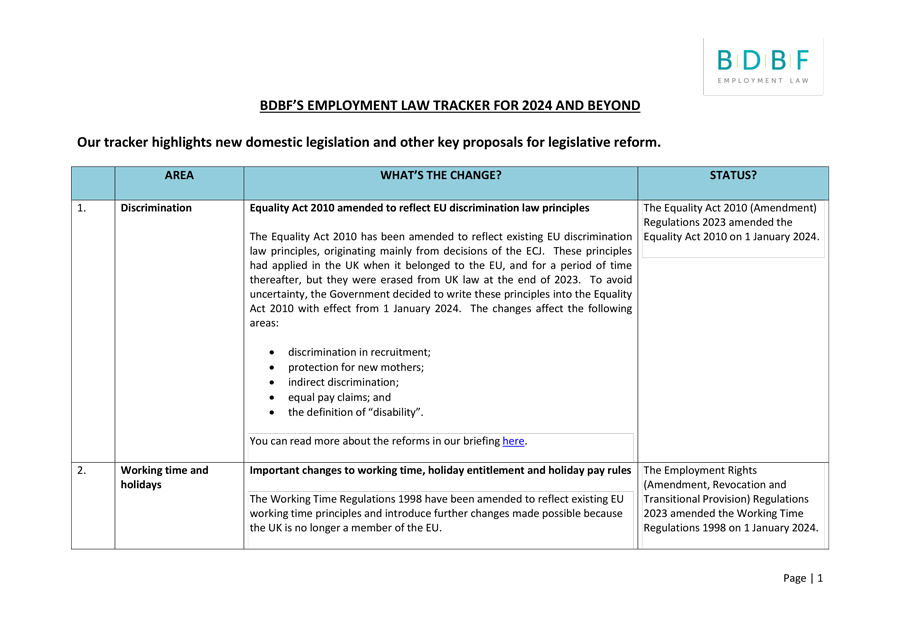
BDBF’s Employment Law Tracker for 2024 and Beyond

Our detailed employment law tracker highlights new domestic legislation and other key proposals for legislative reform.

Please click the image below for an at-a-glance guide to all the significant pieces of employment legislation on the horizon, as well as links to more detailed briefings on the most important changes. 


If you would like further information, or to discuss how to prepare for any of these changes, please contact Amanda Steadman (amandasteadman@bdbf.co.uk) or your usual BDBF contact.


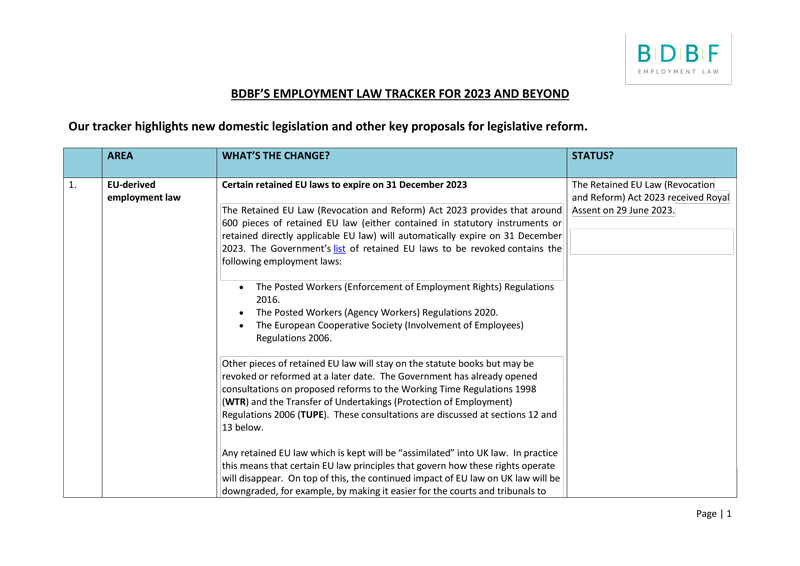
BDBF’s Employment Law Tracker for 2023 and Beyond

Our detailed employment law tracker highlights new domestic legislation and other key proposals for legislative reform.

Please click the image below for an at-a-glance guide to all the significant pieces of employment legislation on the horizon, as well as links to more detailed briefings on the most important changes. 


If you would like further information, or to discuss how to prepare for any of these changes, please contact Amanda Steadman (amandasteadman@bdbf.co.uk) or your usual BDBF contact.


BDBF Partners recognised in Who’s Who Legal 2023 for Labour, Employment & Benefits

BDBF Partners Gareth Brahams, Claire Dawson and Paula Chan have been recognised as Global Leaders in the Labour, Employment & Benefits field in 2023’s Who’s Who Legal, with Gareth and Claire also selected as Thought Leaders.

BDBF’s team of employment lawyers is top ranked by the leading legal directories, and we’re delighted to see our lawyers recognised by Who’s Who Legal.

Congratulations to our colleagues in the employment law world who have also been ranked this year. 


BDBF WELCOMES NEW ASSOCIATE

[et_pb_section fb_built=”1″ _builder_version=”3.0.100″ background_image=”http://davidk423.sg-host.com/wp-content/uploads/2017/09/bdbf_final-stages-1-4-1.jpg” custom_padding=”|||” global_module=”2165″ saved_tabs=”all” global_colors_info=”{}”][et_pb_row _builder_version=”4.7.4″ min_height=”66.4px” custom_padding=”50px||||false|false” global_colors_info=”{}”][et_pb_column type=”4_4″ _builder_version=”3.25″ custom_padding=”|||” global_colors_info=”{}” custom_padding__hover=”|||”][et_pb_text _builder_version=”4.7.4″ _dynamic_attributes=”content” text_font=”|700|||||||” text_font_size=”27px” background_layout=”dark” custom_margin=”0px|||” custom_padding=”0px|||” global_colors_info=”{}”]@ET-DC@eyJkeW5hbWljIjp0cnVlLCJjb250ZW50IjoicG9zdF90aXRsZSIsInNldHRpbmdzIjp7ImJlZm9yZSI6IiIsImFmdGVyIjoiIn19@[/et_pb_text][et_pb_text _builder_version=”4.7.4″ _dynamic_attributes=”content” _module_preset=”default” background_layout=”dark” global_colors_info=”{}”]@ET-DC@eyJkeW5hbWljIjp0cnVlLCJjb250ZW50IjoicG9zdF9kYXRlIiwic2V0dGluZ3MiOnsiYmVmb3JlIjoiIiwiYWZ0ZXIiOiIiLCJkYXRlX2Zvcm1hdCI6ImRlZmF1bHQiLCJjdXN0b21fZGF0ZV9mb3JtYXQiOiIifX0=@[/et_pb_text][/et_pb_column][/et_pb_row][/et_pb_section][et_pb_section fb_built=”1″ admin_label=”section” _builder_version=”3.22.3″ global_colors_info=”{}”][et_pb_row admin_label=”row” _builder_version=”4.7.4″ background_size=”initial” background_position=”top_left” background_repeat=”repeat” global_colors_info=”{}”][et_pb_column type=”4_4″ _builder_version=”3.25″ custom_padding=”|||” global_colors_info=”{}” custom_padding__hover=”|||”][et_pb_text _builder_version=”4.10.7″ text_orientation=”justified” hover_enabled=”0″ use_border_color=”off” global_colors_info=”{}” sticky_enabled=”0″]

BDBF is delighted to announce the recent appointment of Rebecca Rubin.  Rebecca is the third associate to join the team at BDBF this year, following the recent arrival of James Hockley and Theo Nicou.

The firm has 11 associates and senior associates, in addition to 5 partners.

BDBF’s ability to attract high calibre talent is testament to the quality of its client base, the complex and interesting work the team does, and its collaborative culture. BDBF has been ranked in the top tier for acting for senior executives for the last seven years consecutively.  The firm also has a growing practice acting for employers on their high stakes and high value employment work.

Gareth Brahams, Managing Partner of BDBF said: 

“We are pleased to welcome Rebecca to the team, especially at a time of increasing demand for employment litigation and advisory support. She joins us from Clifford Chance where she gained invaluable employment law experience. This makes Rebecca well placed to give the best advice and expert support to our clients.” 

Rebecca Rubin said:

“I am very excited to have joined BDBF, a market-leader in the employment law field with such a strong reputation for supporting its clients and delivering results. I am looking forward to working alongside such experienced and well-regarded industry experts.”

[/et_pb_text][/et_pb_column][/et_pb_row][/et_pb_section][et_pb_section fb_built=”1″ _builder_version=”3.26.6″ global_colors_info=”{}”][et_pb_row _builder_version=”3.26.6″ global_colors_info=”{}”][et_pb_column type=”4_4″ _builder_version=”3.26.6″ global_colors_info=”{}”][/et_pb_column][/et_pb_row][/et_pb_section]


AWARD WINNING EMPLOYMENT LAW FIRM BDBF LANDS SLATER & GORDON’S FORMER NATIONAL HEAD OF EMPLOYMENT CLAIRE DAWSON

[et_pb_section fb_built=”1″ _builder_version=”3.0.100″ background_image=”http://davidk423.sg-host.com/wp-content/uploads/2017/09/bdbf_final-stages-1-4-1.jpg” custom_padding=”|||” global_module=”2165″ saved_tabs=”all”][et_pb_row _builder_version=”3.25″ custom_padding=”|||”][et_pb_column type=”4_4″ _builder_version=”3.25″ custom_padding=”|||” custom_padding__hover=”|||”][et_pb_text _builder_version=”3.27.4″ background_layout=”dark” custom_margin=”0px|||” custom_padding=”0px|||”]

Employment Law News


[/et_pb_text][/et_pb_column][/et_pb_row][/et_pb_section][et_pb_section fb_built=”1″ admin_label=”section” _builder_version=”3.22.3″][et_pb_row column_structure=”3_5,2_5″ admin_label=”row” _builder_version=”3.25″ background_size=”initial” background_position=”top_left” background_repeat=”repeat”][et_pb_column type=”3_5″ _builder_version=”3.25″ custom_padding=”|||” custom_padding__hover=”|||”][et_pb_text _builder_version=”4.7.4″ text_orientation=”justified” hover_enabled=”0″ use_border_color=”off” sticky_enabled=”0″]

AWARD-WINNING EMPLOYMENT LAW FIRM BDBF LANDS SLATER & GORDON’S FORMER NATIONAL HEAD OF EMPLOYMENT CLAIRE DAWSON

Top-ranked, specialist employment law firm BDBF today announces the appointment of new equity partner Claire Dawson. She is one of the most highly regarded lawyers in the field of employment law. She was National Head of the Employment Law Practice at Slater & Gordon, and most recently a partner in market-leading employment law firm CC Solicitors in Dublin.  Claire’s hire follows hot on the heels of the appointment of Paula Chan six months ago, who also joined the firm from Slater & Gordon. Both significantly bolster BDBF’s already strong market lead for advising and representing senior individuals in high-profile employment disputes.

BDBF was launched in 2012 by high profile former Lewis Silkin partner and Head of Employment at Stewarts, Gareth Brahams. The new firm quickly made the top of the legal directory rankings and the firm has led on ground-breaking cases. Since its inception the firm has grown from strength to strength, acquiring top talent in the senior executive employment dispute space, putting BDBF in an even better position to attract the best cases and the best talent.

[/et_pb_text][/et_pb_column][et_pb_column type=”2_5″ _builder_version=”3.25″ custom_padding=”|||” custom_padding__hover=”|||”][et_pb_image src=”http://davidk423.sg-host.com/wp-content/uploads/2021/03/Claire-Dawson.jpg” title_text=”Claire-Dawson” _builder_version=”4.7.4″ border_width_all=”4px” border_color_all=”#1D7078″][/et_pb_image][/et_pb_column][/et_pb_row][et_pb_row admin_label=”row” _builder_version=”3.25″ background_size=”initial” background_position=”top_left” background_repeat=”repeat”][et_pb_column type=”4_4″ _builder_version=”3.25″ custom_padding=”|||” custom_padding__hover=”|||”][et_pb_text _builder_version=”4.7.4″ text_orientation=”justified” use_border_color=”off”]

Claire has over 17 years’ experience as an employment lawyer and she is dual qualified in England & Wales and Ireland.   Claire has been consistently recommended in the Legal 500 and the Chambers Guide for London Employment: Senior Executive, most recently in the top 20 lawyers in the Chambers Guide and a leading practitioner in Who’s Who Legal (England) when practising in London. She is also a recommended Global Leader in Labour & Employment Law (Ireland). Having trained and qualified at a firm focusing on employer work, she made the switch to advising and representing employees early in her career at Russell Jones & Walker (later acquired by Slater & Gordon). Since then, Claire has acted for a wide range of senior individuals in financial services, professional services, large multinationals, healthcare and technology in relation to disputes and exits.  She has significant experience of running high-value discrimination and whistleblowing complaints for those working in regulated sectors.  Claire has a particular interest in issues facing women at work, including pregnancy and maternity discrimination, the gender pay gap and sexual harassment. Claire is a regular speaker and commentator on employment law issues, both nationally and internationally.

Gareth Brahams, Managing Partner of BDBF said,

“We are delighted Claire has joined the firm. Claire joins us as the world of work is about to undergo yet another period of radical change as we move out of lockdown. The firm continues to attract the employment sector’s heavyweights, driving success on landmark and complex cases. Our ambitious and considered growth trajectory will ensure that we continue to strengthen our position as the go-to firm for senior regulated individuals in their employment disputes.”

Claire said,

“I am excited to be joining BDBF, a firm that is not only at the very top of its field professionally, acting on the most significant employment cases, but one that also places such emphasis on looking after its people, promoting close team working and developing a positive and supportive culture internally.”


[/et_pb_text][/et_pb_column][/et_pb_row][/et_pb_section][et_pb_section fb_built=”1″ _builder_version=”3.26.6″][et_pb_row _builder_version=”3.26.6″][et_pb_column type=”4_4″ _builder_version=”3.26.6″][/et_pb_column][/et_pb_row][/et_pb_section]
Just Blue Monday, or something more?

[et_pb_section fb_built=”1″ _builder_version=”3.0.100″ background_image=”http://davidk423.sg-host.com/wp-content/uploads/2017/09/bdbf_final-stages-1-4-1.jpg” custom_padding=”|||” global_module=”2165″ saved_tabs=”all”][et_pb_row _builder_version=”3.25″ custom_padding=”|||”][et_pb_column type=”4_4″ _builder_version=”3.25″ custom_padding=”|||” custom_padding__hover=”|||”][et_pb_text _builder_version=”3.27.4″ background_layout=”dark” custom_margin=”0px|||” custom_padding=”0px|||”]

Employment Law News


[/et_pb_text][/et_pb_column][/et_pb_row][/et_pb_section][et_pb_section fb_built=”1″ admin_label=”section” _builder_version=”3.22.3″][et_pb_row admin_label=”row” _builder_version=”3.25″ background_size=”initial” background_position=”top_left” background_repeat=”repeat”][et_pb_column type=”4_4″ _builder_version=”3.25″ custom_padding=”|||” custom_padding__hover=”|||”][et_pb_text _builder_version=”4.7.4″ text_orientation=”justified” hover_enabled=”0″ use_border_color=”off” sticky_enabled=”0″]

Just Blue Monday, or something more? 

The third Monday in January is typically labelled “Blue Monday” and is said to be the most depressing day of the year. Christmas festivities are over, the weather remains is cold and dark, New Year’s resolutions have fallen by the wayside and Christmas credit card bills are in but people have not yet been paid.

In 2021, people are likely to feel the effects of Blue Monday more acutely due to the third lockdown imposed by the government in response to the Covid-19 pandemic. It is therefore more important than ever for people to ask themselves whether any “blue” feelings are a temporary symptom of the season or a sign that they could be suffering from a more serious condition.

This article considers this question in the context of the workplace, although of course this issue is relevant to all aspects of life.

What if you’re just “feeling blue”?

Short periods of “feeling blue” are completely normal and for the most part do not interfere with doing your job. You might find that making use of informal support networks, such as attending (virtual) coffees with colleagues can be all that it takes to lift your spirits. Some employers have mental health first aiders and/or support helplines that can provide valuable advice for those needing more support. 

Whatever the case, you should keep your moods under review by keeping a record of how you feel from week to week. This does not need to be formal, but it can help you spot signs of a more serious or prolonged condition and will enable you to take appropriate measures to prevent it.  

What if it is something more serious?  

If you consider that you are already suffering from a more serious condition, it is important to seek support from a medical professional, like your GP.

Employers have a duty to provide their employees with a reasonably safe system and place of work, exercise reasonable care for their safety and health and take all necessary steps to protect employees from risks that are reasonably foreseeable, including risks of psychiatric injury or damage.

If you believe your working conditions are affecting your health, start a conversation with your employer. It is important to discuss this with your line manager, HR, or someone else in the management chain that you feel comfortable approaching.

Let them know how you are feeling and what is causing you to feel unwell. Talk through the support you need to alleviate your condition. In some cases, it may be beneficial to attend an appointment with Occupational Health, so that a more formal support program can be put in place.

Depending on the nature and extent of your condition, you may have a “disability” under the Equality Act 2010. Your condition will amount to a disability if it is a physical or mental impairment and the impairment has a substantial and long-term adverse effect on your ability to carry out normal day-to-day activities. While there are many aspects to this definition, it is important to be aware that for a condition to be long term, so as to satisfy this part of the test, it needs to have lasted, or be expected to last, for at least 12 months. 

Importantly, employers are under a proactive duty to make reasonably adjustments for disabled employees to avoid the disadvantage caused by their disability in the workplace. For mental health issues, this duty arises irrespective of whether the impairment was caused by work or by an external factor.

The duty to make reasonable adjustments is the cornerstone of disability law. It arises only once the employer knows, or could reasonably be expected to know, of an employee’s disability. In practice, this means that you do need to communicate with your employer about your condition so that they are put on actual notice. This makes having a conversation with your employer incredibly important. For example, if you are unable to work because you are struggling with your mental health, you should consider making this clear during a return to work interview and on any sick notes provided by your GP rather than, as happens frequently, recording your absence as a cold or other such illness. As well as helping you to access immediate support, it will assist your position in any subsequent legal proceedings should the support you need be unavailable or should you be subjected to detrimental treatment.

It is unlawful for your employer to treat you unfavourably because of your disability. It is also unlawful for you to be treated unfavourably because of something arising in consequence of your disability, unless such treatment can be objectively justified. For example, some people with depression find it difficult to get up in the mornings, making them late for work. If this is an effect of your depression and you are disciplined for poor time-keeping, without account being taken of your depression, this could constitute discrimination arising from your disability, i.e. the unfavourable treatment was because of something that was not the disability itself, but caused by the disability. If you find yourself in this situation, it is important to be open with your employer about why your timekeeping suffers in the mornings and discuss whether changes can be made to your working pattern to assist you.

Conclusion

The stigma around mental health in the workplace is reducing, but there is still some way to go. If you are finding work difficult due to mental health reasons, an important first step is to have a conversation with someone within the organisation that you trust so that they can help you access the support that should be available, whether that is to alleviate the effects of Blue Monday or as part of a longer term need.  

[/et_pb_text][/et_pb_column][/et_pb_row][/et_pb_section][et_pb_section fb_built=”1″ _builder_version=”3.26.6″][et_pb_row _builder_version=”3.26.6″][et_pb_column type=”4_4″ _builder_version=”3.26.6″][/et_pb_column][/et_pb_row][/et_pb_section]


Webinar: 10 things for employers to know about in 2021

[et_pb_section fb_built=”1″ _builder_version=”3.0.100″ background_image=”http://davidk423.sg-host.com/wp-content/uploads/2017/09/bdbf_final-stages-1-4-1.jpg” custom_padding=”|||” global_module=”2165″ saved_tabs=”all”][et_pb_row _builder_version=”3.25″ custom_padding=”|||”][et_pb_column type=”4_4″ _builder_version=”3.25″ custom_padding=”|||” custom_padding__hover=”|||”][et_pb_text _builder_version=”3.27.4″ background_layout=”dark” custom_margin=”0px|||” custom_padding=”0px|||”]

Employment Law News


[/et_pb_text][/et_pb_column][/et_pb_row][/et_pb_section][et_pb_section fb_built=”1″ admin_label=”section” _builder_version=”3.22.3″][et_pb_row admin_label=”row” _builder_version=”3.25″ background_size=”initial” background_position=”top_left” background_repeat=”repeat”][et_pb_column type=”4_4″ _builder_version=”3.25″ custom_padding=”|||” custom_padding__hover=”|||”][et_pb_text _builder_version=”4.7.4″ text_orientation=”justified” hover_enabled=”0″ use_border_color=”off” sticky_enabled=”0″]

Webinar: 10 things for employers to know about in 2021

Join our lunchtime webinar on 25 January 2021 when we will survey the big changes in employment law coming up in 2021, including reforms to recruitment practices, employment contracts, settlement agreements, and family-friendly rights. Click on the link below for full details of the agenda. If you’d like to sign up please email Amanda Steadman at amandasteadman@bdbf.co.uk.

[/et_pb_text][/et_pb_column][/et_pb_row][/et_pb_section][et_pb_section fb_built=”1″ _builder_version=”3.26.6″][et_pb_row _builder_version=”3.26.6″][et_pb_column type=”4_4″ _builder_version=”3.26.6″][/et_pb_column][/et_pb_row][/et_pb_section]


Getting ready for employment law reform in 2021: 10 things employers really need to know

[et_pb_section fb_built=”1″ _builder_version=”3.0.100″ background_image=”http://davidk423.sg-host.com/wp-content/uploads/2017/09/bdbf_final-stages-1-4-1.jpg” custom_padding=”|||” global_module=”2165″ saved_tabs=”all”][et_pb_row _builder_version=”3.25″ custom_padding=”|||”][et_pb_column type=”4_4″ _builder_version=”3.25″ custom_padding=”|||” custom_padding__hover=”|||”][et_pb_text _builder_version=”3.27.4″ background_layout=”dark” custom_margin=”0px|||” custom_padding=”0px|||”]

Employment Law News


[/et_pb_text][/et_pb_column][/et_pb_row][/et_pb_section][et_pb_section fb_built=”1″ admin_label=”section” _builder_version=”3.22.3″][et_pb_row admin_label=”row” _builder_version=”3.25″ background_size=”initial” background_position=”top_left” background_repeat=”repeat”][et_pb_column type=”4_4″ _builder_version=”3.25″ custom_padding=”|||” custom_padding__hover=”|||”][et_pb_text _builder_version=”4.7.4″ text_orientation=”justified” use_border_color=”off”]

Getting ready for employment law reform in 2021: 10 things employers really need to know

It’s been said that death and taxes are the only certainties in life, but employers may wish to add a third – changes to employment law.  Both caused by Brexit and the pandemic, and independent of them, reforms haven’t ceased.  In this article, we round up the top 10 changes for people with responsibility for HR to watch out for in 2021.

  1. Recruiting EEA nationals is about to get a lot more complicated…

The new year brings new headaches for employers wishing to recruit EEA nationals.  From 1 January 2021, EEA nationals will lose their automatic right to live and work in the UK.  For those based in the UK before this date, the solution is to apply for either Settled Status or Pre-Settled Status before 30 June 2021.  Either status will give the individual the right to continue to live and work in the UK.  Successful applicants will usually be given a “share code” to provide to their employers to prove their right to work in the UK.  Employers will need to establish a system of checking the share codes of affected employees after 30 June 2021.

From 1 January 2021, EEA nationals wishing to come to the UK to work will need to be sponsored by a UK employer under the new points-based based immigration system.  Employers wishing to sponsor workers will need a licence to do so.  Employers will need to make sure the sponsor licence is in place in good time (licence applications can take between 3 to 6 weeks to process).  Further guidance on the points-based immigration system is available here.

  1. …and so is engaging contractors

The way in which the off-payroll working rules (known as “IR35”) operate in the private sector is set to change on 6 April 2021.  The reforms were due to come into force on 6 April 2020 but were deferred in the light of the coronavirus pandemic

These reforms will see contractors lose the ability to determine their own tax status and place this burden on those who engage them.  Large and medium-sized businesses in the private sector that engage independent contractors via an intermediary (usually a personal service company) will become responsible for assessing whether the IR35 rules apply – this is known as the “status determination”.  The determination process is notoriously difficult, and you may well need to take legal advice.

Once the status determination has been made, the business must notify various parties of its decision and provide an opportunity to challenge the assessment.

On top of this, where a business contracts directly with the intermediary (i.e. it is the fee payer), it will also become responsible for deducting income tax and NICs and paying employer’s NICs.

Those running the payroll will need to be ready to implement these changes from April 2021.  You can read more about the IR35 reforms in our detailed note on the new regime here.

  1. Be prepared for new limits on how you draft your employment contracts…

After jumping the hurdle of recruitment, employers also need to be ready for changes affecting their onboarding arrangements.

Currently, the Government is consulting on two areas which may affect the drafting of employment contracts.

Views are sought on proposals to restrict the use of non-compete restrictions.  It’s possible that non-compete clauses could be made unenforceable altogether, meaning employers would not be able to include them in employment contracts at all.  Alternatively, they may be permissible for a prescribed period of time and only where the employer provides compensation during the term of the clause.  Either change would see employers having to amend existing employment contracts and update template documents.  You can read our further thoughts on this consultation and also find out how to feedback your thoughts to the Government here.

The Government is also seeking views on extending the ban on exclusivity clauses in employment contracts to prevent employers from restricting low-paid employees (i.e. those earning below £120 per week) from working for another employer.  Currently, the ban only applies to those working under zero-hours contracts.  If the ban is extended, affected contracts will need to be amended.

Both consultations close on 26 February 2021 and new laws could be in place later this year.

4…and standby to overhaul your family-friendly policies

And it’s not just employment contracts that may need a rewrite in 2021.  Employers may need a cold towel at the ready when it comes to overhauling family-friendly policies as there are a raft of changes in the offing.

The Pregnancy and Maternity (Redundancy) Protection Bill 2019-21 is on its passage through Parliament, with the next stage of the Bill taking place on 12 March 2021.  If passed, it will prohibit redundancy during pregnancy and maternity leave and for the six months after the return to work, save in limited circumstances.

The Government has also consulted on several proposals to update family leave rights including reforming the system of parental leave and pay; introducing a new right to neonatal leave and pay; and requiring employers to publish their family leave and flexible working policies.  Although still at the proposal stage, it would be wise for employers to make sure that family leave and flexible working policies are kept up to date, particularly as the publication requirement could be introduced fairly swiftly.

There are also plans afoot to introduce a new right for workers with caring responsibilities to take one week’s unpaid leave.  This new form of leave would supplement other relevant forms of leave such as parental leave or time off for dependant emergencies.

  1. Wave goodbye to the furlough scheme…

The furlough scheme is currently set to change on 1 February 2021, with a likely reduction in the Government’s contribution to the wages of furloughed employees.  The scheme is then due to close for good on 31 March 2021 and is likely to be replaced with a less generous form of wage support.  You can read more about the furlough scheme in our detailed guide here.

Payroll teams dealing with furloughed employees will need to ensure that final claims are made to HMRC in good time.  At the same time, employers need to have a strategy in place for what happens next: will furloughed staff be brought back to work or made redundant?  If redundancies are needed, will time-consuming collective consultation be triggered?  If so, when will that consultation process begin?

6.…and say hello to a flurry of flexible working requests

The roll out of the Covid-19 vaccine in 2021 signals the hope of return to normal life, including in the world of work.  But after a year or more of working from home, will staff be prepared to return to commuting five days per week? Some will, but employers should get ready for an influx of flexible working requests from staff who have got used to the benefits of working from home.

This could range from requests to work from home on a flexi-basis or 1 or 2 fixed days per week, through to requests for permanent home working.  Employers should consider now whether they are willing to continue with home working and, if not, the grounds for refusing such requests.  Rejecting requests will be harder where the employee can demonstrate that they have worked effectively from home for a long period of time.

It’s also worth bearing in mind that the Government intends to put its weight behind flexible working for all jobs.  There are plans for a new Employment Bill which would make flexible working the default for all job roles, meaning that jobs should be advertised as open to flexible working.   This will represent a big change for employers – a recent survey revealed that 78% of job ads did not mention flexible working at all and, of those that did, the majority offered it only on a temporary basis to cope with the Covid-19 pandemic.

  1. Pay equality issues will be back in the spotlight…

HR and payroll teams at large employers had a reprieve from crunching their gender pay gap numbers in 2020, after the Government paused publication in the light of the Covid-19 pandemic.  As far as we know, reporting is back on the agenda in 2021, with a deadline for private sector employers of 4 April 2021.

However, there are some unanswered questions about what needs to be reported. It’s not yet clear whether businesses will have to report the missing 2019/20 figures at the same time as their 2020/21 figures.  It’s also not clear whether staff who were on furlough on the snapshot date of 5 April 2020 should be included in the 2020/21 figures.  And if they are to be included, is their pay their normal rate of pay or the reduced furlough rate of pay?   HR and payroll teams will need to watch out for further guidance from the Government and be ready to adjust their calculations and accompanying narrative.

Businesses outside of the gender pay gap reporting regime will escape these headaches for now – but employers should note that there are plans to reduce the reporting threshold to employers with 100 or more employees.  The Equal Pay (Information and Claims) Bill 2019-21 is on its passage through Parliament and aims to reduce the threshold for gender pay gap reporting and bring in ethnicity pay reporting for employers at the same threshold.  The next stage of the Bill is scheduled to take place on 15 January 2021.  Although these changes are unlikely to come into force in 2021, they would involve a great deal of preparatory work for affected businesses and so employers are advised to keep a close eye on this development.

In addition, the Bill seeks to reform equal pay law and, among other things, would introduce a right for employees to know what their colleagues are paid.  This could shine a light on pay disparities and trigger equal pay disputes on an individual or group basis.  With the Supreme Court’s decision in the high-profile Asda equal pay dispute expected any day now, pay inequality issues will be firmly back in the public eye in 2021.

8.….and holiday pay headaches will rumble on

It’s hard to believe but holiday pay issues continue to rumble on, many years after the wave of cases which looked at which components of pay must be included in holiday pay.  In June 2021, the Supreme Court will consider whether voluntary overtime payments should be included in the calculation of holiday pay and whether a “series” of unlawful deductions from holiday pay is only present where the deductions are not more than three months apart.  Both decisions could have a big impact for employers’ holiday pay liability and employers should monitor the outcome.

And when it comes to holiday requests, don’t forget that special rules were introduced to allow staff to roll over any holiday that they were unable to take due to the Covid-19 pandemic.  Where this is the case, the unused holiday may be carried forward and taken over the next two leave years.  This may mean that some employees have higher than usual holiday entitlements in 2021 and possibly into 2022.

  1. Protection for whistleblowers is on track to be strengthened

Protection for those blowing the whistle looks likely to be enhanced in 2021.  At EU level, a new Directive introduces protection for those reporting certain breaches of EU law.  EU Member States have until 17 December 2021 to implement the Directive into national law.  It’s not yet clear whether the UK will be obliged to introduce such legislation. This will depend on the terms of any post-Brexit relationship agreed between the UK and the EU.  However, employers with operations in EU Member States will have to comply with the new rules in those jurisdictions and may wish to take a uniform approach across their business, including in the UK.

The Directive requires employers with 50 or more employees to have internal whistleblowing procedures which offer a range of reporting mechanisms.  UK employers are not currently required to have such procedures in place, save in certain regulated sectors.  Employers will also be required to provide feedback to whistleblowers about their internal investigation.  Employers should be poised to prepare such procedures and roll out relevant training to staff.

There are also efforts underway in the UK to enhance whistleblower protection, with two Private Members’ Bill currently on their passage through Parliament.  The Public Interest Disclosure (Protection) Bill 2019-21 and the Office of the Whistleblower Bill 2019-21 are both aimed at strengthening protection for whistleblowers.   The next stage of the Public Interest Disclosure (Protection) Bill 2019-21 is scheduled to take place on 26 February 2021.

  1. And finally, when parting ways with employees watch out for new rules affecting terminations

When parting ways with employees in 2021, employers should take note of the Government’s commitment to introduce new laws as soon as possible to restrict the use of non-disclosure agreements (NDAs) in settlement agreements where there has been an allegation of harassment or discrimination.  The new rules will mean that:

  • NDAs must not prevent someone from making a disclosure to the police, regulated health and care professionals or legal professionals;
  • the limitations of an NDA must be made clear to those signing them; and
  • new enforcement measures will be introduced for non-compliant clauses.

Employers will need to amend template settlement agreements in due course to comply with these new rules.

You can find out more about these and other developments on the horizon in BDBF’s 2021 Employment Law Tracker.  If your business needs advice on preparing for any of these changes please contact Amanda Steadman (amandasteadman@bdbf.co.uk) or your usual BDBF contact.

[/et_pb_text][/et_pb_column][/et_pb_row][/et_pb_section][et_pb_section fb_built=”1″ _builder_version=”3.26.6″][et_pb_row _builder_version=”3.26.6″][et_pb_column type=”4_4″ _builder_version=”3.26.6″][/et_pb_column][/et_pb_row][/et_pb_section]


BDBF’S 2021 Employment Law Tracker

[et_pb_section fb_built=”1″ _builder_version=”3.0.100″ background_image=”http://davidk423.sg-host.com/wp-content/uploads/2017/09/bdbf_final-stages-1-4-1.jpg” custom_padding=”|||” global_module=”2165″ saved_tabs=”all”][et_pb_row _builder_version=”3.25″ custom_padding=”|||”][et_pb_column type=”4_4″ _builder_version=”3.25″ custom_padding=”|||” custom_padding__hover=”|||”][et_pb_text _builder_version=”3.27.4″ background_layout=”dark” custom_margin=”0px|||” custom_padding=”0px|||”]

Employment Law News

[/et_pb_text][/et_pb_column][/et_pb_row][/et_pb_section][et_pb_section fb_built=”1″ admin_label=”section” _builder_version=”3.22.3″][et_pb_row admin_label=”row” _builder_version=”3.25″ background_size=”initial” background_position=”top_left” background_repeat=”repeat”][et_pb_column type=”4_4″ _builder_version=”3.25″ custom_padding=”|||” custom_padding__hover=”|||”][et_pb_text _builder_version=”4.7.4″ text_orientation=”justified” hover_enabled=”0″ use_border_color=”off” sticky_enabled=”0″]

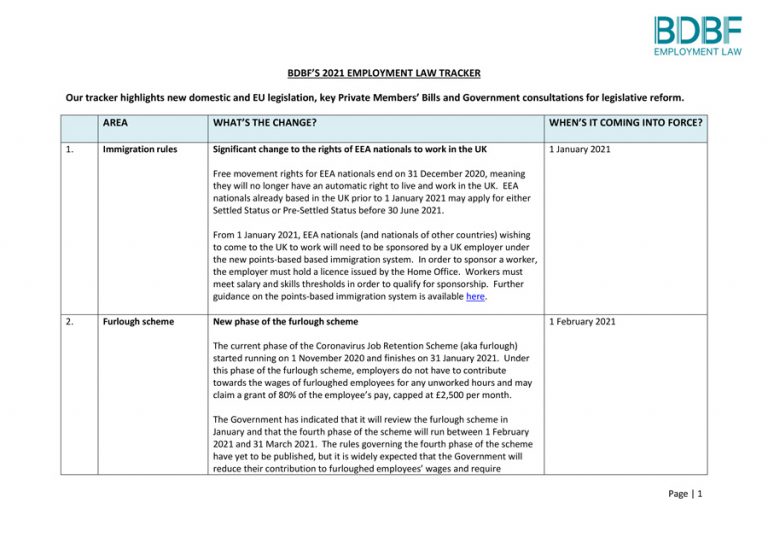
Our tracker highlights new domestic and EU legislation, key Private Members’ Bills and Government consultations for legislative reform. 

[/et_pb_text][et_pb_image src=”http://davidk423.sg-host.com/wp-content/uploads/2020/12/2021-Employment-Law-Tracker-PDF-FINAL-1.jpg” title_text=”2021-Employment-Law-Tracker-PDF-(FINAL)-1″ url=”http://davidk423.sg-host.com/wp-content/uploads/2020/12/2021-Employment-Law-Tracker-PDF-FINAL.pdf” url_new_window=”on” _builder_version=”4.7.4″ _module_preset=”default” hover_enabled=”0″ border_width_all=”1px” border_color_all=”#159687″ align=”center” sticky_enabled=”0″][/et_pb_image][et_pb_text _builder_version=”4.7.4″ text_orientation=”justified” use_border_color=”off”]

If your business needs advice on preparing for any of these changes please contact Amanda Steadman (amandasteadman@bdbf.co.uk) or your usual BDBF contact.

[/et_pb_text][/et_pb_column][/et_pb_row][/et_pb_section][et_pb_section fb_built=”1″ _builder_version=”3.26.6″][et_pb_row _builder_version=”3.26.6″][et_pb_column type=”4_4″ _builder_version=”3.26.6″][/et_pb_column][/et_pb_row][/et_pb_section]


Reflecting on employment law cases and developments in 2020

[et_pb_section fb_built=”1″ _builder_version=”3.0.100″ background_image=”http://davidk423.sg-host.com/wp-content/uploads/2017/09/bdbf_final-stages-1-4-1.jpg” custom_padding=”|||” global_module=”2165″ saved_tabs=”all”][et_pb_row _builder_version=”3.25″ custom_padding=”|||”][et_pb_column type=”4_4″ _builder_version=”3.25″ custom_padding=”|||” custom_padding__hover=”|||”][et_pb_text _builder_version=”3.27.4″ background_layout=”dark” custom_margin=”0px|||” custom_padding=”0px|||”]

Employment Law News


[/et_pb_text][/et_pb_column][/et_pb_row][/et_pb_section][et_pb_section fb_built=”1″ admin_label=”section” _builder_version=”3.22.3″][et_pb_row admin_label=”row” _builder_version=”3.25″ background_size=”initial” background_position=”top_left” background_repeat=”repeat”][et_pb_column type=”4_4″ _builder_version=”3.25″ custom_padding=”|||” custom_padding__hover=”|||”][et_pb_text _builder_version=”4.7.4″ text_orientation=”justified” hover_enabled=”0″ use_border_color=”off” sticky_enabled=”0″]Reflecting on employment law cases and developments in 2020

Dealing with the impact of the Covid-19 pandemic on the workforce has held the top spot on the HR to-do list for most of 2020.  But what other developments should employers note from the last 12 months?   Putting Covid-19 to one side, we’ve picked out some interesting cases and other developments from 2020 for employers to reflect on as the year draws to a close. 

Equality and discrimination

As usual, there has been a great deal of activity in the equality sphere:

  • Vegetarianism and veganism: we learnt that whilst vegetarianism was not a philosophical belief capable of protection under the Equality Act 2010, ethical veganism was protected. At the tail end of 2019, the Employment Tribunal ruled in the case of Conisbee v Crossley Farms that the plurality of reasons for becoming a vegetarian (e.g. lifestyle, health, animal welfare, personal taste etc) meant it did not attain the necessary level of cogency, seriousness, cohesion and importance to qualify for protection as a philosophical belief.  By contrast, the Employment Tribunal in Casamitjana v The League Against Cruel Sports decided that ethical veganism was worthy of protection.  You can read more about these decisions in our briefing here.  The protection of veganism could raise interesting employment law issues in 2021 where vegan employees refuse to have the Covid-19 vaccine on the grounds that it has been tested on animals.
  • Gender fluidity: we also learnt that a belief that gender cannot be fluid is a belief worthy of protection in a democratic society. In the case of Higgs v Farmor’s School an Employment Tribunal decided that a Christian employee’s belief that gender cannot be fluid, and that an individual cannot change their biological sex, were beliefs worthy of respect in a democratic society and capable of protection under the Equality Act 2010.  On the facts of the case, however, the employee had not been discriminated against because of her protected beliefs.  You can read the Tribunal’s decision here.   More recently, in the case of Taylor v Jaguar Land Rover Ltd, an Employment Tribunal decided that a gender fluid / non-binary employee had the protected characteristic of gender reassignment.  The employee was awarded £180,000 damages in respect of the discrimination and harassment they had suffered.  You can read the Tribunal’s decision here.
  • Disability: in Hill v Lloyds Bank plc, the EAT decided that the employer had discriminated against a depressed employee when it failed to guarantee a severance package in the event that it could not keep her from having to work with her alleged harassers again. It decided that providing such a guarantee would have been a reasonable adjustment for the employer to make and their failure to do so was discriminatory.  The employee was awarded £7,500 damages and the employer was ordered to provide the guarantee to the employee. You can read more about this decision in our briefing here.
  • Sexual harassment: in January 2020, the Equalities and Human Rights Commission published new and detailed guidance on sexual harassment and other forms of workplace harassment. Whilst the guidance is not a statutory code of practice, it is described as the authoritative and comprehensive guide to the law and best practice.  This means it can be considered by an Employment Tribunal in relevant cases.  The guidance recaps on the legal framework and considers steps for employers to take in preventing and responding to harassment.  You can read more about the guidance in our briefing here.
  • Race: in the case of Lamonby v Solent University an Employment Tribunal had to consider whether it was fair to dismiss an employee who had made remarks which betrayed a tendency to stereotype according to race, even where such stereotypes were sometimes positive. The Tribunal concluded that ascribing certain abilities or talents (or the opposite of them) to a group by virtue of their nationality, race, ethnic or religious group was potentially racist and offensive.  Despite the fact the employee had not intended to cause offence, the Tribunal found that dismissal was within the range of reasonable responses.  You can read more about this decision in our briefing here.   Race inequality issues came to the forefront of the HR agenda in the Summer in response to the Black Lives Matter movement.  In this briefing we discussed the continuing underrepresentation of black people in senior positions in the UK and the calls for action to secure more diverse workforces.
  • Pay inequality: in January 2020, the BBC journalist, Samira Ahmed, won her equal pay case against the BBC. We discussed the impact of that decision here and also we looked at the important role of gender pay gap reporting here.  Although gender pay gap reporting was paused during the pandemic, it is firmly back on the agenda with legislation in the pipeline which aims to expand the obligation to smaller employers as well as introducing ethnicity pay reporting and a right to know what colleagues are paid.  You can more read about these proposals in our briefing here.

Employment contracts and policies

  • New rules on statements of particulars: on 6 April 2020, the rules governing statements of employment particulars were overhauled. The wider category of “workers” became entitled to receive a statement and statements had to be provided earlier and contain more information.  Typically, employers comply with the requirement to provide written statements by providing an employment contract.  Accordingly, employers had to update template employment contracts and prepare appropriate worker contracts or statements.  You can read more about this development in our briefing here.
  • Bereavement leave policies: on 6 April 2020 a new law, known as “Jack’s Law”, was introduced to provide bereaved parents with a new right to 2 weeks’ bereavement leave (and in some cases, pay) following the death of a child.  In this briefing, we took a closer look at the new right and the preparatory steps employers needed to take.

Whistleblowing

  • Whistleblowing in the financial services sector: earlier this year, Protect, the whistleblowers’ charity, published a report looking at the recent experiences of whistleblowers in the financial services sector.  In this briefing, we discussed the key findings including the typical wrongdoing raised by whistleblowers in the sector, where they were most likely to raise their concerns and the treatment they received. We also outlined five key learning points for employers in the sector.
  • Interim relief and Covid-related complaints: in Morales v Premier Fruits (Covent Garden) Ltd, the employee sought interim relief (i.e. an order that he should get his job back pending the full hearing of the case) on the basis that he had been automatically unfairly dismissed because of his trade union membership or activities and/or because he had made whistleblowing disclosures about Covid-related matters. He was granted interim relief on the basis that it was likely that he would be able to show that he had been dismissed because of his trade union membership or activities rather than the whistleblowing disclosures.  You can read more about this decision in our briefing here.

Vicarious liability

  • Deliberate data breach: in an important and welcome decision for employers, the Supreme Court ruled that an employer was not vicariously liable for a significant data breach committed by a disgruntled employee.  In Morrisons v Various Claimants it could not be said that there was a sufficient connection between the errant employee’s authorised activities and the wrongful act of publishing the data on the internet. The fact that the employee’s job merely provided him with the opportunity to commit the wrongful act was not enough to establish a sufficient connection.  You can read more about this decision in our briefing here.
  • Practical jokes: following on from the Morrisons decision, the High Court in the case of Chell v Tarmac Cement and Lime Ltd found that an employer was not vicariously liable for the actions of an employee whose practical joke injured a contractor in the workplace. It was expecting too much of an employer to implement a policy governing practical jokes or horseplay by employees.  Although the prank that caused the injury happened in the workplace, it could not be said that there was a sufficient connection between the employee’s authorised activities and the prank.  You can read the High Court’s decision here.

TUPE

  • Changing terms and conditions: in Ferguson v Astrea Asset Management Ltd the EAT considered whether four company directors were entitled to rely on contractual terms which had been put in place shortly before a TUPE transfer which were designed to significantly improve their position after the transfer. The EAT decided that the changes, even though they were beneficial, were void because they were by reason of the transfer.   You can read more about the EAT’s decision in our briefing here.
  • Transfers to multiple employers: in ISS Facility Services v Govaerts the ECJ decided, for the first time, that where there is a TUPE transfer to multiple transferees, a full-time contract of employment of a transferring employee can be split between the transfers into several part-time contracts on a pro rata basis. However, if splitting the contract is impossible, or worsens the working conditions or rights of the employee, then the contract may be terminated instead.  You can read the ECJ’s decision here.

Terminations

  • Redundancy processes: in Gwynedd Council v Barrett, the EAT considered whether an employer can require a potentially redundant employee to go through a competitive interview process for an alternative role. In the wake of the coronavirus pandemic, some employers will be facing the prospect of reorganising their businesses and making redundancies.  Employers in this position should take note of this decision which highlights the risks of getting the process wrong.  You can read more about the EAT’s decision in our briefing here.
  • Collective consultation: in UQ v Marclean Technologies SLU the ECJ ruled on how employers should calculate numbers of redundancies for collective consultation purposes. In an onerous decision for employers, the ECJ ruled that employers have to look either side of an individual dismissal on a rolling 90-day basis to identify the relevant reference period.  The reference period will be the period of 90 days which includes the individual dismissal, and which contains the greatest number of redundancy dismissals effected by the employer. Whether this will be read across into UK law is not resolved.   You can read more about the ECJ’s decision in our briefing here.
  • Misconduct dismissals: If an investigating officer fails to pass on relevant information to a dismissing officer, could this undermine the reasonableness of the dismissing officer’s decision? In Uddin v London Borough of Ealing the EAT said that it could, with the result that an employee accused of sexual assault was unfairly dismissed. The decision underlined the need for employers to ensure that their dismissal processes are unimpeachable and that both investigating officers and dismissing officers receive detailed training on the scope of their role.  You can read more about the EAT’s decision in our briefing here.
  • Procedural failings: the decision in Gallacher v Abellio Scotrail Ltd shows that where there has been an irretrievable breakdown in relations between colleagues, an employer may be able to dispense with a formal dismissal process and still dismiss fairly. Although it will be unusual and rare for a dismissal to be fair without any procedure, the mutual loss of trust and confidence meant that following a formal process would have been futile and even damaging.  You can read more about the EAT’s decision in our briefing here.

Settlements and disputes

  • Termination payments: from 6 April 2020, employer’s class 1A NICs became payable on termination payments above £30,000. Termination payments remain completely exempt from employee’s NICs.  Employers must remember to factor in this extra cost when negotiating settlements with departing employees.  You can read more about this development in our briefing here.
  • Breach of settlement terms: if an employee breaches a confidentiality clause contained in a COT3 agreement or, more commonly, a Settlement Agreement, what are the employer’s options? The answer is that it will depend on the importance of the clause or the severity of the employee’s breach.  The High Court’s decision in Duchy Farms Kennels Ltd v Steels offers a salutary lesson for employers on the need to draft settlement documents carefully. You can read more about the High Court’s decision in our briefing here.
  • Tribunal disputes: with the pandemic likely to intensify the backlog of employment tribunal claims, the Government introduced a raft of the changes designed to streamline the conduct of disputes and improve capacity within the tribunal system, including extending the length of Acas early conciliation to 6 weeks in all cases. You can read more about this development in our briefing here.

If you would like to know more about any of these developments please contact Amanda Steadman (amandasteadman@bdbf.co.uk) or your usual BDBF contact.[/et_pb_text][/et_pb_column][/et_pb_row][/et_pb_section][et_pb_section fb_built=”1″ _builder_version=”3.26.6″][et_pb_row _builder_version=”3.26.6″][et_pb_column type=”4_4″ _builder_version=”3.26.6″][/et_pb_column][/et_pb_row][/et_pb_section]


Government announces new consultation on restrictive covenants

[et_pb_section fb_built=”1″ _builder_version=”3.0.100″ background_image=”http://davidk423.sg-host.com/wp-content/uploads/2017/09/bdbf_final-stages-1-4-1.jpg” custom_padding=”|||” global_module=”2165″ saved_tabs=”all”][et_pb_row _builder_version=”3.25″ custom_padding=”|||”][et_pb_column type=”4_4″ _builder_version=”3.25″ custom_padding=”|||” custom_padding__hover=”|||”][et_pb_text _builder_version=”3.27.4″ background_layout=”dark” custom_margin=”0px|||” custom_padding=”0px|||”]

Employment Law News


[/et_pb_text][/et_pb_column][/et_pb_row][/et_pb_section][et_pb_section fb_built=”1″ admin_label=”section” _builder_version=”3.22.3″][et_pb_row admin_label=”row” _builder_version=”3.25″ background_size=”initial” background_position=”top_left” background_repeat=”repeat”][et_pb_column type=”4_4″ _builder_version=”3.25″ custom_padding=”|||” custom_padding__hover=”|||”][et_pb_text _builder_version=”4.7.4″ text_orientation=”justified” hover_enabled=”0″ use_border_color=”off” sticky_enabled=”0″]

Government announces new consultation on restrictive covenants

Does the current law on non-compete clauses stifle the creation of start-ups?  And should the law be changed?

These are questions the government will likely seek answers to as part of a new consultation on post-termination obligations in employment contracts which, the FT reports, will be launched in the coming days.  Apparently ministers are keen to make it harder for employers to stop their employees leaving and setting up in competition, in a bid to make the UK more attractive to EU entrepreneurs after Brexit.

The FT reports that the approach taken to such clauses in California – where they are essentially unenforceable –  is one of the reasons given by entrepreneurs for the rapid growth of the technology sector in Silicon Valley.   However, this may also be one of the reasons that tech giants such as Apple and Google faced a class action lawsuit from 64,000 employees in relation to an alleged nonpoaching conspiracy between those companies.  A $415million settlement was agreed in that case.

This is not the first time the government has looked at this issue in recent years.  In May 2016 BEIS launched a call for evidence in relation to the use of non-compete clauses.  At that time ministers were influenced by a report published by the US Department of the Treasury which analysed the economic effects of non-compete clauses and made the case for their reform.  Unsurprisingly, the responses to that consultation were fairly polarised with established businesses favouring the current law but new ones looking for more flexibility.  The issue was shelved by the government at that time and no proposals for reform were put forward.

As recognised experts in the field of employee competition, BDBF will be providing input into the consultation.  If you would like us to include your views too, then please contact Tom McLaughlin who specialises in this area.

[/et_pb_text][/et_pb_column][/et_pb_row][/et_pb_section][et_pb_section fb_built=”1″ _builder_version=”3.26.6″][et_pb_row _builder_version=”3.26.6″][et_pb_column type=”4_4″ _builder_version=”3.26.6″][/et_pb_column][/et_pb_row][/et_pb_section]