BDBF Reveals New Branding in its Tenth Year

BDBF has today announced the launch of its new branding and refreshed logo, which is launched at the same time as its new website.

Recognised as one of the leading specialist employment law firms in London for high stakes and high value cases, the rebrand reflects BDBF’s growth and vision.

Gareth Brahams, Managing Partner at BDBF said:

“From when we launched ten years ago to now, we have been one of the ‘go to’ firms for clients with high value/high stakes employment law disputes. It has always been a collective drive and I am proud of the team of 25 people (including six partners and 11 associates) we have built to deliver on that ambition.

This iteration of our brand reflects how we have evolved as a firm but how the vision remains constant. It’s about putting our clients’ and our own experience to work to get the best outcomes for clients, whether that is through negotiation or winning cases.

But it is also about who we are as a firm and our culture of pulling together with exuberance, fearlessness and spirit.

Our new branding captures our essence: this is a great place to work, and these are great people to work with to get the best outcomes in the big moments in people’s working lives.”

BDBF is a leading law firm based at Bank in the City of London specialising in employment law. If you would like to discuss an employment related issue, please get in touch with your usual BDBF contact or email info@bdbf.co.uk.


Government starts the ball rolling on reform of UK whistleblowing laws

On 27 March 2023 the Government announced the launch of a review of the current UK whistleblowing legal framework.  In this briefing we take stock of what we know so far and what it means for employers.

The last of overhaul of the UK’s whistleblowing framework took place in 2013, when a number of major changes were introduced, including:

  • the requirement that disclosures would only qualify for protection where the worker reasonably believed the disclosure to be in the “public interest”;
  • the removal of the requirement that disclosures had to be made in “good faith” (but with provision for reduced compensation if the disclosure was not made in good faith);
  • employees and agents became personally liable for detriments against whistleblowers and, in turn, employers and principals could be vicariously liable for this; and
  • the inclusion of various NHS contractors in the definition of “worker” for whistleblowing purposes (and a power to bring further categories of people within that definition).

In the decade since these changes, there have been calls for further upgrades to the framework.  In 2021, Protect, the whistleblowers’ charity, launched the “Let’s Fix Whistleblowing Law” campaign, in which it called for the expansion of the scope of whistleblowing protection to the self-employed, non-executive directors, trustees and governors, volunteers and job applicants.  It also called for the introduction of a requirement for employers to have internal speak-up arrangements (currently only employers in certain regulated sectors are obliged to have such procedures) and the extension of time limits for whistleblowers to bring claims in the employment tribunal.

Also in 2021, the Office of the Whistleblower Bill 2021-22 was introduced to Parliament. The Bill incorporated the recommendations made in a 2019 report by the All Party Parliamentary Group on Whistleblowing.  The Bill made provision for the creation of an “Office of the Whistleblower” which would have various powers including to maintain a fund to support whistleblowers and provide financial redress to individuals whose whistleblowing had harmed the individual’s employment, reputation or career.  However, as a Private Members’ Bill, it did not complete its passage through Parliament.  However, another Private Members’ Bill – the Protection for Whistleblowers Bill 2022 -23 – is currently on its passage through Parliament and seeks, amongst other things, to introduce an Office of the Whistleblower, and to make the mistreatment of whistleblowers a criminal offence.

What is the purpose and scope of the review?

The purpose of the review is to take stock of the existing whistleblowing framework and consider whether it is meeting its original objectives, namely to:

  • provide a route for workers to blow the whistle about certain types of wrongdoing;
  • protect those who have blown the whistle from detrimental treatment and/or dismissal, and provide a route of redress where it does happen; and
  • support wider cultural change, in which the benefits of whistleblowing are recognised and promote action by employers and others.

The terms of reference of the review state that the review will look at the following core questions:

  • How the whistleblowing framework facilitates disclosures.
  • How the whistleblowing framework protects workers (and the review will also consider the definition of “worker” for whistleblowing purposes).
  • Whether information about whistleblowing is available and accessible to workers, employers, prescribed persons and others.
  • What have been the wider benefits and impacts of the whistleblowing framework on employers, prescribed persons and others.
  • What best practice looks like in terms of responding to disclosures.

To some extent, these questions dovetail with some of the calls for further reform, such as the extension of protection to further categories of people and the need for mandatory internal whistleblowing procedures.  However, no mention is made of the introduction of an Office of the Whistleblower or the introduction of a new criminal offence.

What are the next steps?

It is said that the review will be led by the Department for Business and Trade (DBT) and will “investigate the roles and perspectives of the actors involved [in whistleblowing] such as workers, employers, regulators and tribunals”.  This suggests that employers will be given the opportunity to submit their views on the core research questions, and their wider thoughts on the whistleblowing framework.  However, it is not yet clear how the DBT intends to gather this information.  Ordinarily, interested members of the public would be able to submit responses to the questions raised by way of an online form or by email.  We will provide further updates about this in our future newsletters.

The findings of the review will provide an up-to-date evidence base to inform Government policy in this area.  Yet no commitments are made regarding future legislative reforms.  Indeed, it is uncertain whether any such reforms could be achieved before the next election.  The review is expected to conclude by Autumn 2023.  It will then take several months to consider the findings and decide upon next steps. Before any new laws are introduced, it is highly likely that a public consultation on any proposed reforms would be needed, which could take anything from six to twelve months to conclude (judging by the Government’s recent track record on responding to consultations on employment law matters).

Therefore, it seems unlikely that any new legislation would be presented to Parliament before Autumn 2024 at the earliest.  With the next General Election taking place by no later than 28 January 2025 (and widely expected to take place earlier than this), it is not at all clear whether legal reforms could be achieved in time.  That said, the findings may lead to reforms after the election, whichever party assumes power.  For now, employers should monitor this development and consider submitting their views, but there is no need to change internal practices or procedures just yet.

Review of the whistleblowing framework – terms of reference

BDBF is a leading law firm based at Bank in the City of London specialising in employment law. If you would like to discuss any issues relating to the content of this article, please contact Amanda Steadman (AmandaSteadman@bdbf.co.uk) or your usual BDBF contact.

Refusal to extend employment with employer after dismissal was reasonable and did not amount to a failure to mitigate loss

In the recent case of Wade v Jansen UK Ltd an Employment Tribunal ruled that it had been reasonable for an employee to refuse to extend his employment with his employer after he had been dismissed and he had taken reasonable steps to mitigate his losses.

What happened in this case?

Mr Wade began working for Jansen UK Ltd as a Sales Manager on 1 July 2019.  Mr Wade’s role involved selling poultry farming systems and equipment.  He met his sales target in 2020 but fell far short in both 2019 and 2021.

In May 2021, Mr Lisle, a manager at Jansen, had a discussion with Mr Wade about dismissal.  Mr Wade was told he was to be dismissed because he had worked for Jansen for one year and eleven months and they did not want him to acquire employment rights.  In a second conversation, it was agreed that Mr Wade would “pretend to resign” and that he would be reinstated after one month.  The resignation and reinstatement went ahead.

In 2022 Mr Wade was given a sales target of selling three to four systems (i.e. between £750,000 to £1 million of sales).  By the end of January 2022, he had made sales of £244,048 and was on track to achieve his target.  Despite his positive sales figures, at the end of February 2022, Mr Ryan, Jansen’s Managing Director, called Mr Wade without warning and dismissed him, ostensibly for “poor performance”, without following any sort of dismissal process.  Mr Ryan then said that he would set Mr Wade the challenge of selling another system by the end of March – and if he did that then they would reconsider the dismissal.  This was later set out in an email.  Mr Wade replied expressing shock but received no reply.  A couple of days later, Mr Ryan called Mr Wade again to berate him about work and he asked him if he wanted him to “wipe his arse for him”.

In March, Mr Lisle called Mr Wade and offered to extend his notice by a month.  Mr Wade refused on the basis that there was no guarantee of reinstatement and he felt it would be better to spend his time looking for a new role.

Mr Wade brought a claim for unfair dismissal.  Jansen conceded at a Preliminary Hearing that the resignation in May 2021 was a sham and that Mr Wade had the two years’ service needed to proceed with the claim.

What was decided?

The Employment Tribunal found that the true reason for dismissal was not poor performance but an ongoing dispute about a contractual bonus owed to Mr Wade, which the company did not wish to pay.  Jansen conceded that the dismissal was unfair as it had not followed a fair procedure prior to dismissal.

Therefore, the only issue for the Tribunal to decide was what compensation should be awarded to Mr Wade.  Where an employer is able to show that an employee would have been fairly dismissed in any event, the Tribunal can reduce the compensation award.  Further, if an employer can show that the ex-employee failed to take steps to mitigate their losses compensation can be reduced.

Jansen argued they would have fairly dismissed Mr Wade for poor performance in any event.  However, The Tribunal rejected this, finding that Mr Wade’s performance in 2022 was good and he was on track to meet his sales targets. Further, it would have required warnings, a chance to improve and the provision of support.  The Tribunal concluded that there was no chance of a fair performance dismissal taking place.

On the question of mitigation, Jansen argued that it was unreasonable of Mr Wade to have rejected the offer of working an additional month’s notice.  The Tribunal rejected this, finding it reasonable not to want to return to a company whose way of doing business was to sack without warning or process and a few days later to ask whether he wanted the Managing Director to “wipe his arse for him”.  Furthermore, there was no guarantee of further work at the end of the additional month.  Accordingly, it was reasonable for Mr Wade to have refused the offer and focused on looking for a new job.

Jansen also argued that Mr Wade had failed to mitigate his losses by applying for suitable roles.  However, Jansen did not produce a single job advert or piece of evidence of a role at a lower (or any) rate of pay that they said Mr Wade should or could have applied for.  In contrast, Mr Wade produced evidence that he had applied for hundreds of jobs after his dismissal. These applications were for different roles on a range of salaries, including salaries well below that paid to him by Jansen (around £36,000 per annum).  He secured only one interview for a role paying £23,000 but was unsuccessful.  The Tribunal concluded that Jansen had not discharged the burden of proving that Mr Wade had failed to mitigate his losses.  The Tribunal awarded Mr Wade his full losses from the date of dismissal to the hearing and future losses of a further six months.

What are the learning points for employers?

Although only first instance, this decision raises a number of interesting points for employers to note.

First, it demonstrates that if you have concerns about an employee’s performance you should avoid burying your head in the sand and instigate a performance management process.  Only by following such a process can a fair performance dismissal be achieved.  Here, the employer did have some genuine performance concerns but did not address them at the right time.  By the end of the employment relationship the performance concerns were not live, meaning the employer lost the argument that it could have legitimately dismissed for poor performance.

Second, it underlines that as well as needing a fair reason for dismissal, an employer must follow a fair process, or risk the dismissal being procedurally unfair (as the employer ultimately had to concede here).

Third, on mitigation, it makes it clear that an employee only has to take reasonable steps to mitigate their losses – not any steps.  Expecting an employee to extend their employment with an unscrupulous employer will not be viewed a reasonable step. In those circumstances, a dismissed employee is entitled to walk away and claim losses for any time they are out of work.

Fourth, it reminds us that the burden of showing that an employee has failed to mitigate their losses lies squarely with the employer.  Simply asserting that an employee has failed in this respect is not good enough.  The employer needs to collate records of jobs it says the employee should have applied for and present this evidence to the Tribunal.

Finally – although a rare occurrence – it shows that artificially stopping and restarting employment in an attempt to avoid employment rights will be viewed as a sham and will not work.

Wade v Jansen UK Ltd

BDBF is a leading law firm based at Bank in the City of London specialising in employment law. If you would like to discuss any issues relating to the content of this article, please contact Amanda Steadman (AmandaSteadman@bdbf.co.uk) or your usual BDBF contact.


Neurodiverse employee’s aggressive and disruptive behaviour did not arise from his disabilities

In the recent case of McQueen v General Optical Council the EAT upheld a decision that an employer had not discriminated against a neurodiverse employee by disciplining him in connection with aggressive and disruptive behaviour at work.

What happened in this case?

Mr McQueen worked for the General Optical Council.  He had various conditions including dyslexia, symptoms of Asperger’s and left-sided hearing loss.  His employer knew about these conditions and accepted that he was disabled for the purposes of the Equality Act 2010.

Medical evidence predating the employment relationship indicated that in situations of stress, anxiety or conflict, Mr McQueen had a tendency to raise his voice and adopt mannerisms suggestive of aggression, with inappropriate speech and tone.  During the employment relationship, occupational health advice was obtained which said that Mr McQueen found it difficult to deal with changes to ways of working.  As a result, it was agreed that such changes should be notified to him in writing before a conversation about them took place.

Problems arose with Mr McQueen’s performance and conduct.  In April 2015, a manager told him to prioritise certain work.  In response, Mr McQueen behaved in a rude and disrespectful manner and used aggressive gestures and inappropriate body language.  In April 2016, he had a second “meltdown” after the same manager asked him to clear a backlog of work.  He responded aggressively and the manager was driven to tears.

Mr McQueen became angry towards colleagues over various other issues, including a disagreement over his job description, his failure to follow instructions, his low appraisal rating and his giving out incorrect advice to a client.  Mr McQueen was disciplined on more than one occasion and given a final written warning.  Separately, he was verbally warned by managers about his tendency to stand up at his desk and speak loudly to colleagues, which was felt to be unnecessarily disruptive.

Mr McQueen brought a disability discrimination claim under section 15 of the Equality Act 2010, alleging that he had been subjected to unfavourable treatment for “something” (i.e. the aggressive and disruptive behaviour) which arose out of his disabilities.

The Employment Tribunal rejected the claim.  Although it accepted that Mr McQueen found it difficult to deal with changes to ways of working, it did not accept that his disabilities meant he had difficulty discussing either performance or conduct related matters.  Rather, his aggressive response was simply because he resented being told what to do and was short-tempered.  Further, it found that his tendency to stand up and speak loudly was a habit and was not linked to his disabilities.

Mr McQueen appealed to the Employment Appeal Tribunal (EAT).  He argued that it was enough for his disabilities to have merely played a part in triggering his problematic behaviour – they did not have to be the sole or principal cause.

What was decided?

The EAT dismissed the appeal, holding that the Tribunal’s reasoning was not flawed by any error of law or principle.

The Tribunal had considered the medical evidence and made findings about Mr McQueen’s disabilities and their extent and effect.  It had rejected Mr McQueen’s view that the effects of his disabilities went further and meant that he found it difficult to deal with the raising of performance or conduct issues and that he had a need to stand up and speak loudly.  The Tribunal was not bound by Mr McQueen’s self-assessment and it had drawn a legitimate conclusion that his disabilities played no part in his conduct.

However, it is worth noting that the EAT observed that the Tribunal’s decision was confusing in places and it suggested that the following structure be adopted in decisions in cases such as this:

  • What are the disabilities?
  • What are their effects?
  • What unfavourable treatment is alleged (and in time and proved)?
  • Was that unfavourable treatment because of an effect of the disability?


What are the learning points for employers?

This case underlines the need to get over two separate hurdles in a discrimination arising from disability case:

  • firstly, the claimant must show that the “something” (here, the aggressive and disruptive behaviour) arose out of the disability. The disability need not be the sole or principal cause of the something – it is enough for it to be a contributing factor (provided that it is more than minor or trivial); and
  • secondly, the claimant must show that the unfavourable treatment by the employer was because of that something.

This decision makes it clear that Tribunals will not take a broad-brush approach to the first question.  Although there was some evidence that the employee could respond aggressively in situations of stress or conflict, this was not enough.  The specific medical evidence obtained during the employment relationship suggested that the difficulties were confined to changes to ways of working.  Here, the problematic behaviour was not linked to changes in the way of working and it could not be said that they arose out of the disabilities.

However, employers should be aware that this case does not mean that a neurodiverse employee will never be able to get over the first hurdle in a similar scenario.  It will be fact-specific, and may be dependent upon medical evidence specifying the particular effects of the employee’s particular disability or disabilities.

Even where an employee is able to show that they received unfavourable treatment because of aggressive or disruptive behaviour which did arise out of their disability, this does not necessarily mean they would succeed in a disability discrimination claim.  It is open to employers to objectively justify the treatment – this means showing that there was a legitimate aim behind the treatment and that it was proportionate.  Where an employee’s aggressive behaviour at work is causing distress to other staff the employer may be able to point to legitimate aims such as protecting the health and safety of other staff and maintaining harmony within the workforce.  The key question would then be whether the treatment was proportionate.  To get over this hurdle the employer will need to show that they had considered less discriminatory alternatives (for example, behavioural coaching and mentoring or moving the employee to a different role).

McQueen v General Optical Council

 BDBF is a leading law firm based at Bank in the City of London specialising in employment law. If you would like to discuss any issues relating to the content of this article, please contact Amanda Steadman (AmandaSteadman@bdbf.co.uk) or your usual BDBF contact.


BDBF grows its partnership with the promotion of Clare Brereton as sixth partner

BDBF is delighted to announce that Clare Brereton has joined the firm’s partnership. Clare will become the firm’s sixth partner, effective 1 April 2023.

Clare joined BDBF five years ago and focuses her practice on matters involving whistleblowing, stress at work, PHI and disability discrimination in addition to the full range of employment matters.

Clare has been a key member of the teams that have delivered some of the firm’s most notable victories in recent years, including Queensgate v MilletMoore v Phoenix, and Jones v JP Morgan.

BDBF has been top-ranked by the leading independent directories for acting for senior executives for almost all of its ten years. BDBF also has a growing practice representing employers with their high stakes and high-value employment work.

Gareth Brahams, Managing Partner of BDBF said, “We are delighted to have Clare joining the partnership. She has a phenomenal track record of winning cases and does it the BDBF way – fearless, focused, creative and diligent whilst always maintaining her poise and good humour with clients and opponents. She is also capable of being a pragmatic deal-maker, when called for.

We are proud to have supported her journey to Partner, and as BDBF marks its tenth year, Clare’s promotion represents the next chapter for the firm and underlines the strength and depth of talent we have here.

Clare Brereton said, “I am delighted to be joining the partnership. Since joining the firm as an associate five years ago I have had the opportunity to represent clients in some fascinating and ground-breaking cases alongside brilliant colleagues. I am looking forward to this next step in both my and BDBF’s journey and to working with the BDBF team to achieve more successes for clients in the future.”


Lunchtime Webinar – Sexual harassment at work: What employers need to know

LUNCHTIME WEBINAR – 25 APRIL 2023

Sexual harassment in the workplace is nothing new, but over the last few years we have seen an intense focus on the issue following several high-profile scandals and the #MeToo movement which encouraged victims of harassment to speak up about their experiences.

In our latest webinar, our expert team will unravel the legal framework and consider the steps that employers need to take when faced with allegations of sexual harassment at work. We will cover the following areas:

  • What is sexual harassment? Who is protected and who is liable?
  • How should employers respond to complaints of sexual harassment?
  • What should an employer do if it suspects that a criminal offence has been committed and/or a regulatory obligation has been breached?
  • What kinds of claims could employers face from victims and those accused of sexual harassment?

Date: Tuesday, 25 April 2023
Time: 12.00pm-12.50pm

Click here to register.


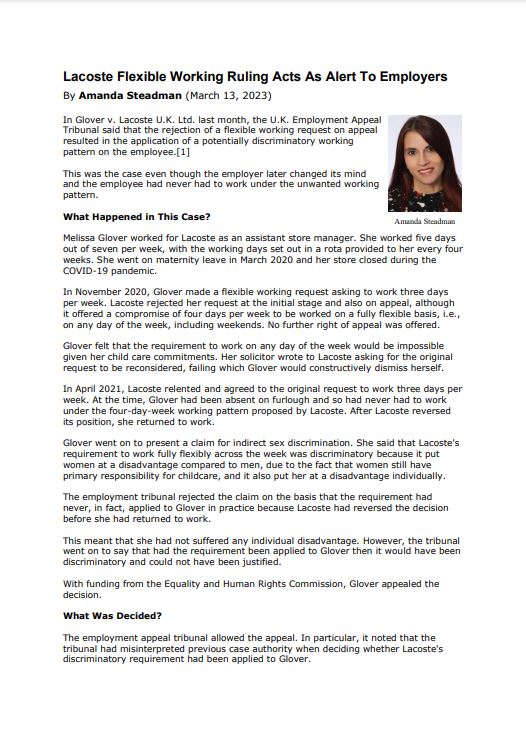
Law360 article – Lacoste Flexible Working Ruling Acts As Alert To Employers

In a recent article for Law360, BDBF Principal Knowledge Lawyer Amanda Steadman discusses the recent EAT decision of Glover v Lacoste UK Ltd which demonstrates that employers should take careful consideration when handling requests for flexible working, especially those received from absent employees. Amanda uncovers the key learning points for employers here.

BDBF is a leading law firm based at Bank in the City of London specialising in employment law. If you would like to discuss any issues relating to the content of this article, please contact Amanda Steadman (AmandaSteadman@bdbf.co.uk) or your usual BDBF contact.

Gareth Brahams speaking at “Discrimination: The Law & Strategy” ELA Course

On 16 March 2023, BDBF Partner, Gareth Brahams will be speaking at “Discrimination: The Law & Strategy,” a two-day residential course with the Employment Lawyers Association (ELA). The course will explore the practical issues of running discrimination claims, and what strategies can be used for different types of claims.

Gareth will be discussing identifying the claim and other pre-litigation steps from the claimant perspective.

Register here.


International Women’s Day 2023 – Spotlight on: Theo Nicou

To close our International Women’s Day celebrations, BDBF Senior Associate Theo Nicou, discusses his thoughts on promoting equity in the workplace.

What does International Women’s Day mean to you and why is it important?

International Women’s Day is about equality. It is about celebrating women and their achievements and being conscious that we still have a long way to go to eliminate discrimination, both conscious and unconscious.

In your opinion, what more can be done to promote equity in the workplace?

It is mind-boggling that in 2023 pay parity does not exist. Greater transparency is required to eliminate the gender pay gap which casts a long shadow over women’s careers and unjustifiably disadvantages them.  

What do you think has been the most positive step forward for gender equity over the last few years?

The normalisation of flexible working, largely enforced due to the pandemic, has meant that there is greater understanding of how well working from home or at non-standard times can work, in some cases removing barriers for women who can be disproportionately disadvantaged by old requirements of full time, in person attendance. 

Finally, tell us about a professional goal that you are proud of?

I have always been motivated to represent individuals, be it to advise them as they embark on an exciting new opportunity or to help defend them in their hour of need, and everything in between! The fact that I can do this on a daily basis is very satisfying and enhanced by the excellent lawyers I have the good fortune to work with.


Claire Dawson to speak at ABA Employment Rights and Responsibilities Committee Midwinter Meeting

BDBF Partner, Claire Dawson, is speaking on a panel about the post-pandemic future of work at the ABA Section of Labor and Employment Law Employment Rights and Responsibilities Committee Midwinter Meeting in California on 13-17 March.  


International Women’s Day 2023 – Spotlight on: Amanda Steadman

Today BDBF Principal Knowledge Lawyer Amanda Steadman, shares with us her thoughts on gender equity.

Tell us about your female role models.

Any woman who manages to keep all the balls that life throws at you in the air is a role model to me!  

In your opinion, what more can be done to promote equity in the workplace? 

In theory, shared parental leave is a great idea. It puts both parents in more or less the same boat when it comes to the possibility of taking leave during a child’s first year. This evening up should mean that women of childbearing age face less prejudice about the prospect that they may become pregnant and take maternity leave – as a father could also take extended leave. It should also encourage fathers to take a more hands on role with childcare after the first year – which should help to avoid the “childcare disparity” that often emerges with the father focusing on his career and the mother having primary responsibility for the children and having to make her career fit around that.  

In practice, however, the shared parental leave scheme is extremely fiddly and probably quite off-putting for a lot of parents. I suspect the fact that shared parental pay is so low also discourages many from even considering it. Simplifying the scheme, uplifting statutory pay to bring it in line with statutory maternity pay would make a big difference to uptake – and I think that would have real power to promote equity over time.

What do you think has been the most positive step forward for gender equity over the last few years?

The fact that so many of us have moved away from full-time office-based work has undone the (incorrect) notion that someone who works flexibly, especially sometimes from home, is somehow less committed to their role or is on the “mummy track”. Advances in technology and the normalisation of more flexible ways of working, including part-time working, hybrid working and homeworking have been helpful for women, because men want to work in these ways too.  

Finally, tell us about a professional goal or achievement that you are proud of, and what (or who) inspired you to go for it?

I think it is important not to get into too much of a comfort zone in your professional life. Taking yourself out of the comfort zone helps you to develop new skills and, I think, often helps you to produce your best work. I took a bit of a gamble when I moved from working in large, full-service respondent-facing firms into a boutique claimant-facing firm. I wasn’t sure whether I’d be able to adjust to working in such a different environment but I decided to do it anyway and I’m very glad I did! It did take me out of my comfort zone but I feel I am developing and learning all the time and have become a better lawyer for it. It also helps that BDBF is such a great place to work!


International Women’s Day 2023: Pro Bono

To mark International Women’s Day, lawyers at BDBF are each offering one hour’s free legal advice to an employee facing a discrimination and/or harassment issue at work who might not otherwise be able to obtain legal advice. To make use of this opportunity, book your appointment on International Women’s Day by contacting us on +44(0)20 3828 0350 or at info@bdbf.co.uk.

The small print:

  1. A limited number of slots are available. Appointments must be booked on International Women’s Day. We will update this post when they have all been filled.
  2. Advice will be provided over Zoom or Teams.
  3. We will need to undertake a conflict check and can only provide advice where we do not have a conflict of interest.
  4. Clients for free legal advice will need to sign our usual retainer letter and complete our onboarding process (including ID checks).
  5. We won’t be undertaking any means testing, but would like this opportunity to be used by those who might otherwise not be able to access legal advice.