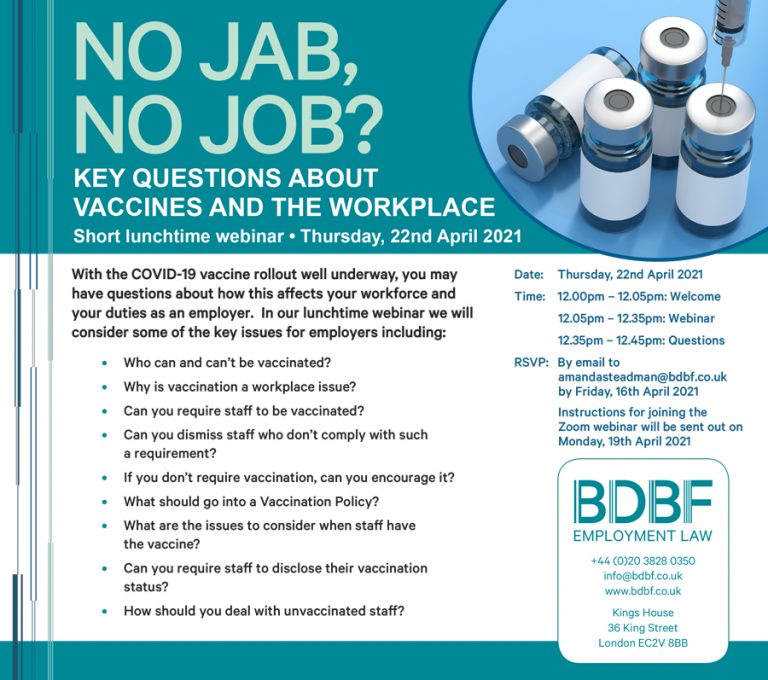
Webinar: No jab, no job? Key questions about vaccines and the workplace

[et_pb_section fb_built=”1″ _builder_version=”3.0.100″ background_image=”http://davidk423.sg-host.com/wp-content/uploads/2017/09/bdbf_final-stages-1-4-1.jpg” custom_padding=”|||” global_module=”2165″ saved_tabs=”all”][et_pb_row _builder_version=”3.25″ custom_padding=”|||”][et_pb_column type=”4_4″ _builder_version=”3.25″ custom_padding=”|||” custom_padding__hover=”|||”][et_pb_text _builder_version=”3.27.4″ background_layout=”dark” custom_margin=”0px|||” custom_padding=”0px|||”]

Employment Law News


[/et_pb_text][/et_pb_column][/et_pb_row][/et_pb_section][et_pb_section fb_built=”1″ admin_label=”section” _builder_version=”3.22.3″][et_pb_row admin_label=”row” _builder_version=”3.25″ background_size=”initial” background_position=”top_left” background_repeat=”repeat”][et_pb_column type=”4_4″ _builder_version=”3.25″ custom_padding=”|||” custom_padding__hover=”|||”][et_pb_text _builder_version=”4.7.4″ text_orientation=”justified” use_border_color=”off”]

Webinar: No jab, no job? Key questions about vaccines and the workplace

In this 45 minute webinar, BDBF’s Knowledge Lawyer Amanda Steadman and Managing Associate Tom McLaughlin consider key questions about vaccines and the workplace.  This webinar was originally delivered on 22 April 2021 and reflects our understanding as at that date.  Do get in contact with either of the speakers if you would like to discuss any of the issues raised. 

To view the PDF webinar slides please click on the image below, or view the recording of the webinar:

[/et_pb_text][/et_pb_column][/et_pb_row][et_pb_row column_structure=”1_2,1_2″ admin_label=”row” _builder_version=”3.25″ background_size=”initial” background_position=”top_left” background_repeat=”repeat”][et_pb_column type=”1_2″ _builder_version=”3.25″ custom_padding=”|||” custom_padding__hover=”|||”][et_pb_image src=”http://davidk423.sg-host.com/wp-content/uploads/2021/04/BDBF-vaccine-webinar-22-April-2021.jpg” title_text=”BDBF-vaccine-webinar-22-April-2021″ url=”http://davidk423.sg-host.com/wp-content/uploads/2021/04/BDBF-vaccine-webinar-22-April-2021.pdf” url_new_window=”on” align=”center” _builder_version=”4.7.4″ _module_preset=”default” border_width_all=”2px” border_color_all=”#008395″][/et_pb_image][/et_pb_column][et_pb_column type=”1_2″ _builder_version=”3.25″ custom_padding=”|||” custom_padding__hover=”|||”][et_pb_video src=”https://youtu.be/vj_6LfTRsDE” _builder_version=”4.7.4″ _module_preset=”default”][/et_pb_video][/et_pb_column][/et_pb_row][et_pb_row admin_label=”row” _builder_version=”3.25″ background_size=”initial” background_position=”top_left” background_repeat=”repeat”][et_pb_column type=”4_4″ _builder_version=”3.25″ custom_padding=”|||” custom_padding__hover=”|||”][et_pb_text _builder_version=”4.7.4″ text_orientation=”justified” use_border_color=”off”]

Please contact Amanda Steadman (amandasteadman@bdbf.co.uk), Tom McLaughlin (tommclaughlin@bdbf.co.uk), or your usual BDBF contact, for further advice.

[/et_pb_text][/et_pb_column][/et_pb_row][/et_pb_section][et_pb_section fb_built=”1″ _builder_version=”3.26.6″][et_pb_row _builder_version=”3.26.6″][et_pb_column type=”4_4″ _builder_version=”3.26.6″][/et_pb_column][/et_pb_row][/et_pb_section]
https://www.youtube.com/watch?v=vj_6LfTRsDE


AWARD WINNING EMPLOYMENT LAW FIRM BDBF LANDS SLATER & GORDON’S FORMER NATIONAL HEAD OF EMPLOYMENT CLAIRE DAWSON

[et_pb_section fb_built=”1″ _builder_version=”3.0.100″ background_image=”http://davidk423.sg-host.com/wp-content/uploads/2017/09/bdbf_final-stages-1-4-1.jpg” custom_padding=”|||” global_module=”2165″ saved_tabs=”all”][et_pb_row _builder_version=”3.25″ custom_padding=”|||”][et_pb_column type=”4_4″ _builder_version=”3.25″ custom_padding=”|||” custom_padding__hover=”|||”][et_pb_text _builder_version=”3.27.4″ background_layout=”dark” custom_margin=”0px|||” custom_padding=”0px|||”]

Employment Law News


[/et_pb_text][/et_pb_column][/et_pb_row][/et_pb_section][et_pb_section fb_built=”1″ admin_label=”section” _builder_version=”3.22.3″][et_pb_row column_structure=”3_5,2_5″ admin_label=”row” _builder_version=”3.25″ background_size=”initial” background_position=”top_left” background_repeat=”repeat”][et_pb_column type=”3_5″ _builder_version=”3.25″ custom_padding=”|||” custom_padding__hover=”|||”][et_pb_text _builder_version=”4.7.4″ text_orientation=”justified” hover_enabled=”0″ use_border_color=”off” sticky_enabled=”0″]

AWARD-WINNING EMPLOYMENT LAW FIRM BDBF LANDS SLATER & GORDON’S FORMER NATIONAL HEAD OF EMPLOYMENT CLAIRE DAWSON

Top-ranked, specialist employment law firm BDBF today announces the appointment of new equity partner Claire Dawson. She is one of the most highly regarded lawyers in the field of employment law. She was National Head of the Employment Law Practice at Slater & Gordon, and most recently a partner in market-leading employment law firm CC Solicitors in Dublin.  Claire’s hire follows hot on the heels of the appointment of Paula Chan six months ago, who also joined the firm from Slater & Gordon. Both significantly bolster BDBF’s already strong market lead for advising and representing senior individuals in high-profile employment disputes.

BDBF was launched in 2012 by high profile former Lewis Silkin partner and Head of Employment at Stewarts, Gareth Brahams. The new firm quickly made the top of the legal directory rankings and the firm has led on ground-breaking cases. Since its inception the firm has grown from strength to strength, acquiring top talent in the senior executive employment dispute space, putting BDBF in an even better position to attract the best cases and the best talent.

[/et_pb_text][/et_pb_column][et_pb_column type=”2_5″ _builder_version=”3.25″ custom_padding=”|||” custom_padding__hover=”|||”][et_pb_image src=”http://davidk423.sg-host.com/wp-content/uploads/2021/03/Claire-Dawson.jpg” title_text=”Claire-Dawson” _builder_version=”4.7.4″ border_width_all=”4px” border_color_all=”#1D7078″][/et_pb_image][/et_pb_column][/et_pb_row][et_pb_row admin_label=”row” _builder_version=”3.25″ background_size=”initial” background_position=”top_left” background_repeat=”repeat”][et_pb_column type=”4_4″ _builder_version=”3.25″ custom_padding=”|||” custom_padding__hover=”|||”][et_pb_text _builder_version=”4.7.4″ text_orientation=”justified” use_border_color=”off”]

Claire has over 17 years’ experience as an employment lawyer and she is dual qualified in England & Wales and Ireland.   Claire has been consistently recommended in the Legal 500 and the Chambers Guide for London Employment: Senior Executive, most recently in the top 20 lawyers in the Chambers Guide and a leading practitioner in Who’s Who Legal (England) when practising in London. She is also a recommended Global Leader in Labour & Employment Law (Ireland). Having trained and qualified at a firm focusing on employer work, she made the switch to advising and representing employees early in her career at Russell Jones & Walker (later acquired by Slater & Gordon). Since then, Claire has acted for a wide range of senior individuals in financial services, professional services, large multinationals, healthcare and technology in relation to disputes and exits.  She has significant experience of running high-value discrimination and whistleblowing complaints for those working in regulated sectors.  Claire has a particular interest in issues facing women at work, including pregnancy and maternity discrimination, the gender pay gap and sexual harassment. Claire is a regular speaker and commentator on employment law issues, both nationally and internationally.

Gareth Brahams, Managing Partner of BDBF said,

“We are delighted Claire has joined the firm. Claire joins us as the world of work is about to undergo yet another period of radical change as we move out of lockdown. The firm continues to attract the employment sector’s heavyweights, driving success on landmark and complex cases. Our ambitious and considered growth trajectory will ensure that we continue to strengthen our position as the go-to firm for senior regulated individuals in their employment disputes.”

Claire said,

“I am excited to be joining BDBF, a firm that is not only at the very top of its field professionally, acting on the most significant employment cases, but one that also places such emphasis on looking after its people, promoting close team working and developing a positive and supportive culture internally.”


[/et_pb_text][/et_pb_column][/et_pb_row][/et_pb_section][et_pb_section fb_built=”1″ _builder_version=”3.26.6″][et_pb_row _builder_version=”3.26.6″][et_pb_column type=”4_4″ _builder_version=”3.26.6″][/et_pb_column][/et_pb_row][/et_pb_section]


Webinar: 10 things for employers to know about in 2021

Employment Law News

BDBF’S Webinar: 10 things for employers to know about in 2021

On 25 January 2021, we held a webinar looking at the top 10 things for employers to know about in 2021.  Here you can access the recording of that webinar, together with the slide presentation used on the day.  Also on our website, you can access the BDBF 2021 Roadmap for HR, which covers the key actions points from the webinar.

To view the PDF webinar slides please click on the image below, or view the recording of the webinar:

BDBF can help businesses and employers prepare for the future. Please contact Amanda Steadman (amandasteadman@bdbf.co.uk), or your usual BDBF contact, for further advice.


Employers urged to help survivors of domestic abuse

[et_pb_section fb_built=”1″ _builder_version=”3.0.100″ background_image=”http://davidk423.sg-host.com/wp-content/uploads/2017/09/bdbf_final-stages-1-4-1.jpg” custom_padding=”|||” global_module=”2165″ saved_tabs=”all”][et_pb_row _builder_version=”3.25″ custom_padding=”|||”][et_pb_column type=”4_4″ _builder_version=”3.25″ custom_padding=”|||” custom_padding__hover=”|||”][et_pb_text _builder_version=”3.27.4″ background_layout=”dark” custom_margin=”0px|||” custom_padding=”0px|||”]

Employment Law News


[/et_pb_text][/et_pb_column][/et_pb_row][/et_pb_section][et_pb_section fb_built=”1″ admin_label=”section” _builder_version=”3.22.3″][et_pb_row admin_label=”row” _builder_version=”3.25″ background_size=”initial” background_position=”top_left” background_repeat=”repeat”][et_pb_column type=”4_4″ _builder_version=”3.25″ custom_padding=”|||” custom_padding__hover=”|||”][et_pb_text _builder_version=”4.7.4″ text_orientation=”justified” hover_enabled=”0″ use_border_color=”off” sticky_enabled=”0″]Employers urged to help survivors of domestic abuse

This week marks sexual abuse and sexual violence awareness week. Most employers are aware of their obligations to prevent abuse and violence in the workplace, but with lines blurring between the home and the office should employers support those suffering at home?

During the first lockdown period, there was a significant surge in victims seeking support for domestic abuse. Refuge recorded an 80% increase in calls in March alone. This trend has continued over the last 12 months.

The nature of lockdown (and we are now on national lockdown number three) has meant that victims of domestic abuse have become even more isolated. The loss of connections to the outside world has made them more vulnerable and allowed perpetrators even more control over their lives. The most horrifying fallout of the national lockdowns is that it has prevented victims from any respite from their abuse – trapped in their own homes – a supposedly safe space for so many of us. Most notably, there have been more reports of abusers’ control over their victims’ IT devices, making it even more difficult for those in need of help to seek help.

On 14 January 2021, Business Minster Paul Scully MP sent an open letter to all employers urging them (us) to consider what can be done to help survivors of domestic abuse.

https://www.gov.uk/government/publications/domestic-abuse-open-letter-to-employers-on-how-to-help-workers-find-the-right-support/domestic-abuse-open-letter-from-the-business-minister-to-employers

The open letter rightly points out that domestic abuse is still a taboo subject and few employers have any coherent workplace policy or support framework to deal with the possibility that its workers could be victims of domestic abuse. Given the strides forward so far as mental health at work is concerned, why shouldn’t the same apply in relation to domestic abuse?

At present, the only social contact many victims have is with colleagues (albeit virtually). Employers are therefore in a unique position to identify changes in their employees’ conduct which could indicate abuse. For example, if an employee is suddenly more withdrawn, overly critical of themselves and their work, there is an unexpected dip in their performance or references being made to their partner’s (or other family member’s) controlling behaviour. These cues may be subtle to begin with, but over time they may build to reveal the reality of incredibly difficult personal circumstances.

But what can an employer do if it suspects that an employee is suffering abuse?

Firstly, acknowledge that domestic abuse can take many different forms including: coercive control, economic abuse, online or digital abuse, harassment and stalking, psychological and sexual abuse.

The open letter refers to the following initiatives an employer could implement in order to help those who may need help:

  1. Respond appropriately – listen, try to understand and take care not to place blame on the victim. Acknowledge how brave it is to talk about domestic abuse.
  1. Raise awareness – is there a policy in place offering useful guidance and information on how to access support? Has training been offered to help staff spot the signs and what to do if they suspect a colleague is being subjected to domestic abuse? Is there a clear message that all staff should feel comfortable raising these issues and in doing so that they will be supported? A poster/email or information on the intranet with details of support groups is a great start. Small things can make a big difference.
  1. Pragmatic ways to help – it’s not always about offering a shoulder to cry on, there are practical ways to help too. For example, offer to pay an employee’s salary into a separate bank account, put in place flexible working arrangements or provide a private space for employees to make calls or other administrative tasks they may not be able to freely do at home.
  1. There is lots of free support available – use it! Please see the links at the end of this article which signpost useful toolkits on how employers and employees can help those suffering from domestic abuse.
  1. Involve experts – domestic abuse is a sensitive and complex issue. No one expects an employer to become an expert overnight. If an employer finds itself in a difficult situation concerning an employee and domestic abuse, it should seek external help. The type of external support will depend on the situation and also whether or not an employer has the victim’s permission to do so.
  1. Critically – household isolation instructions as a result of coronavirus do not apply if you need to leave your home to escape domestic abuse However, make sure to get professional advice before advising on this specific point.

Dealing with the possibility that an employee may be the subject of domestic abuse is a terrifying prospect and most employers would be fearful of getting it wrong. The primary way to begin tackling this deeply complex and frightening situation is by raising awareness, offering an open and trustworthy environment for victims and identifying a need for support.

Emily Plosker is a Senior Associate at leading employment law firm BDBF

Further support can be found here:

Helplines/Websites

https://www.nationaldahelpline.org.uk/

The freephone, 24-hour National Domestic Abuse Helpline 0808 2000 247

https://www.solacewomensaid.org/contact-us

Men’s Advice Line – confidential helpline, email and webchat service for male victims of domestic abuse.

Call 0808 8010327 or visit mensadviceline.org.uk

 [/et_pb_text][/et_pb_column][/et_pb_row][/et_pb_section][et_pb_section fb_built=”1″ _builder_version=”3.26.6″][et_pb_row _builder_version=”3.26.6″][et_pb_column type=”4_4″ _builder_version=”3.26.6″][/et_pb_column][/et_pb_row][/et_pb_section]


Race equality week, what is it and how can you get involved?

[et_pb_section fb_built=”1″ _builder_version=”3.0.100″ background_image=”http://davidk423.sg-host.com/wp-content/uploads/2017/09/bdbf_final-stages-1-4-1.jpg” custom_padding=”|||” global_module=”2165″ saved_tabs=”all”][et_pb_row _builder_version=”3.25″ custom_padding=”|||”][et_pb_column type=”4_4″ _builder_version=”3.25″ custom_padding=”|||” custom_padding__hover=”|||”][et_pb_text _builder_version=”3.27.4″ background_layout=”dark” custom_margin=”0px|||” custom_padding=”0px|||”]

Employment Law News


[/et_pb_text][/et_pb_column][/et_pb_row][/et_pb_section][et_pb_section fb_built=”1″ admin_label=”section” _builder_version=”3.22.3″][et_pb_row admin_label=”row” _builder_version=”3.25″ background_size=”initial” background_position=”top_left” background_repeat=”repeat”][et_pb_column type=”4_4″ _builder_version=”3.25″ custom_padding=”|||” custom_padding__hover=”|||”][et_pb_text _builder_version=”4.7.4″ text_orientation=”justified” use_border_color=”off”]

Race equality week, what is it and how can you get involved?

Did you know that we are in the middle of the UK’s first ever Race Equality Week?  The week runs from 1 to 7 February 2021 and aims to bring UK employers, organisations and the wider public together to address issues affecting ethnic minority employees with the aim of igniting real change.

The Race Equality Network launched the initiative against the backdrop of the world-changing events that took place in 2020, namely the Black Lives Matter movement and the disproportionate impact of Covid-19 on ethnic minorities. These events generated a new level of public consciousness of race inequality on our doorstep in the UK.

The Race Equality Network have multiple events on this week and have highlighted on their website the ways for organisations and individuals to get involved by taking part in one or more of their three key initiatives  – The Virtual Badge Campaign, Safe Space and The Big Promise.

The theme of this year’s Race Equality Week

The theme of this year’s Race Equality Week is “Transparency, Accountability, Action” which is already a hot topic across many different sectors. The ambition for the week is “let’s not go back to normal”. An interesting point as prior to 2020, 75% of ethnic minorities experienced racism in the workplace. The week’s ambition is that we take what we have learnt from 2020 and use that to drive change.

In addition, lack of representation continues to be an issue.  Figures published by Business in the Community have shown that despite making up over 3% of the population of England and Wales, black people held just 1.5% of the 3.7 million director and manager level roles across the public and private sectors in 2019.  This is only a 0.1% increase since the last Race at the Top report in 2014.

What can employers do?

Beyond getting involved in the Race Equality Week initiative and events, employers should consider the measures set out in the Race at Work charter devised by Business in the Community.   The charter contains five calls to action to ensure that ethnic minority employees are represented at all levels in an organisation:

  1. Appoint an Executive Sponsor for race: this should assist to provide visible leadership and drive key decisions. this approach has been adopted with some success in the context of improving gender equality within the workplace. For example, annual gender pay gap reports must be signed off by a director or equivalent within the business, and many reports now open with a statement by that person, outlining the company’s values and progress in that arena.
  1. Capture ethnicity data and publicise progress: gathering ethnicity data from the employee population is essential to be able to monitor and report progress over time. This data will also be necessary if, and when, businesses are required to report on their ethnicity pay. However, there are many hurdles around collecting, analysing and reporting ethnicity data.  For example, employees are not legally obliged to disclose their ethnicity to their employer and research shows that self-declaration can be as low as 50%, meaning data sets will be incomplete.  Employers need to think carefully how they can encourage self-declaration (e.g. by demonstrating that the data will be kept secure) and ensure that it is collected at different points (e.g. at the recruitment stage and then again at the onboarding stage) and at regular enough intervals to enable progress to be monitored effectively.
  1. Commit at Board level to zero tolerance of harassment and bullying: a recent survey revealed that 25% of ethnic minority employees reported that they had witnessed or experienced racial harassment or bullying from managers. Board level commitment should be secured to stamp this out.  In addition, appropriate training should be delivered across the workforce, clear policies must be put in place and a consistent approach taken towards any offending behaviour.
  1. Make clear that supporting equality in the workplace is the responsibility of all leaders and managers: for example, performance objectives could be tied to such responsibilities. Again, this is something we have seen used to good effect in gender equality arena. For example, senior executives at TSB had their bonuses cut for failing to meet gender equality targets.
  1. Take action that supports ethnic minority career progression: taking positive action has the potential to make the biggest impact on representation rates. Many employers will have embraced (or be prepared to embrace) positive action pre-recruitment, for example, deploying targeted advertising, outreach work and offering mentoring, training and networking opportunities.  However, few employers within the private sector will have used positive action at the point of recruitment, largely for fear of “reverse discrimination” claims.  BDBF have published a detailed paperand presentation on Positive Action in the Workplace, which aims to demystify this area of the law.

If you would like to discuss any of the issues raised in this article or how BDBF can help your business navigate race at work issues,  then please contact Hannah Lynn (hannahlynn@bdbdf.co.uk), Amanda Steadman (amandasteadman@bdbf.co.uk) or your usual BDBF contact.


[/et_pb_text][/et_pb_column][/et_pb_row][/et_pb_section][et_pb_section fb_built=”1″ _builder_version=”3.26.6″][et_pb_row _builder_version=”3.26.6″][et_pb_column type=”4_4″ _builder_version=”3.26.6″][/et_pb_column][/et_pb_row][/et_pb_section]


Race Equality Week to kickstart long term racial equality at work

[et_pb_section fb_built=”1″ _builder_version=”3.0.100″ background_image=”http://davidk423.sg-host.com/wp-content/uploads/2017/09/bdbf_final-stages-1-4-1.jpg” custom_padding=”|||” global_module=”2165″ saved_tabs=”all”][et_pb_row _builder_version=”3.25″ custom_padding=”|||”][et_pb_column type=”4_4″ _builder_version=”3.25″ custom_padding=”|||” custom_padding__hover=”|||”][et_pb_text _builder_version=”3.27.4″ background_layout=”dark” custom_margin=”0px|||” custom_padding=”0px|||”]

Employment Law News


[/et_pb_text][/et_pb_column][/et_pb_row][/et_pb_section][et_pb_section fb_built=”1″ admin_label=”section” _builder_version=”3.22.3″][et_pb_row admin_label=”row” _builder_version=”3.25″ background_size=”initial” background_position=”top_left” background_repeat=”repeat”][et_pb_column type=”4_4″ _builder_version=”3.25″ custom_padding=”|||” custom_padding__hover=”|||”][et_pb_text _builder_version=”4.7.4″ text_orientation=”justified” use_border_color=”off”]

Race Equality Week to kickstart long term racial equality at work

In this article, Melvyna Mumunie explains the continuing pressure on the Government to introduce mandatory ethnicity pay reporting and outlines the key considerations for its implementation. 

What is Race Equality Week and what is the key theme this year?

The UK’s first Race Equality Week runs from 1 to 7 February 2021. The initiative is designed to promote and effect change in the workplace – its stated aim being to unite “…hundreds of organisations and individuals in activity to address the barriers facing race equality in the workplace”.  The central theme for 2021 is “Transparency and Accountability”.

Although employer engagement will be key in a movement towards greater racial equality in the workplace, the Government holds the key to one of the most important mechanisms for promoting transparency and accountability – ethnicity pay reporting.

Where does the Government stand on ethnicity pay reporting?

It has been unlawful to discriminate in employment on the grounds of race since the implementation of the 1968 Race Relations Act.  Yet in 2018 the Government acknowledged that workers from ethnic minority backgrounds are still more likely to be in low paid and low skilled employment. In an effort to address the continuing issue of race inequality, the Government consulted on proposals to introduce mandatory ethnicity pay reporting for large employers (i.e. those with 250+ employees).  That consultation closed in January 2019 but the Government is yet to publish its response.  However, there are reasons to think that there is broad support for the consultation proposals.

In December 2020 the BBC reported that it had obtained an unpublished document in connection with the consultation, which revealed that 73% of the 321 respondents to the consultation supported compulsory ethnicity pay reporting for large employers.  Moreover, some organisations such as the Employment Lawyers Association and the Black Solicitors Network published their own responses to the consultation.  In response to the key question, “What are the main benefits for employers in reporting their ethnicity pay information?”, they highlighted several positives including the promotion of integrity and accountability, establishing and improving employee relations, marketing and profile-raising and societal benefit in the context of equal pay.

Is there an appetite for ethnicity pay reporting?

Despite the radio silence from the Government, calls for the introduction of the regime gathered momentum throughout 2020 amongst businesses, politicians and wider society.  For example:

  • In 2020, a Parliamentary petition to introduce mandatory ethnicity pay reporting received over 130,000 signatures by the time it closed. The Government’s lukewarm response was to refer back to the consultation stating that: “The Government is continuing to analyse this data and is committed to responding to the consultation by the end of the year at the latest.” No response was published in 2020.
  • In February 2020, the Confederation of British Industry renewed pressure on large employers by calling for companies with more than 250 employees to publish their ethnicity pay data voluntarily, mirroring the format used for gender pay reporting. And employers have not baulked at this.   Many high profile organisations including the BBC, Deloitte, Network Rail and Lloyds Banking Group have led the way on voluntarily reporting their figures.  Furthermore, a PricewaterhouseCoopers’ poll of over 100 companies (that collectively employ more than one million UK employees) found an increase from 8% in 2018 to 23% in 2020 in voluntary ethnicity pay reporting amongst employers.
  • More recently, Labour MP Stella Creasy’s Equal Pay (Information and Claims) Private Member’s Bill began its passage through Parliament in October 2020.  Amongst other things, the Bill seeks to introduce ethnicity pay reporting to organisations with 100+ employees. While Private Member’s Bills don’t often make it onto the statute books, this Bill has cross-party support and might just make it.  At the very least, it has the capacity to keep up the pressure on the Government in this area.

What are the keys to success?

For a reporting regime to effectively facilitate equality in the workplace, lessons should be learnt from the gender pay gap reporting regime introduced in 2017.

While most employers were comfortable with the idea of gender pay reporting, many found the process to be difficult and required external legal advice on navigating the process.  The complexity of the process led to the reporting of some highly improbable, inaccurate or questionable data in the early days of the regime. A clear and accessible framework for reporting will be key to enabling businesses to report their figures accurately and inform their strategy for change.

Raw data and numbers alone do not help employees or the public understand an employer’s pay gap information. Mandatory narratives and reporting of contextual data (e.g. a breakdown of ethnicities across the workforce, a breakdown of employees by region/geographical location and pay bands where relevant), would help address this issue.

Reporting poor figures can lead to public embarrassment, but embarrassment does not necessarily result in change.

Employers should also be encouraged to publish action plans and report on how pay gaps will be closed.   Employers should also be encouraged to report on, and take into account, various overlapping characteristics for example, ethnicity and gender.  This will help employers develop meaningful strategies to address complex pay disparity issues affecting employees.

Closing thoughts

Clearly, there is an appetite for an ethnicity pay reporting regime and it may be within grasp.  The Government would do well to approach the implementation of the regime with great care to ensure that it is more than just a tick box compliance exercise.  Of course, the approach may need to be developed and refined over time, but there are many clear lessons that can be learnt from the events of the past year, historical data collection and the gender pay gap reporting regime.

If you would like to know more, or your business needs advice, please contact Melvyna Mumunie (melvynamumunie@bdbf.co.uk), Amanda Steadman (amandasteadman@bdbf.co.uk) or your usual BDBF contact.

[/et_pb_text][/et_pb_column][/et_pb_row][/et_pb_section][et_pb_section fb_built=”1″ _builder_version=”3.26.6″][et_pb_row _builder_version=”3.26.6″][et_pb_column type=”4_4″ _builder_version=”3.26.6″][/et_pb_column][/et_pb_row][/et_pb_section]


Unfair dismissal: interim relief applications should be heard in public

[et_pb_section fb_built=”1″ _builder_version=”3.0.100″ background_image=”http://davidk423.sg-host.com/wp-content/uploads/2017/09/bdbf_final-stages-1-4-1.jpg” custom_padding=”|||” global_module=”2165″ saved_tabs=”all”][et_pb_row _builder_version=”3.25″ custom_padding=”|||”][et_pb_column type=”4_4″ _builder_version=”3.25″ custom_padding=”|||” custom_padding__hover=”|||”][et_pb_text _builder_version=”3.27.4″ background_layout=”dark” custom_margin=”0px|||” custom_padding=”0px|||”]

Employment Law News


[/et_pb_text][/et_pb_column][/et_pb_row][/et_pb_section][et_pb_section fb_built=”1″ admin_label=”section” _builder_version=”3.22.3″][et_pb_row admin_label=”row” _builder_version=”3.25″ background_size=”initial” background_position=”top_left” background_repeat=”repeat”][et_pb_column type=”4_4″ _builder_version=”3.25″ custom_padding=”|||” custom_padding__hover=”|||”][et_pb_text _builder_version=”4.7.4″ text_orientation=”justified” hover_enabled=”0″ use_border_color=”off” sticky_enabled=”0″]

Unfair dismissal: interim relief applications should be heard in public

In Queensgate Investments LLP v Millet the Employment Appeal Tribunal (EAT) ruled that applications for interim relief should be heard in public, save where an order is made to restrict publicity.  This is the first appellant authority on this point, with BDBF acting for the successful respondent to the appeal.

What does the law say?

Interim relief is a powerful remedy open to claimants in a small number of specific claims for automatic unfair dismissal, namely where the dismissal is for one of the following reasons:

  • making a protected disclosure (whistleblowing);
  • trade union membership or activities; and
  • activities as a representative for health and safety, collective redundancy, TUPE or working time purposes or as a pension scheme trustee.

Where a Tribunal grants interim relief, the consequences for the employer are particularly onerous.  The Tribunal will order that the employer either reinstates or reengages the claimant, pending the outcome of the unfair dismissal claim (which could be many months after the interim relief application hearing).  If the employer is unwilling to do this, the Tribunal will order the employer to pay the claimant’s wages as if the employment contract was continuing, again pending the outcome of the unfair dismissal claim.  What’s notable is that even if the claimant loses the unfair dismissal claim, they do not have to repay these sums to the employer.

Applications for interim relief have to made within seven days of the date of dismissal, with the hearing of the application following as soon as practicable thereafter.  Interim relief will only be granted where the Tribunal is satisfied that the claimant is likely to succeed in their claim for automatic unfair dismissal.  In practice, this means that the allegations surrounding the dismissal are ventilated at a much earlier point in proceedings than would otherwise have been the case.

BDBF has advised on many applications for interim relief.  In each case, the hearing of such applications has been held in public.  However, until now, there has been no binding authority on this point.

What was decided?

Put simply, the EAT’s decision was that the Employment Tribunal Rules of Procedure 2013 (ET Rules) require interim relief hearings to be held in public.  The EAT ruled that interim relief applications involve the determination of a preliminary issue and the ET Rules provide that hearings of such matters are held in public.

The EAT also noted that the principle of open justice required hearings to be held in public absent any clear statement in the ET Rules to the contrary (and there was no such statement).  Furthermore, holding interim relief applications in private could infringe a claimant’s right to a fair and public hearing and/or freedom of expression under the European Convention on Human Rights.

Therefore, the default position is that an interim relief application must be heard in public, although an exception may be made where an order is made restricting publicity of the claim.  However, such orders are not made lightly.  A risk that the employer will suffer commercial embarrassment is not enough.  Instead, the employer would need to demonstrate that publicity could have catastrophic consequences for the business, such that justice could not be done unless the hearing was held in private.  The burden is on the employer to prove such circumstances exist and compelling evidence must be provided with the application.

What does this mean for employers?

If you are on the receiving end of an interim relief application, you should work on the assumption that the hearing will be held in public.  This is something you will need to factor into your overall litigation strategy, particularly where the allegations are potentially damaging to your business.

In appropriate cases, you may be able to secure an order restricting publicity.  Where this is not possible, and you wish to proceed with defending the application, then you may wish to consider engaging the services of a media consultant to optimise your media strategy and protect your interests.  Alternatively, you may take the commercial decision to settle the claim.  Here, it’s important to remember that the hearing will take place quickly and so the time available to negotiate a settlement will be very limited.

The key point is that time will be extremely short and legal advice should be sought as soon as possible.

Queensgate Investments LLP v Millet

If you would like to know more, or your business needs advice on how to respond to an interim relief application, please contact Amanda Steadman (amandasteadman@bdbf.co.uk) or your usual BDBF contact.

[/et_pb_text][/et_pb_column][/et_pb_row][/et_pb_section][et_pb_section fb_built=”1″ _builder_version=”3.26.6″][et_pb_row _builder_version=”3.26.6″][et_pb_column type=”4_4″ _builder_version=”3.26.6″][/et_pb_column][/et_pb_row][/et_pb_section]


Getting your restrictive covenants right – a cautionary tale

[et_pb_section fb_built=”1″ _builder_version=”3.0.100″ background_image=”http://davidk423.sg-host.com/wp-content/uploads/2017/09/bdbf_final-stages-1-4-1.jpg” custom_padding=”|||” global_module=”2165″ saved_tabs=”all”][et_pb_row _builder_version=”3.25″ custom_padding=”|||”][et_pb_column type=”4_4″ _builder_version=”3.25″ custom_padding=”|||” custom_padding__hover=”|||”][et_pb_text _builder_version=”3.27.4″ background_layout=”dark” custom_margin=”0px|||” custom_padding=”0px|||”]

Employment Law News


[/et_pb_text][/et_pb_column][/et_pb_row][/et_pb_section][et_pb_section fb_built=”1″ admin_label=”section” _builder_version=”3.22.3″][et_pb_row admin_label=”row” _builder_version=”3.25″ background_size=”initial” background_position=”top_left” background_repeat=”repeat”][et_pb_column type=”4_4″ _builder_version=”3.25″ custom_padding=”|||” custom_padding__hover=”|||”][et_pb_text _builder_version=”4.7.4″ text_orientation=”justified” hover_enabled=”0″ use_border_color=”off” sticky_enabled=”0″]

Getting your restrictive covenants right – a cautionary tale

A recent High Court decision reminds employers of the importance of tailoring restrictive covenants to the employee.  In Quilter Private Client Advisers Ltd v Falconer, the employer had legitimate business interests worthy of protection, but the post-termination restrictions it had put in place were unreasonable.

What does the law say?

Restrictive covenants are used by employers to protect their interests once an employee has departed the business. These may take the form of:

  • non-competition clauses, which prevent an employee from working in a competing business for a period of time usually in a particular role and sometimes confined to a geographical area;
  • non-solicitation clauses, which prevent an employee from soliciting specified clients or customers for a period of time; and
  • non-dealing covenants which prevent an employee from dealing with specified clients or customers of the business for a period of time.

The starting point is that such covenants are treated as an unlawful restraint of trade unless they protect a legitimate proprietary business interest of the employer.  Any restraint that is to overcome this hurdle must be reasonable and go no further than is necessary to protect the employer’s legitimate interests.  It is for the employer to show that the restraint is reasonable.

What happened in this case?

Ms Falconer was employed by Quilter as a financial adviser, taking over an existing client base from a retiring adviser.  Her contract of employment contained several post-termination restrictions, including a nine-month non-compete clause and 12-month non-solicitation and non-dealing clauses.

Ms Falconer did not enjoy working for Quilter and resigned after six months to work as a self-employed adviser for an organisation called Continuum.  As she was still within her probationary period, she was subject to a two-week notice period only. 

Ms Falconer took confidential information belonging to Quilter regarding various clients whom she wished to engage in her new role.  Quilter sued Ms Falconer for breach of contract and sought an interim injunction (and ultimately a final injunction) to enforce the restrictive covenants.  Quilter alleged that Ms Falconer had breached the implied duty of fidelity and the express terms of her employment contract by:

  • not showing Continuum her Quilter employment contract containing the restrictive covenants;
  • contacting Quilter’s clients during her period of garden leave without Quilter’s permission; and
  • taking confidential information before she left Quilter’s employment.

Quilter also sued Continuum for inducing Ms Falconer to take the confidential information in breach of contract.

What was decided?

The High Court granted an interim injunction against Ms Falconer requiring her to abide by the covenants until the earlier of the date by which they expired and a full trial.  In many cases that would have ended the dispute.  However, in this case, a full trial did go on to take place.

The High Court dismissed the claim of inducement against Continuum.  Ms Falconer was engaged as an independent contractor and she had (unbeknownst to Continuum) uploaded the confidential material she had taken from Quilter onto a portal provided by Continuum.  Merely facilitating a breach of contract (without knowing about it) was not enough to amount to inducement.

Ms Falconer was found to have breached her contract in the following ways:

  • she had scanned confidential client information onto her personal laptop;
  • she had not shown Continuum her contract of employment with Quilter (in breach of an express clause);
  • she had attended Continuum’s induction course while still employed by Quilter; and
  • she had contacted Quilter’s clients during her garden leave with a view to transferring their business without permission.

However, the High Court went on to decide that the restrictive covenants were invalid.  Although Quilter had legitimate business interests worthy of protection, the restrictions went too far.

The non-competition clause

The Court said that the non-compete went beyond what was reasonably necessary.  Quilter’s legitimate interests were the protection of its goodwill and confidential information, but this could have been achieved by way of non-dealing and non-solicitation covenants and confidentiality clauses.  The covenant was not saved by its geographical limitations because it covered wider areas than those that Ms Falconer had covered (and even if it had covered the correct area, it may not have come to Quilter’s rescue).

The Court also took into account Ms Falconer’s length of service.  The nine-month non-compete applied no matter how long Ms Falconer had been employed by Quilter.  No adjustment had been made for employees leaving during their probationary period and/or after only a short period of employment.  The Court considered that in her short period of employment Ms Falconer would not have been able to establish long-term relationships with clients. 

In addition, the Court noted that the length of the notice period can be an indication of the unreasonableness of the length of the restraint.  The shorter the notice period (here, it was 2 weeks), the less important the employee’s services appear to be to the employer and, therefore, the harder it is to persuade the Court that nine months of non-competition is reasonably necessary to protect business interests.  Moreover, a much more senior employee in the business was subject to a shorter non-compete restriction of six-months.

Taking all of this together, the High Court found the non-compete restriction to be void.

The non-solicitation and non-dealing clauses

Ms Falconer’s contract also had 12-month non-solicitation and non-dealing clauses which restricted her from soliciting, or providing financial services to, anyone who had been a Quilter client in the 18 months before her employment ended and with whom she had had material personal contact or had been materially concerned with during that time.  

However, the drafting of the covenants meant that the restrictions were not, in fact, limited to clients that she had dealt with, or to those who had been clients during the course of her employment.  Quilter also failed to give evidence to support why an 18-month backstop was necessary, particularly in an environment where clients had bi-annual reviews.  A six-month or 12-month backstop might have been reasonable.

The Court concluded that these restrictions were wider than necessary and, therefore, void.

What are the learning points?

Like many other cases before it, this decision highlights the importance of avoiding a blanket approach when drafting post-termination restrictions.  It is important to look at the specific circumstances before putting pen to paper.  Where non-compete restrictions are concerned, it is also important to tailor these to reflect the length of the employment relationship and importance of the employee’s role.  Such covenants should be benchmarked against similar covenants in place for more senior employees. 

The Government is consulting on whether non-compete restrictions should be banned altogether, or subject to new rules placing limits on the length of the restriction and requiring employers to compensate the employee during any restricted period.   If taken forward, employers will need to adjust, or even remove, non-compete restrictions and consider strengthening other post-termination restrictions where possible.

BDBF can help you prepare an appropriate suite of covenants for your employees.  If you would like to discuss this, please contact Amanda Steadman (amandasteadman@bdbf.co.uk) or your usual BDBF contact.

[/et_pb_text][/et_pb_column][/et_pb_row][/et_pb_section][et_pb_section fb_built=”1″ _builder_version=”3.26.6″][et_pb_row _builder_version=”3.26.6″][et_pb_column type=”4_4″ _builder_version=”3.26.6″][/et_pb_column][/et_pb_row][/et_pb_section]


BDBF’S 2021 ROADMAP FOR HR

[et_pb_section fb_built=”1″ _builder_version=”3.0.100″ background_image=”http://davidk423.sg-host.com/wp-content/uploads/2017/09/bdbf_final-stages-1-4-1.jpg” custom_padding=”|||” global_module=”2165″ saved_tabs=”all”][et_pb_row _builder_version=”3.25″ custom_padding=”|||”][et_pb_column type=”4_4″ _builder_version=”3.25″ custom_padding=”|||” custom_padding__hover=”|||”][et_pb_text _builder_version=”3.27.4″ background_layout=”dark” custom_margin=”0px|||” custom_padding=”0px|||”]

Employment Law News


[/et_pb_text][/et_pb_column][/et_pb_row][/et_pb_section][et_pb_section fb_built=”1″ admin_label=”section” _builder_version=”3.22.3″][et_pb_row admin_label=”row” _builder_version=”3.25″ background_size=”initial” background_position=”top_left” background_repeat=”repeat”][et_pb_column type=”4_4″ _builder_version=”3.25″ custom_padding=”|||” custom_padding__hover=”|||”][et_pb_text _builder_version=”4.7.4″ text_orientation=”justified” hover_enabled=”0″ use_border_color=”off” sticky_enabled=”0″]

 BDBF’S 2021 Roadmap for HR 

On 25 January 2021, we held a webinar looking at the top 10 things for employers to know about in 2021.  Here you can access the BDBF 2021 Roadmap for HR, which covers the key actions points from the webinar.  Each action point has been given a “red, amber, green” rating to help you prioritise your activities for the year ahead.

To view the PDF guide please click on the image below:

[/et_pb_text][et_pb_image src=”http://davidk423.sg-host.com/wp-content/uploads/2021/01/BDBFs-2021-Roadmap-for-HR-PDF-1.jpg” title_text=”BDBF’s-2021-Roadmap-for-HR-(PDF)-1″ url=”http://davidk423.sg-host.com/wp-content/uploads/2021/01/BDBFs-2021-Roadmap-for-HR-PDF.pdf” url_new_window=”on” align=”center” _builder_version=”4.7.4″ _module_preset=”default” hover_enabled=”0″ border_width_all=”2px” border_color_all=”#008395″ sticky_enabled=”0″][/et_pb_image][et_pb_text _builder_version=”4.7.4″ text_orientation=”justified” hover_enabled=”0″ use_border_color=”off” sticky_enabled=”0″]

BDBF can help businesses and employers prepare for the future. Please contact Amanda Steadman (amandasteadman@bdbf.co.uk), or your usual BDBF contact, for further advice.

[/et_pb_text][/et_pb_column][/et_pb_row][/et_pb_section][et_pb_section fb_built=”1″ _builder_version=”3.26.6″][et_pb_row _builder_version=”3.26.6″][et_pb_column type=”4_4″ _builder_version=”3.26.6″][/et_pb_column][/et_pb_row][/et_pb_section]


https://www.youtube.com/watch?v=VNrVPZEsz0I


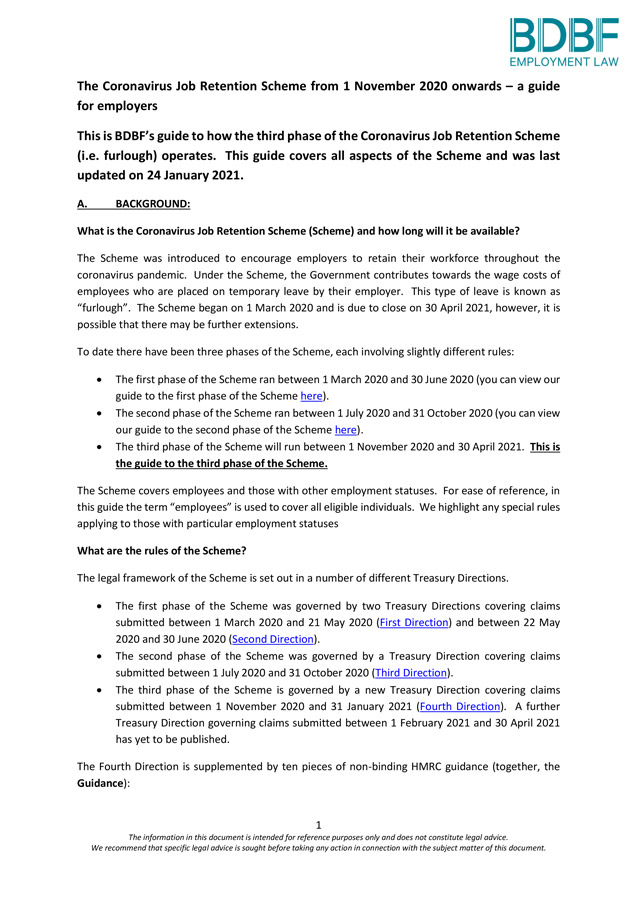
The Coronavirus Job Retention Scheme from 1 November 2020 onwards – a guide for employers

[et_pb_section fb_built=”1″ _builder_version=”3.0.100″ background_image=”http://davidk423.sg-host.com/wp-content/uploads/2017/09/bdbf_final-stages-1-4-1.jpg” custom_padding=”|||” global_module=”2165″ saved_tabs=”all”][et_pb_row _builder_version=”3.25″ custom_padding=”|||”][et_pb_column type=”4_4″ _builder_version=”3.25″ custom_padding=”|||” custom_padding__hover=”|||”][et_pb_text _builder_version=”3.27.4″ background_layout=”dark” custom_margin=”0px|||” custom_padding=”0px|||”]

Employment Law News


[/et_pb_text][/et_pb_column][/et_pb_row][/et_pb_section][et_pb_section fb_built=”1″ admin_label=”section” _builder_version=”3.22.3″][et_pb_row admin_label=”row” _builder_version=”3.25″ background_size=”initial” background_position=”top_left” background_repeat=”repeat”][et_pb_column type=”4_4″ _builder_version=”3.25″ custom_padding=”|||” custom_padding__hover=”|||”][et_pb_text _builder_version=”4.7.4″ text_orientation=”justified” use_border_color=”off”]

 The Coronavirus Job Retention Scheme from 1 November 2020 onwards – a guide for employers 

This is BDBF’s guide to how the third phase of the Coronavirus Job Retention Scheme (i.e. furlough) operates.  This guide covers all aspects of the Scheme and was last updated on 24 January 2021.

To view the PDF guide please click on the image below:

[/et_pb_text][et_pb_image src=”http://davidk423.sg-host.com/wp-content/uploads/2021/01/Guide-to-the-COVID-19-Job-Retention-Scheme-from-1-November-2020-24-January-2021-1.jpg” title_text=”Guide-to-the-COVID-19-Job-Retention-Scheme-from-1-November-2020-(24-January-2021)-1″ url=”http://davidk423.sg-host.com/wp-content/uploads/2021/01/Guide-to-the-COVID-19-Job-Retention-Scheme-from-1-November-2020-24-January-2021.pdf” url_new_window=”on” align=”center” _builder_version=”4.7.4″ _module_preset=”default” hover_enabled=”0″ border_width_all=”2px” border_color_all=”#008395″ sticky_enabled=”0″][/et_pb_image][et_pb_text _builder_version=”4.7.4″ text_orientation=”justified” use_border_color=”off”]

BDBF is currently advising many employers and employees on the challenges presented by the coronavirus.  If you or your business needs advice on furlough or other coronavirus-related matter please contact Amanda Steadman (amandasteadman@bdbf.co.uk) or your usual BDBF contact.

[/et_pb_text][/et_pb_column][/et_pb_row][/et_pb_section][et_pb_section fb_built=”1″ _builder_version=”3.26.6″][et_pb_row _builder_version=”3.26.6″][et_pb_column type=”4_4″ _builder_version=”3.26.6″][/et_pb_column][/et_pb_row][/et_pb_section]


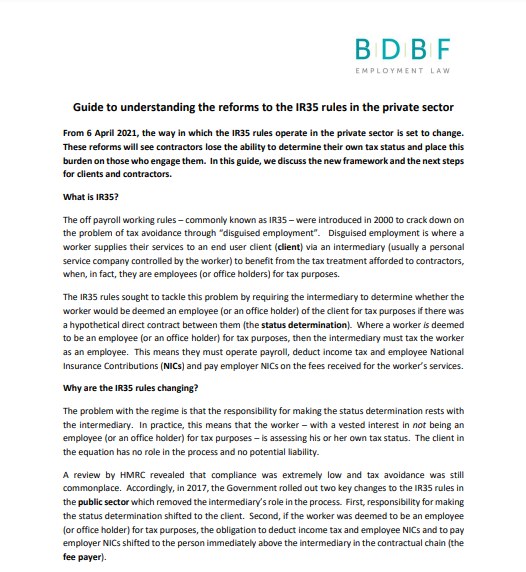
Guide to understanding the reforms to the IR35 rules in the private sector

Guide to understanding the reforms to the IR35 rules in the private sector

From 6 April 2021, the way in which the IR35 rules operate in the private sector is set to change.  These reforms will see contractors lose the ability to determine their own tax status and place this burden on those who engage them.  In this guide, we discuss the new framework and the next steps for clients and contractors.

To view the PDF guide please click on the image below:

"/

BDBF can help businesses and contractors prepare for the new regime. Please contact Amanda Steadman (amandasteadman@bdbf.co.uk), or your usual BDBF contact, for further advice.


Just Blue Monday, or something more?

[et_pb_section fb_built=”1″ _builder_version=”3.0.100″ background_image=”http://davidk423.sg-host.com/wp-content/uploads/2017/09/bdbf_final-stages-1-4-1.jpg” custom_padding=”|||” global_module=”2165″ saved_tabs=”all”][et_pb_row _builder_version=”3.25″ custom_padding=”|||”][et_pb_column type=”4_4″ _builder_version=”3.25″ custom_padding=”|||” custom_padding__hover=”|||”][et_pb_text _builder_version=”3.27.4″ background_layout=”dark” custom_margin=”0px|||” custom_padding=”0px|||”]

Employment Law News


[/et_pb_text][/et_pb_column][/et_pb_row][/et_pb_section][et_pb_section fb_built=”1″ admin_label=”section” _builder_version=”3.22.3″][et_pb_row admin_label=”row” _builder_version=”3.25″ background_size=”initial” background_position=”top_left” background_repeat=”repeat”][et_pb_column type=”4_4″ _builder_version=”3.25″ custom_padding=”|||” custom_padding__hover=”|||”][et_pb_text _builder_version=”4.7.4″ text_orientation=”justified” hover_enabled=”0″ use_border_color=”off” sticky_enabled=”0″]

Just Blue Monday, or something more? 

The third Monday in January is typically labelled “Blue Monday” and is said to be the most depressing day of the year. Christmas festivities are over, the weather remains is cold and dark, New Year’s resolutions have fallen by the wayside and Christmas credit card bills are in but people have not yet been paid.

In 2021, people are likely to feel the effects of Blue Monday more acutely due to the third lockdown imposed by the government in response to the Covid-19 pandemic. It is therefore more important than ever for people to ask themselves whether any “blue” feelings are a temporary symptom of the season or a sign that they could be suffering from a more serious condition.

This article considers this question in the context of the workplace, although of course this issue is relevant to all aspects of life.

What if you’re just “feeling blue”?

Short periods of “feeling blue” are completely normal and for the most part do not interfere with doing your job. You might find that making use of informal support networks, such as attending (virtual) coffees with colleagues can be all that it takes to lift your spirits. Some employers have mental health first aiders and/or support helplines that can provide valuable advice for those needing more support. 

Whatever the case, you should keep your moods under review by keeping a record of how you feel from week to week. This does not need to be formal, but it can help you spot signs of a more serious or prolonged condition and will enable you to take appropriate measures to prevent it.  

What if it is something more serious?  

If you consider that you are already suffering from a more serious condition, it is important to seek support from a medical professional, like your GP.

Employers have a duty to provide their employees with a reasonably safe system and place of work, exercise reasonable care for their safety and health and take all necessary steps to protect employees from risks that are reasonably foreseeable, including risks of psychiatric injury or damage.

If you believe your working conditions are affecting your health, start a conversation with your employer. It is important to discuss this with your line manager, HR, or someone else in the management chain that you feel comfortable approaching.

Let them know how you are feeling and what is causing you to feel unwell. Talk through the support you need to alleviate your condition. In some cases, it may be beneficial to attend an appointment with Occupational Health, so that a more formal support program can be put in place.

Depending on the nature and extent of your condition, you may have a “disability” under the Equality Act 2010. Your condition will amount to a disability if it is a physical or mental impairment and the impairment has a substantial and long-term adverse effect on your ability to carry out normal day-to-day activities. While there are many aspects to this definition, it is important to be aware that for a condition to be long term, so as to satisfy this part of the test, it needs to have lasted, or be expected to last, for at least 12 months. 

Importantly, employers are under a proactive duty to make reasonably adjustments for disabled employees to avoid the disadvantage caused by their disability in the workplace. For mental health issues, this duty arises irrespective of whether the impairment was caused by work or by an external factor.

The duty to make reasonable adjustments is the cornerstone of disability law. It arises only once the employer knows, or could reasonably be expected to know, of an employee’s disability. In practice, this means that you do need to communicate with your employer about your condition so that they are put on actual notice. This makes having a conversation with your employer incredibly important. For example, if you are unable to work because you are struggling with your mental health, you should consider making this clear during a return to work interview and on any sick notes provided by your GP rather than, as happens frequently, recording your absence as a cold or other such illness. As well as helping you to access immediate support, it will assist your position in any subsequent legal proceedings should the support you need be unavailable or should you be subjected to detrimental treatment.

It is unlawful for your employer to treat you unfavourably because of your disability. It is also unlawful for you to be treated unfavourably because of something arising in consequence of your disability, unless such treatment can be objectively justified. For example, some people with depression find it difficult to get up in the mornings, making them late for work. If this is an effect of your depression and you are disciplined for poor time-keeping, without account being taken of your depression, this could constitute discrimination arising from your disability, i.e. the unfavourable treatment was because of something that was not the disability itself, but caused by the disability. If you find yourself in this situation, it is important to be open with your employer about why your timekeeping suffers in the mornings and discuss whether changes can be made to your working pattern to assist you.

Conclusion

The stigma around mental health in the workplace is reducing, but there is still some way to go. If you are finding work difficult due to mental health reasons, an important first step is to have a conversation with someone within the organisation that you trust so that they can help you access the support that should be available, whether that is to alleviate the effects of Blue Monday or as part of a longer term need.  

[/et_pb_text][/et_pb_column][/et_pb_row][/et_pb_section][et_pb_section fb_built=”1″ _builder_version=”3.26.6″][et_pb_row _builder_version=”3.26.6″][et_pb_column type=”4_4″ _builder_version=”3.26.6″][/et_pb_column][/et_pb_row][/et_pb_section]