Employment Rights Bill: Consultation on expanding protection from dismissal for pregnant women and new mothers

Last month, the Government opened a consultation on enhancing protection from dismissal for pregnant women and new mothers during a protected period.  At its most restrictive, the proposed protection would ban capability and SOSR dismissals altogether, permit redundancy dismissals only where a business is closing and allow conduct or illegality dismissals in very limited circumstances.   

What is the current legal position and what did the Employment Rights Bill propose?

In the UK, there is already extensive protection from dismissal for pregnant women, new mothers and other parents.  It is unlawful to:

  • treat an employee unfavourably because of her pregnancy or maternity leave during the “protected period” (which begins when a woman becomes pregnant and ends when she returns from maternity leave);

  • treat an employee less favourably than a male comparator for reasons to do with her pregnancy or maternity leave outside the protected period;

  • dismiss an employee for a reason connected to her pregnancy or maternity leave (or to certain types of other family leave including adoption, shared parental and neonatal care leave);

  • make an employee redundant during pregnancy or maternity leave (or adoption leave, shared parental leave or neonatal care leave) where there is a suitable alternative vacancy available; or

  • make an employee redundant who has recently returned to work from a period of maternity leave (or adoption leave, shared parental leave or neonatal care leave) where there is a suitable alternative vacancy available.

Despite this wide protection, the Government is concerned that pregnant women and new mothers remain especially vulnerable to mistreatment and dismissal.  This is supported by a 2016 report from the Equality and Human Rights Commission which indicated that up to 54,000 mothers leave their jobs each year, including approximately 4,100 dismissals.

Accordingly, the Employment Rights Bill (the Bill) (currently on its passage through Parliament) provided that regulations would be introduced to allow enhanced protection from dismissal during pregnancy, maternity leave and following the return from maternity leave.  This would mean that such employees could not be fairly dismissed at all, save where the law allowed for an exception.  The Bill does not specify how long the protection would apply following the return from leave, however, the Government has said it should be at least six months.

The Bill also proposed extending the enhanced protection to those returning from certain other forms of extended family leave, namely, adoption leave, shared parental leave, neonatal care leave and bereaved partner’s paternity leave (the latter of which is not yet in force). 

What does the consultation paper propose?

On 23 October 2025, the Government published a consultation paper entitled Enhanced dismissal protections for pregnant women and new mothers”, seeking views on how the enhanced dismissal protection should work in practice.   The Government says it wishes to strike a fair balance between strengthening the protection for employees and preserving the ability to dismiss “…in cases where continuing employment would have serious consequences for the employer or other staff”.  It is also concerned to avoid unintended consequences, such as employers becoming hesitant to hire women of child-bearing age if the protections are overly restrictive.

The consultation proposes two broad options:

  • Option 1 – Introduce a stricter fairness test: one option is to introduce a stricter test to assess the fairness of such dismissals for any of the existing five fair reasons for dismissal (i.e. conduct, capability, redundancy, illegality or some other substantial reason (SOSR)). 

  • Option 2 – Narrow the five fair reasons for dismissal: an alternative option is to narrow the existing five fair reasons for dismissal (and/or potentially remove some of them entirely) when applied to pregnant women or new mothers.  The proposals to narrow down the scope of each reason are as follows:

  • Conduct: the options put forward range from permitting conduct dismissals only where the employee commits gross misconduct (as defined by the employer), to allowing dismissal only for a much narrower band of serious misconduct where continuing employment would either (i) pose a health and safety risk to a third party, (ii) have a serious negative impact on the wellbeing of others, or (iii) cause significant harm to the business.

  • Capability (covering both performance and ill-heath): again, various options are put forward, ranging from permitting capability dismissals only if there is no suitable alternative role available (or where one was offered and refused), to allowing dismissal only for a much narrower band of incapability where continuing employment would either (i) pose a health and safety risk to a third party, (ii) have a serious negative impact on the wellbeing of others, or (iii) seriously harm the business.  An even more restrictive proposal of banning capability dismissals altogether is also given.

  • Redundancy: two options are proposed. First, permitting redundancy dismissals only where there is no suitable alternative vacancy available and where termination would mitigate any financial difficulties that were affecting (or likely to affect in the immediate future) the employer’s ability to continue the business.  The second and more restrictive option is to permit redundancy dismissals only where the business ceases to exist (and where any suitable alternative vacancy that is available has been offered).

  • Illegality: only one possible change is put forward: to allow dismissal for illegality only if there is no suitable alternative role available (or where one was offered and refused).

  • SOSR: various options are put forward, ranging from permitting SOSR dismissals only where there is no suitable alternative role available (or where one was offered and refused), to allowing SOSR dismissals only for a much narrower band of dismissals where continuing employment would either (i) pose a health and safety risk to a third party, (ii) have a serious negative impact on the wellbeing of others, or (iii) seriously harm the business.  An even more restrictive proposal of banning SOSR dismissals altogether is given.

Additionally, in each of the above cases, the option of either making no changes to the law, or of making some other type of unspecified change are given (and in the latter case, the respondent is asked to set out what change they think should be made).

When should the protection start and end?

The existing dismissal protections for pregnant women and new mothers are all “Day 1” employment rights.  The consultation paper asks whether an employee should also be entitled to benefit from the proposed enhanced protections from Day 1 of employment.   Set against that, it is acknowledged that this could require an employer to retain and pay an employee throughout pregnancy, maternity leave and for at least six months thereafter, and that this might be considered an unreasonable burden on employers especially in respect of new employees who may not have demonstrated their capability for the role.  Therefore, the consultation gives the alternative option of only affording these rights to women who have completed a qualifying period of employment of somewhere between three to nine months.  It is said that such a qualifying period could help to mitigate unintended consequences, such as reluctance to hire women of childbearing age. 

In terms of when the enhanced protection should end, the consultation paper proposes either 18 months from the birth of the child (which has the benefit of aligning with the redundancy priority rules) or six months after the return to work from maternity leave, whenever that is.  The first option would mean that all new mothers would have an 18-month window of protection – regardless of when they returned to work.  The second option would mean that women taking less than 12 months maternity leave would have a shorter overall window of protection.  However, it would be simpler for employers to navigate, since they would know that all returners have six months protection after their return from maternity leave.  No individual calculations would be needed.

Should the enhanced protection be available where certain other types of family leave are taken?

The consultation paper goes on to seek information and views on the extent to which parents taking either adoption, shared parental or neonatal care leave are subjected to unfair treatment, including dismissal.  It goes on to ask whether the proposed enhanced dismissal protections should be extended to employees taking these forms of leave (and also bereaved partner’s paternity leave) and, if so, when the protection should start and end.  For adoption leave, it is proposed that the protection should end 18 months after the birth of the child or placement for adoption.  For the other three types of leave, it is proposed that the protection should end either on the last day of the leave (where less than six weeks of continuous leave was taken), or 18 months from the birth or adoption placement (where more than six weeks of continuous leave was taken).

Other points and next steps

The consultation paper asks whether various unintended consequences could arise from the enhanced protection including increased discrimination, delaying dismissal decisions and unrealistic asks of small businesses.  Finally, the consultation asks what the main causes of pregnancy and maternity discrimination are and what more the Government should be doing to tackle it.

The consultation closes on 15 January 2026, after which the Government’s response and final position will be published.  The measures are due to be implemented some time in 2027.

Consultation paper – Enhanced dismissal protections for pregnant women and new mothers

BDBF is a leading employment law firm based at Bank in the City of London. If you would like to discuss any issues relating to the content of this article, please contact Amanda Steadman (AmandaSteadman@bdbf.co.uk) or your usual BDBF contact.
BDBF Webinar – The Employment Rights Bill: where are we now? – 7 October 2025

In this 1-hour webinar, BDBF Principal Knowledge Lawyer Amanda Steadman and Associate Esmat Faiz unpack the landmark Employment Rights Bill, now on the brink of becoming law. This webinar was originally delivered on 7 October 2025 and reflects our understanding as of that date. Do get in contact with either of the speakers if you would like to discuss any of the issues raised.

To view the PDF webinar slides please click on the image below, or view the recording of the webinar:


https://youtu.be/X9cPDr2nEvg

Please contact Amanda Steadman (AmandaSteadman@bdbf.co.uk), Esmat Faiz (EsmatFaiz@bdbf.co.uk) or your usual BDBF contact, for further advice.


Employment Rights Bill:  what are the latest changes and when will the Bill become law?

The Employment Rights Bill (the Bill) is currently in the final stages of progression through Parliament and is expected to become law in late 2025. The Bill is a significant development to UK employment rights and offers a broad range of new worker protections, including expansion of unfair dismissal rights, changes to Tribunal time limits, widening of access to family leave and strengthening of protections against harassment and discrimination.

On 15 September 2025, MPs considered the significant amendments to the Bill which had been put forward by the House of Lords and, as published on 16 September 2025, rejected the majority of the Lords’ suggestions. This indicates a strong commitment to the original rights proposed by the Bill.

What are the implications of these changes?

As noted in a press release from the Government on 15 September 2025, the amendments proposed by the House of Lords were considered to dilute the protections offered to workers under the Bill and, as a result, have broadly been rejected by the House of Commons.

The most significant of the Lords’ proposals was the removal of protection against unfair dismissal as a planned ‘Day One’ right, and replacement of this with a reduced qualifying period of six months (compared to the current two years’ service requirement).

They had also proposed limiting the new obligation to offer guaranteed hours contracts to zero or low-hours workers to situations where the employee had made a request for such a contract, and allowing exceptions to this entitlement for those undertaking seasonal work.

Other amendments were additionally suggested to the right to be accompanied, whistleblowing protections and the planned trade union reforms. 

All of these amendments were rejected, meaning that the stronger protections for employees as originally contemplated by the Bill have been reinstated – most notably the protection against unfair dismissal from the first day of employment.

However, two proposals were accepted to some extent by the Commons and will now feature in principle in the next version of the Bill. The effect of these changes is as follows:

  • It has been confirmed that the prohibition of non-disclosure agreements (NDAs) concerning harassment and discrimination is accepted in principle by MPs, having been proposed as an amendment to the Bill by a Labour Peer earlier this year. It has also been clarified that this prohibition will extend to concerns regarding a failure to make reasonable adjustments under the Equality Act 2010. Please see our full briefing here for further guidance on the effect of these changes on NDAs.

  • A provision will be inserted requiring a review of the extent of the right to time off for public duties, including specifically whether employers should be required to permit time off for performing the functions of a special constable. This acknowledges the Lords’ proposal to introduce a new express right to time off for special constables, but falls short of introducing such a right.

What’s next for the Employment Rights Bill?

The Bill will now return to the House of Lords for consideration of the MPs’ amendments, on a date yet to be scheduled. It will then progress to receiving Royal Assent this Autumn.

For an updated outline of the changes planned under the Employment Rights Bill and the expected timeline for implementation, please join our webinar “The Employment Rights Bill: Where are we now?” on 7 October 2025.

BDBF is a leading employment law firm based at Bank in the City of London. If you would like to discuss any issues relating to the content of this article, please contact Rose Lim (RoseLim@bdbf.co.uk), Amanda Steadman (AmandaSteadman@bdbf.co.uk) or your usual BDBF contact


Rise in sexual harassment concerns: how can employers prepare for the Employment Rights Bill?

Recent research shows a 39% increase in sexual harassment concerns since the introduction of the “duty to prevent” sexual harassment in October 2024.  With the Employment Rights Bill set to make that duty even more onerous, we explore the steps employers should take to put themselves in the best position to ensure compliance with the enhanced duty.  We also consider other changes in the Bill relevant to sexual harassment at work.

As recently published on Law360, the volume of calls to ACAS about sexual harassment concerns has increased by 39% so far this year. According to figures obtained by Nockolds, ACAS received 5,583 calls in the first half of 2025 compared to 4,001 in the first half of 2024.

This increase is significant following the changes made to the legal duties on employers to prevent sexual harassment in October 2024, and gives an important insight into rising employee awareness of their employer’s responsibility to protect them.

What has led to this change?

In October 2024, the Equality Act 2010 was amended to introduce a duty on employers to take reasonable steps to prevent sexual harassment of their employees at work. This applies both to potential harassment from other workers and from third parties (such as customers or clients). The change sits alongside the pre-existing prohibitions against sexual harassment and related less favourable treatment, and places a proactive requirement on the employer to prevent their staff being subjected to unwanted conduct of a sexual nature in the course of their employment.

Failure to comply with this duty may lead to enforcement by the Equality and Human Rights Commission (EHRC) and/or an uplift of up to 25% to any related Employment Tribunal award made to the employee.

Whilst it is unclear whether the calls being made to ACAS relate directly to alleged failings on the part of employers to comply with this new duty, the significant increase in volume suggests that, at the very least, this legal change has encouraged employees to speak up about workplace harassment.

What is changing now?

As part of the widespread changes planned under the Employment Rights Bill, the employer duty to prevent sexual harassment will change from taking “reasonable steps” to taking “all reasonable steps”. This is expected to come into force in October 2026, with further clarification of potential “reasonable steps” expected to come via regulations in 2027.

According to current guidance from the EHRC, the existing preventative duty to take “reasonable steps” requires employers to conduct a tailored risk assessment, anticipating when their workforce may be at risk of sexual harassment and identifying steps that are reasonable for them to take to prevent it.  The test of what is ‘reasonable’ will be objective and consider factors such as the size and resources of the employer, the nature of the working environment (including exposure to third parties), and any concerns raised by the workforce or responses to previous incidents.

Under the new legislation, the employer duty is being ‘upgraded’ to mean that employers must show not just that they took reasonable steps, but that they took all of the steps which were reasonable for them to take. On a strict reading, this means that businesses will need to justify why any steps which were not taken would not have been reasonable, and that this ‘reasonableness’ assessment may be more open to challenge by employees.

It remains to be seen how Tribunals will treat this change, in particular the extent to which they will scrutinise commercial decisions made by the employer when determining what is reasonable for their workplace. However, it is expected that the approach will broadly mirror that taken to the existing “all reasonable steps” defence available to employers in response to acts of discrimination by employees, as set out in the factsheet produced by the Department for Business and Trade. Particular attention will therefore be paid to the content and regularity of training, whether the employer had comprehensive policies in place (and whether those policies were enforced, including through disciplinary action), and what actions were taken in response to any complaints of harassment from staff.

What does this mean for employers?

In preparation for this new duty, employers should therefore now be considering what steps they have taken to prevent sexual harassment, if there any additional steps which might be reasonable for them to take, and be ready to defend not taking any steps which are identified but not considered viable.

Whilst employers may understandably feel apprehensive about scrutinising their own approach in this way or highlighting steps that they have chosen not to take, failing to document any learnings or the rationale for business decisions is likely to leave more room for employees to challenge whether all reasonable steps have been taken to protect them.

Practical steps for employers to take now could include:

  • Revisiting the existing risk assessment for sexual harassment (or if none has yet been undertaken, doing so promptly).
  • Reviewing where employees might be at particular risk of sexual harassment based on the sector, type of work undertaken and level of engagement with both other workers and third parties.
  • Assessing the response taken to any incidents that have occurred, including any trends in complaints, appropriateness of any disciplinary actions taken, and whether any pre-emptive steps might have reduced the possibility of those incidents occurring.
  • Engaging with employees or appropriate representatives at regular intervals to identify any concerns or areas of exposure, and obtaining their input on what actions they feel might protect them at work.
  • Reiterating anti-harassment policies and ensuring that regular mandatory training is delivered on both policies and reporting procedures.
  • Displaying signage to raise both colleague and third party awareness of the workplace not tolerating sexual harassment.
  • Documenting any steps which have been identified but which have not been taken, including why those steps would not have been reasonable for their particular business to take.

How does this fit into the wider landscape?

The upgraded employer duty to prevent sexual harassment is one of numerous significant changes planned for UK employment law under the Employment Rights Bill.

Most notably in relation to sexual harassment, the latest draft of the Bill proposes to ban non-disclosure agreements (NDAs) which prevent employees from speaking out about harassment (including sexual harassment) and discrimination. This includes confidentiality provisions in employment agreements and settlement agreements, and is covered in more detail in our latest update here. The Bill also will clarify that raising concerns of sexual harassment can be a protected disclosure for the purposes of whistleblowing protections under the Employment Rights Act 1996.

In addition, employers will become liable under the Bill for harassment of their employees by third parties based on other protected characteristics such as race, disability and religion, under a similar “all reasonable steps” duty. Businesses would therefore be wise to consider these other types of harassment when looking at the reasonable steps they can take to protect their staff from sexual harassment, and ensure that any changes they make comprehensively consider the risks that their employees might be exposed to in the workplace.

For a comprehensive insight into the key changes planned under the Employment Rights Bill, please join our webinar “The Employment Rights Bill: Where are we now?” on 7 October 2025.

BDBF is a leading employment law firm based at Bank in the City of London. If you would like to discuss any issues relating to the content of this article, please contact Rose Lim (RoseLim@bdbf.co.uk), Amanda Steadman (AmandaSteadman@bdbf.co.uk) or your usual BDBF contact


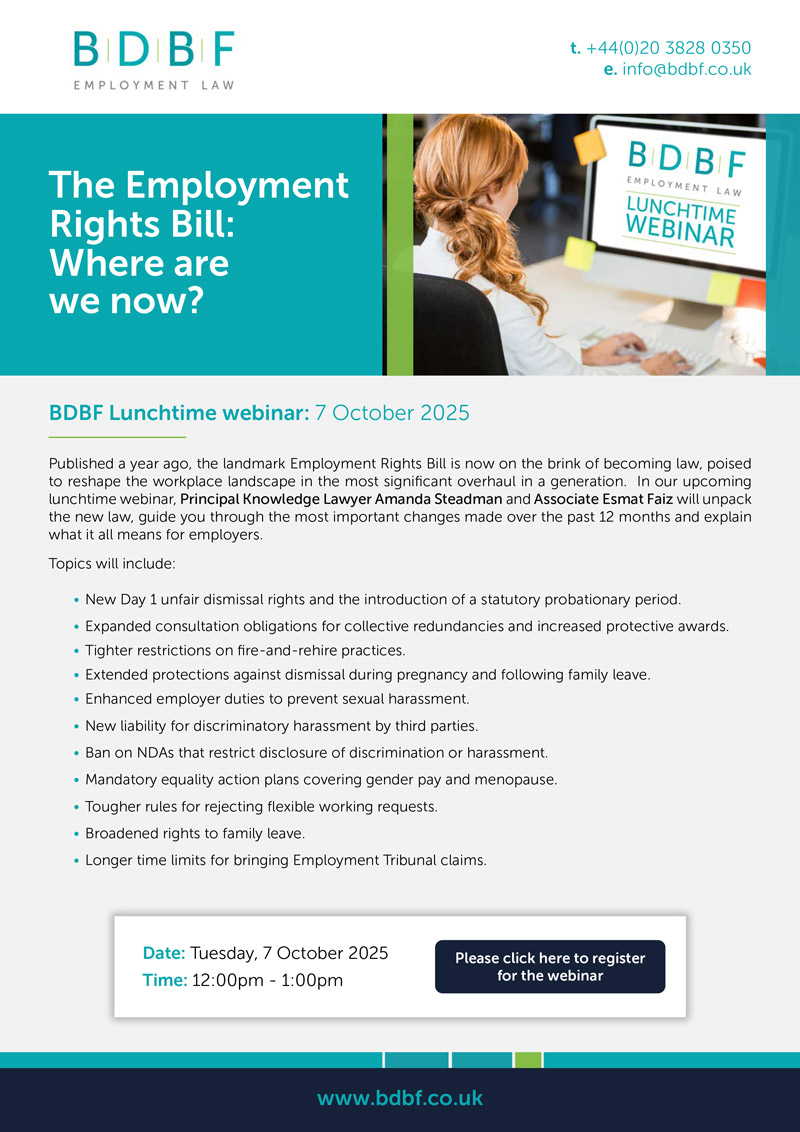
LUNCHTIME WEBINAR – The Employment Rights Bill: Where are we now?

LUNCHTIME WEBINAR – 7 October 2025

Published a year ago, the landmark Employment Rights Bill is now on the brink of becoming law, poised to reshape the workplace landscape in the most significant overhaul in a generation. In our upcoming lunchtime webinar, Principal Knowledge Lawyer Amanda Steadman and Associate Esmat Faiz will unpack the new law, guide you through the most important changes made over the past 12 months and explain what it all means for employers.

Topics will include:

  • New Day 1 unfair dismissal rights and the introduction of a statutory probationary period.
  • Expanded consultation obligations for collective redundancies and increased protective awards.
  • Tighter restrictions on fire-and-rehire practices.
  • Extended protections against dismissal during pregnancy and following family leave.
  • Enhanced employer duties to prevent sexual harassment.
  • New liability for discriminatory harassment by third parties.
  • Ban on NDAs that restrict disclosure of discrimination or harassment.
  • Mandatory equality action plans covering gender pay and menopause.
  • Tougher rules for rejecting flexible working requests.
  • Broadened rights to family leave.
  • Longer time limits for bringing Employment Tribunal claims.

Date: Tuesday, 7 October 2025

Time: 12.00pm-1.00pm


Click here to register


Government launches 18-month long review of the UK’s parental leave and pay framework

On 1 July 2025, the Government launched a wholesale review of the UK’s parental leave framework, covering all existing leave and pay rights.  Although the review is expected to run until December 2026, the Call for Evidence from stakeholders closes in August 2025.

Aims of the review

The Government recognises that the existing system of parental leave and pay entitlements have grown incrementally over time.  The end result is a complex legislative framework of leave and pay entitlements that were never designed to operate as a single system.   This piecemeal approach also means that an overarching set of objectives for the system has not been articulated before.  The review is said to be an opportunity to reset the approach. 

The Government’s Terms of Reference for the review states that its aims are to:

  • articulate the objectives for the parental leave and pay system;
  • expand the existing evidence base and understanding of the current system;
  • consider the options and principles for a system of parental leave and pay that better supports the Government’s objectives; and
  • develop a roadmap for how to move to a system that better supports those objectives.

In turn, the objectives against which the Government will assess the parental leave system are prioritising maternal health, supporting economic growth through labour market participation (thereby reducing the gender pay gap and the “motherhood penalty”), ensuring children have the best start in life and supporting parents to make balanced childcare choices, including co-parenting.

All current and upcoming parental leave and pay entitlements will be in the scope of the review, including maternity, paternity, adoption, shared parental, parental bereavement and neonatal care leave and pay.  It will also cover unpaid parental leave, maternity allowance and the forthcoming right to bereaved partner’s paternity leave.  The review will also consider the needs of those who do not qualify for existing leave and pay entitlements, such as “kinship” carers and the self-employed.

The Call for Evidence

To inform the work of the review, the Government has published a Call for Evidence to receive information and evidence from a variety of stakeholders including businesses and parents.  Specifically, the Call for Evidence is seeking views on the Government’s objectives (as outlined in the Terms of Reference) and whether the existing parental leave framework meets these objectives.  It also asks whether further objectives should be added, and which objectives are the most important.

There is a particular focus on receiving new information and evidence which has not previously been shared with the Government.  To this end, a summary of existing evidence has also been published alongside the Call for Evidence.  Amongst other things, this reveals that 83% of mothers took maternity leave, with the average length of leave being 44 weeks.  70% of mothers received statutory maternity pay and just 13% received enhanced maternity pay from their employer.  In contrast, 59% of fathers took paternity leave, with the average length of leave being 1.7 weeks.  Over half of those who took paternity leave received full pay from their employer (which is perhaps unsurprising given its short length).  A further 4% of fathers took shared parental leave for an average of 14 weeks.  Financial constraints were reported as the biggest barrier to taking leave.

Although the review is open for 18 months, the Call for Evidence itself is only open for just under two months, closing on 26 August 2025.

Next steps?

The review is expected to run for 18 months until 31 December 2026.  The Government then plans to release a set of findings, together with a roadmap of future reforms.  Accordingly, the earliest that we can expect to see any changes to the current system would be mid to late 2027.

Employers (and other stakeholders) are encouraged to participate in the review.  It is said that “Government convened round tables” will be held, providing the opportunity to contribute views and expertise.  Employers may also submit written responses to the Call for Evidence – this can be done online or by email before 26 August 2025.

Parental leave and pay review – 1 July 2025

BDBF is a leading employment law firm based at Bank in the City of London. If you would like to discuss any issues relating to the content of this article, please contact Amanda Steadman (AmandaSteadman@bdbf.co.uk) or your usual BDBF contact.


Government softens fire and rehire provisions in the Employment Rights Bill

The Government has proposed amendments which would soften the impact of the “fire and rehire” restrictions in the Employment Rights Bill.

On 7 July 2025, an Amendment Paper setting out a running list of proposed amendments to the Employment Rights Bill (the Bill) was published.  The paper includes Government-backed amendments, which are likely to be pass into law, including plans to soften the “fire and rehire” provisions in the Bill.

What did the Bill originally say about fire and rehire?

“Fire and rehire” is a shorthand used to describe the practice of dismissing an employee then offering to re-engage them on inferior terms and conditions.   Before the election, the Labour Party had talked about wanting to end fire and rehire practices altogether.  This was slightly watered down during the General Election, with a promise to end the practice, save in exceptional circumstances.

The first draft of the Bill delivered on that promise and proposed that it would be automatically unfair to dismiss an employee:

  • for failing to agree to a change to their terms and conditions of employment; or

  • in order to re-engage them (or someone else) under varied terms and conditions of employment, but where the role is otherwise substantially the same.

The sole exception was where the reason for the variation was to eliminate, prevent or significantly reduce or mitigate the effect of any financial difficulties which, at the time of the dismissal, were affecting, or were likely in the immediate future to affect, the employer’s ability to carry on its business, and there was no way the need to make the variation could reasonably have been avoided.  However, even where the exception applied, the dismissal could still be ordinarily unfair, even if not automatically unfair. 

Shortly after the Bill was published, the Government consulted on extending the remedy of interim relief to employees who had fire and rehire dismissal claims. It was argued that permitting interim relief in this situation would lead to greater protection of employees and further disincentivise employers from using fire and rehire at all.  However, the Government ultimately declined to extend interim relief to such dismissals.  Instead, it confirmed that it planned to revise the Statutory Code of Practice on Dismissal and Re-engagement to reflect the new rights in the Bill.  Importantly, where the Code is breached, a Tribunal may uplift compensation by up to 25%.

What amendments have been proposed?

Automatic unfair dismissal for “restricted variations” only

The most significant amendment would be to restrict the automatic unfair dismissal protection only to cases where the employee is dismissed:

  • for failing to agree to a “restricted variation” to their terms and conditions of employment; or

  • in order to re-engage them (or someone else) under varied terms and conditions of employment, where one of more of the differences between the two sets of terms constitutes a “restricted variation”, but where the role is otherwise substantially the same.

A “restricted variation” means variations relating to:

  • pay;

  • pensions or pension schemes;

  • working hours;

  • the timing or duration of shifts; and

  • a reduction in the amount of time off.

It would also cover other variations of a description specified in regulations made by the Secretary of State or the inclusion of a term enabling the employer to make any other restricted variation without the employee’s agreement.

Where an employee is dismissed for refusing to agree to a variation (or in order to re-engage them or someone else on varied terms), and the variation in question in not a restricted variation, then the dismissal will not be automatically unfair.  Instead, certain matters must be considered by the Employment Tribunal to determine whether the dismissal is ordinarily unfair including the reason for the variation, any consultation carried out about the proposed variation (including with a trade union), anything offered to the employee in return for agreeing to the variation and any other matters specified in regulations.

Other proposed amendments

Other proposed amendments to the fire and rehire provisions of relevance to private sector employers include limiting the scope of the automatic unfair dismissal protection:

  • only to cases where the variation in question would result in a reduction of the employee’s pay and benefits;

  • to exclude minor and non-detrimental variations which do not relate to pay, working hours or place of work; and/or

  • to exclude place of work redundancy dismissals (i.e. these would be subject to the ordinary unfair dismissal regime in the usual way).

A further amendment provides that an employee’s dismissal would be automatically unfair if the reason for the dismissal was to enable the employer to replace the employee on a broadly like-for-like basis which someone who is not employed, for example, an agency worker or a self-employed contractor.  The exception to this rule would be where the employer can show that the reason for the replacement was to address financial difficulties and the employer could not reasonably have avoided the need to replace the employee.

What will these changes mean for employers in practice? 

Given that many of the amendments have been proposed by a Labour Peer, including the “restricted variation” line of amendments, it seems likely that at least some of these changes will make their way into the final version of the Bill. 

If the “restricted variation” amendments are taken forward, this will soften the impact of the fire and rehire provisions somewhat, but employers will still have a higher exposure to automatic unfair dismissal claims.   The terms which would constitute “restricted variations” if varied are the very terms that would usually lead an employer to consider the extreme solution of fire and rehire in the first place – pay, benefits, hours and leave entitlements.  

Nevertheless, it would be reassuring to employers to know that dismissals connected to other types of variations do not give rise to automatic unfair dismissal claims.   It would also be helpful for the Bill to clarify that a place of work redundancy dismissal does not give rise to a fire and rehire automatic unfair dismissal claim.

The amendments to the Bill were considered by the House of Lords on 14July 2025 and will need to be reconsidered by the House of Commons.  Although the Bill is expected to pass later this year, the fire and rehire provisions will not come into force straight away, meaning employers still have time to digest and adapt to the final rules. In its recently-published roadmap for implementing the Bill, the Government said it intends to commence consultation on fire and rehire-related regulations in Autumn 2025, with the regime expected to come into force in October 2026.

BDBF is a leading employment law firm based at Bank in the City of London. If you would like to discuss any issues relating to the content of this article, please contact Amanda Steadman (AmandaSteadman@bdbf.co.uk) or your usual BDBF contact.


Government releases roadmap for implementing the measures in the Employment Rights Bill

The Government has published a roadmap setting out how it plans to implement the workplace reforms set out in the Employment Rights Bill.  Reforms will be introduced on a phased basis with dates stretching into 2027.

The Government’s flagship piece of employment legislation is nearing the end of its passage through Parliament.  You can read more about the Bill’s measures in our briefings here and here.  However, not every part of the Bill will come into force straight away.  The measures will be introduced in tranches to give employers time to prepare and adapt.  And further consultation is required on some measures to fine tune the details – in some case further regulations may be needed.

Given the sheer volume of reforms in the Bill, a phased timetable for introduction is helpful for employers – if a little confusing.  To assist with this, the Government has recently published a “roadmap” setting out its proposed timetable for further consultation and for implementing the reforms.  Employers may be relieved to see the timetable stretches over 18 months, with the most hotly anticipated change – the introduction of Day 1 unfair dismissal rights – pushed back to 2027.

Consultation roadmap

The Government says that the implementation of the measures outlined in the Employment Rights Bill must work for all stakeholders and that consultation may be needed to determine the most effective way to introduce the reforms.  Such consultation will be phased to allow stakeholders to engage fully with the “complex policy issues at hand”.  Following consultation, the Government will develop its final policy positions to deliver the measures.  Below is the planned consultation timetable for some of the key measures in the Bill.  You can view the full consultation timetable here.

When? Area for consultation?  
Summer / Autumn 2025 • Day 1 protection from unfair dismissal (including what the dismissal process should look like during the statutory probationary period).  
Autumn 2025 • Limits on fire and rehire practices.
• Introduction of bereavement leave.
• Introduction of new rights for pregnant workers.
• Restrictions on the use of zero hours contracts.  
Winter / Early 2026 • Collective redundancy reforms.
• Flexible working reforms.  

Commencement roadmap

Although some of the trade union-related measures will come into force as soon as the Bill passes, the commencement of other key measures will be phased in to allow stakeholders to “plan their time and resources to make sure they are ready when the changes come in”.   Below is the planned implementation timetable for some of the key measures in the Bill.  You can view the full implementation timetable here.

When? Commencement date  
6 April 2026 • Collective redundancy protective maximum award to be raised form 90 to 180 days.
• Day 1 Paternity Leave and unpaid Parental Leave.
• New whistleblowing protections.
• Fair Work Agency body established.
• Statutory Sick Pay – removal of the Lower Earnings Limit and waiting period.  
1 October 2026 • Fire and rehire reforms.
• Employers required to take “all reasonable steps” to prevent sexual harassment of their workers.
• New obligation on employers not to permit the harassment of their employees by third parties.
• Extension of Employment Tribunal time limits to six months.  
“In 2027” • Day 1 protection from unfair dismissal.
• Gender pay gap and menopause action plans (to be introduced on a voluntary basis in April 2026).
• New rights for pregnant workers.
• Power to enable regulations to specify steps that are to be regarded as “reasonable”, to determine whether an employer has taken all reasonable steps to prevent sexual harassment.
• Collective redundancy consultation threshold expanded.
• Flexible working reforms.
• Introduction of bereavement leave.
• Ending the exploitative use of zero hours contracts.  

Next steps?

For now, employers should diarise the proposed 2026 implementation dates and consider which policies and practices will need to be reviewed and updated in readiness for the changes.

BDBF will keep you updated with dedicated briefings and webinars on the reforms of most significance to you. 

Implementing the Employment Rights Bill: roadmap

BDBF is a leading employment law firm based at Bank in the City of London. If you would like to discuss any issues relating to the content of this article, please contact Amanda Steadman (AmandaSteadman@bdbf.co.uk) or your usual BDBF contact.


Government to ban NDAs gagging workers from speaking out about discrimination or harassment

In the final stages of its passage through Parliament, the Government has tabled a number of significant amendments to the Employment Rights Bill.  Of considerable interest is a new clause tabled by Labour Peer Baroness Jones addressing contractual duties of confidentiality relating to harassment and discrimination – commonly known as “non-disclosure agreements” or NDAs.

What are the proposals?

On 7 July 2025, an Amendment Paper listing proposed amendments to the Employment Rights Bill (the Bill) was published.  The paper includes a number of Government-backed amendments, including a new provision addressing contractual duties of confidentiality relating to harassment and discrimination.

New Clause 22A of the Bill would render any provision in an agreement between an employer and a worker void in so far as it purports to prevent the worker from making an “allegation” or a “disclosure of information” relating to:

  • relevant harassment or discrimination; or

  • the employer’s response to either the relevant harassment or discrimination itself or the making of an allegation or disclosure of relevant harassment or discrimination.

Could the employer’s “response” potentially encompass the fact of the exit discussions and existence of the settlement agreement?  Arguably, these steps form part of the employer’s response to the allegation or disclosure and, if so, should also be excluded from any NDA.

What is an “allegation”?

“Allegation” is not defined in Clause 22A or elsewhere in the Bill.  The dictionary definition of “allegation” is “a statement that someone has done something wrong or illegal, made without proof that this is true”.  On its face, therefore, this could even extend to false or bad faith allegations – certainly these types of allegations have not been excluded in the initial drafting. 

However, the victimisation provisions in clause 27 of the Equality Act 2010 may be instructive here.  Workers are protected from detrimental treatment where they have raised an allegation of discrimination.  However, that protection is not engaged where the allegation is false or made in bad faith. 

It will be interesting to see whether similar drafting makes its way into the final version of Clause 22A.  Without this caveat, as a matter of contract law, it appears that employers will be unable to prevent a worker from repeating false or bad faith allegations even where a claim has been settled – they would still be “allegations” after all.  An individual against whom false or bad faith allegations have been made would have to look to the law of defamation for recourse.   

What is a “disclosure of information”?

“Disclosure of information” is also not defined in Clause 22A.  In the context of whistleblowing law, the term “disclosure of information” is understood to mean a disclosure which has sufficient factual content or specificity.  This is more than a mere allegation, although a disclosure containing a mix of facts and allegations would be enough. 

It is not clear whether the meaning of the term in Clause 22A will mirror the way it is understood in the whistleblowing context, but, in the absence of any other guidance, it seems reasonable to assume that it will.

What is “relevant harassment and discrimination”?

For these purposes, “harassment” covers all forms of discriminatory harassment, sexual harassment and less favourable treatment for having not submitted to sexual harassment (in each case as defined in the Equality Act 2010).  It does not cover harassment arising under other legislation, such as the Protection from Harassment Act 1997, nor bullying more generally.

“Discrimination” covers direct and indirect discrimination and discrimination arising from disability (in each case as defined in the Equality Act 2010).  Notably, allegations and disclosures relating to failures to make reasonable adjustments or to victimisation are not covered.  It is not clear why these forms of discrimination have been excluded.  

Such harassment and discrimination will be regarded as “relevant” for these purposes if it consists of (or is alleged to consist of) conduct committed by either the employer or a co-worker.  

It will also be “relevant” where the victim of the harassment or discrimination is the worker or a co-worker.  Although not expressly stated, this suggests that allegations or disclosures of harassment committed by third parties will also be covered once the new legal protection against third party harassment comes into effect (according to the Government’s roadmap for implementing the Bill, protection from third party harassment will be implemented in October 2026).

Which agreements are covered?

The prohibition will cover relevant NDAs contained in both employment contracts and settlement agreements, but it will not extend to agreements that satisfy “such conditions as the Secretary of State may specify in regulations” – these are to be known as “excepted agreements”. 

There are no further clues as to what types of agreement might constitute an excepted agreement.  However, it is stated that regulations may provide that even in excepted agreements a relevant NDA may be subject to limits, including that it must not preclude allegations or disclosures to certain people, for certain purposes or in certain circumstances.  In other words, it is unlikely that even excepted agreements may contain a blanket NDA.

Who is covered?

Agreements covering allegations made by employees and workers (i.e. those working under a contract whereby the individual undertakes to do or perform personally any work or services for another party to the contract who is not a client or customer of any profession or business undertaking carried on by the individual) are covered.

However, the protection may be extended further.  It is provided that regulations may extend the protection to cover those who fall outside the legal definition of “worker”, including to those undertaking work experience or training.  It may also cover those who enter into or work under a relevant contract of a specified description.  Such regulations may also state who is to be regarded as the employer of such individuals.  

Clearly, the scope of the coverage needs to be thrashed out in separate regulations, but the intention is that the protection will be wide.

How does this proposal differ from existing prohibitions on NDAs concerning harassment and discrimination?

Section 43J of the Employment Rights Act 1996

Section 43J of the Employment Rights Act 1996 already provides that any provision in an agreement between an employer and worker is void in so far as it purports to preclude the worker from making a “protected disclosure”.  A protected disclosure covers disclosures of information that a worker reasonably believes tends to show one or more types of wrongdoing or relevant failure.  The worker must also have a reasonable belief that the disclosure is in the public interest, and it must also be made to certain specified persons (with more rigorous rules applying to wider disclosures).  Accordingly, this may capture some disclosures about harassment and discrimination. 

The new proposal goes further in that it covers “allegations” as well as “disclosures of information”.  Nor is there a requirement for such allegations or disclosures to jump the other hurdles involved in making a protected disclosure.  Rather, the worker is able to disclose the allegation or information to anyone and be confident that they are not barred from doing so.

Section 17 of the Victims and Prisoners Act 2024

From 1 October 2025, section 17 of the Victims and Prisoners Act 2024 provides that NDAs will be unenforceable against victims of crime (or people who reasonably believe that they are a victim of a crime) in relation to disclosures of information about the crime to certain specified persons, including the police, qualified lawyers or healthcare professionals.  Disclosures made for the primary purpose of releasing information into the public domain (or for any purpose not specified in the legislation) are not covered.  Accordingly, disclosures about harassment and discrimination may be covered in some circumstances.  However, there will be instances of misconduct (including of sexual harassment) which would not amount to a crime and so be out of scope.

Again, the new proposal goes further in that it covers “allegations” as well as “disclosures of information”, no criminal act needs to have occurred or be suspected, and there are no restrictions on the purposes or recipients of the allegation or disclosure.

What are the implications for workers and employers? 

The amendment has been welcomed by those who campaigned for it.  Their aim is to prevent  discrimination and harassment in the workplace being swept under the carpet, particularly in the context of serial perpetrators of sexual misconduct.   Whether it is effective in doing so remains to be seen.  However, for individual employees bringing claims of harassment or discrimination who would prefer to settle, and would be willing or actively want to do so on a confidential basis, the concern is that it will take away a route to resolution that they may welcome.

Employers will be wary of this change.  Although employers are now in the habit of carving out exceptions to NDAs, for example, in respect of protected disclosures and disclosures to the police or a regulator, this takes things even further.  Workers can make relevant allegations or disclosures to anyone, without the need to jump any other hurdles.  This weakens both straightforward confidentiality clauses and non-disparagement clauses.  In some cases, this may mean settlement is a less attractive option for an employer.

This raises the question of whether a worker could volunteer to sign up to a more restrictive NDA in order to incentivise settlement.  As it stands, it seems that any such clause would still be void and employers would be ill-advised to rely upon it.  Further, if the worker went on to breach the NDA and, in turn, the employer sought to withhold or clawback a settlement payment as a result, that act could potentially amount to an act of post-employment victimisation.

Will the proposal make its way into law?

Clause 22A has been proposed by a Labour Peer and so is highly likely to pass into law, albeit there may be amendments to the drafting.

However, Louise Haigh MP confirmed on Radio 5 Live on 8 July 2025 that the ban will not be retrospective, meaning that workers will not be able to unpick existing NDA provisions, provided that they are otherwise lawful.  This gives rise to concerns about a two-tier system whereby those who entered NDAs before a certain date are prevented from speaking about discrimination and harassment, whereas those who did so after a certain date are not.  Could this proposed change to the law force a change in culture whereby employers do not feel able to enforce any NDAs which apply in those circumstances? 

It is not clear whether the ban will come into force when the Bill passes later this year, or whether it will be phased in at a later date.  The Government has recently published its roadmap for implementing the Bill, but it makes no mention of the NDA ban (having been published before the amendment was tabled).

Employment lawyers should expect the SRA’s Warning Notice on the use of NDAs to be updated in due course to reflect the change in the law.

BDBF is a leading employment law firm based at Bank in the City of London. If you would like to discuss any issues relating to the content of this article, please contact Amanda Steadman (AmandaSteadman@bdbf.co.uk) or your usual BDBF contact.


Government calls for evidence on a raft of new equality law reforms

In April 2025, the Government published a Call for Evidence seeking views on a number of proposed equality law reforms.  In this briefing, we consider the key areas of interest for private sector employers.

Background

The Government’s flagship workplace law, the Employment Rights Bill, will take forward a number of the Labour Party’s Election Manifesto commitments in the sphere of equality law, for example requiring large employers to publish equality action plans and strengthening the duty to prevent sexual harassment at work.  You can read our detailed briefing on the Employment Rights Bill here.  

However, the Labour Party’s Election Manifesto and the subsequent Next Steps to Make Work Pay outlined plans for further workplace reforms – including more equality law reforms – to be taken forward separately from the Bill.   Last month, the Government started the ball rolling on many of these further equality law reforms, when it issued a “Call for Evidence” seeking views and evidence on the proposals from various stakeholders, including employers.  It also raises, for the first time, the prospect of new pay transparency laws. 

This briefing considers the key areas of interest for private sector employers – but it is worth noting that the Call for Evidence also seeks views on compliance with the public sector equality duty and the implementation of the socio-economic duty by public authorities in England.

Expanding equal pay law

The Government states that it is committed to end pay discrimination at work and that it intends to take forward its previous commitments in this area.  The Call for Evidence seeks evidence and views to help shape policy development in four areas.

Understanding the prevalence and patterns of pay discrimination

It is acknowledged that pay inequality persists for disabled and ethnic minority workers but that different groups may experience different types of pay discrimination.  The example is given of disabled workers tending to face discrimination in respect of the criteria applied in performance-related pay or bonus schemes, whereas this is less common for ethnic minority workers.   In order for its next steps to be effective, the Government says it wishes to fully account for the particular contexts and patterns of pay discrimination on the basis of race, disability and sex and seeks evidence on these issues.

Making the right to equal pay effective for ethnic minority and disabled people

Currently, sex discrimination in relation to contractual pay must be brought as an equal pay claim.   However, someone who has experienced race or disability discrimination in relation to contractual pay is not able to bring an equal pay claim but must bring a discrimination claim – usually direct or indirect discrimination.  However, the Government says it is only aware of a limited number of such cases being brought in comparison to “thousands of equal pay claims brought each year”, which could suggest that the equal pay regime offers a stronger form of redress.

The Government intends to give disabled and ethnic minority workers the right to bring equal pay claims in relation to contractual pay discrimination.  However, it first wishes to understand the reasons why claims of pay discrimination on the basis of disability and race are so rare and so it is seeking views and evidence on this. 

Commentators have been sceptical of this proposal due to the fact that equal pay claims are notoriously complex, and it is easy to see how claimants will get bogged down in questions of who the correct comparator is and whether work is of equal value.   In a nod to this concern, the Government also seeks views on whether the procedural rules and use of job evaluation schemes could be simplified.

Including outsourced workers within the scope of equal pay comparisons

Currently, a worker wishing to bring an equal pay claim must be able to compare themselves to someone employed by the same or an “associated” employer.  This permits a worker to compare their terms to someone employed by a company which is a subsidiary of their own employer, or where both workers are employed by companies which are subsidiaries of a third company.  However, outsourced workers who are employed by independent companies would not be able to compare their terms to “in-house” workers. 

In response to evidence that outsourced staff are underpaid, the Government is considering allowing comparisons to be made between outsourced workers and in house workers in equal pay claims.  The Government believes this will raise standards, stop undercutting and allow businesses to compete in a race to the top.

The Call for Evidence seeks views on the prevalence of pay discrimination suffered by outsourced workers, which practices should fall within the scope of the new law and where liability for such claims should lie – the direct employer, the end user or both?

Improving enforcement, including through the implementation of the Equal Pay Regulatory and Enforcement Unit

Under the current equal pay regime, workers must enforce their rights through the Employment Tribunal system.  However, the complexity of such claims means achieving a resolution takes time.  The Call for Evidence states that in the 10 years to March 2021 over 200,000 equal pay claims were made brought, but less than 1% were resolved by way of a full hearing.  Of those that did, under one third were successful.

The Equality and Human Rights Commission (the EHRC) is already able to take action to enforce equal pay law, however, the Government wishes to go further.  It is considering improving the enforcement regime by establishing am Equal Pay Regulatory and Enforcement Unit, which could build on the EHRC’s existing role or have new functions such as undertaking litigation, facilitating dispute resolution  and providing training to employers.   The Call for Evidence seeks views on the effectiveness of the existing framework and what more can be done.

Improving pay transparency

The Government is considering introducing new pay transparency measures to help end pay discrimination and tackle the gender pay gap.  The Call for Evidence says that possible measures include requiring employers to:

  • provide the specific salary or salary range on a job advert or prior to interview;
  • not ask candidates their salary history;
  • publish or provide employees with information on pay, pay structures and criteria for progression;
  • provide employees with information on their pay level and how their pay compares to those doing the same role or work of equal value; and
  • identify actions that they need to take to avoid equal pay breaches occurring or continuing.

The Government seeks views and evidence on the impact of increased pay transparency to help it decide whether additional pay transparency measures would be proportionate and effective. 

Views are also sought on the effectiveness of separate regulations which allow Tribunals to order employers who lose equal pay claims to conduct equal pay audits and whether they should be expanded to cover race and disability in due course.

Introducing combined discrimination protection

The Government has committed toenact the combined discrimination protections which already exist under section 14 of the Equality Act 2010, but which have not yet been brought into force.  Enacting the dual discrimination provisions would mean that workers may complain about discrimination arising out of the combination of two protected characteristics, rather than one as is presently the case.  The Government considers this will help ensure that the “full reality of claimants’ experience is recognised” and that discrimination law can better address disadvantage.

The Call for Evidence seeks views and evidence on the prevalence of combined discrimination including across different sectors and region and also whether section 14 is fit for purpose.

Clarity on sexual harassment at work

Effective steps to prevent workplace sexual harassment

Last year, the mandatory duty on employers to take reasonable steps to prevent sexual harassment at work was introduced.  Under the Employment Rights Bill (currently on its passage through Parliament), this duty will be extended to require all reasonable steps to be taken.  Added to which, employers will become liable for all forms of discriminatory harassment of their workers committed by third parties.

The Government says it plans to publish regulations which will specify the steps that employers must take to prevent sexual harassment, however, it will only do this if there is a clear evidence basis supporting the use of particular steps (in light of the fact that a Government report from 2021 had concluded that evidence does not support a clear understanding of “what works” to reduce and prevent sexual harassment at work).   Therefore, the Call for Evidence seeks input on what steps are effective and how best practice may differ according to employer size, sector or other factors.

Scope of protections against sexual harassment

Workplace protection from sexual harassment extends to employees, workers, apprentices and others, however, it does not cover volunteers.  The Government believes that volunteers should be protected while recognising that the wide range of volunteering activity may pose difficulties in implementing a blanket arrangement.  The Call for Evidence seeks input on the question of expanding protection to volunteers, in particular, whether it should be extended to all or just certain types of volunteer and whether some types of organisation would be more likely to be adversely affected by the change than others.

Next steps? 

The Call for Evidence closes on 30 June 2025 and so interested employers should submit responses on areas of interest before then (it is not necessary to respond to every question).  Separately, the Government has issued a Consultation paper on the introduction of mandatory ethnicity and disability pay gap reporting.  You can read our briefing about that Consultation here

The responses to the Call for Evidence and Consultation will shape the forthcoming Equality (Race and Disability) Bill.  However, it seems unlikely that these reforms would come into force before late 2026 or early 2027 at the earliest, given that employers have the immediate (and significant) challenge of complying with the Employment Rights Bill and given that the new Bill will need to complete its passage through Parliament. 

BDBF is a leading employment law firm based at Bank in the City of London. If you would like to discuss any issues relating to the content of this article, please contact Amanda Steadman (AmandaSteadman@bdbf.co.uk) or your usual BDBF contact.


Government gears up to launch mandatory ethnicity and disability pay gap reporting

A consultation on mandatory ethnicity and disability pay gap reporting for employers with 250 or more employees has been launched.  The plan is to use a similar reporting framework for ethnicity and disability pay reporting to the one that is already in use for gender pay gap reporting.  The consultation closes on 10 June 2025.

The Government’s Next Steps to Make Work Pay , issued alongside the Employment Rights Bill last October, set out plans to take forward its remaining Manifesto commitments on workplace law reform.  A new Equality (Race and Disability) Bill was promised which would, amongst other things introduce ethnicity and disability pay gap reporting for employers with 250 or more staff.  

In advance of publishing the Bill, the Government has launched a consultation seeking views on the following proposals:


  • Geographical scope: the proposal is to follow the same approach as gender pay gap reporting, namely, mandaring reporting by large private and voluntary sector employers in Great Britain, large public sector bodies in England and certain public authorities across Great Britain.


  • Pay gap calculations: the proposal is to require in-scope employers to report the same set of pay gap measures for ethnicity and disability as for gender, namely, mean and median hourly pay gaps and bonus gaps, the percentage of employees receiving bonus pay and the percentage of employees in four pay quartiles, ranked from highest to lowest hourly pay.  In addition, the proposal is to make it mandatory for employers to report on the overall breakdown of the workforce by ethnicity and disability and the percentage of employees who declined to disclose their personal date on their ethnicity and disability.  The aim here is to give context to the employer’s disability and ethnicity pay gap figures and help build a clearer picture about an employer’s overall commitment to inclusiveness.


  • Action plans: the Employment Rights Bill contains provisions which will require employers to produce annual “equality action plans” setting out the measures being taken to close their gender pay gap.  This consultation seeks views on whether employers should have to produce action plans for ethnicity and disability pay reporting – the intention is that reporting practices should be supported by initiatives to increase workplace equality.  It is also said that employees will be able to use the plans to understand the actions the employer is taking and to hold them to account.


  • Additional reporting requirements for public bodies: the Government intends to set higher threshold for public bodies (such as NHS bodies and schools) for reporting ethnicity information to drive transparency and accountability.  The additional information required would be ethnicity pay difference by grade or salary band and data relating to recruitment, retention and progression.  It is said this data will help public bodies identify where racial inequalities persist.  Views are also sought on whether this additional information should capture disability.


  • Dates, deadlines and reporting: again, the proposal is to mirror the gender pay gap reporting regime and ask private sector employers to use a pay snapshot date of 5 April each year to collect their pay data, with results to be reported within 12 months (and by no later than 4 April the following year).  Different snapshot and reporting dates will be used for public sector employers.  It is also proposed that the data is reported online in the same way as gender pay information is reported on the Government’s gender pay gap service.


  • Enforcement: the proposal is that ethnicity and disability pay reporting is enforced by the Equality and Human Rights Commission, in the same way as gender pay gap reporting.


  • Ethnicity and data reporting: in terms of how ethnicity data is reported, all employers will be required to report on a binary basis comparing White British (or, alternatively, White employees or those in whichever is the largest ethnic group) with all other ethnic minority groups combined. Added to which, the Government says it will “encourage” employers to show pay gap measures for as many ethnic groups as they can since this will provide a much richer picture and better inform action plans.  However, to protect employee privacy, it is proposed that data should only be reported for an ethnic group where there is a minimum of 10 employees in that group.  Employers will be permitted to aggregate some ethnic groups to meet this threshold of 10.  Alternatively, if an employer has small numbers of employees in different ethnic groups, they can report on a binary basis only, but this should be kept under review, with the aim of reporting on more ethnic groups in future.


  • Disability and comparing pay across employee groups: the proposal is to require employers to report on the disability pay gap on a binary basis by comparing the pay of disabled employees with non-disabled employees (as opposed to reporting the gaps between employees with different types of disabilities and non-disabled employees).  For these purposes, the definition of “disability” used in the Equality Act 2010 will apply to ensure a consistent definition of disability across equality-related measures.  Employees will not be required to disclose their disability if they do not wish to do so. Again, to protect employee privacy, it is proposed that data should only be reported where there is a minimum of 10 employees in each group (i.e. disabled and non-disabled). 


Next steps?

Employers with 250 or more employees (or those close to that threshold) should consider submitting their views on the consultation proposals.  Responses may be submitted online, by email or by post by 10 June 2025. 

Separately, the Government has issued a Call for Evidence seeking views on a wide range of additional equality law proposals.  You can read our briefing on the Call for Evidence here

The responses to the Consultation and the Call for Evidence will shape the forthcoming Equality (Race and Disability) Bill.  However, it seems unlikely that these reforms would come into force before late 2026 or early 2027 at the earliest, given that employers have the immediate (and significant) challenge of complying with the Employment Rights Bill and given that the new Bill will need to complete its passage through Parliament. 

In the meantime, in scope employers should begin to consider the following questions:


  • Who will have ownership of the data collection and reporting processes within the business?  Is additional resource needed?  Will relevant staff need training?


  • Are systems in place to collect and hold the relevant data securely?  It should be remembered that ethnicity and disability data will constitute “special category data” for the purposes of data protection laws. 


  • How and when will you inform staff about the exercises and who will do this?


  • Would a “dry run” of collecting and analysing the data be desirable to test the robustness of the process and to understand the likely results? 


Equality (Race and Disability) Bill: mandatory ethnicity and disability pay gap reporting – Government Consultation

BDBF is a leading employment law firm based at Bank in the City of London. If you would like to discuss any issues relating to the content of this article, please contact Amanda Steadman (AmandaSteadman@bdbf.co.uk) or your usual BDBF contact.


Employment Rights Bill latest: Government puts forward significant amendments to the Bill

Earlier this month, the Government published responses to various consultations on proposals in the Employment Rights Bill.  At the same time, it published a paper setting out numerous amendments to the Employment Rights Bill.  In this briefing, we round up the latest developments and what they mean for employers.

Collective redundancy consultation

You can read our detailed briefing on the latest amendments affecting collective redundancies here.

Fire and rehire

The Bill proposed that it would become automatically unfair to dismiss an employee for failing to agree to a change to their terms and conditions of employment, or in order to re-engage them (or someone else) under varied terms and conditions of employment where the role was the same or substantially the same.  You can read more about the initial proposals in our briefing here.

Shortly after the Bill was published, the Government consulted on extending the remedy of interim relief to employees who had fire and rehire dismissal claims. You can read more about the consultation in our briefing here.  In its response, the Government has declined to extend interim relief to such dismissals.  However, the Government has said that it will revise the Statutory Code of Practice on Dismissal and Re-engagement to reflect the new rights in the Bill.  Importantly, where the Code is breached, a Tribunal may uplift compensation by up to 25%.

Zero and low hours workers

The Bill proposed two key changes, which would restrict the use of such zero and low hours contracts and penalise employers who abuse them.  First, zero and low hours workers who have worked a certain number of hours regularly over a “reference period” would have a new statutory right to have those hours guaranteed in their contract.  At the end of each reference period, the employer must make a guaranteed hours offer to any worker within scope.  Second, employers would be required to give zero and low workers (and any other worker who does not have a set working pattern), reasonable notice of shifts, and changes or cancellations of shifts, with a right to compensation where late notice was given.  You can read more about the initial proposals in our briefing here.

In light of a concern that the proposals might drive employers to use agency workers to avoid the new rules, the Government opened a consultation considering whether the measures should be applied to agency workers engaged on zero or low hours contracts.  In its response, the Government has confirmed that the proposed measures will be extended to agency workers on zero or low hours contracts, although there are some nuances around how it will work in practice.  The Bill has been amended to capture the following changes:

  • the obligation to offer a guaranteed hours contract must be made by the end user not the agency (save in certain scenarios to be spelt out in secondary legislation);
  • the duty to provide reasonable notice of shifts, shift changes and cancellations falls on both the end user and agency; and
  • where a guaranteed payment entitlement for short notice cancellation or changes to shifts is triggered, the payment is to be made by the agency (but it is envisaged that the agency and end user will be able to agree terms allowing the agency to recover a proportion of the payment from the end user to reflect its responsibility for the cancellation or change).

Separately, further amendments to the Bill introduce anti-avoidance measures designed to avoid the duty to make a guaranteed hours offer to a worker.  Further, provision is made to allow employers to contract out of the zero and low hours measures in their entirety (for all workers, not just agency workers) by way of a collective agreement with a trade union.

Statutory sick pay (SSP)

The Bill proposed some small tweaks to the SSP regime.  First, the “waiting days” were to be removed, meaning that SSP will be payable from the first day of sickness, rather than from the fourth day as is currently the case.  Second, the lower earnings limit for SSP – which currently sits at £123 per week – would be removed meaning that employees would become entitled to SSP regardless of income levels.  You can read more about the initial proposals in our briefing here.

A consultation was launched to consider what rate of SSP should be paid to employees earning below the lower earnings limit.  In its response, the Government has confirmed that the percentage rate will be 80% of normal weekly earnings.  This means that employees will be paid SSP at the lower of either the standard SSP rate (currently £116.75 per week) or 80% of their normal weekly earnings.  The Bill has been amended accordingly.

Trade unions

The Bill contained a number of provisions aimed at strengthening trade unions including:

  • requiring employers to notify workers of their right to join a trade union in writing when they start employment and at other times;
  • enhancing the rights of trade unions to access workplaces for the purpose of meeting, recruiting and organising workers and facilitating collective bargaining;
  • simplifying the process for trade union recognition;
  • repealing rules which impeded the financing of trade unions; and
  • repealing or amending existing laws governing industrial action (for example, in relation to balloting, voting and the giving of notice of industrial action) with the aim of making it easier for trade unions to call such action.  

On 21 October 2024, the Government published a consultation on ways to further strengthen the legislative framework underpinning trade unions.   In its response, the Government has promised significant further changes in this area and the Bill has been amended accordingly.  The areas of change include:

  • improving the process and transparency around trade union recognition;
  • extending access provisions to cover digital access;
  • introducing a fast-track route for achieving an access agreement where certain conditions are met, with penalties in place for non-compliance;
  • simplifying the current information requirements on industrial action ballots;
  • notice for industrial action to be reduced from 14 to 10 days;
  • consultation on delivering e-balloting; and
  • extending the expiry of a mandate for industrial action from 6 to 12 months.

Fair Work Agency

The Bill provided that the Secretary of State would assume responsibility for enforcing certain aspects of labour market legislation, by way of a “Fair Work Agency”.  In terms of addressing non-compliance with the labour market laws within its remit, the Fair Work Agency would have the power to:

  • obtain documents or information;
  • enter business premises in order to obtain documents or information;
  • remove and retain documents or information;
  • request that “labour market enforcement undertakings” be provided; and
  • apply to Court for a “labour market enforcement order” which prohibits or restricts certain actions or requires certain actions to be taken (and which may last for up to two years).

You can read more about the initial proposals in our briefing here.  Now, the Government has proposed several amendments to the Bill which will strengthen the powers of the Fair Work Agency even further.  These include:

  • a power to enforce a new requirement for employers to maintain adequate records of holiday entitlement and pay for 6 years;
  • a power to give notice to an employer to remedy an underpayment of a statutory payment (such as SSP or holiday pay) within 28 days and to pay a penalty of up to 200% of such underpayment (up to a maximum of £20,000 for each individual payment);
  • a power to bring a claim in the Employment Tribunal in lieu of a worker (and the Tribunal may still make a financial award in favour of the worker);
  • a power to provide or arrange for assistance to someone bringing an employment claim (this may include legal advice and representation); and
  • a power to recover any enforcement costs from an employer in breach.

Umbrella companies

The Government has published a response to a consultation commenced back in 2023 concerning the regulation of umbrella companies.  In its response, the Government confirms that umbrella companies will be defined as an entity which is in the business of:

  • employing a person with a view to them being supplied to a hirer; or
  • paying for, receiving or forwarding payment for the services of a person with a view to them being supplied to a hirer.

This change will bring umbrella companies within the scope of the Employment Agencies Act 1973, meaning that workers employed by umbrella companies will gain comparable employment law rights and protections to workers employed directly by an agency.

Further, from April 2026, PAYE/NICs compliance will move from the umbrella company to the agency (or to the end user if there is no agency).

Other key changes to note

  • It has been reported that the Government has dropped plans to introduce a right to disconnect.  However, as this proposal was not covered in the original draft of the Bill, no changes have been made to the Bill itself.

  • There have been reports that the Government will back a proposed non-Government amendment to the Bill which would introduce a right to two weeks’ paid parental bereavement leave for those who suffer an early pregnancy loss (i.e. before 24 weeks).

  • The amendment paper contains numerous other non-Government amendments which would introduce new rights and protections across a number of areas including family leave, equality law, flexible working, discipline and grievance, health and safety and whistleblowing.  At this stage, it is unclear whether any of these will be taken forward.

Next steps

The Bill will continue on its passage through Parliament and will shortly move to be debated in the House of Lords, which will likely lead to further changes to the text of the Bill. 

The expectation is that the Bill will pass later this year, although the implementation of many of the changes will be deferred and/or will depend on the introduction of separate regulations.  

Although there is still some time before the Bill’s reforms will take effect, the sheer volume of changes means employers would be wise to keep track of the Bill and take advice on implementation in good time.

Employment Rights Bill: Amendment Paper, 4 March 2025

BDBF is a leading employment law firm based at Bank in the City of London. If you would like to discuss any issues relating to the content of this article, please contact Amanda Steadman (AmandaSteadman@bdbf.co.uk) or your usual BDBF contact.