What’s on the horizon for HR in 2020?

[et_pb_section fb_built=”1″ _builder_version=”3.0.100″ background_image=”http://davidk423.sg-host.com/wp-content/uploads/2017/09/bdbf_final-stages-1-4-1.jpg” custom_padding=”|||” global_module=”2165″ saved_tabs=”all”][et_pb_row _builder_version=”3.25″ custom_padding=”|||”][et_pb_column type=”4_4″ _builder_version=”3.25″ custom_padding=”|||” custom_padding__hover=”|||”][et_pb_text _builder_version=”3.27.4″ background_layout=”dark” custom_margin=”0px|||” custom_padding=”0px|||”]

Employment Law News


[/et_pb_text][/et_pb_column][/et_pb_row][/et_pb_section][et_pb_section fb_built=”1″ admin_label=”section” _builder_version=”3.22.3″][et_pb_row admin_label=”row” _builder_version=”3.25″ background_size=”initial” background_position=”top_left” background_repeat=”repeat”][et_pb_column type=”4_4″ _builder_version=”3.25″ custom_padding=”|||” custom_padding__hover=”|||”][et_pb_text _builder_version=”4.2.2″ text_orientation=”justified” hover_enabled=”0″ use_border_color=”off”]

What’s on the horizon for HR in 2020?

Brexit aside, 2020 promises to be yet another busy year for HR professionals, with a raft of reforms coming into force on 6 April 2020.  On top of this, the Queen’s Speech delivered at the end of 2019 outlined plans to introduce a new Employment Bill, which will contain further measures aimed at enhancing workers’ rights.   Here, we round up the top 10 reforms for HR professionals to focus on over the coming year.  To complete the picture, next month we will round up the top 10 employment law cases in 2020 for HR to track.

  AREA AND ACTION POINT BY WHEN? 
1.

Workforce: changes to the IR35 rules in the private sector

Devise processes for: (i) making tax status determinations for relevant contractors; and (ii) responding to challenges to your decision. Make sure contracts with intermediaries allow you to deduct income tax and NICs.  Updates to contracts with agencies may also be needed.

Large and medium-sized businesses in the private sector that engage independent contractors via an intermediary (usually a personal service company) will become responsible for assessing whether the off payroll working rules (known as IR35) apply.  Once the client has made its assessment it must notify certain parties of its decision and provide them with the opportunity to challenge the assessment.  Where the client contracts with intermediary, it will also become responsible for deducting income tax and NICs and paying employer NICs.  You can read our detailed guide to the IR35 reforms here.

6 April 2020
2.

Workforce: improved rights for agency workers 

Check whether you engage any agency workers on “Swedish derogation” contracts and calculate the additional cost to the business of paying them in line with comparable permanent staff.   Updates to contracts with agencies may also be needed.

The provision which exempts agency workers from the right to pay parity with permanent employees once they have 12 weeks’ service (known as the “Swedish derogation”) is to be repealed.  Agencies must: (i) notify agency workers of their right to have the same conditions as permanent employees of the client (including pay) and (ii) provide them with a “Key Facts” statement before starting a placement, setting out core information relating to the proposed placement.

6 April 2020
3.

Contracts: changes to minimum requirements for employment contracts

Update template employment contracts to capture the new requirements and identify any workers who will need a statement of particulars

In future, the initial statement of particulars must deal with the existing principal particulars plus some of the existing supplementary particulars.  In addition, new particulars relating to working time, paid leave, benefits and probationary periods must also be incorporated into the initial statement.  Only a limited amount of information may be given separately within two months of starting work, including a new requirement to provide particulars of training entitlements.  The right will also be extended to workers and must be given on or before the first day of work.

6 April 2020
4.

Holidays: check that you are calculating holiday pay correctly

Ensure that internal policies and payroll reflects the change in reference period and the latest case law guidance

The reference period used to calculate holiday pay for certain types of workers will change.  Where a worker has variable pay because they have either: (i) no normal working hours; or (ii) normal working hours but pay that varies with the amount of work done or the time the work is done, then the reference period will increase from 12 weeks to 52 weeks (or the number of complete weeks for which they have been engaged if fewer than 52 weeks).  When reviewing your holiday pay arrangements, it would be a good time to check that the way you calculate holiday pay also reflects the latest guidance from the Tribunals concerning: (i) term-time workers; and (ii) voluntary overtime payments.

6 April 2020
5.

Family-friendly: new right to parental bereavement leave and pay

Prepare a parental bereavement leave policy, outlining the new right and any enhancements that you will offer

A new right to take two weeks’ parental bereavement leave will be available to employees who suffer the loss of a child below the age of 18 or a stillbirth after 24 weeks of pregnancy.   Employees with 26 weeks’ service will also be entitled to receive statutory pay.

6 April 2020 (date tbc)
6.

Family-friendly: new right to parental neonatal care leave and pay

Monitor the Employment Bill and prepare a parental neonatal leave policy, outlining the right and any enhancements that you will offer

The Employment Bill will include a new right for parents to take one week’s leave for each week that their baby is in neonatal care.  This leave would supplement other leave entitlements such as maternity leave, paternity leave or shared parental leave.  Certain employees will also be entitled to receive statutory pay.   The Government has consulted on whether to cap the number of weeks of leave and pay that will be available and their response is awaited.

Date tbc
7.

Family-friendly: new right to carer’s leave

Monitor the Employment Bill and prepare a carer’s leave policy, outlining the right and any enhancements that you will offer

The new Employment Bill will also introduce a new right to take one week’s leave for workers with caring responsibilities.  It is not clear whether this leave is intended to be paid or unpaid.  This new leave would supplement other forms of leave such as unpaid parental leave or unpaid time off for dependant emergencies.

Date tbc
8.

Flexible working: employers to be required to offer flexible working for all job roles as the default position

Monitor the Employment Bill and the proposed consultation on this proposal.  Consider responding to the consultation with your views.  In due course, you may need to update your flexible working policy and ensure that job advertisements and role profiles state whether the role is open to flexible working.

The new Employment Bill will also make flexible working available for all job roles as the default position, save where the employer has a “good reason” not to allow this.  The Government has committed to consult on this proposal before it is introduced.  The consultation has not yet been published.  Separately, it is worth noting that the Employment Bill will also introduce a new right for all workers to request “a more predictable contract”.  This reform is intended to assist zero hours workers (but the right will apply to all).

Date tbc
9.

Pregnancy and maternity: special redundancy protection for pregnant workers and those returning from maternity leave

Monitor the Employment Bill and update your redundancy procedure.  Ensure that managers involved in redundancy processes receive training on the employer’s obligations.

The new Employment Bill will also extend the special redundancy protection currently afforded to women on maternity leave to: (i) pregnant workers from the point that they notify their employer of the pregnancy; and (ii) women returning from maternity leave for a period of 6 months after their return.  In a nutshell, this means that these women will have preferential treatment in relation to any suitable alternative employment that is available for up to 27 months (in practice, it will often be less than this as most women will not notify their employer of their pregnancy until 3 months has passed).  The Government has already consulted on this proposal.  In its response to the consultation, the Government indicated that the return to work protection would also apply to those returning from adoption leave and shared parental leave (although the protected period for shared parental leave may be different). 

Date tbc
10.

Termination: changes to taxation of termination payments

Remember to factor in this extra cost when negotiating settlements with departing employees and ensure that the employer NICs payments are made from 6 April 2020 onwards.

Employer class 1A NICs will become payable on termination payments above £30,000 (which are currently only subject to income tax).  Termination payments will remain completely exempt from employee NICs.

6 April 2020

If you need help or would like to discuss the issues raised in this news article, please contact Amanda Steadman or your usual BDBF contact

[/et_pb_text][/et_pb_column][/et_pb_row][/et_pb_section][et_pb_section fb_built=”1″ _builder_version=”3.26.6″][et_pb_row _builder_version=”3.26.6″][et_pb_column type=”4_4″ _builder_version=”3.26.6″][/et_pb_column][/et_pb_row][/et_pb_section]

Protection of workers’ rights downgraded in Brexit withdrawal legislation

[et_pb_section fb_built=”1″ _builder_version=”3.0.100″ background_image=”http://davidk423.sg-host.com/wp-content/uploads/2017/09/bdbf_final-stages-1-4-1.jpg” custom_padding=”|||” global_module=”2165″ saved_tabs=”all”][et_pb_row _builder_version=”3.25″ custom_padding=”|||”][et_pb_column type=”4_4″ _builder_version=”3.25″ custom_padding=”|||” custom_padding__hover=”|||”][et_pb_text _builder_version=”3.26.6″ background_layout=”dark” custom_margin=”0px|||” custom_padding=”0px|||”]

Employment Law News


[/et_pb_text][/et_pb_column][/et_pb_row][/et_pb_section][et_pb_section fb_built=”1″ admin_label=”section” _builder_version=”3.22.3″][et_pb_row admin_label=”row” _builder_version=”3.25″ background_size=”initial” background_position=”top_left” background_repeat=”repeat”][et_pb_column type=”4_4″ _builder_version=”3.25″ custom_padding=”|||” custom_padding__hover=”|||”][et_pb_text _builder_version=”3.26.6″ text_orientation=”justified” use_border_color=”off”]

Protection of workers’ rights downgraded in Brexit withdrawal legislation

With Britain set to leave the European Union on 31 January 2020, thoughts inevitably turn to what lies ahead.  A key question for those working in HR is what will happen to workers’ rights post-Brexit.  Will EU workplace rights be retained and will the ECJ’s judgments on workers’ rights remain binding?

An important part of the jigsaw in understanding the future of workers’ rights in the UK is the European Union (Withdrawal Agreement) Act 2020 (the Act).  The Act is the legislation which enshrines the draft Withdrawal Agreement between UK and EU in law and allows the Government to formally agree the Withdrawal Agreement.   The Act became law on 23 January 2020.

The previous draft version of the legislation contained provisions which ringfenced workers’ rights.  First, there was a lock on EU-derived workers’ rights as at the end of the transition period (currently, 31 December 2020).  This lock meant that before the Government could change workers’ rights, it would have to consult employer bodies and trade unions and issue a “non-regression statement” confirming that EU-derived workers’ rights would not be watered down by any new proposals.  Second, there were provisions which put ECJ decisions on a par with UK Supreme Court decisions.  In other words, only the UK Supreme Court would have the power to depart from a ruling of the ECJ; lower courts could not.

However, these two key protections have been removed from the Act.  The lock on EU-derived rights has gone and there are new provisions which would allow lower courts and tribunals to depart from earlier decisions on EU-derived workers’ rights, whether from the ECJ or our own courts or tribunals.  What do these changes mean in practice?  The Employment Lawyers Association (ELA) has considered these changes and concluded that they have the potential to “create substantial, and long-lasting, uncertainty” for both employers and employees alike.  You can read ELA’s full statement on the Act and its potential impact on workplace here.

[/et_pb_text][/et_pb_column][/et_pb_row][/et_pb_section][et_pb_section fb_built=”1″ _builder_version=”3.26.6″][et_pb_row _builder_version=”3.26.6″][et_pb_column type=”4_4″ _builder_version=”3.26.6″][/et_pb_column][/et_pb_row][/et_pb_section]


New EHRC guidance on sexual harassment

[et_pb_section fb_built=”1″ _builder_version=”3.0.100″ background_image=”http://davidk423.sg-host.com/wp-content/uploads/2017/09/bdbf_final-stages-1-4-1.jpg” custom_padding=”|||” global_module=”2165″ saved_tabs=”all”][et_pb_row _builder_version=”3.25″ custom_padding=”|||”][et_pb_column type=”4_4″ _builder_version=”3.25″ custom_padding=”|||” custom_padding__hover=”|||”][et_pb_text _builder_version=”3.26.6″ background_layout=”dark” custom_margin=”0px|||” custom_padding=”0px|||”]

Employment Law News


[/et_pb_text][/et_pb_column][/et_pb_row][/et_pb_section][et_pb_section fb_built=”1″ admin_label=”section” _builder_version=”3.22.3″][et_pb_row admin_label=”row” _builder_version=”3.25″ background_size=”initial” background_position=”top_left” background_repeat=”repeat”][et_pb_column type=”4_4″ _builder_version=”3.25″ custom_padding=”|||” custom_padding__hover=”|||”][et_pb_text _builder_version=”3.26.6″ text_orientation=”justified” use_border_color=”off”]

New EHRC guidance on sexual harassment

Employers should take note of new guidance from the Equalities and Human Rights Commission covering sexual harassment and other forms of harassment at work.  Whilst the guidance is not a statutory code of practice, it is described as the authoritative and comprehensive guide to the law and best practice.  This means it can be considered by an Employment Tribunal in relevant cases. 

The legal framework

The guidance begins by examining the scale and effect of sexual harassment and other forms of harassment in the workplace (i.e. on the grounds of sexual orientation, race, religion or belief, age and disability).  It goes on to remind us of the legal meanings of harassment, sexual harassment and victimisation.  It also considers issues such as who is protected and who can be liable for harassment and victimisation.  Helpfully, it also addresses tricky legal issues such as harassment by third parties and harassment by a colleague outside of the workplace.

Having established the legal framework, the guidance explores the practical steps employers should take to prevent and respond to harassment.

Preventing harassment

As far as preventing harassment is concerned, the most important step is to ensure that effective and well-communicated policies and practices in place.  The guidance recommends having separate policies for sexual harassment and other forms of harassment (or having one policy which is clearly delineated).  It also suggests that employers prepare separate strategy documents setting out what measures they will take to tackle different forms of harassment.   Helpfully, the guidance also includes a checklist of the kinds of things a good anti-harassment policy should cover (pages 56-57).

It also highlights the importance of not over-emphasising malicious complaints in the policy, since the vast majority of complaints are made in good faith.  Whilst it is acceptable to explain how you will deal with a malicious complaint, this should be worded very carefully.

Other important policy issues are:

  • The need for anti-harassment policies to cohere with other relevant policies such as disciplinary and social media policies.
  • The need to raise awareness of anti-harassment policies amongst the workforce. Amongst other things, the guidance suggests that employers place the policy on their external-facing website and regularly communicate it to staff, for example, before events such as work parties.
  • Ensuring anti-harassment policies are evaluated annually and by reference to any trends apparent from internal complaints and through the use of staff surveys.

Aside from having a good policy in place, employers also need to consider which methods to employ to detect harassment (e.g. informal one-to-ones, sickness return-to-work meetings and exit interviews).  It is recommended that employers introduce an external reporting system which allows workers to make complaints anonymously if they wish.

Another important step to prevent harassment is the provision of regular training to all employees on the law and the internal procedure.  Such training should be tailored to the audience, with managers, for example, needing additional guidance on how to deal with complaints they receive.  As well as this, it is recommended that some workers are trained to act as “harassment guardians”, who can provide extra support to victims during the handling of the complaint.

Other preventative steps include conducting harassment risk assessments, reviewing agency worker arrangements and addressing power imbalances.

Responding to harassment

The guidance goes on to discuss how employers should respond to harassment and looks at a variety of issues.  It begins by focusing on the procedure and when to use an informal or formal approach. Much of this discussion rehearses the key principles of a fair process that employers will already be familiar with.  However, there are a few interesting points worth noting:

  • The guidance makes it clear that employers should always investigate historic complaints in the normal way and not assume that they will be unable to find any evidence.
  • It is recommended that employers extend the right to be accompanied to allow people other than colleagues or trade union representatives to act as the companion.
  • Employers should ensure that investigators have appropriate expertise to investigate the particular complaint (e.g. an investigator appointed to deal with a complaint of antisemitism should have a good understanding of what antisemitism means).  Employers will need to consider this prior to appointing the investigator and this could limit the pool of potential candidates in particular cases (e.g. where the complaint is relatively unusual, such as transgender harassment).  In certain cases, it may even mean the employer has to appoint an external investigator.

One very important issue the guidance looks at is how employers should deal with requests by the victim not to take any action.  The advice is that employers should still take steps to ensure the matter is resolved.  Amongst other things, this means the need to keep a record of the complaint, to encourage informal resolution and to keep the situation under review.  It also goes on to say that there may be cases which are so serious that the employer has to take formal action despite the victim’s wishes.

This section also addresses issues such as what to do if the harassment amounts to a criminal offence, how to prevent further harassment or victimisation during an investigation and steps to take at the end of the process.

Next steps for employers

Although the new guidance does not have statutory force, at 82 pages it is certainly comprehensive.  Employers should review the guidance and benchmark anti-harassment policies and procedures against the EHRC’s recommendations.  Where policies are updated, employers should take the opportunity to highlight them to employees.  This will be help to avoid vicarious liability for harassment carried out by employees.

Employers should also monitor the Government’s response to its Consultation on Workplace Sexual Harassment which closed on 2 October 2019.  This consultation sought views on proposals such as introducing a mandatory duty to prevent harassment in the workplace and re-introducing protection against third party harassment.  The Government’s response is expected shortly and this could lead to more reforms in this area.

If you need help or would like to discuss the issues raised in this news article, please contact Amanda Steadman or your usual BDBF contact.

[/et_pb_text][/et_pb_column][/et_pb_row][/et_pb_section][et_pb_section fb_built=”1″ _builder_version=”3.26.6″][et_pb_row _builder_version=”3.26.6″][et_pb_column type=”4_4″ _builder_version=”3.26.6″][/et_pb_column][/et_pb_row][/et_pb_section]


Pay inequality issues continue to remain high on the agenda

[et_pb_section fb_built=”1″ _builder_version=”3.0.100″ background_image=”http://davidk423.sg-host.com/wp-content/uploads/2017/09/bdbf_final-stages-1-4-1.jpg” custom_padding=”|||” global_module=”2165″ saved_tabs=”all”][et_pb_row _builder_version=”3.25″ custom_padding=”|||”][et_pb_column type=”4_4″ _builder_version=”3.25″ custom_padding=”|||” custom_padding__hover=”|||”][et_pb_text _builder_version=”3.26.6″ background_layout=”dark” custom_margin=”0px|||” custom_padding=”0px|||”]

Employment Law News


[/et_pb_text][/et_pb_column][/et_pb_row][/et_pb_section][et_pb_section fb_built=”1″ admin_label=”section” _builder_version=”3.22.3″][et_pb_row admin_label=”row” _builder_version=”3.25″ background_size=”initial” background_position=”top_left” background_repeat=”repeat”][et_pb_column type=”4_4″ _builder_version=”3.25″ custom_padding=”|||” custom_padding__hover=”|||”][et_pb_text _builder_version=”3.26.6″ text_orientation=”justified” use_border_color=”off”]

Pay inequality issues continue to remain high on the agenda

The interest in pay inequality between men and women shows no signs of waning in 2020.  In January, an Employment Tribunal upheld a female TV presenter’s equal pay claim against the BBC, who are now on the hook to pay an estimated £700,000 in compensation.  In a little over two months, pay inequality will come under the spotlight again, when large employers publish the third round of gender pay gap reports. 

Samira Ahmed wins equal pay claim against the BBC

Samira Ahmed is a journalist and presenter of BBC’s Newswatch programme. She brought an equal pay claim against the BBC seeking to compare her pay (£440 per episode) to that of the male presenter of Points of View, Jeremy Vine (who was paid £3000 per episode).  Ms Ahmed argued that she did the same or similar work to Mr Vine.  The BBC said that the work was different because Newswatch was a news programme and Points of View an entertainment programme. They also argued that a popular programme like Points of View required the presenter to have a “glint” in the eye.

The Tribunal agreed that there were enough similarities between Ms Ahmed’s and Mr Vine’s roles meaning that their pay could be compared.  They both presented magazine-style programmes which involved a discussion of viewers’ opinion.  Both programmes lasted 15 minutes and both were pre-recorded and scripted by producers.  The requirement for a “glint” in the eye did not denote any special skills or experience needed for the role.

This meant that the BBC had to explain the difference in pay, by reference to a material and non-discriminatory factor.  It put forward a number of factors including the profile of the programmes and the presenters, the experience of the presenters and different market rates for the roles.  However, their defence was significantly weakened by the fact that: (i) they did not operate a transparent and consistent pay process for presenters; and (ii) there was an absence of documentary or witness evidence to explain the pay decisions that had been taken.

Notably, the Tribunal gave short shrift to the “market rates” argument because the BBC had taken an inconsistent approach.  For Mr Vine, the market rate was the amount the BBC considered it had to pay to persuade him to present Points of View.  For Ms Ahmed, it was the amount the BBC considered it had to pay for the role.  The Tribunal said that market rate had to mean the same for both the man and the woman.

The Tribunal upheld Ms Ahmed’s claim, finding that she and Mr Vine performed like work and that the BBC had failed to show that the difference in pay was because of a non-discriminatory material factor.  However, from the point that Ms Ahmed moved to a permanent BBC contract there was a non-discriminatory reason for the difference.  Ms Ahmed is set to recover an estimated £700,000 compensation covering a 6-year period.

Although this decision does not change the law, it serves as a useful reminder of the dangers of operating an opaque reward system.  The lack of a transparent and consistent pay process and the absence of evidence explaining the pay decisions hampered the BBC’s ability to defend the claim.  The lesson for employers is to operate a fair and transparent reward system, backed up by records setting out the reasons for pay decisions.  To minimise risk, employers should also interrogate whether their existing pay awards are free from discrimination by undertaking an equal pay audit.

Polly Rodway, a partner at BDBF specialising in discrimination and equal pay issues, spoke to BBC London and The Guardian about the Tribunal’s decision.  You can listen to the BBC London broadcast here and the read The Guardian article here.

Third round of gender pay gap reports to be published by 4 April 2020

Employers with 250 or more employees will be required to publish their annual gender pay gap reports for the third time on, or before, 4 April 2020.  Reporting employers can expect intense media scrutiny of both the accuracy of their figures and the progress made in closing their gender pay gap.

First, on the accuracy of the figures, we know that employers are struggling with the process and getting it wrong.  The BEIS Select Committee Report on Gender Pay Gap Reporting from 2018 highlighted that businesses found the reporting process “very difficult” and many had required external legal advice to help them understand how to comply with the rules.  The Committee also found that some employers had published highly improbable, inaccurate or questionable” data and some had reported mathematically impossible figures.  Around 725 employers had submit their figures more than once.

The Committee also identified the need for better guidance to help employers complete the reporting process accurately.  The current guidance, Managing Gender Pay Gap Reporting, is not exhaustive, meaning that there are many areas where firms are having to make their own judgement on how to report.  This inevitably leads to mistakes and inconsistencies which undermine transparency.  Polly Rodway recently spoke to The Times about the urgent need for the gender pay gap reporting guidance to be revised to ensure better reporting.  You can read Polly’s comments here.

Second, now that the regime has had time to bed in, employers will increasingly come under pressure to reduce their pay and bonus gaps and redress gender imbalances in the most senior and highly paid roles.   However, it’s generally accepted that there are no “quick fixes” to closing the gender pay gap.  It is helpful for employers to tackle this issue head on in their reports by providing an explanatory narrative putting the results in context.  What kinds of things should employers consider including in their narrative?

  • Statement from senior person in the business: an opening statement from a senior person within the business, such as the HR director, demonstrates senior buy-in and provides a good opportunity to restate the organisation’s commitment to diversity measures.
  • The difference between the gender pay gap and unequal pay: although research shows that the vast majority of employers understand this distinction, it is inevitable that some readers won’t. It’s worth briefly explaining the difference.
  • What the report covers: clarify which entity or entities are being reported on and explain the reporting methodology (e.g. who has been counted as a “relevant employee” and how absent employees have been treated).
  • Year on year comparisons: there is no requirement to provide this information, but it would be in keeping with the transparency aim of the gender pay reporting. Also, if figures have remained static (or worsened) then this provides an opportunity to explain why this is the case.   For example, the employer may have recruited a higher proportion of women at the start of their career to improve the future pipeline of female talent.  This may negatively affect the pay gap in the short term.
  • Action plan for closing the gap: this is not compulsory, but the Equality and Human Rights Commission encourage employers to provide an action plan setting out the positive, measurable and time-bound steps they will take to close their gap. Care should be taken to outline specific measures, rather than a recital of standing diversity initiatives.

If you need help with any equal pay issues or producing your next gender pay gap report, please contact Polly Rodway, Amanda Steadman or your usual BDBF contact.

[/et_pb_text][/et_pb_column][/et_pb_row][/et_pb_section][et_pb_section fb_built=”1″ _builder_version=”3.26.6″][et_pb_row _builder_version=”3.26.6″][et_pb_column type=”4_4″ _builder_version=”3.26.6″][/et_pb_column][/et_pb_row][/et_pb_section]


Understanding the reforms to the IR35 rules in the private sector

Understanding the reforms to the IR35 rules in the private sector

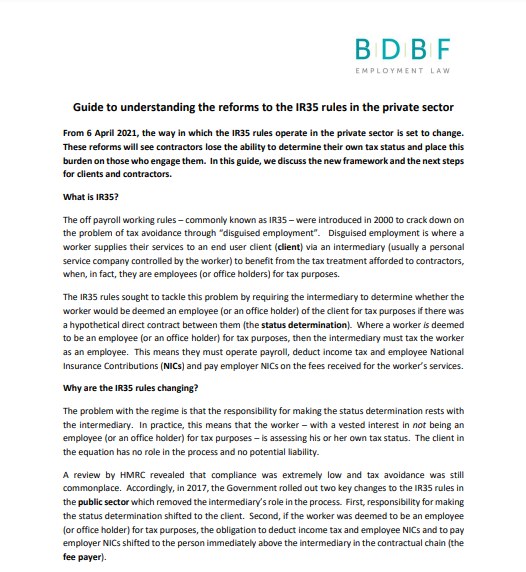
From 6 April 2020, the way in which the IR35 rules operate in the private sector is set to change.  These reforms will see contractors lose the ability to determine their own tax status and place this burden on those who engage them.  In this article, we discuss the new framework and the next steps for clients and contractors.

Please click the image below to view the information:

BDBF can help businesses and contractors prepare for the new regime.  Please contact Amanda Steadman or your usual BDBF contact for further advice.