Detailed briefing on the COVID 19 Job Retention Scheme (8 June 2020)

[et_pb_section fb_built=”1″ _builder_version=”3.0.100″ background_image=”http://davidk423.sg-host.com/wp-content/uploads/2017/09/bdbf_final-stages-1-4-1.jpg” custom_padding=”|||” global_module=”2165″ saved_tabs=”all”][et_pb_row _builder_version=”3.25″ custom_padding=”|||”][et_pb_column type=”4_4″ _builder_version=”3.25″ custom_padding=”|||” custom_padding__hover=”|||”][et_pb_text _builder_version=”3.27.4″ background_layout=”dark” custom_margin=”0px|||” custom_padding=”0px|||”]

Employment Law News

[/et_pb_text][/et_pb_column][/et_pb_row][/et_pb_section][et_pb_section fb_built=”1″ admin_label=”section” _builder_version=”3.22.3″][et_pb_row admin_label=”row” _builder_version=”3.25″ background_size=”initial” background_position=”top_left” background_repeat=”repeat”][et_pb_column type=”4_4″ _builder_version=”3.25″ custom_padding=”|||” custom_padding__hover=”|||”][et_pb_text _builder_version=”4.2.2″ text_orientation=”justified” hover_enabled=”0″ use_border_color=”off”]

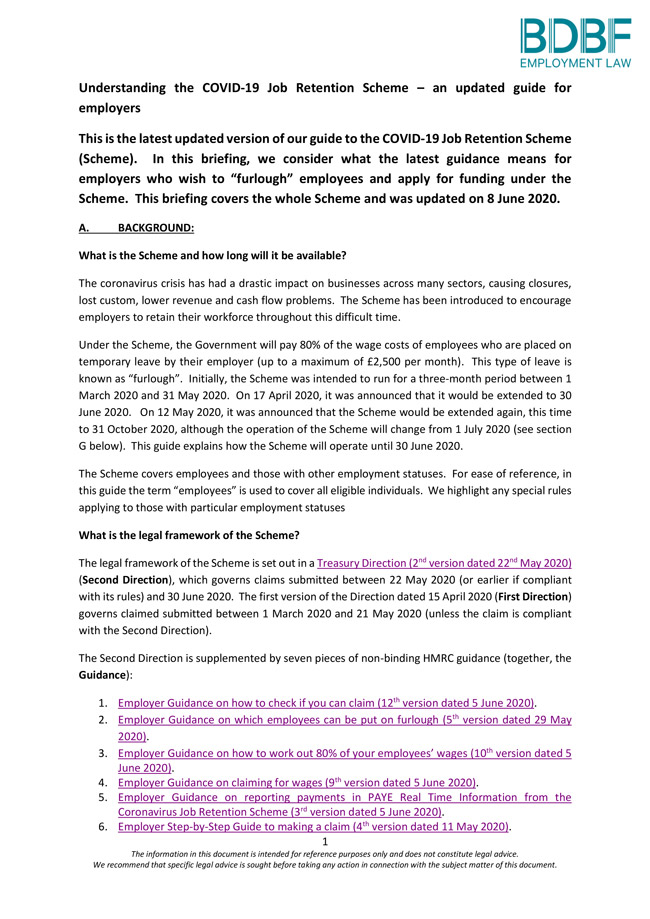
 Understanding the COVID-19 Job Retention Scheme – an updated guide for employers 

This is the latest updated version of our guide to the COVID-19 Job Retention Scheme (Scheme). In this briefing, we consider what the latest guidance means for employers who wish to “furlough” employees and apply for funding under the Scheme. This briefing covers the whole Scheme and was updated on 8 June 2020. 

Please click on the image below to view the PDF:

[/et_pb_text][et_pb_image src=”http://davidk423.sg-host.com/wp-content/uploads/2020/04/Detailed-briefing-on-the-COVID-19-Job-Retention-Scheme-8-June-2020-1.jpg” url=”http://davidk423.sg-host.com/wp-content/uploads/2020/04/Detailed-briefing-on-the-COVID-19-Job-Retention-Scheme-8-June-2020.pdf” align=”center” _builder_version=”4.2.2″ hover_enabled=”0″ border_radii=”on|1px|1px|1px|1px” border_width_all=”1px” border_color_all=”#009b9b”][/et_pb_image][et_pb_text _builder_version=”4.2.2″ text_orientation=”justified” use_border_color=”off”]

BDBF is currently advising many employers and employees on the challenges presented by the coronavirus. If you or your business needs advice on furlough or other coronavirus-related matter please contact Amanda Steadman (amandasteadman@bdbf.co.uk) or your usual BDBF contact. 

[/et_pb_text][/et_pb_column][/et_pb_row][/et_pb_section][et_pb_section fb_built=”1″ _builder_version=”3.26.6″][et_pb_row _builder_version=”3.26.6″][et_pb_column type=”4_4″ _builder_version=”3.26.6″][/et_pb_column][/et_pb_row][/et_pb_section]


Round up of the latest coronavirus-related HR reforms

[et_pb_section fb_built=”1″ _builder_version=”3.0.100″ background_image=”http://davidk423.sg-host.com/wp-content/uploads/2017/09/bdbf_final-stages-1-4-1.jpg” custom_padding=”|||” global_module=”2165″ saved_tabs=”all”][et_pb_row _builder_version=”3.25″ custom_padding=”|||”][et_pb_column type=”4_4″ _builder_version=”3.25″ custom_padding=”|||” custom_padding__hover=”|||”][et_pb_text _builder_version=”3.27.4″ background_layout=”dark” custom_margin=”0px|||” custom_padding=”0px|||”]

Employment Law News


[/et_pb_text][/et_pb_column][/et_pb_row][/et_pb_section][et_pb_section fb_built=”1″ admin_label=”section” _builder_version=”3.22.3″][et_pb_row admin_label=”row” _builder_version=”3.25″ background_size=”initial” background_position=”top_left” background_repeat=”repeat”][et_pb_column type=”4_4″ _builder_version=”3.25″ custom_padding=”|||” custom_padding__hover=”|||”][et_pb_text _builder_version=”4.2.2″ text_orientation=”justified” hover_enabled=”0″ use_border_color=”off”]

Round up of the latest coronavirus-related HR reforms

Whilst the Coronavirus Job Retention Scheme has occupied much of the limelight in the HR world over the past few weeks, a number of other employment law changes have been introduced in response to the pandemic.  Here, we take stock of the key developments beyond the furlough scheme.

Changes to the Statutory Sick Pay (SSP) regime

There have been a number of different changes affecting SSP entitlement:

  • State-funding of SSP for certain employers: SSP will be state-funded for coronavirus-related incapacity of individuals employed by organisations with up to 250 employees. This applies to absences going back to 13 March 2020 and covers up to 14 days of coronavirus-related absence.  HMRC has published guidance for affected employers on how to reclaim the funds.

  • SSP can be claimed from Day 1 of absence: the usual three “waiting days” to be eligible for SSP have been suspended and SSP can be received from the first day of incapacity from work due to coronavirus. This applies to absences going back to 13 March 2020.
  • SSP entitlement for those who are self-isolating (or live with someone who is): those who are experiencing symptoms of coronavirus and self-isolating as a result (and those who live them) are deemed incapable of work and will qualify for SSP. This applies to absences going back to 13 March 2020.
  • SSP entitlement for those who are shielding: those who are extremely vulnerable and have been given notice to shield are also deemed incapable of work and will qualify for SSP. The relevant regulations came into force on 16 April 2020 but do not appear to backdate the protection.
  • Certification of absence: employees can self-certify for the first 7 days of sickness absence. After that, an employee must provide a statement of fitness to work from their GP to certify their absence if asked to do so by their employer.  To alleviate the  pressure on GPs, the Government has introduced a new online sick note and isolation note service via the NHS 111  Coronavirus online and telephone service.

Separately, the latest furlough guidance confirms that sick, self-isolating and shielding workers can all be furloughed.  However, the rules on how this works in practice are complicated.  For a full discussion of the issues, please see our guidance note on the Coronavirus Job Retention Scheme.

Changes to carrying over accrued holiday

New regulations have been introduced which relax the restrictions on the carrying over of accrued but untaken annual leave under the Working Time Regulations 1998 (WTR).  Where it has not been reasonably practicable for a worker to take holiday because of the coronavirus pandemic, they will be entitled to carry it over into the next 2 leave years.

Only the 4 weeks of annual leave as provided under Regulation 13 of WTR may be carried over. The additional 1.6 weeks of annual leave under Regulation 13A of WTR may not be carried over as this leave is subject to separate carry-over rules.

New right to take emergency volunteering leave

The Coronavirus Act 2020 introduced a new right for workers to take unpaid leave from their main job to volunteer in the NHS or the social care sector.  A worker must give their employer 3 working days’ notice of their intention to take the leave and provide a certificate from an appropriate authority such as an NHS Commissioning Board, a local authority or the Secretary of State for Health and Social Care.

The leave must be taken in blocks of either 2, 3 or 4 weeks in a 16-week reference period, beginning on the day the legislation came into force.  Micro businesses (those with 10 or fewer employees) are exempt from this leave. When a request is made, employers do not have the right to refuse it.  Employees are also protected from detriment or dismissal because they have taken, or sought to take, the leave.

Although the leave is unpaid, the legislation leaves it open for the Secretary of State to make payments to such volunteers by way of compensation for loss of earnings, travelling and subsistence.

If your business needs advice on how to navigate these or any other employment law issues arising out of the coronavirus pandemic, please contact Amanda Steadman (amandasteadman@bdbf.co.uk)  or your usual BDBF contact.

[/et_pb_text][/et_pb_column][/et_pb_row][/et_pb_section][et_pb_section fb_built=”1″ _builder_version=”3.26.6″][et_pb_row _builder_version=”3.26.6″][et_pb_column type=”4_4″ _builder_version=”3.26.6″][/et_pb_column][/et_pb_row][/et_pb_section]


Is there light at the end of the lockdown tunnel for employers?

[et_pb_section fb_built=”1″ _builder_version=”3.0.100″ background_image=”http://davidk423.sg-host.com/wp-content/uploads/2017/09/bdbf_final-stages-1-4-1.jpg” custom_padding=”|||” global_module=”2165″ saved_tabs=”all”][et_pb_row _builder_version=”3.25″ custom_padding=”|||”][et_pb_column type=”4_4″ _builder_version=”3.25″ custom_padding=”|||” custom_padding__hover=”|||”][et_pb_text _builder_version=”3.27.4″ background_layout=”dark” custom_margin=”0px|||” custom_padding=”0px|||”]

Employment Law News


[/et_pb_text][/et_pb_column][/et_pb_row][/et_pb_section][et_pb_section fb_built=”1″ admin_label=”section” _builder_version=”3.22.3″][et_pb_row admin_label=”row” _builder_version=”3.25″ background_size=”initial” background_position=”top_left” background_repeat=”repeat”][et_pb_column type=”4_4″ _builder_version=”3.25″ custom_padding=”|||” custom_padding__hover=”|||”][et_pb_text _builder_version=”4.2.2″ text_orientation=”justified” hover_enabled=”0″ use_border_color=”off”]

Is there light at the end of the lockdown tunnel for employers?

In this article, we look at five key issues for employers to consider as we emerge from a strict lockdown into a changed working world.

On 16 April 2020, the Government announced that the current strict social distancing rules – also known as “lockdown” – would be extended until 7 May 2020.  However, with school examinations cancelled and the furlough scheme extended to 30 June 2020, it seems unlikely that there will be an immediate return to normal life in early May.  Indeed, the Chief Medical Officer, Professor Chris Whitty, recently said that “highly disruptive social distancing” would need to be in place at least until the end of 2020.  What might this new world look like for employers and how should they prepare?

Adjusting work patterns for long-term social distancing

We don’t yet know what ‘highly disruptive social distancing’ will mean for the workplace.  It has been reported that the Government are considering asking employers to adopt radical measures such as:

  • Staggered start times for workers of 7am, 10am and 1pm.
  • Alternating days working at the employer’s premises and from home.
  • Introducing weekend working.

The intention is that such measures will promote social distancing by easing rush hours and reducing the number of people in the workplace at any one time.  Whether or not such measures come to pass remains to be seen.  However, it would be wise for employers to begin considering how to respond to the long-term need to reduce the number of workers travelling to and from work each day.  Employers should consider which, if any, functions and roles need to return first and for how many hours per week.  Another option would be to organise the workforce into separate teams which attend the workplace on alternate weeks.  It may also be possible for some roles to continue to be performed entirely from home in the long term.

Employers will need to consult with affected workers and/or their representatives about the feasibility of new working patterns.  Workers will be subject to different pressures and/or have different concerns about returning to work, for example:

  • Some workers may have ongoing caring responsibilities which may mean it is difficult for them to resume work outside the home (e.g. for children until schools and nurseries reopen and/or for older and vulnerable relatives who are shielding).
  • Some workers may have a high level of anxiety about returning to work, particularly in the initial phase after the lockdown is relaxed.
  • Pregnant workers and those with certain underlying health conditions may be subject to restrictions on their movements outside the home. If this is the case, employers will have to consider how to treat such workers, in light of any continued Government support which may be available.

Wherever possible, employers should try to reach a suitable compromise.  Forcing such workers to return could breach the duty of mutual trust and confidence and may also be discriminatory (e.g. on the grounds of sex or disability).

Managing health and safety in the workplace post-lockdown

Before workers return to the workplace, employers should conduct a health and safety risk assessment and take measures to address any identified risks.  Importantly, employers will need to comply with ongoing rules around social distancing, such as maintaining distances between workers of at least 2 metres.  This may involve reorganising workstations and placing limits on the number of people that can use common areas, such as meeting rooms and eating areas.

Once workers have returned to work, employers should adopt other appropriate measures to help prevent the spread of coronavirus.  This could include the following:

  • Circulating the Government’s latest guidance to staff, together with any internal policies, and providing a point of contact within the business to discuss any concerns.
  • Reminding staff about the recommended hygiene measures such as regular handwashing.
  • Providing access to anti-bacterial handwash, hand sanitiser and antibacterial wipes (especially near items which are touched by multiple people, such as photocopiers).
  • Closing, or staggering the use of, the staff kitchen area and/or canteen.
  • Providing anti-bacterial surface spray or wipes in kitchen and/or eating areas.
  • Providing plenty of free tissues and additional bins.
  • Engaging additional deep cleaning services.
  • Designating a special area for breastfeeding mothers to wash and store breast pump equipment and expressed milk.
  • Designating a closed-off area for anyone displaying symptoms of coronavirus whilst at work.
  • Discouraging physical forms of greetings such as handshakes and kisses.
  • Temporarily banning attendance at non-essential meetings, conferences and social events.
  • Placing restrictions on third parties entering the workplace (e.g. clients, contractors, couriers).
  • Providing face masks to workers who use public transport to get to and from work.

Some employers may also wish to consider introducing mandatory employee temperature checks and antibody testing.  Very careful consideration would need to be given to such measures in light of the data protection implications involved in the gathering health data from workers.

Helping workers manage anxiety and mental wellbeing

Employers already know that managing workers’ anxiety about coronavirus is one of their most pressing challenges.  A survey of 300+ employers conducted by People Management and the CIPD revealed that with 67% of employers viewed managing coronavirus anxiety as one of their top priorities.  The length and severity of the pandemic will have taken its toll on the mental wellbeing of workers, with many feeling anxious about issues such as job security, finances, their own health and that of family members.  Some workers may have spent lockdown alone and suffered the stress of social isolation.  Others may have suffered coronavirus-related health problems or experienced bereavements.

The Lancet Psychiatry journal recently reported that emerging studies into coronavirus and previous pandemics have shown a profound and potentially long-term impact on mental health.  After the SARs outbreak of 2003, there was evidence of higher rates of anxiety, depression, PTSD and suicide.  To help tackle this, medical experts recommend real time monitoring of mental health issues across the general population and at-risk groups, such as those with pre-existing mental impairments.  Employers can play their part here by ensuring managers are in regular communication with workers, listening to their concerns and making reasonable adjustments where it is appropriate to do so.  Employers may also offer access to mental health support services such as counselling or employee assistance programmes.

Responding to increased requests for permanent flexible working

The lockdown has forced employers to embrace certain forms of flexible working such as homeworking, reduced hours and/or flexi hours.  What was borne of necessity, may develop into the new normal when the pandemic is over, with many employees seeking to work flexibly on a permanent basis.

Where employers have previously refused requests to work from home and/or work reduced/flexi hours, they may well see the same request put forward again.  This time, the employee will be able to point to a tried and tested lockdown working pattern.  Where such a pattern has worked successfully in respect of a particular role, it could be harder for the employer to reject the request.  Furthermore, employers could see brand new requests from employees who had not considered flexible working before, but who have now experienced the benefits and are confident using remote technology.

It’s even possible that the Government may legislate to force employers to allow workers to work from home if they wish to do so.  In Germany, there are plans to introduce a new right to work from home where a job is capable of being performed remotely.  The German Labour Minister, Hubertus Heil, is championing the legislation which would allow workers to work from home for some, or all, of their working week, even after the pandemic is over.  The proposal was formulated in response to the successful homeworking arrangements put in place during the German lockdown.  The German Vice Chancellor, Olaf Scholz, noted that the lockdown had “…shown how much is possible when working from home – this is a real achievement that we should not forget about”.

Reducing staff costs when the furlough scheme ends

There are differing reports on how many businesses have applied for grants under the Government’s furlough scheme.  The Office of National Statistics has reported that around 30% of businesses have applied for funding under the scheme.  The British Chamber of Commerce Coronavirus Business Impact Tracker revealed that 71% of employers surveyed had furloughed at least some of their workforce.  Either way, a significant number of employers will have had help with their wage costs for the duration of the scheme.  When that comes to an end, employers will need to consider whether they are able to return to their pre-furlough position, or whether they need to reduce staff costs in the longer term.

Various options are available to help achieve this including:

  • Keeping workers laid off without pay if there is a contractual right to lay off.
  • Agreeing with workers that they will remain laid off on reduced pay if there is no contractual right to lay off (funded by the employer).
  • Agreeing reduced working hours and pro-rating pay accordingly.
  • Agreeing reductions in pay and benefits and/or pay freezes.
  • Allowing fixed-term contracts to expire.
  • Terminating arrangements with contractors, agency workers and/or casual workers.
  • Putting in place a recruitment freeze.

Ultimately, some employers may find that they need to consider downsizing their workforce.  Indeed, the People Management/CIPD survey found that 25% of employers expected to make redundancies, with 15% expecting to make up to 10% of their existing workforce redundant.  Where redundancies are in prospect, employers need to remember to follow a fair process, including collective consultation where 20+ employees are to be made redundant within a 90-day period.

Conclusion

Understandably, employers are keen for the lockdown restrictions to be lifted to allow their businesses to survive and thrive.  Whilst we don’t know when the lockdown will be relaxed, what’s clear is that “business as normal” is some way off.  Employers should now turn their minds towards preparing for the new world that awaits as we emerge from the lockdown tunnel.

If your business needs advice on how to navigate these or any other employment law issues arising upon the end of the lockdown restrictions, please contact Amanda Steadman (amandasteadman@bdbf.co.uk)  or your usual BDBF contact.

[/et_pb_text][/et_pb_column][/et_pb_row][/et_pb_section][et_pb_section fb_built=”1″ _builder_version=”3.26.6″][et_pb_row _builder_version=”3.26.6″][et_pb_column type=”4_4″ _builder_version=”3.26.6″][/et_pb_column][/et_pb_row][/et_pb_section]


Employer not vicariously liable for employee’s deliberate data breach

[et_pb_section fb_built=”1″ _builder_version=”3.0.100″ background_image=”http://davidk423.sg-host.com/wp-content/uploads/2017/09/bdbf_final-stages-1-4-1.jpg” custom_padding=”|||” global_module=”2165″ saved_tabs=”all”][et_pb_row _builder_version=”3.25″ custom_padding=”|||”][et_pb_column type=”4_4″ _builder_version=”3.25″ custom_padding=”|||” custom_padding__hover=”|||”][et_pb_text _builder_version=”3.27.4″ background_layout=”dark” custom_margin=”0px|||” custom_padding=”0px|||”]

Employment Law News


[/et_pb_text][/et_pb_column][/et_pb_row][/et_pb_section][et_pb_section fb_built=”1″ admin_label=”section” _builder_version=”3.22.3″][et_pb_row admin_label=”row” _builder_version=”3.25″ background_size=”initial” background_position=”top_left” background_repeat=”repeat”][et_pb_column type=”4_4″ _builder_version=”3.25″ custom_padding=”|||” custom_padding__hover=”|||”][et_pb_text _builder_version=”4.2.2″ text_orientation=”justified” hover_enabled=”0″ use_border_color=”off”]

Employer not vicariously liable for employee’s deliberate data breach

In a welcome decision for employers, the Supreme Court has ruled that an employer was not vicariously liable for a significant data breach committed by a disgruntled employee.  It could not be said that there was a sufficient connection between the employee’s authorised activities and the wrongful act of publishing the data on the internet.

What does the law say?

Employers may be liable for torts committed by their employees under the doctrine of vicarious liability.  Vicarious liability arises where the connection between the employment relationship and the employee’s wrongful act is sufficient to justify holding the employer responsible for the consequences of the employee’s conduct. 

The sufficient connection test was considered by the Supreme Court in its landmark decision in Mohamud v WM Morrison Supermarkets plc [2016] UKSC 11 (Mohamud).   The Supreme Court ruled that the sufficient connection test involves consideration of two questions:

  1. What functions or field of activities have been entrusted by the employer to the employee?
  2. Was there a sufficiently close connection between the employee’s role and the wrongful conduct so as to make it just and reasonable for there to be vicarious liability?

In Mohamud, this approach led the Supreme Court to decide that Morrisons was liable for a petrol station attendant’s unprovoked assault on a customer.  They said that the employee had been employed to serve customers and Morrisons had “…entrusted him with that position and…they should be responsible for their employee’s abuse of it”.  Although the employee had physically left his workstation and followed the customer to the forecourt to assault him, the Court said this was a “seamless episode” and there had been “an unbroken sequence of events”. 

In another case involving WM Morrison Supermarkets plc (Morrisons), the Supreme Court was asked to decide whether Morrisons was vicariously liable for claims arising out a deliberate data breach committed by a disgruntled employee. 

What happened in this case?

Mr Skelton was a senior auditor at Morrisons who developed a grudge after receiving a disciplinary warning in July 2013 for using the company’s mail facilities to send out personal eBay packages.  During an annual external audit in November 2013, Mr Skelton was given access to payroll data in order to pass it on to Morrisons’ auditors, KPMG.  However, Mr Skelton copied the data onto a personal USB and went on to post the personal details of 99,998 Morrisons’ employees onto a file sharing website.

In March 2014, just before Morrisons was due to announce its annual financial report, Mr Skelton sent a CD containing the data to three UK newspapers.  Mr Skelton was ultimately arrested and sentenced to eight years’ in prison for offences under the Computer Misuse Act 1990 and the Data Protection Act 1998 (DPA).

Over 9000 affected employees brought proceedings against Morrisons for damages in respect of claims of misuse of private information, breach of confidence and breach of statutory duty under the DPA. The claimants claimed that Morrisons was primarily liable for Mr Skelton’s actions.  In the alternative, they were vicariously liable.  The High Court and the Court of Appeal held that Morrisons was not primarily liable but was vicariously liable for Mr Skelton’s actions. 

Relying on the decision in Mohamud, the Court of Appeal said there had been an unbroken sequence of events because:

  • Morrisons had trusted Mr Skeleton with the payroll data and his job role included disclosing the data to a third party (namely KPMG). Therefore, the subsequent disclosure of the data online was closely related to his job, even though it was unauthorised. 
  • The fact that the wrongful acts took place at Mr Skelton’s home, on his own computer and on a Sunday several weeks after he had been given access to the data in a work capacity did not prevent the close connection test from being satisfied.
  • Mr Skelton’s motivation for doing what he did (i.e. revenge for having been disciplined) was irrelevant.

Morrisons appealed to the Supreme Court.

What was decided?

The Supreme Court allowed Morrisons appeal and held that they were not vicariously liable for Mr Skelton’s actions. 

The Court said that the High Court and Court of Appeal had gone wrong in their interpretation of the decision in Mohamud.  That decision was not intended to elevate the importance of the causal and temporal connection between events.  Rather, the references to a “seamless episode” and an “unbroken sequence of events” were aimed at the capacity in which the employee was acting.  Further, the reference to the irrelevance of motive was specific to the Mohamud decision.

In this case, it simply could not be said that the disclosure of data on the internet formed any part of Mr Skelton’s field of activities.  The close causal and temporal link between the authorised activities (i.e. passing the data to KPMG) and the unauthorised activities (i.e. publishing the data on the internet) was not enough to demonstrate a sufficient connection justifying the imposition of vicarious liability.  Further, Mr Skelton’s motive for acting as he did was material.  It was clear that he was pursuing a personal vendetta against Morrisons.  For these reasons, the Court decided that it was not just and reasonable to make Morrisons vicariously liable for the conduct.

Separately, the Court ruled that the DPA did not exclude the possibility of vicarious liability for breaches of the DPA and/or of obligations arising at common law or in equity.  The imposition of a statutory duty on an employee acting as a data controller was not inconsistent with the imposition of vicarious liability on the employer.  However, in this case, it was not just and reasonable to impose vicarious liability on Morrisons.

What are the learning points?

This is a welcome decision for employers which shows that the concept of vicarious liability is confined by the employee’s field of activities.  The fact that the employee’s job provides them with the opportunity to commit a wrongful act is not enough to establish a sufficient connection.  There is a distinction between cases where the employee is misguidedly attempting to further his employer’s business interests and cases where the employee is simply “on a frolic of his own” and pursuing his own interests.  An employee acting to further a personal vendetta against his employer is very likely to be in the latter camp. 

Whilst employers should be mindful of the risk of vicarious liability for breaches of the Data Protection Act 2018 and the GDPR (the successors to the DPA), the circumstances in which an employee will be elevated to acting as a data controller will be relatively rare.  Most employee data breaches are caused by negligence and do not involve criminal acts.  Nonetheless, employers should limit employees’ access to personal data and review access privileges on a regular basis.

If you would like to discuss any of the issues raised in this article, please contact Amanda Steadman (amandasteadman@bdbf.co.uk) or your usual BDBF contact.

[/et_pb_text][/et_pb_column][/et_pb_row][/et_pb_section][et_pb_section fb_built=”1″ _builder_version=”3.26.6″][et_pb_row _builder_version=”3.26.6″][et_pb_column type=”4_4″ _builder_version=”3.26.6″][/et_pb_column][/et_pb_row][/et_pb_section]


A closer look at the new right to parental bereavement leave

[et_pb_section fb_built=”1″ _builder_version=”3.0.100″ background_image=”http://davidk423.sg-host.com/wp-content/uploads/2017/09/bdbf_final-stages-1-4-1.jpg” custom_padding=”|||” global_module=”2165″ saved_tabs=”all”][et_pb_row _builder_version=”3.25″ custom_padding=”|||”][et_pb_column type=”4_4″ _builder_version=”3.25″ custom_padding=”|||” custom_padding__hover=”|||”][et_pb_text _builder_version=”3.27.4″ background_layout=”dark” custom_margin=”0px|||” custom_padding=”0px|||”]

Employment Law News


[/et_pb_text][/et_pb_column][/et_pb_row][/et_pb_section][et_pb_section fb_built=”1″ admin_label=”section” _builder_version=”3.22.3″][et_pb_row admin_label=”row” _builder_version=”3.25″ background_size=”initial” background_position=”top_left” background_repeat=”repeat”][et_pb_column type=”4_4″ _builder_version=”3.25″ custom_padding=”|||” custom_padding__hover=”|||”][et_pb_text _builder_version=”4.2.2″ text_orientation=”justified” use_border_color=”off”]

A closer look at the new right to parental bereavement leave

From 6 April 2020 a new law, known as “Jack’s Law”, was introduced which gives parents the right to take 2 weeks’ bereavement leave following the death of a child.  In this article, we take a closer look at the new right and the steps employers need to take. 

Why has parental bereavement leave been introduced?

Jack’s Law was introduced in memory of Jack Herd, who tragically drowned in 2010, aged 23 months. It is the result of a campaign led by his mother, Lucy, to give bereaved parents a guaranteed right to a period of leave following the death of their child. 

Prior to 6 April 2020, UK employees did not have a specific statutory right to take time off following the death of a child. Whilst employees had a right to take a reasonable amount of time off work to take “action which is necessary… as a consequence of the death of a dependant”, there was no statutory right to be paid during this time.  Further, the caselaw in this area made it clear that the purpose of dependant’s leave in this context was to deal with practical matters, such as arranging a funeral, not to grieve.

Whilst some employers went further and allowed employees to take a period of compassionate leave following a bereavement, this was a matter of discretion for the employer.  Beyond this, if an employee wished to take time off work to grieve following the death of a child, they would have to take either sick leave, annual leave or agree a period of unpaid leave with their employer.

The new right to take parental bereavement leave (PBL) and, in some circumstances, receive statutory parental bereavement pay (SPBP), was introduced on 6 April 2020 and is set out in the Parental Bereavement (Leave and Pay) Act 2018 and the Parental Bereavement Leave Regulations 2020.  The Government has also published brief guidance on the new right.  PBL does not affect a bereaved employee’s right to take any other relevant forms of leave, such as dependant’s leave or sick leave.

Who is eligible to take PBL?

Employed parents who lose a child aged under 18, including through a stillbirth after 24 weeks, are entitled to take up to 2 weeks’ PBL.   The right to take PBL is only available to employees, not to other workers, self-employed contractors or agency workers (unless they are employees of the employment business).  It is a Day 1 right, meaning employees do not need to have a specified period of service with their employer to be eligible to take PBL (although there is a length of service requirement in relation to pay, see below).

Whether an employee is a “bereaved parent” within the meaning of the legislation is determined with reference to their relationship to the deceased child.  It is a wide-ranging definition and covers the following categories of parent:  

  • a child’s natural or adoptive parent, including employees who have become parents following surrogacy or other forms of IVF treatment;
  • the natural parent of a child that has been adopted, where there is a court order authorising the child to have contact with the natural parent;
  • an individual with whom the child has been placed for adoption by a British adoption agency, or under a fostering for adoption scheme, provided the placement has not been terminated;
  • in circumstances where a child has entered Great Britain from overseas for the purposes of adoption, a person living with that child and who intends to adopt them and has received official notification from the British authorities that they are eligible to adopt;
  • an intended parent under a surrogacy arrangement where it was expected that the court would make a parental order under the Human Fertilisation and Embryology Act 2008;
  • a “parent in fact”, being someone in whose home the child was living and who had day-to-day responsibility for the child’s care for at least the 4 weeks prior to death, provided that the child’s parent or someone with parental responsibility was not also living in the home; and
  • the partner of any of the above, being a person living in an enduring family relationship with another person and their child, and who is not that person’s parent (including adoptive parents), grandparent, sibling (including a half-sibling), aunt or uncle (including half-aunts and uncles). The purpose of this category is to include stepparents.

How do employees take PBL?

The leave can be taken as a single 2-week block or as separate 1-week blocks and can be taken any time up to 56 weeks after the date of the child’s death or stillbirth.  The reason for the 56-week period is to allow parents to take their second week of leave over the first anniversary of the death if they wish.  In circumstances where more than one child has died, or been stillborn after 24 weeks, a parent can take a separate period of leave for each child.

In order to take PBL, an employee needs to notify their employer of:

  • the date of their child’s death or stillbirth;
  • the date on which they intend their PBL to start; and
  • whether they intend to take 1 or 2 weeks’ leave.

Whilst the legislation does not require this notice to be given in writing, it would be sensible for employers to ask for notice to be given in writing so that there is a record.  The employee does not need to provide evidence of the death or stillbirth. 

How much notice the employee is required to give depends on when they would like PBL to start. If the employee intends to take PBL within the 8 weeks following their child’s death, then they only need to notify their employer before the first day of leave. If, however, they wish to take PBL after the first 8 weeks (but before the end of the 56-week period) then they need to provide 7 days’ notice. The legislation allows an employee to change the dates of their PBL by giving the same period of notice. However, once a period of PBL has started, it cannot be cancelled.

Who is eligible to be paid SPBP?

Unlike the right to take PBL, the statutory right for a bereaved parent (as defined above) to be paid during this time is not a Day 1 employment right.   Instead, the employee must have:

  • been in the employer’s employment for a continuous period of at least 26 weeks, ending with the week prior to the week in which the child died or was stillborn;
  • remained in that employment until at least the date on which the child died or was stillborn; and
  • received normal weekly earnings in the 8 weeks before the relevant week that was not less than the lower earnings limit in force at the end of the relevant week. For the 2020/2021 tax year, the lower earnings limit is £120 per week.

If an employee has more than one employer then they can claim SPBP from each employer, provided they meet the eligibility criteria in respect of each employer.

How do employees claim SPBP?

In order to claim SPBP an employee must notify their employer that they are eligible and intend to claim SPBP. This should be done either before the start of their SBL period, or no later than 28 days after the first day of leave.

The employee’s notice must contain the following information:

  • their name;
  • the date of death of the child; and
  • a declaration that they satisfy the definition of bereaved parent.

How much will eligible employees be paid?

The rate of SPBP is the same as statutory maternity, paternity, adoption and shared parental leave. This is the lower of either 90% of the employee’s basic salary or the prescribed rate (which for the 2020/2021 tax year is £151.20 per week).

SPBP is not payable for any week in which the employee is entitled to receive statutory sick pay or does any work for the employer (or another employer where they do not meet the eligibility criteria for SPBP). 

Employers are able to recover SPBP from HMRC at a rate of either 103% or 92% depending on the size of the organisation.

Protections for employees during PBL

An employee taking a period of PBL is entitled to benefit from the same protections as employees taking other forms of family leave.   In summary:

  • their terms and conditions of employment (excluding those relating to remuneration) remain in full force and effect, meaning, for example, that they will continue to accrue holiday;
  • in most cases they have the right to return to the same job that they held prior to taking a period of PBL;
  • any dismissal because they took, sought to take, or the employer believed that they were likely to take, a period of PBL will be automatically unfair; and
  • it will be unlawful to subject the employee to any other form of detriment because they took, sought to take, or the employer believed that they were likely to take, a period of PBL

Practical tips for employers

PBL is a new type of leave, operating in a completely different set of circumstances to other forms of family leave.  It’s important for employers to recognise this in communications with employees following the death of a child.

We recommend that employers put in place a parental bereavement leave and pay policy which sets out the scope of the right and the steps the employee needs to take in order to exercise it.  However, we also recommend allowing a degree of flexibility to employees, for example, allowing them to make the notification of their intention to take leave by way of text message if that is more convenient.

Employers who offer enhanced benefits packages could consider enhancing the statutory regime in the following ways:

  • enabling PBL to be taken following the death of a child of any age, not just for those aged under 18;
  • allowing employees to take more than two weeks leave;
  • granting an additional day’s leave each year on the anniversary of a child’s death; and/or
  • topping up SPBP so that the employee receives full pay during this period.

On an employee’s return to work the employer should speak to them and discuss whether there are any adjustments that could be made to their role and working practices (on a temporary or permanent basis).  When doing so, the employer should remember that every situation is different and that they should discuss with each employee what would be helpful for them and not impose any changes without discussion. The important point to remember is to keep lines of communication open and to treat employees with compassion.

If your business needs advice on parental bereavement leave please contact either Clare Brereton (claretaylor@bdbf.co.uk), Amanda Steadman (amandasteadman@bdbf.co.uk)  or your usual BDBF contact.

[/et_pb_text][/et_pb_column][/et_pb_row][/et_pb_section][et_pb_section fb_built=”1″ _builder_version=”3.26.6″][et_pb_row _builder_version=”3.26.6″][et_pb_column type=”4_4″ _builder_version=”3.26.6″][/et_pb_column][/et_pb_row][/et_pb_section]