Employee unfairly dismissed for refusing to put work app on her personal phone

An Employment Tribunal has ruled that a journalist was unfairly dismissed for refusing to install an “intrusive” work-related app on her personal phone, which would have left her unable to separate her work and home life.  The employer should have considered alternatives such as providing her with a work phone or installing the app on her laptop.

What happened in this case?

The Claimant worked as an Online News Editor for the Respondent newspaper.  The Respondent had regarded her as a self-employed freelancer, but it was later determined that she was actually an employee.

By 2017, the Online News team was publishing at least one hundred news stories per day, and it had become impossible for the team’s supervisors and editor to review every article before publication.  To help with this, the Respondent introduced a new online platform called Viber to track what stories were being submitted and avoid duplication of content.  Viber would also alert supervisors more efficiently to when sensitive articles needed to be checked.  Initially, the use of Viber was not compulsory.  

The Respondent developed concerns that the Claimant had duplicated articles that had already been published by them.  On 1 November 2019, Ms Aloul, the Editor in Chief, sent the Claimant a message asking her to start using Viber “now” to avoid mistakes in the publication of articles.  Yet on 4 and 26 November 2019, the Claimant published articles on topics that had already been covered.  Again, the Claimant was asked to use Viber.  

However, the Claimant objected to having the Viber app on her personal mobile phone.  She said she was getting disturbed by the volume of messages that came through the app, day and night.  She asked to be provided with a separate work phone for this purpose.  The Claimant was told that she could mute the Viber notifications, but she did not feel that was an acceptable solution since she would still be able to see the visual notifications on her phone screen.  Alternatively, she was told to buy a separate phone herself, but that the Respondent would not pay for it as she was a freelancer.

The Claimant continued to refuse to put the Viber app on her phone.  As a result, on 8 January 2020, Ms Aloul gave the instruction to block the Claimant’s access to the Respondent’s systems.  On 13 January 2020, the Claimant raised a grievance alleging bullying, harassment and race discrimination by Ms Aloul.  The relationship was eventually terminated on 6 February 2020.  

The Claimant brought claims alleging that she had been unfairly dismissed.  She also brought claims of breach of contract, unlawful deductions from wages and unpaid holiday pay.  This briefing considers the unfair dismissal claim only.

What was decided?

The Employment Tribunal decided that the principal reason for the Claimant’s dismissal was that she had refused to put the Viber app on her personal phone.  The refusal to use the app fell within the category of “conduct” and was, therefore, a potentially fair reason for dismissal.  

Whether or not the dismissal was, in fact, fair turned on whether the decision to dismiss fell within the “band of reasonable responses”.  The Tribunal found that it did not.  It held that no reasonable employer would have dismissed an employee for refusing to put an intrusive work-related app on their personal phone.  The Respondent’s approach meant that the Claimant would not be able to separate her home and work life.  This was unreasonable given that there were alternative solutions available, such as providing her with a separate work phone or phone number or downloading the app onto her laptop.

In any event, the dismissal was procedurally unfair, given that no investigation or disciplinary hearing took place before a final decision to terminate was taken.  Nor had the Claimant received any prior disciplinary warnings about the matter.  It was clear that the Respondent did not feel it had to follow proper procedures because it (erroneously) believed that the Claimant was self-employed.   

The Tribunal also dismissed the argument that this was a case in which it was fair to dismiss without following any procedure on the basis that there had been a complete breakdown in working relations, meaning that a procedure would serve no useful purpose.  While there had been some arguments in the past, there had not been a major breakdown in working relations.  There was no reason a disciplinary hearing could not have been held.

The Tribunal declined to order reinstatement on the basis that trust and confidence between the Claimant and Ms Aloul had now broken down.  Instead, it awarded compensation of almost £20,000 for the unfair dismissal, including an uplift of 25% for failure to comply with the statutory Acas Code of Practice on Discipline and Grievance.  The Tribunal also awarded a further £12,000 in respect of the claims for breach of contract, unpaid holiday pay and unlawful deductions from wages.

What are the learning points for employers?

Firstly, this decision highlights the need for employers to be clear about the employment status of those working for them.  Had the employer understood that the Claimant was an employee, they could have made sure that they followed a proper process prior to any dismissal.  The failure in this respect meant that the dismissal was unfair and also landed them with an uplift to compensation of 25%.

Secondly, employers facing resistance from employees about the use of technology should explore whether any other solutions are available.  In this case, the issue may have been swiftly resolved by providing a work phone or installing the app on a laptop.  Had the Claimant continued to refuse to use the app in those circumstances, it is likely that the employer could have fairly dismissed for misconduct, subject to following a fair procedure.

Thirdly, the decision reminds employers to be wary of the degree to which work-related technology intrudes into the personal lives of employees.  Although many employers in this situation would  have provided a work phone, it may well have come with an expectation that the employee would monitor notifications outside normal working hours.  This still presents the problem of leaving employees unable to separate their work and home lives and blurring the line between working time and non-working time.  Depending on the circumstances, it may not be unreasonable for an employee to refuse to do so.

And it may not be long before workers are given a specific legal right to disconnect.  The Labour Party has indicated that it would legislate to introduce a right for workers not to be contacted about work outside of normal working hours.  Indeed, several EU member states have already successfully introduced legislation or guidance in this area, including France, Italy, Spain, Ireland, Portugal and Belgium.  Further, in January 2021, the European Parliament passed a resolution calling for a new EU Directive to introduce a right to disconnect.  

Alsnih v Al Quds Al-Arabi Publishing & Advertising

BDBF is a leading employment law firm based at Bank in the City of London. If you would like to discuss any issues relating to the content of this article, please contact Amanda Steadman (AmandaSteadman@bdbf.co.uk) or your usual BDBF contact.


New law passed which will shake up flexible working regime

On 20 July 2023, the Employment Relations (Flexible Working) Act 2023 received Royal Assent and became law.  The Act introduces reforms to the flexible working regime, which are due to come into force in a year’s time.  The statutory Acas Code of Practice on flexible working will be updated to reflect the changes to the law.

What is the background to the reforms?

In September 2021, the Government published a consultation setting out its proposals for change to the flexible working framework.  In particular, views were sought on whether the right to request flexible working should become a Day 1 employment right (currently, 26 weeks’ service is required before a statutory request can be made).  

The Government responded to the consultation in December 2022 and confirmed that it would make the right to request flexible working a Day 1 employment right.   It is estimated that this will bring a further 2.2 million employees within the scope of the flexible working regime.

Separately, the response confirmed that the Government would support the Employment Relations (Flexible Working) Bill 2022-23, a Private Members’ Bill sponsored by the Labour MP, Yasmin Quereshi.  The Bill received Royal Assent on 20 July 2023 and became the Employment Relations (Flexible Working) Act 2023.

What changes will be made to the flexible working framework?

The Act will make the following changes to the flexible working framework:

  • Employees will no longer be required to explain what effect they think the requested change would have on their employer and how that effect might be dealt with.

  • Employees will be permitted to make two flexible working requests per year rather than one.

  • Employers will be required to consult with employees before refusing requests.

  • Employers will have two months to make a decision on a flexible working request rather than three, unless an extension is agreed.

However, the Act does not take forward the Government’s proposal of making the right to request flexible working a Day 1 employment right.   The Government has said that secondary legislation will be introduced separately to implement this.

Are there any other changes employers need to know about?

On 12 July 2023, Acas launched a consultation on proposals to update its statutory Code of Practice on handling flexible working requests.   Although the Code is not legally binding, it is taken into account by Employment Tribunals when considering relevant cases. The Code has been updated to reflect changes to ways of working since the Code was first introduced in 2014, and to reflect the new legal reforms.  The draft Code encourages employers to approach requests with an open mind and engage in meaningful dialogue.  It also:

  • Provides clarity on what consultation should involve and recommends that meetings are held both when a request is to be rejected or accepted.

  • Extends the categories of individuals who may accompany an employee at meetings to discuss a request (so that it mirrors the position for disciplinary and grievance meetings).

  • Provides guidance on the information that employers should set out to help explain their decision.

  • Encourages employers to allow for an appeal process where a request is rejected.

  • Provides information about the planned new right for workers to be able to request more predictable working patterns (which is separate to the right to request flexible working).

The consultation on the draft Code close 6 September 2023.  Acas has said it will also update its non-statutory guidance on flexible working, which complements the Code.

Separately, on 19 July 2023, the Government launched a call for evidence on “non-statutory” flexible working.  This covers regular flexible working arrangements that have been agreed outside the statutory regime, as well as ad hoc arrangements which are occasional or temporary in nature.  In particular, the Government wishes to understand the extent to which individuals and businesses are using such practices, how and why they are using them, as well as the barriers and the benefits.  It also wants to receive examples of best practice and case studies.  The Government wishes to develop an evidence base in this area, which it says will inform the Government’s future flexible working strategy.

What steps should employers take now?

The Act provides that the changes may come into force on a date or dates specified by the Secretary of State.  The Government has said it “expects” the measures to come into force approximately a year after Royal Assent, in order to give employers time to prepare i.e. in July 2024.  The intention is that the secondary legislation introducing the Day 1 right to request flexible working will be introduced at the same time.

Therefore, employers have a year to prepare for these changes. We would recommend that you consider taking the following preparatory steps:

  • Consider whether you will specify what flexible working options would be suitable for a role in job advertisements and identify candidates’ preferences in job interviews.  Although this will not prevent an employee asking for something different on Day 1 of their employment, the hope is that discussing this upfront will allow a suitable pattern to be identified from the off, rather than having to deal with a request in the first few months of employment.

  • Revise your flexible working policies to reflect the legal reforms.  Although employees are no longer required to explain the potential effect of their request, we would recommend that this is still encouraged on the basis that it may help speed up consideration of the request.

  • Consider what your consultation process will look like.  As the draft Code outlines, this should usually include a face-to-face meeting.  Where you are tending towards rejecting a request, a meeting affords the employee an opportunity to make further submissions and allows time for consideration of alternatives.  Where you are tending towards accepting a request, a meeting can add value by allowing an opportunity to discuss the request in more detail and think about ways to implement the arrangement successfully.

  • Train HR and line managers on how these reforms will impact the handling of flexible working requests.  When the Acas Code is finalised, HR and line managers should be asked to read it.

  • Consider whether you need to devote further resource to the management of flexible working requests, in light of the ability to make two requests per year, the shorter time frame for providing responses and that requests may be made from Day 1 of employment.

  • Consider whether record-keeping procedures should be strengthened (for example, to record how many requests have been made within a 12-month period and to document what consultation has been undertaken).

In addition to the above, you may wish to contribute to the consultation on the Acas flexible working code and the call for evidence on non-statutory flexible working.

Employment Relations (Flexible Working) Act 2023

BDBF is a leading employment law firm based at Bank in the City of London. If you would like to discuss any issues relating to the content of this article, please contact Amanda Steadman (AmandaSteadman@bdbf.co.uk) or your usual BDBF contact.


Government announces plans to relax paternity leave rules

The Government has announced that it intends to introduce legislation to make it easier for fathers to take paternity leave.  It is not yet known when these changes will come into force.

Last month, the Government published its response to a 2019 consultation on reforming parental leave and pay entitlements.  In its response, the Government announced plans to make the following changes to the paternity leave framework:

  • Allowing discontinuous blocks of leave: eligible employees will be able to take the two weeks’ statutory paternity leave in two separate blocks of one week of leave (currently, only one week or a single block of two weeks may be taken).

  • Providing a longer window within which to take the leave: eligible employees will be able to take their statutory paternity leave within 52 weeks of birth or placement for adoption (currently, it must be taken in the first eight weeks after birth or placement for adoption).

  • Simplifying notice requirements: the notice requirements will be changed to make them more proportionate to the amount of time the father or partner plans to take off work. It is proposed that fathers will need to give 28 days’ notice before each period of leave they intend to take, although the notice of entitlement will still need to be given 15 weeks before birth.

At the same time, the Government confirmed that it does not intend to reform either the shared parental leave or unpaid parental leave frameworks.

The Government has said secondary legislation will be needed to effect these changes and will be introduced in due course.  

We will provide a further update on these reforms once the draft legislation has been published.

Parental Leave and Pay: Government response, June 2023

BDBF is a leading employment law firm based at Bank in the City of London. If you would like to discuss any issues relating to the content of this article, please contact Amanda Steadman (AmandaSteadman@bdbf.co.uk) or your usual BDBF contact.


Employment law developments in 2023: past, present and yet to come – Lunchtime Webinar – Tuesday, 18 July 2023

In this 50-minute webinar, BDBF’s Principal Knowledge Lawyer Amanda Steadman and Managing Associate Tom McLaughlin look at the key cases and developments from the first half of 2023 and discuss what lies ahead in the coming months. This webinar was originally delivered on 18 July 2023 and reflects our understanding as of that date. Do get in contact with either of the speakers if you would like to discuss any of the issues raised.

To view the PDF webinar slides please click on the image below, or view the recording of the webinar.


Please contact Amanda Steadman (AmandaSteadman@bdbf.co.uk), Tom McLaughlin (TomMcLaughlin@bdbf.co.uk) or your usual BDBF contact, for further advice.


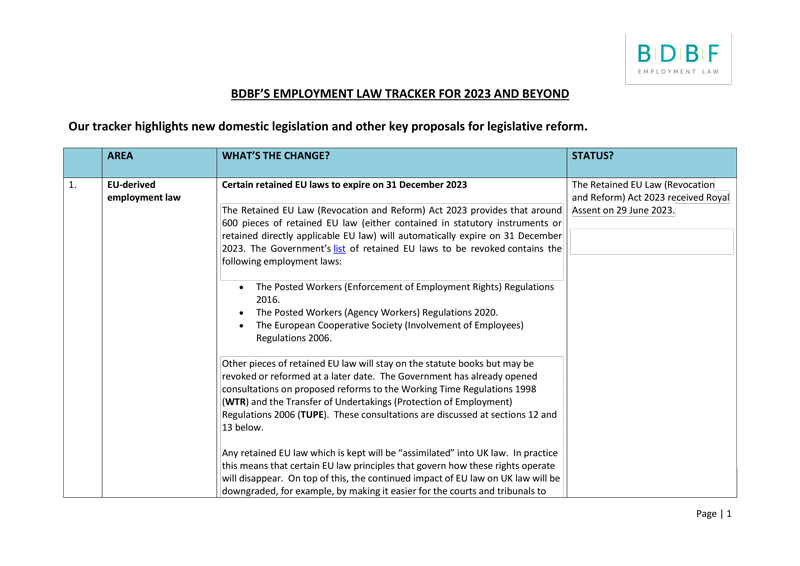
BDBF’s Employment Law Tracker for 2023 and Beyond

Our detailed employment law tracker highlights new domestic legislation and other key proposals for legislative reform.

Please click the image below for an at-a-glance guide to all the significant pieces of employment legislation on the horizon, as well as links to more detailed briefings on the most important changes. 


If you would like further information, or to discuss how to prepare for any of these changes, please contact Amanda Steadman (amandasteadman@bdbf.co.uk) or your usual BDBF contact.


BDBF Partners recognised in Who’s Who Legal 2023 for Labour, Employment & Benefits

BDBF Partners Gareth Brahams, Claire Dawson and Paula Chan have been recognised as Global Leaders in the Labour, Employment & Benefits field in 2023’s Who’s Who Legal, with Gareth and Claire also selected as Thought Leaders.

BDBF’s team of employment lawyers is top ranked by the leading legal directories, and we’re delighted to see our lawyers recognised by Who’s Who Legal.

Congratulations to our colleagues in the employment law world who have also been ranked this year. 


Unusual and onerous non-compete restriction is potentially enforceable – but the employer’s delay ruled out an interim injunction

The High Court has held that an unusual non-compete covenant lasting for a period of up to 12 months at the employer’s discretion may, in principle, be enforceable, even where the employee had already spent 12 months on garden leave.  However, the Judge declined to award an interim injunction due to the employer’s excessive and unreasonable delay.

What happened in this case?

Mr Couture began working for Jump Trading International Ltd (Jump), a leading trading and investment firm, in June 2016.  He worked as a quantitative researcher in Jump’s London-based trading team.   His employment contract contained a non-compete restriction preventing him from engaging in “competitive activity” during the “non-compete period”.  Unusually, the contract gave Jump discretion to set a non-compete period of up to 12 months within 20 days of notice of termination being given.   Further, the contract bucked the trend of setting off time spent on garden leave against the non-compete period.  Instead, the non-compete period would start after the end of the garden leave period.  

On 23 March 2022, Mr Couture accepted a job offer from Verition Advisers UK Partners LLP (Verition).  On 30 March 2022, Mr Couture resigned on notice, however, he did not tell Jump that he was intending to work for Verition.  Jump told Mr Couture that he would be placed on garden leave for the duration of his 12-month notice period.

On 31 March 2022, Verition received advice from its lawyers than the non-compete restriction in Mr Couture’s contract was not enforceable.   On the same day, Jump told Mr Couture that after his garden leave had ended he would be subject to a 12-month non-compete period, expiring on 30 March 2024.  Mr Couture said this was not acceptable.

On 12 July 20222, Mr Couture told Jump that he intended to work for Verition after his garden leave had ended.  Jump’s position was that this would be competitive activity and breach the non-compete restriction.  Attempts were made at resolving the dispute, but, ultimately, these fell flat.

On 17 November 2022, Mr Couture wrote to Jump stating that he would join Verition in April 2023, but that for the first 12 months he would be writing software rather than trading, which he did not believe amounted to competitive activity.   Mr Couture also said that, in any event, he did not believe the non-compete restriction was enforceable.  Jump eventually replied on 6 March 2023, reiterating its position that Mr Couture would be in breach of the restriction if he went to work for Verition.  

On 14 April 2023, Jump sued Mr Couture for breach of the non-compete restriction and Verition for inducing Mr Couture to breach the non-compete restriction.  Jump sought an interim injunction to prevent Mr Couture working for Verition pending the outcome of the full trial.   

This briefing covers the decision of the High Court in relation to the interim injunction application only.  The full trial is due to take place in either late June or early July 2023.

What was decided?

When deciding whether to grant an interim injunction, the Court has to address a number of key questions.  

Was there a “serious issue” to be tried? 

Employers wishing to obtain an interim injunction need show only, so far as its prospects of success in the full trial are concerned, that there is a “serious issue” to be tried.  This is a  relatively low hurdle to get over – the employer does not need to show that it is “likely” or “probable” that they would succeed at trial.  

Here, it was agreed that Jump had legitimate interests to protect, and that Mr Couture had had access to confidential information.  Given the difficulties of policing the use of confidential information, a non-compete restriction could, in principle, be justified.  However, Mr Couture argued that the non-compete was unenforceable and so there was no serious issue to be tried.  

First, it was argued that the uncertainty in the length of the restriction meant that it was unenforceable.  However, the Court was persuaded that the clause itself provided a means for resolving that uncertainty (by allowing Jump to decide the length), albeit that this did not address the issue of certainty at the time the contract was entered into.  The Judge said that “…although the clause’s temporal extent was not known at the time the contract was entered into, the fact that it had a maximum duration of twelve months and a mechanism by which the employee would know its extent once an election was made does not necessarily make it unreasonable for the purpose of the restraint of trade doctrine”.  Acknowledging that there was no direct authority on the validity of this type of non-compete restriction, the Court said there was a serious issue to be tried.  

Second, it was argued that a 12-month non-compete restriction on top of a 12-month garden leave restriction was unreasonable.  Jump argued that confidential information remained confidential for two years, therefore, justifying the overall amount of time that Mr Couture would be prevented from working for a competitor. The Court said there were issues about whether the length of the clause should be assessed in light of the garden leave period, or separately from it.  The Court agreed that a 12-month non-compete coupled with a 12-month garden leave period seemed long, but, ultimately, this was a fact-specific issue and could not be resolved at the interim stage.  Therefore, there was a serious issue to be tried.

Third, it was argued that the clause was too wide in scope.  In particular, the definitions of “competitive activity” and “competitive entity” were defined in broad and non-specific terms. For example, “competitive activity” referred to “similar services” to the services that Mr Couture had provided to Jump, without explaining what this meant.  However, the Court said the scope was not so obviously wide that it could conclude at the interim stage that there was no serious issue to be tried.  

Overall, the Court concluded that there was a serious issue to be tried in respect of the enforceability of the non-compete restriction against Mr Couture.  However, the Court said there was no serious issue to be tried in respect of the inducement to breach claim brought against Verition, on the basis that it had received legal advice that the non-compete clause was unenforceable.   Following the Court of Appeal’s decision in Allen t/a David Allen Chartered Accountants v Dodd & Co Ltd, this was sufficient to defeat a claim of inducement to breach.  This was the case even though the advice Verition received was “short and not unequivocal”.  

Would damages be an adequate remedy for either party?

In deciding whether to grant an interim injunction, the Court must also consider whether damages would be an adequate remedy for the employer if it went on to succeed at trial.  If damages would be an adequate remedy for an employer, then an injunction would not normally be granted.  Here, the Court accepted that if the clause was enforceable and Mr Couture went to work for Verition, then an award of damages would not be an adequate remedy for Jump. 

The Court must also consider whether an award of damages would be sufficient protection for the employee if an injunction was granted but not upheld at the full trial.  If damages would be an adequate remedy for an employee in this situation, then this would weigh in favour awarding an injunction.  Here, the Court said that if an injunction was granted which prevented Mr Couture from working for Verition, then damages would not an adequate remedy for him given the overall amount of time he would have been prevented from working and using his skills in such a “dynamic area”.

What would be the “balance of convenience” if the injunction was granted?

The Court should then weigh into the mix other relevant factors such as any delay in seeking the injunction and the overall merits of the case. 

Here, it held that Jump had known about Mr Couture’s intentions since 12 July 2022.  It had taken over nine months to issue proceedings and seek an injunction.  Moreover, after Mr Couture had set out his detailed position in the letter of 17 November 2022, it took Jump over three months to even muster a reply and then another month and a half to seek the injunction.  This delay was unreasonable and excessive and Jump simply had no explanation for it.

If Jump had moved more quickly, a speedy trial could have been ordered to take place before Mr Couture’s intended start date with Verition.  This would have avoided the need for an interim injunction application altogether.  On top of this, Mr Couture’s employment contract contained an arbitration clause, meaning that the dispute could have been resolved via arbitration, which, again may have avoided an interim injunction application.  

On the basis of the considerable delay, the Court decided it would be unjust to grant an interim injunction at such a late stage.  However, it is worth noting that the Judge said that if it had been necessary to do so, he would have weighed into the balance the overall strength of the case, noting that the long duration and wide scope of the restriction indicated that Mr Couture’s and Verition’s arguments were stronger. 

What are the learning points for employers?

It remains to be seen whether this unusual discretionary non-compete restriction with no provision for setting off time spent on garden leave will be enforced.  If it is, this may embolden some employers to adopt a similar approach. However, it should be remembered that these cases tend to be fact-specific, turning on the nature of the employee’s role, their seniority, the market practice in the industry they work in and the proposed role with the competitor employer.  Further, the Government has recently announced plans to limit the length of non-competes to a maximum of three months.  Therefore, even if upheld, this decision may be of limited value to employers wishing to follow suit. 

The other very important learning point for employers who utilise post-termination restrictions is to act without delay where there is reason to believe that a restriction has been, or will be, breached.  Here, the employer had known about the employee’s detailed plans for almost five months before it applied for an injunction to restrain him.  This was simply too long and meant it would have been unjust to award an interim injunction.  The result is that the employer walked away without the injunction and, perhaps more importantly, without a precedent to be used to deter other workers from doing the same thing.  Instead, it is faced with preparing for a full trial in short order, no doubt with the Judge’s comments about the relative weakness of their case ringing in their ears.

Jump Trading International Ltd v (1) Damien Couture (2) Verition Advisors (UK Partners) LLP

BDBF is a leading employment law firm based at Bank in the City of London. If you would like to discuss any issues relating to the content of this article, please contact Amanda Steadman (AmandaSteadman@bdbf.co.uk) or your usual BDBF contact.
Pregnancy discrimination: employers should be prepared for scrutiny of dismissals to find out who decided to dismiss and why

In the recent case of Alcedo Orange Limited v Ferridge-Gunn the Employment Appeal Tribunal underlined the importance of scrutinising dismissal decisions in discrimination claims. 

What happened in this case?

In this case, an employee was dismissed within her probationary period days after announcing her pregnancy.  The chain of events unfolded as follows:

  • On 27 January 2019, the claimant started working for the respondent employer and was subject to a three-month probationary period.  On 14 February, the claimant met with Mr Boardman, the managing director of the respondent, and Ms Caunt, her manager.  Mr Boardman and Ms Caunt raised some concerns about her performance.  

  • On 19 February the claimant announced that she was pregnant.  On 21 February  a second meeting was held to discuss the claimant’s performance and it was accepted that there had been a degree of improvement.

  • On 24 and 25 February the claimant was absent on sick leave as a result of morning sickness.  When the claimant notified Ms Caunt, she asked whether it was contagious, how much time off she would need and that she was sorry to be unsympathetic, but she has never been pregnant before.  

  • During the claimant’s absence on sick leave, Ms Caunt discovered that certain documents (such as references, DBS checks and training certificates) had not been uploaded to the respondent’s IT systems.  She told Mr Boardman that the claimant had misled them by saying that she had made progress in her performance targets.

  • On 27 February – a mere eight days after announcing her pregnancy – the claimant was called to a meeting and dismissed.  She was told that her performance was “below par” and things were “not working out”.  

The claimant brought claims in the Employment Tribunal alleging that her dismissal amounted to pregnancy discrimination and that it was also an automatically unfair dismissal.  The Tribunal found that the accusation that the claimant had deliberately misled Ms Caunt in the second performance meeting was unfair and that the claimant would have completed the outstanding tasks had she not been absent with morning sickness (and they were, in fact, completed shortly after she returned to work).  

The Tribunal dismissed the automatic unfair dismissal claim, holding that the claimant was dismissed for performance reasons and her pregnancy was not the sole or principal reason for the dismissal.  However, it upheld her pregnancy discrimination claim.  In deciding to dismiss, Mr Boardman had relied upon Ms Caunt’s views about having been misled by the claimant at the second performance meeting.  However, Ms Caunt’s views had been influenced by the claimant’s pregnancy and sickness absence.  

The respondent appealed to the Employment Appeal Tribunal.

What was decided?

The respondent argued that Mr Boardman was the dismissal decision-maker and had dismissed on performance grounds.  Although Ms Caunt had supplied information to Mr Boardman, she was not a decision-maker and, as such, her motivations were not relevant to the dismissal decision.

The EAT acknowledged that the Tribunal had not been referred to the leading authority on this point, namely, the Court of Appeal’s decision in CLFIS (UK) Ltd v Reynolds (Reynolds).  The Court of Appeal in Reynolds held that the correct approach is to consider different acts separately. The Court said: “supplying information or opinions which are used for the purpose of a decision by someone else does not constitute participation in that decision“.   

If a person supplying information or opinions has discriminatory motives, but the dismissal decision-maker does not, then the discriminatory act would be the supplying of the tainted information, not the dismissal.

In contrast, where it can be said that a decision has been made jointly, then a Tribunal should assess the motives of all the parties involved in that decision.   A decision may be regarded as a joint decision where the appointed decision-maker has been heavily influenced by someone else, even if they have not been formally appointed as a decision-maker.  A discriminatory motive held by one co-decision maker would be enough to taint the overall decision

The EAT said this case cried out for an analysis of whether Mr Boardman was a sole decision maker, a sole decision-maker whose decision had been influenced by Ms Caunt or whether he and Ms Caunt were joint decision-makers.  The case was remitted to the Employment Tribunal.

What are the learning points for employers?

Previous cases have acknowledged that the “separate acts” approach endorsed in Reynolds presents a danger that unscrupulous employers could use unclear decision-making processes as a means of hiding discrimination.  To counter this risk, Tribunals are prepared to scrutinise decision-making processes to identify anyone who has heavily influenced the “official” decision-maker and assess whether they should, in fact, be treated as a joint decision-maker and what their motivations were.

The practical takeaway for employers is to train decision-makers on equality law and the scope of their role.  In particular, the need for them to make their decisions alone – or only in conjunction with any “official” co-decision-makers.  Further, anyone supplying information or evidence to the official decision-maker/s should be asked to do just that and avoid pushing for a preferred outcome.  Together, these steps should ensure that only the motivations of the official decision-maker/s are taken into account when assessing whether the dismissal was discriminatory.  Although this does not avoid the risk of a discrimination claim altogether, it should help to ensure the dismissal decision is unimpeachable.

It is worth noting that the position for discrimination claims is different to whistleblowing dismissal claims where, if a sole decision-maker is misled by someone acting from improper motives, the dismissal decision itself may be considered unfair (rather than the acts being treated as separate).  You can read more about the position for whistleblowing claims here. 

Alcedo Orange Limited v Ferridge-Gunn

BDBF is a leading employment law firm based at Bank in the City of London. If you would like to discuss any issues relating to the content of this article, please contact Amanda Steadman (AmandaSteadman@bdbf.co.uk) or your usual BDBF contact.


New law offering workplace rights to those with caring responsibilities

The Carer’s Leave Bill received Royal Assent on 24 May 2023, becoming the Carer’s Leave Act 2023.  The Act provides the pathway to new rights and protections at work for employees who have caring responsibilities.  In this briefing, we outline where things currently stand and what steps employers should take next.

What is the background?

The charity, Carers UK, estimates that that there is a 50:50 chance of a person in the UK having caring responsibilities before the age of 50 – long before retirement age.  Caring responsibilities can take many forms.  It may include caring for an elderly relative, but it may cover other scenarios such as caring for a child who has a disability, or a partner injured in an accident.  It can extend to caring for those suffering with mental health impairments (such as dementia or depression) as well as physical health impairments. 

Carers UK reports that caring is often “invisible” in the workplace, with many not identifying themselves as carers or feeling uncomfortable about raising personal matters at work.  The result is that many carers struggle on in silence, attempting to juggle their unpaid carer’s role with work.  These pressures have led one in ten carers to consider reducing their working hours or giving up work altogether and over 200,000 people per year end up leaving the workplace.

To help address this issue, in September 2021 the Government confirmed that a Day 1 employment right to carer’s leave would be introduced “as soon as Parliamentary time allowed”.   However, the legislation did not materialise.  Instead, the Government chose to back a Private Members’ Bill – the Carer’s Leave Bill – which would allow regulations to be made to provide new rights and protections for carers.

What rights and protections will carers be given?

The Carer’s Leave Act 2023 provides for the introduction of new rights and protections for carers including: 

  • a Day 1 right for employees to take at least one week’s unpaid carer’s leave in any 12-month period to provide care for, or make arrangements to provide care for, a dependant who has a long-term care need. In this context, a “long-term care need” means: 
    • an illness or injury (whether physical or mental) likely to require at least three months of care;
    • a disability under the Equality Act 2010; or
    • care needs relating old age (although “old age” is not defined).
  • a right to benefit from the existing terms and conditions of employment that would have applied but for the leave (apart from terms and conditions about remuneration);
  • a right to return to work to a job of a kind to be prescribed by the regulations;
  • a right to claim compensation from employers who unreasonably postpone, attempt to prevent or prevent the taking of carer’s leave; and
  • protection from detriment or dismissal as a result of having taken carer’s leave.

However, the precise scope and mechanics of the new rights will be set out in separate regulations.  For example, the regulations will address:

  • how much leave an employee may take (it must be at least one week in any 12-month period);
  • when and how leave may be taken (e.g. continuously or discontinuously);
  • the amount and form of notice to be given to the employer;
  • what records employers will need to keep;
  • whether, and in what circumstances, an employer is able to postpone the leave; and
  • which activities count as “providing care” or “making arrangements to provide care”. 

The Government has said that the regulations will be laid in due course, although it is expected that this will not be before April 2024.  

What steps should employers take now?

With just under a year before these new rights come into force, employers should devise their approach to carer’s leave now.  Although employers will need to await the publication of the regulations to understand the finer detail of how the rights will work, employers should consider the following policy issues now:

  • Who will have “ownership” of ensuring compliance with the new rules in your business (including things like preparing a staff policy, training line managers and managing any record-keeping obligations)?
  • Will you enhance the amount of carer’s leave available?  If so, to what amount?
  • Will you offer paid leave?  If so, how much?
  • Will you extend the rights to non-employees on a voluntary basis (albeit that any individuals benefitting from this would not be able to bring relevant claims before an Employment Tribunal as they would fall outside the statutory scheme)?
  • If the regulations provide that leave may only be taken continuously, will you take a more flexible approach and allow the employee to take it discontinuously (e.g. a day at a time)?
  • Will you relax any notice requirements provided for in the regulations?  If so, what would be the minimum notice required?  What form must it take (e.g. would verbal notice be sufficient)?

Employers should also remember that employees taking carer’s leave will remain entitled to other relevant forms of leave such as unpaid time off for dependant emergencies or unpaid parental leave.  Eligible employees may also be able to request temporary or permanent flexible working arrangements.  

In addition, where an employee is caring for someone with a disability, they may also have rights under the Equality Act 2010.  Although such employees are not entitled to have reasonable adjustments made for them, they are protected from less favourable treatment because of their association with a disabled person.  Further, where an apparently neutral workplace policy or practice disadvantages such an employee, this may amount to indirect disability discrimination by association, unless the employer is able to justify its approach.  

Carer’s Leave Act 2023

BDBF is a leading employment law firm based at Bank in the City of London. If you would like to discuss any issues relating to the content of this article, please contact Amanda Steadman (AmandaSteadman@bdbf.co.uk) or your usual BDBF contact.


New rights and protections at work for parents of babies requiring neonatal care 

The Neonatal Care (Leave and Pay) Bill received Royal Assent on 24 May 2023 becoming the Neonatal Care (Leave and Pay) Act 2023.  The Act provides the pathway to new rights and protections at work for employees who are parents of babies requiring neonatal care.  In this briefing, we outline where things currently stand and what steps employers should take next.

What is the background?

Currently, parents of a baby requiring neonatal care must use existing statutory leave entitlements to allow them to take time off work while their baby remains in hospital.  For mothers, this means using up some of their 52-week maternity leave entitlement (the start of which is triggered on the day of the birth).   For fathers, this would usually mean using up their two-week paternity leave entitlement, perhaps in combination with other leave rights such as unpaid parental leave, unpaid dependant emergency leave or annual leave.  In some cases, the mother may exchange up to 50 weeks of her maternity leave for shared parental leave to share with the father.  Doing this would enable the father to take a longer period of time off work, but would, in turn, reduce the amount of time off work that the mother is able to take.

Over the last ten years there have been calls to create special leave and pay rights for parents of premature babies in receipt of neonatal care.  In 2015, two premature baby charities, Bliss and The Smallest Things, submitted a joint petition to Government on the issue.  The aim was to create an entitlement to ringfenced rights which did not exhaust other forms of leave. 

Back in 2019, the Government consulted on proposals to introduce new workplace rights to neonatal leave and pay.  In March 2020, the Government responded to the consultation and committed to introducing such rights.  However, the legislation did not materialise.   Instead, the Government opted to back a Private Members’ Bill – the Neonatal Care (Leave and Pay) Bill.

What rights and protections will affected employees be given?

The Neonatal Care (Leave and Pay) Bill received Royal Assent on 24 May 2023 and became the Neonatal Care (Leave and Pay) Act 2023.  The Act provides for the introduction of rights and protections for employees who are parents of babies up to 28 days old who require neonatal care for at least one week without interruption.  The rights and protections include:

  • a Day 1 right for employees to take leave where they are the parent of a baby who needs to spend at least one week in neonatal care; 

  • a right for employees with at least 26 weeks’ continuous service and whose weekly earnings are at or above the “lower earnings limit” (currently £123 per week) to be paid statutory neonatal pay;

  • a right to benefit from the existing terms and conditions of employment that would have applied but for the leave (apart from terms and conditions about remuneration);

  • a right to return to work to a job of a kind to be prescribed by the regulations; and

  • protection from detriment or dismissal as a result of having taken or sought to take neonatal leave.

However, the precise scope and mechanics of the new rights will be set out in separate regulations.  For example, the regulations will address:

  • the precise meaning of “neonatal care”;

  • how much leave an employee may take (this will be set at between one and 12 weeks);

  • the period within which the leave may be taken (this will be at least 68 weeks from the child’s birth);

  • how leave may be taken (e.g. continuously or discontinuously);

  • the rate and duration of statutory neonatal pay;

  • the amount and form of notice to be given to the employer; 

  • the evidence of entitlement to be given to the employer;

  • what records the employer will need to keep; and

  • what will happen is special cases (e.g. where the parent has more than one child receiving neonatal care, or a child receives neonatal care on two or more separate occasions).

In response to written questions on 22 May 2023, Kevin Hollinrake MP stated that the new neonatal leave and pay entitlements are expected to be delivered in April 2025, with regulations to be laid in due course.

What steps should employers take now?

Although employers will need to await the publication of the regulations to understand the finer detail of how the new rights will work, employers should consider the following policy issues now:

  • Who will have “ownership” of ensuring compliance with the new rules in your business (including things like preparing a staff policy and updating related policies, training line managers and managing any record-keeping obligations)?

  • Will you enhance the amount of neonatal leave available?  If so, to what amount?

  • Will you enhance the rate of neonatal pay?  If so, to what level and for how long?

  • Will you extend the rights to non-employees on a voluntary basis (albeit that any individuals benefitting from this would not be entitled to statutory pay and would not be able to bring relevant claims before an Employment Tribunal as they would fall outside the statutory scheme)?

  • If the regulations provide that leave may only be taken continuously, will you take a more flexible approach and allow the employee to take it discontinuously (e.g. a day at a time)?

  • Will you relax any notice and evidence requirements provided for in the regulations?  If so, what would be the minimum notice required?  What form must it take (e.g. would verbal notice be sufficient)?

Neonatal Care (Leave and Pay) Act 2023

BDBF is a leading employment law firm based at Bank in the City of London. If you would like to discuss any issues relating to the content of this article, please contact Amanda Steadman (AmandaSteadman@bdbf.co.uk) or your usual BDBF contact.


New law offering greater protection in redundancy processes during pregnancy and after return from family leave

The Protection from Redundancy (Pregnancy and Family Leave) Bill received Royal Assent on 24 May 2023, becoming the Protection from Redundancy (Pregnancy and Family Leave) Act 2023.  The new law will protect pregnant women and those returning from certain types of family leave in redundancy situations.  In this briefing, we outline where things currently stand and what steps employers should take next.

What is the background?

Currently, employees absent on either maternity, adoption or shared parental leave are afforded special protection in redundancy situations.  The law provides that before making a woman who is on maternity leave (or an employee on adoption or shared parental leave) redundant, an employer must offer a suitable alternative vacancy to them, where one is available.  In other words, the employee moves to the front of the queue for such roles, ahead of other colleagues and has a right of first refusal of such a role.  If an employer fails to comply with its obligations in this respect, the employee may be able to bring an automatic unfair dismissal claim.

In 2019, the Government consulted on extending this protection to pregnant employees and those who had recently returned to work following a period of maternity, adoption or shared parental leave.  The Queen’s Speech delivered at the end of 2019 outlined plans for a new Employment Bill which would introduce these new rights.  However, the Employment Bill did not materialise.  Instead, the Government backed a Private Members’ Bill – the Protection from Redundancy (Pregnancy and Family Leave) Bill – which aimed to deliver these changes.

What rights and protections will employees be given?

The Protection from Redundancy (Pregnancy and Family Leave) Bill received Royal Assent on 24 May 2023 and became the Protection from Redundancy (Pregnancy and Family Leave) Act 2023.  The Act is due to come into force on 24 July 2023 and allows for regulations to be made which would give:

  • pregnant employees who are at risk of redundancy priority for any suitable alternative vacancy that is available from the point that they notify the employer of their pregnancy; 

  • employees returning from maternity, adoption or shared parental leave who are at risk of redundancy priority for any suitable alternative vacancy that is available following their return to work.  It is anticipated that returners from maternity or adoption leave will be protected for six months after their return to work, but that the protected period may be different for shared parental leave given that it may be taken in discontinuous blocks; and

  • employees the right to claim automatic unfair dismissal claim where an employer fails to comply with its obligations regarding offering suitable alternative vacancies and the employee is dismissed as a result. 

In practice, this will mean that a woman who notifies her employer of her pregnancy at the three-month stage and then takes 12 months’ maternity leave would be protected for a total of 24 months (i.e. six months’ protection during pregnancy plus 12 months’ protection during maternity leave plus a further six months’ protection upon the return to work).  At present, such a woman would be protected for the 12-month maternity leave period only.

However, the precise scope and mechanics of these new rights and protections will be set out in separate regulations.  It is not yet known when these will be laid before Parliament, although the next General Election must take place by the end of January 2025.

What steps should employers take now?

Although employers will need to await the publication of the regulations to understand the finer detail of how the rights will work, employers should consider the following policy issues now:

  • Who will have responsibility for updating any relevant staff-facing procedures and internal guidelines on how to manage a redundancy process?

  • Who will deliver training to members of HR and managers who have responsibility for redundancy processes? These groups will need to understand the new rules, know how to apply them and be clear about the consequences of non-compliance.

Protection from Redundancy (Pregnancy and Family Leave) Act 2023

BDBF is a leading employment law firm based at Bank in the City of London. If you would like to discuss any issues relating to the content of this article, please contact Amanda Steadman (AmandaSteadman@bdbf.co.uk) or your usual BDBF contact.


The psychology of whistleblowing: why do some blow the whistle and others not? 

Whistleblowing is the act of speaking up to expose unethical or unlawful activity within an organisation. What motivates this act can vary from a sense of duty, a desire to protect others from harm, or a belief in the importance of transparency and accountability. So, what drives an individual to blow the whistle? In this briefing, we consider some of the key psychological factors that influence whether or not someone will blow the whistle on wrongdoing.

The decision to blow the whistle can be a difficult one since it often involves going against the norms and values of an organisation and brings with it the risk of retaliatory action. What are the factors that affect whether or not an individual will blow the whistle?

Research suggests that the following two factors may mean someone is more likely to blow the whistle:

  • Personal integrity: individuals with a strong sense of personal integrity and a commitment to ethical behaviour are more likely to blow the whistle. Research suggests that whistleblowers are driven by a belief that they are doing the right thing and have a duty to expose wrongdoing. In addition, whistleblowers may experience a sense of guilt or shame from being associated with an employer who engages in unethical behaviour and feel driven to speak up.

  • Courageousness: individuals who witness unethical or unlawful activity within their organisation may be afraid to speak up for fear of losing their job or facing other negative consequences. This fear is not unfounded. Studies have shown that whistleblowers are often subject to retaliation from their colleagues, supervisors and even the general public. It takes a great deal of personal courage to speak up in spite of these risks. 

Other factors may deter someone from blowing the whistle, including:

  • Loyalty: another factor intrinsic to the psychology of whistleblowing is the concept of loyalty. Employees are likely to struggle with the decision to come forward, feeling torn between loyalty to their employer and their sense of moral duty. This can lead to a great deal of internal conflict and anxiety, and, ultimately, may deter someone from speaking up.

  • Fear of isolation: whistleblowers are often seen as “troublemakers” and may be ostracised by their colleagues. This can lead to feelings of loneliness and a lack of social support, which, in turn, can be damaging to mental health. Faced with this, many will decide to stick with the herd rather than stand alone and speak up.

In conclusion, the psychology of whistleblowing is a complex and multi-faceted issue. Fear, loyalty, and isolation are all factors that can prevent employees from coming forward with concerns. Despite these challenges, those who decide to blow the whistle play a critical role in exposing wrongdoing in organisations. It is important for employers to embed a supportive culture that values transparency and encourages employees to come forward with concerns without fear of retaliation. In addition, employers should provide whistleblowers with the resources and support they need to navigate the difficult process of speaking up.

BDBF is a leading employment law firm based at Bank in the City of London. If you would like to discuss a whistleblowing issue, please contact info@bdbf.co.uk, or your usual BDBF contact.