Webinar: 10 things for employers to know about in 2021

[et_pb_section fb_built=”1″ _builder_version=”3.0.100″ background_image=”http://davidk423.sg-host.com/wp-content/uploads/2017/09/bdbf_final-stages-1-4-1.jpg” custom_padding=”|||” global_module=”2165″ saved_tabs=”all”][et_pb_row _builder_version=”3.25″ custom_padding=”|||”][et_pb_column type=”4_4″ _builder_version=”3.25″ custom_padding=”|||” custom_padding__hover=”|||”][et_pb_text _builder_version=”3.27.4″ background_layout=”dark” custom_margin=”0px|||” custom_padding=”0px|||”]

Employment Law News


[/et_pb_text][/et_pb_column][/et_pb_row][/et_pb_section][et_pb_section fb_built=”1″ admin_label=”section” _builder_version=”3.22.3″][et_pb_row admin_label=”row” _builder_version=”3.25″ background_size=”initial” background_position=”top_left” background_repeat=”repeat”][et_pb_column type=”4_4″ _builder_version=”3.25″ custom_padding=”|||” custom_padding__hover=”|||”][et_pb_text _builder_version=”4.7.4″ text_orientation=”justified” hover_enabled=”0″ use_border_color=”off” sticky_enabled=”0″]

Webinar: 10 things for employers to know about in 2021

Join our lunchtime webinar on 25 January 2021 when we will survey the big changes in employment law coming up in 2021, including reforms to recruitment practices, employment contracts, settlement agreements, and family-friendly rights. Click on the link below for full details of the agenda. If you’d like to sign up please email Amanda Steadman at amandasteadman@bdbf.co.uk.

[/et_pb_text][/et_pb_column][/et_pb_row][/et_pb_section][et_pb_section fb_built=”1″ _builder_version=”3.26.6″][et_pb_row _builder_version=”3.26.6″][et_pb_column type=”4_4″ _builder_version=”3.26.6″][/et_pb_column][/et_pb_row][/et_pb_section]

Getting ready for employment law reform in 2021: 10 things employers really need to know

[et_pb_section fb_built=”1″ _builder_version=”3.0.100″ background_image=”http://davidk423.sg-host.com/wp-content/uploads/2017/09/bdbf_final-stages-1-4-1.jpg” custom_padding=”|||” global_module=”2165″ saved_tabs=”all”][et_pb_row _builder_version=”3.25″ custom_padding=”|||”][et_pb_column type=”4_4″ _builder_version=”3.25″ custom_padding=”|||” custom_padding__hover=”|||”][et_pb_text _builder_version=”3.27.4″ background_layout=”dark” custom_margin=”0px|||” custom_padding=”0px|||”]

Employment Law News


[/et_pb_text][/et_pb_column][/et_pb_row][/et_pb_section][et_pb_section fb_built=”1″ admin_label=”section” _builder_version=”3.22.3″][et_pb_row admin_label=”row” _builder_version=”3.25″ background_size=”initial” background_position=”top_left” background_repeat=”repeat”][et_pb_column type=”4_4″ _builder_version=”3.25″ custom_padding=”|||” custom_padding__hover=”|||”][et_pb_text _builder_version=”4.7.4″ text_orientation=”justified” use_border_color=”off”]

Getting ready for employment law reform in 2021: 10 things employers really need to know

It’s been said that death and taxes are the only certainties in life, but employers may wish to add a third – changes to employment law.  Both caused by Brexit and the pandemic, and independent of them, reforms haven’t ceased.  In this article, we round up the top 10 changes for people with responsibility for HR to watch out for in 2021.

  1. Recruiting EEA nationals is about to get a lot more complicated…

The new year brings new headaches for employers wishing to recruit EEA nationals.  From 1 January 2021, EEA nationals will lose their automatic right to live and work in the UK.  For those based in the UK before this date, the solution is to apply for either Settled Status or Pre-Settled Status before 30 June 2021.  Either status will give the individual the right to continue to live and work in the UK.  Successful applicants will usually be given a “share code” to provide to their employers to prove their right to work in the UK.  Employers will need to establish a system of checking the share codes of affected employees after 30 June 2021.

From 1 January 2021, EEA nationals wishing to come to the UK to work will need to be sponsored by a UK employer under the new points-based based immigration system.  Employers wishing to sponsor workers will need a licence to do so.  Employers will need to make sure the sponsor licence is in place in good time (licence applications can take between 3 to 6 weeks to process).  Further guidance on the points-based immigration system is available here.

  1. …and so is engaging contractors

The way in which the off-payroll working rules (known as “IR35”) operate in the private sector is set to change on 6 April 2021.  The reforms were due to come into force on 6 April 2020 but were deferred in the light of the coronavirus pandemic

These reforms will see contractors lose the ability to determine their own tax status and place this burden on those who engage them.  Large and medium-sized businesses in the private sector that engage independent contractors via an intermediary (usually a personal service company) will become responsible for assessing whether the IR35 rules apply – this is known as the “status determination”.  The determination process is notoriously difficult, and you may well need to take legal advice.

Once the status determination has been made, the business must notify various parties of its decision and provide an opportunity to challenge the assessment.

On top of this, where a business contracts directly with the intermediary (i.e. it is the fee payer), it will also become responsible for deducting income tax and NICs and paying employer’s NICs.

Those running the payroll will need to be ready to implement these changes from April 2021.  You can read more about the IR35 reforms in our detailed note on the new regime here.

  1. Be prepared for new limits on how you draft your employment contracts…

After jumping the hurdle of recruitment, employers also need to be ready for changes affecting their onboarding arrangements.

Currently, the Government is consulting on two areas which may affect the drafting of employment contracts.

Views are sought on proposals to restrict the use of non-compete restrictions.  It’s possible that non-compete clauses could be made unenforceable altogether, meaning employers would not be able to include them in employment contracts at all.  Alternatively, they may be permissible for a prescribed period of time and only where the employer provides compensation during the term of the clause.  Either change would see employers having to amend existing employment contracts and update template documents.  You can read our further thoughts on this consultation and also find out how to feedback your thoughts to the Government here.

The Government is also seeking views on extending the ban on exclusivity clauses in employment contracts to prevent employers from restricting low-paid employees (i.e. those earning below £120 per week) from working for another employer.  Currently, the ban only applies to those working under zero-hours contracts.  If the ban is extended, affected contracts will need to be amended.

Both consultations close on 26 February 2021 and new laws could be in place later this year.

4…and standby to overhaul your family-friendly policies

And it’s not just employment contracts that may need a rewrite in 2021.  Employers may need a cold towel at the ready when it comes to overhauling family-friendly policies as there are a raft of changes in the offing.

The Pregnancy and Maternity (Redundancy) Protection Bill 2019-21 is on its passage through Parliament, with the next stage of the Bill taking place on 12 March 2021.  If passed, it will prohibit redundancy during pregnancy and maternity leave and for the six months after the return to work, save in limited circumstances.

The Government has also consulted on several proposals to update family leave rights including reforming the system of parental leave and pay; introducing a new right to neonatal leave and pay; and requiring employers to publish their family leave and flexible working policies.  Although still at the proposal stage, it would be wise for employers to make sure that family leave and flexible working policies are kept up to date, particularly as the publication requirement could be introduced fairly swiftly.

There are also plans afoot to introduce a new right for workers with caring responsibilities to take one week’s unpaid leave.  This new form of leave would supplement other relevant forms of leave such as parental leave or time off for dependant emergencies.

  1. Wave goodbye to the furlough scheme…

The furlough scheme is currently set to change on 1 February 2021, with a likely reduction in the Government’s contribution to the wages of furloughed employees.  The scheme is then due to close for good on 31 March 2021 and is likely to be replaced with a less generous form of wage support.  You can read more about the furlough scheme in our detailed guide here.

Payroll teams dealing with furloughed employees will need to ensure that final claims are made to HMRC in good time.  At the same time, employers need to have a strategy in place for what happens next: will furloughed staff be brought back to work or made redundant?  If redundancies are needed, will time-consuming collective consultation be triggered?  If so, when will that consultation process begin?

6.…and say hello to a flurry of flexible working requests

The roll out of the Covid-19 vaccine in 2021 signals the hope of return to normal life, including in the world of work.  But after a year or more of working from home, will staff be prepared to return to commuting five days per week? Some will, but employers should get ready for an influx of flexible working requests from staff who have got used to the benefits of working from home.

This could range from requests to work from home on a flexi-basis or 1 or 2 fixed days per week, through to requests for permanent home working.  Employers should consider now whether they are willing to continue with home working and, if not, the grounds for refusing such requests.  Rejecting requests will be harder where the employee can demonstrate that they have worked effectively from home for a long period of time.

It’s also worth bearing in mind that the Government intends to put its weight behind flexible working for all jobs.  There are plans for a new Employment Bill which would make flexible working the default for all job roles, meaning that jobs should be advertised as open to flexible working.   This will represent a big change for employers – a recent survey revealed that 78% of job ads did not mention flexible working at all and, of those that did, the majority offered it only on a temporary basis to cope with the Covid-19 pandemic.

  1. Pay equality issues will be back in the spotlight…

HR and payroll teams at large employers had a reprieve from crunching their gender pay gap numbers in 2020, after the Government paused publication in the light of the Covid-19 pandemic.  As far as we know, reporting is back on the agenda in 2021, with a deadline for private sector employers of 4 April 2021.

However, there are some unanswered questions about what needs to be reported. It’s not yet clear whether businesses will have to report the missing 2019/20 figures at the same time as their 2020/21 figures.  It’s also not clear whether staff who were on furlough on the snapshot date of 5 April 2020 should be included in the 2020/21 figures.  And if they are to be included, is their pay their normal rate of pay or the reduced furlough rate of pay?   HR and payroll teams will need to watch out for further guidance from the Government and be ready to adjust their calculations and accompanying narrative.

Businesses outside of the gender pay gap reporting regime will escape these headaches for now – but employers should note that there are plans to reduce the reporting threshold to employers with 100 or more employees.  The Equal Pay (Information and Claims) Bill 2019-21 is on its passage through Parliament and aims to reduce the threshold for gender pay gap reporting and bring in ethnicity pay reporting for employers at the same threshold.  The next stage of the Bill is scheduled to take place on 15 January 2021.  Although these changes are unlikely to come into force in 2021, they would involve a great deal of preparatory work for affected businesses and so employers are advised to keep a close eye on this development.

In addition, the Bill seeks to reform equal pay law and, among other things, would introduce a right for employees to know what their colleagues are paid.  This could shine a light on pay disparities and trigger equal pay disputes on an individual or group basis.  With the Supreme Court’s decision in the high-profile Asda equal pay dispute expected any day now, pay inequality issues will be firmly back in the public eye in 2021.

8.….and holiday pay headaches will rumble on

It’s hard to believe but holiday pay issues continue to rumble on, many years after the wave of cases which looked at which components of pay must be included in holiday pay.  In June 2021, the Supreme Court will consider whether voluntary overtime payments should be included in the calculation of holiday pay and whether a “series” of unlawful deductions from holiday pay is only present where the deductions are not more than three months apart.  Both decisions could have a big impact for employers’ holiday pay liability and employers should monitor the outcome.

And when it comes to holiday requests, don’t forget that special rules were introduced to allow staff to roll over any holiday that they were unable to take due to the Covid-19 pandemic.  Where this is the case, the unused holiday may be carried forward and taken over the next two leave years.  This may mean that some employees have higher than usual holiday entitlements in 2021 and possibly into 2022.

  1. Protection for whistleblowers is on track to be strengthened

Protection for those blowing the whistle looks likely to be enhanced in 2021.  At EU level, a new Directive introduces protection for those reporting certain breaches of EU law.  EU Member States have until 17 December 2021 to implement the Directive into national law.  It’s not yet clear whether the UK will be obliged to introduce such legislation. This will depend on the terms of any post-Brexit relationship agreed between the UK and the EU.  However, employers with operations in EU Member States will have to comply with the new rules in those jurisdictions and may wish to take a uniform approach across their business, including in the UK.

The Directive requires employers with 50 or more employees to have internal whistleblowing procedures which offer a range of reporting mechanisms.  UK employers are not currently required to have such procedures in place, save in certain regulated sectors.  Employers will also be required to provide feedback to whistleblowers about their internal investigation.  Employers should be poised to prepare such procedures and roll out relevant training to staff.

There are also efforts underway in the UK to enhance whistleblower protection, with two Private Members’ Bill currently on their passage through Parliament.  The Public Interest Disclosure (Protection) Bill 2019-21 and the Office of the Whistleblower Bill 2019-21 are both aimed at strengthening protection for whistleblowers.   The next stage of the Public Interest Disclosure (Protection) Bill 2019-21 is scheduled to take place on 26 February 2021.

  1. And finally, when parting ways with employees watch out for new rules affecting terminations

When parting ways with employees in 2021, employers should take note of the Government’s commitment to introduce new laws as soon as possible to restrict the use of non-disclosure agreements (NDAs) in settlement agreements where there has been an allegation of harassment or discrimination.  The new rules will mean that:

  • NDAs must not prevent someone from making a disclosure to the police, regulated health and care professionals or legal professionals;
  • the limitations of an NDA must be made clear to those signing them; and
  • new enforcement measures will be introduced for non-compliant clauses.

Employers will need to amend template settlement agreements in due course to comply with these new rules.

You can find out more about these and other developments on the horizon in BDBF’s 2021 Employment Law Tracker.  If your business needs advice on preparing for any of these changes please contact Amanda Steadman (amandasteadman@bdbf.co.uk) or your usual BDBF contact.

[/et_pb_text][/et_pb_column][/et_pb_row][/et_pb_section][et_pb_section fb_built=”1″ _builder_version=”3.26.6″][et_pb_row _builder_version=”3.26.6″][et_pb_column type=”4_4″ _builder_version=”3.26.6″][/et_pb_column][/et_pb_row][/et_pb_section]


BDBF’S 2021 Employment Law Tracker

[et_pb_section fb_built=”1″ _builder_version=”3.0.100″ background_image=”http://davidk423.sg-host.com/wp-content/uploads/2017/09/bdbf_final-stages-1-4-1.jpg” custom_padding=”|||” global_module=”2165″ saved_tabs=”all”][et_pb_row _builder_version=”3.25″ custom_padding=”|||”][et_pb_column type=”4_4″ _builder_version=”3.25″ custom_padding=”|||” custom_padding__hover=”|||”][et_pb_text _builder_version=”3.27.4″ background_layout=”dark” custom_margin=”0px|||” custom_padding=”0px|||”]

Employment Law News

[/et_pb_text][/et_pb_column][/et_pb_row][/et_pb_section][et_pb_section fb_built=”1″ admin_label=”section” _builder_version=”3.22.3″][et_pb_row admin_label=”row” _builder_version=”3.25″ background_size=”initial” background_position=”top_left” background_repeat=”repeat”][et_pb_column type=”4_4″ _builder_version=”3.25″ custom_padding=”|||” custom_padding__hover=”|||”][et_pb_text _builder_version=”4.7.4″ text_orientation=”justified” hover_enabled=”0″ use_border_color=”off” sticky_enabled=”0″]

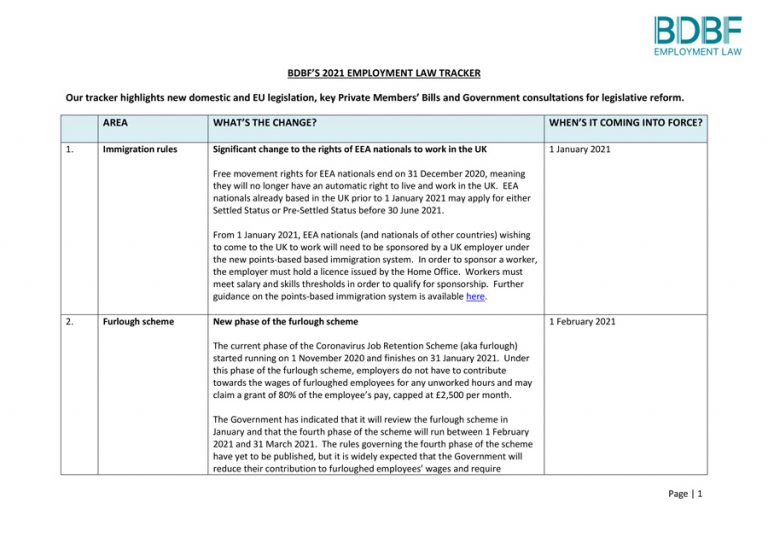
Our tracker highlights new domestic and EU legislation, key Private Members’ Bills and Government consultations for legislative reform. 

[/et_pb_text][et_pb_image src=”http://davidk423.sg-host.com/wp-content/uploads/2020/12/2021-Employment-Law-Tracker-PDF-FINAL-1.jpg” title_text=”2021-Employment-Law-Tracker-PDF-(FINAL)-1″ url=”http://davidk423.sg-host.com/wp-content/uploads/2020/12/2021-Employment-Law-Tracker-PDF-FINAL.pdf” url_new_window=”on” _builder_version=”4.7.4″ _module_preset=”default” hover_enabled=”0″ border_width_all=”1px” border_color_all=”#159687″ align=”center” sticky_enabled=”0″][/et_pb_image][et_pb_text _builder_version=”4.7.4″ text_orientation=”justified” use_border_color=”off”]

If your business needs advice on preparing for any of these changes please contact Amanda Steadman (amandasteadman@bdbf.co.uk) or your usual BDBF contact.

[/et_pb_text][/et_pb_column][/et_pb_row][/et_pb_section][et_pb_section fb_built=”1″ _builder_version=”3.26.6″][et_pb_row _builder_version=”3.26.6″][et_pb_column type=”4_4″ _builder_version=”3.26.6″][/et_pb_column][/et_pb_row][/et_pb_section]


Reflecting on employment law cases and developments in 2020

[et_pb_section fb_built=”1″ _builder_version=”3.0.100″ background_image=”http://davidk423.sg-host.com/wp-content/uploads/2017/09/bdbf_final-stages-1-4-1.jpg” custom_padding=”|||” global_module=”2165″ saved_tabs=”all”][et_pb_row _builder_version=”3.25″ custom_padding=”|||”][et_pb_column type=”4_4″ _builder_version=”3.25″ custom_padding=”|||” custom_padding__hover=”|||”][et_pb_text _builder_version=”3.27.4″ background_layout=”dark” custom_margin=”0px|||” custom_padding=”0px|||”]

Employment Law News


[/et_pb_text][/et_pb_column][/et_pb_row][/et_pb_section][et_pb_section fb_built=”1″ admin_label=”section” _builder_version=”3.22.3″][et_pb_row admin_label=”row” _builder_version=”3.25″ background_size=”initial” background_position=”top_left” background_repeat=”repeat”][et_pb_column type=”4_4″ _builder_version=”3.25″ custom_padding=”|||” custom_padding__hover=”|||”][et_pb_text _builder_version=”4.7.4″ text_orientation=”justified” hover_enabled=”0″ use_border_color=”off” sticky_enabled=”0″]Reflecting on employment law cases and developments in 2020

Dealing with the impact of the Covid-19 pandemic on the workforce has held the top spot on the HR to-do list for most of 2020.  But what other developments should employers note from the last 12 months?   Putting Covid-19 to one side, we’ve picked out some interesting cases and other developments from 2020 for employers to reflect on as the year draws to a close. 

Equality and discrimination

As usual, there has been a great deal of activity in the equality sphere:

  • Vegetarianism and veganism: we learnt that whilst vegetarianism was not a philosophical belief capable of protection under the Equality Act 2010, ethical veganism was protected. At the tail end of 2019, the Employment Tribunal ruled in the case of Conisbee v Crossley Farms that the plurality of reasons for becoming a vegetarian (e.g. lifestyle, health, animal welfare, personal taste etc) meant it did not attain the necessary level of cogency, seriousness, cohesion and importance to qualify for protection as a philosophical belief.  By contrast, the Employment Tribunal in Casamitjana v The League Against Cruel Sports decided that ethical veganism was worthy of protection.  You can read more about these decisions in our briefing here.  The protection of veganism could raise interesting employment law issues in 2021 where vegan employees refuse to have the Covid-19 vaccine on the grounds that it has been tested on animals.
  • Gender fluidity: we also learnt that a belief that gender cannot be fluid is a belief worthy of protection in a democratic society. In the case of Higgs v Farmor’s School an Employment Tribunal decided that a Christian employee’s belief that gender cannot be fluid, and that an individual cannot change their biological sex, were beliefs worthy of respect in a democratic society and capable of protection under the Equality Act 2010.  On the facts of the case, however, the employee had not been discriminated against because of her protected beliefs.  You can read the Tribunal’s decision here.   More recently, in the case of Taylor v Jaguar Land Rover Ltd, an Employment Tribunal decided that a gender fluid / non-binary employee had the protected characteristic of gender reassignment.  The employee was awarded £180,000 damages in respect of the discrimination and harassment they had suffered.  You can read the Tribunal’s decision here.
  • Disability: in Hill v Lloyds Bank plc, the EAT decided that the employer had discriminated against a depressed employee when it failed to guarantee a severance package in the event that it could not keep her from having to work with her alleged harassers again. It decided that providing such a guarantee would have been a reasonable adjustment for the employer to make and their failure to do so was discriminatory.  The employee was awarded £7,500 damages and the employer was ordered to provide the guarantee to the employee. You can read more about this decision in our briefing here.
  • Sexual harassment: in January 2020, the Equalities and Human Rights Commission published new and detailed guidance on sexual harassment and other forms of workplace harassment. Whilst the guidance is not a statutory code of practice, it is described as the authoritative and comprehensive guide to the law and best practice.  This means it can be considered by an Employment Tribunal in relevant cases.  The guidance recaps on the legal framework and considers steps for employers to take in preventing and responding to harassment.  You can read more about the guidance in our briefing here.
  • Race: in the case of Lamonby v Solent University an Employment Tribunal had to consider whether it was fair to dismiss an employee who had made remarks which betrayed a tendency to stereotype according to race, even where such stereotypes were sometimes positive. The Tribunal concluded that ascribing certain abilities or talents (or the opposite of them) to a group by virtue of their nationality, race, ethnic or religious group was potentially racist and offensive.  Despite the fact the employee had not intended to cause offence, the Tribunal found that dismissal was within the range of reasonable responses.  You can read more about this decision in our briefing here.   Race inequality issues came to the forefront of the HR agenda in the Summer in response to the Black Lives Matter movement.  In this briefing we discussed the continuing underrepresentation of black people in senior positions in the UK and the calls for action to secure more diverse workforces.
  • Pay inequality: in January 2020, the BBC journalist, Samira Ahmed, won her equal pay case against the BBC. We discussed the impact of that decision here and also we looked at the important role of gender pay gap reporting here.  Although gender pay gap reporting was paused during the pandemic, it is firmly back on the agenda with legislation in the pipeline which aims to expand the obligation to smaller employers as well as introducing ethnicity pay reporting and a right to know what colleagues are paid.  You can more read about these proposals in our briefing here.

Employment contracts and policies

  • New rules on statements of particulars: on 6 April 2020, the rules governing statements of employment particulars were overhauled. The wider category of “workers” became entitled to receive a statement and statements had to be provided earlier and contain more information.  Typically, employers comply with the requirement to provide written statements by providing an employment contract.  Accordingly, employers had to update template employment contracts and prepare appropriate worker contracts or statements.  You can read more about this development in our briefing here.
  • Bereavement leave policies: on 6 April 2020 a new law, known as “Jack’s Law”, was introduced to provide bereaved parents with a new right to 2 weeks’ bereavement leave (and in some cases, pay) following the death of a child.  In this briefing, we took a closer look at the new right and the preparatory steps employers needed to take.

Whistleblowing

  • Whistleblowing in the financial services sector: earlier this year, Protect, the whistleblowers’ charity, published a report looking at the recent experiences of whistleblowers in the financial services sector.  In this briefing, we discussed the key findings including the typical wrongdoing raised by whistleblowers in the sector, where they were most likely to raise their concerns and the treatment they received. We also outlined five key learning points for employers in the sector.
  • Interim relief and Covid-related complaints: in Morales v Premier Fruits (Covent Garden) Ltd, the employee sought interim relief (i.e. an order that he should get his job back pending the full hearing of the case) on the basis that he had been automatically unfairly dismissed because of his trade union membership or activities and/or because he had made whistleblowing disclosures about Covid-related matters. He was granted interim relief on the basis that it was likely that he would be able to show that he had been dismissed because of his trade union membership or activities rather than the whistleblowing disclosures.  You can read more about this decision in our briefing here.

Vicarious liability

  • Deliberate data breach: in an important and welcome decision for employers, the Supreme Court ruled that an employer was not vicariously liable for a significant data breach committed by a disgruntled employee.  In Morrisons v Various Claimants it could not be said that there was a sufficient connection between the errant employee’s authorised activities and the wrongful act of publishing the data on the internet. The fact that the employee’s job merely provided him with the opportunity to commit the wrongful act was not enough to establish a sufficient connection.  You can read more about this decision in our briefing here.
  • Practical jokes: following on from the Morrisons decision, the High Court in the case of Chell v Tarmac Cement and Lime Ltd found that an employer was not vicariously liable for the actions of an employee whose practical joke injured a contractor in the workplace. It was expecting too much of an employer to implement a policy governing practical jokes or horseplay by employees.  Although the prank that caused the injury happened in the workplace, it could not be said that there was a sufficient connection between the employee’s authorised activities and the prank.  You can read the High Court’s decision here.

TUPE

  • Changing terms and conditions: in Ferguson v Astrea Asset Management Ltd the EAT considered whether four company directors were entitled to rely on contractual terms which had been put in place shortly before a TUPE transfer which were designed to significantly improve their position after the transfer. The EAT decided that the changes, even though they were beneficial, were void because they were by reason of the transfer.   You can read more about the EAT’s decision in our briefing here.
  • Transfers to multiple employers: in ISS Facility Services v Govaerts the ECJ decided, for the first time, that where there is a TUPE transfer to multiple transferees, a full-time contract of employment of a transferring employee can be split between the transfers into several part-time contracts on a pro rata basis. However, if splitting the contract is impossible, or worsens the working conditions or rights of the employee, then the contract may be terminated instead.  You can read the ECJ’s decision here.

Terminations

  • Redundancy processes: in Gwynedd Council v Barrett, the EAT considered whether an employer can require a potentially redundant employee to go through a competitive interview process for an alternative role. In the wake of the coronavirus pandemic, some employers will be facing the prospect of reorganising their businesses and making redundancies.  Employers in this position should take note of this decision which highlights the risks of getting the process wrong.  You can read more about the EAT’s decision in our briefing here.
  • Collective consultation: in UQ v Marclean Technologies SLU the ECJ ruled on how employers should calculate numbers of redundancies for collective consultation purposes. In an onerous decision for employers, the ECJ ruled that employers have to look either side of an individual dismissal on a rolling 90-day basis to identify the relevant reference period.  The reference period will be the period of 90 days which includes the individual dismissal, and which contains the greatest number of redundancy dismissals effected by the employer. Whether this will be read across into UK law is not resolved.   You can read more about the ECJ’s decision in our briefing here.
  • Misconduct dismissals: If an investigating officer fails to pass on relevant information to a dismissing officer, could this undermine the reasonableness of the dismissing officer’s decision? In Uddin v London Borough of Ealing the EAT said that it could, with the result that an employee accused of sexual assault was unfairly dismissed. The decision underlined the need for employers to ensure that their dismissal processes are unimpeachable and that both investigating officers and dismissing officers receive detailed training on the scope of their role.  You can read more about the EAT’s decision in our briefing here.
  • Procedural failings: the decision in Gallacher v Abellio Scotrail Ltd shows that where there has been an irretrievable breakdown in relations between colleagues, an employer may be able to dispense with a formal dismissal process and still dismiss fairly. Although it will be unusual and rare for a dismissal to be fair without any procedure, the mutual loss of trust and confidence meant that following a formal process would have been futile and even damaging.  You can read more about the EAT’s decision in our briefing here.

Settlements and disputes

  • Termination payments: from 6 April 2020, employer’s class 1A NICs became payable on termination payments above £30,000. Termination payments remain completely exempt from employee’s NICs.  Employers must remember to factor in this extra cost when negotiating settlements with departing employees.  You can read more about this development in our briefing here.
  • Breach of settlement terms: if an employee breaches a confidentiality clause contained in a COT3 agreement or, more commonly, a Settlement Agreement, what are the employer’s options? The answer is that it will depend on the importance of the clause or the severity of the employee’s breach.  The High Court’s decision in Duchy Farms Kennels Ltd v Steels offers a salutary lesson for employers on the need to draft settlement documents carefully. You can read more about the High Court’s decision in our briefing here.
  • Tribunal disputes: with the pandemic likely to intensify the backlog of employment tribunal claims, the Government introduced a raft of the changes designed to streamline the conduct of disputes and improve capacity within the tribunal system, including extending the length of Acas early conciliation to 6 weeks in all cases. You can read more about this development in our briefing here.

If you would like to know more about any of these developments please contact Amanda Steadman (amandasteadman@bdbf.co.uk) or your usual BDBF contact.[/et_pb_text][/et_pb_column][/et_pb_row][/et_pb_section][et_pb_section fb_built=”1″ _builder_version=”3.26.6″][et_pb_row _builder_version=”3.26.6″][et_pb_column type=”4_4″ _builder_version=”3.26.6″][/et_pb_column][/et_pb_row][/et_pb_section]


Government announces new consultation on restrictive covenants

[et_pb_section fb_built=”1″ _builder_version=”3.0.100″ background_image=”http://davidk423.sg-host.com/wp-content/uploads/2017/09/bdbf_final-stages-1-4-1.jpg” custom_padding=”|||” global_module=”2165″ saved_tabs=”all”][et_pb_row _builder_version=”3.25″ custom_padding=”|||”][et_pb_column type=”4_4″ _builder_version=”3.25″ custom_padding=”|||” custom_padding__hover=”|||”][et_pb_text _builder_version=”3.27.4″ background_layout=”dark” custom_margin=”0px|||” custom_padding=”0px|||”]

Employment Law News


[/et_pb_text][/et_pb_column][/et_pb_row][/et_pb_section][et_pb_section fb_built=”1″ admin_label=”section” _builder_version=”3.22.3″][et_pb_row admin_label=”row” _builder_version=”3.25″ background_size=”initial” background_position=”top_left” background_repeat=”repeat”][et_pb_column type=”4_4″ _builder_version=”3.25″ custom_padding=”|||” custom_padding__hover=”|||”][et_pb_text _builder_version=”4.7.4″ text_orientation=”justified” hover_enabled=”0″ use_border_color=”off” sticky_enabled=”0″]

Government announces new consultation on restrictive covenants

Does the current law on non-compete clauses stifle the creation of start-ups?  And should the law be changed?

These are questions the government will likely seek answers to as part of a new consultation on post-termination obligations in employment contracts which, the FT reports, will be launched in the coming days.  Apparently ministers are keen to make it harder for employers to stop their employees leaving and setting up in competition, in a bid to make the UK more attractive to EU entrepreneurs after Brexit.

The FT reports that the approach taken to such clauses in California – where they are essentially unenforceable –  is one of the reasons given by entrepreneurs for the rapid growth of the technology sector in Silicon Valley.   However, this may also be one of the reasons that tech giants such as Apple and Google faced a class action lawsuit from 64,000 employees in relation to an alleged nonpoaching conspiracy between those companies.  A $415million settlement was agreed in that case.

This is not the first time the government has looked at this issue in recent years.  In May 2016 BEIS launched a call for evidence in relation to the use of non-compete clauses.  At that time ministers were influenced by a report published by the US Department of the Treasury which analysed the economic effects of non-compete clauses and made the case for their reform.  Unsurprisingly, the responses to that consultation were fairly polarised with established businesses favouring the current law but new ones looking for more flexibility.  The issue was shelved by the government at that time and no proposals for reform were put forward.

As recognised experts in the field of employee competition, BDBF will be providing input into the consultation.  If you would like us to include your views too, then please contact Tom McLaughlin who specialises in this area.

[/et_pb_text][/et_pb_column][/et_pb_row][/et_pb_section][et_pb_section fb_built=”1″ _builder_version=”3.26.6″][et_pb_row _builder_version=”3.26.6″][et_pb_column type=”4_4″ _builder_version=”3.26.6″][/et_pb_column][/et_pb_row][/et_pb_section]


The Coronavirus Job Retention Scheme from 1 November 2020 onwards – a guide for employers

[et_pb_section fb_built=”1″ _builder_version=”3.0.100″ background_image=”http://davidk423.sg-host.com/wp-content/uploads/2017/09/bdbf_final-stages-1-4-1.jpg” custom_padding=”|||” global_module=”2165″ saved_tabs=”all”][et_pb_row _builder_version=”3.25″ custom_padding=”|||”][et_pb_column type=”4_4″ _builder_version=”3.25″ custom_padding=”|||” custom_padding__hover=”|||”][et_pb_text _builder_version=”3.27.4″ background_layout=”dark” custom_margin=”0px|||” custom_padding=”0px|||”]

Employment Law News


[/et_pb_text][/et_pb_column][/et_pb_row][/et_pb_section][et_pb_section fb_built=”1″ admin_label=”section” _builder_version=”3.22.3″][et_pb_row admin_label=”row” _builder_version=”3.25″ background_size=”initial” background_position=”top_left” background_repeat=”repeat”][et_pb_column type=”4_4″ _builder_version=”3.25″ custom_padding=”|||” custom_padding__hover=”|||”][et_pb_text _builder_version=”4.7.4″ text_orientation=”justified” use_border_color=”off”]

The Coronavirus Job Retention Scheme from 1 November 2020 onwards – a guide for employers

This is BDBF’s guide to how the third phase of the Coronavirus Job Retention Scheme (i.e. furlough) will operate between 1 November 2020 and 31 January 2021.  This guide was last updated on 26 November 2020.

To view the PDF guide please click on the image below:

[/et_pb_text][et_pb_image src=”http://davidk423.sg-host.com/wp-content/uploads/2020/12/Guide-to-the-COVID-19-Job-Retention-Scheme-from-1-November-2020-v3-1.jpg” title_text=”Guide-to-the-COVID-19-Job-Retention-Scheme-from-1-November-2020-(v3)-1″ url=”http://davidk423.sg-host.com/wp-content/uploads/2020/12/Guide-to-the-COVID-19-Job-Retention-Scheme-from-1-November-2020-v3.pdf” align=”center” _builder_version=”4.7.4″ _module_preset=”default” hover_enabled=”0″ border_width_all=”2px” border_color_all=”#008395″ url_new_window=”on” sticky_enabled=”0″][/et_pb_image][et_pb_text _builder_version=”4.7.4″ text_orientation=”justified” use_border_color=”off”]

BDBF is currently advising many employers and employees on the challenges presented by the coronavirus.  If you or your business needs advice on furlough or other coronavirus-related matter please contact Amanda Steadman (amandasteadman@bdbf.co.uk) or your usual BDBF contact.

[/et_pb_text][/et_pb_column][/et_pb_row][/et_pb_section][et_pb_section fb_built=”1″ _builder_version=”3.26.6″][et_pb_row _builder_version=”3.26.6″][et_pb_column type=”4_4″ _builder_version=”3.26.6″][/et_pb_column][/et_pb_row][/et_pb_section]


Collective redundancies: new ECJ ruling on how to calculate numbers of redundancies

[et_pb_section fb_built=”1″ _builder_version=”3.0.100″ background_image=”http://davidk423.sg-host.com/wp-content/uploads/2017/09/bdbf_final-stages-1-4-1.jpg” custom_padding=”|||” global_module=”2165″ saved_tabs=”all”][et_pb_row _builder_version=”3.25″ custom_padding=”|||”][et_pb_column type=”4_4″ _builder_version=”3.25″ custom_padding=”|||” custom_padding__hover=”|||”][et_pb_text _builder_version=”3.27.4″ background_layout=”dark” custom_margin=”0px|||” custom_padding=”0px|||”]

Employment Law News


[/et_pb_text][/et_pb_column][/et_pb_row][/et_pb_section][et_pb_section fb_built=”1″ admin_label=”section” _builder_version=”3.22.3″][et_pb_row admin_label=”row” _builder_version=”3.25″ background_size=”initial” background_position=”top_left” background_repeat=”repeat”][et_pb_column type=”4_4″ _builder_version=”3.25″ custom_padding=”|||” custom_padding__hover=”|||”][et_pb_text _builder_version=”4.7.4″ text_orientation=”justified” hover_enabled=”0″ use_border_color=”off” sticky_enabled=”0″]

Collective redundancies: new ECJ ruling on how to calculate numbers of redundancies 

If employers are proposing to make more than 20 people from a single establishment redundant within a 90-day period, they have to go through onerous collective consultation procedures.  But when does the 90-day reference period start and end?  In UQ v Marclean Technologies SLU, the ECJ ruled that employers have to look either side of an individual dismissal on a rolling basis to identify the relevant reference period.  The reference period will be the period of 90 days which includes the individual dismissal, and which contains the greatest number of redundancy dismissals effected by the employer.

What does the law say?

Collective redundancy obligations originate from the EU Collective Redundancies Directive (the Directive).  In the UK, the Trade Union and Labour Relations (Consolidation) Act 1992 (TULRCA) implements the Directive. 

TULRCA provides that where an employer is “proposing” to dismiss 20 or more employees within a 90-day period it must consult collectively with representatives of the affected employees.  Where 20 to 99 dismissals are proposed, the consultation period is 30 days and where 100+ dismissals are proposed it is 45 days.  The employer must also notify the Secretary of State about the proposed dismissals using the HR1 form.  A failure to do so is a criminal offence.

When calculating the numbers of proposed dismissals falling within the 90-day period there are some rules which favour employers.

  • First, TULRCA provides that where collective consultation is already underway in respect of a first batch of redundancies, the numbers in the second batch can be viewed in isolation (assuming there is no evidence of bad faith on the part of the employer). For example, an employer begins collective consultation in respect of 30 redundancies on 1 March 2021 and two weeks later it proposes a further 10 redundancies.  Although the employer is proposing to dismiss a total of 40 people as redundant within a 90-day period, it is excused from adding the 30 to the 10, meaning that collective consultation is not triggered for the 10.   However, if the employer had not started the consultation process for the first batch, then the proposal to dismiss the 30 remains a “proposal” and should be added to the 10, meaning that collective consultation would apply to all 40 proposed dismissals.
  • Second, in the case of Transport and General Workers’ Union v Nationwide Haulage Ltd [1978] IRLR 143an Employment Tribunal said that employers do not need to look backwards to count earlier redundancy dismissals that have already taken effect, where further redundancy proposals emerge. The Tribunal said this would “demand the impossible” and that a “proposal” refers to what may happen in the future, not what had already happened. 

This latest decision of the ECJ has upset the applecart by suggesting that employers should look either side of an individual dismissal and count all the redundancies occurring within a rolling reference period to assess whether collective consultation is triggered. 

What happened in this case?

The facts of the case are simple.  UQ worked for Marclean in Spain and was dismissed on 31 May 2018.  In June 2018 he brought a claim arguing that his dismissal was one of a number of hidden collective redundancies.  Between 31 May 2018 and 15 August 2018 (a 77-day period), a further 36 people left the business.  Marclean had labelled the majority of these exits as voluntary resignations.  UQ argued this was a sham and that they were really redundancies, meaning collective consultation should have taken place. 

The Spanish Court went on to find that at least 30 of these workers had been made redundant.  However, the Spanish Court was unsure whether the redundancies taking place after UQ’s dismissal should be taken into account when deciding whether collective consultation had been triggered. It asked the ECJ to rule on whether the reference period ran:

  • backwards from the date of dismissal;
  • forwards from the date of dismissal; or
  • as a rolling 90-day period spanning either side of the dismissal if necessary.

What was decided?

The ECJ noted that the purpose of the Directive was to strengthen worker protection in the event of collective redundancies and that only the third option complied with this purpose. 

They ruled that the relevant reference period is the period of 90 days which includes the individual dismissal, and which contains the greatest number of redundancy dismissals effected by the employer – in other words a rolling assessment must be made.  If the threshold number of redundancy dismissals is reached at any point across the 90-day reference period, collective consultation is triggered.   

What does this mean for employers?

This decision has potentially onerous consequences for employers who choose to stagger waves of redundancies.  It means that the employer must look either side of a proposed dismissal – on a rolling basis – to assess whether the threshold of 20 or more redundancy dismissals is reached at any point within that period.  Although not explicit in the ruling, this appears to capture redundancy dismissals:

  • that are at the proposal stage;
  • for which collective consultation has already begun; and/or
  • that have already taken effect.  

As far as (ii) and (iii) are concerned, this represents a change to the established approach in the UK and calls into question whether TULRCA complies with the Directive. 

This will require very careful analysis and planning by employers to ensure that they do not accidentally cross the threshold over a rolling 90-day period.  Were this to happen, the employer would be tied to a collective consultation period of either 30 or 45 days (in addition to an individual period of consultation) before the first dismissal can take effect.  This will extend the life of the employment relationship, potentially triggering entitlements to bonuses or share options that the employer may not have accounted for.   The alternative is to dismiss in breach of the collective consultation obligations and face protective award claims of up to 90 days’ gross actual pay per affected employee

Further, employers will need to ensure that the correct numbers of proposed redundancies are reflected on the HR1 form or risk committing a criminal offence.

UQ v Marclean Technologies SU (the judgment has not yet been published in English)

If you would like to know more or your business needs advice on how to manage a redundancy process please contact Amanda Steadman (amandasteadman@bdbf.co.uk) or your usual BDBF contact.

[/et_pb_text][/et_pb_column][/et_pb_row][/et_pb_section][et_pb_section fb_built=”1″ _builder_version=”3.26.6″][et_pb_row _builder_version=”3.26.6″][et_pb_column type=”4_4″ _builder_version=”3.26.6″][/et_pb_column][/et_pb_row][/et_pb_section]


A strategy for dealing with informal complaints of bullying

[et_pb_section fb_built=”1″ _builder_version=”3.0.100″ background_image=”http://davidk423.sg-host.com/wp-content/uploads/2017/09/bdbf_final-stages-1-4-1.jpg” custom_padding=”|||” global_module=”2165″ saved_tabs=”all”][et_pb_row _builder_version=”3.25″ custom_padding=”|||”][et_pb_column type=”4_4″ _builder_version=”3.25″ custom_padding=”|||” custom_padding__hover=”|||”][et_pb_text _builder_version=”3.27.4″ background_layout=”dark” custom_margin=”0px|||” custom_padding=”0px|||”]

Employment Law News


[/et_pb_text][/et_pb_column][/et_pb_row][/et_pb_section][et_pb_section fb_built=”1″ admin_label=”section” _builder_version=”3.22.3″][et_pb_row admin_label=”row” _builder_version=”3.25″ background_size=”initial” background_position=”top_left” background_repeat=”repeat”][et_pb_column type=”4_4″ _builder_version=”3.25″ custom_padding=”|||” custom_padding__hover=”|||”][et_pb_text _builder_version=”4.7.4″ text_orientation=”justified” hover_enabled=”0″ use_border_color=”off” sticky_enabled=”0″]

A strategy for dealing with informal complaints of bullying

The Home Secretary, Priti Patel, has avoided being sanctioned for bullying on the grounds that no formal complaints were made against her at the time and she was unaware of the impact of her behaviour.  In this article, we consider the learning points for employers and suggest a strategy for dealing with “off the record” complaints of bullying.

Why is bullying in the news again?

As national anti-bullying week drew to a close, news broke that a Cabinet Office inquiry had found evidence that the Home Secretary, Priti Patel, had bullied staff and broken the ministerial code.   The alleged behaviour included shouting, swearing, belittling people and making unreasonable demands.      

It later emerged that Ms Patel had a history of such behaviour.  In 2015, Ms Patel was accused of bullying a civil servant in the Department for Work and Pensions – the case was kept out of the press after a settlement payment was made to the victim.  In 2017, civil servants at the Department for International Development alleged that Ms Patel had humiliated civil servants in front of colleagues. 

The Cabinet Office inquiry found that Ms Patel was “action orientated”, could be “direct” and felt justifiably frustrated with civil servants on occasions.  However, this manifested itself in “forceful expression, including some occasions of shouting and swearing” which had upset staff.  The inquiry noted that Ms Patel had failed to treat her civil servants with consideration and respect and that her approach amounted to “…behaviour that can be described as bullying in terms of the impact felt by individuals”.   It concluded that such behaviour breached the ministerial code, even if this was unintentional. 

Yet her boss, the Prime Minister, declined to sack Ms Patel, instead suggesting that the victims and their managers were at fault for failing to complain formally about the bullying at the time.  He pointed to the fact that the inquiry had found that no feedback had been given to Ms Patel regarding her behaviour and that she was “…unaware of the issues that she could otherwise have addressed”. 

Why is the Priti Patel case of interest to employers?

What’s interesting is that the explanation given for Ms Patel escaping serious sanction was that the alleged victims did not raise bullying complaints at the time.  She was, therefore, unaware of the impact of her behaviour and unable to take corrective action.  In the employment context, it is questionable whether such a defence would hold water – particularly as most employers will have a written bullying and harassment policy in place which stipulates which forms of behaviour are unacceptable in the workplace (and this would usually include things like shouting, swearing and belittling colleagues).  

Yet it’s also true that grey areas do exist.  What may be considered as firm management action by line managers, may be viewed as oppressive behaviour by their subordinates.  It’s particularly easy to envisage how such scenarios could arise amongst staff working at home during the COVID-19 pandemic.  With staff at a physical distance, there is a lower risk of flashpoints of aggressive behaviour, however, remote bullying can manifest itself in other forms, for example, micromanagement, exclusion from virtual meetings or by sending tersely worded communications.   Further, small issues may fester in a remote working environment, where face to face contact is limited and the usual social bonds that bind teams together are absent.

In such circumstances, unless perpetrators are made aware of the impact of their behaviour, they will be unable to take steps to correct it.  Therefore, it’s important for employers to support employees to come forward with bullying complaints.  However, a common problem that employers face in these kinds of situations is that the victim does not want to “rock the boat” and so will seek to make an informal or off the record complaint. 

This puts the employer in a difficult position.  On one hand, they are now on notice of the alleged bullying and may be exposed to risk if they do nothing.  On the other hand, the victim does not want them to take action. 

How should employers respond to informal complaints of bullying?

There is no “one size fits all” answer to the question of how an employer should respond to such a complaint.  In practice, employers will need to grapple with a number of preliminary questions in order to decide upon a suitable response. 

Is it bullying and is it a grievance?

In contrast to the related concept of discriminatory harassment, there is no legal definition of bullying.  The non-statutory Acas Guide for Managers and Employers on Bullying and Harassment at Work offers a wide-ranging definition of bullying as: “Offensive, intimidating, malicious or insulting behaviour, an abuse or misuse of power through means that undermine, humiliate, denigrate or injure the recipient”.  It is not necessary for such treatment to be related to a protected characteristic under the Equality Act 2010.   As above, the employer’s internal policies will usually spell out what types of behaviour may be viewed as bullying.

The statutory Acas Code of Practice on Disciplinary and Grievance Procedures (Acas Code) defines grievances as:“…concerns, problems or complaints that employees raise with their employer”.  This very broad definition means that any disclosure by employees that they are (or someone else is) being bullied at work would be a grievance for the purposes of the Acas Code. 

In short, the learning point is that even an informal complaint about bullying may amount to a grievance requiring some form of response from the employer.  In appropriate cases, it may be that the response is limited to informal resolution.  However, what an employer should not do is park the matter and hope that it blows over.  Action of some sort will almost always be required.

What is the employee trying to achieve?

In deciding upon the right strategy, it’s helpful for the employer to try to understand the employee’s underlying motivation for raising a complaint that they say they simply want “noted”.

Employers should not be tempted to avoid dealing with a complaint simply because it’s felt that an overly sensitive employee is “venting” and looking for moral support.  However, it may lead an employer to favour an informal response.  Where matters appear to be relatively minor, and the employee over-sensitive, resolution with the support of HR may be all that’s required to get things back on track.

Yet employers should exercise caution when making such assessments and ensure that they build up a full picture of what has happened.  As the Acas Guide to Bullying highlights: “People being bullied or harassed may sometimes appear to overreact to something that seems relatively trivial, but which may be the last straw in a series of incidents”. Indeed, in the case of Green v DB Group Services (UK) Ltd [2006] EWHC 1898 (QB) the High Court held that the cumulative effect of the alleged conduct had to be considered, rather than individual incidents.  In that case, Ms Green was subjected to a long-term campaign of mean and spiteful behaviour which included actions such as blowing raspberries as she walked by, telling her she “stank”, removing her image from the company intranet and hiding her work.   In isolation, acts of this nature may seem relatively minor but, together, they will expose the employer to significant risk if no action is taken.  In Green, the bullying campaign led Ms Green to have a nervous breakdown and she was award £817,000 in damages.   

Alternatively, by raising a bullying complaint informally, the employee may be preparing the ground for a future formal grievance if the behaviour continues.  The ability to refer to earlier examples of bullying behaviour would strengthen a future complaint by helping to demonstrate that there has been a campaign of bullying. 

What legal claims could the employee have?

Although there is no express legal claim for bullying, there are a suite of other legal claims available to an employee who has been the victim of bullying including claims for:

  • constructive dismissal;
  • personal injury;
  • failure to make reasonable adjustments (if disabled);
  • discriminatory harassment (if the bullying relates to a protected characteristic such as sex, race, age, religion, sexual orientation);
  • victimisation (if the bullying followed a protected act such as complaining of sexual harassment);
  • whistleblowing detriment (if the bullying was as a result of the employee raising concerns about, for example, regulatory breaches); and/or
  • harassment under the Protection from Harassment Act 1997.

When deciding on how to respond to an informal bullying complaint, employers should, as far as possible, consider the exposure to these legal claims.  The more serious the complaint, the higher the legal risk and the more likely it is that the employer will need to pursue a formal approach.

What other factors are important?

Employers should consider other issues such as compliance with internal policies and procedures, and also with a regulator’s expectations, if applicable.  By way of example, financial services employers subject to the Financial Conduct Authority’s (FCA) Senior Managers and Certification Regime must assess “senior managers” and “certification employees” to be “fit and proper”.  The “fit and proper” test focuses on honesty, integrity and reputation amongst other things.  Accordingly, allegations of bullying may mean that a Senior Manager or a Certification Employee is not fit and proper.  Where such allegations are raised, it is imperative that the employer investigates to decide whether those allegations are well-founded and should be reported to the FCA. 

Employers should also consider the wider consequences for their organisation of leaving bullying unchecked.  The Acas Guide to Bullying highlights that the problem can fester and cause serious problems for the employer including poor morale and employee relations; loss of respect for managers and supervisors; poor performance; lost productivity; absences; resignations; and reputational damage.

What are the employer’s options?

The employer should consider all of these preliminary issues in light of the precise nature of the complaint, including the severity of the alleged bullying, the length of time it has been going on, the number of victims and the seniority of the perpetrator.  They will then be in a position to form a view about what steps to take in response.  There are four possible options.

  • Option 1 – Note the complaint and do nothing else: this is a high-risk option and should be avoided in most cases.
  • Option 2 – Informal resolution: where the complaint appears relatively minor, a better option for the employer would be to propose some form of informal resolution such as a supported discussion or mediation.
  • Option 3 – Formal procedure with the employee’s participation: in more serious cases a formal investigation should be undertaken. This is the only route by which the employer can reach a conclusion on whether the allegations are true or false and issue sanctions and take remedial action.
  • Option 4 – Formal procedure without the employee’s participation: there may be cases where the employee is unwilling to pursue a formal complaint under any circumstances. This puts the employer in the difficult position of having to go against the employee’s wishes. However, in serious cases the risk of doing nothing is too high.  Inaction jeopardises the health and safety of the employee (and possibly other employees), fails to afford the perpetrator the chance to explain their behaviour and exposes the employer to legal risk and possibly regulatory censure.

The issues in this article were considered in greater depth in a recent presentation we gave at the White Paper Dismissal Conference 2020.  If you would like a copy of that presentation and the associated discussion paper please contact Amanda Steadman (amandasteadman@bdbf.co.uk) or your usual BDBF contact.

[/et_pb_text][/et_pb_column][/et_pb_row][/et_pb_section][et_pb_section fb_built=”1″ _builder_version=”3.26.6″][et_pb_row _builder_version=”3.26.6″][et_pb_column type=”4_4″ _builder_version=”3.26.6″][/et_pb_column][/et_pb_row][/et_pb_section]


Company was entitled to terminate its relationship with a contractor without giving notice despite being in breach of contract itself

[et_pb_section fb_built=”1″ _builder_version=”3.0.100″ background_image=”http://davidk423.sg-host.com/wp-content/uploads/2017/09/bdbf_final-stages-1-4-1.jpg” custom_padding=”|||” global_module=”2165″ saved_tabs=”all”][et_pb_row _builder_version=”3.25″ custom_padding=”|||”][et_pb_column type=”4_4″ _builder_version=”3.25″ custom_padding=”|||” custom_padding__hover=”|||”][et_pb_text _builder_version=”3.27.4″ background_layout=”dark” custom_margin=”0px|||” custom_padding=”0px|||”]

Employment Law News


[/et_pb_text][/et_pb_column][/et_pb_row][/et_pb_section][et_pb_section fb_built=”1″ admin_label=”section” _builder_version=”3.22.3″][et_pb_row admin_label=”row” _builder_version=”3.25″ background_size=”initial” background_position=”top_left” background_repeat=”repeat”][et_pb_column type=”4_4″ _builder_version=”3.25″ custom_padding=”|||” custom_padding__hover=”|||”][et_pb_text _builder_version=”4.7.4″ text_orientation=”justified” hover_enabled=”0″ use_border_color=”off” sticky_enabled=”0″]

Company was entitled to terminate its relationship with a contractor without giving notice despite being in breach of contract itself

A recent High Court decision demonstrates that where a Company has breached the express or implied terms of the contract, if the response or reaction from the other party itself amounts to a breach, the Company may still be able to rely on the other party’s breach and terminate the contract with immediate effect.

What does the law say?

If a party to a contract commits a repudiatory breach (a breach of contract that is so serious as to go to the root of the relationship), the other party is entitled to terminate the contract immediately or “summarily” (i.e. without notice or payment in lieu of notice, if relevant).

In an employment context, this may include scenarios such as where the worker is guilty of gross misconduct or the employer does not pay the worker his or her salary.

What happened in this case?

Mr Palmeri was a self-employed investment manager at Charles Stanley (the Company), who employed his own team.  His contract provided for termination by either party on three months’ notice, but there was no right for the Company to terminate the contract immediately and pay in lieu of notice (PILON).  As such, the only way in which the Company was permitted to stop the contract straight away was if Mr Palmeri was in repudiatory breach of contract (e.g. guilty of gross misconduct).

Some years into the relationship, the Company proposed to change its operating model.   The Company wished to take a larger amount of the revenue that Mr Palmeri generated, meaning that he would suffer a 15% reduction in income.

Negotiations on the new terms were not fruitful.  Accordingly, the Company called Mr Palmeri into a meeting and adopted a “take it or leave it” approach.  Mr Palmeri was told that if he did not accept the new terms, his old contract would be terminated with immediate effect and he would be paid in lieu of notice (despite the fact that the contract did not permit this).

Mr Palmeri reacted aggressively to this ultimatum.  He shouted, swore and questioned the integrity and competence of senior management.  Mr Palmeri had a history of aggressive outbursts and had been warned that if it occurred again, he risked termination.

Following this episode, Mr Palmeri said he would agree to the new contractual terms and work under protest. However, the Company decided that the outburst was so serious his contract should be terminated with immediate effect.  Later, the Company discovered that Mr Palmeri was responsible for certain compliance and regulatory breaches, which would have been grounds for summary termination in any event.

Mr Palmeri brought a claim for wrongful termination of his contract.  He argued that the Company breached the contract when they suggested the immediate termination and payment in lieu of notice when there was no contractual right to do this.  He also argued that the Company wished to prevent the orderly transition of his clients (which would have happened had the Company allowed him to serve his three months’ notice) and this was a breach of the implied term of trust and confidence.  He argued that he was entitled to substantial damages.

What was decided?

The Court held that Mr Palmeri’s conduct (including the outburst and the regulatory breaches) amounted to sufficiently serious misconduct as to amount to a fundamental breach of contract.  The Court also noted that it could not ignore the history of similar incidents and the warning given to Mr Palmeri about his behaviour.

The fact that the Company had been prepared to commit a repudiatory breach of contract itself did not prevent them from relying on Mr Palmeri’s repudiatory conduct (including that which was discovered after he had left).

The Court concluded that the contract had been lawfully terminated and the Company was not liable to pay any compensation to Mr Palmeri for any losses he suffered as a result.

What are the learning points?

Just because one party to a contract has already breached the contract, it doesn’t give the other party carte blanche to behave inappropriately.  They have a choice.  They can either accept the outrageous behaviour as bringing the contract to an end or they can affirm the contract – i.e. keep it alive, which is what Mr Palmieri did.  However, if the worker does that then s/he must abide by the terms of the contract. 

Palmeri & Ors v Charles Stanley & Co Ltd

If you would like to know more or your business needs advice on how to manage a termination process please contact Amanda Steadman (amandasteadman@bdbf.co.uk) or your usual BDBF contact.

[/et_pb_text][/et_pb_column][/et_pb_row][/et_pb_section][et_pb_section fb_built=”1″ _builder_version=”3.26.6″][et_pb_row _builder_version=”3.26.6″][et_pb_column type=”4_4″ _builder_version=”3.26.6″][/et_pb_column][/et_pb_row][/et_pb_section]


What does a second national lockdown mean for employers?

[et_pb_section fb_built=”1″ _builder_version=”3.0.100″ background_image=”http://davidk423.sg-host.com/wp-content/uploads/2017/09/bdbf_final-stages-1-4-1.jpg” custom_padding=”|||” global_module=”2165″ saved_tabs=”all”][et_pb_row _builder_version=”3.25″ custom_padding=”|||”][et_pb_column type=”4_4″ _builder_version=”3.25″ custom_padding=”|||” custom_padding__hover=”|||”][et_pb_text _builder_version=”3.27.4″ background_layout=”dark” custom_margin=”0px|||” custom_padding=”0px|||”]

Employment Law News


[/et_pb_text][/et_pb_column][/et_pb_row][/et_pb_section][et_pb_section fb_built=”1″ admin_label=”section” _builder_version=”3.22.3″][et_pb_row admin_label=”row” _builder_version=”3.25″ background_size=”initial” background_position=”top_left” background_repeat=”repeat”][et_pb_column type=”4_4″ _builder_version=”3.25″ custom_padding=”|||” custom_padding__hover=”|||”][et_pb_text _builder_version=”4.2.2″ text_orientation=”justified” hover_enabled=”0″ use_border_color=”off”]

What does a second national lockdown mean for employers?

On 31 October 2020, the Prime Minister announced a second national lockdown across England starting on Thursday, 5 November 2020.  In this briefing, we outline the consequences of the new “stay at home” guidance for employers and the one-month extension to the furlough scheme.

  1. How long will the second lockdown last?

The second lockdown will operate in England for 28 days beginning on 5 November 2020 and ending on 2 December 2020.   Until 5 November 2020, the local COVID alert levels – also known as tiers – will remain in force and employers should follow the restrictions that apply to their local area.

After 2 December, 2020, the Government intends to return to the localised approach, however, Michael Gove MP, Minister for the Cabinet Office, has said that the second lockdown may be have to be extended if the “R rate” (i.e. the rate at which the virus is reproducing) does not fall below 1.

The lockdown will not apply to Wales, Scotland and Northern Ireland, where the devolved administrations have implemented their own restrictions.

  1. What are the basic rules of the second lockdown of interest to employers?

On 31 October 2020, the Government published the New National Restrictions from 5 November guidance (Guidance), which summarises the restrictions that will apply during the second lockdown.  The relevant regulations and detailed guidance have yet to be published.

The key rules for employers to note are as follows:

  • Businesses and venues: certain businesses and venues have been ordered to close for the duration of the lockdown (see 3 below).
  • Stay at home: people will be required to stay at home, except for specific defined purposes, which includes attending work where the workplace is open, and the employee cannot work from home (see 4 below). There are special rules for vulnerable employees (see 5 below).
  • Social distancing: people will be required to minimise time spent outside the home and maintain social distancing with anyone not belonging to their household or support bubble. Workplaces that are open should already have implemented social distancing measures in line with the COVID-19 Secure Guidelines.
  • Travel: people should avoid travelling in or out of their local area and should look to reduce the number of journeys they make. However, people may travel for a number of reasons including travelling to and from work where this cannot be done from home.  Overnight stays away from home will also not be allowed (both within the UK and overseas), except for specific defined purposes, which includes for work purposes.
  • Financial support: the Coronavirus Job Retention Scheme (the furlough scheme) has been extended until the end of the lockdown period (see 6 below).
  1. Which businesses must close during the lockdown?

The following types of business must close during the lockdown:

  • All non-essential retail businesses (e.g. clothing and electronic stores) although they may remain open for delivery and click and collect.
  • All hospitality venues (e.g. restaurants, bars and pubs) although they may remain open for delivery and takeaway services.
  • Hotels and other accommodation although they may remain open for those travelling for work purposes and certain other limited cases.
  • Indoor and outdoor leisure facilities (e.g. gyms and swimming pools).
  • Entertainment venues (e.g. theatres, museums and cinemas).
  • Personal care facilities (e.g. hairdressers and beauty salons).

Food shops, supermarkets, garden centres and other essential retailers may remain open.  A number of public services will also remain open including the NHS, medical services and the Courts.

A full list of businesses required to close will be set out in the regulations.

  1. If the business is open, can employees be required to attend the workplace?

The primary position in the Guidance is that people must not leave their home, except for specific defined purposes, which includes attending work where the workplace is open, and the employee cannot work from home.  In some cases, it will be obvious that an employee cannot work from home and must attend the workplace (e.g. a retail employee).

The position is less clear for office employees.  Elsewhere in the Guidance, it states that “everyone who can work effectively from home must do so”.  This is the same wording used in the last iteration of the COVID-19 Secure Guidelines for office-based employers (published before the announcement of the second lockdown).  At the time, this was understood to give employers (and employees) greater latitude about where employees may work – we discuss this further in our briefing here.

However, given that the primary feature of the lockdown is that people must not leave their home (and it will probably be a criminal offence to do so without reasonable excuse), it’s fair to say that the needle has shifted decisively towards working from home.  The ability to work from the office remains, but the circumstances in which this may be done have narrowed.  Office-based employers should give consideration to what reasons might justify attendance in the workplace where the employee is otherwise able to work from home.

  1. Are there any special rules for vulnerable employees?

The Guidance says that anyone who is pregnant, “clinically vulnerable” or aged over 60 must be especially careful to follow the rules and minimise contact with others (“clinically vulnerable” includes those with asthma, diabetes and a body mass index of 40 or more).  All such employees may still attend work, but employers will have to give special consideration to whether such employees are able to work safely.

Different rules apply to “clinically extremely vulnerable” employees.  In the first national lockdown, such employees were required to shield and were not able to attend work.  If they were unable to work from home, the employer was able to furlough them.  However, from 1 August 2020, such employees were able to return to work where they could not work from home, provided that they were offered the safest available on-site role which enabled them to maintain social distancing.

The new Guidance reverses this position.  Clinically extremely vulnerable employees are “advised” to work from home for the duration of the lockdown and not to go to work.  The Guidance says that such employees may be eligible for Statutory Sick Pay or Employment Support Allowance.  No mention is made of whether such employees can be furloughed under the extended furlough scheme (see 6 below), but it would be surprising if this were not permitted.  Full guidance for clinically extremely vulnerable people is due to be published shortly.

  1. What wage support is available for businesses?

The furlough scheme was due to close on 31 October 2020 and be replaced by the less generous Job Support Scheme (JSS) on 1 November 2020.  The JSS had recently been expanded to provide different levels of support for businesses which were open (but were experiencing reduced demand) and businesses which had been required to close by virtue of local COVID restrictions.  However, the second lockdown means that the furlough scheme will be extended until the end of the lockdown period.  The JSS has been put on ice and will only come into force after the closure of the extended furlough scheme.

Further guidance on the terms of the extended furlough scheme is awaited.  However, we know the following details:

  • Continuous wage support: there will be no gap in eligibility between the previously announced end date (i.e. 31 October 2020) and the date upon which the first round of claims can be made under the extended furlough scheme.
  • Open to new entrants: the extended furlough scheme will be open to new entrants. This means employers who have not made a claim under the furlough scheme before can apply for a grant and also employers can apply for grants for employees who have not been furloughed before.  To be eligible under the extended furlough scheme, employees must have been on the employer’s payroll on 30 October 2020 and a Real Time Information submission notifying payment for that employee to HMRC must have been made on or before 30 October 2020.
  • Full or flexible furlough available: the flexible furlough rules will continue to apply, meaning employees can work part time (on any arrangement) and be placed on furlough for the remainder of their normal working time. Alternatively, employees can be fully furloughed.  This means the scheme will support employers that are open but experiencing reduced demand and those that have had to close (whether because of the lockdown rules or out of choice).
  • Pay for hours worked: employers will be responsible for paying the employee’s salary in full (plus the associated employer’s National Insurance Contributions (NICs) and employer’s pension contributions) for any hours that the employee works.
  • Pay for hours not worked: employees will be entitled to up to 80% of their pay for hours not worked, capped at £2,500 per month. Employers will not have to contribute anything towards the employee’s pay for the unworked hours but will have to pay employer’s NICs and employer’s pension contributions.  This is more generous than the position under the furlough scheme in September or October and is comparable to the position in August  (discussed further in our previous guide to the scheme).
  • Calculations: calculations for the grant are expected to follow broadly the same methodology used under the original furlough scheme and employers will need to report and claim for a minimum period of seven consecutive calendar days.

We will update our detailed guide to the furlough scheme once the guidance on the extended scheme is published.

BDBF is currently advising many employers and employees on the challenges presented by the coronavirus.  If you or your business needs advice on the implications of the second lockdown, the extended furlough scheme or any other coronavirus-related matter please contact Amanda Steadman (amandasteadman@bdbf.co.uk) or your usual BDBF contact.

[/et_pb_text][/et_pb_column][/et_pb_row][/et_pb_section][et_pb_section fb_built=”1″ _builder_version=”3.26.6″][et_pb_row _builder_version=”3.26.6″][et_pb_column type=”4_4″ _builder_version=”3.26.6″][/et_pb_column][/et_pb_row][/et_pb_section]


Job Support Scheme: expansion of the scheme and further details released

[et_pb_section fb_built=”1″ _builder_version=”3.0.100″ background_image=”http://davidk423.sg-host.com/wp-content/uploads/2017/09/bdbf_final-stages-1-4-1.jpg” custom_padding=”|||” global_module=”2165″ saved_tabs=”all”][et_pb_row _builder_version=”3.25″ custom_padding=”|||”][et_pb_column type=”4_4″ _builder_version=”3.25″ custom_padding=”|||” custom_padding__hover=”|||”][et_pb_text _builder_version=”3.27.4″ background_layout=”dark” custom_margin=”0px|||” custom_padding=”0px|||”]

Employment Law News


[/et_pb_text][/et_pb_column][/et_pb_row][/et_pb_section][et_pb_section fb_built=”1″ admin_label=”section” _builder_version=”3.22.3″][et_pb_row admin_label=”row” _builder_version=”3.25″ background_size=”initial” background_position=”top_left” background_repeat=”repeat”][et_pb_column type=”4_4″ _builder_version=”3.25″ custom_padding=”|||” custom_padding__hover=”|||”][et_pb_text _builder_version=”4.2.2″ text_orientation=”justified” hover_enabled=”0″ use_border_color=”off”]

Job Support Scheme: expansion of the scheme and further details released

Last month we reported on the new wage subsidy scheme designed to replace the Coronavirus Job Retention Scheme (i.e. furlough).  With a second lockdown coming into force on 5 November 2020, the Job Support Scheme has been delayed until early December 2020.  Here, we outline how the Job Support Scheme will work.

  1. What is the Job Support Scheme (JSS) and when is it coming into force?

The JSS is the successor to the Coronavirus Job Retention Scheme (CJRS) or “furlough” scheme and will come into operation after the CJRS closes.  Initially, the JSS was to run between 1 November 2020 and 30 April 2021.  However, the second national lockdown (between 5 November 2020 and 2 December 2020) means it has been delayed.  Instead, the CJRS will run for the duration of the lockdown and the JSS will come into force thereafter.

The newly published JSS Policy Paper provides that the JSS is intended to “…support individuals and businesses to deal with the challenges created by coronavirus this winter” and “help employers retain their employees”.

There will be two forms of support available under the revised JSS:

  • JSS Open: this is available for businesses that are operating but facing decreased demand. The intention is that JSS Open will allow such employers to reduce their employees’ working hours and claim wage support, rather than make redundancies.
  • JSS Closed: this is available for businesses that are legally required to close their premises as a direct result of coronavirus restrictions set by one or more of the four governments of the UK.
  1. What wage support is available under JSS Open?

Under JSS Open employees must work at least one fifth of their normal working hours but may work more than this if needed.  Note that under the original proposals, support would only have been made available for employees working at least one third of their normal working hours, and so the revised scheme is more generous.

The employer is responsible for paying the employee for all the hours actually worked (and such pay must comply with national minimum wage legislation).  However, the burden of the unworked hours will be split three ways:

  • The Government will pay 61.67% of the “reference salary” up to a maximum of £1,541.75 per month (note that under the original proposals the Government would have paid only 33% up to a maximum of £697.92 per month).
  • The employer will pay 5% of the “reference salary” up to a maximum of £125 per month, but they may pay more if they wish to do so (note that under the original proposals the employer would have had to pay 33%).
  • The employee will suffer a wage reduction for the remaining third of the unworked hours.

For these purposes, “reference salary” includes: regular wages; non-discretionary payments for hours worked, including overtime; non-discretionary fees; non-discretionary commission payments; and piece rate payments.  It does not include: discretionary payments, bonuses or commission; non-cash payments; and non-monetary benefits (e.g. benefits in kind or salary sacrifice).

The employer is also responsible for paying employer’s National Insurance Contributions (NICs) and employer’s pension contributions on the full amount paid to the employee (including the amount paid by the Government).

In practice, employees earning up to £37,500 per annum will only suffer the wage reduction caused by the lost third of pay for the unworked hours (see Worked Example 1).  However, higher earners will suffer a wage reduction by virtue of the application of the cap on the employer’s and Government’s contributions and the lost third of pay for the unworked hours (see Worked Example 2).  The higher the salary, the greater the wage reduction.

Worked example 1: a full-time employee who normally works 35 hours per week and is paid an annual salary of £37,500 / monthly salary of £3,125:

During the life of JSS Open an employee works one fifth of his/her normal working hours.  The employee’s monthly salary will be paid as follows:

• employer pays £625 for the worked hours and, by virtue of the employer’s cap, £125 in respect of the unworked hours;

• Government pays £1,541.75 in respect of the unworked hours; and

• employee suffers a wage reduction of £833.25.

The employee receives a total of £2,291.75 per month (or c.73% of their normal pay)

The employer pays a total of £750 per month (or c.24% of normal pay), plus employer’s NICs and employer’s pension contributions on £2,291.75 per month, in exchange for the employee working 20% of his/her hours.


Worked example 2: a full-time employee who normally works 35 hours per week and is paid an annual salary of £120,000 / monthly salary of £10,000:

During the life of JSS Open an employee works one fifth of his/her normal working hours.  The employee’s monthly salary will be paid as follows:

• employer pays £2,000 for the worked hours and, by virtue of the employer’s cap, £125 in respect of the unworked hours;

• Government pays £1,541.75 in respect of the unworked hours; and

• employee suffers a wage reduction of £6,333.25.

The employee receives a total of £3,666.75 per month (or c.37% of his normal pay).

The employer pays a total of £2,125 per month (or c.21.25% of normal pay), plus employer’s NICs and employer’s pension contributions on £3,666.75 per month, in exchange for the employee working 20% of his/her normal hours.


  1. What wage support is available under JSS Closed?

Where an employer is legally required to close their premises as a direct result of the coronavirus restrictions, they will be able to apply under JSS Closed for wage support for employees who are unable to work.  Under JSS Closed, each eligible employee will be paid as follows:

  • The Government will pay 66.67% of the “reference salary” up to a maximum of £2,083.33 per month.
  • The employer is not required to pay anything to the employee but may pay something if it wishes to do so.
  • Assuming the employer pays nothing, the employee will suffer a wage reduction of 33.33% or more if the employee is higher paid.

Guidance on the meaning of “reference salary” for these purposes will be published shortly.

The employer will be responsible for paying employer’s NICs and employer’s pension contributions on the full amount paid to the employee (including the amount paid for by the Government).

In practice, employees earning up to £37,500 per annum will only suffer the wage reduction caused by the lost third of pay (see Worked Example 3).  However, higher earners will suffer a wage reduction by virtue of the application of the cap on the Government’s contribution and the lost third of pay (See Worked Example 4).  The higher the salary, the greater the wage reduction.

Worked example 3: a full-time employee who normally works 35 hours per week and is paid an annual salary of £37,500 / monthly salary of £3,125:

During the life of JSS Closed the employee’s monthly salary will be paid as follows:

• employer pays nothing;

• Government pays £2,083.33; and

• employee suffers a wage reduction of £1,041.67.

The employee receives a total of £2,083.33 per month (or c.66.67% of her/his normal pay).

The employer pays employer NICs and employer pension contributions on £2,083.33 per month.


Worked example 4: a full-time employee who normally works 35 hours per week and is paid an annual salary of £120,000 / monthly salary of £10,000:

During the life of JSS Closed the employee’s monthly salary will be paid as follows:

• employer pays nothing;

• Government pays £2,083.33; and

• employee suffers a wage reduction of £7,916.67.

The employee receives a total of £2,083.33 per month (or c.20.83% of her/his normal pay).

The employer pays employer NICs and employer pension contributions on £2,083.33 per month.


  1. Which employers are eligible to apply for support under the JSS?

General eligibility criteria – all employers

All employers with a UK bank account and a UK PAYE scheme are potentially able to claim a JSS grant, regardless of whether or not they have claimed under the CJRS before.  However, organisations that have staff costs that are fully publicly funded should not use the JSS.

Employers will be able to claim grants under both JSS Open and JSS Closed at the same time for different employees (e.g. a pub chain may have employees working reduced hours in pubs in areas subject to tier one and tier two restrictions and have employees not working at all where pubs have had to close in areas subject to tier three restrictions).

Employers claiming a JSS grant will still be eligible to claim the Job Retention Bonus if they are eligible.  You can read more about the Job Retention Bonus in our briefing here.

Additional eligibility criteria – employers claiming under JSS Open

Employers wishing to make a claim under JSS Open must meet the following additional eligibility criteria:

  • Financial Impact: employers with 250 or more employees on 23 September 2020 must undertake a “Financial Impact Test” demonstrating that their turnover has remained equal or fallen, to show that they have been adversely affected due to coronavirus. (Employers with fewer than 250 employees on 23 September don’t have to do this). Further details of the Financial Impact Test are set out in the JSS Policy Paper. The Government says that it expects (but will not require) employers with 250 or more employees not to make capital distributions while claiming JSS Open (or JSS Closed).
  • Affected employees: the employer may only claim in respect of employees who are working reduced hours (and at least 20% of their normal working hours). Training will be treated as working time provided it is paid for by the employer at the normal rate of pay.
  • Consultation and agreement with employees: the employer must have consulted with affected employees and reached a written agreement with them (or, where relevant, a written collective agreement with a trade union) on the terms of the temporary working arrangement before making a claim. This agreement must be kept for five years and be available for inspection by HMRC upon request.   Further guidance on what to include in the written agreement is expected shortly.

Importantly, the JSS Policy Paper highlights that when employers are making decisions, such as to whom they should offer reduced hours, employment and discrimination laws will apply in the usual way and must be complied with.

Additional eligibility criteria – employers claiming under JSS Closed

Employers wishing to make a claim under JSS Closed must meet the following additional eligibility criteria:

  • Closure of business premises: the employer’s business premises must have been legally required to close as a direct result of coronavirus restrictions. This includes premises restricted to delivery or collection only services and those restricted to provision of food and/or drink outdoors.  However, business premises required to close by local public health authorities as a result of specific workplace outbreaks are not eligible for JSS Closed.
  • Claims may only be made while closure restrictions are in place: claims under JSS Closed may only be made while the relevant restrictions are in place and will not cover any period when the premises are legally allowed to reopen (although the employer may then be able to claim under JSS Open if eligible).
  • Affected employees: the employer may only claim in respect of employees whose primary place of work has been legally required to close and such employees must cease work for at least seven consecutive calendar days.
  • Consultation and agreement with employees: the employer must have consulted with affected employees and reached a written agreement with them (or, where relevant, a written collective agreement with a trade union) on the terms of the temporary working arrangement before making a claim. This agreement must be kept for five years and be available for inspection by HMRC upon request.   Further guidance on what to include in the written agreement is expected shortly.

Further eligibility criteria for JSS Closed will be published shortly.

  1. Which employees are covered?

In order to make a claim for wage support under either JSS Open or JSS Closed the employee in question must meet these eligibility criteria:

  • Employees only: to be an employee for the purposes of the JSS, the individual must be treated as an employee for income tax purposes (regardless of what type of contract they have).
  • On payroll: the employee must have been on the employer’s payroll between 6 April 2019 and 11.59pm on 23 September 2020 (i.e. a Real Time Information submission notifying payment to that employee to HMRC must have been made at some point in that period). Employees who were in employment on 23 September 2020, but were terminated after that date, may be rehired and claimed for under the JSS.
  • Not redundant or under notice: the employee must not have been made redundant or be serving a period of statutory or contractual notice during a claim period.
  1. How are JSS claims made?

The JSS will open after the end of the lockdown and the closure of the CJRS.  Currently, this means the JSS should start on 3 December 2020.  However, this is not certain as the lockdown period may be extended beyond 2 December 2020 if the “R rate” is not reduced below 1.   It is not clear how long the JSS will run for.  The original plan was that it would close on 30 April 2020.  However, as the situation is fast-moving, we should expect this date to be reviewed in due course.

Grants will be paid in arrears, meaning that a claim may only be submitted once payment of the full amount claimed has actually been made to the employee and has been reported to HMRC.  This is in contrast to the procedure under the CJRS, where grants could be claimed in advance of paying staff.  Employers are not permitted to charge the employee an administration charge or fee which would have the effect of reducing wages below the amount claimed under the JSS.

  1. How will HMRC manage fraudulent claims?

HMRC will check claims and payments may be withheld where it suspects a claim is ineligible.  Where a claim is found to be fraudulent, the full amount of the grant must be repaid and penalties of up to 100% of the grant may be applied.

In an effort to encourage the reporting of fraud by the public, HMRC intends to publish the names of all employers who use the JSS.  It is also considering publicly “naming and shaming” employers who are charged penalties for making a fraudulent JSS claim.

  1. Where can employers find out more?

Employers can find out more about the JSS, including how to run calculations for JSS Open, in the Job Support Scheme – Policy Paper.

Detailed guidance on JSS Open and JSS Closed has been published, however, this is likely to be revised given the delay to the introduction of the scheme.  We will update you on the position as soon as this is clear.

BDBF is currently advising many employers and employees on the challenges presented by the coronavirus.  If you or your business needs advice on the Job Support Scheme or other coronavirus-related matter please contact Amanda Steadman (amandasteadman@bdbf.co.uk) or your usual BDBF contact.

[/et_pb_text][/et_pb_column][/et_pb_row][/et_pb_section][et_pb_section fb_built=”1″ _builder_version=”3.26.6″][et_pb_row _builder_version=”3.26.6″][et_pb_column type=”4_4″ _builder_version=”3.26.6″][/et_pb_column][/et_pb_row][/et_pb_section]


New Bill gives employees the right to know colleagues’ salaries and expands pay reporting obligations

[et_pb_section fb_built=”1″ _builder_version=”3.0.100″ background_image=”http://davidk423.sg-host.com/wp-content/uploads/2017/09/bdbf_final-stages-1-4-1.jpg” custom_padding=”|||” global_module=”2165″ saved_tabs=”all”][et_pb_row _builder_version=”3.25″ custom_padding=”|||”][et_pb_column type=”4_4″ _builder_version=”3.25″ custom_padding=”|||” custom_padding__hover=”|||”][et_pb_text _builder_version=”3.27.4″ background_layout=”dark” custom_margin=”0px|||” custom_padding=”0px|||”]

Employment Law News


[/et_pb_text][/et_pb_column][/et_pb_row][/et_pb_section][et_pb_section fb_built=”1″ admin_label=”section” _builder_version=”3.22.3″][et_pb_row admin_label=”row” _builder_version=”3.25″ background_size=”initial” background_position=”top_left” background_repeat=”repeat”][et_pb_column type=”4_4″ _builder_version=”3.25″ custom_padding=”|||” custom_padding__hover=”|||”][et_pb_text _builder_version=”4.2.2″ text_orientation=”justified” hover_enabled=”0″ use_border_color=”off”]

New Bill gives employees the right to know colleagues’ salaries and expands pay reporting obligations

A new Bill seeking to increase transparency in the field of equal pay and expand pay reporting obligations to smaller organisations has begun its passage through Parliament.  In this briefing we bring you up to date with what is proposed.

What is the Equal Pay Information and Claims Bill 2019 – 2021 about?

The Equal Pay Information and Claims Bill 2019 – 2021 (EPIC Bill) is a Private Members’ Bill launched by the Labour MP Stella Creasy on 20 October 2020.  The EPIC Bill seeks to increase transparency in the field of equal pay and expand pay reporting obligations.  The main aspects of the EPIC Bill are as follows:

  • Right to know what colleagues are paid: employees would be given the legal right to know what their colleagues are paid as a means to promoting pay equality. Introducing the EPIC Bill, Stella Creasy MP said “pay discrimination is prevalent because it is hard to get transparency”.  The gender equality charity, the Fawcett Society, who helped the draft the EPIC Bill, highlighted research showing that 6 out of 10 working women do not know whether they are being paid less than a male comparator and only 3 out of 10 believed that their employer would tell them the answer if they asked the question.
  • Expansion of gender pay gap reporting: gender pay gap reporting came into force on 6 April 2017 for organisations with 250 or more employees. Under the current rules, organisations are required to report certain gender pay information annually, including their mean and median gender pay gaps.  The EPIC Bill seeks to expand the obligations by reducing the threshold to organisations with 100 or more employees and introducing a new requirement to publish an action plan for closing the gap.  The Office of National Statistics has published data showing that the gender pay gap amongst organisations with between 10 and 249 employees is higher than those with 250 or more employees.  Accordingly, the expansion of gender pay gap reporting to smaller organisations may well provoke unrest amongst female workers and, in turn, lead to more questions being asked about how their pay compares to specific male colleagues (potentially leading to equal pay claims).
  • Introduction of ethnicity pay reporting: organisations with 100 or more employees would also be required to publicly report their ethnicity pay gap. Although ethnicity pay reporting has been on the Government’s “to do” list for some time, it has not yet found its way into law.  One of the recommendations coming out of the 2017 McGregor-Smith “Race in the Workplace” report was that larger employers (i.e. those with 250 or more employees) should be required to publish ethnicity pay information.  In October 2018, Theresa May’s Government opened a consultation on the introduction of mandatory ethnicity pay reporting.  However, that consultation closed in January 2019 and no action has yet been taken to introduce relevant legislation.

The EPIC Bill also contains measures aimed at reforming remedies and time limits relating to equal pay, providing a right to equal pay where a single source can rectify the inequality and requiring the statement of employment particulars to include equal pay.

Is the EPIC Bill likely to become law?

Although Private Members’ Bills generally don’t make their way onto the statute books, the EPIC Bill has cross party support and so has some chance of doing so.  The Fawcett Society is confident that it will become law given the cross-party and wider public support.

The second reading of the EPIC Bill is due to take place in the House of Commons on 13 November 2020.  However, it will need to complete three further stages in the Commons and then repeat the whole process in the House of Lords before coming into law – it remains to be seen whether sufficient Parliamentary time will be made available.  We will keep you updated on the progress of the EPIC Bill over the coming months.

Equal Pay Information and Claims Bill 2019 – 2021

If your business needs advice on equal pay or pay reporting obligations please contact Amanda Steadman (amandasteadman@bdbf.co.uk) or your usual BDBF contact.

[/et_pb_text][/et_pb_column][/et_pb_row][/et_pb_section][et_pb_section fb_built=”1″ _builder_version=”3.26.6″][et_pb_row _builder_version=”3.26.6″][et_pb_column type=”4_4″ _builder_version=”3.26.6″][/et_pb_column][/et_pb_row][/et_pb_section]