Does it matter if an employee bends the truth on their CV?

[et_pb_section fb_built=”1″ _builder_version=”3.0.100″ background_image=”http://davidk423.sg-host.com/wp-content/uploads/2017/09/bdbf_final-stages-1-4-1.jpg” custom_padding=”|||” global_module=”2165″ saved_tabs=”all” global_colors_info=”{}”][et_pb_row _builder_version=”4.16″ min_height=”66.4px” custom_padding=”50px||||false|false” global_colors_info=”{}”][et_pb_column type=”4_4″ _builder_version=”4.16″ custom_padding=”|||” global_colors_info=”{}” custom_padding__hover=”|||”][et_pb_text _builder_version=”4.16″ _dynamic_attributes=”content” text_font=”|700|||||||” text_font_size=”27px” background_layout=”dark” custom_margin=”0px|||” custom_padding=”0px|||” global_colors_info=”{}”]@ET-DC@eyJkeW5hbWljIjp0cnVlLCJjb250ZW50IjoicG9zdF90aXRsZSIsInNldHRpbmdzIjp7ImJlZm9yZSI6IiIsImFmdGVyIjoiIn19@[/et_pb_text][et_pb_text _builder_version=”4.16″ _dynamic_attributes=”content” _module_preset=”default” text_text_color=”#FFFFFF” global_colors_info=”{}”]@ET-DC@eyJkeW5hbWljIjp0cnVlLCJjb250ZW50IjoicG9zdF9kYXRlIiwic2V0dGluZ3MiOnsiYmVmb3JlIjoiIiwiYWZ0ZXIiOiIiLCJkYXRlX2Zvcm1hdCI6ImRlZmF1bHQiLCJjdXN0b21fZGF0ZV9mb3JtYXQiOiIifX0=@[/et_pb_text][/et_pb_column][/et_pb_row][/et_pb_section][et_pb_section fb_built=”1″ admin_label=”section” _builder_version=”4.16″ global_colors_info=”{}”][et_pb_row admin_label=”row” _builder_version=”4.16″ background_size=”initial” background_position=”top_left” background_repeat=”repeat” global_colors_info=”{}”][et_pb_column type=”4_4″ _builder_version=”4.16″ custom_padding=”|||” global_colors_info=”{}” custom_padding__hover=”|||”][et_pb_text _builder_version=”4.17.4″ text_orientation=”justified” hover_enabled=”0″ use_border_color=”off” global_colors_info=”{}” sticky_enabled=”0″]

In R v Andrewes the Supreme Court ordered the confiscation of almost £100,000 from a senior executive who committed “CV fraud” by making false representations and failing to disclose the truth about his qualifications and experience when he applied for and secured several senior posts. 

What happened in this case?

In 2004, Mr Andrewes was offered and accepted a role as Chief Executive Officer at St Margaret’s Hospice in Taunton. The job advert stated that a first degree was “essential” and an MBA “desirable”. In terms of experience, ten years of managerial experience with three years in a senior position was “essential” and five years in a senior appointment was “desirable”. Mr Andrewes fraudulently misrepresented his qualifications and experience on his application form.  In July 2007 and July 2015, Mr Andrewes applied to join two NHS Trusts again relying on the same false academic qualifications and falsehoods about his employment history.

In 2015, the truth emerged about Mr Andrewes misrepresentations and his employment at the Hospice and appointments at the two NHS Trusts came to an end.  The Chair of Trustees of the Taunton Hospice said that Mr Andrewes would not have been offered the CEO role if it had been known that he was lying about his previous education and experience. This was also the case with his appointments to the two NHS Trusts.

Despite this, throughout Mr Andrewes’ time as CEO, his performance and aptitude for the CEO role was never called into question. Indeed, Mr Andrewes was regularly appraised as being either strong or outstanding in his annual reviews. A review of his work at one of the two NHS Trusts just one month before the termination of his appointment gave a similarly glowing account of his skills in all areas.

Mr Andrewes was prosecuted under the Theft Act 1968 and the Fraud Act 2006, and the Crown sought a confiscation order in respect of his earnings under the Proceeds of Crime Act 2002.

What was decided?

In the Crown Court, it was decided that Mr Andrewes’ benefit from his criminal conduct comprised the earnings he received from his employment and the two NHS appointments. The total benefit was £643,602.91. The Court went on to identify the available amount, and hence the “recoverable amount”, as £96,737.24.  A confiscation order was made for the full recoverable amount on the basis that it would not be disproportionate to do so since that amount represented less than 15% of the total benefit figure.

The Court of Appeal allowed Mr Andrewes’ appeal on the grounds that the confiscation order was disproportionate. It found that by performing the services which it was lawful for him to carry out, Mr Andrewes had given full value for the remuneration he had received. This situation, according to the Court of Appeal, amounted to “double recovery” which went beyond confiscation and amounted to a penalty. It was this “double recovery” that made the confiscation order disproportionate.  The Crown appealed to the Supreme Court.

The Supreme Court considered the “take all” approach put forward by the Crown and the “take nothing” approach put forward by Mr Andrewes. Under the “take all” approach, the Crown argued that it would not be disproportionate to take Mr Andrewes’ full net earnings from the period in question as it would otherwise allow him to enjoy the proceeds of his criminal enterprise. Under the “take nothing” approach, Mr Andrewes argued that to deny him his net earnings where he had restored the benefit by providing his services in full would constitute “double recovery” and therefore be a penalty which was disproportionate (as had been held in the Court of Appeal).

However, the Supreme Court found a “middle way” between these two approaches and restored the confiscation order of £96,737.24.  The Supreme Court compared the salary that Mr Andrewes received in his new job as CEO in 2004 with the salary he earnt immediately beforehand. The percentage difference between the two was 38%. On a broad-brush basis, a proportionate confiscation order (assuming it did not exceed the recoverable amount) would have been 38% of the total benefit (i.e. 38% of £643,602.91) which would was £244,569. This amount represented the profit Mr Andrewes had made from his CV fraud.  As this amount far exceeded the recoverable amount of £96,737.34, the Supreme Court held that it was proportionate to confiscate the full recoverable amount.

The Supreme Court also stressed that this “middle way” would not, at least as a general rule, be appropriate where the performance of the services constitutes a criminal offence. This is because the employee or officeholder in that situation has not provided restoration by performing valuable services. In at least most cases, performance of those services has no value that the law should recognise as valid. In that situation, confiscation of the full net earnings would not be disproportionate. That is, the “take all” approach is a proportionate approach in that situation and there is no justification for taking the “middle way” which may lead to a lower confiscation order. This was not the case for Mr Andrewes who had provided his services lawfully and in full, albeit that they were tainted by his initial fraudulent representations.

What does this mean for employers?

The key takeaway from this case is that employers should always conduct thorough due diligence when hiring employees and ensure that they verify an applicant’s qualifications and experience where these are necessary for a particular role.  Employment contracts should also state that a failure to meet the specified requirements for the role may result in summary dismissal and, if appropriate, be reported to the police.

R v Andrewes

BDBF is a law firm based at Bank in the City of London specialising in employment law. If you would like to discuss any issues relating to the content of this article, please contact Associate James Hockley (jameshockley@bdbf.co.uk), Principal Knowledge Lawyer Amanda Steadman (amandasteadman@bdbf.co.uk) or your usual BDBF contact.

[/et_pb_text][/et_pb_column][/et_pb_row][/et_pb_section][et_pb_section fb_built=”1″ _builder_version=”4.16″ global_colors_info=”{}”][et_pb_row _builder_version=”4.16″ global_colors_info=”{}”][et_pb_column type=”4_4″ _builder_version=”4.16″ global_colors_info=”{}”][/et_pb_column][/et_pb_row][/et_pb_section]

Employee who had Covid at the date of dismissal, and later developed long Covid, was not disabled

[et_pb_section fb_built=”1″ _builder_version=”3.0.100″ background_image=”http://davidk423.sg-host.com/wp-content/uploads/2017/09/bdbf_final-stages-1-4-1.jpg” custom_padding=”|||” global_module=”2165″ saved_tabs=”all” global_colors_info=”{}”][et_pb_row _builder_version=”4.16″ min_height=”66.4px” custom_padding=”50px||||false|false” global_colors_info=”{}”][et_pb_column type=”4_4″ _builder_version=”4.16″ custom_padding=”|||” global_colors_info=”{}” custom_padding__hover=”|||”][et_pb_text _builder_version=”4.16″ _dynamic_attributes=”content” text_font=”|700|||||||” text_font_size=”27px” background_layout=”dark” custom_margin=”0px|||” custom_padding=”0px|||” global_colors_info=”{}”]@ET-DC@eyJkeW5hbWljIjp0cnVlLCJjb250ZW50IjoicG9zdF90aXRsZSIsInNldHRpbmdzIjp7ImJlZm9yZSI6IiIsImFmdGVyIjoiIn19@[/et_pb_text][et_pb_text _builder_version=”4.16″ _dynamic_attributes=”content” _module_preset=”default” text_text_color=”#FFFFFF” global_colors_info=”{}”]@ET-DC@eyJkeW5hbWljIjp0cnVlLCJjb250ZW50IjoicG9zdF9kYXRlIiwic2V0dGluZ3MiOnsiYmVmb3JlIjoiIiwiYWZ0ZXIiOiIiLCJkYXRlX2Zvcm1hdCI6ImRlZmF1bHQiLCJjdXN0b21fZGF0ZV9mb3JtYXQiOiIifX0=@[/et_pb_text][/et_pb_column][/et_pb_row][/et_pb_section][et_pb_section fb_built=”1″ admin_label=”section” _builder_version=”4.16″ global_colors_info=”{}”][et_pb_row admin_label=”row” _builder_version=”4.16″ background_size=”initial” background_position=”top_left” background_repeat=”repeat” global_colors_info=”{}”][et_pb_column type=”4_4″ _builder_version=”4.16″ custom_padding=”|||” global_colors_info=”{}” custom_padding__hover=”|||”][et_pb_text _builder_version=”4.17.4″ text_orientation=”justified” hover_enabled=”0″ use_border_color=”off” global_colors_info=”{}” sticky_enabled=”0″]

An Employment Tribunal has decided that an employee who was dismissed shortly after contracting Covid was not disabled for the purposes of the Equality Act 2010.  Although the employee did go on to develop long Covid, it could not be said that this was likely to happen on the date she was dismissed.   

What happened in this case?

The Claimant was employed by Sense Scotland, a disability services and awareness charity, from 9 July 2019 until her dismissal on 27 July 2021.   She tested positive for Covid around 11 July 2021 and self-isolated until around 20 July 2021.   The Claimant experienced a variety of Covid symptoms including fatigue, shortness of breath, aches and pains, headaches and brain fog.  These symptoms continued even after the end of the self-isolation period and affected many aspects of her everyday life, for example she struggled with shopping and driving and ceased socialising and exercising.

On 26 July 2021, the Claimant booked an appointment to see her GP on 2 August 2021, to discuss the ongoing symptoms.  However, Sense Scotland dismissed the Claimant the next day.  The Claimant’s GP deemed her unfit to work between 2 August 2021 and 27 September 2021 and a diagnosis of “long Covid” was eventually made on 12 September 2021.  The Claimant started a new full-time job on 23 September 2021, which she was able to perform with some adjustments. 

The Claimant brought various claims against Sense Scotland, including for disability discrimination.  A Preliminary Hearing was held to decide whether she was disabled on the date that she was dismissed.

What was decided?

After being infected with Covid, most people find that their symptoms resolve within four weeks.  However, some experience symptoms for longer periods.  “Long Covid” is a shorthand term used to describe symptoms that continue after the acute phase of a Covid infection.  Employment Tribunals have previously accepted that some people suffering with long Covid will pass the disability test and so be protected from discrimination in the workplace.  Indeed, in the recent cases of Matthews v Razors Edge Group Ltd and Burke v Turning Point Scotland, the employees were found to be disabled by reason of long Covid. 

However, not everyone who suffers with long Covid will be disabled.  Individuals will have to pass the four elements of the disability test as follows:

  1. Does the person have a physical or mental impairment?
  2. If yes, does this have an adverse effect on their ability to carry out normal day-to-day activities?
  3. If yes, is the adverse effect substantial?
  4. If yes, is the adverse effect also long-term i.e. has lasted more than 12 months, or is likely to last more than 12 months (in this context, “likely to” means “could well happen”)?

In this case, the Claimant passed the first three elements of the disability test.  However, the Tribunal decided that, at the date of her dismissal, the Claimant’s impairment was properly described as Covid, rather than long Covid (as she had only contracted the disease about two weeks before the dismissal).  Nonetheless, they said this had a substantial adverse effect on her day-to-day activities. 

However, she fell at the final hurdle.  At the time of the dismissal, the substantial adverse effect had only lasted for just over two weeks and the diagnosis of long Covid was not made until around six weeks after the dismissal.   The Tribunal accepted that someone who contracts Covid is at risk of developing long Covid, which, in turn, may last for a year or more.  Yet the Tribunal noted that the substantial majority of people who contract Covid do not go on to develop long Covid.  While there was a risk that the Claimant would go on to develop long Covid and have it for a year or more, it could not be said that this was a risk that “could well happen”.   Therefore, she failed the long-term element of the disability test.

What does this mean for employers?

This decision does not mean that those who do not have an official diagnosis of long Covid, or who have not been ill for a year, will never be disabled.  Rather, it will always be a fact-specific question.  Indeed, in Matthews the employee had only been ill for three months at the date of dismissal and had not been diagnosed with long Covid.  Nevertheless, the Tribunal was satisfied of the likelihood of the condition lasting up to a year and held that the employee was disabled. 

Although Covid is less prevalent today, our understanding of the disease has grown.  Employers should be mindful that employees presenting with ongoing Covid symptoms many weeks or months after contracting Covid may be suffering from long Covid.  Where it is known, or suspected, that employees have long Covid, they may qualify as disabled.  This will trigger the duty to make reasonable adjustments and should also inform any potential dismissal process.  Where an employee is disabled, employers will usually be expected to explore other less discriminatory options before moving to dismiss, for example, allowing more time for recovery or redeployment.

Quinn v Sense Scotland

BDBF is a law firm based at Bank in the City of London specialising in employment law.  If you would like to discuss any issues relating to the content of this article, please contact Principal Knowledge Lawyer Amanda Steadman (amandasteadman@bdbf.co.uk) or your usual BDBF contact.

[/et_pb_text][/et_pb_column][/et_pb_row][/et_pb_section][et_pb_section fb_built=”1″ _builder_version=”4.16″ global_colors_info=”{}”][et_pb_row _builder_version=”4.16″ global_colors_info=”{}”][et_pb_column type=”4_4″ _builder_version=”4.16″ global_colors_info=”{}”][/et_pb_column][/et_pb_row][/et_pb_section]


Can you protect the identity of employees who are named in Employment Tribunal proceedings?

[et_pb_section fb_built=”1″ _builder_version=”3.0.100″ background_image=”http://davidk423.sg-host.com/wp-content/uploads/2017/09/bdbf_final-stages-1-4-1.jpg” custom_padding=”|||” global_module=”2165″ saved_tabs=”all” global_colors_info=”{}”][et_pb_row _builder_version=”4.16″ min_height=”66.4px” custom_padding=”50px||||false|false” global_colors_info=”{}”][et_pb_column type=”4_4″ _builder_version=”4.16″ custom_padding=”|||” global_colors_info=”{}” custom_padding__hover=”|||”][et_pb_text _builder_version=”4.16″ _dynamic_attributes=”content” text_font=”|700|||||||” text_font_size=”27px” background_layout=”dark” custom_margin=”0px|||” custom_padding=”0px|||” global_colors_info=”{}”]@ET-DC@eyJkeW5hbWljIjp0cnVlLCJjb250ZW50IjoicG9zdF90aXRsZSIsInNldHRpbmdzIjp7ImJlZm9yZSI6IiIsImFmdGVyIjoiIn19@[/et_pb_text][et_pb_text _builder_version=”4.16″ _dynamic_attributes=”content” _module_preset=”default” text_text_color=”#FFFFFF” global_colors_info=”{}”]@ET-DC@eyJkeW5hbWljIjp0cnVlLCJjb250ZW50IjoicG9zdF9kYXRlIiwic2V0dGluZ3MiOnsiYmVmb3JlIjoiIiwiYWZ0ZXIiOiIiLCJkYXRlX2Zvcm1hdCI6ImRlZmF1bHQiLCJjdXN0b21fZGF0ZV9mb3JtYXQiOiIifX0=@[/et_pb_text][/et_pb_column][/et_pb_row][/et_pb_section][et_pb_section fb_built=”1″ admin_label=”section” _builder_version=”4.16″ global_colors_info=”{}”][et_pb_row admin_label=”row” _builder_version=”4.16″ background_size=”initial” background_position=”top_left” background_repeat=”repeat” global_colors_info=”{}”][et_pb_column type=”4_4″ _builder_version=”4.16″ custom_padding=”|||” global_colors_info=”{}” custom_padding__hover=”|||”][et_pb_text _builder_version=”4.17.4″ text_orientation=”justified” hover_enabled=”0″ use_border_color=”off” global_colors_info=”{}” sticky_enabled=”0″]

In the recent case of Dr Piepenbrock v London School of Economics and Political Science the EAT made an anonymity order to protect the identity of a non-party and non-witness to the proceedings who was the subject of false, lurid sexual allegations.

What happened in this case?

Dr Piepenbrock was a fellow of the LSE.  In 2012 he was in the US delivering lectures, accompanied by a much younger female colleague who was referred to in the Employment Tribunal and EAT proceedings as “Ms D”.  Ms D went on to make a complaint of sexual harassment against him.  In turn, Dr Piepenbrock alleged that Ms D had made sexual advances towards him, was stalking him and had exposed herself to him.

Dr Piepenbrock went on sick leave with anxiety and stress for 20 months and his fixed-term contract was not renewed in 2014. He subsequently brought claims in the Tribunal for unfair dismissal, victimisation and discrimination arising from disability and also High Court claims for personal injury and defamation.

Dr Piepenbrock made an amendment application in the Tribunal to add new claims. This was refused. He then appealed to the EAT and lodged various documents which included the allegations he had made against Ms D (including some in which she was named).

The EAT dismissed Dr Piepenbrock’s appeal but decided that an application made by the LSE for an order to prevent the disclosure to the public of Ms D’s identity should be heard separately.  Ms D was not a party to the proceedings, nor a witness to the appeal to the EAT, but she had given evidence on behalf of the LSE in the Tribunal.  An interim order was made to preserve Ms D’s anonymity in the meantime.

Before the EAT heard the anonymity application, the Tribunal dismissed all of Dr Piepenbrock’s claims against the LSE. The Tribunal’s judgment concluded that he was not a reliable or credible witness, that Ms D had not made any sexual advances towards him, and the allegations made against Ms D were untrue and Dr Piepenbrock had made them maliciously. Ms D was anonymised in the Tribunal’s judgment.

What was decided?

An indefinite anonymity order was granted in order to preserve Ms D’s right to a private life under the European Convention of Human Rights.  This was the result of a balancing exercise in which the EAT also considered the fundamental  principle of open justice, Dr Piepenbrock’s right to a fair trial, and the right to freedom of expression. The EAT held that if Ms D was named in a judgment Dr Piepenbrock would be very likely to use any document associated with the appeal to “name and shame”, vilify and harass Ms D and would not stop doing so voluntarily.

The EAT accepted Ms D’s evidence in the Tribunal that she had been traumatised by Dr Piepenbrock’s actions and would continue to suffer if her identity was published. The EAT held that he would use the court process in a way that was an abuse of the system and contrary to the interests of justice. 

What does this mean for employers?

While this case shows that the principle of open justice can be outweighed by other rights, and courts will grant anonymity orders, the facts were at the more extreme end of the scale.  The EAT clearly had concern for the potential impact on Ms D if it was not ordered based on Dr Piepenbrock’s conduct and his desire to expose her.  Employers may be able to protect the identity of third parties in Tribunal proceedings, but this is not a given.  The court will undertake a balancing exercise and the decision will be dependent on the facts.

Dr Piepenbrock v London School of Economics and Political Science

BDBF is a law firm based at Bank in the City of London specialising in employment law.  If you would like to discuss any issues relating to the content of this article, please contact Senior Associate Theo Nicou (theo.nicou@bdbf.co.uk), Principal Knowledge Lawyer Amanda Steadman (amandasteadman@bdbf.co.uk) or your usual BDBF contact.

[/et_pb_text][/et_pb_column][/et_pb_row][/et_pb_section][et_pb_section fb_built=”1″ _builder_version=”4.16″ global_colors_info=”{}”][et_pb_row _builder_version=”4.16″ global_colors_info=”{}”][et_pb_column type=”4_4″ _builder_version=”4.16″ global_colors_info=”{}”][/et_pb_column][/et_pb_row][/et_pb_section]


Parliamentary Committee calls for the introduction of robust menopause discrimination laws

[et_pb_section fb_built=”1″ _builder_version=”3.0.100″ background_image=”http://davidk423.sg-host.com/wp-content/uploads/2017/09/bdbf_final-stages-1-4-1.jpg” custom_padding=”|||” global_module=”2165″ saved_tabs=”all” global_colors_info=”{}”][et_pb_row _builder_version=”4.16″ min_height=”66.4px” custom_padding=”50px||||false|false” global_colors_info=”{}”][et_pb_column type=”4_4″ _builder_version=”4.16″ custom_padding=”|||” global_colors_info=”{}” custom_padding__hover=”|||”][et_pb_text _builder_version=”4.16″ _dynamic_attributes=”content” text_font=”|700|||||||” text_font_size=”27px” background_layout=”dark” custom_margin=”0px|||” custom_padding=”0px|||” global_colors_info=”{}”]@ET-DC@eyJkeW5hbWljIjp0cnVlLCJjb250ZW50IjoicG9zdF90aXRsZSIsInNldHRpbmdzIjp7ImJlZm9yZSI6IiIsImFmdGVyIjoiIn19@[/et_pb_text][et_pb_text _builder_version=”4.16″ _dynamic_attributes=”content” _module_preset=”default” text_text_color=”#FFFFFF” global_colors_info=”{}”]@ET-DC@eyJkeW5hbWljIjp0cnVlLCJjb250ZW50IjoicG9zdF9kYXRlIiwic2V0dGluZ3MiOnsiYmVmb3JlIjoiIiwiYWZ0ZXIiOiIiLCJkYXRlX2Zvcm1hdCI6ImRlZmF1bHQiLCJjdXN0b21fZGF0ZV9mb3JtYXQiOiIifX0=@[/et_pb_text][/et_pb_column][/et_pb_row][/et_pb_section][et_pb_section fb_built=”1″ admin_label=”section” _builder_version=”4.16″ global_colors_info=”{}”][et_pb_row admin_label=”row” _builder_version=”4.16″ background_size=”initial” background_position=”top_left” background_repeat=”repeat” global_colors_info=”{}”][et_pb_column type=”4_4″ _builder_version=”4.16″ custom_padding=”|||” global_colors_info=”{}” custom_padding__hover=”|||”][et_pb_text _builder_version=”4.17.4″ text_orientation=”justified” hover_enabled=”0″ use_border_color=”off” global_colors_info=”{}” sticky_enabled=”0″]

The Women and Equalities Select Committee has completed its inquiry into the impact of the menopause in the workplace and called for major reforms in this area, including making menopause the tenth protected characteristic in the Equality Act 2010.  We take stock of the recommendations in our latest briefing.

What was the purpose of the menopause inquiry?

On 23 July 2021, the House of Commons Women and Equalities Select Committee (the Committee) opened an inquiry into the impact of menopause in the workplace.  The purpose of the inquiry was to receive evidence on current workplace practices and views on whether existing discrimination legislation sufficiently protects workers going through the menopause, or whether more needs to be done.  Currently, discrimination against workers going through the menopause is only covered by the Equality Act 2010 where it is connected to one of the existing nine protected characteristics such as age, sex and disability.  The inquiry also looked at whether employers should be compelled to put in place workplace menopause policies.

The inquiry closed on 17 September 2021 and the Committee published its report on 28 July 2022.  The inquiry received over 80 written submissions from the public, legal and medical experts, health organisations, trade unions and academics.  Oral evidence was also taken from these groups and business representatives.

What recommendations for change have been made?

The Committee’s report makes a number of recommendations in the fields of health, workplace and equality.  In this briefing we consider the workplace and equality recommendations only.

Menopause Ambassador to lead the way in showcasing good practice to business

The report states that the Government has a key strategic role in helping businesses and should lead the way in developing and disseminating good practice on managing the menopause at work. The report asks the Government to appoint a “menopause ambassador” to work with stakeholders from business, unions and advisory groups to encourage and disseminate awareness, good practice and guidance to employers.  The menopause ambassador should publish biannual reports on the progress made by businesses, including real life examples of good and poor practices.

It remains to be seen whether the Government will take forward this recommendation.   However, in the meantime, it has already committed to appointing “Menopause Employment Champions” to spearhead a campaign outlining the benefits of recruiting and retaining menopausal workers.

Government should produce model menopause policies

Evidence to the inquiry was divided on whether workplaces should be legally required to have menopause policies.  For example, the CIPD were opposed to compulsory policies, believing that this would promote a “tick box” approach instead of taking action aimed at securing real change on the ground.

The Committee was not persuaded that a legal requirement for every workplace to have a menopause policy would embed meaningful change.  However, the report recommends that the Government produce a model menopause policy for employers, which should cover as a minimum:

  • how staff can request reasonable adjustments and other support;
  • advice on flexible working;
  • sick leave for menopausal symptoms; and
  • provisions for education, training and building a supporting culture.

Introduce Day 1 right to request flexible working

Flexible working was referred to repeatedly in the evidence before the inquiry as being particularly helpful for menopausal employees.  Back in February 2021, the Committee had recommended the introduction of a “Day 1” right to request flexible working and later that year the Government opened a consultation on the issue.  That consultation closed on 1 December 2021, but the response has yet to be published.

The report recommends that the Government should bring forward legislation before the end of the current Parliament to make the right to request flexible working a Day 1 right for all.  In addition, the Government is urged to issue guidance encouraging employers to grant all reasonable requests for flexible working rather than placing the burden on the employees to justify their requests.

Large public sector employer should trial specific “menopause leave”

The report notes that menopausal symptoms can have a significant, and sometimes debilitating, impact on women at work, which often leads to periods of sickness absence.   The presence of rigid sickness absence thresholds may trigger formal absence management processes which can lead to women leaving the workplace.

To counter this problem, the Committee asks the Government to work with a large public sector employer with a strong public profile to develop and pilot a specific “menopause leave” policy.  The Government should publish proposals for a wider roll out within 12 months of the commencement of the scheme.

New guidance on the law should be published

Despite there being existing legal obligations under health and safety and equality laws, the report notes that neither the Health and Safety Executive (HSE) nor the Equality and Human Rights Commission (EHRC) has published any form of guidance on their websites in respect of the menopause.  The HSE’s position is that they do not hear enough from people looking for this sort of guidance to justify producing it, however, they acknowledge that the lack of approaches could be down to embarrassment and/or lack of awareness of the legal obligations.

The report recommends that both the HSE and the EHRC publish guidance on the legal considerations when supporting employees experiencing menopause.

Commence dormant dual discrimination provisions in section 14 of the Equality Act 2010

Evidence to the inquiry was that because menopause is essentially an “intersectional” phenomenon (i.e. in the main it affects older women), the dormant dual discrimination provisions in the Equality Act 2010 should be enacted. Enacting these provisions would entitle a worker to complain of discrimination arising out of the combination of two protected characteristics, rather than one as is presently the case.  This change would help menopausal workers who have typically found it difficult to succeed with complaints based on a single protected characteristic.  The Committee took a robust approach on this issue, stating that the current law “does not serve or protect menopausal women” and that section 14 is “shelf ready” and should be commenced immediately.

However, this is the second time that the Government has been urged to commence the dual discrimination provisions to tackle the issue of menopause discrimination.  In November 2021, the Government-appointed “Roundtable of Older Workers” recommended that the Government enact the dual discrimination provisions.  The Government rejected their recommendation, stating that the existing legal framework provided sufficient protection and further changes were not needed.  Therefore, it seems unlikely that the Government will change tack in response to this latest recommendation.

Consult on making menopause the tenth protected characteristic in the Equality Act 2010

There was considerable support for creating a new protected characteristic of menopause on the basis that it would provide a direct and clear protection to those experiencing discrimination because of menopause.  Some of those giving evidence pointed out the disparity between the way pregnancy and menopause are treated in the workplace.  Pregnancy is legally protected, and menopause is not, even though all women will experience menopause but not all women will experience pregnancy.  Some of those giving evidence also argued that if a new protected characteristic was created this should include a duty to make reasonable adjustments, in the same way that there is for disabled workers.

The Committee was persuaded that a new protected characteristic should be created.  The report recommends that the Government urgently consult on introducing a new protected characteristic, including a duty to make reasonable adjustments for menopausal employees.  The report recommends that this consultation should launch by the end of January 2023.

What are the next steps?

The Government’s response to the Committee’s report is due to be published by 28 September 2022.  However, the extended period of mourning following the Queen’s passing may mean this date is pushed back.  Given the previous statements on the dual discrimination provisions, as well as the new Prime Minister’s deregulatory agenda, it seems unlikely that the Government will back radical legal reform in this area.  What seems more likely is that the Government will commit to producing template policies and encouraging the publication of new guidance.

If you would like to learn more about menopause and the workplace, including what you can do to support your affected workers, you can view BDBF’s latest webinar on this topic here.

Menopause and the Workplace Report – 28 July 2022

BDBF is a law firm based at Bank in the City of London specialising in employment law.  If you would like to discuss any issues relating to the content of this article, please contact Principal Knowledge Lawyer Amanda Steadman (amandasteadman@bdbf.co.uk) or your usual BDBF contact.

[/et_pb_text][/et_pb_column][/et_pb_row][/et_pb_section][et_pb_section fb_built=”1″ _builder_version=”4.16″ global_colors_info=”{}”][et_pb_row _builder_version=”4.16″ global_colors_info=”{}”][et_pb_column type=”4_4″ _builder_version=”4.16″ global_colors_info=”{}”][/et_pb_column][/et_pb_row][/et_pb_section]


BDBF continues to go from strength to strength with a further employment lawyer hire

[et_pb_section fb_built=”1″ _builder_version=”3.0.100″ background_image=”http://davidk423.sg-host.com/wp-content/uploads/2017/09/bdbf_final-stages-1-4-1.jpg” custom_padding=”|||” global_module=”2165″ saved_tabs=”all” global_colors_info=”{}”][et_pb_row _builder_version=”4.16″ min_height=”66.4px” custom_padding=”50px||||false|false” global_colors_info=”{}”][et_pb_column type=”4_4″ _builder_version=”4.16″ custom_padding=”|||” global_colors_info=”{}” custom_padding__hover=”|||”][et_pb_text _builder_version=”4.16″ _dynamic_attributes=”content” text_font=”|700|||||||” text_font_size=”27px” background_layout=”dark” custom_margin=”0px|||” custom_padding=”0px|||” global_colors_info=”{}”]@ET-DC@eyJkeW5hbWljIjp0cnVlLCJjb250ZW50IjoicG9zdF90aXRsZSIsInNldHRpbmdzIjp7ImJlZm9yZSI6IiIsImFmdGVyIjoiIn19@[/et_pb_text][et_pb_text _builder_version=”4.16″ _dynamic_attributes=”content” _module_preset=”default” text_text_color=”#FFFFFF” global_colors_info=”{}”]@ET-DC@eyJkeW5hbWljIjp0cnVlLCJjb250ZW50IjoicG9zdF9kYXRlIiwic2V0dGluZ3MiOnsiYmVmb3JlIjoiIiwiYWZ0ZXIiOiIiLCJkYXRlX2Zvcm1hdCI6ImRlZmF1bHQiLCJjdXN0b21fZGF0ZV9mb3JtYXQiOiIifX0=@[/et_pb_text][/et_pb_column][/et_pb_row][/et_pb_section][et_pb_section fb_built=”1″ admin_label=”section” _builder_version=”4.16″ global_colors_info=”{}”][et_pb_row column_structure=”1_2,1_2″ admin_label=”row” _builder_version=”4.16″ background_size=”initial” background_position=”top_left” background_repeat=”repeat” global_colors_info=”{}”][et_pb_column type=”1_2″ _builder_version=”4.16″ custom_padding=”|||” global_colors_info=”{}” custom_padding__hover=”|||”][et_pb_text _builder_version=”4.17.4″ text_orientation=”justified” hover_enabled=”0″ use_border_color=”off” global_colors_info=”{}” sticky_enabled=”0″]

BDBF is delighted to announce the recent appointment of Anthony Nzegwu, who joins as a newly qualified lawyer from Ashurst. Anthony has a keen interest in discrimination work and looks forward to supporting BDBF’s clients.   

The top-ranked Employment Law firm’s ability to attract high calibre talent is testament to the quality of its client base, its stellar track record in litigation, the complex and interesting work the team does, and the collaborative approach it fosters.

BDBF has been top ranked by the leading independent directories for acting for senior executives for the last eight years consecutively. BDBF also has a growing practice acting for employers on their high stakes and high value employment work.

Anthony’s appointment brings the firm’s headcount to five partners and 12 associates, in addition to its practice team.

Gareth Brahams, Managing Partner of BDBF said, “I am delighted to welcome Anthony to the team. Anthony is following a well-trodden path for BDBF lawyers out of the magic and silver circle to our door.”

Anthony Nzegwu said, “I am delighted to be joining BDBF. As the go-to firm for senior executives, and employment advice more broadly, there seems no better place to embark on my career as an employment lawyer. I look forward to being part of the BDBF family and working with the team on sector-leading cases.”

[/et_pb_text][/et_pb_column][et_pb_column type=”1_2″ _builder_version=”4.16″ custom_padding=”|||” global_colors_info=”{}” custom_padding__hover=”|||”][et_pb_image src=”http://davidk423.sg-host.com/wp-content/uploads/2022/09/Anthony-NzegwuWEB.jpg” title_text=”Anthony-Nzegwu(WEB)” _builder_version=”4.17.4″ _module_preset=”default” hover_enabled=”0″ global_colors_info=”{}” sticky_enabled=”0″][/et_pb_image][/et_pb_column][/et_pb_row][/et_pb_section][et_pb_section fb_built=”1″ _builder_version=”4.16″ global_colors_info=”{}”][et_pb_row _builder_version=”4.16″ global_colors_info=”{}”][et_pb_column type=”4_4″ _builder_version=”4.16″ global_colors_info=”{}”][/et_pb_column][/et_pb_row][/et_pb_section]


BDBF Associate, Melvyna Mumunie, will be chairing a webinar for the Employment Lawyers Association (ELA) on 12 October 2022.

[et_pb_section fb_built=”1″ _builder_version=”3.0.100″ background_image=”http://davidk423.sg-host.com/wp-content/uploads/2017/09/bdbf_final-stages-1-4-1.jpg” custom_padding=”|||” global_module=”2165″ saved_tabs=”all” global_colors_info=”{}”][et_pb_row _builder_version=”4.16″ min_height=”66.4px” custom_padding=”50px||||false|false” global_colors_info=”{}”][et_pb_column type=”4_4″ _builder_version=”4.16″ custom_padding=”|||” global_colors_info=”{}” custom_padding__hover=”|||”][et_pb_text _builder_version=”4.16″ _dynamic_attributes=”content” text_font=”|700|||||||” text_font_size=”27px” background_layout=”dark” custom_margin=”0px|||” custom_padding=”0px|||” global_colors_info=”{}”]@ET-DC@eyJkeW5hbWljIjp0cnVlLCJjb250ZW50IjoicG9zdF90aXRsZSIsInNldHRpbmdzIjp7ImJlZm9yZSI6IiIsImFmdGVyIjoiIn19@[/et_pb_text][et_pb_text _builder_version=”4.16″ _dynamic_attributes=”content” _module_preset=”default” text_text_color=”#FFFFFF” global_colors_info=”{}”]@ET-DC@eyJkeW5hbWljIjp0cnVlLCJjb250ZW50IjoicG9zdF9kYXRlIiwic2V0dGluZ3MiOnsiYmVmb3JlIjoiIiwiYWZ0ZXIiOiIiLCJkYXRlX2Zvcm1hdCI6ImRlZmF1bHQiLCJjdXN0b21fZGF0ZV9mb3JtYXQiOiIifX0=@[/et_pb_text][/et_pb_column][/et_pb_row][/et_pb_section][et_pb_section fb_built=”1″ admin_label=”section” _builder_version=”4.16″ global_colors_info=”{}”][et_pb_row column_structure=”1_2,1_2″ admin_label=”row” _builder_version=”4.16″ background_size=”initial” background_position=”top_left” background_repeat=”repeat” global_colors_info=”{}”][et_pb_column type=”1_2″ _builder_version=”4.16″ custom_padding=”|||” global_colors_info=”{}” custom_padding__hover=”|||”][et_pb_text _builder_version=”4.17.4″ text_orientation=”justified” hover_enabled=”0″ use_border_color=”off” global_colors_info=”{}” sticky_enabled=”0″]

BDBF Associate, Melvyna Mumunie, will be chairing a webinar for the Employment Lawyers Association (ELA) on 12 October 2022. Becoming an Employment Lawyer is aimed at improving knowledge of, and access to, a career in employment law. The session is targeted at students from ethnic minority and socio-economically disadvantaged backgrounds and will cover the different careers available within employment law; how to become an employment lawyer; and a typical working day in the life of an employment solicitor, barrister or judge. Register here.

[/et_pb_text][/et_pb_column][et_pb_column type=”1_2″ _builder_version=”4.16″ custom_padding=”|||” global_colors_info=”{}” custom_padding__hover=”|||”][et_pb_image src=”http://davidk423.sg-host.com/wp-content/uploads/2019/10/Melvyna-Cutout.jpg” title_text=”Melvyna-Cutout” _builder_version=”4.17.4″ _module_preset=”default” hover_enabled=”0″ global_colors_info=”{}” sticky_enabled=”0″][/et_pb_image][/et_pb_column][/et_pb_row][/et_pb_section][et_pb_section fb_built=”1″ _builder_version=”4.16″ global_colors_info=”{}”][et_pb_row _builder_version=”4.16″ global_colors_info=”{}”][et_pb_column type=”4_4″ _builder_version=”4.16″ global_colors_info=”{}”][/et_pb_column][/et_pb_row][/et_pb_section]


BDBF Senior Associate, Clare Brereton, speaking at Westminster Insight’s Mental Health and Wellbeing at Work Conference

[et_pb_section fb_built=”1″ _builder_version=”3.0.100″ background_image=”http://davidk423.sg-host.com/wp-content/uploads/2017/09/bdbf_final-stages-1-4-1.jpg” custom_padding=”|||” global_module=”2165″ saved_tabs=”all” global_colors_info=”{}”][et_pb_row _builder_version=”4.16″ min_height=”66.4px” custom_padding=”50px||||false|false” global_colors_info=”{}”][et_pb_column type=”4_4″ _builder_version=”4.16″ custom_padding=”|||” global_colors_info=”{}” custom_padding__hover=”|||”][et_pb_text _builder_version=”4.16″ _dynamic_attributes=”content” text_font=”|700|||||||” text_font_size=”27px” background_layout=”dark” custom_margin=”0px|||” custom_padding=”0px|||” global_colors_info=”{}”]@ET-DC@eyJkeW5hbWljIjp0cnVlLCJjb250ZW50IjoicG9zdF90aXRsZSIsInNldHRpbmdzIjp7ImJlZm9yZSI6IiIsImFmdGVyIjoiIn19@[/et_pb_text][et_pb_text _builder_version=”4.16″ _dynamic_attributes=”content” _module_preset=”default” text_text_color=”#FFFFFF” global_colors_info=”{}”]@ET-DC@eyJkeW5hbWljIjp0cnVlLCJjb250ZW50IjoicG9zdF9kYXRlIiwic2V0dGluZ3MiOnsiYmVmb3JlIjoiIiwiYWZ0ZXIiOiIiLCJkYXRlX2Zvcm1hdCI6ImRlZmF1bHQiLCJjdXN0b21fZGF0ZV9mb3JtYXQiOiIifX0=@[/et_pb_text][/et_pb_column][/et_pb_row][/et_pb_section][et_pb_section fb_built=”1″ admin_label=”section” _builder_version=”4.16″ global_colors_info=”{}”][et_pb_row column_structure=”1_2,1_2″ admin_label=”row” _builder_version=”4.16″ background_size=”initial” background_position=”top_left” background_repeat=”repeat” global_colors_info=”{}”][et_pb_column type=”1_2″ _builder_version=”4.16″ custom_padding=”|||” global_colors_info=”{}” custom_padding__hover=”|||”][et_pb_text _builder_version=”4.17.4″ text_orientation=”justified” hover_enabled=”0″ use_border_color=”off” global_colors_info=”{}” sticky_enabled=”0″]

BDBF Senior Associate, Clare Brereton, will be speaking at Westminster Insight’s Mental Health and Wellbeing at Work Conference on 10 October 2022. With the pandemic and the cost of living crisis both disproportionately affecting mental health, staff wellbeing must be a top priority for employers.

This hybrid conference will discuss best practice in mental health support in the workplace and explore how to create a positive working environment for all staff. Clare will be taking part in an interactive interview on the employment law relating to mental health and employers’ legal responsibilities. Register here.

[/et_pb_text][/et_pb_column][et_pb_column type=”1_2″ _builder_version=”4.16″ custom_padding=”|||” global_colors_info=”{}” custom_padding__hover=”|||”][et_pb_image src=”http://davidk423.sg-host.com/wp-content/uploads/2018/01/BDBF-TeamPhotoBanners_0014_-180105_BDBF_Clare_012.jpg” title_text=”BDBF-TeamPhotoBanners_0014_ 180105_BDBF_Clare_012″ _builder_version=”4.17.4″ _module_preset=”default” global_colors_info=”{}”][/et_pb_image][/et_pb_column][/et_pb_row][/et_pb_section][et_pb_section fb_built=”1″ _builder_version=”4.16″ global_colors_info=”{}”][et_pb_row _builder_version=”4.16″ global_colors_info=”{}”][et_pb_column type=”4_4″ _builder_version=”4.16″ global_colors_info=”{}”][/et_pb_column][/et_pb_row][/et_pb_section]


How should employers deal with next week’s bank holiday?

[et_pb_section fb_built=”1″ _builder_version=”3.0.100″ background_image=”http://davidk423.sg-host.com/wp-content/uploads/2017/09/bdbf_final-stages-1-4-1.jpg” custom_padding=”|||” global_module=”2165″ saved_tabs=”all” global_colors_info=”{}”][et_pb_row _builder_version=”4.16″ min_height=”66.4px” custom_padding=”50px||||false|false” global_colors_info=”{}”][et_pb_column type=”4_4″ _builder_version=”4.16″ custom_padding=”|||” global_colors_info=”{}” custom_padding__hover=”|||”][et_pb_text _builder_version=”4.16″ _dynamic_attributes=”content” text_font=”|700|||||||” text_font_size=”27px” background_layout=”dark” custom_margin=”0px|||” custom_padding=”0px|||” global_colors_info=”{}”]@ET-DC@eyJkeW5hbWljIjp0cnVlLCJjb250ZW50IjoicG9zdF90aXRsZSIsInNldHRpbmdzIjp7ImJlZm9yZSI6IiIsImFmdGVyIjoiIn19@[/et_pb_text][et_pb_text _builder_version=”4.16″ _dynamic_attributes=”content” _module_preset=”default” text_text_color=”#FFFFFF” global_colors_info=”{}”]@ET-DC@eyJkeW5hbWljIjp0cnVlLCJjb250ZW50IjoicG9zdF9kYXRlIiwic2V0dGluZ3MiOnsiYmVmb3JlIjoiIiwiYWZ0ZXIiOiIiLCJkYXRlX2Zvcm1hdCI6ImRlZmF1bHQiLCJjdXN0b21fZGF0ZV9mb3JtYXQiOiIifX0=@[/et_pb_text][/et_pb_column][/et_pb_row][/et_pb_section][et_pb_section fb_built=”1″ admin_label=”section” _builder_version=”4.16″ global_colors_info=”{}”][et_pb_row admin_label=”row” _builder_version=”4.16″ background_size=”initial” background_position=”top_left” background_repeat=”repeat” global_colors_info=”{}”][et_pb_column type=”4_4″ _builder_version=”4.16″ custom_padding=”|||” global_colors_info=”{}” custom_padding__hover=”|||”][et_pb_text _builder_version=”4.17.4″ text_orientation=”justified” hover_enabled=”0″ use_border_color=”off” global_colors_info=”{}” sticky_enabled=”0″]

The Queen’s State Funeral on Monday, 19 September 2022 has been declared a bank holiday across the UK. The Government has said that this bank holiday will operate in the same way as other bank holidays.  Do workers have the right to have the day off work?  If so, does this leave need to be paid?  The short answer is: it depends on what the employer’s contracts and policies say.

What does the law say?

  • The Working Time Regulations 1998 entitle workers to a minimum of 5.6 weeks’ paid annual leave.
  • There is no statutory entitlement to time off for bank holidays, but employers may include bank holidays as part of a worker’s leave entitlement.
  • When drafting employment contracts employers have freedom in how that minimum entitlement is distributed – this can be done in various ways with different consequences.

What do the contracts and policies say?

As a starting point, employers should check the drafting of relevant policies and contracts.  This will determine whether employees are entitled to leave, and pay, for this additional bank holiday.

 Some possibilities of how the contract might set out holiday entitlement include:

  • 4 weeks plus 8 standard bank holidays (and in some cases, the bank holidays are specified): In this scenario, there is no automatic entitlement to an extra day off but if the worker has some of their annual leave entitlement remaining then they may request to take it as a day’s leave in the usual way.
  • 4 weeks plus all bank holidays: This wider wording would suggest that workers are entitled to an extra day off. This effectively means workers working five days per week would get 30 days’ leave this year as there was an additional bank holiday earlier in the year for the Queen’s Platinum Jubilee.
  • 6 weeks inclusive of the 8 standard bank holidays: This wording would suggest that there is no automatic entitlement to an extra day off as the leave entitlement is ultimately capped at 28 days for a worker working 5 days per week.  However, as above, if the worker has some of their annual leave entitlement remaining then they may request to take it as a day’s leave in the usual way.
  • 6 weeks inclusive of all bank holidays: There would be no entitlement to an extra day off as the leave entitlement is ultimately capped at 28 days, but the day may have to be taken as a day off (whether the worker wants to or not) and would need to be taken out of the worker’s usual entitlement.

What practical issues should employers consider?

In addition to checking what contracts and policies say, employers will want to think about the optics of their decision – both internally, in terms of impact on staff morale, as well as externally to customers and clients.

Schools will be closed on the bank holiday and so this has direct impact on workers with children. Employment Tribunals recognise that decisions impacting childcare have a disproportionate impact on women.  Employers will want to be mindful of indirectly discriminating against mothers with childcare responsibilities and may wish to permit working from home on the day or offering workers the opportunity of taking unpaid parental leave, should staff not be entitled to paid leave. The law also provides a specific right to (unpaid) time off to provide emergency care for dependants, which may be engaged, depending on the circumstances.

Employers will also want to consider what to do if a worker makes a request to have the day off but has exhausted their leave, including whether they would permit them to take unpaid leave.

At present, it is not clear what impact there will be on transport on the day, but it will nevertheless be a key consideration for those who are required to attend their workplace.

Some employees may prefer to work on the bank holiday.  Can employers require employees to take the day off, and take the leave out of their annual entitlement? Can employees ask to take a different day off at some other time?  Again, the answer will be found in the employment contract and relevant policies.

The Government has stated that “The bank holiday will be a unique national moment, and we would encourage employers to respond sensitively to requests from workers who wish to take time off.”  Given the historic nature of the event, it is advisable for employers to take a holistic view, beyond simply their contractual obligations.

BDBF is a law firm based at Bank in the City of London specialising in employment law.  If you would like to discuss any issues relating to the content of this article, please contact Principal Knowledge Lawyer Amanda Steadman (amandasteadman@bdbf.co.uk), Senior Associate Theo Nicou or your usual BDBF contact.

[/et_pb_text][/et_pb_column][/et_pb_row][/et_pb_section][et_pb_section fb_built=”1″ _builder_version=”4.16″ global_colors_info=”{}”][et_pb_row _builder_version=”4.16″ global_colors_info=”{}”][et_pb_column type=”4_4″ _builder_version=”4.16″ global_colors_info=”{}”][/et_pb_column][/et_pb_row][/et_pb_section]


Blair Wassman featured in article on Intersectionality in this quarter’s issue of Legal Women

[et_pb_section fb_built=”1″ _builder_version=”3.0.100″ background_image=”http://davidk423.sg-host.com/wp-content/uploads/2017/09/bdbf_final-stages-1-4-1.jpg” custom_padding=”|||” global_module=”2165″ saved_tabs=”all” global_colors_info=”{}”][et_pb_row _builder_version=”4.16″ min_height=”66.4px” custom_padding=”50px||||false|false” global_colors_info=”{}”][et_pb_column type=”4_4″ _builder_version=”4.16″ custom_padding=”|||” global_colors_info=”{}” custom_padding__hover=”|||”][et_pb_text _builder_version=”4.16″ _dynamic_attributes=”content” text_font=”|700|||||||” text_font_size=”27px” background_layout=”dark” custom_margin=”0px|||” custom_padding=”0px|||” global_colors_info=”{}”]@ET-DC@eyJkeW5hbWljIjp0cnVlLCJjb250ZW50IjoicG9zdF90aXRsZSIsInNldHRpbmdzIjp7ImJlZm9yZSI6IiIsImFmdGVyIjoiIn19@[/et_pb_text][et_pb_text _builder_version=”4.16″ _dynamic_attributes=”content” _module_preset=”default” text_text_color=”#FFFFFF” global_colors_info=”{}”]@ET-DC@eyJkeW5hbWljIjp0cnVlLCJjb250ZW50IjoicG9zdF9kYXRlIiwic2V0dGluZ3MiOnsiYmVmb3JlIjoiIiwiYWZ0ZXIiOiIiLCJkYXRlX2Zvcm1hdCI6ImRlZmF1bHQiLCJjdXN0b21fZGF0ZV9mb3JtYXQiOiIifX0=@[/et_pb_text][/et_pb_column][/et_pb_row][/et_pb_section][et_pb_section fb_built=”1″ admin_label=”section” _builder_version=”4.16″ global_colors_info=”{}”][et_pb_row column_structure=”1_2,1_2″ admin_label=”row” _builder_version=”4.16″ background_size=”initial” background_position=”top_left” background_repeat=”repeat” global_colors_info=”{}”][et_pb_column type=”1_2″ _builder_version=”4.16″ custom_padding=”|||” global_colors_info=”{}” custom_padding__hover=”|||”][et_pb_text _builder_version=”4.17.4″ text_orientation=”justified” hover_enabled=”0″ use_border_color=”off” global_colors_info=”{}” sticky_enabled=”0″]

BDBF Senior Associate, Blair Wassman, was delighted to contribute to an article on Intersectionality in this quarter’s issue of Legal Women. Blair shares her thoughts on applying intersectionality in policy and practice, and the tangibility of law reform. Legal Women promotes Equality, Diversity & Inclusion for all women working in UK law. Read the full article here.

[/et_pb_text][/et_pb_column][et_pb_column type=”1_2″ _builder_version=”4.16″ custom_padding=”|||” global_colors_info=”{}” custom_padding__hover=”|||”][et_pb_image src=”http://davidk423.sg-host.com/wp-content/uploads/2020/10/Blair1-BDBF.jpg” title_text=”Blair1-BDBF” _builder_version=”4.17.4″ _module_preset=”default” global_colors_info=”{}”][/et_pb_image][/et_pb_column][/et_pb_row][/et_pb_section][et_pb_section fb_built=”1″ _builder_version=”4.16″ global_colors_info=”{}”][et_pb_row _builder_version=”4.16″ global_colors_info=”{}”][et_pb_column type=”4_4″ _builder_version=”4.16″ global_colors_info=”{}”][/et_pb_column][/et_pb_row][/et_pb_section]


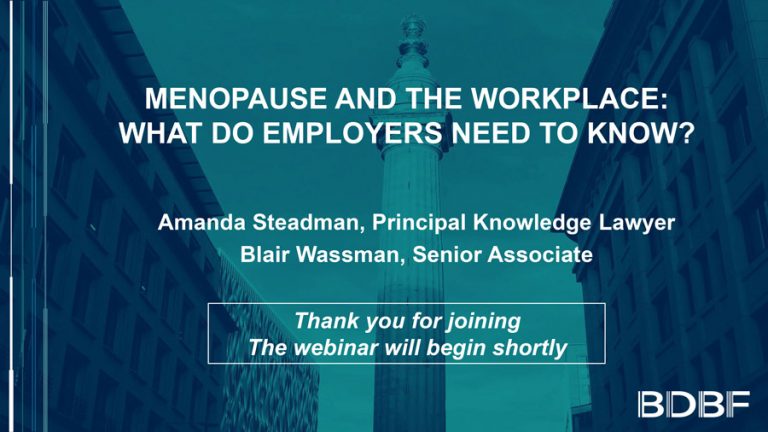
Webinar: Menopause and the workplace: what employers need to know

In this 50-minute webinar, BDBF’s Principal Knowledge Lawyer Amanda Steadman and Senior Associate Blair Wassman consider the hot topic of menopause and the workplace. This webinar was originally delivered on 7 September 2022 and reflects our understanding as of that date. Do get in contact with either of the speakers if you would like to discuss any of the issues raised.

To view the PDF webinar slides please click on the image below, or view the recording of the webinar:

Please contact Amanda Steadman (amandasteadman@bdbf.co.uk), Blair Wassman (blairwassman@bdbf.co.uk), or your usual BDBF contact, for further advice.


https://www.youtube.com/watch?v=rzO9M3F8xBA


Claire Dawson appointed by the ABA Section of Labor and Employment Law

[et_pb_section fb_built=”1″ _builder_version=”3.0.100″ background_image=”http://davidk423.sg-host.com/wp-content/uploads/2017/09/bdbf_final-stages-1-4-1.jpg” custom_padding=”|||” global_module=”2165″ saved_tabs=”all” global_colors_info=”{}”][et_pb_row _builder_version=”4.16″ min_height=”66.4px” custom_padding=”50px||||false|false” global_colors_info=”{}”][et_pb_column type=”4_4″ _builder_version=”4.16″ custom_padding=”|||” global_colors_info=”{}” custom_padding__hover=”|||”][et_pb_text _builder_version=”4.16″ _dynamic_attributes=”content” text_font=”|700|||||||” text_font_size=”27px” background_layout=”dark” custom_margin=”0px|||” custom_padding=”0px|||” global_colors_info=”{}”]@ET-DC@eyJkeW5hbWljIjp0cnVlLCJjb250ZW50IjoicG9zdF90aXRsZSIsInNldHRpbmdzIjp7ImJlZm9yZSI6IiIsImFmdGVyIjoiIn19@[/et_pb_text][et_pb_text _builder_version=”4.16″ _dynamic_attributes=”content” _module_preset=”default” text_text_color=”#FFFFFF” global_colors_info=”{}”]@ET-DC@eyJkeW5hbWljIjp0cnVlLCJjb250ZW50IjoicG9zdF9kYXRlIiwic2V0dGluZ3MiOnsiYmVmb3JlIjoiIiwiYWZ0ZXIiOiIiLCJkYXRlX2Zvcm1hdCI6ImRlZmF1bHQiLCJjdXN0b21fZGF0ZV9mb3JtYXQiOiIifX0=@[/et_pb_text][/et_pb_column][/et_pb_row][/et_pb_section][et_pb_section fb_built=”1″ admin_label=”section” _builder_version=”4.16″ global_colors_info=”{}”][et_pb_row column_structure=”1_2,1_2″ admin_label=”row” _builder_version=”4.16″ background_size=”initial” background_position=”top_left” background_repeat=”repeat” global_colors_info=”{}”][et_pb_column type=”1_2″ _builder_version=”4.16″ custom_padding=”|||” global_colors_info=”{}” custom_padding__hover=”|||”][et_pb_text _builder_version=”4.17.4″ text_orientation=”justified” use_border_color=”off” global_colors_info=”{}”]

BDBF Partner, Claire Dawson, has been appointed by the ABA Section of Labor and Employment Law as Employee Co-Chair of the International Labor & Employment Law Committee. 

[/et_pb_text][/et_pb_column][et_pb_column type=”1_2″ _builder_version=”4.16″ custom_padding=”|||” global_colors_info=”{}” custom_padding__hover=”|||”][et_pb_image src=”http://davidk423.sg-host.com/wp-content/uploads/2021/08/Claire-Dawson-Blog.jpg” title_text=”Claire-Dawson-Blog” _builder_version=”4.17.4″ _module_preset=”default” global_colors_info=”{}”][/et_pb_image][/et_pb_column][/et_pb_row][/et_pb_section][et_pb_section fb_built=”1″ _builder_version=”4.16″ global_colors_info=”{}”][et_pb_row _builder_version=”4.16″ global_colors_info=”{}”][et_pb_column type=”4_4″ _builder_version=”4.16″ global_colors_info=”{}”][/et_pb_column][/et_pb_row][/et_pb_section]


Gareth Brahams recommended as a top adviser in the Spear’s Magazine Employment Lawyers Index 2022

[et_pb_section fb_built=”1″ _builder_version=”3.0.100″ background_image=”http://davidk423.sg-host.com/wp-content/uploads/2017/09/bdbf_final-stages-1-4-1.jpg” custom_padding=”|||” global_module=”2165″ saved_tabs=”all” global_colors_info=”{}”][et_pb_row _builder_version=”4.16″ min_height=”66.4px” custom_padding=”50px||||false|false” global_colors_info=”{}”][et_pb_column type=”4_4″ _builder_version=”4.16″ custom_padding=”|||” global_colors_info=”{}” custom_padding__hover=”|||”][et_pb_text _builder_version=”4.16″ _dynamic_attributes=”content” text_font=”|700|||||||” text_font_size=”27px” background_layout=”dark” custom_margin=”0px|||” custom_padding=”0px|||” global_colors_info=”{}”]@ET-DC@eyJkeW5hbWljIjp0cnVlLCJjb250ZW50IjoicG9zdF90aXRsZSIsInNldHRpbmdzIjp7ImJlZm9yZSI6IiIsImFmdGVyIjoiIn19@[/et_pb_text][et_pb_text _builder_version=”4.16″ _dynamic_attributes=”content” _module_preset=”default” text_text_color=”#FFFFFF” global_colors_info=”{}”]@ET-DC@eyJkeW5hbWljIjp0cnVlLCJjb250ZW50IjoicG9zdF9kYXRlIiwic2V0dGluZ3MiOnsiYmVmb3JlIjoiIiwiYWZ0ZXIiOiIiLCJkYXRlX2Zvcm1hdCI6ImRlZmF1bHQiLCJjdXN0b21fZGF0ZV9mb3JtYXQiOiIifX0=@[/et_pb_text][/et_pb_column][/et_pb_row][/et_pb_section][et_pb_section fb_built=”1″ admin_label=”section” _builder_version=”4.16″ global_colors_info=”{}”][et_pb_row admin_label=”row” _builder_version=”4.16″ background_size=”initial” background_position=”top_left” background_repeat=”repeat” global_colors_info=”{}” column_structure=”1_2,1_2″][et_pb_column type=”1_2″ _builder_version=”4.16″ custom_padding=”|||” global_colors_info=”{}” custom_padding__hover=”|||”][et_pb_text _builder_version=”4.17.4″ text_orientation=”justified” use_border_color=”off” global_colors_info=”{}”]

We are pleased to announce that BDBF Partner, Gareth Brahams, has been recommended as a top adviser in the Spear’s Magazine Employment Lawyers Index 2022. Congratulations to our fellow employment law practitioners who have also been featured, and thank you to our peers and clients across the employment law network for their feedback. Read more here.

[/et_pb_text][/et_pb_column][et_pb_column type=”1_2″ _builder_version=”4.16″ custom_padding=”|||” global_colors_info=”{}” custom_padding__hover=”|||”][et_pb_image _builder_version=”4.17.4″ _module_preset=”default” title_text=”Gareth-WhitePaper-Cutout” src=”http://davidk423.sg-host.com/wp-content/uploads/2022/08/Gareth-WhitePaper-Cutout.jpg” hover_enabled=”0″ sticky_enabled=”0″][/et_pb_image][/et_pb_column][/et_pb_row][/et_pb_section][et_pb_section fb_built=”1″ _builder_version=”4.16″ global_colors_info=”{}”][et_pb_row _builder_version=”4.16″ global_colors_info=”{}”][et_pb_column type=”4_4″ _builder_version=”4.16″ global_colors_info=”{}”][/et_pb_column][/et_pb_row][/et_pb_section]