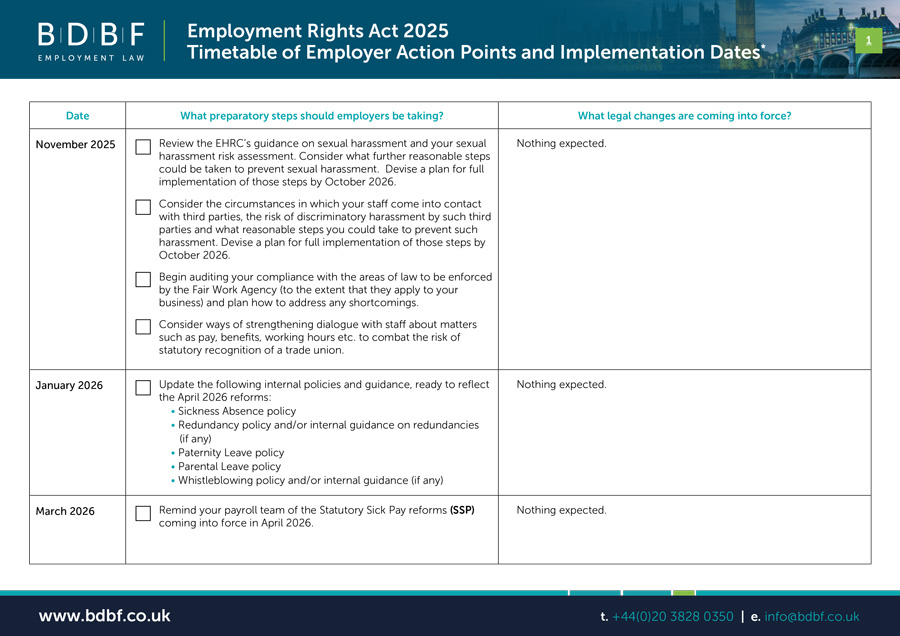
The Employment Rights Act 2025 (the ERA) became law on 18 December 2025 and will make sweeping and significant reforms to our employment law landscape over the next two years. Our guide explains the detail of all the key reforms, what they mean for employers in practice and the next steps. You may also find the practical tips set out in our Timetable of Action Points for Employers and Implementation Dates useful.
Unfair dismissal
Reduction of the qualifying period from two years to six months
Currently, an employee must have two years’ continuous service with their employer in order to bring a claim of ordinary unfair dismissal in an Employment Tribunal. There is a limited exception, where it is shown that the dismissal was for an “automatically unfair” reason, such as for having made a protected disclosure. In such cases, the employee is able to claim automatic unfair dismissal from Day 1 of their employment. However, where there are no such aggravating factors, an employer is able to dismiss an employee with under two years’ service relatively easily. There is no need to identify a fair reason for the dismissal and nor does the employer need to show it acted reasonably.
Initially, the Employment Rights Bill had proposed to remove the two-year qualifying period for ordinary unfair dismissal claims, converting it to a Day 1 employment right. However, faced with resistance to this measure from the House of Lords, the Government undertook discussions with relevant stakeholders, including major business representatives such as the Confederation of British Industry and the Federation of Small Businesses. The outcome of those discussions was a surprise U-turn on Day 1 unfair dismissal rights. Instead, a compromise solution of a six-month qualifying period was settled upon. In addition, the ERA makes it harder for future governments to undo this change, by stipulating that primary legislation will be needed to vary the qualifying period.
Removal of the cap on compensation
Currently, the “compensatory award” for unfair dismissal is limited to the lower of either 52 weeks’ gross pay or a statutory cap. The statutory cap rises each year but is currently set at £118,223.
Initially, the Employment Rights Bill contained no proposals relating to the compensatory award. However, a surprise decision to abolish the cap was made by the Government shortly before the Bill passed into law, seemingly as a quid pro quo for the U-turn on Day 1 unfair dismissal rights.
This means that awards for unfair dismissal will be broadly comparable with those made in discrimination and whistleblowing dismissal claims.
What will these changes mean for employers in practice?
- These changes are certain to generate more grievances and Employment Tribunal claims. The Government’s recently published impact assessment estimates that the reduction of the qualifying period will lead to 9,000 additional Acas “early conciliation” notifications and 3,000 additional Employment Tribunal claims. However, this estimate does not build in additional notifications and claims flowing from the removal of the compensation cap because the Government says the response of employers and employees to this change is too uncertain.
- A rise in disputes will take time and money to deal with, with small businesses lacking a formal HR function disproportionately affected. And a rise in claims will increase pressure on an already stretched Tribunal system which could mean even longer delays before reaching a hearing.
- In particular, the removal of the cap on compensation is likely to lead to a rise in claims from higher earners and those with valuable benefits, who will now be able to seek their full losses flowing from the dismissal. We also expect to see more claimants arguing for multi-year and even career-long loss. At the same time, settlements may be harder to achieve in these types of cases as claimants may feel they hold the upper hand. You can read our detailed article about the wider impact of the removal of the compensation cap here.
- All of these risks mean that employers will wish to be more cautious when it comes to recruitment so as to limit the prospect of a bad hire. Employers may wish to consider extending probationary periods to six months to mirror the qualifying period. And after recruitment, line managers will need to manage probationary periods actively to ensure that any performance or conduct issues are identified and dealt with within the first six months of employment. Once an employee has accrued six months’ service, any subsequent dismissal process will need to be executed meticulously, with careful adherence to procedure and the Acas Code.
- Is there any upside for employers? Conceivably, it could lead to some reduction in whistleblowing dismissal and discriminatory dismissal claims, which are currently the only statutory claims that employees with under two years’ service can bring about their dismissal and recover uncapped compensation. A decline in those types of claims could be a good thing for employers, not least from a reputational perspective and because the cost and complexity of defending those types of claims is higher. However, where a claimant believes there was a discriminatory reason at play, or they have been dismissed for whistleblowing, they are still likely to pursue that claim.
What are the next steps?
The Government announced in Parliament that it intends to reduce the qualifying period with effect from 1 January 2027. Although it has not yet confirmed when the cap on compensation will be abolished, it is widely expected that this will come into force on the same date. If this happens, it will mean that employees engaged by 2 July 2026 would qualify for the right to bring an uncapped unfair claim on 1 January 2027.
Separately, the Government’s impact assessment says that a series of meetings will be held early in 2026, to enable stakeholders to feed in their view on the unfair dismissal changes and a summary of those responses will also be published in 2026. The Government has said it will also consider what additional dedicated support or guidance might be needed.
Dismissal during pregnancy and following a period of statutory family leave
Currently, there is extensive protection from dismissal for pregnant women, new mothers and other parents. It is unlawful to:
- treat an employee unfavourably because of her pregnancy or maternity leave during the “protected period” (which begins when a woman becomes pregnant and ends when she returns from maternity leave);
- treat an employee less favourably than a male comparator for reasons to do with her pregnancy or maternity leave outside the protected period;
- dismiss an employee for a reason connected to her pregnancy or maternity leave (or connected to certain types of other family leave including adoption, shared parental and neonatal care leave);
- make an employee redundant during pregnancy or maternity leave (or adoption leave, shared parental leave or neonatal care leave) where there is a suitable alternative vacancy available; or
- make an employee redundant who has recently returned to work from a period of maternity leave (or adoption leave, shared parental leave or neonatal care leave) where there is a suitable alternative vacancy available.
Despite this wide protection, the ERA provides that regulations may be introduced which will provide enhanced protection from dismissal during pregnancy and following return from maternity leave, adoption leave, shared parental leave, neonatal care leave and bereaved partners’ paternity leave (the latter of which is due to come into force on 6 April 2026).
This would mean that such employees could not be fairly dismissed, save where the regulations allowed for an exception. The ERA also provides that the regulations will specify the notices that must be given to employees, the evidence to be produced and any additional procedures to be followed, as well as the consequences of failing to do these things.
On 23 October 2025, the Government published a consultation paper seeking views on how the enhanced dismissal protection should operate in practice. The consultation proposed two broad options:
- Introduce a stricter fairness test: one option is to introduce a stricter test to assess the fairness of such dismissals for any of the existing five fair reasons for dismissal (i.e. conduct, capability, redundancy, illegality or some other substantial reason).
- Narrow the five fair reasons for dismissal: an alternative option is to narrow the existing five fair reasons for dismissal (and/or potentially remove some of them entirely) when applied to pregnant women or new mothers (and other returners). You can read what is proposed in respect of each reason in our detailed briefing here.
The consultation paper also asked whether the new protection should apply from Day 1 of employment or only after a qualifying period of somewhere between three to nine months. In terms of when the protection should end, the consultation paper proposed either 18 months from the birth of the child or six months after the return to work from maternity leave, whenever that is.
Further, the consultation paper asked whether the same protections should be extended to employees taking adoption leave, shared parental leave, neonatal care leave and bereaved partners’ paternity leave and, if so, when the protection should start and end.
What will these changes mean for employers in practice?
- The impact for employers can only be fully assessed once the Government decides the scope of the protections to be introduced. That said, whichever option is pursued, it is clear that employers will have their hands tied to a significant extent when it comes to dismissing employees who are pregnant, absent on certain types of family leave and following return from the same.
- It also appears that where an employer needs to dismiss an employee in a protected group there will be an increased administrative burden in terms of notices, evidence and procedures to be followed, with penalties for getting it wrong. Smaller businesses are likely to be disproportionately affected by these requirements.
- Employers will also need to take care not to make hiring decisions based on the likelihood of a candidate falling into one of these protected groups. For example, a refusal to hire a woman of child-bearing age (out of fear of being subsequently being restricted from dismissal) would itself be discriminatory.
What are the next steps?
The consultation closed on 15 January 2026. The Government’s response and final position will be published in due course.
The final measures are due to be implemented some time in 2027.
Dismissal for failing to agree a variation of contract (aka “fire and rehire”) or to be replaced by a non-employee
“Fire and rehire” is a shorthand used to describe the practice of dismissing an employee then offering to re-engage them on inferior terms and conditions. Currently, if an employer wishes to deploy this practice, it must comply with the statutory Code of Practice on dismissal and re-engagement, which came into force in July 2024. A failure to do so may lead to an uplift of up to 25% to compensation awarded to an employee by an Employment Tribunal.
Initially, the Employment Rights Bill had proposed that it would be automatically unfair to dismiss an employee for failing to agree to any change to their terms and conditions of employment, or in order to re-engage them (or someone else) under varied terms and conditions of employment, where the role is otherwise substantially the same. A limited exception was to be made where the reason for the variation was to eliminate, prevent or significantly reduce or mitigate the effect of any financial difficulties which were affecting the employer’s ability to carry on its business.
However, in July 2025, the Government announced plans to soften the fire and rehire provisions. These revised provisions are now reflected in the ERA, which provides that a dismissal will be automatically unfair where the employee is dismissed:
- for failing to agree to “restricted variations” to their terms and conditions of employment; or
- in order to re-employ them (or to employ someone else) under varied terms and conditions, where one of more of the differences between the two sets of terms is a restricted variation, but where the role is otherwise substantially the same.
A “restricted variation” means a variation relating to pay, pensions or pension schemes, working hours, the timing or duration of shifts or a reduction in the amount of time off. It also covers the inclusion of a unilateral flexibility term allowing the employer to make a restricted variation in future without the employee’s agreement. The list of restricted variations may be expanded in future and, may also provide that “pay” excludes expenses and benefits in kind. The ERA continues to allow for a limited exception for variations made in response to serious financial difficulties affecting the employer’s ability to carry on business as a going concern and where there is no reasonable alternative.
Where either:
- the financial difficulties exception applies; or
- an employee is dismissed (i) for refusing to agree to other types of non-restricted variations or (ii) to re-employ them (or to employ someone else) on varied terms,
then the dismissal will not be automatically unfair. However, the ERA provides that certain matters must then be considered by the Employment Tribunal to determine whether the dismissal is ordinarily unfair including: the reason for the variation, any consultation carried out about the proposed variation (including with a trade union), anything offered to the employee in return for agreeing to the variation and any other matters specified in regulations.
Separately, the ERA contains a provision (which was only added to the Bill in the Summer) designed to prevent employers from simply replacing an employee with a non-employee. This provision is not linked to contractual variations. The ERA says it will be automatically unfair to dismiss an employee in order to replace them with a non-employee (e.g. a self-employed contractor, agency worker or outsourced worker) where the non-employee would carry out the same or substantially the same role (either alone or taken together with others). This will even capture the scenario where the employee is dismissed and offered re-engagement but stripped of their employment status. However, the financial difficulties exception will apply.
What will these changes mean for employers in practice?
- These provisions are complex and contain many pitfalls. Employers considering changing terms and conditions or restructuring their workforce will certainly need to spend time familiarising themselves with the new rules and will likely require specialist legal advice before proceeding.
- In future, employers wishing to change terms and conditions will have a higher exposure to automatic unfair dismissal claims. The terms which constitute “restricted variations” if varied are the very terms that would usually lead an employer to consider the extreme solution of fire and rehire in the first place – namely, pay, benefits, hours and leave entitlements. This increased risk will reduce flexibility for employers in managing workforce changes. Instead, employers will need to seek agreement to vary terms through negotiation.
- Further, the prohibition on replacing employees with non-employees could potentially have a dramatic impact in outsourcing situations. In outsourcings, the TUPE legislation will often apply to protect the employee’s employment, with the result that the employee either transfers to the contractor or, if they are dismissed, their dismissal is automatically unfair. Yet TUPE does not apply in every outsourcing situation, for example, where the activities are split up (or “fragmented”) between multiple different service providers. In this situation, an employer could usually dismiss the employee fairly by reason of redundancy or some other substantial reason. However, under the ERA, an employee may still be regarded as unlawfully “replaced” in this scenario because the protection extends to situations where the employee’s work is performed by a mix of different non-employees (i.e. where the activities are outsourced to several different providers) or by a mix of employees and non-employees (i.e. where some of the activities are kept in-house and some are outsourced). Employees in this position may now acquire automatic unfair dismissal protection despite not being covered by TUPE.
- The Government’s impact assessment suggests that these measures may protect up to 125,000 employees from fire and rehire practices each year and will also lead to unquantified benefits, including greater wellbeing, productivity, and fairness.
What are the next steps?
The Government intends to bring these changes into force in January 2027.
However, the Government had planned to consult on related regulations and on updating the statutory Code of Practice in Autumn 2025. Those consultations have not yet started, which may mean that the planned implementation date will be postponed.
Collective redundancies
Currently, collective redundancy consultation is triggered where there is a proposal to dismiss as redundant 20 or more employees assigned to one “establishment” within a 90-day period. The question of what an “establishment” has been ventilated in litigation – with employees arguing it should mean the business as a whole rather than the local place of work. This would mean that collective consultation would be triggered more frequently as redundancy numbers would have to be counted across the whole business. However, the senior courts concluded that “establishment” means the local unit where the employee works, not the business as a whole.
Initially, the Employment Rights Bill had proposed to reverse this, so that collective consultation would be triggered where there were 20 proposed redundancies within 90 days across the business rather than in just one workplace.
The Government also consulted on (i) increasing the maximum protective award from 90 to 180 days (or having no upper limit at all) where an employer was found to not have properly followed a collective redundancy process, and (ii) what role interim relief could play in protecting employees who have protective award claims. In March 2025, the Government responded to that consultation and put forward amendments to the key trigger proposal, aimed at softening the impact for employers.
The ERA provides that collective consultation will be triggered where there is a proposal to dismiss as redundant within a 90-day period either 20 or more employees assigned to one establishment (i.e. the current position), or a “threshold number of employees” across the whole workforce. This new threshold number will be defined in regulations but may be either a specified number of redundancies or an overall percentage of the workforce or determined in another way (but in any case the threshold will not be below 20 redundancies). For example, if the threshold were to be set at 10% of the workforce, and the employer employed 500 employees across different sites, then a proposal of 50 or more redundancies across the whole business within a 90-day period would trigger collective consultation even where fewer than 20 redundancies were proposed at any single establishment. The trigger for providing the Secretary of State with advance notice of proposed collective redundancies via the HR1 form will also be aligned with the new threshold test.
Employers will be required to notify employee representatives in writing of the total number of proposed redundancies across the workforce and at which establishments. However, employers will not be required to consult all such representatives together, nor undertake consultation with a view to reaching the same agreement with all of them.
In terms of remedies, the maximum protective award will rise from 90 to 180 days’ gross pay per employee. However, interim relief will not be extended to protective award claims.
What will this change mean for employers in practice?
- The retention of the words “at one establishment” is a concession to business and means that collective consultation will not be triggered where a multi-site employer proposes small pockets of redundancies at different sites unless the total numbers exceed the new threshold – whatever that is. Clearly, the level at which the new threshold is set will be important: the lower it is, the more frequently collective consultation will be required.
- The administrative burden will increase for multi-site employers, who will need to have a system in place to ensure that they keep track of proposed redundancies across the whole workforce. Where “across the workforce” consultation is triggered, they will need to have appropriate representatives in place for all affected employees no matter where they are based. This will be more time-consuming to achieve where elections are needed.
- The consultation process itself could become more cumbersome and disjointed as employers may be consulting about several small pockets of unrelated redundancies at the same time, with different groups of representatives (albeit you are not required to consult all such representatives together, nor undertake consultation with a view to reaching the same agreement with all of them). More time and resources will need to be devoted to organising and managing multiple consultation meetings.
- Getting it wrong will also be more costly: employees will be entitled to a protective award of up to 180 days’ gross pay. The Government’s impact assessment accepts there will be an increased cost to business where collective redundancy obligations are not met. However, it envisages that the increased penalty will drive greater compliance which, in turn may have the positive effect of identifying ways to reduce the number of redundancies needed.
What are the next steps?
The protective award is due to increase in April 2026 (the precise date is to be confirmed).
The Government has promised to consult about the level at which the “across the workforce” threshold should be set. That consultation is expected to launch in early 2026. After the Government has settled on its final position, regulations will be needed to introduce the new test. The Government has said this change will come into force some time in 2027.
Separately, the Government has indicated that when consulting about the trigger, it will also seek views on doubling the 45-day consultation period needed where 100+ redundancies are proposed. Although this proposal is outside the ERA, it is possible that this change could be taken forward at the same time as the change to the trigger.
Sexual harassment
Duty to prevent
Since 26 October 2024, all employers have been required to take reasonable steps to prevent sexual harassment of their workers (including by third parties). If this duty is breached, an uplift of 25% may be applied to compensation in relevant claims, and the Equality and Human Rights Commission (the EHRC) may investigate and take enforcement action.
Under the ERA, this duty will become more onerous and require employers to take all reasonable steps to prevent sexual harassment or risk these consequences.
The ERA provides that regulations may be introduced to specify the steps that will be regarded as reasonable for the purposes of both: (i) this new proactive duty to prevent sexual harassment; and (ii) the existing defence that an employer has taken all reasonable steps to prevent sexual harassment. This may include steps such as carrying out risk assessments, publishing plans or policies, and steps relating to the reporting and handling of complaints.
This change is expected to come into force in October 2026, with the regulations to follow at a later date.
Disclosures constitute whistleblowing
In addition, disclosures about actual or likely sexual harassment will be listed as one of the types of malpractice about which a whistleblowing disclosure may be made. All other elements of the test for qualifying as a protected disclosure (such as being made in the public interest) will still apply. This change is expected to come into force in April 2026.
What will these changes mean for employers in practice?
- It will be harder for employers to discharge the duty to prevent sexual harassment once it has been enhanced in this way, as they will need to show that they have done everything that was reasonable for them to do. In particular, a lot will be expected from large and well-resourced employers and from employers where sexual harassment is especially prevalent.
- Once regulations are made setting out the list of potentially reasonable steps, this will hopefully offer a degree of certainty about what is required. For now, the recommended steps to prevent sexual harassment are set out in the EHRC’s non-statutory Technical Guidance on Sexual Harassment and Harassment at Work and its 8-step Guide to Preventing Sexual Harassment at Work.
- We are likely to see an increase in employers pleading the “all reasonable steps” defence in relevant cases. Given that the work that will have gone in to take steps to discharge the duty, employers are likely to want the added benefit of avoiding liability for a sexual harassment claim.
- Making it clear that disclosures about sexual harassment may amount to whistleblowing disclosures is helpful, although arguably unnecessary. The Tribunals have already made it clear that disclosures about sexual harassment are capable of amounting to whistleblowing disclosures, since they represent breaches of the Equality Act 2010 (see for example Mysakowski v Broxborn Bottlers Ltd). Nonetheless, it is a helpful sign to those wishing to report sexual harassment that they may be protected as whistleblowers.
What are the next steps?
Given that these measures are expected to take effect this year, employers would be wise to begin working towards taking all reasonable steps now. Not only will this help employers be ready for the raised requirement in good time, it opens up the possibility of pleading the “all reasonable steps” defence in relevant sexual harassment claims.
As a starting point, employers should review the EHRC’s guidance on sexual harassment and their sexual harassment risk assessment and consider what further reasonable steps could be taken to prevent sexual harassment. Full implementation of those steps should be in place by October 2026.
Liability for discriminatory harassment by third parties
The ERA will reintroduce employers’ liability for discriminatory harassment of staff by third parties. This had originally been in place until 1 October 2013 under the Equality Act 2010, when it was removed by the Coalition Government.
This protection extends to all forms of discriminatory harassment under the Equality Act 2010, not just sexual harassment. Liability will also arise from the first instance of harassment (unlike the previous provisions, which required it to have taken place more than once). This means that, for example, racially motivated comments made towards a shopworker by a customer may lead to the employer being liable. However, similarly to the defence for sexual harassment claims, employers will be able to avoid liability where they can show they took “all reasonable steps” to prevent the third party harassment.
What will these changes mean for employers in practice?
- The reintroduction of liability for third party harassment is one of the most important reforms in the ERA, significantly widening an employer’s exposure to claims of discriminatory harassment. For employers operating in sectors where staff frequently come into contact with third parties (such as the transport, retail and hospitality sectors), that risk is heightened even further.
- While the “all reasonable steps” defence remains open to an employer to defend such a claim, it will be an onerous task to discharge every possible reasonable step – many employers are likely to fall short. For this reason, employers may wish to begin work on scoping out how it might meet this standard sooner rather than later.
- As far as sexual harassment is concerned, employers who are found liable for third party sexual harassment may also face the prospect of an uplift to compensation of up to 25%. A Tribunal may award this where it finds that the employer has breached the duty to prevent sexual harassment.
What are the next steps?
Liability for third-party harassment is expected to come into force in October 2026. Employers should be considering now what reasonable steps they could take to prevent harassment of their employees by third parties, and implement them before October.
Equality action plans
Currently, employers with 250 or more employees are required to publish information on their gender pay gap on an annual basis. However, in-scope employers must report their pay gap figures and nothing else – they are not required to explain the figures nor how they intend to close their gender pay gap (and, in fact, they are not required to close it all). The hope was simply that “what gets measured gets managed” and that reporting alone would drive employers to take steps to close their gaps. However, progress in closing gender pay gaps remains slow.
The ERA provides that regulations may be published requiring private employers with 250 or more employees to develop and publish “equality action plans” on an annual basis. These action plans must set out the steps the employer is taking in relation to addressing its gender pay gap and also supporting employees going through the menopause.
The action plan will have to meet the minimum standards, which are to be set out in regulations. There will be consequences for failure to comply, but, again, this will be dealt with in regulations.
Further, when reporting their gender pay gaps, employers will be required provide information about whom they contract with for outsourced workers. Such workers are not employees of the employer and, therefore, do not need to be included in the gender pay gap figures. It seems that the intention here is to allow a fuller understanding of an organisation’s gender pay gap. For example, if an organisation’s outsourced roles were typically fulfilled by low-paid female workers, this would have the effect of improving the gender pay gap figures since this pay data would not need to be factored in. The new requirement, therefore, adds a layer of transparency to show this.
What will these changes mean for employers in practice?
- Gender pay gap reporting will become more onerous for in-scope employers. Although some employers already publish sophisticated narratives and actions plans, many do not. All will need to publish an annual plan setting out what action is being taken to close the gap. A failure to do so will have consequences, but what is not clear is whether there will be consequences for publishing a compliant plan and then not implementing it or attempting to implement it but failing to actually make a dent in the gender pay gap.
- The Government has confirmed that these requirements are part of a wider reform to expand equality and pay transparency, sitting alongside the planned Equality (Race and Disability) Bill. This Bill intends to introduce both ethnicity and disability pay reporting which would mirror the gender pay gap reporting regime, on which the Government’s consultation closed on 10 June 2025 (with feedback reportedly still being analysed). Further consultation will also be needed prior to the regulations implementing the ERA’s reforms.
- The forthcoming requirement to publish information about the steps taken to support menopausal workers means employers will need to give thought to what can be said in this regard. Some employers are well advanced in terms of support offered. Others will need to start work on providing appropriate support measures in order to be able to populate the action plan. That said, most employers will already have some things to say here, for example, the provision of flexible working options and relevant benefits such as discounted gym memberships or employee assistance programmes. However, more is likely to be needed.
What are the next steps?
The Government’s ERA factsheet indicates that implementation of equality action plans will be voluntary from Spring 2026 and mandatory from Spring 2027. Mandatory reporting of outsourcing measures is likely to take longer to take effect.
Ban on non-disclosure agreements preventing disclosures about discrimination or harassment
The ERA will prohibit the use of non-disclosure agreements (NDAs) to prevent disclosures of information about harassment or discrimination by the employer or fellow workers, including allegations of “relevant harassment or discrimination”. Any term purporting to do so will be void, and this includes those in any contract (e.g. the employment contract, a settlement agreement or any separate NDA).
This prohibition will also apply to allegations or disclosures of information relating to the employer’s response to the harassment or discrimination (or to the allegation / information). This could arguably include steps such as the fact of exit discussions and the existence of a settlement agreement, where the underlying matter concerns harassment or discrimination.
“Allegation” for these purposes is not defined, and there is nothing (at present) to exclude the making of false or bad faith statements. This would mean that employers would be unable to prevent a worker from repeating false or bad faith allegations even where a claim had settled. An individual against whom false or bad faith allegations have been made would have to look to the law of defamation for recourse.
Additionally, the concept of “relevant harassment and discrimination” is very broad, including all forms of harassment and discrimination under the Equality Act 2010. The provisions specific to victimisation in the Equality Act 2010 are not expressly included, although the prohibition on preventing discussion of the employer’s response may cover this in practice. It applies to any such conduct provided that it is committed by the employer or a co-worker or the victim of the conduct is the worker or a co-worker. This suggests that, once the new legal protections against third-party harassment come into effect, this will also be covered by the NDA prohibition.
The ERA anticipates that there will be certain types of “excepted agreements” (where disclosures can be validly restricted), but the detail of these will be set out in regulations. Regulations may also extend the protection to cover those outside the definition of “worker”, such as those undertaking work experience or training.
For a deep dive into this provision – which has not substantively changed since it was added to the Employment Rights Bill in July 2025 – you can read our earlier article here.
What will these changes mean for employers in practice?
- Currently, any provision banning workers from making protected disclosures will be void under the Section 43J of the Employment Rights Act 1996. However, this is subject to a stringent test, including that the disclosure has to be in the public interest and must be made to certain categories of persons. Equally, under section 17 of the Victims and Prisoners Act 2024, NDAs cannot be used to prevent victims of crime disclosing information to certain categories of person for the purposes of support.
- These amendments go much further and will, in effect, permit employees to make any allegation of discrimination or harassment (or about their employer’s response to the same), regardless of the purpose of that statement and regardless of the recipient. In parallel, the Victims and Prisoners Act 2024 is due to be expanded (although it is unclear when), removing any restrictions around the purpose or recipient of disclosures that it covers.
- The key issue for employers will no doubt be clarification of what will constitute an “excepted agreement”, and many may be more reluctant to resolve matters via settlement agreements (at the very least until this certainty is in place). Some employees may also be keen for this clarity, particularly those who are seeking closure via settlement and are happy for this to be on a confidential basis. It has not been set in stone that the restrictions will be forward-looking only (i.e. that they will not affect NDAs which are already in place), and so whilst commentary at the time of the proposals indicated that they would not apply retrospectively, the uncertainty may add to parties’ concern.
What are the next steps?
These provisions were not anticipated in the original Employment Rights Bill, but were added via an Amendment Paper tabled in July 2025. Whilst they have therefore not been included in the Government’s roadmap for implementation, consultation on the proposals opened on 15 April 2026 and will run until 8 July 2026. The changes are expected to come into force in 2027.
Flexible working
Currently, employers may refuse flexible working requests where they consider that at least one of eight grounds specified in the Employment Rights Act 1996 applies. This includes things like the burden of additional costs, an inability to reorganise work among existing staff or detrimental impact on quality or performance. Importantly, this is a subjective test. In other words, as long as an employer considers that one of the eight grounds applies, and that view is based on correct facts, that is a sound basis upon which to reject a request.
There is no statutory right to appeal a refusal, but many employers offer an appeals process. Employees may also challenge the decision via other claims such as automatic unfair dismissal or indirect sex discrimination.
The ERA will require an employer’s refusal of a request to be based on one of the existing eight grounds and be an objectively reasonable one. Further, when refusing a request, the employer must notify the employee of the ground for refusing the request and explain why it considers that it is reasonable to refuse the application on that ground. Where an employer’s decision is not reasonable, or where it fails to explain this to the employee, the employee will be able to complain to an Employment Tribunal.
There is one further small change. From 6 April 2024, employers have been required to consult with employees before refusing a request. Under the ERA, regulations may also be issued setting out the precise steps that an employer must take in order to comply with this consultation requirement.
What will these changes mean for employers in practice?
- We think that employers are going to have to go further to be able to justify the ground or grounds for refusal. For example, if a request is refused on the basis of an inability to reorganise work among existing staff or recruit additional staff, and the employer has not consulted with existing staff about the possibility of doing so or attempted to recruit additional staff, it is likely that a refusal on such grounds would be unreasonable. Or where a request was to be refused on the basis of detrimental impact on quality or performance, again, the question will be: what is the evidence for this view? Unless there is some historical evidence (e.g. if an employee has worked the same or similar pattern in the past and it was unsuccessful), it is likely that an employer would need to allow a trial period of the proposed working pattern for a reasonable period of time in order to assess whether there was, in fact, such a detrimental impact. The end result is that more requests are likely to be accepted.
- Where an employer breaches the rules governing flexible working requests, an employee may complain to an Employment Tribunal. The Tribunal may order the employer to pay compensation of up to eight weeks’ pay (currently capped at £719 per week but due to rise in April 2026) and require the employer to reconsider the application. Where an employer’s refusal is found to have been unreasonable, we can expect Tribunals to more readily order employers to reconsider requests.
- Further, if a refusal is unreasonable, this could assist the employee in other potential claims. For example, if an employer has adopted an unreasonable position this may be sufficient to amount to a repudiatory breach of contract, justifying constructive dismissal. Indeed, in the case of Johnson v Bronzeshield Lifting Ltd, a Tribunal held that an employer’s failure to take into account relevant information before refusing a flexible working request was a repudiatory breach. This was on the basis that the hours that an employee works has a major impact on their lives, and it also matters how flexible working applications are dealt with – the outcome is not the only thing of importance. It is not a stretch to see that a Tribunal could reach a similar decision where a request has been refused unreasonably.
- It looks like specific rules are on the way governing the form of consultation needed before refusing a request. The existing statutory Acas Code of Practice on requests for flexible working sets out recommendations on the scope of such consultation. The Code suggests gathering all relevant information, holding a meeting with the employee to discuss the request and considering alternatives if needed. A written record of the meeting should be kept, and a right of appeal is also recommended. A failure to follow the Code does not give rise to a claim but Tribunals will take it into account when considering relevant cases. Therefore, we think it is likely that the Code’s provisions on consultation will be elevated into law.
- In due course, employers will need to update policies and practices to reflect the new rules on refusing requests.
What are the next steps?
The provisions regarding flexible working under the ERA are expected to come into force in 2027, following consultation which is expected to commence imminently. Regulations regarding consultation steps prior to refusal will likely follow.
Family leave rights
There are three areas of change in the field of family leave rights under the ERA.
Unpaid parental leave
Currently, employees with one year’s service have a right to take up to four weeks’ unpaid parental leave per year in respect of children under the age of 18 (up to a maximum of 18 weeks’ leave in total).
Under the ERA, the service requirement will be removed and unpaid parental leave will become a Day 1 employment right. This is expected to take effect in April 2026.
Paternity leave
Currently, employees with 26 weeks’ service ending with the week immediately before the 14th week before the expected week of childbirth (or the week in which an adopter is notified of a match) have a right to take up to two weeks’ paternity leave. The same service requirement applies in respect of eligibility for statutory paternity pay.
The ERA will remove the service requirement for paternity leave, making it a Day 1 employment right. However, there is no provision lifting the service requirement for statutory paternity pay, which suggests that it will remain at least for now.
Further, currently, where an employee is entitled to paternity leave and pay and shared parental leave and pay, the paternity leave and pay must be taken before the shared parental leave and pay. If the employee takes the shared parental leave and pay first, they lose their entitlement to paternity leave and pay. The ERA will remove this restriction, meaning that employees may take shared parental leave and pay first if they wish, and retain their entitlement to paternity leave and pay. These changes to paternity leave will take effect in April 2026.
Bereavement leave
Currently, employees have a Day 1 employment right to take two weeks’ bereavement leave if a child under the age of 18 dies or is stillborn after 24 weeks of pregnancy (and those with 26 weeks’ service ending with the week before the child died are also entitled to receive statutory parental bereavement pay). Employees taking parental bereavement leave are also protected from detriment and dismissal. However, there is no general right to take bereavement leave outside of this, for example when a spouse, parent or sibling dies, or for losses earlier in pregnancy. Of course, many employers do permit compassionate leave in such circumstances, but there is no legal requirement to do so.
The ERA amends the parental bereavement leave rules (which are set out in the Employment Rights Act 1996) to turn “parental bereavement leave” into “bereavement leave”, although some special rules will still apply where a child dies. Regulations will specify the relationships which will entitle an employee to take bereavement leave, however, we can expect it to cover most close relationships such as a spouse, civil partner, other life partner, grandchild, parent, sibling or grandparent (in line with the definitions used for time off for “dependants” in emergency circumstances). The ERA also confirms that pregnancy loss occurring before 24 weeks of pregnancy will be included.
The bereavement leave entitlement in most cases must be not less than one week, however, the leave entitlement will stay at two weeks where a child has died. It appears that the leave will be unpaid, save that statutory pay will remain available where a child dies. The consultation for these rights encouraged employers to “go above and beyond” the ERA’s minimum requirements.
The substance of these changes remains to be set out in the forthcoming regulations, consultation for which closed on 15 January 2026. The changes are expected to take effect in 2027.
What will these changes mean for employers in practice?
- The removal of the service requirements for unpaid parental leave and paternity leave will mean that a larger cohort of employees will become eligible to take these forms of leave. The result is that employers will have to manage a higher number of these types of absences than is currently the case. In due course, employers will need to adjust relevant policies to reflect the wider scope.
- Many employers already offer paid bereavement leave but the new statutory right will introduce rules around how such leave is managed and provide protections for those taking the leave. Employers will need to revise their bereavement leave policy in due course and will also need to consider whether to enhance the right and offer paid leave.
What are the next steps?
The rights to unpaid parental leave and paternity leave from Day 1 (as well as the right to take both paternity and shared parental leave) will come into force in April 2026.
Implementation of the bereavement-related changes is subject to regulations, which have not yet been drafted following the closing of consultation in January 2026. The changes are not expected to take effect before 2027.
Separately, the Government acknowledges that some reforms will take longer to implement, including a full review of the entire parental leave framework and a review of the benefits of introducing paid carer’s leave. No specific time frame for these reviews is given, however we note that in parallel, draft regulations have very recently been published to bring into action the Paternity Leave (Bereavement) Act 2024. These regulations are intended to take effect in April 2026, setting out the detail of the rights of co-parents to extended leave where the “primary carer” of the child has died.
Zero and low hours contracts
A zero hours contract is one where the employer does not guarantee any number of hours of work, but the worker is obliged to accept work whenever it is offered, without any certainty of how much work there will be or when. Sometimes the contracts are less onerous, and the worker is permitted to reject the work offered if they wish. A low hours contract is similar, save the employer will guarantee some hours of work, but it will be at the employer’s discretion as to when the work is performed.
The ERA introduces three key changes, which will restrict the use of such contracts and penalise employers who abuse them.
First, zero and low hours workers who have worked a certain number of hours regularly over a reference period will have the right to have those hours guaranteed in their contract. The rules governing this new right are complex, but, in summary, provide as follows:
- At the end of each reference period, the employer must make a guaranteed hours offer to any worker within scope.
- The offer must meet certain minimum requirements (to be further set out in regulations), including that it must set out the proposed working days and hours (or specific working pattern) which must reflect the working hours over the reference period.
- In most cases, the terms of the offer may not be less favourable to the worker, for example, making an offer on a lower rate of pay.
- On top of this, employers must also provide specified information to workers about their right to guaranteed hours within two weeks of starting employment and ensure they continue to have access to that information.
- A failure to make the offer, or making one incorrectly, will give rise to an Employment Tribunal claim for which compensation may be awarded.
- A worker will be able to complain to an Employment Tribunal where the employer fails to provide the specified information, fails to make the guaranteed hours offer or makes one incorrectly or where an employer deliberately adjusts a worker’s working hours within the reference period to avoid having to make an offer.
We do not know who will qualify as a low hours worker, how many hours must be worked to trigger the right to a guaranteed hours offer, nor the length of the reference period to be used. All these finer details are to be dealt with in separate regulations.
Second, zero and low workers (and any other worker who does not have a set working pattern) will have the right to reasonable notice of shifts and changes to shift, with a right to compensation where late notice is given. Again, the rules are complex, but, in summary, provide as follows:
- Employers must give affected workers reasonable notice of a shift that the employer wants or requires the worker to work (specifying the day, time and hours to be worked).
- Employers must give notice of any change to, or cancellation of, a shift.
- Regulations will set out the minimum amount of notice that must be given which will not be more than 7 days.
- Where an employer cancels, moves or curtails a shift at short notice, it must make a fixed payment of a to the worker – regulations will specify how much that payment must be.
- A breach of any of the notice or payment requirements will give rise to an Employment Tribunal claim for which compensation may be awarded.
Third, similar rules will be introduced for agency workers. The above changes could have encouraged employers to consider switching away from using zero and low hours workers towards using agency workers instead. However, following consultation, the Government decided to amend the Employment Rights Bill to introduce similar rules for agency workers. In summary, the rules, provide as follows:
- The responsibility to make guaranteed hours offers will rest with the end user who must make an offer to the agency worker to enter into a guaranteed hours contract directly with them – thereby changing the structure of the tripartite relationship. This will be a significant deterrent to using agency workers as a flexible resource.
- The requirement to provide specified information about the right to guaranteed hours within two weeks of starting employment will rest with the agency.
- The duty to give reasonable notice about shift changes and cancellations will be shared jointly between the hirer and agency. And in related claims a Tribunal may apportion liability. However, the duty to make a fixed payment following short notice cancellation of a shift will rest with the agency (although there is nothing to stop the agency seeking to recoup such costs from the end user in the contractual agreement).
What will these changes mean for employers in practice?
- These changes will make it considerably more difficult for employers to manage these types of contracts and introduce risks for getting it wrong.
- The requirement to monitor working hours within reference periods on a rolling basis will be administratively cumbersome, particularly where there are multiple zero or low hours workers.
- The requirement for the employer to make repeated offers of guaranteed hours contracts at the end of each reference period is onerous. These offers must continue to be made even where a worker (or agency worker) has made it clear that their preference is to remain on a zero or low hours contract – no provision is made allowing workers to opt out of receiving offers. Could one unintended consequence of the Bill be that workers who genuinely prefer to work on a zero or low hours basis feel pressured to accept a guaranteed hours contract by virtue of the repeated offers from their employer? Will employers be left overstaffed when customer demand falls? Although the ERA does provide an option for employers to use fixed term contracts instead of being caught by these rules, this is only permitted in limited situations.
- As far as the giving notice of shifts and changes to, or cancellation of, shifts is concerned, there will be a risk of tripping up on the notice requirements especially if the notice is generous, leaving an employer liable to make a payment to the worker and at risk of an Employment Tribunal claim.
- What can employers do? For now, a sensible starting point would be to audit your workforce to identify any zero and part time workers (and it may be sensible to focus your attention here on those working below 16 hours). This will help you understand the likely impact of these changes for your business. Where you have workers regularly working in excess of their contracted hours you might consider regularising that situation before these rules come in.
What are the next steps?
Multiple sets of regulations are needed to bring in these reforms. Detailed guidance is also expected.
The Government has committed to consult further on these changes before the regulations are produced. A consultation paper is due to be published soon (having been postponed from Autumn 2025).
The Government has said the changes will come into force in 2027.
Statements of particulars of employment: notification of right to join a trade union
Currently, employers must provide employees and workers with a written statement of the particulars of their employment when they start work. The scope of those particulars is set out in section 1 of the Employment Rights Act 1996.
The ERA provides that employers must give employees and workers a written statement that they have the right to join a trade union, and that this must be given at the same time as the statement of particulars (although it does not require it to be included within the statement itself). It must also be given at “other prescribed times” which are not specified.
Regulations will set out precisely what information must be included in the statement, the form of the statement and how and when it must be given to the employee or worker. In October 2025, the Government opened a consultation seeking views on the following matters:
- Content of the statement: it was suggested that the statement included a brief overview of the functions of a trade union, a summary of the statutory rights arising in relation to trade union membership, a list of trade unions recognised by the employer (if any) and a signpost to the Gov.uk list of trade unions.
- Form of the statement: views were sought on where the statement should be in a standard form provided by the Government or drafted by the employer in line with specified requirements. The Government’s preference is for a standard form on the basis that it would reduce the administrative burdens on employers and help ensure a clear statement is delivered to all workers.
- Manner of delivery: views were sought on direct methods of delivering the statement (e.g. letters or emails) versus indirect methods (e.g. posting on a notice board or intranet). The Government’s preference appears to be for direct delivery.
- Frequency of delivery: as far as new employees and workers are concerned the statement must be delivered at the same time as the s.1 statement of particulars. Views are sought on how frequently it must be given thereafter, with three options on the table: once every six months, once a year or different frequencies for different sectors. The Government’s preference appears to be for the statement (or reminders) to be provided on an annual basis.
The consultation closed on 18 December 2025 and the Government’s final position is awaited.
A failure to provide the statement will give rise to an Employment Tribunal claim. A Tribunal will have the power to determine and amend the particulars and, if the claimant has been successful in certain other substantive claims before the Tribunal, award compensation of between two to four weeks’ pay (currently capped at £719 per week).
What will this change mean for employers in practice?
- The Government’s preference appears to be for a standard form statement to be provided directly to employees and workers on the commencement of employment and on an annual basis thereafter. If taken forward in this way, compliance should be relatively straightforward in most workplaces (e.g. sending the statement to new recruits with their contract and then sending to all staff by email once a year). However, we must await the outcome of the consultation to understand the precise requirements for employers.
- The policy aim behind this reform is to increase trade union membership. It remains to be seen whether a requirement to provide information to staff will have this effect. However, it is worth noting that certain unrecognised trade unions will also acquire the right to access workplaces under the ERA, meaning that, at the very least, awareness of trade unions is likely to increase among the workforce.
What are the next steps?
The Government has said this change will come into force in October 2026.
The consultation on the finer detail closed on 18 December 2025. The Government’s response setting out its final position is awaited. Regulations providing the outstanding details will be needed before the change takes effect.
Statutory Sick Pay (SSP)
The ERA makes three small tweaks to SSP regime as follows:
- The “waiting days” will be removed, meaning that SSP will be payable from Day 1 of sickness, rather than from the fourth day as is currently the case.
- The “lower earnings limit” for SSP – which currently sits at £125 per week – will be removed meaning that workers will be entitled to SSP regardless of income levels.
- SSP will be calculated as the lower of 80% of an employee’s average weekly earnings or the flat rate (currently £118.75 per week).
What will these changes mean for employers in practice?
- Employers will need to adjust payroll practices to ensure that SSP is paid from Day 1 of sickness and at the appropriate rate.
- Employers will need to review whether any of their workforce have been ineligible for SSP to date, because of the lower earnings limit, and ensure that they are now included as eligible to receive SSP for any period of sickness.
What are the next steps?
The changes regarding SSP are expected to take effect in April 2026.
Increase to time limits for bringing Employment Tribunal claims
Before the election, the Labour Party promised to extend the time limits to bring claims in the Employment Tribunal from three months (strictly, three months less a day) to six months (again, strictly, six months less a day). Although a few claims already have a six-month time limit (e.g. equal pay claims and statutory redundancy payment claims), the vast majority of statutory claims currently have a three-month time limit, for example, unfair dismissal and discrimination claims.
Curiously, this proposal was missing from the initial draft of the Employment Rights Bill. Then, in November 2024, the Government amended the Bill, to add a provision extending the time limits for statutory employment.
However, it should be noted that the time limit for bringing a breach of contract claim in the Employment Tribunal will not be extended and will remain subject to a three-month time limit. It is unclear whether this exclusion is a deliberate policy choice or an oversight.
What will this change mean for employers in practice?
- Of course, settlement agreements are often used where it is thought that there is a high risk of claims, and this change will not affect that practice. In fact, the longer time frame to commence a claim may allow settlements to get over the line without the individual filing a protective claim.
- However, where a settlement agreement is not used, this change will mean that employers will not be “out of the woods” in terms of potential litigation for a longer period of time. In turn, this will mean that care will need to be taken to preserve relevant documents in case they are needed in the context of a future dispute.
- Further, the final Employment Tribunal hearing may be scheduled quite a long time after a claimant’s employment has ended (as a result of this change combined with the recent increase to the maximum Acas early conciliation period to 12 weeks and the ongoing backlogs in the Employment Tribunal system). This may negatively affect witness evidence due to fading of memories and also the risk that witnesses have moved on to new employment by the time the hearing takes place.
- The Government’s impact assessment estimates this change will result in annual direct costs to business of £13.6 million, covering the costs of an estimated 5% increase in Employment Tribunal cases and an initial familiarisation cost of £13.1 million.
What are the next steps?
The Government has said this change will come into force no earlier than October 2026.
Fair Work Agency
Currently, most employment rights need to be enforced by individual workers in the Employment Tribunal system, something which is often challenging for workers with limited resources. A limited number of rights are enforced by the State on behalf of workers, namely, by the Gangmasters and Labour Abuse Authority, the Employment Agency Standards Inspectorate and HMRC’s National Minimum Wage Enforcement Team.
Under the ERA, the Secretary of State will take over responsibility for enforcing certain aspects of labour market legislation via a new public authority, expected to be called the “Fair Work Agency”. The Fair Work Agency will have responsibility for enforcement of the following areas of law, known as “relevant labour market legislation”:
- statutory payment regimes, including National Minimum Wage and Statutory Sick Pay;
- holiday pay rights;
- the regulation of employment agencies and employment businesses;
- the unpaid Employment Tribunal financial penalties scheme for failure to pay sums ordered or settlement sums;
- the licensing regime for businesses operating as “gangmasters” in certain sectors;
- parts 1 and 2 of the Modern Slavery Act 2015; and
- penalties issued by the Fair Work Agency itself.
This list may be expanded in future under powers built into the ERA, however at least for now, it appears that primary enforcement of equality law is remaining with the EHRC.
In terms of addressing non-compliance with the laws within its remit, the Fair Work Agency will have the power to:
- obtain documents or information, including entering business premises to obtain them, requiring their production, and retaining them or taking copies;
- giving “notices of underpayment”, which may order payment to be made to any underpaid individual within 28 days of the notice (for claims going back up to six years), with accompanying penalties payable to the Secretary of State;
- bring proceedings in an Employment Tribunal on behalf of a worker, where that worker is not planning to do so, for any employment rights under any enactment (with limited exceptions). Any financial award would still go to the worker;
- provide or arrange for legal advice, representation or assistance in relation to employment, trade union or labour relations law (excluding settlement facilitation), with the Agency’s costs being recoverable if an award is made;
- require “labour market enforcement undertakings” to comply with prohibitions, restrictions or requirements stipulated by the Fair Work Agency (and which may last for up to two years); and
- apply to Court for a “labour market enforcement order” which prohibits or restricts certain actions or requires certain actions to be taken (and which may last for up to two years).
Where a person provides false information or documents, obstructs enforcement, fails to comply with a requirement of the Fair Work Agency and/or fails to comply with a labour market enforcement order, they will commit a criminal offence punishable by a fine or imprisonment. Notably, where an offence is committed by a company and it is shown that the offence was committed with the consent of an officer of the company, or was attributable to any neglect on their part, then that officer will also be guilty of a criminal offence. In this context, “officer” means a director, manager, secretary or other similar officer or person purporting to act in such capacity
What do these changes mean in practice for employers?
- The possibility of State enforcement of labour market laws tends not to be on the radar of most employers. Naturally, the focus is usually placed on the risk of Employment Tribunal claims by individual employees, which carry the risk of compensation awards and bad publicity. Currently, State enforcement is dispersed amongst different bodies, with low levels of knowledge about the remit of those bodies and their enforcement powers. The transition to a single State enforcement body is likely to achieve the desired impact of creating a single, recognisable brand, which, in turn, may increase the reporting of malpractice.
- The Fair Work Agency has teeth. It has strong investigatory and enforcement powers, which could lead to fines and criminal convictions, including, in certain circumstances, for the senior executives working in the offending business. This has the effect of incentivising those individuals to ensure that the business is meeting its legal obligations. A failure to do so could mean they end up with a criminal record. Further, if they work in a regulated sector, this could result in regulatory action against them and potentially jeopardise their ability to practice in their chosen career. Therefore, a lot is at stake.
- Employers may also be alarmed by the ability of the Fair Work Agency to bring Tribunal proceedings on behalf of workers and/or provide legal assistance. In the areas within its remit, the Fair Work Agency will have specific enforcement powers as covered above, meaning it will likely be unattractive for them to try and enforce such rights via the Employment Tribunal. However, their ability to bring and/or offer support with proceedings applies to any employment rights and could in theory therefore extend to matters such as unfair dismissal or even discrimination. It remains to be seen whether these powers will be used in practice, and they will be perhaps most attractive for landmark “test” cases making their way to higher courts where the costs risk is likely to put off most employees from litigating.
- The establishment of the Fair Work Agency will take time and its success will, in large part, depend on whether it has sufficient resources to discharge its duties.
What are the next steps?
The Fair Work Agency is expected to be established in April 2026, with further details of implementation timelines for its powers being provided in due course.
What else is covered?
To complete the picture, we have rounded up below the other areas covered by the ERA, some of which are sector-specific.
|
Area
|
Reform
|
What are the next steps?
|
|
Holiday pay records
|
The ERA will require all employers to keep records demonstrating compliance with holiday entitlement, covering both the amount of leave and pay, however, there is no prescribed format for these records. The records must be retained for six years and failure to comply will be a criminal offence punishable by a fine.
|
Implementation to be announced.
|
|
Tipping practices
|
Legislation regulating the allocation of tips introduced in 2025 requires affected employers to have a written policy on how it dealt with tips and gratuities. That policy must include information on whether the employer requires or encourages customers to pay tips, gratuities and service charges and how the employer ensures that all qualifying tips, gratuities and service charges are dealt with in accordance with the law, including how they are allocated between workers.
The ERA will amend the law to provide that before producing the first version of the policy, an employer must consult with trade union or other worker representatives, or, if none, with the workers affected by the policy. Further, at least once every three years employers must review the policy and carry out further consultation with workers or their representatives. Whenever consultation is carried out, the employer must make a summary of the views expressed in the consultation process available in anonymised form to all workers.
|
Consultation awaited.
Implementation in October 2026
|
|
Umbrella companies
|
The ERA will amend the definition of “umbrella companies” contained in section 13(3) of the Employment Agencies Act 1973 and enable the future regulation of umbrella companies.
|
Consultation awaited.
Implementation in 2027.
|
|
Time off for public duties
|
The ERA provides that within 12 months of implementation, the Secretary of State must (i) review the purposes for which employers are required to permit their employees to take time off to carry out public duties; and (ii) publish a report setting out the findings of the review.
|
Implemented on 18 December 2025.
Review findings to be published by 18 December 2026.
|
|
Trade unions
|
The ERA contains various provisions aimed at strengthening trade unions including:
- requiring employers to notify workers of their right to join a trade union in writing when they start employment and at other times;
- enhancing the rights of trade unions to access workplaces for the purpose of meeting, recruiting and organising workers and facilitating collective bargaining;
- simplifying the process for trade union recognition;
- repealing rules which impeded the financing of trade unions; and
- repealing or amending existing laws governing industrial action (for example, in relation to balloting, voting and the giving of notice of industrial action) with the aim of making it easier for trade unions to call such action.
|
Implementation in April and October 2026.
|
|
Workers involved in trade union activities
|
The ERA contains various detailed provisions aimed at strengthening protection for workers involved in trade union activities including:
- improved access to facilities for trade union representatives taking time off to carry out their duties;
- introducing a new statutory role for “union equality representatives” in workplaces with recognised unions;
- introducing protection from detriment for having taken part in industrial action;
- removing the cap on the number of weeks for which an employee is protected from dismissal for taking part in industrial action (i.e. the first 12 weeks), meaning they will be protected throughout; and
- modernising the existing law on blacklisting to protect more people from blacklisting due to their trade union membership or activity.
|
Consultation awaited.
Implementation in October 2026 (save for the blacklisting reforms which will be in 2027).
|
|
Public sector
|
The ERA contains a power for regulations to be made to ensure that, where public services are outsourced, the private sector contractor’s workforce are not treated less favourably than the incoming public sector workers, and vice versa, thereby preventing a “two-tier workforce”.
|
Code of Practice and Regulations awaited.
Implementation in October 2026.
|
|
Ships’ crews
|
The ERA contains some fine-tuning amendments to the notification rules in certain collective redundancies involving ships’ crews. In addition, it contains measures to strengthen seafarers’ rights at sea and implement international conventions on seafarers’ employment.
|
Implementation in April and December 2026.
|
|
School support staff
|
The ERA gives the power to reinstate the “School Support Staff Negotiating Body”, a body which will have the power to negotiate on the pay and conditions of affected workers.
|
Consultation, Code of Practice and Regulations awaited.
Implementation in October 2026.
|
|
Adult social care workers
|
The ERA gives the power to introduce a “Fair Pay Agreement” in the adult social care sector and establish an “Adult Social Care Negotiating Body”, which will have the have the power to negotiate on the pay and conditions of affected workers.
|
Consultation closed in January 2026. Response, Code of Practice and Regulations awaited.
Implementation in October 2026.
|
BDBF is a leading employment law firm based at Bank in the City of London. If you would like to discuss any issues relating to the content of this article, please contact Amanda Steadman (AmandaSteadman@bdbf.co.uk), Rose Lim (RoseLim@bdbf.co.uk), or your usual BDBF contact