Employment Rights Bill latest: important changes made to the proposals on collective consultation

Earlier this month, the Government published its response to the consultation on strengthening remedies for breaches of the collective redundancy consultation rules.  Alongside that, it published various amendments to the Employment Rights Bill, including some important amendments to the collective consultation proposals.  In this briefing, we bring you up to speed on the latest developments and what they mean for employers.

What’s the background?

Currently, collective redundancy consultation is triggered where there is a proposal to dismiss as redundant 20 or more employees assigned to one “establishment” within a 90-day period.  In this context, “establishment” has been held by the courts to mean the local unit where the employee works, not the business as a whole.  A failure by an employer to comply with these obligations may lead to a protective award of a sum not exceeding 90 days’ gross pay per employee. This award is intended to penalise the employer for breaching the statutory requirements and deter others from doing so. The amount of the award is determined by the Employment Tribunal according to what is just and equitable but, usually, the more serious the breach, the higher the protective award.

Initially, the Bill proposed to change the law to trigger collective consultation where there are 20 or more proposed redundancies within 90 days across an entire business rather than in just one establishment. This would mean that collective consultation would be triggered more frequently.  This raised the question of whether the consultation would need to be conducted with all the employee representatives at the same time even where the redundancies were in different locations and unrelated.  You can read more about the initial proposals in our briefing here.

Shortly after the Bill was published, the Government published a consultation looking at options for strengthening the remedies available for a breach of the collective consultation rules.  The options under consideration were:

  • Raising the protective award to 180 days’ gross pay or removing the cap altogether. In either case, the Tribunal would retain discretion as to the amount of the protective award, based on what it determines to be just and equitable in light of the severity of the employer’s breach.

  • Extending the remedy of interim relief to affected workers. Where interim relief is granted by a Tribunal it will order the employer to reinstate the claimant to their previous role or re-engage them in a different role pending the determination of the unfair dismissal claim at the final hearing.  Where the employer is not willing to do this, the Tribunal will make a “continuation order”, meaning the employer is ordered to pay the claimant as if their employment contract was still continuing, until the final hearing. Sums paid under a continuation order are irrecoverable regardless of the outcome of the final hearing. This makes interim relief a potentially very valuable remedy for claimants, and a burdensome one for employers.

You can read more about the consultation in our briefing here

What’s the latest?

The Government has put forward a number of key amendments to the Bill in this area.

  1. Collective consultation will be triggered where there is a proposal to dismiss as redundant within a 90-day period either 20 or more employees assigned to one establishment (i.e. the current position), or a “threshold number of employees” across the wider workforce. This threshold number will be defined in regulations but may be either a specified number of redundancies or an overall percentage of the workforce. For example, if the threshold were to be set at 10% of the workforce, and the employer employed 500 employees across different sites, then a proposal of 50 or more redundancies across the whole business within a 90-day period would trigger collective consultation even where fewer than 20 redundancies were proposed at any one site.
  2. Employers will be required to notify employee representatives in writing of the total number of proposed redundancies across the business and at which establishments.   However, employers will not be required to consult all such representatives together, nor undertake consultation with a view to reaching the same agreement with all of them.  These changes mean that all employee representatives will be entitled to information about the proposed redundancies across the entire business, but employers will have flexibility about how the consultation process is conducted.
  3. The trigger for providing the Secretary of State with advance notice of proposed collective redundancies via the HR1 form will be aligned with the new collective consultation thresholds in the Bill. 
  4. In terms of remedies, the maximum protective award will rise from 90 to 180 days’ gross pay per employee.  However, interim relief will not be extended to protective award claims.

In due course, the Government will also publish new guidance for employers on collective consultation which will reflect these changes.  It also plans to consult on additional ways to strengthen employee rights in collective redundancy situations.

What does this mean for employers?

These changes represent good and bad news for employers.  The retention of the words “at one establishment” is a concession to business and means collective consultation will not be triggered where a multi-site employer proposes small pockets of redundancies at different sites provided that the total numbers do not exceed the new threshold.  Clearly, the level at which the new threshold is set will be important – the lower it is, the more likely that collective consultation will be required.   

Further, the fact that consultation will not have to be conducted with all the employee representatives at the same time, nor with a view to reaching the same agreement, means that even where collective consultation is triggered by multiple pockets of smaller redundancies across different sites, there is flexibility in how that process operates.  The new guidance will be an important reference document for employers in this situation.

The doubling of the maximum protective award to 180 days’ pay significantly increases the risk to employers of failing to comply with the statutory requirements for collective consultation.  However, the Employment Tribunal will retain discretion to set the award at a figure which reflects the severity of the breach, which means minor breaches should not incur an award at the upper end of the scale.  “Buying out” protective award claims will now be more costly and therefore less attractive for employers, meaning they may choose to comply with the statutory requirements and conduct a collective consultation process.

Government Response to Consultation on strengthening remedies against abuse of rules on collective redundancy and fire and rehire, 4 March 2025

Employment Rights Bill: Amendment Paper, 4 March 2025

BDBF is a leading employment law firm based at Bank in the City of London. If you would like to discuss any issues relating to the content of this article, please contact Amanda Steadman (AmandaSteadman@bdbf.co.uk) or your usual BDBF contact.


BDBF Webinar – Unlocking the future: what the Employment Rights Bill means for employers – 28 January 2025

In this 1-hour webinar, BDBF Managing Associate Tom McLaughlin and Principal Knowledge Lawyer Amanda Steadman discuss the “once-in-a-generation” changes the Employment Rights Bill will bring for UK employers. This webinar was originally delivered on 28 January 2025 and reflects our understanding as of that date. Do get in contact with either of the speakers if you would like to discuss any of the issues raised.

To view the PDF webinar slides please click on the image below, or view the recording of the webinar:


https://www.youtube.com/watch?v=dz9obtp5gRQ

Please contact Tom McLaughlin (TomMcLaughlin@bdbf.co.uk), Amanda Steadman (AmandaSteadman@bdbf.co.uk) or your usual BDBF contact, for further advice.


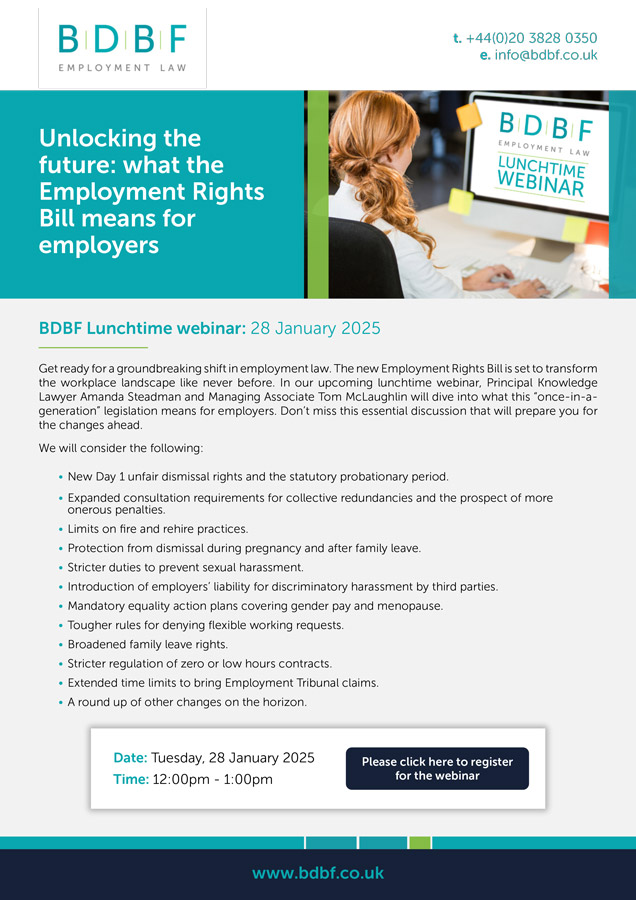
LUNCHTIME WEBINAR – Unlocking the future: what the Employment Rights Bill means for employers

LUNCHTIME WEBINAR – 28 January 2025

Get ready for a groundbreaking shift in employment law. The new Employment Rights Bill is set to transform the workplace landscape like never before. In our upcoming lunchtime webinar, Principal Knowledge Lawyer Amanda Steadman and Managing Associate Tom McLaughlin will dive into what this “once-in-a-generation” legislation means for employers. Don’t miss this essential discussion that will prepare you for the changes ahead.

We will consider the following:

  • New Day 1 unfair dismissal rights and the statutory probationary period.
  • Expanded consultation requirements for collective redundancies and the prospect of more onerous penalties.
  • Limits on fire and rehire practices.
  • Protection from dismissal during pregnancy and after family leave.
  • Stricter duties to prevent sexual harassment.
  • Introduction of employers’ liability for discriminatory harassment by third parties.
  • Mandatory equality action plans covering gender pay and menopause.
  • Tougher rules for denying flexible working requests.
  • Broadened family leave rights.
  • Stricter regulation of zero or low hours contracts.
  • Extended time limits to bring Employment Tribunal claims.
  • A round up of other changes on the horizon.

Date: Tuesday, 28 January 2025

Time: 12.00pm-1.00pm


Click here to register


Consultation on expanding the remedies for breaches of collective redundancy and fire and rehire laws

On 21 October 2024 the Department for Business and Trade opened a consultation on proposals for further reforms to the rules on collective redundancy consultation and fire and rehire (the Consultation). The Consultation will run for just six weeks, closing on 2 December 2024. In this briefing, we explain what is proposed and what it means for employers.

Collective redundancy consultation

What is the current position and how will the Employment Rights Bill change things?

Currently, collective redundancy consultation is triggered where there is a proposal to dismiss as redundant 20 or more employees assigned to one “establishment” within a 90-day period. Where 20 to 99 redundancies are proposed, the consultation must begin at least 30 days before the first dismissal. Where 100 or more redundancies are proposed, the consultation must begin at least 45 days before the first dismissal. The question of what counts as an “establishment” has been ventilated in litigation – with the courts concluding that it means the local unit where the employee works, not the business overall.

A failure to comply with these obligations may lead to a “protective award” of a sum not exceeding 90 days’ gross actual pay per employee. This award is intended to penalise the employer and disincentivise breaching the rules. The amount of the award is determined by the Employment Tribunal according to what is just and equitable but, in a nutshell, the worse the breach, the higher the protective award and vice versa.

The Employment Rights Bill proposes to change the law to trigger collective consultation where there are 20 or more proposed redundancies within 90 days across the business overall rather than in just one workplace. This would mean that collective consultation would be triggered more frequently as redundancy numbers would need to be counted across the whole business, even where the redundancies are unrelated. The Government has said that this change will mean that more employees will benefit from collective consultation, including those who are not assigned to a local unit and work remotely.

What is proposed in the Consultation?

The Consultation does not revisit the Bill proposal, but, rather, seeks views on strengthening the remedies available for breaches of the rules.

Raising the protective award

Firstly, the Consultation asks whether the maximum period of the protective award should be raised from 90 days, in an effort to tackle the problem of employers flouting the rules and “buying out” potential claims in settlement agreements. The Government says that an absence of consultation removes the chance to prevent or reduce the volume of redundancies needed. The consultation proposes two options: doubling the cap to 180 days’ gross actual pay or removing the cap altogether. In either case, the Tribunal would retain discretion as to the length of the protected award, based on what it determines to be just and equitable in light of the severity of the employer’s breach. However, any increased period would not apply to insolvent firms, where the award is paid by the Insolvency Service and is capped at 8 weeks’ pay.

Introducing the remedy of interim relief

Secondly, the Consultation asks whether the remedy of interim relief should be made available to affected workers. Interim relief is a remedy available in a limited number of automatic unfair dismissal claims (e.g. dismissal for having made a protected disclosure). In such cases, the dismissed employee may be able to apply to the Employment Tribunal for interim relief within seven days of the date of termination of employment. If granted, the Employment Tribunal will order the employer to reinstate the claimant to their previous role or re-engage them in a different role pending the determination of the unfair dismissal claim at the final hearing. If the employer is willing to reinstate or re-engage the claimant then they go back to work.

Where (much more commonly) the employer is not willing, the Tribunal will make a “continuation order”, meaning the employer is ordered to pay the claimant as if their employment contract was still continuing, until the final hearing. Sums paid under a continuation order are irrecoverable. This means that a claimant does not have to repay the salary paid even if they ultimately lose their claim at the final hearing. This makes interim relief a potentially very valuable remedy for claimants, and a burdensome one for employers. The Consultation says that extending the remedy of interim relief to employees who have protective award claims would be an additional deterrent to employers against abuse of the collective consultation rules.

Fire and rehire

What is the current position and how will the Employment Rights Bill change things?

“Fire and rehire” is a shorthand used to describe the practice of dismissing an employee then offering to re-engage them on inferior terms and conditions. Currently, this practice is lawful provided that the employer has a good business reason for needing to make change. Since 18 July 2024, employers have also been required to comply with a new statutory Code of Practice on dismissal and re-engagement. A failure to do so may give rise to an uplift to compensation of up to 25% in certain related claims. Further, where over 20 employees are affected in a 90-day period at one establishment, the employer must also undertake collective consultation.

The Employment Rights Bill will change the law so that it will be automatically unfair to dismiss an employee:

  • for not agreeing to change their terms and conditions of employment; or
  • in order to rehire them (or hire someone else) under varied terms and conditions for substantially the same role.


The sole exception will be where the reason for the variation was to eliminate, prevent or significantly reduce or mitigate the effect of any financial difficulties which, at the time of the dismissal, were affecting, or were likely in the immediate future to affect, the employer’s ability to carry on its business, and there was no way the need to make the variation could reasonably have been avoided.

What is proposed in the Consultation?

Again, the Consultation does not revisit the Bill proposal, but seeks views on strengthening the remedies available for breaches of the rules. The Consultation asks whether the remedy of interim relief (as discussed above) should be extended to employees who have fire and rehire-related automatic unfair dismissal claims. The Government believes that permitting interim relief in this situation would lead to greater protection of employees and further disincentivise employers from using fire and rehire at all.

Interestingly, the Consultation goes on to say that the Government is considering whether, in fire and rehire cases, adjustments are needed to the interim relief process to ensure that the remedy can work effectively and be determined promptly. Given that the window for applying for interim relief is extremely short (seven days from dismissal), this suggests that the extra time may be afforded in fire and rehire-related cases.

What do these proposals mean for employers?

The Government is satisfied that employers who “play by the rules” will not be subject to any additional burden as a result of these changes. Only those who flout the rules could end up paying significantly more. However, a steep increase to the protective award is likely to deter employers from buying out such claims and force their hand to undertake consultation of either 30 or 45 days instead – which appears to be the aim behind this measure. Indeed, if the cap is removed altogether, it may be impossible to even agree the level at which the claim could be bought out. The Consultation does recognise that removing the cap altogether “could cause uncertainty” for business, which may indicate that the Government is leaning towards a cap of 180 days.

Extending the remedy of interim relief to claimants who have protective award claims or fire and rehire dismissal claims clearly raises the stakes for employers. Breaching the rules in either case would carry not only the risk of a Tribunal award at the end of the litigation but would also present the immediate risk of paying salary until the final hearing, which may be many months away. That said, the threshold for granting interim relief is high – a claimant must show that they have a “pretty good chance” of winning their claim. In whistleblowing claims, this is not straightforward: the claimant has the uphill battle of showing that they are a worker, that they have made a protected disclosure and that protected disclosure was the sole or principal reason for the dismissal. The result is that interim relief is rarely granted.

However, in a protective award claim, it will usually be clear whether the collective consultation rules have been breached. If breached, even in a minor way (e.g. the consultation fell a day short of the minimum period before the first dismissal), surely it could be said that the claimant has “a pretty good chance” of succeeding in their protective award claim? Although any protective award ultimately awarded might be adjusted downwards by the Tribunal to reflect the minor nature of the breach, it is not clear that the severity of the breach would be relevant to a decision to grant interim relief. As such, in cases of minor breaches, the threat of interim relief will be viewed as a more powerful weapon than the protective award claim itself. It also fast-tracks the case to an early public hearing.

If taken forward, these proposals will raise the stakes in collective consultation exercises (which will occur more frequently as a result of the Employment Rights Bill change). The majority of employers will be forced to undertake consultation and manage it with care to avoid the risk of claims and interim relief applications. Legal advice is likely to be needed to avoid inadvertent and costly errors. Similarly, introducing interim relief on top of a new right to claim automatic unfair dismissal in fire and rehire scenarios will make such dismissals more hazardous for employers. Employers wishing to respond to the consultation have until 2 December 2024 to do so.

Consultation on strengthening remedies against abuse of rules on collective redundancy and fire and rehire

BDBF is a law firm based at Bank in the City of London specialising in employment law. If you would like to discuss any issues relating to the content of this article, please contact Principal Knowledge Lawyer Amanda Steadman (amandasteadman@bdbf.co.uk) or your usual BDBF contact.


An at-a-glance guide to the Employment Rights Bill

On 10 October 2024, the Government published the Employment Rights Bill (the Bill), which will take forward many of its proposals for workplace reform. Running to more than 150 pages, the Bill puts forward a vast array of reforms affecting the workplace, including dismissals, equality law, family-friendly rights, contracts and pay, trade unions and industrial action and labour market enforcement.

Alongside the Bill, a policy paper entitled Next Steps to Make Work Pay was published setting out how the Government intended to deliver on its manifesto commitments through the Bill and also by way of wider reforms outside the Bill.

You can get up to speed with the key provisions of the Bill and what else lies ahead using our at-a-glance guide below.

Day 1 unfair dismissal rights

Abolition of the two-year qualifying service requirement

Currently, an employee must have two years’ continuous service with their employer in order to bring a claim of ordinary unfair dismissal in an Employment Tribunal.  There is a limited exception to this rule, where it is shown that the dismissal was for an “automatically unfair” reason, such as for having made a protected disclosure.  In such cases, the employee is able to claim automatic unfair dismissal from Day 1 of their employment.  However, where there are no such aggravating factors, an employer is able to dismiss an employee with under two years’ service relatively easily.  There is no need to identify a fair reason for the dismissal and nor does the employer need to show it acted reasonably.

The Bill proposes to remove the two-year qualifying period for ordinary unfair dismissal claims, converting it to a Day 1 employment right.  To complement the abolition of the qualifying period, a new provision will be introduced preventing employees who have not yet started work from claiming unfair dismissal.  However, if the reason for dismissal is automatically unfair, relates to the employee’s political opinions or affiliations, or is connected to their membership of a reserve force, then an employee who has not even started work will be able to claim unfair dismissal.

Special rules for new employees

There has been much speculation in the press about whether the Bill will make it simpler to dismiss employees during a probationary period.  Importantly, the Bill provides that regulations may be introduced which will “modify” the standard of reasonableness that must be met to dismiss fairly during the “initial period of employment”.  The initial period of employment is not specified in the Bill (this will be dealt with in the regulations) however, the Government has signalled its preference for this period to be set at nine months.   In practice, this will be longer than most contractual probationary periods operated by employers, which generally sit at between three to six months. 

Exactly how the test will be modified remains to be seen.  Currently, employers must show that they have acted reasonably in treating the reason as sufficient to dismiss, viewed in light of the size and resources of the employer.  In many cases, this requires the employer to comply with the steps set out in the statutory Acas Code of Practice on Disciplinary and Grievance procedures.  In Next Steps to Make Work Pay it is suggested that, at the very least, the modified test will require employers to meet with employees to discuss proposed dismissals during an initial period of employment. 

All of which will provide some reassurance for employers, however, there are some important limitations to note.

First, the modified test will only apply where the reason for dismissal is capability, conduct, illegality or some other substantial reason (SOSR) “relating to the employee”.  It will not apply to redundancy dismissals during the probationary period, and nor does it seem to apply to SOSR dismissals which do not relate the employee.  Where the dismissal is by reason of redundancy (or SOSR which does not relate to the employee), the existing reasonableness test will apply i.e. that the employer has acted reasonably in treating the reason as sufficient to dismiss, viewed in light of the size and resources of the employer.  

Second, the modified test will only apply where the dismissal takes effect on or before the last day of the initial period of employment, or where the employer gives notice to terminate before the end of the initial period of employment and the dismissal takes effect within three months of the end of the that period. 

What will these changes mean for employers in practice? 

  • The abolition of the qualifying period is certain to generate more grievances and Employment Tribunal claims, some of which will be justified and some not. But all of them will take time and money to deal with.  Certainly, employers will wish to be more cautious when it comes to recruitment so as to limit the risk of a bad hire.  And after recruitment, line managers will need to actively manage probationary periods to ensure that any performance or conduct issues are identified and dealt with at an early stage.
  • Making it simpler to dismiss new employees takes some of the sting out of this reform for employers. However, care must be taken to diarise the relevant dates and ensure that notice to terminate is given before the end of the initial period of employment (which is expected to be nine months).  And in cases where the employee has a notice period in excess of three months, that notice must be given earlier so as to ensure that the termination date falls within three months of the end of the initial period.  A failure to do so may mean that the employer inadvertently falls outside the modified test, making a finding of unfair dismissal more likely. 
  • It is also important to remember that it is not the case that new employees can never bring an unfair dismissal claim. Although the modified test will make it easier to dismiss them, employers will still be required to do something.  Short circuiting those modified requirements could open the door to an unfair dismissal claim.  When it comes to redundancy dismissals, employers must remember that the current test of reasonableness will apply.  This means that in all redundancy dismissals employers will need to warn and consult with employees, adopt a fair basis on which to select employees for redundancy and consider suitable alternative vacancies (and, if applicable, collectively consult).  Further, the reforms do not affect an employee’s right to claim automatic unfair dismissal from Day 1 of their employment.
  • The interplay between an employer’s probationary period and the initial period of employment will need to be considered. Employers do not necessarily need to increase their contractual probationary periods in line with the initial period.  On the face of it, there is nothing to prevent an employer dismissing an employee who has already passed their probationary period during the initial period of employment and relying on the modified test.  For example, an employee could pass a probationary period of three months, after which time their conduct or performance declined, or a one-off serious act of misconduct or negligence occurred.  In those circumstances, the fact that the employee has passed their probationary period should not make any difference.  That said, some employers may wish to consider aligning probationary periods with the initial period of employment.
  • Is there any upside for employers in making ordinary unfair dismissal a Day 1 employment right? Conceivably, it could lead to some reduction in claims for automatic unfair dismissal (such as whistleblowing claims) and discriminatory dismissal claims, which are currently the only statutory claims that employees with under two years’ service can bring about their dismissal.  A decline in those types of claims could be a good thing for employers, not least from a reputational perspective and because the cost and complexity of defending those types of claims is higher.  However, compensation is uncapped for certain automatic unfair dismissal claims and for discriminatory dismissal claims, meaning there is still an incentive for claimants to bring such claims.  Therefore, in terms of impact on claims, the most likely outcome is that claimants with automatic unfair dismissal or discriminatory dismissal claims (especially if higher paid) will continue to bring those claims but will plead ordinary unfair dismissal as an alternative claim.
     

What are the next steps?

The Bill has just started its passage through Parliament, which will take time.  Even when passed, the various dismissal provisions will not come in straight away.  Indeed, in the context of unfair dismissal alone, the Government has said it will consult on:

  • the length of the initial period of employment for the purposes of unfair dismissal;
  • how the initial period of employment interacts with the Acas Code of Practice on Disciplinary and Grievance procedures; and
  • the appropriate compensation regime for dismissal during the initial period of employment;

Regulations will also be needed in relation to the modified unfair dismissal test.

Next Steps to Make Work Pay states that the unfair dismissal reforms will take effect “no sooner than Autumn 2026”.

Dismissal during pregnancy and following a period of statutory family leave

The Bill provides that regulations may be introduced which will provide enhanced protection from dismissal during pregnancy and following return from maternity leave, adoption leave or shared parental leave (it will also apply to return from certain other forms of leave which are not yet in force and so are not discussed in this briefing).  It is not known how long the protection will apply following the return from family leave, however, the Government has previously suggested it will be six months. No further details of this proposal are given in the Bill or the Explanatory Notes to the Bill. 

What will these changes mean for employers in practice?   

  • We must await the publication of the related regulations to understand the full extent of this proposal. However, it seems likely that the intention is to restrict the circumstances in which an employer may dismiss a pregnant employee or family leave returner fairly. 
  • It is already unlawful to dismiss an employee because of her pregnancy or maternity leave (or for a reason related to it), by reason of redundancy during pregnancy or following the return from maternity leave, adoption leave or shared parental leave where there was a suitable alternative vacancy available. Therefore, this proposal appears to go further and suggests that even if there is a non-discriminatory and fair reason for dismissal, the dismissal would be unlawful, subject to some exceptions.  Common sense would suggest that the exceptions must, at least, permit dismissal for gross misconduct, gross negligence or illegality or also where there is a large-scale redundancy such as where the whole business is closing down.  


What are the next steps?

The Bill has just started its passage through Parliament, which will take time.  Even when passed, the various dismissal provisions will not come in straight away.  Regulations will be needed in relation to the restriction of dismissals during pregnancy and following the return from family leave. 

Next Steps to Make Work Pay states that the majority of the Bill’s reforms will not come into force until 2026.

Dismissal for failing to agree a variation to a contract

“Fire and rehire” is a shorthand used to describe the practice of dismissing an employee then offering to re-engage them on inferior terms and conditions.   Before the election, the Labour Party had talked about wanting to end fire and rehire practices altogether.  This was slightly watered down during the General Election, with a promise to end the practice, save in exceptional circumstances.

The Bill delivers on that promise and proposes that it will be automatically unfair to dismiss an employee:

  • for failing to agree to a change to their terms and conditions of employment; or
  • in order to re-engage them (or someone else) under varied terms and conditions of employment, but where the role is otherwise substantially the same.

The sole exception will be where the reason for the variation was to eliminate, prevent or significantly reduce or mitigate the effect of any financial difficulties which, at the time of the dismissal, were affecting, or were likely in the immediate future to affect, the employer’s ability to carry on its business, and there was no way the need to make the variation could reasonably have been avoided. 

However, even where the exception does apply, the dismissal could still be ordinarily unfair, even if not automatically unfair.  The Bill provides that in such cases various matters must be taken into account by an Employment Tribunal when determining whether the dismissal is fair or not, including any consultation with the employee and any trade union or employee representatives about the proposed variation and anything offered to the employee in exchange for agreeing to the variation.

What will these changes mean for employers in practice? 

  • It will be much riskier for employers to impose contract variations on employees by way of fire and rehire practices. Nor can employers escape the risk of automatic unfair dismissal by simply “firing” in these circumstances and not offering to rehire.  This is not to say that it will never be right to deploy fire and rehire practices – the practice may still be used but it carries a high risk of Tribunal claims.  However, it is possible that the employee may relent and agree to be rehired on the varied terms.  If the employee does not go on to bring a claim in time, the employer will have achieved its aim.
     
  • Once this change comes into force, the current statutory Code of Practice on dismissal and re-engagement (which came into force on 18 July 2024) will need to be replaced. As it stands, that Code prescribes the process to be followed by employers before dismissing and offering to re-engage in any circumstances.  A breach of that process does not give rise to a legal claim in itself but may lead to an uplift of 25% to any compensation awarded in related claims.  

What are the next steps?

The Bill has just started its passage through Parliament, which will take time.  Even when passed, the various dismissal provisions will not come in straight away.  Indeed, on 21 October 2024, the Government opened a consultation on what role interim relief could play in protecting employees in fire and rehire situations.  The consultation closes on 2 December 2024.

Next Steps to Make Work Pay states that the majority of the Bill’s reforms will not come into force until 2026.

Collective redundancies

Currently, collective redundancy consultation is triggered where there is a proposal to dismiss as redundant 20 or more employees assigned to one “establishment” within a 90-day period.  The question of what an “establishment” has been ventilated in litigation – with employees arguing it should mean the business as a whole rather than the local place of work.  This would mean that collective consultation would be triggered more frequently as redundancy numbers would have to be counted across the whole business.  After some to-ing and fro-ing the senior courts concluded that “establishment” meant the local unit where the employee works, not the business as a whole.

The Bill proposes to reverse this, so that collective consultation is triggered where there are 20 proposed redundancies within 90 days across the business rather than in just one workplace. 

What will this change mean for employers in practice? 

  • Collective consultation will be triggered more frequently and multi-site employers will need to have a system in place to ensure that they keep track of proposed redundancies across the whole business.
  • The process will be administratively more burdensome as employers will need to have appropriate representatives in place for all affected employees no matter where they are based.
  • The consultation itself will potentially be cumbersome and disjointed as employers may be consulting about several small pockets of unrelated redundancies.
  • Getting it wrong will be costly: employees may claim a “protective award” which is currently capped at 90 days’ gross actual pay.


What are the next steps?

 The Bill has just started its passage through Parliament, which will take time.  Even when passed, the various dismissal provisions will not come in straight away.  On 21 October 2024, the Government opened a consultation on: (i) increasing the maximum protective award from 90 to 180 days (or having no upper limit at all) where an employer is found to not have properly followed a collective redundancy process; and (ii) what role interim relief could play in protecting employees who have protective award claims.  The consultation closes on 2 December 2024.

Next Steps to Make Work Pay states that the majority of the Bill’s reforms will not come into force until 2026.

Sexual harassment

From 26 October 2024, all employers were obliged to take reasonable steps to prevent sexual harassment at work.  Where this duty is breached, an uplift of 25% may be applied to compensation in relevant claims, and the Equality and Human Rights Commission (the EHRC) will have the power to investigate and take enforcement action.  Initially, the plan was for this duty to require employers to take all reasonable steps, however, the word “all” was eventually dropped on the basis that it would be too onerous for employers.  You can find out more about the duty in our recent webinar here.

The Bill provides that the word “all” will be reintroduced, meaning that employers will be required to take every possible reasonable step to prevent sexual harassment, or risk a compensation uplift and EHRC action.  Separately, the Bill provides that regulations may be introduced specifying the steps that are to be regarded as reasonable for the purposes of both the new duty to prevent sexual harassment and the existing reasonable steps defence.  The Bill states that this may include steps such as carrying out risk assessments, publishing plans or policies, and steps relating to the reporting and handling of complaints.  Currently, the recommended steps to prevent sexual harassment are set out in the EHRC’s non-statutory Technical Guidance on Sexual Harassment and Harassment at Work and its 8-step Guide to Preventing Sexual Harassment at Work.

In addition, the Bill provides that disclosures about actual or likely sexual harassment will be listed as one of the types of malpractice about which a whistleblowing disclosure may be made. 

What will these changes mean for employers in practice? 

  • It will be harder for employers to discharge the duty to prevent sexual harassment once it has been enhanced in this way. In particular, a lot will be expected from large and well-resourced employers and from employers where sexual harassment is especially prevalent.   That said, the proposal to set out a list of reasonable steps in regulations will be helpful in that it gives employers legal certainty about the steps required.
  • Although it will be some time before these changes to come into force (the Government has suggested not until 2026), employers would be wise to begin working towards taking all reasonable steps now. Not only will this help employers be ready for the raised requirement in good time, it opens up the possibility of pleading the “all reasonable steps defence” in relevant sexual harassment claims.
  • We are likely to see an increase in employers pleading the “all reasonable steps defence” in relevant cases. Given that the work that will have gone in to take steps to discharge the duty, employers are likely to want the added benefit of avoiding liability for a sexual harassment claim. 
  • Making it clear that disclosures about sexual harassment may amount to whistleblowing disclosures is helpful, although arguably unnecessary. The Tribunals have already made it clear that disclosures about sexual harassment are capable of amounting to whistleblowing disclosures, since they represent breaches of the Equality Act 2010 (see for example Mysakowski v Broxborn Bottlers Ltd).  Nonetheless, it is a helpful sign to those wishing to report sexual harassment that they may be protected as whistleblowers.

What are the next steps?

The Bill has just started its passage through Parliament, which will take time.  Even when passed, the various equality provisions will not come in straight away.   For example, regulations are needed for the reforms to the duty to prevent sexual harassment. 

Next Steps to Make Work Pay states that the majority of the Bill’s reforms will not come into force until 2026.

Discriminatory harassment by third parties

Until October 2013, the Equality Act 2010 contained provisions making employers liable for harassment of staff by third parties, albeit that liability only arose where the worker had been harassed more than once.  These provisions were repealed by the Coalition Government on 1 October 2013, with the result that it became much more difficult for workers to bring claims against their employer where they had been harassed by a third party.  Currently, the only way in which an employer attracts liability is in respect of its own actions. 

The Bill will reintroduce employer’s liability for third party harassment.  Importantly, this will extend to harassment for all protected characteristics under the Equality Act, not just sexual harassment, and liability will arise from the first instance of harassment.  For example if a shopworker was racially abused by a customer, the employer would potentially be liable.  However, employers will be able to avoid liability where they can show they took “all reasonable steps” to prevent the harassment. 

What will these changes mean for employers in practice? 

  • The reintroduction of liability for third party harassment is one of the most important reforms in the Bill, significantly widening an employer’s exposure to claims of discriminatory harassment. For employers operating in sectors where staff frequently come into contact with third parties (such as the transport, retail and hospitality sectors), that risk is heightened further.  While the “all reasonable steps” defence remains open to an employer to defend such a claim, it will be an onerous task to discharge every possible reasonable step and many employers are likely to fall short.  For this reason, employers may wish to begin work on scoping out how it might meet this standard sooner rather than later. 
  • As far as sexual harassment is concerned, employers who are found liable for third party sexual harassment may also face the prospect of an uplift to compensation of up to 25%. A Tribunal may award this where it finds that the employer has breached the duty to prevent sexual harassment.

What are the next steps?

The Bill has just started its passage through Parliament, which will take time.  Even when passed, the various equality provisions will not come in straight away.  And it is likely that there will be consultations on this proposal. 

Next Steps to Make Work Pay states that the majority of the Bill’s reforms will not come into force until 2026.

Gender pay gap reporting and the menopause

Currently, employers with 250 or more employees are required to publish gender pay information on an annual basis.  However, in-scope employers must report their pay gap figures and nothing else – they are not required to explain the figures nor how they intend to close their gender pay gap (and, in fact, they are not required to close it all).  The hope was simply that “what gets measured gets managed” and reporting alone would drive employers to take steps to close their gaps.  However, progress in closing gender pay gaps remains slow.

The Bill provides that regulations may be published requiring employers with 250 or more employees to develop and publish “equality actions plans” on an annual basis.  The equality actions plans must set out the steps the employer is taking in relation to addressing its gender pay gap and to supporting employees going through the menopause.  The action plan will have to meet the minimum standards to be set out in regulations.   There will be consequences for failure to comply, but, again, this will be dealt with in regulations.

Further, when reporting their gender pay gaps, employers will be required to set out the identity of any person it contracts with for the supply of outsourced workers.   Such workers are not employees of the employer and, therefore, do not need to be included in the gender pay gap figures.   It seems that the intention here is to allow a fuller understanding of an organisation’s gender pay gap.  For example, if an organisation’s outsourced roles were typically fulfilled by low-paid female workers, this would have the effect of improving the gender pay gap figures since this pay data would not need to be factored in.

What will these changes mean for employers in practice? 

  • Gender pay gap reporting will become more onerous for in-scope employers. Although some employers already publish sophisticated narratives and actions plans, many do not.  All will need to publish an annual plan setting out what action is being taken to close the gap.   A failure to do so will have consequences, but what is not clear is whether there will be consequences for publishing a compliant plan and then not implementing it, or attempting to implement it but failing to make a dent in the gender pay gap.
  • The Government had promised to introduce both ethnicity and disability pay reporting which would mirror the gender pay gap reporting regime. These proposals are not included in the Bill.  However, in Next Steps to Make Work Pay it is stated that this commitment will be delivered via the Equality (Race and Disability) Bill.  The Government says it will begin consulting on that in due course, with a draft Bill to be published during this Parliamentary session for pre-legislative scrutiny. Further consultation will also take place prior to the making of regulations implementing these reforms.  In other words, it is going to be some time before either of these promises come to pass.
  • The forthcoming requirement to publish information about the steps taken to support menopausal workers means employers will need to give thought to what it is able to say in this regard. Some employers are well advanced in terms of support offered.  Others will need to start work on providing appropriate support measures in order to be able to populate the action plan.  That said, most employers will already have some things to say here, for example, the provision of flexible working options and relevant benefits such as discounted gym memberships or employee assistance programmes.   However, more is likely to be needed.

What are the next steps?

The Bill has just started its passage through Parliament, which will take time.  Even when passed, the various equality provisions will not come in straight away.   For example, regulations are needed for the reforms to the gender pay gap reporting regime.  Separately, the Government also says it will produce new menopause guidance for employers. 

Next Steps to Make Work Pay states that the majority of the Bill’s reforms will not come into force until 2026.

Flexible working

Currently, employers may refuse flexible working requests where they consider that at least one of eight grounds specified in the Employment Rights Act 1996 (the ERA) applies.  This includes things like the burden of additional costs, an inability to reorganise work among existing staff or detrimental impact on quality or performance.  Importantly, this is a subjective test.  In other words, as long as an employer considers that one of the eight grounds applies, and that view is based on correct facts, that is a sound basis upon which to reject a request.  Employees are unable to challenge the decision on the basis that they feel the decision was an unreasonable one (albeit they may be able raise other claims such as automatic unfair dismissal or indirect sex discrimination).

The Bill proposes that the law is changed to require an employer’s refusal of a request to be based on one of the existing eight grounds and be an objectively reasonable one.  Further, when refusing a request, the employer must notify the employee of the ground for refusing the request and explain why it considers that it is reasonable to refuse the application on that ground.   Where an employer’s decision is not reasonable, or where it fails to explain this to the employee, the employee will be able to complain to an Employment Tribunal.

There is one further small change.  From 6 April 2024, employers have been required to consult with employees before refusing a request. The Bill provides that, in future, regulations may be issued setting out the precise steps that an employer must take in order to comply with this consultation requirement. 

What will these changes mean for employers in practice? 

  • We think that employers are going to have to go further to be able to justify the ground or grounds for refusal. For example, if a request is refused on the basis of an inability to reorganise work among existing staff or recruit additional staff, and the employer has not consulted with existing staff about the possibility of doing so or attempted to recruit additional staff, it is likely that a refusal on such grounds would be unreasonable.  Or where a request was to be refused on the basis of detrimental impact on quality or performance, again, the question will be: what is the evidence for this view?  Unless there is some historical evidence (e.g. if an employee has worked the same or similar pattern in the past and it was unsuccessful), it is likely that an employer would need to allow a trial period of the proposed working pattern for a reasonable period of time in order to assess whether there was, in fact, such a detrimental impact.  The end result is that more requests are likely to be accepted.
  • Where an employer breaches the rules governing flexible working requests, an employee may complain to an Employment Tribunal. The Tribunal may order the employer to pay compensation of up to eight weeks’ pay (currently capped at £700 per week) and require the employer to reconsider the application.  Where an employer’s refusal is found to have been unreasonable, we can expect Tribunals to more readily order employers to reconsider requests. 
  • Further, if a refusal is unreasonable, this could assist the employee in other potential claims. For example, if an employer has adopted an unreasonable position this may be sufficient to amount to a repudiatory breach of contract, justifying constructive dismissal.  Indeed, in the recent case of Johnson v Bronzeshield Lifting Ltd, a Tribunal held that an employer’s failure to take into account relevant information before refusing a flexible working request was a repudiatory breach.  This was on the basis that the hours that an employee works has a major impact on their lives, and it also matters how flexible working applications are dealt with – the outcome is not the only thing of importance.  It is not a stretch to see that a Tribunal could reach a similar decision where a request has been refused unreasonably.
  • It looks like specific rules are on the way governing the form of consultation needed before refusing a request. The existing statutory Acas Code of Practice on requests for flexible working sets out recommendations on the scope of such consultation.  The Code suggests gathering all relevant information, holding a meeting with the employee to discuss the request and considering alternatives if needed.  A written record of the meeting should be kept, and a right of appeal is also recommended.   A failure to follow the Code does not give rise to a claim but Tribunals will take it into account when considering relevant cases.  Therefore, we think it is likely that the Code’s provisions on consultation will be elevated into law.
  • In due course, employers will need to update policies and practices to reflect the new rules on refusing requests.

What are the next steps?

The Bill has just started its passage through Parliament, which will take time.  Even when passed, the family-friendly provisions will not come in straight away; regulations will be needed to bring them into force.  The Government may also consult on certain aspects of the proposals.  Indeed, it has said that it is important to take into account a range of views and it will develop the detail of the approach “…in consultation and partnership with business, trade unions and third sector bodies”. 

Next Steps to Make Work Pay states that the majority of the Bill’s reforms will not come into force until 2026.

Family leave rights

There are three proposed areas of change in the field of family leave rights.

Unpaid parental leave

Currently, employees with one year’s service have a right to take up to four weeks’ unpaid parental leave per year in respect of children under the age of 18 (up to a maximum of 18 weeks’ leave in total). 

The Bill proposes to remove the service requirement and make unpaid parental leave a Day 1 employment right. 

Paternity leave

Currently, employees with 26 weeks’ service ending with the week immediately before the 14th week before the expected week of childbirth (or the week in which an adopter is notified of a match) have a right to take up to two weeks’ paternity leave.  The same service requirement applies in respect of eligibility for statutory paternity pay. 

The Bill proposes to remove the service requirement for paternity leave, making it a Day 1 employment right.  However, the Bill is silent on whether the service requirement will be lifted for statutory paternity pay, which suggests that it will remain.

Further, currently, where an employee is entitled to paternity leave and pay and shared parental leave and pay, the paternity leave and pay must be taken before the shared parental leave and pay.  If the employee takes the shared parental leave and pay first, they lose their entitlement to paternity leave and pay.  The Bill proposes to remove this restriction, meaning that employees may take shared parental leave and pay first if they wish and retain their entitlement to paternity leave and pay.

Bereavement leave

Currently, employees have a Day 1 employment right to take two weeks’ bereavement leave if a child under the age of 18 dies (and those with 26 weeks’ service ending with the week before the child died are also entitled to receive statutory parental bereavement pay).  Employees taking parental bereavement leave are also protected from detriment and dismissal.  However, there is no general right to take bereavement leave outside of this, for example when a spouse, parent or sibling dies.  Of course, many employers do permit compassionate leave in such circumstances, but there is no legal requirement to do so.

The Bill proposes amending the parental bereavement leave rules (which are set out in the ERA) to turn “parental bereavement leave” into “bereavement leave”, although some special rules will still apply where a child dies.  Regulations will specify the relationships which will entitle an employee to take bereavement leave, however, we can expect it to cover most close relationships such as a spouse, civil partner, other life partner, grandchild, parent, sibling or grandparent. The Bill says that the bereavement leave entitlement must be not less than one week, however, the leave entitlement will stay at two weeks where a child has died.   It appears from the drafting of the Bill that the leave will be unpaid, save that statutory pay will remain available where a child dies.  

What will these changes mean for employers in practice? 

  • The removal of the service requirements for unpaid parental leave and paternity leave will mean that a larger cohort of employees will become eligible to take these forms of leave. The result is that employers will have to manage a higher number of these types absences than is currently the case.  In due course, employers will need to adjust relevant policies to reflect the wider scope.
  • Many employers already offer paid bereavement leave but the new statutory right will introduce rules around how such leave is managed and provide protections for those taking the leave. Employers will need to revise their bereavement leave policy in due course and will also need to consider whether to enhance the right and offer paid leave.

What are the next steps?

The Bill has just started its passage through Parliament, which will take time.  Even when passed, the family-friendly provisions will not come in straight away; regulations will be needed to bring them into force.  The Government may also consult on certain aspects of the proposals. 

Separately, the Government acknowledges that some reforms will take longer to implement, including a full review of the entire parental leave framework and a review of the benefits of introducing paid carer’s leave.  No specific time frame for these reviews is given.

Next Steps to Make Work Pay states that the majority of the Bill’s reforms will not come into force until 2026.

Zero and low hours contracts

A zero hours contract is one where the employer does not guarantee any number of hours of work, but the worker is obliged to accept work whenever it is offered, without any certainty of how much work there will be or when.  Sometimes the contracts are less onerous, and the worker is permitted to reject the work offered if they wish.  A low hours contract is similar, save the employer will guarantee some hours of work, but it will be at the employer’s discretion as to when the work is performed.  Before the election, the Labour Party promised to ban “exploitative” zero hours contracts.

Importantly, the Bill does not go as far as banning zero (or low) hours contracts.  Instead, it introduces two key changes, which will restrict the use of such contracts and penalise employers who abuse them.

First, zero and low hours workers who have worked a certain number of hours regularly over a “reference period” will have a new statutory right to have those hours guaranteed in their contract.  The meaning of low hours worker will be defined in regulations, as will the qualifying number of hours to be worked and the reference period (Next Steps to Make Work Pay talks of a possible 12-week reference period).  The rules governing this new right are extremely complex, but, in summary, require that at the end of each reference period, the employer must make a guaranteed hours offer to any worker within scope.  That offer must meet certain minimum requirements set out in the Bill (and to be further set out in regulations), including that it must set out the proposed working days and hours (or specific working pattern) which must reflect the working hours over the reference period.  Further, in most cases, the terms of the offer may not be less favourable to the worker, for example, making an offer on a lower rate of pay.  A failure to make the offer, or making one incorrectly, will give rise to an Employment Tribunal claim for which compensation may be awarded. 

Second, employers will be required to give zero and low workers (and any other worker who does not have a set working pattern), reasonable notice of shifts and changes to shift, with a right to compensation where late notice is given.   Again, the rules are extremely complex.  In a nutshell, they require employers to give affected workers reasonable notice of a shift that the employer wants or requires the worker to work, specifying the day, time and hours to be worked.  Similarly, they must give notice of any change to, of cancellation of, a shift.  Regulations will set out the minimum amount of notice that must be given.  Where an employer cancels, moves or curtails a shift at short notice, it must make a payment of a specified amount to the worker.  Regulations will set out how much that payment must be.  A breach of any of the notice or payment requirements will give rise to an Employment Tribunal claim for which compensation may be awarded. 

What will these changes mean for employers in practice?

  • These changes do not make zero or low hours contracts unlawful, but they will make them considerably more difficult for employers to manage and introduce risks for getting it wrong. The requirement to monitor working hours within a reference period on a rolling basis will be administratively cumbersome, particularly where an employer has multiple zero or low hours workers.  Similarly, the employer is required to make repeated offers of guaranteed hours contracts at the end of each reference period.  The drafting of the Bill suggests that these offers must continue to be made even where a worker has made it clear that their preference is to remain on a zero or low hours contract.  Could one unintended consequence of the Bill be that workers who genuinely prefer to work on a zero or low hours basis feel pressured to accept a guaranteed hours contract by virtue of the repeated offers from their employer?
  • As far as giving notice of shifts and changes to, or cancellation of, shifts are concerned, it remains to be seen what the minimum notice required will be. If it is generous, this raises the risk of employers tripping up on the notice requirements, meaning they will be liable to make a specified payment to the worker and leave themselves open to an Employment Tribunal claim (which given the levels of public interest in these proposals would be likely to spark high levels of media coverage). 
  • All in all, employers may feel the benefit of a flexible workforce is not worth the potential cost and lead to a move away from the use of zero and low hours contracts, which is perhaps the intention behind these provisions. It could lead to a switch in the use of agency workers, who would not be covered by these rules (although the Bill reserves the right to introduce similar rules for them in the future). 

What are the next steps?

The Bill has just started its passage through Parliament, which will take time.  Even when passed, some of the provisions may not come in straight away.   Regulations are also needed in connection with all of the zero hours measures. Further, on 21 October 2024, the Government opened a consultation on how the Bill’s provisions on zero hours contracts should be applied to agency workers.  The consultation closes on 2 December 2024.

Next Steps to Make Work Pay states that the majority of the Bill’s reforms will not come into force until 2026.

Statements of particulars of employment

Currently, employers must provide employees and workers with a statement of the particulars of their employment when they start work.  The scope of those particulars is set out in section 1 of the Employment Rights Act 1996 (the ERA).

The Bill provides that employers must give workers a written statement that the worker has the right to join a trade union, and this must be given at the same time as the statement of particulars under s.1 of the ERA and at “other prescribed times”.  Regulations may prescribe what information must be included in the statement, the form of the statement and how it must be given to the worker.   A failure to provide the statement will give rise to an Employment Tribunal claim.  A Tribunal may determine and amend the particulars and, if the worker has been successful in certain other substantive claim before the Tribunal, compensation of between two to four weeks’ pay (currently capped at £700 per week) may also be awarded.

What will this change mean for employers in practice?

  • This is a small change that should be easy for employers to deal with. Although there is no obligation to include the statement within the statement of particulars of employment, in practice this will be the easiest way for employers to meet this requirement.  In most cases, employers discharge the obligation to provide a statement of particulars by way of the contract of employment. 
  • It remains to be seen what is meant by providing the statement at “other prescribed times”.

  What are the next steps?

The Bill has just started its passage through Parliament, which will take time.  Even when passed, some of the provisions may not come in straight away.  

Next Steps to Make Work Pay states that the majority of the Bill’s reforms will not come into force until 2026.

Pay measures: Statutory Sick Pay and Tips

Statutory Sick Pay (SSP)

The Bill makes some small tweaks to SSP regime.  First, the “waiting days” will be removed, meaning that SSP will be payable from the first day of sickness, rather than from the fourth day as is currently the case.  Second, the lower earnings limit for SSP – which currently sits at £123 per week – will be removed meaning that workers will be entitled to SSP regardless of income levels.  However, nothing is said about raising the rate of SSP (currently £116.75 per week).

Tips and gratuities

Legislation regulating the allocation of tips introduced earlier this year requires affected employers to have a written policy on how it deals with tips and gratuities.  That policy must include information on whether the employer requires or encourages customers to pay tips, gratuities and service charges and how the employer ensures that all qualifying tips, gratuities and service charges are dealt with in accordance with the law, including how they are allocated between workers.

The Bill amends the law to provide that before producing the first version of the policy, an employer must consult with trade union or other worker representatives, or, if none, with the workers affected by the policy.  Further, employers are required to review the policy at least once every three years, and as part of such reviews the employer must carry out further consultation with workers or their representatives.  Whenever consultation is carried out, the employer must make a summary of the views expressed in the consultation process available in anonymised form to all workers.

What will these changes mean for employers in practice?

  • Employers will need to adjust payroll practices to ensure that SSP is paid from Day 1 of sickness.
  • Employers affected by the tips legislation will need to undertake consultation with staff about their tips policies and remember to diarise reviews as appropriate. There are no specific rules in the Bill governing what form that staff consultation should take, but, typically, it should include the provision of written information followed by one or more face-to-face meetings.

What are the next steps?

The Bill has just started its passage through Parliament, which will take time.  Even when passed, some of the provisions may not come in straight away.  On 21 October 2024, the Government opened a consultation on what the percentage replacement rate for those earning below the current flat rate of SSP should be.  The consultation closes on 4 December 2024.

 Notably the Bill does not address changes to the National Minimum wage regime.  Before the election, Labour promised that it would “make sure the minimum wage is a genuine living wage”.  It planned to do this by changing the remit of the Low Pay Commission (the LPC), the independent body that advises Government about the minimum wage.  The expanded remit would mean that the minimum wage rates should account for the cost of living.  Labour also promised to remove the “discriminatory” minimum wage rate age bands, so that all adults would be entitled to the same rate.  Although not addressed in the Bill, the Labour Government has already taken steps to fulfil this promise by changing the remit of the LPC and asking them to recommend a new wage rate for 18-20 year olds.  It is anticipated that these changes will come into force in April 2025.

Enforcement by the Fair Work Agency

Currently most employment rights need to be enforced by individual workers in the Employment Tribunal system, something which is often challenging for workers with limited resources.  A limited number of rights are enforced by the State on behalf of workers, namely, by the Gangmasters and Labour Abuse Authority, the Employment Agency Standards Inspectorate and HMRC’s National Minimum Wage Enforcement Team.   The Bill provides that the Secretary of State will take over responsibility for enforcing certain aspects of labour market legislation.  The Explanatory Notes to the Bill indicate that the Secretary of State will discharge this responsibility by establishing a new body, likely to be called the “Fair Work Agency”, which will have responsibility for enforcement of the following areas of law:

  • the National Minimum Wage regime;
  • the Statutory Sick Pay regime;
  • holiday pay rights;
  • the regulation of employment agencies and employment businesses;
  • the unpaid Employment Tribunal financial penalties scheme for failure to pay sums ordered or settlement sums;
  • the licensing regime for businesses operating as “gangmasters” in certain sectors;
  • parts 1 and 2 of the Modern Slavery Act 2015; and
  • penalties issued by the Fair Work Agency itself.

The Government’s hope is that bringing these areas together under one roof will help create a “strong, recognisable single brand” so individuals know where to go for help and lead to a more effective use of resources. For now, it appears that enforcement of equality law is remaining with the Equality and Human Rights Commission (the EHRC), however, the Bill reserves the right to expand the Fair Work Agency’s areas of enforcement in future. 

Role of the Fair Work Agency

In terms of addressing non-compliance with the labour market laws within its remit, the Fair Work Agency will have the power to:

  • obtain documents or information;
  • enter business premises in order to obtain documents or information;
  • remove and retain documents or information;
  • request that “labour market enforcement undertakings” are provided, which are undertakings to comply with prohibitions, restrictions or requirements stipulated by the Fair Work Agency (and which may last for up to two years); and
  • apply to Court for a “labour market enforcement order” which prohibits or restricts certain actions or requires certain actions to be taken (and which may last for up to two years).

Where a person provides false information or documents, obstructs enforcement, fails to comply with a requirement of the Fair Work Agency and/or fails to comply with a labour market enforcement order, they will commit a criminal offence punishable by a fine or imprisonment.  Notably, where an offence is committed by a company and it is shown that the offence was committed with the consent of an officer of the company, or was attributable to any neglect on their part, then that officer will also be guilty of a criminal offence.  In this context, “officer” means a director, manager, secretary or other similar officer or person purporting to act in such capacity.

Further, the Bill sets out that the Fair Work Agency must establish an Advisory Board of not fewer than nine members who represent the interests of trade unions and employers, as well as independent experts.  In consultation with the Advisory Board, the Fair Work Agency must publish a “Labour Market Enforcement Strategy” every three years addressing the scale and nature of non-compliance with labour market laws and setting out how its enforcement functions will be exercised in future.  It must also publish an annual report outlining how its enforcement functions were exercised that year, with an assessment of whether its strategy had an impact on the scale and nature of non-compliance.

What do these changes mean in practice for employers?

  • The possibility of State enforcement of labour market laws tends not to be on the radar of most employers. Naturally, the focus is usually placed on the risk of Employment Tribunal claims by individual employees, which carry the risk of compensation awards and bad publicity.  Currently, State enforcement is dispersed amongst different bodies, with low levels of knowledge about the remit of those bodies and their enforcement powers.  The transition to a single State enforcement body is likely to achieve the desired impact of creating a single, recognisable brand, which, in turn, may increase the reporting of malpractice.
  • The Fair Work Agency has teeth. It has strong investigatory and enforcement powers, which could lead to fines and criminal convictions, including, in certain circumstances, for the senior executives working in the offending business.  This has the effect of incentivising those individuals to ensure that the business is meeting its legal obligations.  A failure to do so could mean they end up with a criminal record.  Further, if they work in a regulated sector, this could result in regulatory action against them and potentially jeopardise their ability to practice in their chosen career.  Therefore, a lot is at stake.
  • The establishment of the Fair Work Agency will take time and its success will, in large part, depend on whether it has sufficient resources to discharge its duties.

What are the next steps? 

The Bill has just started its passage through Parliament, which will take time.  We do not expect the Fair Work Agency to be up and running until 2026 at the earliest.  It is worth noting that the Next Steps to Make Work Pay document commits to introducing a separate regulatory and enforcement unit for equal pay.  It is not clear whether this unit will sit within the EHRC (which would be its natural home) or be a standalone body.

What else is covered in the Bill?

To complete the picture, we have rounded up below the other areas covered by the Bill, some of which are sector-specific.

Area

Bill proposal

Public sector workers

A power to make regulations to protect workers who are outsourced from the public sector.

Ships’ crews

Some fine-tuning amendments to the notification rules in certain collective redundancies involving ships’ crews. 

In addition, measures to strengthen seafarers’ rights at sea and implement international conventions on seafarers’ employment will be added to the Bill by way of an amendment as it progresses through Parliament.

School support staff

Provisions reinstating the “School Support Staff Negotiating Body”, a body which will have the power to negotiate on the pay and conditions of affected workers.

Adult social care workers

Provisions introducing a “Fair Pay Agreement” in the adult social care sector and giving the Government the power to establish an “Adult Social Care Negotiating Body”, which will have the have the power to negotiate on the pay and conditions of affected workers.  A consultation on how the Fair Pay Agreement should work will be launched soon.

Trade unions


Provisions aimed at strengthening trade unions including:

  • requiring employers to notify workers of their right to join a trade union in writing when they start employment and at other times (you can read more about this here);
  • enhancing the rights of trade unions to access workplaces for the purpose of meeting, recruiting and organising workers and facilitating collective bargaining;
  • simplifying the process for trade union recognition;
  • repealing rules which impeded the financing of trade unions; and
  • repealing or amending existing laws governing industrial action (for example, in relation to balloting, voting and the giving of notice of industrial action) with the aim of making it easier for trade unions to call such action.  

On 21 October 2024, the Government published a consultation on modernising the legislative framework underpinning trade unions.  The consultation closes on 2 December 2024.

Workers involved in trade union activities

Provisions aimed at strengthening protection for workers involved in trade union activities including:

  • improved access to facilities for trade union representatives taking time off to carry out their duties;
  • modernising the existing law on blacklisting to protect more people from blacklisting due to their trade union membership or activity;
  • introducing protection from detriment for having taken part in industrial action; and
  • removing the cap on the number of weeks for which an employee is protected from dismissal for taking part in industrial action (i.e. the first 12 weeks), meaning they will be protected throughout.

Beyond the Bill: what else is promised?

The Government’s appetite for employment law reform does not end with the Bill.   The Next Steps to Make Work Pay document issued alongside the Bill sets out the plans to take forward the remaining Manifesto commitments on workplace law reform.  The table below summarises the position.

Manifesto commitment

Next steps?

Improving the National Minimum Wage


The Government has already widened the remit of the Low Pay Commission (the LPC) and the LPC’s recommendations for the new rates to apply from April 2025 are expected shortly.  You can read more about this here.


Extending the time limit for statutory Employment Tribunal claims from three to six months


It is stated that this will be introduced by way an amendment to the Bill as it progresses through Parliament.

Strengthening and expanding equal pay and pay reporting laws

A new Equality (Race and Disability) Bill will:

  • introduce ethnicity and disability pay gap reporting for employers with 250 or more staff;
  • introduce the right to bring equal pay claims  on the basis of race or disability;
  •  introduce measures on equal pay, including permitting comparisons with outsourced workers; and
  • introducing a new regulatory and enforcement unit for equal pay.

A draft Bill is expected to be published in this Parliamentary session for “pre-legislative scrutiny” and public consultation on the proposals will begin in due course.

Introducing a “right to switch off”


A new statutory Code of Practice will address the right to switch off, rather than endowing workers with a statutory right to do so.  We can expect a public consultation on the draft Code before it comes into force. 

Regulating employee surveillance


A consultation on workplace surveillance technologies has been promised.

Introducing a single worker status


A consultation on introducing a single worker status has been promised.

Better rights for the self-employed


This will be addressed as part of the consultation on introducing a single worker status.

Reviewing the parental leave framework


A review will be undertaken.

Reviewing the right to carer’s leave


A review will be undertaken.

Reviewing health and safety law and guidance


A review will be conducted “in due course”.  Among other things, the review will consider neurodiversity, extreme temperatures and Long Covid.

Improving TUPE rights and protections


A call for evidence will be launched to examine a “wide variety of issues”.

Banning unpaid internships


A call for evidence will be launched by the end of 2024.

Permitting collective grievances


The Government will engage with Acas about how to facilitate the raising of collective grievances.

Employer guidance on the menopause at work


It is stated that this will be delivered but no further detail is given.


The Employment Rights Bill: a closer look at the remaining provisions of the Bill and at what else is promised

On 10 October 2024, the Government published the Employment Rights Bill, which will take forward many of its proposals for workplace reform.  In the final article in our series analysing the Bill, we consider the remaining proposals in the Bill and what else is promised. 

Running to more than 150 pages, the Employment Rights Bill (the Bill) puts forward a vast array of reforms affecting the workplace, including family-friendly rights, dismissals, equality law, contracts and pay, trade unions and industrial action and labour market enforcement. In the final article in our series of articles explaining the Bill, we sweep up what else is covered by the Bill and consider what else has been promised by the Labour Government.

What else is covered in the Bill?

In our previous five articles we have discussed the core provisions of interest for most employers across all sectors as follows:

To complete the picture, we have rounded up below the other areas covered by the Bill, some of which are sector-specific.

Area Bill proposal
Public sector workers A power to make regulations to protect workers who are outsourced from the public sector.  
Ships’ crews Some fine-tuning amendments to the notification rules in certain collective redundancies involving ships’ crews.   

In addition, measures to strengthen seafarers’ rights at sea and implement international conventions on seafarers’ employment will be added to the Bill by way of an amendment as it progresses through Parliament.  

School support staff Provisions reinstating the “School Support Staff Negotiating Body”, a body which will have the power to negotiate on the pay and conditions of affected workers.  
Adult social care workers Provisions introducing a “Fair Pay Agreement” in the adult social care sector and giving the Government the power to establish an “Adult Social Care Negotiating Body”, which will have the have the power to negotiate on the pay and conditions of affected workers.  A consultation on how the Fair Pay Agreement should work will be launched soon.  
Trade unions Provisions aimed at strengthening trade unions including:  

• requiring employers to notify workers of their right to join a trade union in writing when they start employment and at other times (you can read more about this here);

• enhancing the rights of trade unions to access workplaces for the purpose of meeting, recruiting and organising workers and facilitating collective bargaining;

• simplifying the process for trade union recognition;

• repealing rules which impeded the financing of trade unions; and

• repealing or amending existing laws governing industrial action (for example, in relation to balloting, voting and the giving of notice of industrial action) with the aim of making it easier for trade unions to call such action.    

Workers involved in trade union activities Provisions aimed at strengthening protection for workers involved in trade union activities including:  

• improved access to facilities for trade union representatives taking time off to carry out their duties;

• modernising the existing law on blacklisting to protect more people from blacklisting due to their trade union membership or activity;

• introducing protection from detriment for having taken part in industrial action; and

• removing the cap on the number of weeks for which an employee is protected from dismissal for taking part in industrial action (i.e. the first 12 weeks), meaning they will be protected throughout.  

Beyond the Bill: what else is promised?

The Government’s appetite for employment law reform does not end with the Bill.  The Next Steps to Make Work Pay document issued alongside the Bill sets out the plans to take forward the remaining Manifesto commitments on workplace law reform.  The table below summarises the position.

Manifesto commitment Next steps?
Improving the National Minimum Wage The Government has already widened the remit of the Low Pay Commission (the LPC) and the LPC’s recommendations for the new rates to apply from April 2025 are expected shortly.  You can read more about this here.  
Extending the time limit for statutory Employment Tribunal claims from three to six months It is stated that this will be introduced by way an amendment to the Bill as it progresses through Parliament.
Strengthening and expanding equal pay and pay reporting laws A new Equality (Race and Disability) Bill will:  

• introduce ethnicity and disability pay gap reporting for employers with 250 or more staff;

• introduce the right to bring equal pay claims on the basis of race or disability;

• introduce measures on equal pay, including permitting comparisons with outsourced workers; and

• introducing a new regulatory and enforcement unit for equal pay.  

A draft Bill is expected to be published in this Parliamentary session for “pre-legislative scrutiny” and public consultation on the proposals will begin in due course.  

Introducing a “right to switch off” A new statutory Code of Practice will address the right to switch off, rather than endowing workers with a statutory right to do so.  We can expect a public consultation on the draft Code before it comes into force.   
Regulating employee surveillance A consultation on workplace surveillance technologies has been promised.
Introducing a single worker status A consultation on introducing a single worker status has been promised.
Better rights for the self-employed This will be addressed as part of the consultation on introducing a single worker status.
Reviewing the parental leave framework A review will be undertaken.
Reviewing the right to carer’s leave A review will be undertaken.
Reviewing health and safety law and guidance A review will be conducted “in due course”.  Among other things, the review will consider neurodiversity, extreme temperatures and Long Covid.  
Improving TUPE rights and protections A call for evidence will be launched to examine a “wide variety of issues”.
Banning unpaid internships A call for evidence will be launched by the end of 2024.
Permitting collective grievances The Government will engage with Acas about how to facilitate the raising of collective grievances.
Employer guidance on the menopause at work   It is stated that this will be delivered but no further detail is given.

BDBF is a law firm based at Bank in the City of London specialising in employment law.  If you would like to discuss any issues relating to the content of this article, please contact Principal Knowledge Lawyer Amanda Steadman (amandasteadman@bdbf.co.uk) or your usual BDBF contact.


The Employment Rights Bill: a closer look at the provisions concerning enforcement

On 10 October 2024, the Government published the Employment Rights Bill, which will take forward many of its proposals for workplace reform.  In the fifth article in our series analysing the Bill, we consider the proposals concerning enforcement of employment law. 

Running to more than 150 pages, the Employment Rights Bill (the Bill) puts forward a vast array of reforms affecting the workplace, including family-friendly rights, dismissals, equality law, contracts and pay, trade unions and industrial action and labour market enforcement. In the fifth article in our series of articles explaining the Bill, we consider the proposals affecting enforcement of employment law.

Currently, most employment rights need to be enforced by individual workers in the Employment Tribunal system, something which is often challenging for workers with limited resources.  A limited number of rights are enforced by the State on behalf of workers, namely, by the Gangmasters and Labour Abuse Authority, the Employment Agency Standards Inspectorate and HMRC’s National Minimum Wage Enforcement Team.   The Bill provides that the Secretary of State will take over responsibility for enforcing certain aspects of labour market legislation.  The Explanatory Notes to the Bill indicate that the Secretary of State will discharge this responsibility by establishing a new body, likely to be called the “Fair Work Agency”, which will have responsibility for enforcement of the following areas of law:

  • the National Minimum Wage regime;
  • the Statutory Sick Pay regime;
  • holiday pay rights;
  • the regulation of employment agencies and employment businesses;
  • the unpaid Employment Tribunal financial penalties scheme for failure to pay sums ordered or settlement sums;
  • the licensing regime for businesses operating as “gangmasters” in certain sectors;
  • parts 1 and 2 of the Modern Slavery Act 2015; and
  • penalties issued by the Fair Work Agency itself.

The Government’s hope is that bringing these areas together under one roof will help create a “strong, recognisable single brand” so individuals know where to go for help and lead to a more effective use of resources. For now, it appears that enforcement of equality law is remaining with the Equality and Human Rights Commission (the EHRC), however, the Bill reserves the right to expand the Fair Work Agency’s areas of enforcement in future. 

Role of the Fair Work Agency

In terms of addressing non-compliance with the labour market laws within its remit, the Fair Work Agency will have the power to:

  • obtain documents or information;
  • enter business premises in order to obtain documents or information;
  • remove and retain documents or information;
  • request that “labour market enforcement undertakings” are provided, which are undertakings to comply with prohibitions, restrictions or requirements stipulated by the Fair Work Agency (and which may last for up to two years); and
  • apply to Court for a “labour market enforcement order” which prohibits or restricts certain actions or requires certain actions to be taken (and which may last for up to two years).

Where a person provides false information or documents, obstructs enforcement, fails to comply with a requirement of the Fair Work Agency and/or fails to comply with a labour market enforcement order, they will commit a criminal offence punishable by a fine or imprisonment.  Notably, where an offence is committed by a company and it is shown that the offence was committed with the consent of an officer of the company, or was attributable to any neglect on their part, then that officer will also be guilty of a criminal offence.  In this context, “officer” means a director, manager, secretary or other similar officer or person purporting to act in such capacity.

Further, the Bill sets out that the Fair Work Agency must establish an Advisory Board of not fewer than nine members who represent the interests of trade unions and employers, as well as independent experts.  In consultation with the Advisory Board, the Fair Work Agency must publish a “Labour Market Enforcement Strategy” every three years addressing the scale and nature of non-compliance with labour market laws and setting out how its enforcement functions will be exercised in future.  It must also publish an annual report outlining how its enforcement functions were exercised that year, with an assessment of whether its strategy had an impact on the scale and nature of non-compliance.

What do these changes mean in practice for employers?

  • The possibility of State enforcement of labour market laws tends not to be on the radar of most employers.  Naturally, the focus is usually placed on the risk of Employment Tribunal claims by individual employees, which carry the risk of compensation awards and bad publicity.  Currently, State enforcement is dispersed amongst different bodies, with low levels of knowledge about the remit of those bodies and their enforcement powers.  The transition to a single State enforcement body is likely to achieve the desired impact of creating a single, recognisable brand, which, in turn, may increase the reporting of malpractice.

  • The Fair Work Agency has teeth.  It has strong investigatory and enforcement powers, which could lead to fines and criminal convictions, including, in certain circumstances, for the senior executives working in the offending business.  This has the effect of incentivising those individuals to ensure that the business is meeting its legal obligations.  A failure to do so could mean they end up with a criminal record.  Further, if they work in a regulated sector, this could result in regulatory action against them and potentially jeopardise their ability to practice in their chosen career.  Therefore, a lot is at stake.

  • The establishment of the Fair Work Agency will take time and its success will, in large part, depend on whether it has sufficient resources to discharge its duties.

What are the next steps?

The Bill has just started its passage through Parliament, which will take time.  We do not expect the Fair Work Agency to be up and running until 2026 at the earliest.  It is worth noting that the Next Steps to Make Work Pay document commits to introducing a separate regulatory and enforcement unit for equal pay.  It is not clear whether this unit will sit within the EHRC (which would be its natural home) or be a standalone body.

Stay tuned for our final article in the series, where we will sweep up the outstanding provisions of the Bill not covered in our first five articles and also look ahead to what else is promised.

BDBF is a law firm based at Bank in the City of London specialising in employment law.  If you would like to discuss any issues relating to the content of this article, please contact Principal Knowledge Lawyer Amanda Steadman (amandasteadman@bdbf.co.uk) or your usual BDBF contact.


The Employment Rights Bill: a closer look at the provisions concerning contracts and pay

On 10 October 2024, the Government published the Employment Rights Bill, which will take forward many of its proposals for workplace reform.  In the fourth article in our series analysing the Bill, we consider the proposals concerning contracts and pay. 

Running to more than 150 pages, the Employment Rights Bill (the Bill) puts forward a vast array of reforms affecting the workplace, including family-friendly rights, dismissals, equality law, contracts and pay, trade unions and industrial action and labour market enforcement. In the fourth in our series of articles explaining the Bill, we consider all the proposals affecting contracts and pay.

Zero and low hours contracts

A zero hours contract is one where the employer does not guarantee any number of hours of work, but the worker is obliged to accept work whenever it is offered, without any certainty of how much work there will be or when.  Sometimes the contracts are less onerous, and the worker is permitted to reject the work offered if they wish.  A low hours contract is similar, save the employer will guarantee some hours of work, but it will be at the employer’s discretion as to when the work is performed.  Before the election, the Labour Party promised to ban “exploitative” zero hours contracts.

Importantly, the Bill does not go as far as banning zero (or low) hours contracts.  Instead, it introduces two key changes, which will restrict the use of such contracts and penalise employers who abuse them.

First, zero and low hours workers who have worked a certain number of hours regularly over a “reference period” will have a new statutory right to have those hours guaranteed in their contract.  The meaning of low hours worker will be defined in regulations, as will the qualifying number of hours to be worked and the reference period (the Next Steps to Make Work Pay document talks of a possible 12-week reference period).  The rules governing this new right are extremely complex, but, in summary, require that at the end of each reference period, the employer must make a guaranteed hours offer to any worker within scope.  That offer must meet certain minimum requirements set out in the Bill (and to be further set out in regulations), including that it must set out the proposed working days and hours (or specific working pattern) which must reflect the working hours over the reference period.  Further, in most cases, the terms of the offer may not be less favourable to the worker, for example, making an offer on a lower rate of pay.  A failure to make the offer, or making one incorrectly, will give rise to an Employment Tribunal claim for which compensation may be awarded. 

Second, employers will be required to give zero and low workers (and any other worker who does not have a set working pattern), reasonable notice of shifts and changes to shift, with a right to compensation where late notice is given.   Again, the rules are extremely complex.  In a nutshell, they require employers to give affected workers reasonable notice of a shift that the employer wants or requires the worker to work, specifying the day, time and hours to be worked.  Similarly, they must give notice of any change to, of cancellation of, a shift.  Regulations will set out the minimum amount of notice that must be given.  Where an employer cancels, moves or curtails a shift at short notice, it must make a payment of a specified amount to the worker.  Regulations will set out how much that payment must be.  A breach of any of the notice or payment requirements will give rise to an Employment Tribunal claim for which compensation may be awarded. 

What will these changes mean for employers in practice?

  • These changes do not make zero or low hours contracts unlawful, but they will make them considerably more difficult for employers to manage and introduce risks for getting it wrong.  The requirement to monitor working hours within a reference period on a rolling basis will be administratively cumbersome, particularly where an employer has multiple zero or low hours workers.  Similarly, the employer is required to make repeated offers of guaranteed hours contracts at the end of each reference period.  The drafting of the Bill suggests that these offers must continue to be made even where a worker has made it clear that their preference is to remain on a zero or low hours contract.  Could one unintended consequence of the Bill be that workers who genuinely prefer to work on a zero or low hours basis feel pressured to accept a guaranteed hours contract by virtue of the repeated offers from their employer?

  • As far as giving notice of shifts and changes to, or cancellation of, shifts are concerned, it remains to be seen what the minimum notice required will be.  If it is generous, this raises the risk of employers tripping up on the notice requirements, meaning they will be liable to make a specified payment to the worker and leave themselves open to an Employment Tribunal claim (which given the levels of public interest in these proposals would be likely to spark high levels of media coverage). 

  • All in all, employers may feel the benefit of a flexible workforce is not worth the potential cost and lead to a move away from the use of zero and low hours contracts, which is perhaps the intention behind these provisions.  It could lead to a switch in the use of agency workers, who would not be covered by these rules (although the Bill reserves the right to introduce similar rules for them in the future). 

Statements of particulars of employment

Currently, employers must provide employees and workers with a statement of the particulars of their employment when they start work.  The scope of those particulars is set out in section 1 of the Employment Rights Act 1996 (the ERA).

The Bill provides that employers must give workers a written statement that the worker has the right to join a trade union, and this must be given at the same time as the statement of particulars under s.1 of the ERA and at “other prescribed times”.  Regulations may prescribe what information must be included in the statement, the form of the statement and how it must be given to the worker.   A failure to provide the statement will give rise to an Employment Tribunal claim.  A Tribunal may determine and amend the particulars and, if the worker has been successful in certain other substantive claim before the Tribunal, compensation of between two to four weeks’ pay (currently capped at £700 per week) may also be awarded.

What will this change mean for employers in practice?

  • This is a small change that should be easy for employers to deal with.  Although there is no obligation to include the statement within the statement of particulars of employment, in practice this will be the easiest way for employers to meet this requirement.  In most cases, employers discharge the obligation to provide a statement of particulars by way of the contract of employment. 

  • It remains to be seen what is meant by providing the statement at “other prescribed times”.  

Pay measures

Statutory Sick Pay (SSP)

The Bill makes some small tweaks to SSP regime.  First, the “waiting days” will be removed, meaning that SSP will be payable from the first day of sickness, rather than from the fourth day as is currently the case.  Second, the lower earnings limit for SSP – which currently sits at £123 per week – will be removed meaning that workers will be entitled to SSP regardless of income levels.  However, nothing is said about raising the rate of SSP (currently £116.75 per week).

Tips and gratuities

Legislation regulating the allocation of tips introduced earlier this year requires affected employers to have a written policy on how it deals with tips and gratuities.  That policy must include information on whether the employer requires or encourages customers to pay tips, gratuities and service charges and how the employer ensures that all qualifying tips, gratuities and service charges are dealt with in accordance with the law, including how they are allocated between workers.

The Bill amends the law to provide that before producing the first version of the policy, an employer must consult with trade union or other worker representatives, or, if none, with the workers affected by the policy.  Further, employers are required to review the policy at least once every three years, and as part of such reviews the employer must carry out further consultation with workers or their representatives.  Whenever consultation is carried out, the employer must make a summary of the views expressed in the consultation process available in anonymised form to all workers.

What will these changes mean for employers in practice?

  • Employers will need to adjust payroll practices to ensure that SSP is paid from Day 1 of sickness.

  • Employers affected by the tips legislation will need to undertake consultation with staff about their tips policies and remember to diarise reviews as appropriate.  There are no specific rules in the Bill governing what form that staff consultation should take, but, typically, it should include the provision of written information followed by one or more face-to-face meetings.

What are the next steps?

The Bill has just started its passage through Parliament, which will take time.  Even when passed, some of the provisions may not come in straight away.   Regulations are needed in connection with all of the zero hours measures, and consultation may also be needed.   As far as the SSP change is concerned, the Government has said it will consult on what the percentage replacement rate for those earning below the current flat rate of SSP should be.

Notably the Bill does not address changes to the National Minimum wage regime.  Before the election, Labour promised that it would “make sure the minimum wage is a genuine living wage”.  It planned to do this by changing the remit of the Low Pay Commission (the LPC), the independent body that advises Government about the minimum wage.  The expanded remit would mean that the minimum wage rates should account for the cost of living.  Labour also promised to remove the “discriminatory” minimum wage rate age bands, so that all adults would be entitled to the same rate.  Although not addressed in the Bill, the Labour Government has already taken steps to fulfil this promise by changing the remit of the LPC and asking them to recommend a new wage rate for 18-20 year olds.  It is anticipated that these changes will come into force in April 2025.

Stay tuned for our fifth article in the series, where we will consider the provisions of the Bill affecting enforcement.

BDBF is a law firm based at Bank in the City of London specialising in employment law.  If you would like to discuss any issues relating to the content of this article, please contact Principal Knowledge Lawyer Amanda Steadman (amandasteadman@bdbf.co.uk) or your usual BDBF contact.


The Employment Rights Bill: a closer look at the equality law provisions

On 10 October 2024, the Government published the Employment Rights Bill, which will take forward many of its proposals for workplace reform.  In the third article in our series analysing the Bill, we consider the proposals for equality law reform. 

Running to more than 150 pages, the Employment Rights Bill (the Bill)puts forward a vast array of reforms affecting the workplace, including family-friendly rights, dismissals, equality law, contracts and pay, trade unions and industrial action and labour market enforcement. In the third in our series of articles explaining the Bill, we consider all the proposals in the equality sphere.

Sexual harassment

From 26 October 2024, all employers must take reasonable steps to prevent sexual harassment at work.  Where this duty is breached, an uplift of 25% may be applied to compensation in relevant claims, and the Equality and Human Rights Commission (the EHRC) will have the power to investigate and take enforcement action.  Initially, the plan was for this duty to require employers to take all reasonable steps, however, the word “all” was eventually dropped on the basis that it would be too onerous for employers.  You can find out more about the duty in our recent webinar here.

The Bill provides that the word “all” will be reintroduced, meaning that employers will be required to take every possible reasonable step to prevent sexual harassment, or risk a compensation uplift and EHRC action.  Separately, the Bill provides that regulations may be introduced specifying the steps that are to be regarded as reasonable for the purposes of both the new duty to prevent sexual harassment and the existing reasonable steps defence.  The Bill states that this may include steps such as carrying out risk assessments, publishing plans or policies, and steps relating to the reporting and handling of complaints.  Currently, the recommended steps to prevent sexual harassment are set out in the EHRC’s non-statutory Technical Guidance on Sexual Harassment and Harassment at Work and its 8-step Guide to Preventing Sexual Harassment at Work.

In addition, the Bill provides that disclosures about actual or likely sexual harassment will be listed as one of the types of malpractice about which a whistleblowing disclosure may be made. 

What will these changes mean for employers in practice? 

  • It will be harder for employers to discharge the duty to prevent sexual harassment once it has been enhanced in this way.  In particular, a lot will be expected from large and well-resourced employers and from employers where sexual harassment is especially prevalent.   That said, the proposal to set out a list of reasonable steps in regulations will be helpful in that it gives employers legal certainty about the steps required.

  • Although it will be some time before these changes to come into force (the Government has suggested not until 2026), employers would be wise to begin working towards taking all reasonable steps now.  Not only will this help employers be ready for the raised requirement in good time, it opens up the possibility of pleading the “all reasonable steps defence” in relevant sexual harassment claims.

  • We are likely to see an increase in employers pleading the “all reasonable steps defence” in relevant cases.  Given that the work that will have gone in to take steps to discharge the duty, employers are likely to want the added benefit of avoiding liability for a sexual harassment claim. 

  • Making it clear that disclosures about sexual harassment may amount to whistleblowing disclosures is helpful, although arguably unnecessary.  The Tribunals have already made it clear that disclosures about sexual harassment are capable of amounting to whistleblowing disclosures, since they represent breaches of the Equality Act 2010 (see for example Mysakowski v Broxborn Bottlers Ltd).  Nonetheless, it is a helpful sign to those wishing to report sexual harassment that they may be protected as whistleblowers.

Discriminatory harassment by third parties

Until October 2013, the Equality Act 2010 contained provisions making employers liable for harassment of staff by third parties, albeit that liability only arose where the worker had been harassed more than once.  These provisions were repealed by the Coalition Government on 1 October 2013, with the result that it became much more difficult for workers to bring claims against their employer where they had been harassed by a third party.  Currently, the only way in which an employer attracts liability is in respect of its own actions. 

The Bill will reintroduce employer’s liability for third party harassment.  Importantly, this will extend to harassment for all protected characteristics under the Equality Act, not just sexual harassment, and liability will arise from the first instance of harassment.  For example if a shopworker was racially abused by a customer, the employer would potentially be liable.  However, employers will be able to avoid liability where they can show they took “all reasonable steps” to prevent the harassment. 

What will these changes mean for employers in practice? 

  • The reintroduction of liability for third party harassment is one of the most important reforms in the Bill, significantly widening an employer’s exposure to claims of discriminatory harassment.  For employers operating in sectors where staff frequently come into contact with third parties (such as the transport, retail and hospitality sectors), that risk is heightened further.  While the “all reasonable steps” defence remains open to an employer to defend such a claim, it will be an onerous task to discharge every possible reasonable step and many employers are likely to fall short.  For this reason, employers may wish to begin work on scoping out how it might meet this standard sooner rather than later. 

  • As far as sexual harassment is concerned, employers who are found liable for third party sexual harassment may also face the prospect of an uplift to compensation of up to 25%.  A Tribunal may award this where it finds that the employer has breached the duty to prevent sexual harassment.

Gender pay gap reporting and the menopause

Currently, employers with 250 or more employees are required to publish gender pay information on an annual basis.  However, in-scope employers must report their pay gap figures and nothing else – they are not required to explain the figures nor how they intend to close their gender pay gap (and, in fact, they are not required to close it all).  The hope was simply that “what gets measured gets managed” and reporting alone would drive employers to take steps to close their gaps.  However, progress in closing gender pay gaps remains slow.

The Bill provides that regulations may be published requiring employers with 250 or more employees to develop and publish “equality actions plans” on an annual basis.  The equality actions plans must set out the steps the employer is taking in relation to addressing its gender pay gap and to supporting employees going through the menopause.  The action plan will have to meet the minimum standards to be set out in regulations.   There will be consequences for failure to comply, but, again, this will be dealt with in regulations.

Further, when reporting their gender pay gaps, employers will be required to set out the identity of any person it contracts with for the supply of outsourced workers.   Such workers are not employees of the employer and, therefore, do not need to be included in the gender pay gap figures.   It seems that the intention here is to allow a fuller understanding of an organisation’s gender pay gap.  For example, if an organisation’s outsourced roles were typically fulfilled by low-paid female workers, this would have the effect of improving the gender pay gap figures since this pay data would not need to be factored in.

What will these changes mean for employers in practice? 

  • Gender pay gap reporting will become more onerous for in-scope employers.  Although some employers already publish sophisticated narratives and actions plans, many do not.  All will need to publish an annual plan setting out what action is being taken to close the gap.   A failure to do so will have consequences, but what is not clear is whether there will be consequences for publishing a compliant plan and then not implementing it, or attempting to implement it but failing to make a dent in the gender pay gap.

  • The Government had promised to introduce both ethnicity and disability payreporting which would mirror the gender pay gap reporting regime.  These proposals are not included in the Bill.  However, in the separately-published Next Steps to Make Work Pay it is stated that this commitment will be delivered via the Equality (Race and Disability) Bill.  The Government says it will begin consulting on that in due course, with a draft Bill to be published during this Parliamentary session for pre-legislative scrutiny. Further consultation will also take place prior to the making of regulations implementing these reforms.  In other words, it is going to be some time before either of these promises come to pass.

  • The forthcoming requirement to publish information about the steps taken to support menopausal workers means employers will need to give thought to what it is able to say in this regard.  Some employers are well advanced in terms of support offered.  Others will need to start work on providing appropriate support measures in order to be able to populate the action plan.  That said, most employers will already have some things to say here, for example, the provision of flexible working options and relevant benefits such as discounted gym memberships or employee assistance programmes.   However, more is likely to be needed.

What are the next steps?

The Bill has just started its passage through Parliament, which will take time.  Even when passed, the various equality provisions will not come in straight away.   For example, regulations are needed for the reforms to the duty to prevent sexual harassment and to the gender pay gap reporting regime.  And it is likely that there will be consultations on some of the proposals, although it is not yet clear which ones.

Separately, the Next Steps to Make Work Pay document promises to deliver ethnicity and disability pay reporting by way of a different Bill, which will also extend the current equal pay regime to claims based on ethnicity and disability and also provide for a new regulatory enforcement unit for equal pay.  The Government also says it will produce new menopause guidance for employers. 

Interestingly, no mention is made of the pre-election promise to enact the dual discrimination provisions in the Equality Act 2010, which would allow employees to claim discrimination on the basis of the particular combination of two protected characteristics.  It remains to be seen whether this will be taken forward.

Stay tuned for our fourth article in the series, where we will consider the provisions of the Bill affecting contracts and pay.

BDBF is a law firm based at Bank in the City of London specialising in employment law.  If you would like to discuss any issues relating to the content of this article, please contact Principal Knowledge Lawyer Amanda Steadman (amandasteadman@bdbf.co.uk) or your usual BDBF contact.


The Employment Rights Bill: a closer look at the dismissal-related provisions

On 10 October 2024, the Government published the Employment Rights Bill, which will take forward many of its proposals for workplace reform.  In the second article in our series analysing the Bill, we consider the proposals for dismissal-related reform. 

Running to more than 150 pages, the Employment Rights Bill (the Bill) puts forward a vast array of reforms affecting the workplace, including family-friendly rights, dismissals, equality law, contracts and pay, trade unions and industrial action and labour market enforcement. In the second in our series of articles explaining the Bill, we consider all the proposals in the dismissal sphere.

Unfair dismissal

Abolition of the two-year qualifying service requirement

Currently, an employee must have two years’ continuous service with their employer in order to bring a claim of ordinary unfair dismissal in an Employment Tribunal.  There is a limited exception to this rule, where it is shown that the dismissal was for an “automatically unfair” reason, such as for having made a protected disclosure.  In such cases, the employee is able to claim automatic unfair dismissal from Day 1 of their employment.  However, where there are no such aggravating factors, an employer is able to dismiss an employee with under two years’ service relatively easily.  There is no need to identify a fair reason for the dismissal and nor does the employer need to show it acted reasonably.

The Bill proposes to remove the two-year qualifying period for ordinary unfair dismissal claims, converting it to a Day 1 employment right.  To complement the abolition of the qualifying period, a new provision will be introduced preventing employees who have not yet started work from claiming unfair dismissal.  However, if the reason for dismissal is automatically unfair, relates to the employee’s political opinions or affiliations, or is connected to their membership of a reserve force, then an employee who has not even started work will be able to claim unfair dismissal.

Special rules for new employees

There has been much speculation in the press about whether the Bill will make it simpler to dismiss employees during a probationary period.  Importantly, the Bill provides that regulations may be introduced which will “modify” the standard of reasonableness that must be met to dismiss fairly during the “initial period of employment”.  The initial period of employment is not specified in the Bill (this will be dealt with in the regulations) however, the Government has signalled its preference for this period to be set at nine months.   In practice, this will be longer than most contractual probationary periods operated by employers, which generally sit at between three to six months. 

Exactly how the test will be modified remains to be seen.  Currently, employers must show that they have acted reasonably in treating the reason as sufficient to dismiss, viewed in light of the size and resources of the employer.  In many cases, this requires the employer to comply with the steps set out in the statutory Acas Code of Practice on Disciplinary and Grievance procedures.  In the separately-published Next Steps to Make Work Pay it is suggested that, at the very least, the modified test will require employers to meet with employees to discuss proposed dismissals during an initial period of employment. 

All of which will provide some reassurance for employers, however, there are some important limitations to note.

First, the modified test will only apply where the reason for dismissal is capability, conduct, illegality or some other substantial reason (SOSR) “relating to the employee”.  It will not apply to redundancy dismissals during the probationary period, and nor does it seem to apply to SOSR dismissals which do not relate the employee.  Where the dismissal is by reason of redundancy (or SOSR which does not relate to the employee), the existing reasonableness test will apply i.e. that the employer has acted reasonably in treating the reason as sufficient to dismiss, viewed in light of the size and resources of the employer.  

Second, the modified test will only apply where the dismissal takes effect on or before the last day of the initial period of employment, or where the employer gives notice to terminate before the end of the initial period of employment and the dismissal takes effect within three months of the end of that period. 

What will these changes mean for employers in practice? 

  • The abolition of the qualifying period is certain to generate more grievances and Employment Tribunal claims, some of which will be justified and some not.  But all of them will take time and money to deal with.  Certainly, employers will wish to be more cautious when it comes to recruitment so as to limit the risk of a bad hire.  And after recruitment, line managers will need to actively manage probationary periods to ensure that any performance or conduct issues are identified and dealt with at an early stage.

  • Making it simpler to dismiss new employees takes some of the sting out of this reform for employers.  However, care must be taken to diarise the relevant dates and ensure that notice to terminate is given before the end of the initial period of employment (which is expected to be nine months).  And in cases where the employee has a notice period in excess of three months, that notice must be given earlier so as to ensure that the termination date falls within three months of the end of the initial period.  A failure to do so may mean that the employer inadvertently falls outside the modified test, making a finding of unfair dismissal more likely. 

  • It is also important to remember that it is not the case that new employees can never bring an unfair dismissal claim.  Although the modified test will make it easier to dismiss them, employers will still be required to do something.  Short circuiting those modified requirements could open the door to an unfair dismissal claim.  When it comes to redundancy dismissals, employers must remember that the current test of reasonableness will apply.  This means that in all redundancy dismissals employers will need to warn and consult with employees, adopt a fair basis on which to select employees for redundancy and consider suitable alternative vacancies (and, if applicable, collectively consult).  Further, the reforms do not affect an employee’s right to claim automatic unfair dismissal from Day 1 of their employment.

  • The interplay between an employer’s probationary period and the initial period of employment will need to be considered.  Employers do not necessarily need to increase their contractual probationary periods in line with the initial period.  On the face of it, there is nothing to prevent an employer dismissing an employee who has already passed their probationary period during the initial period of employment and relying on the modified test.  For example, an employee could pass a probationary period of three months, after which time their conduct or performance declined, or a one-off serious act of misconduct or negligence occurred.  In those circumstances, the fact that the employee has passed their probationary period should not make any difference.  That said, some employers may wish to consider aligning probationary periods with the initial period of employment.

  • Is there any upside for employers in making ordinary unfair dismissal a Day 1 employment right?  Conceivably, it could lead to some reduction in claims for automatic unfair dismissal (such as whistleblowing claims) and discriminatory dismissal claims, which are currently the only statutory claims that employees with under two years’ service can bring about their dismissal.  A decline in those types of claims could be a good thing for employers, not least from a reputational perspective and because the cost and complexity of defending those types of claims is higher.  However, compensation is uncapped for certain automatic unfair dismissal claims and for discriminatory dismissal claims, meaning there is still an incentive for claimants to bring such claims.  Therefore, in terms of impact on claims, the most likely outcome is that claimants with automatic unfair dismissal or discriminatory dismissal claims (especially if higher paid) will continue to bring those claims but will plead ordinary unfair dismissal as an alternative claim.

Dismissal during pregnancy and following a period of statutory family leave

The Bill provides that regulations may be introduced which will provide enhanced protection from dismissal during pregnancy and following return from maternity leave, adoption leave or shared parental leave (it will also apply to return from certain other forms of leave which are not yet in force and so are not discussed in this briefing).  It is not known how long the protection will apply following the return from family leave, however, the Government has previously suggested it will be six months. No further details of this proposal are given in the Bill or the Explanatory Notes to the Bill. 

What will these changes mean for employers in practice? 

  • We must await the publication of the related regulations to understand the full extent of this proposal.  However, it seems likely that the intention is to restrict the circumstances in which an employer may dismiss a pregnant employee or family leave returner fairly. 

  • It is already unlawful to dismiss an employee because of her pregnancy or maternity leave (or for a reason related to it), by reason of redundancy during pregnancy or following the return from maternity leave, adoption leave or shared parental leave where there was a suitable alternative vacancy available.  Therefore, this proposal appears to go further and suggests that even if there is a non-discriminatory and fair reason for dismissal, the dismissal would be unlawful, subject to some exceptions.  Common sense would suggest that the exceptions must, at least, permit dismissal for gross misconduct, gross negligence or illegality or also where there is a large-scale redundancy such as where the whole business is closing down.  

Dismissal for failing to agree a variation to a contract

“Fire and rehire” is a shorthand used to describe the practice of dismissing an employee then offering to re-engage them on inferior terms and conditions.   Before the election, the Labour Party had talked about wanting to end fire and rehire practices altogether.  This was slightly watered down during the General Election, with a promise to end the practice, save in exceptional circumstances.

The Bill delivers on that promise and proposes that it will be automatically unfair to dismiss an employee:

  • for failing to agree to a change to their terms and conditions of employment; or  
  • in order to re-engage them (or someone else) under varied terms and conditions of employment, but where the role is otherwise substantially the same.

The sole exception will be where the reason for the variation was to eliminate, prevent or significantly reduce or mitigate the effect of any financial difficulties which, at the time of the dismissal, were affecting, or were likely in the immediate future to affect, the employer’s ability to carry on its business, and there was no way the need to make the variation could reasonably have been avoided. 

However, even where the exception does apply, the dismissal could still be ordinarily unfair, even if not automatically unfair.  The Bill provides that in such cases various matters must be taken into account by an Employment Tribunal when determining whether the dismissal is fair or not, including any consultation with the employee and any trade union or employee representatives about the proposed variation and anything offered to the employee in exchange for agreeing to the variation.

What will these changes mean for employers in practice? 

  • It will be much riskier for employers to impose contract variations on employees by way of fire and rehire practices.  Nor can employers escape the risk of automatic unfair dismissal by simply “firing” in these circumstances and not offering to rehire.  This is not to say that it will never be right to deploy fire and rehire practices – the practice may still be used but it carries a high risk of Tribunal claims.  However, it is possible that the employee may relent and agree to be rehired on the varied terms.  If the employee does not go on to bring a claim in time, the employer will have achieved its aim.

  • Once this change comes into force, the current statutory Code of Practice on dismissal and re-engagement (which came into force on 18 July 2024) will need to be replaced.  As it stands, that Code prescribes the process to be followed by employers before dismissing and offering to re-engage in any circumstances.  A breach of that process does not give rise to a legal claim in itself but may lead to an uplift of 25% to any compensation awarded in related claims.  

Collective redundancies

Currently, collective redundancy consultation is triggered where there is a proposal to dismiss as redundant 20 or more employees assigned to one “establishment” within a 90-day period.  The question of what an “establishment” has been ventilated in litigation – with employees arguing it should mean the business as a whole rather than the local place of work.  This would mean that collective consultation would be triggered more frequently as redundancy numbers would have to be counted across the whole business.  After some to-ing and fro-ing the senior courts concluded that “establishment” meant the local unit where the employee works, not the business as a whole.

The Bill proposes to reverse this, so that collective consultation is triggered where there are 20 proposed redundancies within 90 days across the business rather than in just one workplace. 

What will this change mean for employers in practice? 

  • Collective consultation will be triggered more frequently and multi-site employers will need to have a system in place to ensure that they keep track of proposed redundancies across the whole business. 

  • The process will be administratively more burdensome as employers will need to have appropriate representatives in place for all affected employees no matter where they are based.

  • The consultation itself will potentially be cumbersome and disjointed as employers may be consulting about several small pockets of unrelated redundancies.

  • Getting it wrong will be costly: employees may claim a “protective award” capped at 90 days’ gross actual pay.  The Government has also committed to consult on lifting this cap.

What are the next steps?

The Bill has just started its passage through Parliament, which will take time.  Even when passed, the various dismissal provisions will not come in straight away.  Indeed, in the context of dismissals alone, the Government has said it will consult on:

  • the length of the initial period of employment for the purposes of unfair dismissal;
  • how the initial period of employment interacts with the Acas Code of Practice on Disciplinary and Grievance procedures;
  • the appropriate compensation regime for dismissal during the initial period of employment;
  • lifting the cap on protective awards where an employer is found to not have properly followed a collective redundancy process; and
  • what role interim relief could play in protecting workers in fire and rehire situations.

Regulations will also be needed in relation to the modified unfair dismissal test and the restriction of dismissals during pregnancy and following the return from family leave.

Next Steps to Make Work Pay states that the majority of the reforms will not come into force until 2026, with the unfair dismissal reforms taking effect “no sooner than Autumn 2026”.

Stay tuned for our third article in the series, where we will consider the provisions of the Bill affecting equality law.

BDBF is a law firm based at Bank in the City of London specialising in employment law.  If you would like to discuss any issues relating to the content of this article, please contact Principal Knowledge Lawyer Amanda Steadman (amandasteadman@bdbf.co.uk) or your usual BDBF contact.


The Employment Rights Bill: a closer look at the family-friendly provisions

On 10 October 2024, the Government published the Employment Rights Bill, which will take forward many of its proposals for workplace reform.  In the first in a series of articles analysing the Bill, we consider the proposals for family-friendly reform. 

Running to more than 150 pages, the Employment Rights Bill (the Bill) puts forward a vast array of reforms affecting the workplace, including family-friendly rights, dismissals, equality law, contracts and pay, trade unions and industrial action and labour market enforcement. In the first in a series of articles explaining the Bill, we consider all the proposals in the family-friendly sphere.

Flexible working

Currently, employers may refuse flexible working requests where they consider that at least one of eight grounds specified in the Employment Rights Act 1996 (the ERA) applies.  This includes things like the burden of additional costs, an inability to reorganise work among existing staff or detrimental impact on quality or performance.  Importantly, this is a subjective test.  In other words, as long as an employer considers that one of the eight grounds applies, and that view is based on correct facts, that is a sound basis upon which to reject a request.  Employees are unable to challenge the decision on the basis that they feel the decision was an unreasonable one (albeit they may be able raise other claims such as automatic unfair dismissal or indirect sex discrimination).

The Bill proposes that the law is changed to require an employer’s refusal of a request to be based on one of the existing eight grounds and be an objectively reasonable one.  Further, when refusing a request, the employer must notify the employee of the ground for refusing the request and explain why it considers that it is reasonable to refuse the application on that ground.   Where an employer’s decision is not reasonable, or where it fails to explain this to the employee, the employee will be able to complain to an Employment Tribunal.

There is one further small change.  From 6 April 2024, employers have been required to consult with employees before refusing a request. The Bill provides that, in future, regulations may be issued setting out the precise steps that an employer must take in order to comply with this consultation requirement.

What will these changes mean for employers in practice? 

  • We think that employers are going to have to go further to be able to justify the ground or grounds for refusal. For example, if a request is refused on the basis of an inability to reorganise work among existing staff or recruit additional staff, and the employer has not consulted with existing staff about the possibility of doing so or attempted to recruit additional staff, it is likely that a refusal on such grounds would be unreasonable.  Or where a request was to be refused on the basis of detrimental impact on quality or performance, again, the question will be: what is the evidence for this view?  Unless there is some historical evidence (e.g. if an employee has worked the same or similar pattern in the past and it was unsuccessful), it is likely that an employer would need to allow a trial period of the proposed working pattern for a reasonable period of time in order to assess whether there was, in fact, such a detrimental impact.  The end result is that more requests are likely to be accepted.
  • Where an employer breaches the rules governing flexible working requests, an employee may complain to an Employment Tribunal. The Tribunal may order the employer to pay compensation of up to eight weeks’ pay (currently capped at £700 per week) and require the employer to reconsider the application.  Where an employer’s refusal is found to have been unreasonable, we can expect Tribunals to more readily order employers to reconsider requests.
  • Further, if a refusal is unreasonable, this could assist the employee in other potential claims. For example, if an employer has adopted an unreasonable position this may be sufficient to amount to a repudiatory breach of contract, justifying constructive dismissal.  Indeed, in the recent case of Johnson v Bronzeshield Lifting Ltd, a Tribunal held that an employer’s failure to take into account relevant information before refusing a flexible working request was a repudiatory breach.  This was on the basis that the hours that an employee works has a major impact on their lives, and it also matters how flexible working applications are dealt with – the outcome is not the only thing of importance.  It is not a stretch to see that a Tribunal could reach a similar decision where a request has been refused unreasonably.
  • It looks like specific rules are on the way governing the form of consultation needed before refusing a request. The existing statutory Acas Code of Practice on requests for flexible working sets out recommendations on the scope of such consultation.  The Code suggests gathering all relevant information, holding a meeting with the employee to discuss the request and considering alternatives if needed.  A written record of the meeting should be kept, and a right of appeal is also recommended.   A failure to follow the Code does not give rise to a claim but Tribunals will take it into account when considering relevant cases.  Therefore, we think it is likely that the Code’s provisions on consultation will be elevated into law.
  • In due course, employers will need to update policies and practices to reflect the new rules on refusing requests.


Family leave rights

There are three proposed areas of change in the field of family leave rights.

Unpaid parental leave

Currently, employees with one year’s service have a right to take up to four weeks’ unpaid parental leave per year in respect of children under the age of 18 (up to a maximum of 18 weeks’ leave in total).

The Bill proposes to remove the service requirement and make unpaid parental leave a Day 1 employment right.

Paternity leave

Currently, employees with 26 weeks’ service ending with the week immediately before the 14th week before the expected week of childbirth (or the week in which an adopter is notified of a match) have a right to take up to two weeks’ paternity leave.  The same service requirement applies in respect of eligibility for statutory paternity pay.

The Bill proposes to remove the service requirement for paternity leave, making it a Day 1 employment right.  However, the Bill is silent on whether the service requirement will be lifted for statutory paternity pay, which suggests that it will remain.

Further, currently, where an employee is entitled to paternity leave and pay and shared parental leave and pay, the paternity leave and pay must be taken before the shared parental leave and pay.  If the employee takes the shared parental leave and pay first, they lose their entitlement to paternity leave and pay.  The Bill proposes to remove this restriction, meaning that employees may take shared parental leave and pay first if they wish and retain their entitlement to paternity leave and pay.

Bereavement leave

Currently, employees have a Day 1 employment right to take two weeks bereavement leave if a child under the age of 18 dies (and those with 26 weeks’ service ending with the week before the child died are also entitled to receive statutory parental bereavement pay).  Employees taking parental bereavement leave are also protected from detriment and dismissal.  However, there is no general right to take bereavement leave outside of this, for example when a spouse, parent or sibling dies.  Of course, many employers do permit compassionate leave in such circumstances, but there is no legal requirement to do so.

The Bill proposes amending the parental bereavement leave rules (which are set out in the ERA) to turn “parental bereavement leave” into “bereavement leave”, although some special rules will still apply where a child dies.  Regulations will specify the relationships which will entitle an employee to take bereavement leave, however, we can expect it to cover most close relationships such as a spouse, civil partner, other life partner, grandchild, parent, sibling or grandparent. The Bill says that the bereavement leave entitlement must be not less than one week, however, the leave entitlement will stay at two weeks’ where a child has died.   It appears from the drafting of the Bill that the leave will be unpaid, save that statutory pay will remain available where a child dies.

What will these changes mean for employers in practice? 

  • The removal of the service requirements for unpaid parental leave and paternity leave will mean that a larger cohort of employees will become eligible to take these forms of leave. The result is that employers will have to manage a higher number of these types absences than is currently the case.  In due course, employers will need to adjust relevant policies to reflect the wider scope.
  • Many employers already offer paid bereavement leave but the new statutory right will introduce rules around how such leave is managed and provide protections for those taking the leave. Employers will need to revise their bereavement leave policy in due course and will also need to consider whether to enhance the right and offer paid leave.

What are the next steps?

The Bill has just started its passage through Parliament, which will take time.  Even when passed, the family-friendly provisions will not come in straight away; regulations will be needed to bring them into force.  Regulations may also bring different parts of the Bill into force at different times.  The Government may also consult on certain aspects of the proposals.  Indeed, it has said that in relation to the flexible working reforms it is important to take into account a range of views and it will develop the detail of the approach “…in consultation and partnership with business, trade unions and third sector bodies”. 

It is also worth noting that at the same time as publishing the Bill, the Government published a document entitled Next Steps to Make Work Pay setting out its plans for further workplace reform outside the Bill.  It acknowledges that some reforms will take longer to implement, including a full review of the entire parental leave framework and a review of the benefits of introducing paid carer’s leave.  No specific time frame for these reviews is given.

It also states that the Government will deliver some reforms through means other than legislation, such as taking forward a “right to switch off” through a statutory Code of Practice.  This suggests that there will be no statutory right to switch off – rather statutory best practice guidance which may be taken into account by an Employment Tribunal in relevant claims.  This appears to be a watering down of the pre-election promise that a right to switch off would be introduced.  Although not stated, it is likely that there will be a public consultation upon any such Code of Practice before it comes into force.  However, as legislation would not be required, this could be introduced relatively quickly.

Stay tuned for our second article in the series, where we will consider the provisions of the Bill affecting dismissals.

BDBF is a law firm based at Bank in the City of London specialising in employment law.  If you would like to discuss any issues relating to the content of this article, please contact Principal Knowledge Lawyer Amanda Steadman (amandasteadman@bdbf.co.uk) or your usual BDBF contact.


The Labour Party’s Manifesto: five key proposals that employers need to know about 

The Labour Party’s 2024 Manifesto promises root and branch reform of employment law, with legislation to be launched within 100 days of taking office.  In this briefing, we examine the five proposals that we think will have the greatest impact for the majority of employers.

Background:

Following the announcement that the General Election will take place on 4 July 2024, Labour published its “Plan to Make Work Pay”, setting out its extensive proposals for workplace law reform.  It promises that Labour “…will deliver the biggest upgrade to rights at work for a generation”.  This is underlined in the Labour Party Manifesto – published on 13 June 2024 – which says that Labour will implement Make Work Pay in full and will introduce legislation within 100 days of entering Government (so by 12 October 2024).  

Despite the promise of legislation within 100 days, Make Work Pay attempts to manage expectations about exactly what can be delivered and when.  It provides that there will be full consultation with businesses and workers on how to put the plans into practice before any legislation is passed.  Only then would the legislation begin the Parliamentary process in both Houses, and once passed, there may be an implementation period.  It also points out that much of the detail will be based in regulations and where those regulations are substantial there will be a need for further consultation.

Therefore, while employers need to brace themselves for some root and branch reform of workplace rights, the truth is that it is not going to all come into force with a bang on 12 October 2024.  It will probably take many months, and in some cases, maybe even years.   In this briefing, we take a look at the five proposals that we think will have the greatest impact for the majority of employers, regardless of size or sector.

Key proposal 1 – the creation of a single “worker” status:

Currently, we have a three-tier approach to employment status in the UK: “employee”, “worker” and “self-employed”. Worker status covers employees and a wider group of workers who are engaged under a contract where they are required to work personally, and the employer is not merely a client of the individual’s business.  Workers have some employment rights, but these are inferior to the rights of employees, for example, they do not have the right to claim unfair dismissal or to take various forms of statutory family leave.

The Labour Party argues that this state of affairs is confusing for workers, who often find it difficult to get a clear picture of their status and what employment protections they have.  It is also said that some employers do not label staff properly, sometimes inadvertently and sometimes deliberately.  To resolve this problem, Make Work Pay proposes that employee status should be abolished, and a new single employment status of “worker” should apply to everyone, save for the genuinely self-employed.  Under the proposed new system, all workers would be afforded the same employment rights, for example, sick pay, holiday pay, parental leave, protection against unfair dismissal “and more”. 

This change would radically alter our employment law landscape.  Yet the consultation process is going to take time, not least because the various knock-on effects of the change will need to be addressed, for example: 

  • Currently, some LLP members qualify as workers, but they cannot be employees. If they are still workers under the new framework, would this mean that they would gain full employment rights?  
  • Would the tax status framework be aligned?  If so, would all workers become subject to PAYE (and surely this must be the logical consequence of giving full employment rights to all workers)?  If this happens this would increase employer costs as a result of higher employer NICs. 

Key proposal 2 – unfair dismissal to become a Day 1 right for workers:

It is proposed that the two-year qualifying period for unfair dismissal claims should be removed – meaning the right to claim unfair dismissal will become a Day 1 right (for all workers and not just employees as is currently the case).  Currently, only “automatic” unfair dismissal for certain narrow prohibited reasons, such as whistleblowing, is a Day 1 right.   

Labour says that this will not prevent fair dismissals, nor the use of probationary periods – although it is not clear whether it will, in fact, be easier to dismiss someone within their probationary period, or whether the full rules on dismissal will apply even then.  If it is easier to dismiss during probationary periods this could encourage employers to use them routinely, perhaps for longer periods of time than is currently the case. And query then whether Labour would place an upper limit on the length of probationary periods?

Either way, removing the qualifying period is certain to generate more grievances and Tribunal claims, some of which will be justified and some not.  But all of which will take time and money to deal with.  In terms of impact on claims, we think the most likely outcome is that claimants with automatic unfair dismissal or discriminatory dismissal claims (especially if higher paid) will continue to bring those claims but will plead ordinary unfair dismissal as an alternative or additional claim.  In future, employers will wish to be more cautious when it comes to recruitment so as to limit the risk of a bad hire.  

Also, as discussed below, the plan is that the time limit for bringing this claim will be increased from three to six months.  Therefore, employers will have increased exposure to unfair dismissal claims and will also have to live with the uncertainty about whether a claim will be brought for a longer period of time.  However, one silver lining for employers is that the proposal to remove the caps on compensation in employment claims appears to have been dropped.  Neither Make Work Pay, nor the Manifesto, makes any mention of this.  That said, it may yet appear as a question in any future consultation on the reform of unfair dismissal law. 

Key proposal 3 – changing the trigger for consultation on collective redundancies:

Currently, collective redundancy consultation is triggered when there is a proposal to dismiss as redundant 20 or more employees assigned to one “establishment” within a 90-day period.  The question of what an establishment has been ventilated in litigation, with employees arguing it should mean the business as a whole rather than the local place of work.  This would mean that collective consultation would be triggered more frequently as redundancy numbers would have to be counted across the whole business.  After some to-ing and fro-ing the senior Courts concluded that establishment means the local unit where the employee works, not the business as a whole. 

Labour proposes to reverse this, so that collective consultation is triggered where there are 20 proposed redundancies within 90 days across the entire business rather than in just one local workplace.  If taken forward, this will mean that multi-site employers will need to have a system in place to ensure that they keep track of proposed redundancies across the business.  It will also mean that: 

  • Collective consultation will be triggered more frequently.
  • The process will be administratively more burdensome as employers would need to have appropriate representatives in place for all affected workers no matter where they are based.
  • The consultation itself may be more disjointed as employers may be consulting about several small pockets of unrelated redundancies.

If employers get it wrong, they are exposed to protective award claims of up to 90 days’ gross pay.

Key proposal 4 – introducing a new right for workers to disconnect outside of working hours:

For the first time, it is proposed that UK workers be given the “right to disconnect” from work outside of normal working hours and to not be contacted by their employers.  Make Work Pay says that this is needed in response to the growth in flexible and remote working practices which has “inadvertently blurred the lines between work and home life”.  Are these concerns justified? To some extent, yes. That said, this right is clearly potentially very disruptive to employers, especially if implemented badly.

The plan is to follow similar models to those that are already in place in Ireland or Belgium. In fact, the models used in these two countries are quite different and it is not clear where the Labour proposal will sit on this spectrum.  In Belgium, since 1 April 2023, private sector employers with 20 or more employees have been required to implement a right to disconnect for all employees via either a collective bargaining agreement or work rules.  In Ireland, a voluntary Code of Practice on the Right to Disconnect has been in place since April 2021.  Although only voluntary, workers who regularly work outside their agreed hours may refer to the Code of Practice before the Labour Court or Workplace Relations Commission.

Make Work pay does state clearly that “We will bring in a right to switch off”, which suggests that the Belgian model is the one that we will mirror.  A consultation would, of course, be needed, including on important issues such as:

  • Whether workers will be permitted to “opt out” of the right.
  • What, if any, exceptions there might be (e.g. by reference to job role, sector and/or size of employer).
  • What the consequences would be if a worker was mistreated or dismissed for asserting the right to disconnect. 

Key proposal 5 – extending the time limit for bringing Employment Tribunal claims:

It is proposed that time limits for employment claims will be increased from three to six months.  It appears that this will be for all statutory employment claims.  Labour says that this will allow more time for internal procedures to be completed (and also settlement discussions), potentially decreasing the number of Employment Tribunal claims.   We think that employers may well see a drop in claims as a result of employees not being forced to act quickly to protect their position.  Of course, the downside is that employers will have the threat of claims hanging over their heads for a significantly longer period of time. 

Conspicuous by its absence is the question of introducing fees in the Employment Tribunals.  Earlier this year, the Conservative Government opened a consultation on the question of bringing back “modest” fees in the Employment Tribunal and EAT.  That consultation closed in March 2024 and the response is awaited.  However, it seems very unlikely that a Labour Government would reintroduce Employment Tribunal fees, even at a modest level.

What else is proposed?

While these five proposals are important, they are merely tip of the iceberg.  Make Work Pay promises wide-ranging reforms in almost all areas of employment law as follows:

  • Employment status: introducing better rights for the self-employed and regulating internships.
  • Contracts: banning “exploitative” zero-hours contracts, giving zero-hours workers the right to a regular hours contract after 12 weeks and requiring employers to give reasonable notice of changes to working time.
  • Pay: reflecting the cost of living in the national minimum wage rate, removing the national minimum wage age bands so adult workers receive the same rate, legislating to ensure the fair allocation of tips and making changes to the treatment of travel time as paid working time in certain circumstances.
  • Harassment: strengthening the new duty to take reasonable steps to prevent sexual harassment at work (due to come into force in October 2024) and introducing protection from harassment at work by third parties. 
  • Discrimination and equal pay: enacting the dual discrimination provisions in the Equality Act 2010, changing equal pay law so that comparisons in pay may be made with outsourced workers and introducing the right to bring equal pay claims based on race and disability (in addition to sex).
  • Work life balance: strengthening flexible working rights so that it becomes a “genuine default” and regulating the surveillance of workers. 
  • Family leave: reviewing the entire parental leave framework, removing the qualifying period for parental leave (it is unclear whether this means the one-year qualifying period for unpaid parental leave only or any parental leave rights which have a qualifying period), introducing a statutory right to bereavement leave and consideration to be given to introducing paid carer’s leave.
  • Other workplace rights: strengthening whistleblowing and TUPE rights, reviewing health and safety law and guidance and improving access to Statutory Sick Pay.  
  • Mandatory employer reporting: requiring employers to publish and implement gender pay gap actions plans, introducing ethnicity and disability pay reporting and requiring employers to publish Menopause Action Plans.
  • Disputes and dismissals: giving workers the right to raise collective grievances via Acas (this proposal is unclear as it stands), restricting the dismissal of pregnant workers and maternity leave returners and restricting the use of fire and rehire practices, save in limited circumstances. 
  • Enforcement: introducing a state Single Enforcement Body to enforce certain areas of employment law and introducing a new enforcement unit for equal pay.
  • Collective rights: wide-ranging measures aimed at strengthening the role of trade unions and introducing sectoral collective bargaining on pay.

To learn more about all of these proposals, you can view our recent webinar, Labour’s Big Plans for Employment Law, presented by BDBF’s Managing Partner Gareth Brahams and Principal Knowledge Lawyer Amanda Steadman.  You can view the webinar here.

BDBF is a law firm based at Bank in the City of London specialising in employment law.  If you would like to discuss any issues relating to the content of this article, please contact Principal Knowledge Lawyer Amanda Steadman (amandasteadman@bdbf.co.uk) or your usual BDBF contact.