Court of Appeal confirms that cases on breach of directors’ duties will be highly fact-sensitive

In the recent case of Cheshire Estate & Legal Limited (CEL) v Blanchfield & Ors the Court of Appeal considered the issue of whether two directors were in breach of their statutory and fiduciary duties in preparing to set up a new competitor firm prior to resigning.

What happened in this case?

Mr Blanchfield and Mr Montaldo (the Directors) were Directors of CEL, a corporate firm of solicitors. Prior to resigning from their positions, the Directors had taken preparatory steps to set up a new law firm in competition with CEL, including:

  • registering a trading name;
  • incorporating a corporate vehicle for the new company;
  • seeking professional indemnity insurance for the new company;
  • applying to the Solicitors Regulation Authority (the SRA) to register the company;
  • setting up a website;
  • opening a bank account; and
  • entering discussions with litigation funders, including one with whom the Directors had previously negotiated with on behalf of CEL (albeit those negotiations had failed with CEL entering into an exclusive deal with another funder).

Upon discovering this, CEL applied for an interim injunction. This was granted pending an expedited trial of the issues. At that trial, the judge found that the Directors’ preparatory steps had not “crossed the line” or put them in a position of conflict so as to breach their fiduciary duties, and that there was no conspiracy between them or intention to injure the firm.  CEL appealed to the Court of Appeal.

What was decided?

The appeal judge considered the case law in this area, which suggested that a director should resign as soon as his intention to compete becomes irrevocable. The judge concluded that this was too prescriptive.  Instead, the court needed to consider whether preparatory steps, short of active competition, are consistent with a director’s fiduciary duty to the company. This would be highly fact-sensitive in every case.

The judge described a spectrum with at the one end, discussing an intention to compete with friends and family (clearly consistent with a fiduciary duty) and at the other, actively soliciting clients from the company and diverting them to the director’s new competing business (clearly inconsistent with a fiduciary duty). The court’s role is to map the facts of the particular case onto this spectrum and make a decision accordingly as to whether the director is in breach.

In this case the appeal judge agreed with the trial judge that the Directors’ actions had not crossed the line into breach of fiduciary duty. This was because:

  • trading of the new company was not expected to start until six months after the Directors resigned;
  • the venture was only capable of proceeding after getting clearance from the SRA;
  • the Directors resigned four days after getting that clearance; and
  • in the meantime, they served CEL faithfully and carried out all their duties.

CEL also failed to establish that the Directors’ negotiations with the litigation funder were a conflict, as by that point CEL had entered into an exclusive relationship with a different funder and, in any event, the first litigation funder could have worked with both CEL and the Directors’ new company.

What does this mean for employers?

This case does not fundamentally change the law on directors’ duties but is potentially unwelcome for employers as it illustrates how surprisingly far directors can go in taking preparatory steps to compete before they are deemed to be in breach of their fiduciary duties.

Given how fact-sensitive these cases are, companies will need to produce comprehensive evidence to persuade a court that there has been a breach and that the company has, or will, suffer loss.

Companies should also consider whether the restrictive covenants in directors’ service agreements provide adequate protection against this kind of scenario and ensure these are regularly reviewed so they are relevant to the individuals’ positions in the company.

Cheshire Estate & Legal Limited (CEL) v Blanchfield & Ors 

BDBF is a leading employment law firm based at Bank in the City of London. If you would like to discuss any issues relating to the content of this article, please contact Connie Berry (ConnieBerry@bdbf.co.uk), Amanda Steadman (AmandaSteadman@bdbf.co.uk) or your usual BDBF contact.


Unusual and onerous non-compete restriction is potentially enforceable – but the employer’s delay ruled out an interim injunction

The High Court has held that an unusual non-compete covenant lasting for a period of up to 12 months at the employer’s discretion may, in principle, be enforceable, even where the employee had already spent 12 months on garden leave.  However, the Judge declined to award an interim injunction due to the employer’s excessive and unreasonable delay.

What happened in this case?

Mr Couture began working for Jump Trading International Ltd (Jump), a leading trading and investment firm, in June 2016.  He worked as a quantitative researcher in Jump’s London-based trading team.   His employment contract contained a non-compete restriction preventing him from engaging in “competitive activity” during the “non-compete period”.  Unusually, the contract gave Jump discretion to set a non-compete period of up to 12 months within 20 days of notice of termination being given.   Further, the contract bucked the trend of setting off time spent on garden leave against the non-compete period.  Instead, the non-compete period would start after the end of the garden leave period.  

On 23 March 2022, Mr Couture accepted a job offer from Verition Advisers UK Partners LLP (Verition).  On 30 March 2022, Mr Couture resigned on notice, however, he did not tell Jump that he was intending to work for Verition.  Jump told Mr Couture that he would be placed on garden leave for the duration of his 12-month notice period.

On 31 March 2022, Verition received advice from its lawyers than the non-compete restriction in Mr Couture’s contract was not enforceable.   On the same day, Jump told Mr Couture that after his garden leave had ended he would be subject to a 12-month non-compete period, expiring on 30 March 2024.  Mr Couture said this was not acceptable.

On 12 July 20222, Mr Couture told Jump that he intended to work for Verition after his garden leave had ended.  Jump’s position was that this would be competitive activity and breach the non-compete restriction.  Attempts were made at resolving the dispute, but, ultimately, these fell flat.

On 17 November 2022, Mr Couture wrote to Jump stating that he would join Verition in April 2023, but that for the first 12 months he would be writing software rather than trading, which he did not believe amounted to competitive activity.   Mr Couture also said that, in any event, he did not believe the non-compete restriction was enforceable.  Jump eventually replied on 6 March 2023, reiterating its position that Mr Couture would be in breach of the restriction if he went to work for Verition.  

On 14 April 2023, Jump sued Mr Couture for breach of the non-compete restriction and Verition for inducing Mr Couture to breach the non-compete restriction.  Jump sought an interim injunction to prevent Mr Couture working for Verition pending the outcome of the full trial.   

This briefing covers the decision of the High Court in relation to the interim injunction application only.  The full trial is due to take place in either late June or early July 2023.

What was decided?

When deciding whether to grant an interim injunction, the Court has to address a number of key questions.  

Was there a “serious issue” to be tried? 

Employers wishing to obtain an interim injunction need show only, so far as its prospects of success in the full trial are concerned, that there is a “serious issue” to be tried.  This is a  relatively low hurdle to get over – the employer does not need to show that it is “likely” or “probable” that they would succeed at trial.  

Here, it was agreed that Jump had legitimate interests to protect, and that Mr Couture had had access to confidential information.  Given the difficulties of policing the use of confidential information, a non-compete restriction could, in principle, be justified.  However, Mr Couture argued that the non-compete was unenforceable and so there was no serious issue to be tried.  

First, it was argued that the uncertainty in the length of the restriction meant that it was unenforceable.  However, the Court was persuaded that the clause itself provided a means for resolving that uncertainty (by allowing Jump to decide the length), albeit that this did not address the issue of certainty at the time the contract was entered into.  The Judge said that “…although the clause’s temporal extent was not known at the time the contract was entered into, the fact that it had a maximum duration of twelve months and a mechanism by which the employee would know its extent once an election was made does not necessarily make it unreasonable for the purpose of the restraint of trade doctrine”.  Acknowledging that there was no direct authority on the validity of this type of non-compete restriction, the Court said there was a serious issue to be tried.  

Second, it was argued that a 12-month non-compete restriction on top of a 12-month garden leave restriction was unreasonable.  Jump argued that confidential information remained confidential for two years, therefore, justifying the overall amount of time that Mr Couture would be prevented from working for a competitor. The Court said there were issues about whether the length of the clause should be assessed in light of the garden leave period, or separately from it.  The Court agreed that a 12-month non-compete coupled with a 12-month garden leave period seemed long, but, ultimately, this was a fact-specific issue and could not be resolved at the interim stage.  Therefore, there was a serious issue to be tried.

Third, it was argued that the clause was too wide in scope.  In particular, the definitions of “competitive activity” and “competitive entity” were defined in broad and non-specific terms. For example, “competitive activity” referred to “similar services” to the services that Mr Couture had provided to Jump, without explaining what this meant.  However, the Court said the scope was not so obviously wide that it could conclude at the interim stage that there was no serious issue to be tried.  

Overall, the Court concluded that there was a serious issue to be tried in respect of the enforceability of the non-compete restriction against Mr Couture.  However, the Court said there was no serious issue to be tried in respect of the inducement to breach claim brought against Verition, on the basis that it had received legal advice that the non-compete clause was unenforceable.   Following the Court of Appeal’s decision in Allen t/a David Allen Chartered Accountants v Dodd & Co Ltd, this was sufficient to defeat a claim of inducement to breach.  This was the case even though the advice Verition received was “short and not unequivocal”.  

Would damages be an adequate remedy for either party?

In deciding whether to grant an interim injunction, the Court must also consider whether damages would be an adequate remedy for the employer if it went on to succeed at trial.  If damages would be an adequate remedy for an employer, then an injunction would not normally be granted.  Here, the Court accepted that if the clause was enforceable and Mr Couture went to work for Verition, then an award of damages would not be an adequate remedy for Jump. 

The Court must also consider whether an award of damages would be sufficient protection for the employee if an injunction was granted but not upheld at the full trial.  If damages would be an adequate remedy for an employee in this situation, then this would weigh in favour awarding an injunction.  Here, the Court said that if an injunction was granted which prevented Mr Couture from working for Verition, then damages would not an adequate remedy for him given the overall amount of time he would have been prevented from working and using his skills in such a “dynamic area”.

What would be the “balance of convenience” if the injunction was granted?

The Court should then weigh into the mix other relevant factors such as any delay in seeking the injunction and the overall merits of the case. 

Here, it held that Jump had known about Mr Couture’s intentions since 12 July 2022.  It had taken over nine months to issue proceedings and seek an injunction.  Moreover, after Mr Couture had set out his detailed position in the letter of 17 November 2022, it took Jump over three months to even muster a reply and then another month and a half to seek the injunction.  This delay was unreasonable and excessive and Jump simply had no explanation for it.

If Jump had moved more quickly, a speedy trial could have been ordered to take place before Mr Couture’s intended start date with Verition.  This would have avoided the need for an interim injunction application altogether.  On top of this, Mr Couture’s employment contract contained an arbitration clause, meaning that the dispute could have been resolved via arbitration, which, again may have avoided an interim injunction application.  

On the basis of the considerable delay, the Court decided it would be unjust to grant an interim injunction at such a late stage.  However, it is worth noting that the Judge said that if it had been necessary to do so, he would have weighed into the balance the overall strength of the case, noting that the long duration and wide scope of the restriction indicated that Mr Couture’s and Verition’s arguments were stronger. 

What are the learning points for employers?

It remains to be seen whether this unusual discretionary non-compete restriction with no provision for setting off time spent on garden leave will be enforced.  If it is, this may embolden some employers to adopt a similar approach. However, it should be remembered that these cases tend to be fact-specific, turning on the nature of the employee’s role, their seniority, the market practice in the industry they work in and the proposed role with the competitor employer.  Further, the Government has recently announced plans to limit the length of non-competes to a maximum of three months.  Therefore, even if upheld, this decision may be of limited value to employers wishing to follow suit. 

The other very important learning point for employers who utilise post-termination restrictions is to act without delay where there is reason to believe that a restriction has been, or will be, breached.  Here, the employer had known about the employee’s detailed plans for almost five months before it applied for an injunction to restrain him.  This was simply too long and meant it would have been unjust to award an interim injunction.  The result is that the employer walked away without the injunction and, perhaps more importantly, without a precedent to be used to deter other workers from doing the same thing.  Instead, it is faced with preparing for a full trial in short order, no doubt with the Judge’s comments about the relative weakness of their case ringing in their ears.

Jump Trading International Ltd v (1) Damien Couture (2) Verition Advisors (UK Partners) LLP

BDBF is a leading employment law firm based at Bank in the City of London. If you would like to discuss any issues relating to the content of this article, please contact Amanda Steadman (AmandaSteadman@bdbf.co.uk) or your usual BDBF contact.

Some further details published on proposal to limit non-compete clauses to three months

On 12 May 2023, the Government released some further details about its plans to limit the use of non-compete clauses in employment contracts.  In this briefing, we round up the key points to note. 

On 10 May 2023, the Government announced plans to legislate to limit the use of non-compete restrictions in employment contracts to three months.  You can read our detailed briefing on that announcement here, where we outlined a number of “known unknowns” about the proposals.  Since then, the Government has published its response to the consultation on reform of non-competes (Response), which closed on 26 February 2021.  The Response provides more information about the proposals and answers some, but not all, of the known unknowns.

The Response confirms the following points:

  • The proposed reforms will apply to workers engaged under a worker contract.  The initial announcement referred to “employment contracts” and “employees” only and made no reference to individuals classified as “workers” who worked under a contract to work or perform services for the employer.   The Response confirms that the proposed reforms will apply to worker contracts.  

  • The proposed reforms will not apply to wider types of workplace contracts.  It was unclear whether the proposed reforms would apply to other types of agreements connected to the workplace e.g. LLP agreements, shareholders’ agreements or long-term incentive plans.  The Response confirms that the limitation will not apply to non-compete clauses used in such agreements, on the basis that the bargaining power between the parties is different.  However, it is worth noting that the Response is silent about whether the limitation will apply to a non-compete restriction contained in a settlement agreement.  The Response also appears to overlook the fact that LLP members can be classified as workers depending on the circumstances. 

  • The proposed reforms will apply to non-compete clauses only and not to other types of covenants.  The initial announcement suggested that the limitation would not apply to other types of post-termination restriction, such as non-solicitation, non-dealing or non-poaching clauses.  The Response clarifies that this is the case. Therefore, other types of post-termination restriction may run for longer than three months and will be upheld provided that they are reasonable and go no further than necessary to protect the employer’s legitimate business interests.  The logic for this distinction is that such restrictions do not have such a significant impact on an individual’s ability to earn a living in their chosen profession.

  • Guidance to be published.  The Response also states that the Government plans to enhance transparency by producing guidance on the use of non-competes and the law underpinning them.

However, there are still a number of questions yet to be answered:

  • Will the law apply to existing employment contracts? It is still not clear whether the new law will apply retrospectively or only to new contracts.  In the event that it applies retrospectively, will an existing non-compete restriction which is in excess of three months be deemed to be void in its entirety? Or will it be potentially enforceable, but only up to the three-month cap?  If it would be deemed void, employers will either need to agree changes to the employment contracts of affected employees or accept the loss of the non-compete protection.  

  • How will the new law work alongside garden leave clauses? The initial announcement says that the reforms will not affect an employer’s ability to use paid notice periods or place employees on garden leave.  However, the risk is that employers will respond to the loss of longer non-competes by extending periods of notice in order to place the employee on garden leave and keep them out of the market that way.  Further information about the interplay between non-competes and garden leave is awaited.

  • When will the reforms come into force? The Government has said the legislation will be introduced “when Parliamentary time allows”.  At the time of writing, no timeline for the introduction of the new law has been given.   With a General Election looming, it remains to be seen whether the proposal will ever make its way on to the statute books.

BDBF is a law firm based at Bank in the City of London specialising in employment law.  If you would like to discuss any issues relating to the content of this article, please contact Managing Associate Tom McLaughlin (tommclaughlin@bdbf.co.uk), Principal Knowledge Lawyer Amanda Steadman (amandasteadman@bdbf.co.uk) or your usual BDBF contact.

Non-compete clauses: Response to the Government consultation on measures to reform post-termination non-compete clauses in contracts of employment – 12 May 2023


High Court upholds a one year non-compete restriction against a solicitor

[et_pb_section fb_built=”1″ _builder_version=”3.0.100″ background_image=”http://davidk423.sg-host.com/wp-content/uploads/2017/09/bdbf_final-stages-1-4-1.jpg” custom_padding=”|||” global_module=”2165″ saved_tabs=”all” global_colors_info=”{}”][et_pb_row _builder_version=”4.7.4″ min_height=”66.4px” custom_padding=”50px||||false|false” global_colors_info=”{}”][et_pb_column type=”4_4″ _builder_version=”3.25″ custom_padding=”|||” global_colors_info=”{}” custom_padding__hover=”|||”][et_pb_text _builder_version=”4.7.4″ _dynamic_attributes=”content” text_font=”|700|||||||” text_font_size=”27px” background_layout=”dark” custom_margin=”0px|||” custom_padding=”0px|||” global_colors_info=”{}”]@ET-DC@eyJkeW5hbWljIjp0cnVlLCJjb250ZW50IjoicG9zdF90aXRsZSIsInNldHRpbmdzIjp7ImJlZm9yZSI6IiIsImFmdGVyIjoiIn19@[/et_pb_text][et_pb_text _builder_version=”4.14.7″ _dynamic_attributes=”content” _module_preset=”default” text_text_color=”#FFFFFF” global_colors_info=”{}”]@ET-DC@eyJkeW5hbWljIjp0cnVlLCJjb250ZW50IjoicG9zdF9kYXRlIiwic2V0dGluZ3MiOnsiYmVmb3JlIjoiIiwiYWZ0ZXIiOiIiLCJkYXRlX2Zvcm1hdCI6ImRlZmF1bHQiLCJjdXN0b21fZGF0ZV9mb3JtYXQiOiIifX0=@[/et_pb_text][/et_pb_column][/et_pb_row][/et_pb_section][et_pb_section fb_built=”1″ admin_label=”section” _builder_version=”3.22.3″ global_colors_info=”{}”][et_pb_row admin_label=”row” _builder_version=”4.7.4″ background_size=”initial” background_position=”top_left” background_repeat=”repeat” global_colors_info=”{}”][et_pb_column type=”4_4″ _builder_version=”3.25″ custom_padding=”|||” global_colors_info=”{}” custom_padding__hover=”|||”][et_pb_text _builder_version=”4.14.7″ text_orientation=”justified” hover_enabled=”0″ use_border_color=”off” global_colors_info=”{}” sticky_enabled=”0″]

In the recent case of Law by Design v Ali the High Court upheld a 1-year non-compete restriction preventing a solicitor from going to work for a competitor

What happened in this case?

Ms Ali joined Law by Design (LBD), a boutique employment law firm, as an employee in 2013. She became a shareholder in 2016, at which point she signed a Shareholders’ Agreement which contained restrictive covenants.  In 2021, she received a substantial pay increase and entered into a Service Agreement which included further post termination restrictions lasting for 12 months. This included a non-compete clause preventing her from being involved in any business which was in competition with the parts of LBD that she had been materially involved with in the 12 months before her employment ended.

In May 2021, she resigned to join a larger national firm as a partner. LBD wrote to her asking that she confirm in writing that that she would abide by her restrictions. She refused, stating that, in her and her new employer’s view, the non-compete clause was not enforceable. Ms Ali did agree to abide by the separate non-solicitation and non-dealing restrictions.

LBD applied for an interim injunction to restrain Ms Ali from breaching her obligations.  However, the hearing did not go ahead because Ms Ali provided undertakings that she would comply with the covenants the evening before the hearing. She was, however, ordered to pay LBD’s wasted costs of £50,000 due to the delay in agreeing to LBD’s request.       

What was decided by the High Court?

At the final hearing, the High Court held that, while the restrictions in the Shareholders’ Agreement were too wide to be enforceable, the non-compete clause in the Service Agreement was enforceable. The Court was satisfied that LBD had a legitimate business interest to protect (including confidential information in the form of client contacts, charge-out rates and training materials) and that the restrictions were no wider than reasonably necessary.  In particular:

  • Ms Ali could join a business anywhere in England and Wales which did not compete with LBD for the same clients;
  • the geographical location was definable by the location of LBD’s clients; and
  • the 12-month period was considered to be the shelf life of the confidential information and was also the time required to replace Ms Ali.

It was the Court’s view that Ms Ali was asking it to release her from a restraint so that she could take up employment with “the very type of competitor in respect of whom the restraint was intended to apply”.

What does this mean for employers?

It is surprising that the Court found that LBD was not adequately protected by Ms Ali’s ongoing obligations of confidentiality, non-dealing with and non-solicitation of clients, and needed the non-compete restriction. If it were to be appealed, we do think there is a fair chance this decision would be overturned. In any event, as restrictive covenant cases tend to be fact-specific, this is not a decision that will necessarily be repeated   

In this case, LBD’s position was helped by the fact that it had issued Ms Ali with a Service Agreement when it provided her with a pay rise in 2021. It is prudent for employers to consider updating employees’ contracts at the time of any pay rise or promotion to increase the chances of the restrictive covenants being enforceable. This is because it demonstrates that the restrictions have been considered and that payment is being made in exchange for the employee’s acceptance of the new terms.

This decision also demonstrates that employers may be awarded costs not just when they have succeeded in an application for interim relief but also when an employee has delayed unreasonably in responding to an employer’s request for undertakings that would avoid the need for an interim hearing.  

Law by Design v Ali

If you would like to discuss any issues arising out of this decision please contact Theo Nicou (theonicou@bdbf.co.uk), Amanda Steadman (amandasteadman@bdbf.co.uk) or your usual BDBF contact.

[/et_pb_text][/et_pb_column][/et_pb_row][/et_pb_section][et_pb_section fb_built=”1″ _builder_version=”3.26.6″ global_colors_info=”{}”][et_pb_row _builder_version=”3.26.6″ global_colors_info=”{}”][et_pb_column type=”4_4″ _builder_version=”3.26.6″ global_colors_info=”{}”][/et_pb_column][/et_pb_row][/et_pb_section]


Look both ways before you cross the road: top tips for senior executives thinking of changing roles in 2022

[et_pb_section fb_built=”1″ _builder_version=”3.0.100″ background_image=”http://davidk423.sg-host.com/wp-content/uploads/2017/09/bdbf_final-stages-1-4-1.jpg” custom_padding=”|||” global_module=”2165″ saved_tabs=”all” global_colors_info=”{}”][et_pb_row _builder_version=”4.7.4″ min_height=”66.4px” custom_padding=”50px||||false|false” global_colors_info=”{}”][et_pb_column type=”4_4″ _builder_version=”3.25″ custom_padding=”|||” global_colors_info=”{}” custom_padding__hover=”|||”][et_pb_text _builder_version=”4.7.4″ _dynamic_attributes=”content” text_font=”|700|||||||” text_font_size=”27px” background_layout=”dark” custom_margin=”0px|||” custom_padding=”0px|||” global_colors_info=”{}”]@ET-DC@eyJkeW5hbWljIjp0cnVlLCJjb250ZW50IjoicG9zdF90aXRsZSIsInNldHRpbmdzIjp7ImJlZm9yZSI6IiIsImFmdGVyIjoiIn19@[/et_pb_text][et_pb_text _builder_version=”4.7.4″ _dynamic_attributes=”content” _module_preset=”default” background_layout=”dark” global_colors_info=”{}”]@ET-DC@eyJkeW5hbWljIjp0cnVlLCJjb250ZW50IjoicG9zdF9kYXRlIiwic2V0dGluZ3MiOnsiYmVmb3JlIjoiIiwiYWZ0ZXIiOiIiLCJkYXRlX2Zvcm1hdCI6ImRlZmF1bHQiLCJjdXN0b21fZGF0ZV9mb3JtYXQiOiIifX0=@[/et_pb_text][/et_pb_column][/et_pb_row][/et_pb_section][et_pb_section fb_built=”1″ admin_label=”section” _builder_version=”3.22.3″ global_colors_info=”{}”][et_pb_row admin_label=”row” _builder_version=”4.7.4″ background_size=”initial” background_position=”top_left” background_repeat=”repeat” global_colors_info=”{}”][et_pb_column type=”4_4″ _builder_version=”3.25″ custom_padding=”|||” global_colors_info=”{}” custom_padding__hover=”|||”][et_pb_text _builder_version=”4.14.2″ text_orientation=”justified” hover_enabled=”0″ use_border_color=”off” global_colors_info=”{}” sticky_enabled=”0″]

It’s the start of another year and thoughts naturally turn to the new challenges and adventures that lie ahead – including in the world of work. You may be thinking about looking for a new role, or perhaps a job offer is already on the horizon. In this article, Melvyna Mumunie sets out key tips and considerations for senior executives when exiting and entering a job.  

The prospect of looking for a new job can at the same time be daunting, exciting and all encompassing. When you begin your search, you will be focussed on the end goal – getting the job. The road can be long and winding. However, once you finally have the job offer, for your own sake and that of your new employer’s, you will want to avoid disappointment and ensure that the transition is as smooth and efficient as possible.

So, how do you leave your current employer for another with as few bumps as possible along the way? I gathered some top tips and key considerations from Paula Chan, Tom McLaughlin and Blair Wassman for senior executives looking to make the leap.

Leaving your current role

First thing’s first, be clear about your obligations to your current employer. That way, you can avoid the common mistakes that many make when changing jobs. Make sure you have copies of your employment contract and any other contractual documents you may be subject to, including any relevant company policy and share or incentive plan rules.

Your notice period

Understand your notice obligations. You need to how much notice you need to give your employer before your employment will come to an end.  Details of your notice period, whether you may be placed on garden leave during any notice period and how you should serve notice, will be found in your employment contract.  Usually, notice of termination has to be given in writing.

If there is conflict between your notice period and the start date in your new role, all is not lost. Establish whether there is any flexibility on your start date with your prospective employer. If not, your current employer may be open to negotiating a shorter notice period. It is advisable to have this discussion with your current employer sooner rather than later to give them time to consider suitable handover arrangements.

Be aware that there is no guarantee that your current employer will agree to release you from your full contractual notice period. Your current employer may be unwilling to agree an earlier employment end date for various reasons. Often employers need exiting employees to continue in post until a replacement is ready to take over or, where an employer has the right to do so, they may keep the employee out of the market for the full duration of their notice period by placing them on garden leave.

Restrictive covenants

As a senior employee, you may be subject to restrictive covenants (also known as post-termination restrictions) in your employment contract and/or other contractual documents (e.g. share scheme rules or long-term incentive plans).

By way of example, restrictive covenants may, for a period, prevent you from:

  • Working for a competitor or in competition with your current employer.
  • Approaching employees in an attempt to hire them into a different role (i.e. with your new employer).
  • Approaching and/or dealing with your current employer’s clients, customers or vendors.

If you are subject to restrictive covenants, you should take advice on your duties and restrictions at an early stage. Do not let the matter snowball because the stakes can be high and better outcomes can be achieved all round if the matter is addressed before a dispute arises.

However, it is worth remembering that restrictive covenants will not always hold you back.  Restrictive covenants are not always enforceable. They are only enforceable where they are reasonable and go no further than is necessary to protect your employer’s legitimate business interests. In certain circumstances, you might be able to escape your restrictions (and notice period) altogether. This may be the case if you have been constructively dismissed.  A detailed review of your role, and various other matters is required to establish the likely enforceability of a restrictive covenant and whether there is any escape route.

Make sure your prospective employer is aware of your restrictive covenants. Understanding your obligations will enable you to negotiate potential pay for the period in which you may need to stay out of the job market  and/or support in relation to any dispute with your former employer about your obligations.

Negotiating a new job offer

We are often approached by clients asking: “Can I negotiate my contract?”.  The answer is “yes”, and you are in the best position to negotiate the most beneficial terms before your employment starts.  We commonly assist clients to do this in the background rather than dealing with the prospective employer directly.

Whilst some employers will not deviate from their standard form contract, this is not the case across the board. Many employers will welcome proposals and we often successfully negotiate more favourable terms for professionals joining small and large organisations.

For those looking to negotiate new employment contracts here are our top tips:

  • Pick your battles. This is a new relationship. We recommend that clients pick their battles and focus on the most important elements of the deal when negotiating to get things off to a good start and maximise the prospect of securing what matters most.
  • Read the small print. Some more employer friendly provisions in the contract may be hidden in places you may not expect. For example, you should check whether there is an option for the employer to make a payment in lieu of notice and, if so, whether this payment includes benefits and bonus.
  • Pay attention to probationary periods. Check whether you will be subject to a probationary period and whether there is an option for the employer to unilaterally (without your agreement) extend this period.
  • Do not proceed without a clear understanding of variable remuneration. As part of your job offer, you may be entitled to receive a bonus, incentives or some other form of deferred compensation. It is essential that you understand exactly what you will be entitled to, how awards will be made, and any conditions attached to them.
  • Avoid relying on promises not contained in the contract. All elements of the terms of your job offer should be expressly incorporated into the contract. All terms should be clear and should avoid the employer the luxury of being able to default on promises at a later stage.

As they say, failing to prepare is preparing to fail. We regularly advise our clients on negotiated exits and new employment opportunities. If you would like to know more, or you need advice about a prospective move, please contact Melvyna Mumunie (melvynamumunie@bdbf.co.uk) or your usual BDBF contact.

[/et_pb_text][/et_pb_column][/et_pb_row][/et_pb_section][et_pb_section fb_built=”1″ _builder_version=”3.26.6″ global_colors_info=”{}”][et_pb_row _builder_version=”3.26.6″ global_colors_info=”{}”][et_pb_column type=”4_4″ _builder_version=”3.26.6″ global_colors_info=”{}”][/et_pb_column][/et_pb_row][/et_pb_section]


Non-Compete Clauses Consultation – BDBF Response

Employment Law News

Non-Compete Clauses Consultation – BDBF Response

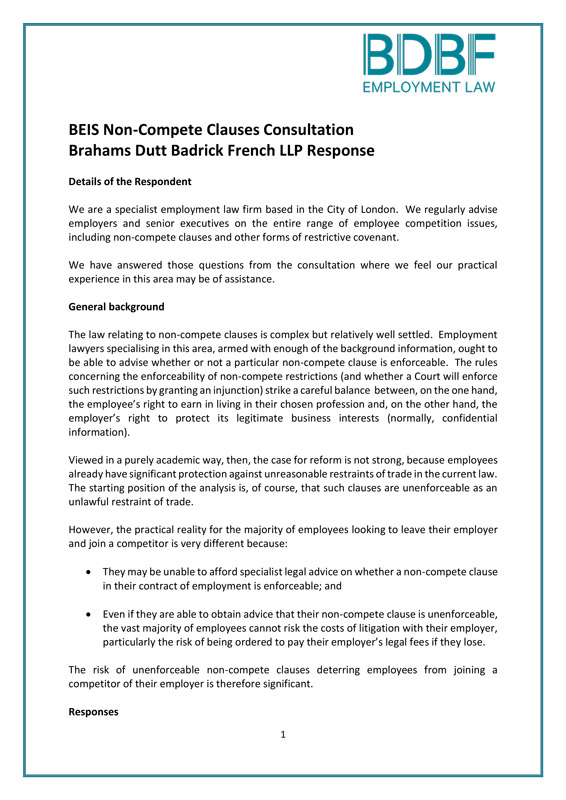
As mentioned at our recent webinar, the government has launched a consultation about regulating the use of non-compete restrictions in employment contracts.  Views are being sought on requiring employers to pay compensation for the duration of non-compete restrictions, or banning their use altogether.  As recognised experts in this field, BDBF has responded to the consultation.  In short, our view is that a requirement to pay compensation is a fair way of deterring inappropriate use of non-compete clauses, but that an outright ban is a step too far.  You can read our full response below.

Please view the PDF by clicking the image below:

If you or your business needs advice on non-compete clauses or other restrictive covenants please contact Tom McLaughlin (tommclaughlin@bdbf.co.uk) or your usual BDBF contact.


Getting your restrictive covenants right – a cautionary tale

[et_pb_section fb_built=”1″ _builder_version=”3.0.100″ background_image=”http://davidk423.sg-host.com/wp-content/uploads/2017/09/bdbf_final-stages-1-4-1.jpg” custom_padding=”|||” global_module=”2165″ saved_tabs=”all”][et_pb_row _builder_version=”3.25″ custom_padding=”|||”][et_pb_column type=”4_4″ _builder_version=”3.25″ custom_padding=”|||” custom_padding__hover=”|||”][et_pb_text _builder_version=”3.27.4″ background_layout=”dark” custom_margin=”0px|||” custom_padding=”0px|||”]

Employment Law News


[/et_pb_text][/et_pb_column][/et_pb_row][/et_pb_section][et_pb_section fb_built=”1″ admin_label=”section” _builder_version=”3.22.3″][et_pb_row admin_label=”row” _builder_version=”3.25″ background_size=”initial” background_position=”top_left” background_repeat=”repeat”][et_pb_column type=”4_4″ _builder_version=”3.25″ custom_padding=”|||” custom_padding__hover=”|||”][et_pb_text _builder_version=”4.7.4″ text_orientation=”justified” hover_enabled=”0″ use_border_color=”off” sticky_enabled=”0″]

Getting your restrictive covenants right – a cautionary tale

A recent High Court decision reminds employers of the importance of tailoring restrictive covenants to the employee.  In Quilter Private Client Advisers Ltd v Falconer, the employer had legitimate business interests worthy of protection, but the post-termination restrictions it had put in place were unreasonable.

What does the law say?

Restrictive covenants are used by employers to protect their interests once an employee has departed the business. These may take the form of:

  • non-competition clauses, which prevent an employee from working in a competing business for a period of time usually in a particular role and sometimes confined to a geographical area;
  • non-solicitation clauses, which prevent an employee from soliciting specified clients or customers for a period of time; and
  • non-dealing covenants which prevent an employee from dealing with specified clients or customers of the business for a period of time.

The starting point is that such covenants are treated as an unlawful restraint of trade unless they protect a legitimate proprietary business interest of the employer.  Any restraint that is to overcome this hurdle must be reasonable and go no further than is necessary to protect the employer’s legitimate interests.  It is for the employer to show that the restraint is reasonable.

What happened in this case?

Ms Falconer was employed by Quilter as a financial adviser, taking over an existing client base from a retiring adviser.  Her contract of employment contained several post-termination restrictions, including a nine-month non-compete clause and 12-month non-solicitation and non-dealing clauses.

Ms Falconer did not enjoy working for Quilter and resigned after six months to work as a self-employed adviser for an organisation called Continuum.  As she was still within her probationary period, she was subject to a two-week notice period only. 

Ms Falconer took confidential information belonging to Quilter regarding various clients whom she wished to engage in her new role.  Quilter sued Ms Falconer for breach of contract and sought an interim injunction (and ultimately a final injunction) to enforce the restrictive covenants.  Quilter alleged that Ms Falconer had breached the implied duty of fidelity and the express terms of her employment contract by:

  • not showing Continuum her Quilter employment contract containing the restrictive covenants;
  • contacting Quilter’s clients during her period of garden leave without Quilter’s permission; and
  • taking confidential information before she left Quilter’s employment.

Quilter also sued Continuum for inducing Ms Falconer to take the confidential information in breach of contract.

What was decided?

The High Court granted an interim injunction against Ms Falconer requiring her to abide by the covenants until the earlier of the date by which they expired and a full trial.  In many cases that would have ended the dispute.  However, in this case, a full trial did go on to take place.

The High Court dismissed the claim of inducement against Continuum.  Ms Falconer was engaged as an independent contractor and she had (unbeknownst to Continuum) uploaded the confidential material she had taken from Quilter onto a portal provided by Continuum.  Merely facilitating a breach of contract (without knowing about it) was not enough to amount to inducement.

Ms Falconer was found to have breached her contract in the following ways:

  • she had scanned confidential client information onto her personal laptop;
  • she had not shown Continuum her contract of employment with Quilter (in breach of an express clause);
  • she had attended Continuum’s induction course while still employed by Quilter; and
  • she had contacted Quilter’s clients during her garden leave with a view to transferring their business without permission.

However, the High Court went on to decide that the restrictive covenants were invalid.  Although Quilter had legitimate business interests worthy of protection, the restrictions went too far.

The non-competition clause

The Court said that the non-compete went beyond what was reasonably necessary.  Quilter’s legitimate interests were the protection of its goodwill and confidential information, but this could have been achieved by way of non-dealing and non-solicitation covenants and confidentiality clauses.  The covenant was not saved by its geographical limitations because it covered wider areas than those that Ms Falconer had covered (and even if it had covered the correct area, it may not have come to Quilter’s rescue).

The Court also took into account Ms Falconer’s length of service.  The nine-month non-compete applied no matter how long Ms Falconer had been employed by Quilter.  No adjustment had been made for employees leaving during their probationary period and/or after only a short period of employment.  The Court considered that in her short period of employment Ms Falconer would not have been able to establish long-term relationships with clients. 

In addition, the Court noted that the length of the notice period can be an indication of the unreasonableness of the length of the restraint.  The shorter the notice period (here, it was 2 weeks), the less important the employee’s services appear to be to the employer and, therefore, the harder it is to persuade the Court that nine months of non-competition is reasonably necessary to protect business interests.  Moreover, a much more senior employee in the business was subject to a shorter non-compete restriction of six-months.

Taking all of this together, the High Court found the non-compete restriction to be void.

The non-solicitation and non-dealing clauses

Ms Falconer’s contract also had 12-month non-solicitation and non-dealing clauses which restricted her from soliciting, or providing financial services to, anyone who had been a Quilter client in the 18 months before her employment ended and with whom she had had material personal contact or had been materially concerned with during that time.  

However, the drafting of the covenants meant that the restrictions were not, in fact, limited to clients that she had dealt with, or to those who had been clients during the course of her employment.  Quilter also failed to give evidence to support why an 18-month backstop was necessary, particularly in an environment where clients had bi-annual reviews.  A six-month or 12-month backstop might have been reasonable.

The Court concluded that these restrictions were wider than necessary and, therefore, void.

What are the learning points?

Like many other cases before it, this decision highlights the importance of avoiding a blanket approach when drafting post-termination restrictions.  It is important to look at the specific circumstances before putting pen to paper.  Where non-compete restrictions are concerned, it is also important to tailor these to reflect the length of the employment relationship and importance of the employee’s role.  Such covenants should be benchmarked against similar covenants in place for more senior employees. 

The Government is consulting on whether non-compete restrictions should be banned altogether, or subject to new rules placing limits on the length of the restriction and requiring employers to compensate the employee during any restricted period.   If taken forward, employers will need to adjust, or even remove, non-compete restrictions and consider strengthening other post-termination restrictions where possible.

BDBF can help you prepare an appropriate suite of covenants for your employees.  If you would like to discuss this, please contact Amanda Steadman (amandasteadman@bdbf.co.uk) or your usual BDBF contact.

[/et_pb_text][/et_pb_column][/et_pb_row][/et_pb_section][et_pb_section fb_built=”1″ _builder_version=”3.26.6″][et_pb_row _builder_version=”3.26.6″][et_pb_column type=”4_4″ _builder_version=”3.26.6″][/et_pb_column][/et_pb_row][/et_pb_section]


Government announces new consultation on restrictive covenants

[et_pb_section fb_built=”1″ _builder_version=”3.0.100″ background_image=”http://davidk423.sg-host.com/wp-content/uploads/2017/09/bdbf_final-stages-1-4-1.jpg” custom_padding=”|||” global_module=”2165″ saved_tabs=”all”][et_pb_row _builder_version=”3.25″ custom_padding=”|||”][et_pb_column type=”4_4″ _builder_version=”3.25″ custom_padding=”|||” custom_padding__hover=”|||”][et_pb_text _builder_version=”3.27.4″ background_layout=”dark” custom_margin=”0px|||” custom_padding=”0px|||”]

Employment Law News


[/et_pb_text][/et_pb_column][/et_pb_row][/et_pb_section][et_pb_section fb_built=”1″ admin_label=”section” _builder_version=”3.22.3″][et_pb_row admin_label=”row” _builder_version=”3.25″ background_size=”initial” background_position=”top_left” background_repeat=”repeat”][et_pb_column type=”4_4″ _builder_version=”3.25″ custom_padding=”|||” custom_padding__hover=”|||”][et_pb_text _builder_version=”4.7.4″ text_orientation=”justified” hover_enabled=”0″ use_border_color=”off” sticky_enabled=”0″]

Government announces new consultation on restrictive covenants

Does the current law on non-compete clauses stifle the creation of start-ups?  And should the law be changed?

These are questions the government will likely seek answers to as part of a new consultation on post-termination obligations in employment contracts which, the FT reports, will be launched in the coming days.  Apparently ministers are keen to make it harder for employers to stop their employees leaving and setting up in competition, in a bid to make the UK more attractive to EU entrepreneurs after Brexit.

The FT reports that the approach taken to such clauses in California – where they are essentially unenforceable –  is one of the reasons given by entrepreneurs for the rapid growth of the technology sector in Silicon Valley.   However, this may also be one of the reasons that tech giants such as Apple and Google faced a class action lawsuit from 64,000 employees in relation to an alleged nonpoaching conspiracy between those companies.  A $415million settlement was agreed in that case.

This is not the first time the government has looked at this issue in recent years.  In May 2016 BEIS launched a call for evidence in relation to the use of non-compete clauses.  At that time ministers were influenced by a report published by the US Department of the Treasury which analysed the economic effects of non-compete clauses and made the case for their reform.  Unsurprisingly, the responses to that consultation were fairly polarised with established businesses favouring the current law but new ones looking for more flexibility.  The issue was shelved by the government at that time and no proposals for reform were put forward.

As recognised experts in the field of employee competition, BDBF will be providing input into the consultation.  If you would like us to include your views too, then please contact Tom McLaughlin who specialises in this area.

[/et_pb_text][/et_pb_column][/et_pb_row][/et_pb_section][et_pb_section fb_built=”1″ _builder_version=”3.26.6″][et_pb_row _builder_version=”3.26.6″][et_pb_column type=”4_4″ _builder_version=”3.26.6″][/et_pb_column][/et_pb_row][/et_pb_section]