Reluctant returners: is a worker’s belief that he or she needs to avoid catching COVID-19 protected from discrimination?

[et_pb_section fb_built=”1″ _builder_version=”3.0.100″ background_image=”http://davidk423.sg-host.com/wp-content/uploads/2017/09/bdbf_final-stages-1-4-1.jpg” custom_padding=”|||” global_module=”2165″ saved_tabs=”all” global_colors_info=”{}”][et_pb_row _builder_version=”4.7.4″ min_height=”66.4px” custom_padding=”50px||||false|false” global_colors_info=”{}”][et_pb_column type=”4_4″ _builder_version=”3.25″ custom_padding=”|||” global_colors_info=”{}” custom_padding__hover=”|||”][et_pb_text _builder_version=”4.7.4″ _dynamic_attributes=”content” text_font=”|700|||||||” text_font_size=”27px” background_layout=”dark” custom_margin=”0px|||” custom_padding=”0px|||” global_colors_info=”{}”]@ET-DC@eyJkeW5hbWljIjp0cnVlLCJjb250ZW50IjoicG9zdF90aXRsZSIsInNldHRpbmdzIjp7ImJlZm9yZSI6IiIsImFmdGVyIjoiIn19@[/et_pb_text][et_pb_text _builder_version=”4.7.4″ _dynamic_attributes=”content” _module_preset=”default” background_layout=”dark” global_colors_info=”{}”]@ET-DC@eyJkeW5hbWljIjp0cnVlLCJjb250ZW50IjoicG9zdF9kYXRlIiwic2V0dGluZ3MiOnsiYmVmb3JlIjoiIiwiYWZ0ZXIiOiIiLCJkYXRlX2Zvcm1hdCI6ImRlZmF1bHQiLCJjdXN0b21fZGF0ZV9mb3JtYXQiOiIifX0=@[/et_pb_text][/et_pb_column][/et_pb_row][/et_pb_section][et_pb_section fb_built=”1″ admin_label=”section” _builder_version=”3.22.3″ global_colors_info=”{}”][et_pb_row admin_label=”row” _builder_version=”4.7.4″ background_size=”initial” background_position=”top_left” background_repeat=”repeat” global_colors_info=”{}”][et_pb_column type=”4_4″ _builder_version=”3.25″ custom_padding=”|||” global_colors_info=”{}” custom_padding__hover=”|||”][et_pb_text _builder_version=”4.14.2″ text_orientation=”justified” use_border_color=”off” global_colors_info=”{}”]

In the case of X v Y, an Employment Tribunal decided that a claimant’s fear of catching COVID-19, and her belief that she needed to protect herself and her partner from catching it, was not a protected belief for the purposes of discrimination legislation. 

What happened in this case?

The first national lockdown was lifted in July 2020 and employers were permitted to return workers to the workplace.  In this case, the claimant took the decision not to return to the workplace on the grounds of health and safety connected to COVID.

In addition to concerns about health and safety in the workplace, the claimant said she was fearful of contracting the virus herself and passing it on to her vulnerable partner.  She explained her position to her employer and said she would not be returning to work.  Her employer stopped paying her wages.

The claimant brought various claims in the Employment Tribunal, including that the employer’s actions amounted to discrimination on the grounds of her protected belief, which was described as “a fear of catching COVID and a need to protect herself and others”.  

What was decided?

We know that workers are protected from discrimination in employment on the grounds of their religion or their religious or philosophical belief.   However, only philosophical beliefs which meet a certain standard are protected.  In order to be covered, a philosophical belief must:

  1. be genuinely held;
  2. be a belief and not a mere opinion or viewpoint based on the present state of information available;
  3. concern a weighty and substantial aspect of human life and behaviour;
  4. have a certain level of cogency, seriousness, cohesion and importance; and
  5. be worthy of respect in a democratic society and not be incompatible with human dignity or conflict with the fundamental rights of others.

The Employment Tribunal decided that the first, fourth and fifth criteria were met, but the second and third were not.

As to the second criterion, it was decided that the claimant’s fear did not amount to a belief.  Rather, it was an instinctive reaction to a threat of physical harm and the need to take steps to avoid or reduce that threat.  Further, a view that certain actions (e.g. attending a crowded place) would increase the risk of contracting COVID, was an opinion based on the state of information available at the time.

As to the third criterion, the Tribunal said that fears about the harm caused by COVID are weighty and substantial and not minor or trivial.  They also concern aspects of human life and behaviour.  The fact that such a fear could be descried as time-specific (i.e. for length of the pandemic) would not, in itself, mean this criterion could not be met.  However, in the claimant’s case, her fear concerned herself and her partner only – there was no wider concern for others.

Accordingly, the claimant’s discrimination complaint was not allowed to proceed.

What does this decision mean for employers?

As the working from home guidance is lifted once more, many employers will be looking to bring workers back to the workplace for some, or all, of the time.  Some workers may be fearful about the return.  This case shows that if negative consequences follow a refusal to return, a worker is unlikely to succeed in a philosophical belief discrimination claim.  Even if a claimant could demonstrate concern for a wider group of people (to satisfy the third criterion), it is difficult to see how they would satisfy the “belief not viewpoint or opinion” requirement.

However, employers should remember that employees in this situation may have other valid claims.  For example, if employees raise concerns about the safety of the workplace and suffers negative consequences they may be protected against detriment and dismissal (under special rules governing health and safety disclosures and/or whistleblowing laws).  In addition, if employees, or someone they live with, are vulnerable to COVID and qualify as disabled, they could argue that a requirement to return to work amounted to indirect disability discrimination.

For these reasons, employers faced with reluctant returners should always engage with employees to understand their concerns and make appropriate adjustments where needed.  It would also be sensible to share workplace risk assessments with staff to reassure them of the steps taken at work to protect their wellbeing.

X v Y

If you would like to discuss any issues arising out of this decision please contact Amanda Steadman (amandasteadman@bdbf.co.uk) or your usual BDBF contact.

[/et_pb_text][/et_pb_column][/et_pb_row][/et_pb_section][et_pb_section fb_built=”1″ _builder_version=”3.26.6″ global_colors_info=”{}”][et_pb_row _builder_version=”3.26.6″ global_colors_info=”{}”][et_pb_column type=”4_4″ _builder_version=”3.26.6″ global_colors_info=”{}”][/et_pb_column][/et_pb_row][/et_pb_section]

Dismissal of employee who brought numerous “frivolous and vexatious” grievances was fair

[et_pb_section fb_built=”1″ _builder_version=”3.0.100″ background_image=”http://davidk423.sg-host.com/wp-content/uploads/2017/09/bdbf_final-stages-1-4-1.jpg” custom_padding=”|||” global_module=”2165″ saved_tabs=”all” global_colors_info=”{}”][et_pb_row _builder_version=”4.7.4″ min_height=”66.4px” custom_padding=”50px||||false|false” global_colors_info=”{}”][et_pb_column type=”4_4″ _builder_version=”3.25″ custom_padding=”|||” global_colors_info=”{}” custom_padding__hover=”|||”][et_pb_text _builder_version=”4.7.4″ _dynamic_attributes=”content” text_font=”|700|||||||” text_font_size=”27px” background_layout=”dark” custom_margin=”0px|||” custom_padding=”0px|||” global_colors_info=”{}”]@ET-DC@eyJkeW5hbWljIjp0cnVlLCJjb250ZW50IjoicG9zdF90aXRsZSIsInNldHRpbmdzIjp7ImJlZm9yZSI6IiIsImFmdGVyIjoiIn19@[/et_pb_text][et_pb_text _builder_version=”4.7.4″ _dynamic_attributes=”content” _module_preset=”default” background_layout=”dark” global_colors_info=”{}”]@ET-DC@eyJkeW5hbWljIjp0cnVlLCJjb250ZW50IjoicG9zdF9kYXRlIiwic2V0dGluZ3MiOnsiYmVmb3JlIjoiIiwiYWZ0ZXIiOiIiLCJkYXRlX2Zvcm1hdCI6ImRlZmF1bHQiLCJjdXN0b21fZGF0ZV9mb3JtYXQiOiIifX0=@[/et_pb_text][/et_pb_column][/et_pb_row][/et_pb_section][et_pb_section fb_built=”1″ admin_label=”section” _builder_version=”3.22.3″ global_colors_info=”{}”][et_pb_row admin_label=”row” _builder_version=”4.7.4″ background_size=”initial” background_position=”top_left” background_repeat=”repeat” global_colors_info=”{}”][et_pb_column type=”4_4″ _builder_version=”3.25″ custom_padding=”|||” global_colors_info=”{}” custom_padding__hover=”|||”][et_pb_text _builder_version=”4.14.2″ text_orientation=”justified” hover_enabled=”0″ use_border_color=”off” global_colors_info=”{}” sticky_enabled=”0″]

In the case of Hope v British Medical Association the Employment Appeal Tribunal upheld a decision that it had been fair to dismiss an employee who raised multiple informal grievances and refused to progress them or attend a grievance hearing. 

What happened in this case?

The claimant was employed by the British Medical Association between June 2014 and May 2019. By February 2019, he had raised around seven grievances.  The claimant said he wished to discuss these grievances informally with his line manager. However, as the grievances related to more senior managers, his line manager did not have authority to resolve the issues raised.

The claimant refused to progress any of the grievances to a formal stage. Instead, he sought to reserve the right to do so and did not withdraw the grievances.  However, the employer treated the complaints as formal grievances and a grievance hearing was scheduled for 21 March 2019.  The claimant refused to attend despite being informed that attendance was a reasonable management instruction. He was also told that if he persisted with filing grievances this may be treated as a disciplinary issue.

Eventually, he was invited to attend a disciplinary hearing in April 2019 to respond to three allegations made against him. These were that:

  • he had submitted numerous, frivolous grievances against two senior managers;
  • he had failed to follow a reasonable management instruction to attend the grievance hearing; and
  • there had been a fundamental breakdown of the working relationship between him and senior management.

The disciplinary chair concluded that each of the allegations was made out and the claimant was dismissed for gross misconduct.  He brought a claim for unfair dismissal. The Employment Tribunal found that the dismissal was fair.  The claimant appealed to the EAT.

What did the EAT decide?

The claimant argued that the Employment Tribunal had failed to consider whether the alleged misconduct was capable of amounting to gross misconduct in the contractual sense.  He suggested that the Tribunal should have considered whether his conduct amounted to either a “deliberate and wilful contradiction of the contractual terms” or “very considerable negligence”.  He also argued that the Tribunal’s decision was perverse, and his conduct did not justify dismissal.

The EAT held that the employer had not raised “contractual gross misconduct” as a reason for the dismissal and, on that basis, a contractual analysis was not required. The EAT disagreed with the claimant’s submission that whenever the label “gross misconduct” is used an analysis of whether the conduct amounts to either a wilful contradiction of the contract or gross negligence is always required.  In this case, the real question was the statutory one, namely, whether the employer had acted reasonably in treating the conduct as a sufficient reason to dismiss.

The EAT also concluded that the Tribunal’s decision was not perverse.  Importantly, the EAT noted that the proper purpose of grievance procedures is to resolve concerns, not to act as a repository for complaints to be left unresolved and resurrected at will.  It was unreasonable for the claimant to raise numerous complaints and expect to leave them unresolved.   His failure to attend the grievance hearing could also be regarded as wrongdoing in the circumstances.  Therefore, the Tribunal was entitled to conclude that the dismissal fell within the band of reasonable responses of a similarly sized employer.  The appeal was dismissed.

What does this mean for employers?

This decision confirms what many employers already knew, namely that a dismissal is fair if it complies with the requirements of the statute – there is no gloss requiring the employer always to show contractual gross misconduct or negligence.  However, this does not mean that dismissing an employee for misconduct is straightforward.  There are still the statutory questions of whether the misconduct is sufficient to justify dismissal and whether a fair dismissal procedure has been followed to address.  Failure to satisfy both elements puts an employer at risk of an unfair dismissal claim.

The decision also shows that the raising of multiple frivolous grievances, and a failure to progress them formally, may justify dismissal.  Employers may wish to update disciplinary rules to specify that this will be treated as gross misconduct.

Hope v British Medical Association

If you would like to discuss any issues arising out of this decision please contact James Hockley (jameshockley@bdbf.co.uk) or your usual BDBF contact.

[/et_pb_text][/et_pb_column][/et_pb_row][/et_pb_section][et_pb_section fb_built=”1″ _builder_version=”3.26.6″ global_colors_info=”{}”][et_pb_row _builder_version=”3.26.6″ global_colors_info=”{}”][et_pb_column type=”4_4″ _builder_version=”3.26.6″ global_colors_info=”{}”][/et_pb_column][/et_pb_row][/et_pb_section]


Is it discriminatory to retract a secondment offer made to a disabled employee on health and safety grounds?

[et_pb_section fb_built=”1″ _builder_version=”3.0.100″ background_image=”http://davidk423.sg-host.com/wp-content/uploads/2017/09/bdbf_final-stages-1-4-1.jpg” custom_padding=”|||” global_module=”2165″ saved_tabs=”all” global_colors_info=”{}”][et_pb_row _builder_version=”4.7.4″ min_height=”66.4px” custom_padding=”50px||||false|false” global_colors_info=”{}”][et_pb_column type=”4_4″ _builder_version=”3.25″ custom_padding=”|||” global_colors_info=”{}” custom_padding__hover=”|||”][et_pb_text _builder_version=”4.7.4″ _dynamic_attributes=”content” text_font=”|700|||||||” text_font_size=”27px” background_layout=”dark” custom_margin=”0px|||” custom_padding=”0px|||” global_colors_info=”{}”]@ET-DC@eyJkeW5hbWljIjp0cnVlLCJjb250ZW50IjoicG9zdF90aXRsZSIsInNldHRpbmdzIjp7ImJlZm9yZSI6IiIsImFmdGVyIjoiIn19@[/et_pb_text][et_pb_text _builder_version=”4.7.4″ _dynamic_attributes=”content” _module_preset=”default” background_layout=”dark” global_colors_info=”{}”]@ET-DC@eyJkeW5hbWljIjp0cnVlLCJjb250ZW50IjoicG9zdF9kYXRlIiwic2V0dGluZ3MiOnsiYmVmb3JlIjoiIiwiYWZ0ZXIiOiIiLCJkYXRlX2Zvcm1hdCI6ImRlZmF1bHQiLCJjdXN0b21fZGF0ZV9mb3JtYXQiOiIifX0=@[/et_pb_text][/et_pb_column][/et_pb_row][/et_pb_section][et_pb_section fb_built=”1″ admin_label=”section” _builder_version=”3.22.3″ global_colors_info=”{}”][et_pb_row admin_label=”row” _builder_version=”4.7.4″ background_size=”initial” background_position=”top_left” background_repeat=”repeat” global_colors_info=”{}”][et_pb_column type=”4_4″ _builder_version=”3.25″ custom_padding=”|||” global_colors_info=”{}” custom_padding__hover=”|||”][et_pb_text _builder_version=”4.14.2″ text_orientation=”justified” hover_enabled=”0″ use_border_color=”off” global_colors_info=”{}” sticky_enabled=”0″]

In Judd v Cabinet Office the Employment Appeal Tribunal upheld a decision that the withdrawal of an overseas secondment opportunity on health and safety grounds was not disability discrimination.  The appeal turned on whether the employer had acted disproportionately in withdrawing the opportunity, rather than allowing the employee to go with safeguards in place.

What happened in this case?

The claimant applied for an overseas secondment to Montenegro and was offered a placement in September 2018.   A few months earlier, she had been the victim of a crime, which had had a negative impact on her health and wellbeing. In fact, she had had two significant health episodes which had resulted in her attending hospital on an emergency basis.

The claimant was required to undergo medical clearance. This was undertaken by Healix, a contractor which provided risk assessments for proposed transfers and secondments abroad. In October 2018, Healix advised the employer that the claimant was “high risk” and should not travel to Montenegro for the time being.

In November 2018, the claimant was then assessed by the employer’s occupational health service. She did not disclose her complete medical history, including the two emergency trips to hospital. Based on incomplete information, Occupational Health assessed her as fit to travel but made certain recommendations, such as registering with a local doctor who could liaise with her GP, taking out appropriate medical insurance, and producing a wellbeing and contingency plan for repatriation in the event of an emergency.  Healix disagreed with this assessment and highlighted that these measures were undeliverable.  As a result, the employer withdrew the secondment offer.

In January 2019, Occupational Health issued another report following two further assessments and having reviewed a letter from the claimant’s consultant which referred to one of the two episodes that had resulted in emergency hospital admission.  The report said the claimant was fit to undertake the secondment, subject to the implementation of its proposals

The employer refused to reinstate the secondment offer and the claimant brought a claim for disability discrimination.

What did the EAT decide?

It was not disputed that the claimant had a disability, nor that the withdrawal of the secondment opportunity constituted unfavourable treatment because of something arising in consequence of her disability.  The dispute centred on whether that unfavourable treatment could be justified.  If it could, the claim would fail.  It was agreed that the employer’s aim was to protect the health, safety and wellbeing of its employees when working abroad. The key question was whether it had acted proportionately.  In other words, could it have achieved the health and safety aim by less discriminatory means?

The Employment Tribunal had found that Healix had classified the claimant as “high risk” which was highly unusual and, indeed, a first for the employer.  The Tribunal accepted that if the same medical emergency happened to the claimant in Montenegro as had happened in the UK, she would not have had the same joined-up services available.  The Tribunal accepted that the assessment was not a permanent restriction but one that could be reviewed after about a year and it was likely that more secondment opportunities would arise.  The Tribunal concluded that there was no alternative action that would have overcome the obstacles and so it dismissed the claim.  It also dismissed the claim that there had been a failure to make reasonable adjustments.

At appeal, the claimant sought to argue that the Tribunal had failed to consider other factors relevant to proportionality when dismissing her case. However, the EAT went on to find that the Tribunal’s findings were not perverse and there was no legal error in its approach. It dismissed her appeal.

What does this mean for employers?

This case does not mean that disabled employees can be excluded from secondment opportunities, even those which carry risk to them.  There may be reasonable steps that an employer can take to mitigate the risk.  It will depend on the particular circumstances of the case.  Here, there was nothing the employer could reasonably do.

What this case does show is that employers must be careful when making offers to employees in situations where risk assessments are required.  Offers should be made conditional upon satisfactory clearance being obtained.  This should be spelt out in any secondment policy and in the secondment offer letter itself.

Even where an employer genuinely believes it is acting in an employee’s best interests, the withdrawal of an opportunity is likely to cause bad feeling.  Having clear and open lines of communication may help to manage expectations and defuse a difficult situation which might otherwise arise.

Judd v Cabinet Office

If you would like to discuss any issues arising out of this decision please contact James Hockley (jameshockley@bdbf.co.uk) or your usual BDBF contact.

[/et_pb_text][/et_pb_column][/et_pb_row][/et_pb_section][et_pb_section fb_built=”1″ _builder_version=”3.26.6″ global_colors_info=”{}”][et_pb_row _builder_version=”3.26.6″ global_colors_info=”{}”][et_pb_column type=”4_4″ _builder_version=”3.26.6″ global_colors_info=”{}”][/et_pb_column][/et_pb_row][/et_pb_section]


NEGOTIATING SENIOR EXECUTIVE CONTRACTS – PITFALLS AND TIPS

NEGOTIATING SENIOR EXECUTIVE CONTRACTS – PITFALLS AND TIPS

With bonus season behind us and the Great Resignation in full swing, many people are beginning to rethink their career or plan their next job move. Clients often ask us: “how do I negotiate my contract?” or “can I negotiate my contract?”. At BDBF, as well as regularly negotiating exits and fighting cases, we are expert in providing bespoke and tailored advice to senior executives at the point of entering new employment contracts. BDBF Partner, Paula Chan and Senior Associate, Blair Wassman offer some guidance below on negotiating your contract.

The first rule of negotiation: negotiate

Many believe employers will not deviate from their standard form contract, and as a result they simply accept the terms on offer. This can be the case, but it does not reflect our experience across the board. Many employers are receptive to proposals and we often successfully negotiate more favourable terms for executives and professionals joining small and large organisations, including listed companies. We commonly do this by assisting in the background rather than dealing with your new employer directly.

You are in the best position to negotiate beneficial terms before your employment commences. Securing talent at a senior level is rarely an easy task for employers and they are likely to be as eager as you to secure your start. Your negotiating leverage is therefore likely better than you think.

Do not assume restrictive covenants are unenforceable 

Restrictive covenants can limit what an employee can do after employment ends. They can prevent an employee from working for a competitor, from soliciting or dealing with clients or potential clients or from poaching or moving with key employees. Many individuals do not pay attention to these restrictions until they wish to move on, mistakenly believing that covenants, particularly non-competes are unenforceable. The drafting and scope of the restrictions may mean they are unenforceable but, where drafted properly, they can prevent an employee working in their desired role on termination of employment.

You should consider with care the duration and scope of any proposed restrictions. They may be too widely drafted and go beyond what is required to protect an employer’s legitimate business interests. Consider how they interact with any notice and garden leave clauses. Often garden leave clauses provide that the duration of restrictive covenants will be reduced by any period spent on garden leave.

Check whether you are restriction free

You may be subject to onerous restrictions in your last employment contract, as well obligations to notify your existing employer about offers of employment you have received or to provide a prospective employer with a copy of your restrictions.

Check whether your new employment contract states that your employment is conditional on you not being bound by any restrictions preventing you from taking up the role. This means that if you are subject to restrictions, your new employer may be able to withdraw their offer or terminate your employment immediately. This can be particularly disastrous for employees who lose deferred compensation on the giving or expiry of notice in order to take up a new role, especially if they are relying on a guaranteed or sign on bonus from their new employer to cover that loss.

If you are concerned about the impact of restrictions on your existing or new employment relationship , it is important to seek legal advice at an early stage before you resign or accept an offer of employment, especially if you are planning on working for a competitor.

If you breach an existing restriction, you (and your new employer) may be subject to costly and time-consuming legal proceedings. You could be ordered by a Court not to commence or to cease employment with your new employer or to make a payment on account of profits to your former employer. Even if legal proceedings do not materialise, it is our experience that a letter from a former employer threatening legal action can be incredibly disruptive to the stability and success of a new employment relationship.

Read the small print 

It is important to read the whole contract, as some employer-friendly provisions may be hidden in places you may not expect.

For example, consider whether there is an option for the employer to make a payment in lieu of notice. Does it include benefits and bonus? Is it subject to certain conditions, i.e. does it allow the employer to make payments in instalments, or is there a requirement for you to mitigate your loss? Check whether your employer can make changes to your benefits or place of work without your consent. This has never been more important given the move towards greater flexibility and more home working with some senior executives moving out of the City whilst retaining City roles.  If you have been led to believe that your role will allow for homeworking does the contract reflect that?

Pay attention to probationary periods

Check whether you will be subject to a probationary period, and whether the employer has the option to unilaterally extend this period. Many probationary clauses will also allow the employer to terminate your employment with very little notice, and some contractual benefits may not commence until you have completed your probation. As unfair dismissal rights only arise once you have two years’ service, the contractual terms surrounding probation and corresponding notice period are crucial.

Do not proceed without a clear understanding of variable remuneration

You may happily be entitled to receive a bonus, incentive or other form of deferred compensation. However, such benefits often come with strings attached. They may be subject to stringent conditions, malus and clawback and plan documents external to your employment contract.

It is essential that you understand exactly what you will be entitled to, how awards will be made, and any conditions attached to incentives. You should ask for copies of the plan documents so that you understand vesting periods, the nature of your employer’s discretion, additional restrictive covenants (which may go beyond those in your contract), and the leaver provisions. Will you lose any unvested awards or bonuses if your employment ends before the awards vest or bonuses are paid?

Further, if you will lose out on variable remuneration as a result of having to leave your previous job, you may want to consider whether your new employer will buy you out and if so, at a guaranteed level.

Avoid relying on promises not contained in the contract 

All elements of the deal should be expressly incorporated into the contract. We often advise against relying on verbal or email assurances as employment contracts may contain entire agreement clauses, which state that the contract records the entire agreement between the parties and replaces any previous agreements or representations.

Look out for “agreements to agree”. These may include a promise of equity or cash bonus ‘to be determined’ on joining. All terms should be clear and should avoid giving the employer the luxury of being able to default on promises at a later stage.

Pick your battles

This is a new relationship. We recommend that clients pick their battles and focus on the most important elements of the deal when negotiating to get things off to a good start and to maximise the prospects of securing what matters most to them. We can provide you with strategic advice on which employment provisions should receive focus and how best to approach discussions.

If you would like to know more, or you need advice regarding your contractual terms, please contact Paula Chan (paulachan@bdbf.co.uk), Blair Wassman (blairwassman@bdbf.co.uk) or your usual BDBF contact.


[/et_pb_text][/et_pb_column][/et_pb_row][/et_pb_section][et_pb_section fb_built=”1″ _builder_version=”3.26.6″ global_colors_info=”{}”][et_pb_row _builder_version=”3.26.6″ global_colors_info=”{}”][et_pb_column type=”4_4″ _builder_version=”3.26.6″ global_colors_info=”{}”][/et_pb_column][/et_pb_row][/et_pb_section]


Changing jobs? Tread softly on LinkedIn

[et_pb_section fb_built=”1″ _builder_version=”3.0.100″ background_image=”http://davidk423.sg-host.com/wp-content/uploads/2017/09/bdbf_final-stages-1-4-1.jpg” custom_padding=”|||” global_module=”2165″ saved_tabs=”all” global_colors_info=”{}”][et_pb_row _builder_version=”4.7.4″ min_height=”66.4px” custom_padding=”50px||||false|false” global_colors_info=”{}”][et_pb_column type=”4_4″ _builder_version=”3.25″ custom_padding=”|||” global_colors_info=”{}” custom_padding__hover=”|||”][et_pb_text _builder_version=”4.7.4″ _dynamic_attributes=”content” text_font=”|700|||||||” text_font_size=”27px” background_layout=”dark” custom_margin=”0px|||” custom_padding=”0px|||” global_colors_info=”{}”]@ET-DC@eyJkeW5hbWljIjp0cnVlLCJjb250ZW50IjoicG9zdF90aXRsZSIsInNldHRpbmdzIjp7ImJlZm9yZSI6IiIsImFmdGVyIjoiIn19@[/et_pb_text][et_pb_text _builder_version=”4.7.4″ _dynamic_attributes=”content” _module_preset=”default” background_layout=”dark” global_colors_info=”{}”]@ET-DC@eyJkeW5hbWljIjp0cnVlLCJjb250ZW50IjoicG9zdF9kYXRlIiwic2V0dGluZ3MiOnsiYmVmb3JlIjoiIiwiYWZ0ZXIiOiIiLCJkYXRlX2Zvcm1hdCI6ImRlZmF1bHQiLCJjdXN0b21fZGF0ZV9mb3JtYXQiOiIifX0=@[/et_pb_text][/et_pb_column][/et_pb_row][/et_pb_section][et_pb_section fb_built=”1″ admin_label=”section” _builder_version=”3.22.3″ global_colors_info=”{}”][et_pb_row admin_label=”row” _builder_version=”4.7.4″ background_size=”initial” background_position=”top_left” background_repeat=”repeat” global_colors_info=”{}”][et_pb_column type=”4_4″ _builder_version=”3.25″ custom_padding=”|||” global_colors_info=”{}” custom_padding__hover=”|||”][et_pb_text _builder_version=”4.14.2″ text_orientation=”justified” hover_enabled=”0″ use_border_color=”off” global_colors_info=”{}” sticky_enabled=”0″]

As the Government’s pandemic restrictions are relaxed, BDBF’s Nick Wilcox writes in the Times about the perils of employees using social media to announce their new roles in the time of the ‘Great Resignation’. Nick considers whether this could be considered solicitation and warns employees against posting something on social media that they would not be comfortable with their employer, or perhaps a judge, seeing.

To view the article please click the link below (please note that you may need a subscription):

thetimes.co.uk/article/changing-jobs-tread-softly-on-linkedin-llhlz7kfv

#greatresignation #restrictivecovenants #ukemplaw

[/et_pb_text][/et_pb_column][/et_pb_row][/et_pb_section][et_pb_section fb_built=”1″ _builder_version=”3.26.6″ global_colors_info=”{}”][et_pb_row _builder_version=”3.26.6″ global_colors_info=”{}”][et_pb_column type=”4_4″ _builder_version=”3.26.6″ global_colors_info=”{}”][/et_pb_column][/et_pb_row][/et_pb_section]


BDBF’S Webinar: What do employers need to know about in 2022?

[et_pb_section fb_built=”1″ _builder_version=”3.0.100″ background_image=”http://davidk423.sg-host.com/wp-content/uploads/2017/09/bdbf_final-stages-1-4-1.jpg” custom_padding=”|||” global_module=”2165″ saved_tabs=”all” global_colors_info=”{}”][et_pb_row _builder_version=”4.7.4″ min_height=”66.4px” custom_padding=”50px||||false|false” global_colors_info=”{}”][et_pb_column type=”4_4″ _builder_version=”3.25″ custom_padding=”|||” global_colors_info=”{}” custom_padding__hover=”|||”][et_pb_text _builder_version=”4.7.4″ _dynamic_attributes=”content” text_font=”|700|||||||” text_font_size=”27px” background_layout=”dark” custom_margin=”0px|||” custom_padding=”0px|||” global_colors_info=”{}”]@ET-DC@eyJkeW5hbWljIjp0cnVlLCJjb250ZW50IjoicG9zdF90aXRsZSIsInNldHRpbmdzIjp7ImJlZm9yZSI6IiIsImFmdGVyIjoiIn19@[/et_pb_text][et_pb_text _builder_version=”4.7.4″ _dynamic_attributes=”content” _module_preset=”default” background_layout=”dark” global_colors_info=”{}”]@ET-DC@eyJkeW5hbWljIjp0cnVlLCJjb250ZW50IjoicG9zdF9kYXRlIiwic2V0dGluZ3MiOnsiYmVmb3JlIjoiIiwiYWZ0ZXIiOiIiLCJkYXRlX2Zvcm1hdCI6ImRlZmF1bHQiLCJjdXN0b21fZGF0ZV9mb3JtYXQiOiIifX0=@[/et_pb_text][/et_pb_column][/et_pb_row][/et_pb_section][et_pb_section fb_built=”1″ admin_label=”section” _builder_version=”3.22.3″ global_colors_info=”{}”][et_pb_row admin_label=”row” _builder_version=”4.7.4″ background_size=”initial” background_position=”top_left” background_repeat=”repeat” global_colors_info=”{}”][et_pb_column type=”4_4″ _builder_version=”3.25″ custom_padding=”|||” global_colors_info=”{}” custom_padding__hover=”|||”][et_pb_text _builder_version=”4.14.2″ text_orientation=”justified” hover_enabled=”0″ use_border_color=”off” global_colors_info=”{}” sticky_enabled=”0″]

On 25 January 2022, we held a webinar looking at what employers needed to know about in 2022.  Here, you can access the recording of that webinar, together with the slide presentation used on the day.  Also on our website, you can access the BDBF’s 2022 Employment Law Tracker, which covers the future developments discussed in the webinar.

To view the PDF webinar slides please click on the image below, or view the recording of the webinar:

[/et_pb_text][/et_pb_column][/et_pb_row][et_pb_row column_structure=”1_2,1_2″ _builder_version=”4.14.2″ _module_preset=”default” global_colors_info=”{}”][et_pb_column type=”1_2″ _builder_version=”4.14.2″ _module_preset=”default” global_colors_info=”{}”][et_pb_image src=”http://davidk423.sg-host.com/wp-content/uploads/2022/01/Employer-webinar-25-January-2022-FINAL-1.jpg” title_text=”Employer-webinar-25-January-2022-(FINAL)-1″ url=”http://davidk423.sg-host.com/wp-content/uploads/2022/01/Employer-webinar-25-January-2022-FINAL.pdf” align=”center” admin_label=”Image” _builder_version=”4.14.2″ _module_preset=”default” border_width_all=”1px” border_color_all=”#118e71″ global_colors_info=”{}”][/et_pb_image][/et_pb_column][et_pb_column type=”1_2″ _builder_version=”4.14.2″ _module_preset=”default” global_colors_info=”{}”][et_pb_video src=”https://www.youtube.com/watch?v=_2e61MmVdRI&ab_channel=BDBFLLP” _builder_version=”4.14.2″ _module_preset=”default” global_colors_info=”{}”][/et_pb_video][/et_pb_column][/et_pb_row][et_pb_row admin_label=”row” _builder_version=”4.7.4″ background_size=”initial” background_position=”top_left” background_repeat=”repeat” global_colors_info=”{}”][et_pb_column type=”4_4″ _builder_version=”3.25″ custom_padding=”|||” global_colors_info=”{}” custom_padding__hover=”|||”][et_pb_text _builder_version=”4.14.2″ text_orientation=”justified” use_border_color=”off” global_colors_info=”{}”]

BDBF can help businesses and employers prepare for the future. Please contact Amanda Steadman (amandasteadman@bdbf.co.uk), or your usual BDBF contact, for further advice.

[/et_pb_text][/et_pb_column][/et_pb_row][/et_pb_section][et_pb_section fb_built=”1″ _builder_version=”3.26.6″ global_colors_info=”{}”][et_pb_row _builder_version=”3.26.6″ global_colors_info=”{}”][et_pb_column type=”4_4″ _builder_version=”3.26.6″ global_colors_info=”{}”][/et_pb_column][/et_pb_row][/et_pb_section]


https://www.youtube.com/watch?v=_2e61MmVdRI


What’s in store for employers in 2022?

[et_pb_section fb_built=”1″ _builder_version=”3.0.100″ background_image=”http://davidk423.sg-host.com/wp-content/uploads/2017/09/bdbf_final-stages-1-4-1.jpg” custom_padding=”|||” global_module=”2165″ saved_tabs=”all” global_colors_info=”{}”][et_pb_row _builder_version=”4.7.4″ min_height=”66.4px” custom_padding=”50px||||false|false” global_colors_info=”{}”][et_pb_column type=”4_4″ _builder_version=”3.25″ custom_padding=”|||” global_colors_info=”{}” custom_padding__hover=”|||”][et_pb_text _builder_version=”4.7.4″ _dynamic_attributes=”content” text_font=”|700|||||||” text_font_size=”27px” background_layout=”dark” custom_margin=”0px|||” custom_padding=”0px|||” global_colors_info=”{}”]@ET-DC@eyJkeW5hbWljIjp0cnVlLCJjb250ZW50IjoicG9zdF90aXRsZSIsInNldHRpbmdzIjp7ImJlZm9yZSI6IiIsImFmdGVyIjoiIn19@[/et_pb_text][et_pb_text _builder_version=”4.7.4″ _dynamic_attributes=”content” _module_preset=”default” background_layout=”dark” global_colors_info=”{}”]@ET-DC@eyJkeW5hbWljIjp0cnVlLCJjb250ZW50IjoicG9zdF9kYXRlIiwic2V0dGluZ3MiOnsiYmVmb3JlIjoiIiwiYWZ0ZXIiOiIiLCJkYXRlX2Zvcm1hdCI6ImRlZmF1bHQiLCJjdXN0b21fZGF0ZV9mb3JtYXQiOiIifX0=@[/et_pb_text][/et_pb_column][/et_pb_row][/et_pb_section][et_pb_section fb_built=”1″ admin_label=”section” _builder_version=”3.22.3″ global_colors_info=”{}”][et_pb_row admin_label=”row” _builder_version=”4.7.4″ background_size=”initial” background_position=”top_left” background_repeat=”repeat” global_colors_info=”{}”][et_pb_column type=”4_4″ _builder_version=”3.25″ custom_padding=”|||” global_colors_info=”{}” custom_padding__hover=”|||”][et_pb_text _builder_version=”4.14.2″ text_orientation=”justified” hover_enabled=”0″ use_border_color=”off” global_colors_info=”{}” sticky_enabled=”0″]

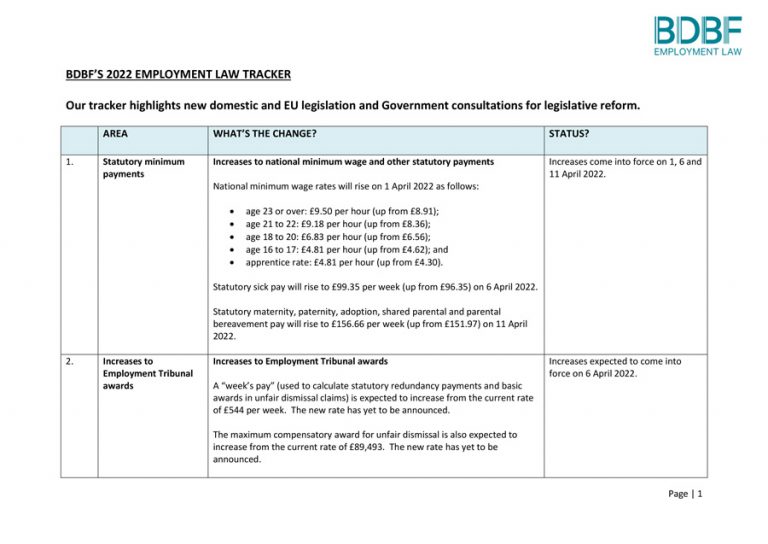
Employment law never stops changing – and 2022 looks like it will be no exception.  The year ahead promises an array of reforms affecting discrimination, sexual harassment, flexible working, redundancy protection and non-compete restrictions.  We will also see the introduction of new employee rights including rights to carer’s leave and neonatal leave, as well as possible new protections for menopausal workers.

Our detailed employment law tracker will provide you with an at-a-glance guide to all of these changes and more, and also links to more detailed briefings on the most important changes.  Click on the image below to view the tracker.

[/et_pb_text][et_pb_image src=”http://davidk423.sg-host.com/wp-content/uploads/2022/01/2022-Employment-Law-Tracker-FINAL-1.jpg” title_text=”2022-Employment-Law-Tracker-(FINAL)-1″ url=”http://davidk423.sg-host.com/wp-content/uploads/2022/01/2022-Employment-Law-Tracker-FINAL.pdf” align=”center” admin_label=”Image” _builder_version=”4.14.2″ _module_preset=”default” border_width_all=”1px” border_color_all=”#118e71″ global_colors_info=”{}”][/et_pb_image][/et_pb_column][/et_pb_row][/et_pb_section][et_pb_section fb_built=”1″ _builder_version=”3.26.6″ global_colors_info=”{}”][et_pb_row _builder_version=”3.26.6″ global_colors_info=”{}”][et_pb_column type=”4_4″ _builder_version=”3.26.6″ global_colors_info=”{}”][/et_pb_column][/et_pb_row][/et_pb_section]


Blue Monday: 5 Tips for Happiness and Wellbeing While WFH this Winter

[et_pb_section fb_built=”1″ _builder_version=”3.0.100″ background_image=”http://davidk423.sg-host.com/wp-content/uploads/2017/09/bdbf_final-stages-1-4-1.jpg” custom_padding=”|||” global_module=”2165″ saved_tabs=”all” global_colors_info=”{}”][et_pb_row _builder_version=”4.7.4″ min_height=”66.4px” custom_padding=”50px||||false|false” global_colors_info=”{}”][et_pb_column type=”4_4″ _builder_version=”3.25″ custom_padding=”|||” global_colors_info=”{}” custom_padding__hover=”|||”][et_pb_text _builder_version=”4.7.4″ _dynamic_attributes=”content” text_font=”|700|||||||” text_font_size=”27px” background_layout=”dark” custom_margin=”0px|||” custom_padding=”0px|||” global_colors_info=”{}”]@ET-DC@eyJkeW5hbWljIjp0cnVlLCJjb250ZW50IjoicG9zdF90aXRsZSIsInNldHRpbmdzIjp7ImJlZm9yZSI6IiIsImFmdGVyIjoiIn19@[/et_pb_text][et_pb_text _builder_version=”4.7.4″ _dynamic_attributes=”content” _module_preset=”default” background_layout=”dark” global_colors_info=”{}”]@ET-DC@eyJkeW5hbWljIjp0cnVlLCJjb250ZW50IjoicG9zdF9kYXRlIiwic2V0dGluZ3MiOnsiYmVmb3JlIjoiIiwiYWZ0ZXIiOiIiLCJkYXRlX2Zvcm1hdCI6ImRlZmF1bHQiLCJjdXN0b21fZGF0ZV9mb3JtYXQiOiIifX0=@[/et_pb_text][/et_pb_column][/et_pb_row][/et_pb_section][et_pb_section fb_built=”1″ admin_label=”section” _builder_version=”3.22.3″ global_colors_info=”{}”][et_pb_row admin_label=”row” _builder_version=”4.7.4″ background_size=”initial” background_position=”top_left” background_repeat=”repeat” global_colors_info=”{}”][et_pb_column type=”4_4″ _builder_version=”3.25″ custom_padding=”|||” global_colors_info=”{}” custom_padding__hover=”|||”][et_pb_text _builder_version=”4.14.2″ text_orientation=”justified” hover_enabled=”0″ use_border_color=”off” global_colors_info=”{}” sticky_enabled=”0″]

Blue Monday is upon us!

For those unfamiliar with this turn-of-phrase, “Blue Monday” is commonly considered the saddest day of the year. It’s been long enough since December for Christmas cheer to have worn off, yet there is little prospect of Winter’s dark and cold grasp loosening any time soon. Add to this the bills racked up from Christmas generosity, and the fact that most of our New Year’s resolutions have already failed, and it is little surprise that we tend to feel a little more “blue” than usual today. This may be particularly true this year, as we share the sinking feeling of being back in lockdown-lite, with COVID infections rife and instructions to “work from home” still in place.

Of course, depending on the nature and extent of your feelings, you may be suffering from more than mere Blue Monday blues. For some people, struggles with mental health such as depression or anxiety will constitute a “disability” under the Equality Act 2010. A condition will amount to a disability if it is a physical or mental impairment which has a substantial and long-term adverse effect on the ability to carry out normal day-to-day activities. While there are many aspects to this definition, it is important to be aware that for a condition to be “long term” it needs to have lasted, or be expected to last, for at least 12 months.

Employers are under a proactive duty to make reasonable adjustments for disabled workers to avoid the disadvantage caused by their disability in the workplace. For mental health issues, this duty arises irrespective of whether the impairment was caused by work or by an external factor.

Even for workers not suffering from  mental health impairments, January can be a bleak month. It is important that we all do as much as we can to protect our own (or our employees) health and wellbeing during this time. With this in mind we have put together a few tips for keeping your spirits up while working from home this winter:

  1. Get properly dressed before starting work each morning. We all loved the rush that comes from joining a Zoom meeting with a smart-shirt on show and a pair of pyjamas hidden below the camera lens, but, in truth, a pair of jeans or similar will help most of us feel more motivated and ready to face the day.
  2. Make sure you are walking. We are all aware of the seemingly unattainable target of 10,000 steps a day. It is particularly difficult this month where it is dark by 4pm, and many of us are working from home. But walking is extremely beneficial for our health and wellbeing (and cannot be substituted by a trip to the gym!). Try and build a walk-a-day into your routine – even if it’s only for 15 minutes.
  3. Slow down. January is a month where we are all trying to achieve a lot, both at work and in our personal lives. Make sure you are taking moments for yourself. Meditation isn’t for everyone (it’s not for me!) but you can still take time for you. One simple tip is to leave your phones behind (work and personal) when making a cup of tea or coffee. Use those few minutes to check-in with yourself, watch the kettle boil, try and settle your racing mind. Trust me, most things can wait 5 minutes!
  4. Reduce screen time. The cold and dark of January, and the fact that we are still largely working from home, inevitably increases our (already excessive) screen time. The first thing most of us probably do in the morning is check our phones. Then we sit in front of our computer screens working all day. Exhausted after dinner we will probably flop in front of the TV. Make sure you are finding some time each day to disconnect from your screens, whether that be going to the gym, cooking dinner in the evening or sitting and talking to those you live with.
  5. DON’T PUT TOO MUCH PRESSURE ON YOURSELF! January is hard enough without self-flagellation for being the same person you were in 2021. We would all like to see some self-improvement this year, whether that be progressing in our careers, being healthier, or being happier – but this doesn’t need to start and end with success in January. Have patience, set yourself achievable goals and if all goes wrong remind yourself… no one expects you to be or feel perfect all of the time.

Remember, these are just a few personal tips for combatting Blue Monday blues. If you believe you are suffering from more serious mental health issues please speak to your doctor.

If you would like to discuss any issues relating to the content of this article, please contact Rebecca Rubin (rebeccarubin@bdbf.co.uk), or your usual BDBF contact.

[/et_pb_text][/et_pb_column][/et_pb_row][/et_pb_section][et_pb_section fb_built=”1″ _builder_version=”3.26.6″ global_colors_info=”{}”][et_pb_row _builder_version=”3.26.6″ global_colors_info=”{}”][et_pb_column type=”4_4″ _builder_version=”3.26.6″ global_colors_info=”{}”][/et_pb_column][/et_pb_row][/et_pb_section]


Look both ways before you cross the road: top tips for senior executives thinking of changing roles in 2022

[et_pb_section fb_built=”1″ _builder_version=”3.0.100″ background_image=”http://davidk423.sg-host.com/wp-content/uploads/2017/09/bdbf_final-stages-1-4-1.jpg” custom_padding=”|||” global_module=”2165″ saved_tabs=”all” global_colors_info=”{}”][et_pb_row _builder_version=”4.7.4″ min_height=”66.4px” custom_padding=”50px||||false|false” global_colors_info=”{}”][et_pb_column type=”4_4″ _builder_version=”3.25″ custom_padding=”|||” global_colors_info=”{}” custom_padding__hover=”|||”][et_pb_text _builder_version=”4.7.4″ _dynamic_attributes=”content” text_font=”|700|||||||” text_font_size=”27px” background_layout=”dark” custom_margin=”0px|||” custom_padding=”0px|||” global_colors_info=”{}”]@ET-DC@eyJkeW5hbWljIjp0cnVlLCJjb250ZW50IjoicG9zdF90aXRsZSIsInNldHRpbmdzIjp7ImJlZm9yZSI6IiIsImFmdGVyIjoiIn19@[/et_pb_text][et_pb_text _builder_version=”4.7.4″ _dynamic_attributes=”content” _module_preset=”default” background_layout=”dark” global_colors_info=”{}”]@ET-DC@eyJkeW5hbWljIjp0cnVlLCJjb250ZW50IjoicG9zdF9kYXRlIiwic2V0dGluZ3MiOnsiYmVmb3JlIjoiIiwiYWZ0ZXIiOiIiLCJkYXRlX2Zvcm1hdCI6ImRlZmF1bHQiLCJjdXN0b21fZGF0ZV9mb3JtYXQiOiIifX0=@[/et_pb_text][/et_pb_column][/et_pb_row][/et_pb_section][et_pb_section fb_built=”1″ admin_label=”section” _builder_version=”3.22.3″ global_colors_info=”{}”][et_pb_row admin_label=”row” _builder_version=”4.7.4″ background_size=”initial” background_position=”top_left” background_repeat=”repeat” global_colors_info=”{}”][et_pb_column type=”4_4″ _builder_version=”3.25″ custom_padding=”|||” global_colors_info=”{}” custom_padding__hover=”|||”][et_pb_text _builder_version=”4.14.2″ text_orientation=”justified” hover_enabled=”0″ use_border_color=”off” global_colors_info=”{}” sticky_enabled=”0″]

It’s the start of another year and thoughts naturally turn to the new challenges and adventures that lie ahead – including in the world of work. You may be thinking about looking for a new role, or perhaps a job offer is already on the horizon. In this article, Melvyna Mumunie sets out key tips and considerations for senior executives when exiting and entering a job.  

The prospect of looking for a new job can at the same time be daunting, exciting and all encompassing. When you begin your search, you will be focussed on the end goal – getting the job. The road can be long and winding. However, once you finally have the job offer, for your own sake and that of your new employer’s, you will want to avoid disappointment and ensure that the transition is as smooth and efficient as possible.

So, how do you leave your current employer for another with as few bumps as possible along the way? I gathered some top tips and key considerations from Paula Chan, Tom McLaughlin and Blair Wassman for senior executives looking to make the leap.

Leaving your current role

First thing’s first, be clear about your obligations to your current employer. That way, you can avoid the common mistakes that many make when changing jobs. Make sure you have copies of your employment contract and any other contractual documents you may be subject to, including any relevant company policy and share or incentive plan rules.

Your notice period

Understand your notice obligations. You need to how much notice you need to give your employer before your employment will come to an end.  Details of your notice period, whether you may be placed on garden leave during any notice period and how you should serve notice, will be found in your employment contract.  Usually, notice of termination has to be given in writing.

If there is conflict between your notice period and the start date in your new role, all is not lost. Establish whether there is any flexibility on your start date with your prospective employer. If not, your current employer may be open to negotiating a shorter notice period. It is advisable to have this discussion with your current employer sooner rather than later to give them time to consider suitable handover arrangements.

Be aware that there is no guarantee that your current employer will agree to release you from your full contractual notice period. Your current employer may be unwilling to agree an earlier employment end date for various reasons. Often employers need exiting employees to continue in post until a replacement is ready to take over or, where an employer has the right to do so, they may keep the employee out of the market for the full duration of their notice period by placing them on garden leave.

Restrictive covenants

As a senior employee, you may be subject to restrictive covenants (also known as post-termination restrictions) in your employment contract and/or other contractual documents (e.g. share scheme rules or long-term incentive plans).

By way of example, restrictive covenants may, for a period, prevent you from:

  • Working for a competitor or in competition with your current employer.
  • Approaching employees in an attempt to hire them into a different role (i.e. with your new employer).
  • Approaching and/or dealing with your current employer’s clients, customers or vendors.

If you are subject to restrictive covenants, you should take advice on your duties and restrictions at an early stage. Do not let the matter snowball because the stakes can be high and better outcomes can be achieved all round if the matter is addressed before a dispute arises.

However, it is worth remembering that restrictive covenants will not always hold you back.  Restrictive covenants are not always enforceable. They are only enforceable where they are reasonable and go no further than is necessary to protect your employer’s legitimate business interests. In certain circumstances, you might be able to escape your restrictions (and notice period) altogether. This may be the case if you have been constructively dismissed.  A detailed review of your role, and various other matters is required to establish the likely enforceability of a restrictive covenant and whether there is any escape route.

Make sure your prospective employer is aware of your restrictive covenants. Understanding your obligations will enable you to negotiate potential pay for the period in which you may need to stay out of the job market  and/or support in relation to any dispute with your former employer about your obligations.

Negotiating a new job offer

We are often approached by clients asking: “Can I negotiate my contract?”.  The answer is “yes”, and you are in the best position to negotiate the most beneficial terms before your employment starts.  We commonly assist clients to do this in the background rather than dealing with the prospective employer directly.

Whilst some employers will not deviate from their standard form contract, this is not the case across the board. Many employers will welcome proposals and we often successfully negotiate more favourable terms for professionals joining small and large organisations.

For those looking to negotiate new employment contracts here are our top tips:

  • Pick your battles. This is a new relationship. We recommend that clients pick their battles and focus on the most important elements of the deal when negotiating to get things off to a good start and maximise the prospect of securing what matters most.
  • Read the small print. Some more employer friendly provisions in the contract may be hidden in places you may not expect. For example, you should check whether there is an option for the employer to make a payment in lieu of notice and, if so, whether this payment includes benefits and bonus.
  • Pay attention to probationary periods. Check whether you will be subject to a probationary period and whether there is an option for the employer to unilaterally (without your agreement) extend this period.
  • Do not proceed without a clear understanding of variable remuneration. As part of your job offer, you may be entitled to receive a bonus, incentives or some other form of deferred compensation. It is essential that you understand exactly what you will be entitled to, how awards will be made, and any conditions attached to them.
  • Avoid relying on promises not contained in the contract. All elements of the terms of your job offer should be expressly incorporated into the contract. All terms should be clear and should avoid the employer the luxury of being able to default on promises at a later stage.

As they say, failing to prepare is preparing to fail. We regularly advise our clients on negotiated exits and new employment opportunities. If you would like to know more, or you need advice about a prospective move, please contact Melvyna Mumunie (melvynamumunie@bdbf.co.uk) or your usual BDBF contact.

[/et_pb_text][/et_pb_column][/et_pb_row][/et_pb_section][et_pb_section fb_built=”1″ _builder_version=”3.26.6″ global_colors_info=”{}”][et_pb_row _builder_version=”3.26.6″ global_colors_info=”{}”][et_pb_column type=”4_4″ _builder_version=”3.26.6″ global_colors_info=”{}”][/et_pb_column][/et_pb_row][/et_pb_section]


What do employers need to know about in 2022?

[et_pb_section fb_built=”1″ _builder_version=”3.0.100″ background_image=”http://davidk423.sg-host.com/wp-content/uploads/2017/09/bdbf_final-stages-1-4-1.jpg” custom_padding=”|||” global_module=”2165″ saved_tabs=”all” global_colors_info=”{}”][et_pb_row _builder_version=”4.7.4″ min_height=”66.4px” custom_padding=”50px||||false|false” global_colors_info=”{}”][et_pb_column type=”4_4″ _builder_version=”3.25″ custom_padding=”|||” global_colors_info=”{}” custom_padding__hover=”|||”][et_pb_text _builder_version=”4.7.4″ _dynamic_attributes=”content” text_font=”|700|||||||” text_font_size=”27px” background_layout=”dark” custom_margin=”0px|||” custom_padding=”0px|||” global_colors_info=”{}”]@ET-DC@eyJkeW5hbWljIjp0cnVlLCJjb250ZW50IjoicG9zdF90aXRsZSIsInNldHRpbmdzIjp7ImJlZm9yZSI6IiIsImFmdGVyIjoiIn19@[/et_pb_text][et_pb_text _builder_version=”4.7.4″ _dynamic_attributes=”content” _module_preset=”default” background_layout=”dark” global_colors_info=”{}”]@ET-DC@eyJkeW5hbWljIjp0cnVlLCJjb250ZW50IjoicG9zdF9kYXRlIiwic2V0dGluZ3MiOnsiYmVmb3JlIjoiIiwiYWZ0ZXIiOiIiLCJkYXRlX2Zvcm1hdCI6ImRlZmF1bHQiLCJjdXN0b21fZGF0ZV9mb3JtYXQiOiIifX0=@[/et_pb_text][/et_pb_column][/et_pb_row][/et_pb_section][et_pb_section fb_built=”1″ admin_label=”section” _builder_version=”3.22.3″ global_colors_info=”{}”][et_pb_row admin_label=”row” _builder_version=”4.7.4″ background_size=”initial” background_position=”top_left” background_repeat=”repeat” global_colors_info=”{}”][et_pb_column type=”4_4″ _builder_version=”3.25″ custom_padding=”|||” global_colors_info=”{}” custom_padding__hover=”|||”][et_pb_text _builder_version=”4.14.2″ text_orientation=”justified” use_border_color=”off” global_colors_info=”{}”]

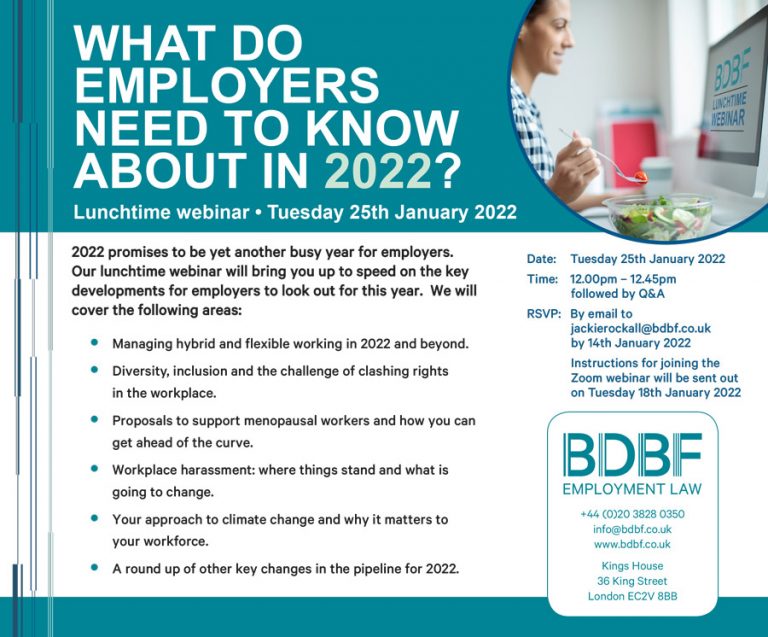
Join our lunchtime webinar on 25 January 2022 when we will survey the key issues for employers in 2022.

Click on the link below for full details of the agenda. If you’d like to sign up please email Jackie Rockall at jackierockall@bdbf.co.uk.

[/et_pb_text][et_pb_image src=”http://davidk423.sg-host.com/wp-content/uploads/2021/12/BDBF-Lunchtime-Webinar-25-January-2022.jpg” title_text=”BDBF-Lunchtime-Webinar-25-January-2022″ url=”http://davidk423.sg-host.com/wp-content/uploads/2021/12/BDBF-Lunchtime-Webinar-25-January-2022.pdf” admin_label=”Image” _builder_version=”4.14.2″ _module_preset=”default” border_width_all=”1px” border_color_all=”#118e71″ global_colors_info=”{}”][/et_pb_image][/et_pb_column][/et_pb_row][/et_pb_section][et_pb_section fb_built=”1″ _builder_version=”3.26.6″ global_colors_info=”{}”][et_pb_row _builder_version=”3.26.6″ global_colors_info=”{}”][et_pb_column type=”4_4″ _builder_version=”3.26.6″ global_colors_info=”{}”][/et_pb_column][/et_pb_row][/et_pb_section]


What does Plan B mean for office-based employers?

[et_pb_section fb_built=”1″ _builder_version=”3.0.100″ background_image=”http://davidk423.sg-host.com/wp-content/uploads/2017/09/bdbf_final-stages-1-4-1.jpg” custom_padding=”|||” global_module=”2165″ saved_tabs=”all” global_colors_info=”{}”][et_pb_row _builder_version=”4.7.4″ min_height=”66.4px” custom_padding=”50px||||false|false” global_colors_info=”{}”][et_pb_column type=”4_4″ _builder_version=”3.25″ custom_padding=”|||” global_colors_info=”{}” custom_padding__hover=”|||”][et_pb_text _builder_version=”4.7.4″ _dynamic_attributes=”content” text_font=”|700|||||||” text_font_size=”27px” background_layout=”dark” custom_margin=”0px|||” custom_padding=”0px|||” global_colors_info=”{}”]@ET-DC@eyJkeW5hbWljIjp0cnVlLCJjb250ZW50IjoicG9zdF90aXRsZSIsInNldHRpbmdzIjp7ImJlZm9yZSI6IiIsImFmdGVyIjoiIn19@[/et_pb_text][et_pb_text _builder_version=”4.7.4″ _dynamic_attributes=”content” _module_preset=”default” background_layout=”dark” global_colors_info=”{}”]@ET-DC@eyJkeW5hbWljIjp0cnVlLCJjb250ZW50IjoicG9zdF9kYXRlIiwic2V0dGluZ3MiOnsiYmVmb3JlIjoiIiwiYWZ0ZXIiOiIiLCJkYXRlX2Zvcm1hdCI6ImRlZmF1bHQiLCJjdXN0b21fZGF0ZV9mb3JtYXQiOiIifX0=@[/et_pb_text][/et_pb_column][/et_pb_row][/et_pb_section][et_pb_section fb_built=”1″ admin_label=”section” _builder_version=”3.22.3″ global_colors_info=”{}”][et_pb_row admin_label=”row” _builder_version=”4.7.4″ background_size=”initial” background_position=”top_left” background_repeat=”repeat” global_colors_info=”{}”][et_pb_column type=”4_4″ _builder_version=”3.25″ custom_padding=”|||” global_colors_info=”{}” custom_padding__hover=”|||”][et_pb_text _builder_version=”4.14.2″ text_orientation=”justified” hover_enabled=”0″ use_border_color=”off” global_colors_info=”{}” sticky_enabled=”0″]

In this briefing we round up the Plan B contingency measures to be adopted in the fight against the Omicron variant and assess what the latest “work from home” guidance really means for office-based employers.

What are the Plan B restrictions and when do they come into force?

The Government’s Autumn and Winter plan set out the measures needed to manage COVID through the Autumn and Winter months, including contingency measures – a “Plan B” – to be followed in the event of unsustainable pressure on the NHS.  On 8 December 2021, the Prime Minister announced that these Plan B measures were to be triggered in the light of the growing number of Omicron variant infections (you can read more about the Omicron variant in our briefing here).  The Plan B restrictions are summarised below.

  • Face coverings: From Friday, 10 December 2021, face coverings were required by law in some public indoor settings, such as theatres and cinemas, but not in hospitality settings.  This was in addition to the existing requirement to wear them in shops, cinemas premises that provide close contact services, transport hubs and on public transport.  There is no requirement to wear them in office settings, although the Working Safely during Coronavirus Guidelines for offices, factories and labs (the Guidelines) encourages the use of them in congested areas (e.g. corridors / lifts etc). 
  • Working from home: from Monday, 13 December 2021, office workers who can work were asked to do so.  However, this is guidance only, not law – it will not be unlawful to leave home to attend work.  For a full discussion of the latest working from home guidance, please see below.
  • Changes to self-isolation rules: new rules introduced in August had exempted certain groups of people (the double vaccinated and others) from the requirement to self-isolate where they had been in contact with a positive case of COVID.  However, these rules were changed in response to the Omicron variant, requiring anyone who was a contact of a suspected or confirmed Omicron variant case to self-isolate for ten days, even if they fell into one of the exempt categories.  However, from Tuesday, 14 December 2021, the rules changed again.  From this date, anyone falling into an exempted group who was a contact of someone with COVID (whether Omicron or otherwise) will not need to self-isolate. Instead, they should take lateral flow tests daily for seven days. You can read more about the new rules here.
  • Covid pass: from 6am on Wednesday 15 December, certain businesses and events (nightclubs and large venues) were required by law to check the COVID status of workers and customers using the NHS COVID pass or a negative lateral flow test.  This should not affect office-based employers.

Do the Plan B restrictions mean that all office workers must now work at home?

No.  The guidance for office-based employers on working from home has evolved subtly throughout the pandemic.   Before considering the latest position, it is helpful to reflect on how the position has changed over the last two years.

  • Spring – Autumn 2020: At the outset of the pandemic, the advice was that everyone should work from home save where it was not possible to do so. By August 2020, the Guidelines had been softened slightly to allow employers greater discretion to return workers to the office, provided it was possible to do so safely. 
  • Autumn 2020 – Spring 2021: When the second wave of the pandemic hit in October 2020, the guidance was tightened up to say that those office workers who could “work effectively” from home should do so over the Winter of 2020.  However, anyone who could not do so was permitted to attend the office, provided that it was safe to do so. This iteration of the guidance was flexible enough to leave it to the worker to decide what “working effectively” meant for them (within reason).
  • Spring – Summer 2021: By Spring 2021, the Guidelines were moderated to provide that workers could return to the office when Step 4 of the unlock roadmap was reached (which eventually took place on 29 July 2021). However, the guidance said that workers could attend the office before Step 4 was reached if they could not work effectively from home, it was appropriate in the light of a worker’s mental or physical health difficulties or it was appropriate in the light of a worker’s “particularly challenging” home working environment.
  • Summer – Winter 2021: All COVID restrictions were lifted on 29 July 2021 and the guidance was updated to allow employers the freedom to return all workers to the office on a gradual basis over the Summer. Most employers did this over the late Summer and Autumn months, although many opted to retain a degree of hybrid working.

The new Guidelines applied from 13 December 2021.  They provide that office workers should work from home “if they can”.  There is no qualification to say that they should do this only where they cannot work “effectively” from home.  However, the guidance goes on to say that anyone who cannot work from home may continue to go into work, for example, where they need to access equipment which is necessary for their role, or where their role mustbe completed in-person.  It also states that employers should consider whether home working is appropriate for workers facing mental or physical health challenges, or those with a particularly challenging home environment. 

Therefore, the Guidelines are similar to those in place throughout Spring and Summer 2021, save that the absence of the word “effectively”, and the emphasis on attending where “necessary” or if they “must”, suggests a slightly more restrictive approach.   In our view, the end result is that employers should not ask workers to attend the office for non-essential reasons (and nor should workers elect to do so).

However, there remains leeway for workers to attend the office where they face mental or physical health difficulties.  For example, if a worker finds that homeworking causes or exacerbates depression or anxiety then they may attend the office.  In addition, if the worker has a “particularly challenging” home working environment it may be appropriate for them to attend the office.  The Guidelines do not expand on what counts as “particularly challenging”, but it is reasonable to conclude that it has to be something more than being bored of working from home or wanting to socialise with colleagues.  It is likely to cover things like:

  • poor internet access;
  • disruption caused by a house move or building works;
  • inability to concentrate due to a noisy environment;
  • cramped working conditions; and/or
  • lack of privacy.

The Guidelines state that where a worker does attend the workplace, they should consider taking regular lateral flow tests to manage the risk.

It’s also worth noting that the Guidelines urge caution in relation to people who are at higher risk of infection from COVID and/or an adverse outcome if infected.  These groups are not specified but will include those who are considered clinically extremely vulnerable, some disabled workers, pregnant workers and, potentially, any unvaccinated workers.  At the same time, employers must take care not to discriminate against a worker because of a protected characteristic.

Next steps?

Office-based employers should now take the following steps:

  • consult with workers and decide who needs to come into the workplace and who can work from home (bearing in mind the special needs of “at risk” workers and those with protected characteristics);
  • update their health and safety risk assessment in light of Omicron and implement any measures;
  • communicate the latest guidance to staff and ensure they understand that they should only attend the office in appropriate circumstances; and
  • stay alert to changes to the restrictions – a review of the current position is expected in the early January 2022.

BDBF is currently advising many employers on the challenges presented by the coronavirus.  If you or your business needs advice on any coronavirus-related matter please contact Amanda Steadman (amandasteadman@bdbf.co.uk) or your usual BDBF contact.

[/et_pb_text][/et_pb_column][/et_pb_row][/et_pb_section][et_pb_section fb_built=”1″ _builder_version=”3.26.6″ global_colors_info=”{}”][et_pb_row _builder_version=”3.26.6″ global_colors_info=”{}”][et_pb_column type=”4_4″ _builder_version=”3.26.6″ global_colors_info=”{}”][/et_pb_column][/et_pb_row][/et_pb_section]


A cautionary tale for all those dealing with flexible working requests

[et_pb_section fb_built=”1″ _builder_version=”3.0.100″ background_image=”http://davidk423.sg-host.com/wp-content/uploads/2017/09/bdbf_final-stages-1-4-1.jpg” custom_padding=”|||” global_module=”2165″ saved_tabs=”all” global_colors_info=”{}”][et_pb_row _builder_version=”4.7.4″ min_height=”66.4px” custom_padding=”50px||||false|false” global_colors_info=”{}”][et_pb_column type=”4_4″ _builder_version=”3.25″ custom_padding=”|||” global_colors_info=”{}” custom_padding__hover=”|||”][et_pb_text _builder_version=”4.7.4″ _dynamic_attributes=”content” text_font=”|700|||||||” text_font_size=”27px” background_layout=”dark” custom_margin=”0px|||” custom_padding=”0px|||” global_colors_info=”{}”]@ET-DC@eyJkeW5hbWljIjp0cnVlLCJjb250ZW50IjoicG9zdF90aXRsZSIsInNldHRpbmdzIjp7ImJlZm9yZSI6IiIsImFmdGVyIjoiIn19@[/et_pb_text][et_pb_text _builder_version=”4.7.4″ _dynamic_attributes=”content” _module_preset=”default” background_layout=”dark” global_colors_info=”{}”]@ET-DC@eyJkeW5hbWljIjp0cnVlLCJjb250ZW50IjoicG9zdF9kYXRlIiwic2V0dGluZ3MiOnsiYmVmb3JlIjoiIiwiYWZ0ZXIiOiIiLCJkYXRlX2Zvcm1hdCI6ImRlZmF1bHQiLCJjdXN0b21fZGF0ZV9mb3JtYXQiOiIifX0=@[/et_pb_text][/et_pb_column][/et_pb_row][/et_pb_section][et_pb_section fb_built=”1″ admin_label=”section” _builder_version=”3.22.3″ global_colors_info=”{}”][et_pb_row admin_label=”row” _builder_version=”4.7.4″ background_size=”initial” background_position=”top_left” background_repeat=”repeat” global_colors_info=”{}”][et_pb_column type=”4_4″ _builder_version=”3.25″ custom_padding=”|||” global_colors_info=”{}” custom_padding__hover=”|||”][et_pb_text _builder_version=”4.14.2″ text_orientation=”justified” hover_enabled=”0″ use_border_color=”off” global_colors_info=”{}” sticky_enabled=”0″]

A delay in hearing an appeal against a refusal to permit an employee to work flexibly left an employer facing an Employment Tribunal claim.  Find out what happened and learn how not to make the same mistakes.

What happened in this case?

The claimant worked for Network Rail.  He submitted a flexible working request on 11 February 2019.  This meant that Network Rail had until 10 May 2019 to decide whether to accept or reject the request.  This “decision period” includes the completion of any appeal process.  The claimant’s request was rejected on 7 March 2019 and an appeal was submitted on 13 March 2019.   Through no fault of either party, there was a delay in fixing the appeal hearing and it did not take place before the end of the decision period.  

On 24 June 2019 the claimant agreed that the appeal hearing should go ahead on 1 July 2019.  However, the next day, he launched a Tribunal claim alleging various breaches of the flexible working legislation, including that the process had not been completed before the expiry of the decision period.  The internal appeal hearing went ahead on 1 July 2019, and the appeal was dismissed on the same day.

The Employment Tribunal dismissed the claimant’s claims on the basis that they had been made prematurely.  The Tribunal said the claimant’s agreement to hold the appeal hearing on 1 July 2019 meant he had also agreed to extend the decision period itself.   Here, the logic was that an appeal has to take place within the decision period, therefore, agreeing an appeal hearing date outside the decision period equates to an agreement that the decision period be extended until at least the same date (and possibly for a reasonable period time afterwards to allow for a decision to be reached).  They said it would have been open to the claimant to have reserved his position on this point, but he had not done so. 

The result was that the claim had been submitted before the expiry of the decision period and was premature, meaning the Tribunal did not have jurisdiction to hear the claims.  The claimant appealed to the Employment Appeal Tribunal.

What was decided?

The key issue was whether the Tribunal had been correct to say that an agreement to attend an appeal hearing after the end of the decision period amounted to an agreement that the decision period itself should be extended. 

The EAT held that an agreement to extend the decision period could be express or implied.  However, it must be clear that there is such an agreement.  Importantly, there was nothing implicit in an employee’s agreement to attend an appeal hearing that meant that he must have agreed to an extension of the decision period. 

The EAT rejected Network Rail’s argument that there would be no point in attending an appeal hearing if the decision period was not also extended.  Holding an appeal hearing outside of the decision period might resolve the parties’ differences and avoid a Tribunal hearing or, at least, narrow the issues in dispute.  If it did not resolve matters, then the claimant was entitled to pursue a claim for compensation for breach of the flexible working rules.

The EAT decided there had been no agreement to extend the decision period and, therefore, the claim was not premature and could proceed.

What does this decision mean for employers?

Strictly speaking, there is no obligation to offer a right of appeal in relation to a flexible working request decision.  However, if you do offer one, then you are obliged to notify the employee of your decision on the appeal within the three-month decision period for concluding the process.  Therefore, one simple way of avoiding the mess that the employer got itself into here could be not to offer a right of appeal at all.  However, in practice, many employers choose to offer an appeal because they consider this the fair thing to do.  Further, an appeal stage is recommended by the Acas Statutory Code of Practice on how to handle flexible working requests in a reasonable manner (which is taken into account by Employment Tribunals where relevant).

Where you do offer an appeal, then it is vital that the person in charge of that process diarises the expiry date of the decision period and works to complete the process by that point.  Yet in the real world, it is not always possible to meet every HR deadline.  This is a particular issue for employers at the moment who are juggling the challenges of COVID-19, sick and isolating staff and managing home working arrangements.  If it becomes clear that the process won’t be completed by the deadline, then you need to seek the employee’s agreement to extend the decision period itself, ideally in writing.  This agreement will be needed where the appeal hearing hasn’t taken place (as in this case), but also where it has taken place, but the decision has not yet been notified to employee.

With a bit of careful planning, you can avoid ending up in the situation that Network Rail have found themselves in.

Walsh v Network Rail Infrastructure Limited. 

[/et_pb_text][/et_pb_column][/et_pb_row][/et_pb_section][et_pb_section fb_built=”1″ _builder_version=”3.26.6″ global_colors_info=”{}”][et_pb_row _builder_version=”3.26.6″ global_colors_info=”{}”][et_pb_column type=”4_4″ _builder_version=”3.26.6″ global_colors_info=”{}”][/et_pb_column][/et_pb_row][/et_pb_section]