The party season is here, and it’s time to celebrate. But before the mulled wine flows and the dance floor calls… ho-ho-how do you keep the festivities merry, bright and free of the dreaded HR hangover?
Unwrap our tips here.
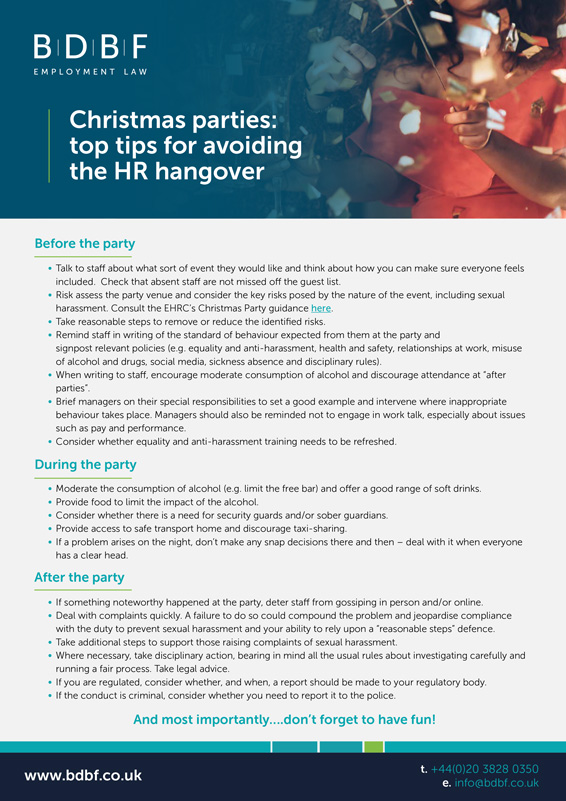
The party season is here, and it’s time to celebrate. But before the mulled wine flows and the dance floor calls… ho-ho-how do you keep the festivities merry, bright and free of the dreaded HR hangover?
Unwrap our tips here.
International Women’s Day falls on Saturday 8 March, and this year’s theme is #AccelerateAction.
Despite being recognised for over a century, many women still encounter bias in the workplace. While many may perceive gender inequality as a relic of the past, our experiences as employment advisors to numerous women tell a different story.
To break the cycle of bias, whether it is conscious or unconscious, it is crucial to identify the stages in a woman’s career where she may encounter challenges. In this mini-webinar series, BDBF Principal Knowledge Lawyer Amanda Steadman examines the professional lifecycle of women, the various obstacles they may face and the actions employers can take to foster an environment where women can thrive.
Menstrual health
Menstrual health is a critical aspect of women’s overall wellbeing, yet it often remains an overlooked or stigmatised issue in the workplace. Every month, millions of working women experience menstruation, which can bring a range of symptoms from mild discomfort to severe pain and distress. This natural biological process can significantly impact productivity, concentration and attendance at work. Inadequate access to sanitary products, unsupportive workplace policies and cultural taboos surrounding menstruation can exacerbate these challenges, leading to missed opportunities and income loss.
Fertility issues and pregnancy loss
Fertility issues and pregnancy loss are profound challenges that many working women face in their quest to start or expand their families. These distressing experiences often occur in the shadows of their professional lives, where they are expected to maintain productivity and composure. The emotional toll of such losses can significantly impact their mental and physical health, affecting their job performance and overall career trajectory. By fostering a supportive work environment, employers can help mitigate the stigma associated with fertility struggles and ensure that these employees feel valued and empowered to navigate the complexities of their personal and professional lives.
Pregnancy
Pregnant working women often face a unique set of challenges as they navigate the physical, emotional and professional changes that accompany their condition. These challenges can range from adjusting work routines to accommodate growing physical needs, managing the fatigue and discomfort associated with pregnancy, to balancing the anticipation and planning of parenthood with job responsibilities. Employers play a critical role in supporting expectant mothers by offering flexible work arrangements, such as modified work hours and ensuring a comfortable and safe work environment. Through open communication, understanding and the provision of appropriate resources, both employers and co-workers can help ensure a positive pregnancy experience for working females, leading to increased job satisfaction and productivity.
Maternity
Maternity is a transformative period in a woman’s life, significantly impacting her professional journey. Working women face a multitude of challenges when they decide to start a family. From navigating the complexities of maternity leave policies to balancing the demands of a career and new motherhood, these experiences can reshape their aspirations and opportunities. Despite societal progress, the intersection of work and family remains fraught with issues like gender bias, workplace flexibility and the persistent wage gap. As women continue to break barriers and redefine work-life balance, the conversation around maternity in the workplace evolves, aiming to ensure equality and foster environments that empower them to thrive both personally and professionally.
Menopause
Menopause is a natural biological process that signals the end of a woman’s reproductive years, and often brings about a multitude of physical and emotional changes that can impact her professional life. Working women may face a range of symptoms, including hot flashes, mood swings, sleep disturbances and decreased concentration, which can affect their job performance, productivity and overall workplace satisfaction. This transition can also coincide with career-defining moments, leading to a potential clash of personal and professional challenges. Employers who understand and support their menopausal employees by offering flexible work arrangements, education and open dialogue can create a more inclusive and supportive environment.
https://youtu.be/B00ITemV4AQ
View webinar PDF
Conclusion
While the experiences of women may vary based on their chosen paths, it is a common reality that each woman is likely to face at least one of the situations discussed in our above mini-webinars throughout her career. As solicitors specialising in employment and discrimination, we recognise the significant effects that unjust and antiquated practices can have on a woman’s professional journey. Although many organisations are actively addressing these challenges, some continue to ignore them. A shift in perceptions is essential to create a more equitable environment.
On this International Women’s Day, we honour those who have championed equality over the years and acknowledge the progress made in empowering and supporting women in the business sector. Nevertheless, there remains much work to be done. We aspire to raise awareness about the experiences of working women, encouraging employers to evaluate their practices and take meaningful strides to #AccelerateAction.
Further information about the movement and related events can be found on the IWD website.
This mini-webinar series was originally recorded on 26 February 2025 and reflects our understanding as of that date. Do get in contact with Amanda Steadman (AmandaSteadman@bdbf.co.uk) or your usual BDBF contact if you would like to discuss any of the issues raised.
The Supreme Court has ruled that an implied term prevented a private sector employer from dismissing and offering to re-engage employees on new terms, where the objective was to withdraw a contractual payment that was intended to be a permanent benefit.
What happened in this case?
In 2007, Tesco restructured its distribution centres, which meant closing some centres, expanding others and opening some new ones. Staff at the closing centres were asked to relocate to different sites instead of being made redundant and receiving redundancy payments. To incentivise the staff to do this, Tesco agreed with the trade union, USDAW, that it would make a “retained payment” to those who agreed to relocate to a different site. The retained payment reflected the difference in value between the employees’ contractual entitlements at the old and new distribution centres. In some cases, this was significant and represented between 30% to 40% of overall pay. It was agreed that the retained payment would be a permanent entitlement for those employees, and a term to this effect was incorporated into their employment contracts.
In 2021, Tesco sought to withdraw the retained payment. The affected employees were offered a lump sum payment in exchange for agreeing to the removal of the benefit. The employees were told that if they did not agree to this, they would be dismissed and offered a new contract of employment on identical terms but excluding the retained payment. In response, USDAW and several of the affected employees applied to the High Court for a declaration as to the meaning of the retained payment term, and an injunction to restrain Tesco from dismissing for the purpose of removing or reducing the retained payment.
USDAW and the employees succeeded at the High Court stage, with the Court deciding that there was an implied term preventing Tesco from terminating and offering re-engagement as a means of withdrawing the retained payment. However, this was overturned by the Court of Appeal, which held that such an implied term was not justified. USDAW and the employees appealed to the Supreme Court.
What was decided?
Tesco argued that the retained payment was permanent only for the duration of the employment contract and was subject always to Tesco’s contractual right to dismiss on notice. This approach was rejected by the Supreme Court on the basis that this would render as meaningless the promise that the retained payment would be a permanent entitlement.
The correct meaning of the term was that it would continue for the duration of employment in the same role. Yet the term had value if Tesco could simply dismiss and offer to re-engage as a route to unilaterally withdrawing it. Therefore, Tesco’s right to terminate the employment contract on notice was subject to an implied term that it could not dismiss for the purpose of depriving the employees of the retained payment.
The Court noted that the affected employees had been incentivised by the retained payment to agree to otherwise “unpalatable” relocations. It simply could not have been the intention that Tesco would have the right to dismiss as a means of withdrawing the retained payment – that would “flout industrial common sense”. However, this did not mean that Tesco could never terminate the employment of the affected employees; they could do so for other reasons, just not to avoid the retained payment. The Court said that the existence of an implied term restraining dismissal in this way was not new. Similar implied terms had been upheld in cases where an employee had a contractual right to permanent health insurance (PHI) benefits, and the dismissal would have deprived a sick employee of such benefits.
In deciding whether to reinstate the injunction preventing dismissal, the Court highlighted that “specific performance” of contractual obligations will not usually be ordered against parties to employment contracts. However, there is an exception to this rule, insofar as specific performance may be ordered against an employer provided there has been no breakdown of mutual trust and confidence. Given that Tesco was prepared to re-engage the employees on inferior terms, there had clearly not been any such breakdown in this case. The Court also noted that specific performance will not be ordered where damages were an adequate remedy for the wronged party. However, it was decided that damages would be inadequate in this case since it would have been limited to damages recoverable in an unfair dismissal claim.
Therefore, the Supreme Court restored the injunction preventing Tesco from dismissing the employees for the purpose of removing the retained payment term.
What does this mean for employers?
Employers stuck with a contractual benefit that they do not like should recognise that fire and rehire will not always come to their rescue – although it should be borne in mind that the facts of this case were unusual. Although it remains a highly unusual step for a Court to limit an employer’s right to terminate a contract of employment, this case underlines that it is possible in certain situations. Here, a term was implied to prevent dismissals aimed solely at removing a contractual benefit intended to be permanent. A similar term may be implied where an employer dismisses a sick employee entitled to PHI benefits, thereby depriving them of the very benefit intended to help them when sick. In both cases it would be necessary to imply the term in order to make sense of the contract and/or to reflect the parties’ actual intentions.
To avoid situations such as these, employers should exercise caution about promising contractual benefits which might be regarded as permanent. When entering into employment contracts, clear wording setting out the parameters of benefits are advisable, for example, by stipulating that they are time-limited and may be withdrawn by the employer.
However, it is important to remember that this decision does not go as far as preventing dismissal for other lawful reasons, for example, misconduct or redundancy. Although, given the background of this case, there is a risk that a future dismissal by Tesco would be viewed as a sham designed to hide the true reason i.e. ending the retained payment.
Tesco Stores Ltd v USDAW and others
BDBF is a law firm based at Bank in the City of London specialising in employment law. If you would like to discuss any issues relating to the content of this article, please contact Principal Knowledge Lawyer Amanda Steadman (amandasteadman@bdbf.co.uk) or your usual BDBF contact.
In the recent case of British Airways plc v Rollett and others the EAT has held that individuals may bring claims of indirect discrimination despite not sharing the protected characteristic of the disadvantaged group, provided that they suffer the same disadvantage.
What happened in this case?
The claimants are cabin crew members employed by British Airways (BA) who were adversely affected by scheduling changes following a restructuring exercise. The claimants argued that these changes unfairly disadvantaged groups with certain protected characteristics, namely: (i) non-British nationals who were required to commute to Heathrow Airport from abroad; and (ii) employees with caring responsibilities (who were predominantly women).
Some claimants had the relevant protected characteristic (i.e. they were non-British nationals and/or women), whereas others did not. Those who did not share the relevant protected characteristics nevertheless argued that they experienced the same disadvantage as those who did. For example, a British national commuting from France argued that she suffered the same disadvantage as her non-British colleagues, as did a male employee with caring responsibilities.
What was decided?
The Employment Tribunal (ET) held that claimants do not need to share the protected characteristic of the disadvantaged group, so long as they suffer the same disadvantage as a result of the employer’s provision, criterion or practice (PCP). The PCP in this case was the scheduling change implemented by BA.
BA appealed, arguing that only those who shared the protected characteristic should be allowed to bring claims of indirect discrimination. BA argued that the ET’s decision was incompatible with the statutory regime on indirect discrimination, since the Equality Act 2010 (Equality Act) requires claimants in indirect discrimination cases to have the same protected characteristic as the group disadvantaged by the PCP.
The EAT dismissed the appeal, holding that the Equality Act could be read compatibly with EU case law, particularly the European Court of Justice’s decision in CHEZ Razpredelenie Bulgaria (CHEZ), which allowed individuals who did not share the protected characteristic to bring indirect discrimination claims if they faced the same disadvantage. The EAT stated that this interpretation of the Equality Act was in line with its purpose, namely to strengthen the law and support progress on equality.
On 1 January 2024, the Equality Act was amended to reflect the decision in CHEZ. BA also sought to challenge the validity of the amendment but the EAT rejected that line of argument.
What does this mean for employers?
The indirect discrimination regime already requires employers to avoid PCPs which apply equally across the workforce, but which place groups with particular protected characteristics at a disadvantage. Claimants who share the relevant protected characteristic may bring indirect discrimination claims and will be successful if they can show that they were disadvantaged by the PCP, and the PCP cannot be objectively justified. The EAT’s decision does not change this. However, the decision clarifies that Employment Tribunals also have jurisdiction to hear such claims even where the claimants do not share the protected characteristic of the disadvantaged group. Although this position was codified in the Equality Act on 1 January 2024, the EAT’s decision remains relevant to claims predating that amendment (as well as also underlining that the amendment is valid).
Employers should remain cautious and consider the impact of any PCP on groups with different protected characteristics, but remember that the class of potential claimants in indirect discrimination cases is broader than it may first appear. For example, a policy of full-time office working may disadvantage workers with certain disabilities (e.g. CFS, depression or conditions affecting mobility), by causing them to suffer additional pain, exhaustion, distress or difficulty. Now, workers who do not meet the legal test of disability, but who experience the same types of disadvantages, may be able to bring indirect disability discrimination claims. For example, a menopausal worker whose symptoms were not considered to have a substantial enough effect on her day-to-day activities to amount to a disability, or a worker suffering from short-term reactive depression who did not pass the long-term element of the test might pursue claims for indirect discrimination on a “same disadvantage” basis. In theory, it might even extend to workers who are specifically excluded from the definition of disability, such as those suffering from alcoholism.
British Airways plc v Rollett and others and Minister for Women and Equalities (Intervener)
BDBF is a leading employment law firm based at Bank in the City of London. If you would like to discuss any issues relating to the content of this article, please contact Abdullah Ahmed (AbdullahAhmed@bdbf.co.uk), Amanda Steadman (AmandaSteadman@bdbf.co.uk) or your usual BDBF contact.
The Equality and Human Rights Commission (EHRC) has published new guidance for employers on how to support disabled workers with hybrid working. Aimed at managers and leaders, it provides practical tips, conversation prompts, questions and case studies, and covers both recruitment and employment.
On 5 September 2024, the EHRC published new guidance for employers on how to support disabled workers with hybrid working. The guidance recognises that working arrangements can bring benefits to disabled workers, including being better able to manage their health and wellbeing. However, it highlights that if it is not designed and implemented well it can also create difficulties like a lack of inclusion, isolation from colleagues or not having the necessary support or equipment in place to enable a worker to thrive in their role.
The guidance addresses the following topics in detail:
It also discusses a number of types of adjustments to hybrid working arrangements for disabled workers including things like: digital support, IT equipment, furniture, online and hybrid meeting etiquette and travel to work. It includes various case studies designed to showcase different types of adjustments including:
Although non-binding, the guidance will be a useful reference document for all employers operating hybrid working arrangements.
Supporting disabled workers with hybrid working: Guidance for employers
BDBF is a law firm based at Bank in the City of London specialising in employment law. If you would like to discuss any issues relating to the content of this article, please contact Principal Knowledge Lawyer Amanda Steadman (amandasteadman@bdbf.co.uk) or your usual BDBF contact.
Just weeks before it was due to come into force, the Government announced it has no plans to introduce the new right for workers to request predictable working patterns. Read on to find out why and what is coming in its place.
What is the background?
On 18 September 2023 the Workers (Predictable Terms and Conditions) Act 2023 became law. The Act was intended to give workers (and agency workers) a statutory right to request more “predictable” working patterns.
Where eligible, workers would be able to request a more predictable working pattern where their current work pattern lacked certainty in terms of hours, days and/or times worked. “Work pattern” also covered the length of the contract, and a presumption was to be made that a fixed-term contract of under 12 months lacked predictability. However, employers would be able to refuse such requests on a wide range of grounds. You can read our full summary of the proposed right here.
Although the Act had passed into law, its provisions did not come into force straight away. The intention was that it would take effect on 18 September 2024. In readiness, Acas published a draft statutory Code of Practice which provided further guidance on how employers should handle such requests.
What has changed?
Earlier this month, a spokesperson for the Department of Business and Trade confirmed that the Government had “no plans” to bring the Act into force. The Government has its own plans to address insecure working and intends to go further than providing a mere right to request a fixed working pattern. Instead, it plans to legislate to give workers the right to a new contract that reflects the number of hours worked over a period of 12 weeks or more. The spokesperson said the Government did not wish to confuse employers and workers with two different models, hence the scrapping of the right to request.
The planned right to a new contract will be complimented by proposals to:
The full detail of these proposals remains to be seen but all are expected to feature in the forthcoming Employment Rights Bill, which Labour had promised to publish within 100 days of taking power (so by 12 October 2024).
What does this mean for employers?
Some employers may have already prepared new policy documents to reflect the right to request a predictable working pattern. It appears these are no longer needed. To the extent that they have been added to Staff Handbooks, they should be withdrawn, and staff notified.
Employers should watch out for the new Employment Rights Bill to understand the proposed scope of the new right to have a fixed working pattern. For those wishing to be as well prepared as possible, it would be sensible to review the working patterns of staff with variable working hours over the previous three months. This will help you identify the average working week of such workers and the potential scale of the changes you may need to make in future.
BDBF is a leading employment law firm based at Bank in the City of London. If you would like to discuss any issues relating to the content of this article, please contact Amanda Steadman (AmandaSteadman@bdbf.co.uk) or your usual BDBF contact.
International Equal Pay Day, celebrated on 18 September 2024, represents the longstanding efforts towards the achievement of equal pay for work of equal value between women and men, recognising that the gender pay gap is estimated at 20% globally. It further builds on the United Nations’ commitment to human rights and against all forms of discrimination, including discrimination against women and girls.
In the UK, we’ve had equal pay legislation since 1970 but there remains a gender pay gap of 7.7% for full-time employees across the UK. This does not necessarily mean that employers are not paying men and women equally for doing the same job, although that is one factor. Other factors which contribute to the gender pay gap are the lack of representation of women in the most senior (and therefore highly paid) roles in organisations and the prevalence of gender segregation in certain types of roles and sectors with what is traditionally considered “women’s work” being historically undervalued.
An interesting development in the UK in recent years has been the number of claims being brought by large groups of claimants in the retail sector who work as sales assistants on the shopfloor (mainly women) who have argued that their work is of equal value to warehouse workers (mainly men).
In Thandi & Others v Next Retail Limited, the Employment Tribunal held that it was a breach of equal pay law for Next to pay warehouse staff a higher rate of basic pay than shopfloor staff. The Tribunal had already found at an earlier hearing that the work of both groups was of equal value. The recent hearing addressed Next’s argument that the difference in pay between the two roles was a material factor “other than the difference in sex” – what is known as the “material factor defence.”
The material factors Next had relied upon were market forces and market price, difficulty recruiting and retaining warehouse staff and the viability, resilience and performance of Next and its group of companies. The Tribunal considered whether the material factors Next had relied upon were directly or indirectly discriminatory on the grounds of sex.
It found there was no direct discrimination. Next had not decided to pay men more than women. There were men and women working in the warehouse and they received the same rate of pay regardless of their sex as did the shopfloor staff.
However, the Tribunal did find that there was indirect discrimination. Under equal pay law, if claimants can produce statistics which demonstrate “an appreciable difference in pay between two jobs of equal value, one of which is carried out almost exclusively by women and the other predominantly by men” an employer must then provide an objective justification for the difference. In Next’s case, 77.5% of its sales staff were female whereas warehouse staff were 52.8% male. In addition, Next benchmarked its pay against the market and the higher paid warehouse labour market was predominantly male.
The Tribunal found that the only reason for the difference in pay was cost-cutting. Next could have afforded to pay a higher rate of basic pay to the sales staff but had decided to keep labour costs to a minimum and maximise profitability. Next was therefore unable to justify the difference in pay as a proportionate means of achieving a legitimate aim because cost alone can never be a legitimate aim.
Interestingly, the Tribunal also said that if market forces were allowed to be a “trump card” in cases like this, it would defeat the purpose of the equal pay legislation and allow lower pay for certain types of work due to indirect discrimination to be continued in perpetuity. This case addresses head on the fact that women’s work has historically been undervalued which is the precise issue that the equal value aspect of the equal pay legislation was designed to address.
The implications of the Tribunal’s decision are very significant. The back pay and compensation claimed is said to be more than £30m – divided between 3,540 claimants. Next has said it is appealing the judgment. Tesco and Asda (among other large retailers) who are defending similar claims will be analysing the judgment carefully. All these cases are likely to be hard fought by the employers concerned because of significant compensation sought for backpay and also the cost of equalising pay for their staff going forwards, meaning the issue is unlikely to be settled by the time International Equal Pay Day 2025 comes around.
BDBF is a law firm based at Bank in the City of London specialising in employment law. If you would like to discuss any issues relating to the content of this article, please contact BDBF Partner Claire Dawson (ClaireDawson@bdbf.co.uk) or your usual BDBF contact.
Described as “a titan of the employment law world,” BDBF Managing Partner Gareth Brahams is ranked in The Legal 500 Hall of Fame. He recently sat down with Legal 500 who asked him to reflect on his greatest achievements, as well as consider the biggest challenges clients are likely to face in the next year.
Check out the video below for an insightful and interesting discussion.
https://www.legal500.com/firms/3963-brahams-dutt-badrick-french-llp/5994-london-england/#Video

https://player.vimeo.com/video/941556532?h=5843db67b0
The concept of “quiet quitting”, where an employee does the minimum amount of work possible to retain their job, became prominent on social media during the Covid lockdowns.
Fast forward a few years and things have turned on their head. The latest viral trend is so-called “Quit-Tok” or “loud quitting”, where dissatisfied employees covertly record resignation or dismissal meetings, redundancy announcements, or meetings regarding poor performance or disciplinary action, and then post them online. Should employers be concerned?
What are the risks for employers?
An employee might even try to use the recordings as evidence in an Employment Tribunal claim, and it is possible that a Tribunal would deem those recordings admissible as evidence.
What can an employer do to mitigate the risks?
BDBF is a leading employment law firm based at Bank in the City of London. If you would like to discuss any issues relating to the content of this article, please contact Emma Burroughs (EmmaBurroughs@bdbf.co.uk), or your usual BDBF contact.
This week, 13 to 19 May 2024, is Mental Health Awareness Week, which aims to provide an opportunity to focus on achieving good mental health.
This year’s theme is “Movement: Moving more for our mental health.”
Working in the legal sector can be rewarding, but it is also demanding. Factors such as workloads, long hours, client demands and emotionally challenging cases can, for some people, lead to mental health problems such as anxiety, depression and stress. Being active can play an important role in maintaining good mental health, yet finding the time for regular movement and exercise can be a struggle for many of us.
The conversation of tackling mental health challenges in the legal sector has been thrown into the spotlight in recent months. Here, we have provided some tips and guidance to help make movement part of your regular routine when you work long hours and have a busy schedule.
Promoting and supporting movement and exercise in the workplace creates a positive work environment, so it is crucial that employers focus on employee health and wellbeing. Not only will this help improve mental health, brain function and productivity, but it will also boost team morale, reduce stress levels and increase job satisfaction, which can attract and keep top talent. Embracing strategies to create an active workplace culture is key.
BDBF has already got a number of initiatives in place that help promote good mental health in our workplace.
These include:
Of course each business and each workplace is different, so the key is finding what initiatives work best to promote positive mental health in your team – maybe take a short walk to discuss it.
BDBF is a leading employment law firm based at Bank in the City of London. If you would like to discuss mental health at work, or any issues relating to the content of this article, please contact info@bdbf.co.uk, or your usual BDBF contact.
In a recent case, the EAT has upheld a decision of an Employment Judge not to strike out Employment Tribunal claims brought against a US company and US-based individuals. In both cases, the claims were reasonably arguable, meaning that striking out was not justified.
What happened in this case?
Dr Armes is a research scientist. He founded a US company, TwistDx Inc, to carry out his work. He also founded a UK company, TwistDx Ltd. In 2010, TwistDx Inc and TwistDx Ltd became subsidiaries of a US company called Alere Inc. Dr Armes remained the sole Director of TwistDx Ltd and was employed as its Managing Director. His wife, Mrs Helen Kent-Armes, was employed as its COO.
In late 2017, Alere Inc was acquired by the multi-national US company, Abbott Laboratories. In May 2018, Dr Armes and his wife were both dismissed. They brought various claims in the Employment Tribunal against:
(together, the Respondents).
The Respondents applied to strike out the claims against the US company and US-based individuals. The Employment Judge dismissed the strike out applications, concluding that the Respondents had failed to show that Dr Armes and Mrs Kent-Armes had no reasonable prospects of successfully establishing that the Employment Tribunal had international jurisdiction.
The Respondents appealed to the EAT.
What was decided?
The EAT began by underlining that jurisdictional issues may arise in Employment Tribunal claims in two ways. First, does the Tribunal have international jurisdiction so that the parties can be brought before it? Second, does the claim fall within the territorial scope of the relevant law? This appeal concerned the first jurisdictional issue only.
Claims against the US company
As far as the claim against the US company was concerned, the EAT had to consider the Recast Brussels Regulation (which was in force at the time the claims were brought). In short, this Regulation provided that in order for the Employment Tribunal to have international jurisdiction over the US company, either the US company would have to be the employer of Dr Armes and Mrs Kent-Armes, or the UK company must be a “branch, agency or establishment” of the US company.
Turning first to the question of whether the US company could have been the “employer” of Dr Armes and Mrs Kent-Armes, the EAT considered case law where individuals have been treated as employees of companies with whom they did not have a traditional contract of employment:
The EAT concluded that the concept of “employment” for the purposes of the Recast Brussels Regulation could potentially include a situation where there was no contract between the “employee” and “employer”.
Turning to the alternative question of whether the UK company was a branch, agency or other establishment of the US company, the Respondents sought to rely on a number of non-binding opinions of the Advocates General of the ECJ that suggested a branch, agency or other establishment cannot have a separate legal personality or authority to fix matters such as working hours (as TwistDx Ltd did). However, the EAT did not accept that these decisions established an absolute prohibition on a branch, agency or other establishment having a legal personality.
The EAT said that it was clear why the Employment Judge had concluded that the Respondents had failed to show that there were no reasonable prospects of Dr Armes and Mrs Kent-Armes establishing that the Employment Tribunal had international jurisdiction to hear the claims against the US company. The Employment Judge had been entitled to conclude that it was arguable that the US company could be the employer for the purposes of the Recast Brussels Regulation and/or that the UK company might be a branch, agency or other establishment of the US company.
Claims against the US individuals
As to the claims against the US individuals, Dr Armes and Mrs Kent-Armes had argued that Rule 8 of the Employment Tribunal Rules 2013 conferred international jurisdiction on the Employment Tribunal on the basis that:
In contrast, the Respondents had argued that Rule 8 was solely concerned with the division of cases between the alternative UK jurisdictions of England, Wales or Scotland.
The EAT noted that there were case authorities supporting both sides of the argument and, therefore, concluded that there was no error of law in the Employment Judge’s decision that Dr Armes and Mrs Kent-Armes’ case was reasonably arguable.
Therefore, the appeal against the refusal to strike out the claims against the US company and the US individuals was dismissed.
What does this mean for employers?
It is important to remember that the EAT has not determined the substantive question of whether an Employment Tribunal has international jurisdiction. Instead, it was tasked with considering the narrower question of whether there was an error of law in the Employment Judge’s decision not to strike out the claims against the US company and US-based individuals.
Striking out a claim is a Draconian step which should only be taken where an applicant can cross the high threshold of showing that the claim (or response) has “no reasonable prospects of success”. Here, the EAT found that the Employment Judge had been entitled to conclude that it was reasonably arguable that the US company and US-based individuals fell within the international jurisdiction of the Employment Tribunal. This is not the same as saying that the Employment Tribunal does have international jurisdiction in these types of scenarios.
Frustratingly, the substantive question has yet to be answered. Indeed, the EAT Judge remarked that he was “troubled” that this issue had been left undecided but said this was the inevitable result of the fact that the issue had been addressed via a strike out application. The substantive question will eventually be considered when this case returns to the Employment Tribunal. However, given that this litigation “…has the feel of a war of attrition, the end of which seems dispiritingly far from view”, the strike out decision may yet be appealed further to the Court of Appeal, which will delay the hearing of the substantive question.
In the meantime, international employers should be prepared to respond to Employment Tribunal claims brought against overseas entities and individuals. Given the shifting sands in this area, it would also be wise to seek legal advice should this issue arise in a claim.
TwistDx Limited and others v Dr Armes and others
BDBF is a law firm based at Bank in the City of London specialising in employment law. If you would like to discuss any issues relating to the content of this article, please contact Principal Knowledge Lawyer Amanda Steadman (amandasteadman@bdbf.co.uk) or your usual BDBF contact.
In Rentokil Initial UK v Miller, the EAT held that offering a trial period in a new role may constitute a reasonable adjustment for a disabled employee. This may be the case even where the employer considers that the employee is not particularly well-suited to the role.
What happened in this case?
The claimant was employed by Rentokil as a pest control technician in April 2016. The role was physically demanding and required him to work at height for a substantial part of his working time. Sadly, around a year into the role, he was diagnosed with multiple sclerosis. Various adjustments were made to his role but, by the end of 2018, Rentokil decided that no other adjustments were possible, and it was no longer safe for him to continue in his role. He was told to remain at home on full pay and efforts were made to find him an alternative role.
In February 2019 the claimant applied for a service administrator role. All candidates were asked to complete maths and spelling assessments. The claimant did not perform well in the tests and, after an interview, it was decided that he did not have the right skills or experience for the role. In particular, he was not proficient at using Excel. Rentokil did not consider offering retraining or a trial period in the role. The claimant was dismissed the following month.
The claimant brought various claims, including a claim for failure to make reasonable adjustments. The Employment Tribunal upheld the claim, finding that it would have been a reasonable adjustment to transfer the claimant into the service administrator role for a four-week trial period. On the facts, there was a reasonable chance that he would have performed better “on the job” than he had in the tests and interview. Further, he could have been provided with training on Excel. The failure to offer the trial period meant that his dismissal was almost inevitable, whereas if he had been offered the trial period there was, in the Tribunal’s view, at least a 50:50 chance that it would have succeeded, and he would have remained in work.
Rentokil appealed to the EAT.
What was decided?
Rentokil argued that the Tribunal had gone wrong by regarding a trial period as a reasonable adjustment, instead of a mere process or tool. The EAT rejected this ground of appeal, holding that where a disability means an employee cannot continue in their present job, and is at risk of dismissal, there is nothing in law that provides that it cannot be a reasonable adjustment to give them a trial period in a new role. Nor is there any legal rule that says that it must certain or likely that the employee would succeed in the trial period before it had to be offered.
This does not mean that in every case it will be a reasonable adjustment for an employer to offer a trial period in a new role. It will depend on all the circumstances, including the suitability of the role and prospects of the employee succeeding in the trial period and avoiding the possibility of dismissal. In this case, the Tribunal had estimated there was a 50:50 chance that the trial period offered the “…prospect of the axe being lifted entirely”.
Rentokil also argued it could not be a reasonable adjustment to require an employer to appoint an employee to a particular role where the employer genuinely and reasonably concludes that the employee is not qualified or suitable for it. The EAT also rejected this ground of appeal, holding that whether it would have been reasonable to offer a role on a trial basis is an objective question for the Tribunal to consider. This means that it will usually be relevant to consider the essential requirements of the role, and the employer’s evidence for considering the employee to be ill-suited and/or ill-qualified. Having considered this, a Tribunal may come to a different view to the employer. In this case, it was not enough for Rentokil to show that the claimant did not perform well by reference to the usual standards that it required from candidates. Rather, it needed to satisfy the Tribunal that the claimant’s performance was such that it would not have been reasonable to have at least given him the role on a trial basis – and it had failed to do this.
What does this mean for employers?
This decision signals that offering a trial period in a new role may constitute a reasonable adjustment. This may be the case even where, at first sight, the employee does not appear to be particularly well qualified for, or suited to, the role. Employers must grapple with the employee’s experience and skill set and consider to what extent they are applicable to the new role. This will require the recruiting manager to have a good understanding of the employee’s actual experience and skills in order to make a fair assessment.
Where the experience and skills are relevant, offering the role on a trial basis may be a reasonable adjustment, even if some degree of retraining is required. However, if after such an assessment it is clear that the employee is not appointable (e.g. because they fail to meet the essential criteria for the role, such as lacking a necessary professional qualification), then it may not be a reasonable adjustment to offer a trial period.
Where an employer is “on the fence” about the employee’s ability to perform the role, the safest course of action would be to assume that it would be a reasonable adjustment to offer a trial period. During the trial, if the employee then failed to perform to an acceptable standard (even with appropriate support and training in place) then the employer will be better able to justify not offering the role to the employee on a permanent basis.
Rentokil Initial UK Ltd v Miller
BDBF is a law firm based at Bank in the City of London specialising in employment law. If you would like to discuss any issues relating to the content of this article, please contact Principal Knowledge Lawyer Amanda Steadman (amandasteadman@bdbf.co.uk) or your usual BDBF contact.