Significant reforms ahead for the law on harassment at work

[et_pb_section fb_built=”1″ _builder_version=”3.0.100″ background_image=”http://davidk423.sg-host.com/wp-content/uploads/2017/09/bdbf_final-stages-1-4-1.jpg” custom_padding=”|||” global_module=”2165″ saved_tabs=”all” global_colors_info=”{}”][et_pb_row _builder_version=”4.16″ min_height=”66.4px” custom_padding=”50px||||false|false” global_colors_info=”{}”][et_pb_column type=”4_4″ _builder_version=”4.16″ custom_padding=”|||” global_colors_info=”{}” custom_padding__hover=”|||”][et_pb_text _builder_version=”4.16″ _dynamic_attributes=”content” text_font=”|700|||||||” text_font_size=”27px” background_layout=”dark” custom_margin=”0px|||” custom_padding=”0px|||” global_colors_info=”{}”]@ET-DC@eyJkeW5hbWljIjp0cnVlLCJjb250ZW50IjoicG9zdF90aXRsZSIsInNldHRpbmdzIjp7ImJlZm9yZSI6IiIsImFmdGVyIjoiIn19@[/et_pb_text][et_pb_text _builder_version=”4.16″ _dynamic_attributes=”content” _module_preset=”default” text_text_color=”#FFFFFF” global_colors_info=”{}”]@ET-DC@eyJkeW5hbWljIjp0cnVlLCJjb250ZW50IjoicG9zdF9kYXRlIiwic2V0dGluZ3MiOnsiYmVmb3JlIjoiIiwiYWZ0ZXIiOiIiLCJkYXRlX2Zvcm1hdCI6ImRlZmF1bHQiLCJjdXN0b21fZGF0ZV9mb3JtYXQiOiIifX0=@[/et_pb_text][/et_pb_column][/et_pb_row][/et_pb_section][et_pb_section fb_built=”1″ admin_label=”section” _builder_version=”4.16″ global_colors_info=”{}”][et_pb_row admin_label=”row” _builder_version=”4.16″ background_size=”initial” background_position=”top_left” background_repeat=”repeat” global_colors_info=”{}”][et_pb_column type=”4_4″ _builder_version=”4.16″ custom_padding=”|||” global_colors_info=”{}” custom_padding__hover=”|||”][et_pb_text _builder_version=”4.19.1″ text_orientation=”justified” use_border_color=”off” global_colors_info=”{}”]

The Government has backed a Private Members’ Bill aimed at extending the obligations on employers under the Equality Act 2010.  Under the proposals, employers will have a new duty to take all reasonable steps to prevent sexual harassment at work and may be found liable for all forms of harassment (not just sexual harassment) committed by third parties. 

What is the background to these proposals?

The current position is that sexual harassment in the workplace is unlawful and employers and individuals can be found liable in claims brought in the employment tribunal.  However, employers can avoid being found vicariously liable for harassment committed by their workers if they can show that they have taken “all reasonable steps” to prevent such harassment from occurring.  In this context, reasonable steps include things like implementing an anti-harassment policy; providing good quality and regular training to staff; and dealing with complaints effectively.  In practice, most employers elect to take such steps, but there is no legal obligation to do so.

Until October 2013, the Equality Act 2010 contained provisions making employers liable for harassment of their staff by third parties (such as contractors or clients), although liability only arose where the worker had been harassed on at least three occasions.  These provisions were repealed by the Coalition Government on 1 October 2013.  

In July 2021, the Government committed to:

  • introduce a new legal duty on employers proactively to take all reasonable steps to protect workers from harassment; and
  • reinstate employer’s liability for the harassment of workers by third parties.

A new statutory Code of Practice and guidance was also promised, which would explain the steps that employers needed to take to prevent harassment.  This would supplement the detailed technical guidance on sexual harassment published by the Equality and Human Rights Commission (the EHRC) in January 2020 (you can read our briefing on that guidance here). 

Nearly 18 months later, the Government has taken no action to meet these commitments.  However, the Liberal Democrat MP, Wera Hobhouse, has sponsored a Private Members’ Bill – the Worker Protection (Amendment of Equality Act 2010) Bill – which seeks to drive through these promises.  The Government is backing the new Bill, meaning it has a good chance of getting onto the statute books even though it is a Private Members’ Bill. 

What changes would the Bill make to the law on harassment?

Legal duty to prevent sexual harassment

First, the Bill would amend the Equality Act 2010 to introduce a mandatory duty on employers to take all reasonable steps to prevent sexual harassment of workers “in the course of their employment”.  This would cover sexual harassment occurring in the workplace, but also at work-related events such as work Christmas parties or leaving drinks.

The Bill proposal appears narrower than the Government’s original commitment in that it applies to the prevention of sexual harassment only, and not harassment related to the other protected characteristics in the Equality Act 2010, such as race, sex or age. 

The Bill provides that where an individual succeeds in a claim of sexual harassment against their employer, the employment tribunal must consider whether, and to what extent, the employer has breached the legal duty to prevent sexual harassment.  Where a tribunal concludes that the employer has breached the duty, it may award an uplift to the compensation award.  Any uplift must correlate to the extent of the employer’s breach but may not exceed 25%. 

Where there is no claim before an employment tribunal of sexual harassment by a worker, the employment tribunal will not have jurisdiction to rule on whether an employer has breached its duty.  In this situation, the employer’s duty may only be enforced by the EHRC.

Liability for third party harassment

Second, the Bill would make employers liable for the harassment of a worker by a third party.  This liability is not confined to instances of third-party sexual harassment but covers all types of harassment under the Equality Act 2010 (e.g. on the grounds of race, sex, age, sexual orientation etc).  Liability may also arise the first time that the harassment occurs.  This represents an extension of the previous iteration of third-party harassment protection, where an employer was only liable after three instances of harassment. 

The current “reasonable steps” defence will be extended to cover third-party harassment claims, meaning that where an employer can show that it had taken reasonable steps to prevent the third-party harassment from occurring it will not be liable.  However, if the third-party harassment is sexual harassment, then the legal duty to prevent sexual harassment discussed above will also apply.  If the employer has breached this duty, then compensation may be uplifted by up to 25%.   

What will the changes mean for employers?

With the Government’s support, the Bill passed its second reading in the House of Commons on 21 October 2022.  It will now progress to the Committee stage, which will allow detailed scrutiny of the Bill.  After that, it would move to the Report stage and third reading and then to the House of Lords to start the process all over again.  So, there is still some way to go before this becomes law.  Further, the Bill states that its provisions will come into force one year from the day on which the Act is passed. 

Therefore, the reforms are unlikely to come into force until 2024, meaning that there are no immediate changes for employers to make.  However, it would be sensible to work on the assumption that the Bill will pass given that it has the Government’s backing, and it reflects the Government’s previous commitments.

If the Bill passes, employers will need to be able to demonstrate that they (i) are doing enough to discharge the new duty to prevent sexual harassment at work; and (ii) have taken all reasonable steps to prevent all forms of third-party harassment.  In practice, we suspect that this will translate to taking the following steps:

  • Having a good suite of policies in place. The EHRC’s existing guidance recommends having separate policies for sexual harassment and other forms of harassment (or having one clearly delineated policy).  These policies should also cohere with other relevant policies such as disciplinary and social media polices.
  • Raising awareness of the anti-harassment policies amongst the workforce. This could mean requiring employers to provide copies to staff at regular intervals and before events where harassment has occurred in the past (e.g. Christmas parties).  The policies should be adapted as appropriate and also shared with third parties such as clients and contractors.  In certain workplaces, it may be appropriate to put a notice on display to alert third parties to the employer’s expectations around the treatment of staff and the consequences of any harassment (e.g. a retailer could state that a customer who harasses a worker will be removed from the store).
  • Reviewing the anti-harassment policies every year. Policies should have an annual health check and be updated to reflect any legal changes and trends apparent from internal complaints, staff surveys and/or exit interviews.
  • Putting in place methods to detect harassment (including third party harassment). This could include informal one-to-ones, sickness return to work meetings, exit interviews and external reporting systems which allow anonymous reports.  We have previously reported on how some employers are making use of apps which permit real time and anonymous reporting of sexual harassment.
  • Providing high quality and regular training to staff.  As a recent decision highlighted, an employer won’t have taken reasonable steps if the training it provides to staff does not pass muster.  Such training should also be tailored to the audience.
  • Dealing with harassment complaints effectively. This includes taking appropriate disciplinary action against the perpetrator of the harassment.  Where the perpetrator is a third party, in some cases this may mean ending the relationship with them.

While there will probably be work for all employers to do, in many cases it should not require doing anything radically different to what is already in place.  That said, getting the groundwork done now will mean you are on the front foot if and when these changes come into force.

We will keep you updated on the progress of the Bill.

Worker Protection (Amendment of Equality Act 2010) Bill 2022 – 23

Brahams Dutt Badrick French LLP are a leading specialist employment law firm based at Bank in the City. If you would like to discuss any issues relating to the content of this article, please contact Amanda Steadman (AmandaSteadman@bdbf.co.uk) or your usual BDBF contact.

[/et_pb_text][/et_pb_column][/et_pb_row][/et_pb_section][et_pb_section fb_built=”1″ _builder_version=”4.16″ global_colors_info=”{}”][et_pb_row _builder_version=”4.16″ global_colors_info=”{}”][et_pb_column type=”4_4″ _builder_version=”4.16″ global_colors_info=”{}”][/et_pb_column][/et_pb_row][/et_pb_section]

More employment law reforms ahead

[et_pb_section fb_built=”1″ _builder_version=”3.0.100″ background_image=”http://davidk423.sg-host.com/wp-content/uploads/2017/09/bdbf_final-stages-1-4-1.jpg” custom_padding=”|||” global_module=”2165″ saved_tabs=”all” global_colors_info=”{}”][et_pb_row _builder_version=”4.16″ min_height=”66.4px” custom_padding=”50px||||false|false” global_colors_info=”{}”][et_pb_column type=”4_4″ _builder_version=”4.16″ custom_padding=”|||” global_colors_info=”{}” custom_padding__hover=”|||”][et_pb_text _builder_version=”4.16″ _dynamic_attributes=”content” text_font=”|700|||||||” text_font_size=”27px” background_layout=”dark” custom_margin=”0px|||” custom_padding=”0px|||” global_colors_info=”{}”]@ET-DC@eyJkeW5hbWljIjp0cnVlLCJjb250ZW50IjoicG9zdF90aXRsZSIsInNldHRpbmdzIjp7ImJlZm9yZSI6IiIsImFmdGVyIjoiIn19@[/et_pb_text][et_pb_text _builder_version=”4.16″ _dynamic_attributes=”content” _module_preset=”default” text_text_color=”#FFFFFF” global_colors_info=”{}”]@ET-DC@eyJkeW5hbWljIjp0cnVlLCJjb250ZW50IjoicG9zdF9kYXRlIiwic2V0dGluZ3MiOnsiYmVmb3JlIjoiIiwiYWZ0ZXIiOiIiLCJkYXRlX2Zvcm1hdCI6ImRlZmF1bHQiLCJjdXN0b21fZGF0ZV9mb3JtYXQiOiIifX0=@[/et_pb_text][/et_pb_column][/et_pb_row][/et_pb_section][et_pb_section fb_built=”1″ admin_label=”section” _builder_version=”4.16″ global_colors_info=”{}”][et_pb_row admin_label=”row” _builder_version=”4.16″ background_size=”initial” background_position=”top_left” background_repeat=”repeat” global_colors_info=”{}”][et_pb_column type=”4_4″ _builder_version=”4.16″ custom_padding=”|||” global_colors_info=”{}” custom_padding__hover=”|||”][et_pb_text _builder_version=”4.19.1″ text_orientation=”justified” use_border_color=”off” global_colors_info=”{}”]

With no sign of the Employment Bill promised in 2019, the Government has decided to pursue its reforms of the employment law landscape by way of support for a series of Private Members’ Bills covering flexible working, carer’s leave, neonatal leave and tipping practices

In 2019, the Government promised a new Employment Bill which would make various changes to the employment law framework in the UK.  That Bill appears to have fallen by the wayside and, instead, the Government is backing a series of Private Members’ Bills that seek to bring about some of the reforms.  We discuss four of the new Bills in brief below.  You can also read our detailed briefings on the Bills seeking to reform harassment law and redundancy protection for certain employees here and here. 

Changes to the flexible working framework 

In September 2021, the Government published a consultation setting out its proposals for change to the flexible working framework.  In particular, views were sought on whether the right to request flexible working should become a Day 1 employment right (currently, 26 weeks’ service is required before a statutory request can be made).  You can read our detailed briefing on the consultation here.

The consultation closed on 1 December 2021 and, almost a year later, the Government has still not published a response.  Instead, the Government is backing a Private Members’ Bill sponsored by the Labour MP, Yasmin Quereshi, which seeks to make modest reforms to the flexible working framework. The Employment Relations (Flexible Working) Bill 2022-23, would amend the law:

  • to remove the requirement for employees to explain in their request what effect they think it will have on their employer;
  • to allow employees to make two flexible working requests per year rather than one;
  • to require employers to consult with the employee before refusing a request; and
  • to reduce the deadline for an employer’s decision on a flexible working request from three months to two months.

However, the Bill would not take forward the Government’s proposal of making the right to request flexible working a Day 1 right.   Overall, the proposals would make the process slightly easier for employees and slightly more onerous for employers.  The Bill passed its second reading on 28 October 2022 and will now progress to the Committee stage for detailed scrutiny. It is not clear when the reforms will come into force if the Bill eventually passes, but it is unlikely that it would be before the first quarter of 2024 at the earliest.

New right to carer’s leave

In September 2021, the Government published its response to a public consultation on proposals for a new right to carer’s leave.  It confirmed that a Day 1 employment right to one week’s unpaid carer’s leave would be introduced “as soon as Parliamentary time allowed”.  You can read our detailed briefing on the proposals set out in the response here.

Over a year later the legislation has not materialised.  Once again, a Private Members’ Bill is attempting to plug the gap.  The Carer’s Leave Bill, sponsored by the Liberal Democrat MP Wendy Chamberlain, seeks to amend the Employment Rights Act 1996 to allow regulations to be made which would entitle employees to take leave from Day 1 of their employment in order to provide or arrange care for a dependant with a long-term care need.  This would cover anyone caring for a spouse, partner, child, parent or other dependant who needs care because of a disability, old age or illness or injury likely to require at least three months of care.

Where eligible, employees taking carer’s leave will remain entitled to take other relevant forms of leave such as unpaid time off for dependant emergencies or unpaid parental leave.  Eligible employees may also be able to request for temporary (or permanent) flexible working arrangements.

The precise scope and mechanics of the new right would be set out in the regulations, but the Bill provides that the right would be to at least one week’s unpaid leave per year.  Employees will be protected from detriment and dismissal as a result of having taken carer’s leave.  Employees will also be able to bring claims for compensation against employers who unreasonably postpone or prevent the taking of carer’s leave.

The Bill has passed the Committee stage and will now progress the Report stage and third reading on 3 February 2023, before moving to the House of Lords.  If the Bill passes, it is expected that the related regulations will come into force some time in 2024.

New right to neonatal leave and pay

In 2019, the Government consulted on proposals to introduce new rights to neonatal leave and pay.  In March 2020, the Government responded to the consultation and committed to introducing these rights.  In what is a bit of running theme, over two and a half years later no further steps have been taken by the Government.

The Neonatal Care (Leave and Pay) Bill, a Private Members Bill sponsored by the Scottish National Party MP Stuart C McDonald, intends to make these commitments a reality.  The Bill seeks to amend the Employment Rights Act 1996 to allow regulations to be made which would allow employees to take leave from Day 1 of their employment where they are the parent of a baby in neonatal care.  Employees with at least 26 weeks’ continuous service would also be entitled to be paid statutory neonatal pay.

Again, the precise scope and mechanics of the leave rights would be set out in the regulations, but the Bill provides that the right would be to take at least one week’s leave within 68 weeks of the child’s birth.  The level and duration of statutory neonatal pay will also be dealt with in the regulations.

The Bill has passed the Committee Stage and will now progress to the Report stage and third reading on 3 February 2023, before moving to the House of Lords.  If the Bill passes, it is expected that the related regulations will come into force some time in 2024 or early 2025.

Tips, gratuities and service charges to be paid to workers in full

Finally, a proposal of relevance to employers operating in the hospitality sector.  The Employment (Allocation of Tips) Bill, a Private Members Bill sponsored by the Conservative MP, Dean Russell, would require employers to ensure that all tips, gratuities and service charges that it receives, or exercises control over, must be paid to workers in full without deductions by the end of the following month.  The Bill would not cover tips paid directly to workers in cash, where those tips are kept by them.

The Bill would also introduce obligations to ensure the fairness of arrangements to distribute tips among workers, either by the employer or an independent tronc arrangement.  A new Code of Practice on Tipping will provide guidance on how tips should be distributed, and employers will also need to have a written policy on how tips are dealt with in their business.  Workers would have the right to bring a claim against employers who failed to comply with the new rules.

The Bill has passed the Committee Stage and will now progress the Report stage and third reading on 20 January 2023, before moving to the House of Lords.  If the Bill passes, it is expected that the changes will come into force some time in 2024.

What do employers need to do now?

There are no immediate changes for employers given that all of these Bills have some way to go before completing their passage through Parliament.  However, it would be sensible to work on the assumption that the Bills will pass into law given that they have the Government’s backing.  In due course, employers will need to:

  • update flexible working policies, practices and training to reflect the changes;
  • familiarise themselves with the new carer’s leave and neonatal leave frameworks and prepare policies and deliver training to HR and managers;
  • consider whether to enhance the right to carer’s leave and/or neonatal leave, for example, by permitting longer periods of leave and offering enhanced pay; and
  • where relevant, familiarise themselves with the new tipping framework and Code of Practice and prepare a policy on company practices on tipping.

We will keep you updated on the progress of all of these Bills.

Employment Relations (Flexible Working) Bill 2022-23

Carer’s Leave Bill 2022-23

Neonatal Care (Leave and Pay) Bill 2022-23

Employment (Allocation of Tips) Bill 2022-23

Brahams Dutt Badrick French LLP are a leading specialist employment law firm based at Bank in the City. If you would like to discuss any issues relating to the content of this article, please contact Amanda Steadman (AmandaSteadman@bdbf.co.uk) or your usual BDBF contact.


[/et_pb_text][/et_pb_column][/et_pb_row][/et_pb_section][et_pb_section fb_built=”1″ _builder_version=”4.16″ global_colors_info=”{}”][et_pb_row _builder_version=”4.16″ global_colors_info=”{}”][et_pb_column type=”4_4″ _builder_version=”4.16″ global_colors_info=”{}”][/et_pb_column][/et_pb_row][/et_pb_section]


Employee could not claim unfair dismissal after she had been reinstated following successful appeal

[et_pb_section fb_built=”1″ _builder_version=”3.0.100″ background_image=”http://davidk423.sg-host.com/wp-content/uploads/2017/09/bdbf_final-stages-1-4-1.jpg” custom_padding=”|||” global_module=”2165″ saved_tabs=”all” global_colors_info=”{}”][et_pb_row _builder_version=”4.16″ min_height=”66.4px” custom_padding=”50px||||false|false” global_colors_info=”{}”][et_pb_column type=”4_4″ _builder_version=”4.16″ custom_padding=”|||” global_colors_info=”{}” custom_padding__hover=”|||”][et_pb_text _builder_version=”4.16″ _dynamic_attributes=”content” text_font=”|700|||||||” text_font_size=”27px” background_layout=”dark” custom_margin=”0px|||” custom_padding=”0px|||” global_colors_info=”{}”]@ET-DC@eyJkeW5hbWljIjp0cnVlLCJjb250ZW50IjoicG9zdF90aXRsZSIsInNldHRpbmdzIjp7ImJlZm9yZSI6IiIsImFmdGVyIjoiIn19@[/et_pb_text][et_pb_text _builder_version=”4.16″ _dynamic_attributes=”content” _module_preset=”default” text_text_color=”#FFFFFF” global_colors_info=”{}”]@ET-DC@eyJkeW5hbWljIjp0cnVlLCJjb250ZW50IjoicG9zdF9kYXRlIiwic2V0dGluZ3MiOnsiYmVmb3JlIjoiIiwiYWZ0ZXIiOiIiLCJkYXRlX2Zvcm1hdCI6ImRlZmF1bHQiLCJjdXN0b21fZGF0ZV9mb3JtYXQiOiIifX0=@[/et_pb_text][/et_pb_column][/et_pb_row][/et_pb_section][et_pb_section fb_built=”1″ admin_label=”section” _builder_version=”4.16″ global_colors_info=”{}”][et_pb_row admin_label=”row” _builder_version=”4.16″ background_size=”initial” background_position=”top_left” background_repeat=”repeat” global_colors_info=”{}”][et_pb_column type=”4_4″ _builder_version=”4.16″ custom_padding=”|||” global_colors_info=”{}” custom_padding__hover=”|||”][et_pb_text _builder_version=”4.19.1″ text_orientation=”justified” use_border_color=”off” global_colors_info=”{}”]

The EAT has held that the dismissal of an employee “vanished” as a consequence of her successful internal appeal of a dismissal decision.  To avoid this outcome, the employee should have withdrawn her appeal in no uncertain terms.  Merely stating that she did not wish to return to work was not enough to constitute the retraction of an appeal. 

What happened in this case?

The Claimant was a Sales Assistant who worked in an Iceland store.  She was dismissed in January 2019 for alleged gross misconduct.  She appealed the decision and asked to be reinstated.  An appeal hearing took place but was adjourned so that further investigations could take place.  In the meantime, the Claimant emailed Iceland to say she had lost trust and confidence in them and no longer wished to return to work.  During the reconvened appeal hearing, the Claimant said that she did not wish to be reinstated but wanted an apology and compensation.

Iceland upheld the appeal against the dismissal.  The Claimant was told that she would be reinstated with continuity of service restored, backpay and a final written warning.  However, she refused to return to work.  Three months later, in July 2019, Iceland dismissed the Claimant for her failure to attend work.  The Claimant brought a claim of unfair dismissal in respect of the January dismissal.  She did not bring a claim about the July dismissal.

Iceland said that the claim was not well-founded because the January dismissal had “vanished” when the appeal was upheld and the Claimant had been reinstated.  The Employment Tribunal agreed, holding that the fact that the Claimant had said she did not want to be reinstated was not enough.  She should have gone further and withdrawn her appeal altogether.  She did not, which meant that she could not escape the consequences of a successful appeal.  The underlying motives, intentions or desires of the Claimant were not relevant.  The Claimant appealed to the EAT.

What was decided?

The Claimant argued that her statements that she did not wish to work for Iceland, and that she only wanted an apology and compensation, were tantamount to a withdrawal of her appeal.

The EAT held that it was well-established that when a contractual right of appeal is exercised, the agreement between the parties is that should the appeal succeed, the employee will be treated as never having been dismissed and will be reinstated with backpay.  This is the objective position, and it does not turn on the employee’s personal motives for appealing, however legitimate (e.g. a desire to “clear their name” or a concern not to risk a deduction to a compensation award for failing to comply with the provisions of the Acas Code of Practice on Disciplinary and Grievance Procedures).

Turning to the question of whether the Claimant’s words were clear enough to amount to a withdrawal, the EAT said they were not.  Although excessive formality was not required, at the very least she could have said “I wish to withdraw my appeal”.  Moreover, the Claimant had accepted before the Tribunal that she had not withdrawn her appeal.

The EAT also noted that the Claimant’s wish not to return to work for Iceland and the pursuit of the appeal were not mutually exclusive.  An employee may pursue an appeal in order to clear their name and/or receive back pay and then resign once they have been reinstated (and potentially claim constructive dismissal).

The outcome was that the Claimant was not dismissed in January 2019 and her claim of unfair dismissal could not proceed.

What are the learning points for employers?

This decision is a useful reminder to employers that if an appeal against a dismissal decision is upheld, the original dismissal will be erased, and the employee will not be able to pursue a claim for unfair dismissal in relation to it.  It would remain open to the employee to resign and claim that they have been constructively dismissed, but this is a riskier claim for the employee as they will first need to show that there had been a fundamental breach of contract by the employer.

Importantly, the decision also tells us that appeal processes should be continued even where an employee says that they have lost trust and confidence and/or that the only remedy they want is compensation and an apology.  Clear words are needed for an appeal to be deemed to have been withdrawn.  Stopping an appeal process withouta clear withdrawal has two negative consequences for employers.  First, it would remove the opportunity to erase a flawed dismissal decision, leaving the door open for an unfair dismissal claim.  Second, it could potentially mean the employer has breached the Acas Code of Practice, which could lead to compensation being increased.

Marangakis v Iceland Food Ltd

Brahams Dutt Badrick French LLP are a leading specialist employment law firm based at Bank in the City. If you would like to discuss any issues relating to the content of this article, please contact Amanda Steadman (AmandaSteadman@bdbf.co.uk) or your usual BDBF contact.

[/et_pb_text][/et_pb_column][/et_pb_row][/et_pb_section][et_pb_section fb_built=”1″ _builder_version=”4.16″ global_colors_info=”{}”][et_pb_row _builder_version=”4.16″ global_colors_info=”{}”][et_pb_column type=”4_4″ _builder_version=”4.16″ global_colors_info=”{}”][/et_pb_column][/et_pb_row][/et_pb_section]


International Men’s Day 2022

[et_pb_section fb_built=”1″ _builder_version=”3.0.100″ background_image=”http://davidk423.sg-host.com/wp-content/uploads/2017/09/bdbf_final-stages-1-4-1.jpg” custom_padding=”|||” global_module=”2165″ saved_tabs=”all” global_colors_info=”{}”][et_pb_row _builder_version=”4.16″ min_height=”66.4px” custom_padding=”50px||||false|false” global_colors_info=”{}”][et_pb_column type=”4_4″ _builder_version=”4.16″ custom_padding=”|||” global_colors_info=”{}” custom_padding__hover=”|||”][et_pb_text _builder_version=”4.16″ _dynamic_attributes=”content” text_font=”|700|||||||” text_font_size=”27px” background_layout=”dark” custom_margin=”0px|||” custom_padding=”0px|||” global_colors_info=”{}”]@ET-DC@eyJkeW5hbWljIjp0cnVlLCJjb250ZW50IjoicG9zdF90aXRsZSIsInNldHRpbmdzIjp7ImJlZm9yZSI6IiIsImFmdGVyIjoiIn19@[/et_pb_text][et_pb_text _builder_version=”4.16″ _dynamic_attributes=”content” _module_preset=”default” text_text_color=”#FFFFFF” global_colors_info=”{}”]@ET-DC@eyJkeW5hbWljIjp0cnVlLCJjb250ZW50IjoicG9zdF9kYXRlIiwic2V0dGluZ3MiOnsiYmVmb3JlIjoiIiwiYWZ0ZXIiOiIiLCJkYXRlX2Zvcm1hdCI6ImRlZmF1bHQiLCJjdXN0b21fZGF0ZV9mb3JtYXQiOiIifX0=@[/et_pb_text][/et_pb_column][/et_pb_row][/et_pb_section][et_pb_section fb_built=”1″ admin_label=”section” _builder_version=”4.16″ global_colors_info=”{}”][et_pb_row admin_label=”row” _builder_version=”4.16″ background_size=”initial” background_position=”top_left” background_repeat=”repeat” global_colors_info=”{}”][et_pb_column type=”4_4″ _builder_version=”4.16″ custom_padding=”|||” global_colors_info=”{}” custom_padding__hover=”|||”][et_pb_text _builder_version=”4.19.0″ text_orientation=”justified” hover_enabled=”0″ use_border_color=”off” global_colors_info=”{}” sticky_enabled=”0″]

A question often asked (on social media in particular) on International Women’s Day (8 March) is, what about international Men’s Day?

Well, I can tell you: International Men’s Day is on 19 November and it is not new. In fact, it’s now 20 years since International Men’s Day was first celebrated.

Whilst some of you reading may scoff at the idea – “why do men need a special day – they already rule the world?”– more should be said about raising the profile of International Men’s Day: by both men and women.

This year, International Men’s Day is focusing on helping men and boys. I have been considering this year’s theme a lot.

As a mother to a sensitive boy and a gregarious girl, I am aware of how society’s norms may seek to stereotype them and what impact this may have on their futures. From my point of view, I am conscious that I have a responsibility to make sure that my son’s sensitive nature and dislike of football should be embraced rather than seen as a negative attribute. The same goes for my daughter too. It’s important for boys and men to feel that they do not have to conform to traditional masculine societal stereotypes, which may leave them discouraged and ashamed of their own unique qualities. I find that a great way to approach this discussion, even with your children, is via the programmes that they watch on TV. It allows a space to question what the images they are watching mean and to start using their critical thinking skills. For example – why are the Go Jetters three boys and one girl? Even at such a young age, it’s fascinating to learn about how young people interpret the world around them.

In Richard Herring’s brilliant book, “The Problem with Men”, there are a few simple ways in which this day can and should be celebrated:

    1. Praise positive male role models and celebrate men’s positive contributions to society. Who would you nominate this year?
    2. Use it as an opportunity to check-in on the wellbeing of male friends and family members – the suicide rate among men is much higher than the rate in women and part of the problem is thought to be men’s inability to communicate properly about their feelings. It’s up to all of us to start breaking this taboo.
    3. Recognise discrimination against men, ascertain who is responsible for this discrimination and tackle it, without blaming feminism (i.e. there is a growing movement amongst some male activists which seeks to attribute men’s rising inequality with women’s increased equality).
    4. Improve and promote equality together. More women should get involved in International Men’s Day and vice versa.
    5. Be part of creating a better, more equal and safer world for everyone.

Celebrating International Men’s Day does not have to be complicated or controversial. If 19 November allows men to talk to each other and to women openly and honestly about the positives and the challenges of being a man in today’s society, then I believe this will help promote equality for women and men (and hopefully put an end to questions like “What about International Men’s Day?” on International Women’s Day).

Brahams Dutt Badrick French LLP are a leading specialist employment law firm based at Bank in the City. If you would like to know more, or you need advice about equality, diversity or sex discrimination please contact Emily Plosker (emilyplosker@bdbf.co.uk) or your usual BDBF contact. You can also reach us on 020 3828 0350 or at info@bdbf.co.uk.

[/et_pb_text][/et_pb_column][/et_pb_row][/et_pb_section][et_pb_section fb_built=”1″ _builder_version=”4.16″ global_colors_info=”{}”][et_pb_row _builder_version=”4.16″ global_colors_info=”{}”][et_pb_column type=”4_4″ _builder_version=”4.16″ global_colors_info=”{}”][/et_pb_column][/et_pb_row][/et_pb_section]


BDBF Team participating in training course with the Employment Lawyers Association

[et_pb_section fb_built=”1″ _builder_version=”3.0.100″ background_image=”http://davidk423.sg-host.com/wp-content/uploads/2017/09/bdbf_final-stages-1-4-1.jpg” custom_padding=”|||” global_module=”2165″ saved_tabs=”all” global_colors_info=”{}”][et_pb_row _builder_version=”4.16″ min_height=”66.4px” custom_padding=”50px||||false|false” global_colors_info=”{}”][et_pb_column type=”4_4″ _builder_version=”4.16″ custom_padding=”|||” global_colors_info=”{}” custom_padding__hover=”|||”][et_pb_text _builder_version=”4.16″ _dynamic_attributes=”content” text_font=”|700|||||||” text_font_size=”27px” background_layout=”dark” custom_margin=”0px|||” custom_padding=”0px|||” global_colors_info=”{}”]@ET-DC@eyJkeW5hbWljIjp0cnVlLCJjb250ZW50IjoicG9zdF90aXRsZSIsInNldHRpbmdzIjp7ImJlZm9yZSI6IiIsImFmdGVyIjoiIn19@[/et_pb_text][et_pb_text _builder_version=”4.16″ _dynamic_attributes=”content” _module_preset=”default” text_text_color=”#FFFFFF” global_colors_info=”{}”]@ET-DC@eyJkeW5hbWljIjp0cnVlLCJjb250ZW50IjoicG9zdF9kYXRlIiwic2V0dGluZ3MiOnsiYmVmb3JlIjoiIiwiYWZ0ZXIiOiIiLCJkYXRlX2Zvcm1hdCI6ImRlZmF1bHQiLCJjdXN0b21fZGF0ZV9mb3JtYXQiOiIifX0=@[/et_pb_text][/et_pb_column][/et_pb_row][/et_pb_section][et_pb_section fb_built=”1″ admin_label=”section” _builder_version=”4.16″ global_colors_info=”{}”][et_pb_row column_structure=”3_5,2_5″ admin_label=”row” _builder_version=”4.16″ background_size=”initial” background_position=”top_left” background_repeat=”repeat” global_colors_info=”{}”][et_pb_column type=”3_5″ _builder_version=”4.16″ custom_padding=”|||” global_colors_info=”{}” custom_padding__hover=”|||”][et_pb_text _builder_version=”4.17.4″ text_orientation=”justified” use_border_color=”off” global_colors_info=”{}”]

On 18 November 2022, BDBF Partner, Polly Rodway and Senior Associate, Theo Nicou will be participating in an “Introduction to Employment Law,” a two-day residential course with the Employment Lawyers Association (ELA). The session will explore the topic of dismissal, including types of dismissal, wrongful and unfair dismissal claims, and dismissal processes. Register here.

[/et_pb_text][et_pb_button _builder_version=”4.17.4″ _module_preset=”default” button_text=”Register” button_url=”https://www.elaweb.org.uk/training-and-events/1268″ hover_enabled=”0″ sticky_enabled=”0″][/et_pb_button][/et_pb_column][et_pb_column type=”2_5″ _builder_version=”4.16″ custom_padding=”|||” global_colors_info=”{}” custom_padding__hover=”|||”][et_pb_image src=”http://davidk423.sg-host.com/wp-content/uploads/2022/11/ELACommittee-TrainingCourseLI.jpg” title_text=”ELACommittee-TrainingCourse(LI)” _builder_version=”4.17.4″ _module_preset=”default” hover_enabled=”0″ global_colors_info=”{}” sticky_enabled=”0″][/et_pb_image][/et_pb_column][/et_pb_row][/et_pb_section][et_pb_section fb_built=”1″ _builder_version=”4.16″ global_colors_info=”{}”][et_pb_row _builder_version=”4.16″ global_colors_info=”{}”][et_pb_column type=”4_4″ _builder_version=”4.16″ global_colors_info=”{}”][/et_pb_column][/et_pb_row][/et_pb_section]


Discrimination Law Association Briefings – November 2022 Copy

[et_pb_section fb_built=”1″ _builder_version=”3.0.100″ background_image=”http://davidk423.sg-host.com/wp-content/uploads/2017/09/bdbf_final-stages-1-4-1.jpg” custom_padding=”|||” global_module=”2165″ saved_tabs=”all” global_colors_info=”{}”][et_pb_row _builder_version=”4.16″ min_height=”66.4px” custom_padding=”50px||||false|false” global_colors_info=”{}”][et_pb_column type=”4_4″ _builder_version=”4.16″ custom_padding=”|||” global_colors_info=”{}” custom_padding__hover=”|||”][et_pb_text _builder_version=”4.16″ _dynamic_attributes=”content” text_font=”|700|||||||” text_font_size=”27px” background_layout=”dark” custom_margin=”0px|||” custom_padding=”0px|||” global_colors_info=”{}”]@ET-DC@eyJkeW5hbWljIjp0cnVlLCJjb250ZW50IjoicG9zdF90aXRsZSIsInNldHRpbmdzIjp7ImJlZm9yZSI6IiIsImFmdGVyIjoiIn19@[/et_pb_text][et_pb_text _builder_version=”4.16″ _dynamic_attributes=”content” _module_preset=”default” text_text_color=”#FFFFFF” global_colors_info=”{}”]@ET-DC@eyJkeW5hbWljIjp0cnVlLCJjb250ZW50IjoicG9zdF9kYXRlIiwic2V0dGluZ3MiOnsiYmVmb3JlIjoiIiwiYWZ0ZXIiOiIiLCJkYXRlX2Zvcm1hdCI6ImRlZmF1bHQiLCJjdXN0b21fZGF0ZV9mb3JtYXQiOiIifX0=@[/et_pb_text][/et_pb_column][/et_pb_row][/et_pb_section][et_pb_section fb_built=”1″ admin_label=”section” _builder_version=”4.16″ global_colors_info=”{}”][et_pb_row column_structure=”3_5,2_5″ admin_label=”row” _builder_version=”4.16″ background_size=”initial” background_position=”top_left” background_repeat=”repeat” global_colors_info=”{}”][et_pb_column type=”3_5″ _builder_version=”4.16″ custom_padding=”|||” global_colors_info=”{}” custom_padding__hover=”|||”][et_pb_text _builder_version=”4.17.4″ text_orientation=”justified” use_border_color=”off” global_colors_info=”{}”]

In the latest edition of Discrimination Law Association Briefings, BDBF Senior Associate, Samantha Prosser, shares her thoughts and considerations on the proportionality of dismissal decisions under Section 15 of the Equality Act 2010. The DLA journal Briefings provide valuable updates and analysis of current developments in discrimination law.

https://discriminationlaw.org.uk/assets/documents/DLA-Briefings-vol-77-1026-1036-Nov-2022-PDF-version.pdf#page=32

[/et_pb_text][/et_pb_column][et_pb_column type=”2_5″ _builder_version=”4.16″ custom_padding=”|||” global_colors_info=”{}” custom_padding__hover=”|||”][et_pb_image src=”http://davidk423.sg-host.com/wp-content/uploads/2022/11/Samantha-DLALI.jpg” title_text=”Samantha-DLA(LI)” _builder_version=”4.17.4″ _module_preset=”default” global_colors_info=”{}”][/et_pb_image][/et_pb_column][/et_pb_row][/et_pb_section][et_pb_section fb_built=”1″ _builder_version=”4.16″ global_colors_info=”{}”][et_pb_row _builder_version=”4.16″ global_colors_info=”{}”][et_pb_column type=”4_4″ _builder_version=”4.16″ global_colors_info=”{}”][/et_pb_column][/et_pb_row][/et_pb_section]


Christmas parties and avoiding the HR hangover – Lunchtime Webinar

[et_pb_section fb_built=”1″ _builder_version=”3.0.100″ background_image=”http://davidk423.sg-host.com/wp-content/uploads/2017/09/bdbf_final-stages-1-4-1.jpg” custom_padding=”|||” global_module=”2165″ saved_tabs=”all” global_colors_info=”{}”][et_pb_row _builder_version=”4.16″ min_height=”66.4px” custom_padding=”50px||||false|false” global_colors_info=”{}”][et_pb_column type=”4_4″ _builder_version=”4.16″ custom_padding=”|||” global_colors_info=”{}” custom_padding__hover=”|||”][et_pb_text _builder_version=”4.16″ _dynamic_attributes=”content” text_font=”|700|||||||” text_font_size=”27px” background_layout=”dark” custom_margin=”0px|||” custom_padding=”0px|||” global_colors_info=”{}”]@ET-DC@eyJkeW5hbWljIjp0cnVlLCJjb250ZW50IjoicG9zdF90aXRsZSIsInNldHRpbmdzIjp7ImJlZm9yZSI6IiIsImFmdGVyIjoiIn19@[/et_pb_text][et_pb_text _builder_version=”4.16″ _dynamic_attributes=”content” _module_preset=”default” text_text_color=”#FFFFFF” global_colors_info=”{}”]@ET-DC@eyJkeW5hbWljIjp0cnVlLCJjb250ZW50IjoicG9zdF9kYXRlIiwic2V0dGluZ3MiOnsiYmVmb3JlIjoiIiwiYWZ0ZXIiOiIiLCJkYXRlX2Zvcm1hdCI6ImRlZmF1bHQiLCJjdXN0b21fZGF0ZV9mb3JtYXQiOiIifX0=@[/et_pb_text][/et_pb_column][/et_pb_row][/et_pb_section][et_pb_section fb_built=”1″ admin_label=”section” _builder_version=”4.16″ global_colors_info=”{}”][et_pb_row admin_label=”row” _builder_version=”4.16″ background_size=”initial” background_position=”top_left” background_repeat=”repeat” global_colors_info=”{}”][et_pb_column type=”4_4″ _builder_version=”4.16″ custom_padding=”|||” global_colors_info=”{}” custom_padding__hover=”|||”][et_pb_text _builder_version=”4.17.4″ text_orientation=”justified” hover_enabled=”0″ use_border_color=”off” global_colors_info=”{}” sticky_enabled=”0″]

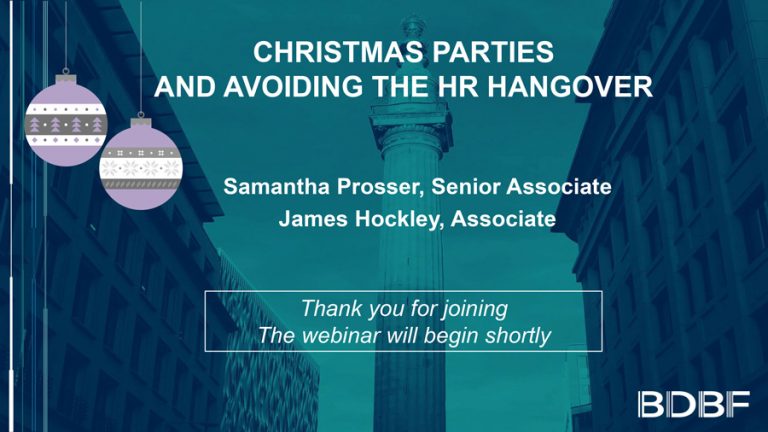
In this 45-minute webinar, BDBF’s Samantha Prosser and James Hockley consider the common problems that can arise at Christmas parties and how to tackle them. This webinar was originally delivered on 8 November 2022 and reflects our understanding as of that date. Do get in contact with either of the speakers if you would like to discuss any of the issues raised.

To view the PDF webinar slides please click on the image below, or view the recording of the webinar:

[/et_pb_text][/et_pb_column][/et_pb_row][et_pb_row column_structure=”1_2,1_2″ admin_label=”row” _builder_version=”4.16″ background_size=”initial” background_position=”top_left” background_repeat=”repeat” global_colors_info=”{}”][et_pb_column type=”1_2″ _builder_version=”4.16″ custom_padding=”|||” global_colors_info=”{}” custom_padding__hover=”|||”][et_pb_image src=”http://davidk423.sg-host.com/wp-content/uploads/2022/11/Christmas-Parties-Webinar-FINAL-SLIDES.jpg” title_text=”Christmas-Parties-Webinar-FINAL-SLIDES” url=”http://davidk423.sg-host.com/wp-content/uploads/2022/11/Christmas-Parties-Webinar-FINAL-SLIDES.pdf” url_new_window=”on” align=”center” _builder_version=”4.17.4″ _module_preset=”default” border_width_all=”2px” border_color_all=”#008395″ global_colors_info=”{}”][/et_pb_image][/et_pb_column][et_pb_column type=”1_2″ _builder_version=”4.16″ custom_padding=”|||” global_colors_info=”{}” custom_padding__hover=”|||”][et_pb_video src=”https://www.youtube.com/watch?v=HBvUrPzVKwQ” _builder_version=”4.17.4″ _module_preset=”default” global_colors_info=”{}”][/et_pb_video][/et_pb_column][/et_pb_row][et_pb_row admin_label=”row” _builder_version=”4.16″ background_size=”initial” background_position=”top_left” background_repeat=”repeat” global_colors_info=”{}”][et_pb_column type=”4_4″ _builder_version=”4.16″ custom_padding=”|||” global_colors_info=”{}” custom_padding__hover=”|||”][et_pb_text _builder_version=”4.17.4″ use_border_color=”off” global_colors_info=”{}”]

Please contact Amanda Steadman (amandasteadman@bdbf.co.uk), Samantha Prosser (samanthaprosser@bdbf.co.uk), James Hockley (jameshockley@bdbf.co.uk) or your usual BDBF contact, for further advice.

[/et_pb_text][/et_pb_column][/et_pb_row][/et_pb_section][et_pb_section fb_built=”1″ _builder_version=”4.16″ global_colors_info=”{}”][et_pb_row _builder_version=”4.16″ global_colors_info=”{}”][et_pb_column type=”4_4″ _builder_version=”4.16″ global_colors_info=”{}”][/et_pb_column][/et_pb_row][/et_pb_section]


https://www.youtube.com/watch?v=HBvUrPzVKwQ


BDBF Partner, Claire Dawson, is attending the ABA’s 16th Annual Labor and Employment Law Conference in Washington, DC

[et_pb_section fb_built=”1″ _builder_version=”3.0.100″ background_image=”http://davidk423.sg-host.com/wp-content/uploads/2017/09/bdbf_final-stages-1-4-1.jpg” custom_padding=”|||” global_module=”2165″ saved_tabs=”all” global_colors_info=”{}”][et_pb_row _builder_version=”4.16″ min_height=”66.4px” custom_padding=”50px||||false|false” global_colors_info=”{}”][et_pb_column type=”4_4″ _builder_version=”4.16″ custom_padding=”|||” global_colors_info=”{}” custom_padding__hover=”|||”][et_pb_text _builder_version=”4.16″ _dynamic_attributes=”content” text_font=”|700|||||||” text_font_size=”27px” background_layout=”dark” custom_margin=”0px|||” custom_padding=”0px|||” global_colors_info=”{}”]@ET-DC@eyJkeW5hbWljIjp0cnVlLCJjb250ZW50IjoicG9zdF90aXRsZSIsInNldHRpbmdzIjp7ImJlZm9yZSI6IiIsImFmdGVyIjoiIn19@[/et_pb_text][et_pb_text _builder_version=”4.16″ _dynamic_attributes=”content” _module_preset=”default” text_text_color=”#FFFFFF” global_colors_info=”{}”]@ET-DC@eyJkeW5hbWljIjp0cnVlLCJjb250ZW50IjoicG9zdF9kYXRlIiwic2V0dGluZ3MiOnsiYmVmb3JlIjoiIiwiYWZ0ZXIiOiIiLCJkYXRlX2Zvcm1hdCI6ImRlZmF1bHQiLCJjdXN0b21fZGF0ZV9mb3JtYXQiOiIifX0=@[/et_pb_text][/et_pb_column][/et_pb_row][/et_pb_section][et_pb_section fb_built=”1″ admin_label=”section” _builder_version=”4.16″ global_colors_info=”{}”][et_pb_row column_structure=”3_5,2_5″ admin_label=”row” _builder_version=”4.16″ background_size=”initial” background_position=”top_left” background_repeat=”repeat” global_colors_info=”{}”][et_pb_column type=”3_5″ _builder_version=”4.16″ custom_padding=”|||” global_colors_info=”{}” custom_padding__hover=”|||”][et_pb_text _builder_version=”4.17.4″ text_orientation=”justified” hover_enabled=”0″ use_border_color=”off” global_colors_info=”{}” sticky_enabled=”0″]

BDBF Partner, Claire Dawson, is attending the ABA’s 16th Annual Labor and Employment Law Conference in Washington, DC on 9-12 November. Claire was recently appointed as Employee Co-Chair of the ABA’s International Labor & Employment Law Committee.  BDBF is delighted to be a sponsor of the International Committee Dinner taking place on 10 November 2022.

[/et_pb_text][/et_pb_column][et_pb_column type=”2_5″ _builder_version=”4.16″ custom_padding=”|||” global_colors_info=”{}” custom_padding__hover=”|||”][et_pb_image src=”http://davidk423.sg-host.com/wp-content/uploads/2021/08/Claire-Dawson-Blog.jpg” title_text=”Claire-Dawson-Blog” _builder_version=”4.17.4″ _module_preset=”default” hover_enabled=”0″ global_colors_info=”{}” sticky_enabled=”0″][/et_pb_image][/et_pb_column][/et_pb_row][/et_pb_section][et_pb_section fb_built=”1″ _builder_version=”4.16″ global_colors_info=”{}”][et_pb_row _builder_version=”4.16″ global_colors_info=”{}”][et_pb_column type=”4_4″ _builder_version=”4.16″ global_colors_info=”{}”][/et_pb_column][/et_pb_row][/et_pb_section]


BDBF Celebrates Ten Years – a message from Gareth Brahams, Managing Partner

[et_pb_section fb_built=”1″ _builder_version=”3.0.100″ background_image=”http://davidk423.sg-host.com/wp-content/uploads/2017/09/bdbf_final-stages-1-4-1.jpg” custom_padding=”|||” global_module=”2165″ saved_tabs=”all” global_colors_info=”{}”][et_pb_row _builder_version=”4.16″ min_height=”66.4px” custom_padding=”50px||||false|false” global_colors_info=”{}”][et_pb_column type=”4_4″ _builder_version=”4.16″ custom_padding=”|||” global_colors_info=”{}” custom_padding__hover=”|||”][et_pb_text _builder_version=”4.16″ _dynamic_attributes=”content” text_font=”|700|||||||” text_font_size=”27px” background_layout=”dark” custom_margin=”0px|||” custom_padding=”0px|||” global_colors_info=”{}”]@ET-DC@eyJkeW5hbWljIjp0cnVlLCJjb250ZW50IjoicG9zdF90aXRsZSIsInNldHRpbmdzIjp7ImJlZm9yZSI6IiIsImFmdGVyIjoiIn19@[/et_pb_text][et_pb_text _builder_version=”4.16″ _dynamic_attributes=”content” _module_preset=”default” text_text_color=”#FFFFFF” global_colors_info=”{}”]@ET-DC@eyJkeW5hbWljIjp0cnVlLCJjb250ZW50IjoicG9zdF9kYXRlIiwic2V0dGluZ3MiOnsiYmVmb3JlIjoiIiwiYWZ0ZXIiOiIiLCJkYXRlX2Zvcm1hdCI6ImRlZmF1bHQiLCJjdXN0b21fZGF0ZV9mb3JtYXQiOiIifX0=@[/et_pb_text][/et_pb_column][/et_pb_row][/et_pb_section][et_pb_section fb_built=”1″ admin_label=”section” _builder_version=”4.16″ global_colors_info=”{}”][et_pb_row admin_label=”row” _builder_version=”4.16″ background_size=”initial” background_position=”top_left” background_repeat=”repeat” global_colors_info=”{}” column_structure=”3_5,2_5″][et_pb_column type=”3_5″ _builder_version=”4.16″ custom_padding=”|||” global_colors_info=”{}” custom_padding__hover=”|||”][et_pb_text _builder_version=”4.17.4″ text_orientation=”justified” hover_enabled=”0″ use_border_color=”off” global_colors_info=”{}” sticky_enabled=”0″]

BDBF is celebrating its tenth anniversary today, 1 November 2022.

We celebrate this milestone with great pride in what we have accomplished in just ten years, and with heartfelt gratitude to the loyal clients, colleagues, collaborators and supporters with whom we have had the privilege of working over the past decade.

Our vision of becoming the ‘go to’ firm for senior executives, employees in financial services, partners in professional service firms and employers and employees with high value disputes became a reality almost from the start but we have cemented that position as we have continued our journey.

We are delighted to have been top ranked for senior executive work by Chambers and Legal 500 year after year. Just this month, Chambers UK 2023 ranked all five of BDBF’s partners as leading individuals as well as identifying two of our other lawyers as “associates to watch.” This elevated us to one of the firms with the most ranked lawyers for senior executive work, which is an incredible achievement.

But it is not the external accolades that make us proud so much as the values we have respected when we have built that success. Since BDBF was formed in 2012, we have lived our five values of vitality, collaboration, professionalism, honesty and adaptability. We bring energy, exuberance, confidence, ambition, fearlessness, brilliance, and spirit to all the things we do. This is reflected in our victories over the years. We have fought and won some of the biggest employment cases over the past decade, including Osipov v International Petroleum & Others, Jones v JP Morgan and Queensgate v Millet. Of course, many more of the cases we have worked on are confidential, but our input has allowed our clients to move on with exceptional outcomes.

We establish effective partnerships with clients and one another to make a positive difference; acting as an integrated team, not sole practitioners.

Our client feedback speaks for itself.

We never fall into the trap of becoming shrill. We preserve our dignity and composure; we prize intelligence and clear thinking; yes, being tough and tenacious when called for but always producing high quality work and being empathetic.

We are bold, creative and inquisitive, open to new ideas and ways of realising our goals.

On top of acting in the highest value/highest stakes covenant, discrimination and whistle-blowing cases, we also take on the types of claims that many other employment lawyers are more wary of (like personal injury stress at work claims and misrepresentation claims). And, when we need to run novel legal arguments, no one does it better than us.

BDBF continues to grow from strength to strength, helping individuals and employers in matters which are complex and important to get the best outcomes.

Our headcount now stands at five partners and 12 associates, in addition to our eight strong practice team.

We have had an outstanding run over the past decade, and we look forward to the next.

Thank you to all our clients over the years, our founders and colleagues, referrers and supporters, the amazing independent bar and our fantastic team at BDBF, past and present. You have all played your part.

With great optimism for our shared future, we look forward to continuing our journey together.

Gareth Brahams
Managing Partner
1 November 2022

[/et_pb_text][/et_pb_column][et_pb_column type=”2_5″ _builder_version=”4.16″ custom_padding=”|||” global_colors_info=”{}” custom_padding__hover=”|||”][et_pb_image _builder_version=”4.17.4″ _module_preset=”default” title_text=”BDBF-10thAnniversary-FINALV1″ src=”http://davidk423.sg-host.com/wp-content/uploads/2022/10/BDBF-10thAnniversary-FINALV1.jpg” hover_enabled=”0″ sticky_enabled=”0″][/et_pb_image][/et_pb_column][/et_pb_row][/et_pb_section][et_pb_section fb_built=”1″ _builder_version=”4.16″ global_colors_info=”{}”][et_pb_row _builder_version=”4.16″ global_colors_info=”{}”][et_pb_column type=”4_4″ _builder_version=”4.16″ global_colors_info=”{}”][/et_pb_column][/et_pb_row][/et_pb_section]


What to do if redundancy is looming

[et_pb_section fb_built=”1″ _builder_version=”3.0.100″ background_image=”http://davidk423.sg-host.com/wp-content/uploads/2017/09/bdbf_final-stages-1-4-1.jpg” custom_padding=”|||” global_module=”2165″ saved_tabs=”all” global_colors_info=”{}”][et_pb_row _builder_version=”4.16″ min_height=”66.4px” custom_padding=”50px||||false|false” global_colors_info=”{}”][et_pb_column type=”4_4″ _builder_version=”4.16″ custom_padding=”|||” global_colors_info=”{}” custom_padding__hover=”|||”][et_pb_text _builder_version=”4.16″ _dynamic_attributes=”content” text_font=”|700|||||||” text_font_size=”27px” background_layout=”dark” custom_margin=”0px|||” custom_padding=”0px|||” global_colors_info=”{}”]@ET-DC@eyJkeW5hbWljIjp0cnVlLCJjb250ZW50IjoicG9zdF90aXRsZSIsInNldHRpbmdzIjp7ImJlZm9yZSI6IiIsImFmdGVyIjoiIn19@[/et_pb_text][et_pb_text _builder_version=”4.16″ _dynamic_attributes=”content” _module_preset=”default” text_text_color=”#FFFFFF” global_colors_info=”{}”]@ET-DC@eyJkeW5hbWljIjp0cnVlLCJjb250ZW50IjoicG9zdF9kYXRlIiwic2V0dGluZ3MiOnsiYmVmb3JlIjoiIiwiYWZ0ZXIiOiIiLCJkYXRlX2Zvcm1hdCI6ImRlZmF1bHQiLCJjdXN0b21fZGF0ZV9mb3JtYXQiOiIifX0=@[/et_pb_text][/et_pb_column][/et_pb_row][/et_pb_section][et_pb_section fb_built=”1″ admin_label=”section” _builder_version=”4.16″ global_colors_info=”{}”][et_pb_row admin_label=”row” _builder_version=”4.16″ background_size=”initial” background_position=”top_left” background_repeat=”repeat” global_colors_info=”{}”][et_pb_column type=”4_4″ _builder_version=”4.16″ custom_padding=”|||” global_colors_info=”{}” custom_padding__hover=”|||”][et_pb_text _builder_version=”4.17.4″ text_orientation=”justified” use_border_color=”off” global_colors_info=”{}”]

Redundancies have always been a way of life in the City, but in the current economic climate, the spectre of redundancy can be especially worrying. In recent months, there have been reports that major employers such as Credit Suisse, Goldman Sachs, Blackrock and Deutsche Bank are restructuring. In this article we set out how to put your best foot forward in this worrying situation.

Follow our guidance for dealing with a potential redundancy to ensure you have the best chance of keeping your role, and the best compensation if you do not.

How to prepare yourself for a potential redundancy situation

1. Do your homework

Check what your employment contract, company policies, and any relevant collective agreement says about redundancy. They might refer to a right to enhanced redundancy pay (over and above the statutory entitlement) or fixed consultation procedures. If so, make sure that your employer is doing what they are supposed to do. Enhanced redundancy terms for City employees are common and range from a multiple of two weeks per complete year of service upwards. Law firms tend to have less generous enhanced terms whereas the traditional banks with unionised workforces tend to be more generous. Also, check bonus, LTIP and share schemes – they might incorporate “good leaver” terms if you are made redundant.

2. Phone a friend

Most employers allow employees to be accompanied at redundancy “at risk” or consultation meetings by a colleague or trade union representative. Although there is no legal obligation to do so, it is good practice. If your employer does not say that you can be accompanied at an “at risk” meeting, then ask. If your employer’s notes are inconsistent with your own (or your companion’s), ask your employer to put a copy of your notes on file.

3. Question time

In order to fairly dismiss for redundancy, your employer should consult with you individually about the redundancy situation, consider alternative ways of saving the role and avoiding the redundancy, give you time to respond, and enable you to apply for different roles within the business. If you have any questions during the consultation process, ask them.
Some key issues to look for (but there are more):

  • Why now? When was the decision made to make redundancies?
  • Have you been told why your role is at risk? Does it make sense?
  • Have you been told who else is at risk? Has one of your colleagues been “missed out”?
  • Do you think that other people should have been included in the ‘at risk’ pool?
  • Do you think that your employer should have considered “bumping” (i.e. removing others from their roles so that you can fill their vacancy)?
  • If you are going through a competitive application process for roles, do you know the selection criteria and what other factors (such as past appraisals) are being taken into consideration?
  • Do any selection criteria disadvantage you due to your particular circumstances e.g. disability or pregnancy/maternity leave?
  • Have you been told about all existing vacancies (including roles that are junior/senior to yours)? Have you been given a fair opportunity to apply for those roles?
  • Have you seen the selection criteria for alternative roles? Do you think they are fair?
  • Is there a job vacancy that you haven’t been told about?

4. What are the possible alternatives to redundancy?

We are in exceptional times. Many businesses are faced with a situation that they have not planned for and are reluctantly having to face – the loss of valued, skilled, hard-working employees.

There may well be a genuine downturn in the requirement for you to continue to do your role, such as investment banking, but that downturn may be short-lived. You may wish to explore other ways of saving your role such as unpaid leave, parental leave, or taking an unpaid sabbatical. This may be a time for quid pro quo whereby an employer wishing to retain an employee but cannot afford to do so offers a retention payment as a sweetener, payable when revenues return to reasonable levels. This would require both parties having confidence that the employer can weather the storm so that the retention payment is not a promise in the wind.

5. It’s a numbers game

If your employer is proposing to make 20 or more employees redundant in a period of 90 days, they have additional collective consultation obligations. If they fail to comply with these obligations, you may have an additional claim for up to 90 days’ pay.

6. Is there another reason?

Employers often view redundancy as the easiest way to eject an employee and retain the employees they really want. For that reason, a redundancy process can be used to cloak an unlawful act (such as discrimination or the repercussions of whistleblowing). If this is the case, you may have additional, more valuable claims against your employer beyond a claim of unfair dismissal. If you suspect discrimination or other unlawful acts, or you think that redundancy is being used to “mask” another reason for your exit, make a careful note of anything that is said or done which supports your allegation. This can be used as evidence further down the line.

7. Appeal

As part of the redundancy process, as a matter of fairness, you should be given a right of appeal. Exercise your right to do so. Make sure your appeal is submitted in time and identifies the specific issues you have with the redundancy process and the decision.

8. Protected conversations and settlement agreements

In the City, a common scenario is for the employer to circumvent the above procedures and offer a severance package or termination payment under a settlement agreement. Such an offer will be made on a confidential basis and independent legal advice would be needed on the settlement agreement. The written agreement will set out terms that will seek to buy you out of any contractual, statutory and other claims you may have (such as unfair dismissal), by offering you compensation. The settlement agreement will ask you to waive any claims that you have in return for signing the agreement. A standard contribution to legal fees for you to obtain advice on the terms and effect of the agreement is usual, but often negotiable if the advice you need is more involved. Any negotiations on the terms of the agreement will be confidential and are unlikely to be admissible in any proceedings unless your employer behaves in a particularly improper manner towards you during the protected discussions.

Brahams Dutt Badrick French LLP are a leading specialist employment law firm based at Bank in the City. We are experienced in advising on severance packages arising from redundancy processes and getting clients the best deals whilst protecting their reputations. If you would like any further advice on redundancy and the topics discussed in this article, please contact Paula Chan (paulachan@bdbf.co.uk), Amanda Steadman (amandasteadman@bdbf.co.uk) or your usual BDBF contact. You can also reach us on 020 3828 0350 or at info@bdbf.co.uk.

[/et_pb_text][/et_pb_column][/et_pb_row][/et_pb_section][et_pb_section fb_built=”1″ _builder_version=”4.16″ global_colors_info=”{}”][et_pb_row _builder_version=”4.16″ global_colors_info=”{}”][et_pb_column type=”4_4″ _builder_version=”4.16″ global_colors_info=”{}”][/et_pb_column][/et_pb_row][/et_pb_section]


EAT rules that unknown future claims may not be waived in settlement agreements

[et_pb_section fb_built=”1″ _builder_version=”3.0.100″ background_image=”http://davidk423.sg-host.com/wp-content/uploads/2017/09/bdbf_final-stages-1-4-1.jpg” custom_padding=”|||” global_module=”2165″ saved_tabs=”all” global_colors_info=”{}”][et_pb_row _builder_version=”4.16″ min_height=”66.4px” custom_padding=”50px||||false|false” global_colors_info=”{}”][et_pb_column type=”4_4″ _builder_version=”4.16″ custom_padding=”|||” global_colors_info=”{}” custom_padding__hover=”|||”][et_pb_text _builder_version=”4.16″ _dynamic_attributes=”content” text_font=”|700|||||||” text_font_size=”27px” background_layout=”dark” custom_margin=”0px|||” custom_padding=”0px|||” global_colors_info=”{}”]@ET-DC@eyJkeW5hbWljIjp0cnVlLCJjb250ZW50IjoicG9zdF90aXRsZSIsInNldHRpbmdzIjp7ImJlZm9yZSI6IiIsImFmdGVyIjoiIn19@[/et_pb_text][et_pb_text _builder_version=”4.16″ _dynamic_attributes=”content” _module_preset=”default” text_text_color=”#FFFFFF” global_colors_info=”{}”]@ET-DC@eyJkeW5hbWljIjp0cnVlLCJjb250ZW50IjoicG9zdF9kYXRlIiwic2V0dGluZ3MiOnsiYmVmb3JlIjoiIiwiYWZ0ZXIiOiIiLCJkYXRlX2Zvcm1hdCI6ImRlZmF1bHQiLCJjdXN0b21fZGF0ZV9mb3JtYXQiOiIifX0=@[/et_pb_text][/et_pb_column][/et_pb_row][/et_pb_section][et_pb_section fb_built=”1″ admin_label=”section” _builder_version=”4.16″ global_colors_info=”{}”][et_pb_row admin_label=”row” _builder_version=”4.16″ background_size=”initial” background_position=”top_left” background_repeat=”repeat” global_colors_info=”{}”][et_pb_column type=”4_4″ _builder_version=”4.16″ custom_padding=”|||” global_colors_info=”{}” custom_padding__hover=”|||”][et_pb_text _builder_version=”4.17.4″ text_orientation=”justified” hover_enabled=”0″ use_border_color=”off” global_colors_info=”{}” sticky_enabled=”0″]

Employers should take note of a recent EAT decision that employees cannot waive the right to pursue claims which are unknown at the time of signing a settlement agreement.  Attempts to secure a release from all potential claims by way of blanket or “kitchen sink” style waivers are not effective.

What happened in this case?

The Claimant was employed as a Chief Officer on a number of different vessels.   In January 2017, the employer notified the Claimant that he was at risk of redundancy and offered him settlement terms, which he accepted.  The Claimant entered into a settlement agreement with the employer, under which he settled all claims against them.

Under the settlement agreement, the employer agreed to pay notice pay, enhanced redundancy pay plus an “additional payment”, which was to be calculated by reference to the terms of a maritime collective agreement.  However, the collective agreement stated that additional payments were only due to officers under the age of 61.  The Claimant was aged 61 at the time of his dismissal.  Therefore, the employer decided not to pay the additional payment to the Claimant after all.  He was notified of this on 26 June 2017, around five months after his employment had terminated.

The Claimant claimed that the decision not to pay the additional payment amounted to direct and/or indirect age discrimination.   The employer accepted that the reason the additional payment was not paid was age.  However, it sought to defend the claim on two jurisdictional grounds:

  • first, that the Claimant had entered into a settlement agreement under which he had waived his rights to pursue claims against them; and
  • second, protection under the Equality Act 2010 did not apply to the Claimant as he was a seafarer.

The Employment Tribunal held that the settlement agreement constituted a full and final settlement of the Claimant’s claims.  It had listed various types of claim, including age discrimination claims and it also included a blanket waiver which excluded “all claims…of whatever nature (whether past, present or future)”.  The Tribunal held that the claim would not have been precluded by virtue of the fact the Claimant was a seafarer, because the claim concerned post-employment discrimination.  However, the end result was that the claim could not proceed.

The Claimant appealed against the decision that the claim had been validly settled.  He argued that the Equality Act 2010 did not permit the settlement of claims before they had arisen, and that settlement was limited to claims which were known to the parties.  The employer cross-appealed against the decision that the Claimant was entitled to bring a claim under the Equality Act 2010 even though he was a seafarer.

What was decided?

The EAT allowed both appeals, meaning the end result was the same: the Claimant could not proceed with the claim. However, its decision about the scope of settlement agreements is of significant interest for employers.

The EAT held that in order for a settlement agreement validly to settle a claim under the Equality Act 2010 it must “relate to a particular complaint”.   The EAT noted that previous case authorities had said that:

  • actual complaints must be identified in a settlement agreement either by a description of the claim or reference to the relevant statutory provision;
  • known potential claims may be settled provided that a description of the claim or the relevant statutory provision is stated, although this could not be achieved by the use of a blanket form of waiver; and
  • even unknown claims could be settled provided that the language was absolutely plain and unequivocal.

However, the EAT took issue with the last of these principles.  In the EAT’s view, there was no clear authority for the proposition that the words “the particular complaint” includes a complaint that may or may not occur at some point in future.  Rather, on a proper reading of the authorities, they only went as far as saying that known complaints which had not yet been brought before an employment tribunal may be settled.

Here, the Claimant had entered into a settlement agreement under which he waived his right to pursue a long list of claims, including age discrimination.  The EAT concluded that the words “the particular complaint” indicated that the parties must anticipate the existence of an actual complaint or circumstances where the grounds of the complaint already existed.   Blanket waivers of all and any claims are not enforceable.  Further, waivers listing all and any type of complaint by reference to their nature or section number (also known as “kitchen sink” waivers) are no better.   In fact, the EAT said there is no difference between a blanket waiver and a kitchen sink waiver.  Both are general waivers – all that distinguishes them is the particularity with which they have been drafted.   Neither are enforceable.

The EAT went on to say that it was apparent that Parliament’s intention had been that the ability to waive statutory employment claims would only be available in respect of complaints that had already arisen between the parties.  To extend this further would expose claimants to the risk of signing away their rights without understanding what they are doing. Indeed, in this case, the Claimant had purportedly signed away his right to sue for age discrimination before he even knew whether he had such a claim.

The EAT held that the terms of the settlement agreement did not preclude the Claimant from pursuing a claim.  However, the Claimant was thwarted in the end as the EAT also allowed the employer’s cross appeal, finding that he was a seafarer at the time of dismissal.  This meant that he was precluded from bring a claim.  The fact that the claim concerned post-employment discrimination made no difference.

What are the learning points for employers?

In our experience, employers tend to specify the particular claims of concern in settlement agreements and then hedge their bets by including a kitchen sink waiver, a blanket waiver, or both.  Employers may continue to do this in the hope that it deters any future claims, however, this decision indicates that such waivers are not enforceable.  This means that employees will not be barred from pursuing statutory employment claims which are not known about at the time of entering into a settlement agreement.  The EAT acknowledged that this may be inconvenient for parties wishing to have a truly clean break.

However, waivers of unknown claims (save for personal injury claims) may still be still valid from a contract law perspective.  Therefore, employers may wish to include a repayment clause under which the employee is required to repay the termination payment in the event of a breach of the settlement agreement.  Although this will not prevent them from pursuing a relevant claim before an employment tribunal, it may be enough to deter them from doing so.

It is possible that this decision will be appealed to the Scottish Court of Session.

Bathgate v Technip UK Ltd and ors

BDBF is a leading law firm based at Bank in the City of London specialising in employment law. If you would like to discuss any issues relating to the content of this article, please contact Amanda Steadman (AmandaSteadman@bdbf.co.uk) or your usual BDBF contact.

[/et_pb_text][/et_pb_column][/et_pb_row][/et_pb_section][et_pb_section fb_built=”1″ _builder_version=”4.16″ global_colors_info=”{}”][et_pb_row _builder_version=”4.16″ global_colors_info=”{}”][et_pb_column type=”4_4″ _builder_version=”4.16″ global_colors_info=”{}”][/et_pb_column][/et_pb_row][/et_pb_section]


Employers must start redundancy consultation at the formative stage of the process and before dismissal becomes a foregone conclusion

[et_pb_section fb_built=”1″ _builder_version=”3.0.100″ background_image=”http://davidk423.sg-host.com/wp-content/uploads/2017/09/bdbf_final-stages-1-4-1.jpg” custom_padding=”|||” global_module=”2165″ saved_tabs=”all” global_colors_info=”{}”][et_pb_row _builder_version=”4.16″ min_height=”66.4px” custom_padding=”50px||||false|false” global_colors_info=”{}”][et_pb_column type=”4_4″ _builder_version=”4.16″ custom_padding=”|||” global_colors_info=”{}” custom_padding__hover=”|||”][et_pb_text _builder_version=”4.16″ _dynamic_attributes=”content” text_font=”|700|||||||” text_font_size=”27px” background_layout=”dark” custom_margin=”0px|||” custom_padding=”0px|||” global_colors_info=”{}”]@ET-DC@eyJkeW5hbWljIjp0cnVlLCJjb250ZW50IjoicG9zdF90aXRsZSIsInNldHRpbmdzIjp7ImJlZm9yZSI6IiIsImFmdGVyIjoiIn19@[/et_pb_text][et_pb_text _builder_version=”4.16″ _dynamic_attributes=”content” _module_preset=”default” text_text_color=”#FFFFFF” global_colors_info=”{}”]@ET-DC@eyJkeW5hbWljIjp0cnVlLCJjb250ZW50IjoicG9zdF9kYXRlIiwic2V0dGluZ3MiOnsiYmVmb3JlIjoiIiwiYWZ0ZXIiOiIiLCJkYXRlX2Zvcm1hdCI6ImRlZmF1bHQiLCJjdXN0b21fZGF0ZV9mb3JtYXQiOiIifX0=@[/et_pb_text][/et_pb_column][/et_pb_row][/et_pb_section][et_pb_section fb_built=”1″ admin_label=”section” _builder_version=”4.16″ global_colors_info=”{}”][et_pb_row admin_label=”row” _builder_version=”4.16″ background_size=”initial” background_position=”top_left” background_repeat=”repeat” global_colors_info=”{}”][et_pb_column type=”4_4″ _builder_version=”4.16″ custom_padding=”|||” global_colors_info=”{}” custom_padding__hover=”|||”][et_pb_text _builder_version=”4.17.4″ text_orientation=”justified” use_border_color=”off” global_colors_info=”{}”]

In Mogane v Bradford Teaching Hospitals NHS Foundation Trust and anor the EAT held that redundancy consultation must commence at the formative stage of the process in order to be meaningful.  Using an arbitrary selection criterion to place an employee into a redundancy pool of one was unfair and also meant that consultation about the dismissal was futile.  

What happened in this case?

The Claimant was one of two “Band 6” nurses.  Both nurses were employed on fixed-term contracts.   The Claimant had been employed for several years on a series of one-year fixed-term contracts.  The second nurse was near to the beginning of a two-year fixed term contract, having recently joined and completed her probationary period. Out of the two nurses, the Claimant’s fixed-term contract was due to expire first.

Financial pressures meant that the employer needed to reduce the number of Band 6 nurses.  Instead of placing both Band 6 nurses into a redundancy pool and using criteria to select one of them for redundancy, the employer decided that the person whose contract was due to expire first would be selected for redundancy – this was the Claimant.  The employer made this decision sometime between 21 March 2019 and 8 May 2019.

A consultation meeting was held on 12 June 2019, by which stage the decision had already been taken that the Claimant would be made redundant.  The only outstanding issue was whether suitable alternative employment could be found for her.  The remainder of the consultation process was focused on that issue. No alternative role was found, and the Claimant was dismissed as redundant on 31 December 2019.

An Employment Tribunal rejected the Claimant’s claim that she had been unfairly dismissed. She appealed to the EAT. She argued that her dismissal was unfair because the employer:

  • failed to consult with her about the proposal to place in her in a pool of one;
  • gave no consideration to whether the second nurse should have been included in the pool as well;
  • used a criterion to select her for redundancy which was arbitrary and unfair (i.e. which fixed term contract was due to expire first).  She argued that it amounted to “a game of musical chairs” which the employer could exploit by deciding when to turn off the music; and
  • used a single criterion to select her for redundancy and this was outside of the band of reasonable responses.

She also argued that the Tribunal had failed to provide any reasons for its conclusion that the employer’s pooling decision was reasonable

What was decided?

Importantly, the EAT said that the employer started the consultation process too late.  Consultation should take place at the formative stage of a redundancy process.  This permits meaningful consultation, since the employee can make representations which have the potential to affect the outcome.  This is the approach taken in collective redundancy consultations and the EAT said that “with appropriate adaptations” this should be applied to individual consultations.

When it came to the pooling decision, the EAT noted that a Tribunal should not easily interfere with an employer’s choice of pool.  However, it must consider whether there is a rational explanation for the pool.   The EAT pointed out that the duty of trust and confidence means that employers must not act arbitrarily between employees.  This impacts on decisions concerning redundancy pooling.

Once the employer decided that the expiry of the fixed-term contract was to be the only criterion, it was a foregone conclusion that the Claimant would be dismissed, meaning that consultation on the dismissal was futile.

The EAT also agreed that the Tribunal’s judgment did not explain why it was reasonable to have used this sole section criterion without prior consultation. The EAT allowed the appeal and held that the dismissal was unfair. 

What are the learning points for employers?

The key takeaway from this case is that employers should ensure that individual as well as collective consultation about proposed redundancies begins early enough in the process to allow meaningful consultation.  In this case, once the selection criterion had been decided upon, it was inevitable that the Claimant would be dismissed (unless an alternative role were found).  Therefore, consultation about the redundancy was meaningless. Had the employer begun the consultation before the pooling decision had been made, the Claimant could have made the case for using additional criteria, which may have led to a pool of two.

Employers must also take care with the criteria used for selecting candidates for redundancy, ensuring that they do not result in arbitrary outcomes.  Obtaining agreement on the proposed criteria during the early stages of the consultation is a sensible step to take and should help to avoid attempts to unpick the redundancy pooling decision later on in the process.  Further, where there are two or more employees in comparable roles, placing only one of them into a redundancy pool will not usually be fair without prior consultation.

Mogane v Bradford Teaching Hospitals NHS Foundation Trust and anor

Brahams Dutt Badrick French LLP are a leading specialist employment law firm based at Bank in the City. If you would like to discuss any issues relating to the content of this article, please contact Amanda Steadman (AmandaSteadman@bdbf.co.uk) or your usual BDBF contact.

[/et_pb_text][/et_pb_column][/et_pb_row][/et_pb_section][et_pb_section fb_built=”1″ _builder_version=”4.16″ global_colors_info=”{}”][et_pb_row _builder_version=”4.16″ global_colors_info=”{}”][et_pb_column type=”4_4″ _builder_version=”4.16″ global_colors_info=”{}”][/et_pb_column][/et_pb_row][/et_pb_section]