Reflecting on employment law cases and developments in 2020

[et_pb_section fb_built=”1″ _builder_version=”3.0.100″ background_image=”http://davidk423.sg-host.com/wp-content/uploads/2017/09/bdbf_final-stages-1-4-1.jpg” custom_padding=”|||” global_module=”2165″ saved_tabs=”all”][et_pb_row _builder_version=”3.25″ custom_padding=”|||”][et_pb_column type=”4_4″ _builder_version=”3.25″ custom_padding=”|||” custom_padding__hover=”|||”][et_pb_text _builder_version=”3.27.4″ background_layout=”dark” custom_margin=”0px|||” custom_padding=”0px|||”]

Employment Law News


[/et_pb_text][/et_pb_column][/et_pb_row][/et_pb_section][et_pb_section fb_built=”1″ admin_label=”section” _builder_version=”3.22.3″][et_pb_row admin_label=”row” _builder_version=”3.25″ background_size=”initial” background_position=”top_left” background_repeat=”repeat”][et_pb_column type=”4_4″ _builder_version=”3.25″ custom_padding=”|||” custom_padding__hover=”|||”][et_pb_text _builder_version=”4.7.4″ text_orientation=”justified” hover_enabled=”0″ use_border_color=”off” sticky_enabled=”0″]Reflecting on employment law cases and developments in 2020

Dealing with the impact of the Covid-19 pandemic on the workforce has held the top spot on the HR to-do list for most of 2020.  But what other developments should employers note from the last 12 months?   Putting Covid-19 to one side, we’ve picked out some interesting cases and other developments from 2020 for employers to reflect on as the year draws to a close. 

Equality and discrimination

As usual, there has been a great deal of activity in the equality sphere:

  • Vegetarianism and veganism: we learnt that whilst vegetarianism was not a philosophical belief capable of protection under the Equality Act 2010, ethical veganism was protected. At the tail end of 2019, the Employment Tribunal ruled in the case of Conisbee v Crossley Farms that the plurality of reasons for becoming a vegetarian (e.g. lifestyle, health, animal welfare, personal taste etc) meant it did not attain the necessary level of cogency, seriousness, cohesion and importance to qualify for protection as a philosophical belief.  By contrast, the Employment Tribunal in Casamitjana v The League Against Cruel Sports decided that ethical veganism was worthy of protection.  You can read more about these decisions in our briefing here.  The protection of veganism could raise interesting employment law issues in 2021 where vegan employees refuse to have the Covid-19 vaccine on the grounds that it has been tested on animals.
  • Gender fluidity: we also learnt that a belief that gender cannot be fluid is a belief worthy of protection in a democratic society. In the case of Higgs v Farmor’s School an Employment Tribunal decided that a Christian employee’s belief that gender cannot be fluid, and that an individual cannot change their biological sex, were beliefs worthy of respect in a democratic society and capable of protection under the Equality Act 2010.  On the facts of the case, however, the employee had not been discriminated against because of her protected beliefs.  You can read the Tribunal’s decision here.   More recently, in the case of Taylor v Jaguar Land Rover Ltd, an Employment Tribunal decided that a gender fluid / non-binary employee had the protected characteristic of gender reassignment.  The employee was awarded £180,000 damages in respect of the discrimination and harassment they had suffered.  You can read the Tribunal’s decision here.
  • Disability: in Hill v Lloyds Bank plc, the EAT decided that the employer had discriminated against a depressed employee when it failed to guarantee a severance package in the event that it could not keep her from having to work with her alleged harassers again. It decided that providing such a guarantee would have been a reasonable adjustment for the employer to make and their failure to do so was discriminatory.  The employee was awarded £7,500 damages and the employer was ordered to provide the guarantee to the employee. You can read more about this decision in our briefing here.
  • Sexual harassment: in January 2020, the Equalities and Human Rights Commission published new and detailed guidance on sexual harassment and other forms of workplace harassment. Whilst the guidance is not a statutory code of practice, it is described as the authoritative and comprehensive guide to the law and best practice.  This means it can be considered by an Employment Tribunal in relevant cases.  The guidance recaps on the legal framework and considers steps for employers to take in preventing and responding to harassment.  You can read more about the guidance in our briefing here.
  • Race: in the case of Lamonby v Solent University an Employment Tribunal had to consider whether it was fair to dismiss an employee who had made remarks which betrayed a tendency to stereotype according to race, even where such stereotypes were sometimes positive. The Tribunal concluded that ascribing certain abilities or talents (or the opposite of them) to a group by virtue of their nationality, race, ethnic or religious group was potentially racist and offensive.  Despite the fact the employee had not intended to cause offence, the Tribunal found that dismissal was within the range of reasonable responses.  You can read more about this decision in our briefing here.   Race inequality issues came to the forefront of the HR agenda in the Summer in response to the Black Lives Matter movement.  In this briefing we discussed the continuing underrepresentation of black people in senior positions in the UK and the calls for action to secure more diverse workforces.
  • Pay inequality: in January 2020, the BBC journalist, Samira Ahmed, won her equal pay case against the BBC. We discussed the impact of that decision here and also we looked at the important role of gender pay gap reporting here.  Although gender pay gap reporting was paused during the pandemic, it is firmly back on the agenda with legislation in the pipeline which aims to expand the obligation to smaller employers as well as introducing ethnicity pay reporting and a right to know what colleagues are paid.  You can more read about these proposals in our briefing here.

Employment contracts and policies

  • New rules on statements of particulars: on 6 April 2020, the rules governing statements of employment particulars were overhauled. The wider category of “workers” became entitled to receive a statement and statements had to be provided earlier and contain more information.  Typically, employers comply with the requirement to provide written statements by providing an employment contract.  Accordingly, employers had to update template employment contracts and prepare appropriate worker contracts or statements.  You can read more about this development in our briefing here.
  • Bereavement leave policies: on 6 April 2020 a new law, known as “Jack’s Law”, was introduced to provide bereaved parents with a new right to 2 weeks’ bereavement leave (and in some cases, pay) following the death of a child.  In this briefing, we took a closer look at the new right and the preparatory steps employers needed to take.

Whistleblowing

  • Whistleblowing in the financial services sector: earlier this year, Protect, the whistleblowers’ charity, published a report looking at the recent experiences of whistleblowers in the financial services sector.  In this briefing, we discussed the key findings including the typical wrongdoing raised by whistleblowers in the sector, where they were most likely to raise their concerns and the treatment they received. We also outlined five key learning points for employers in the sector.
  • Interim relief and Covid-related complaints: in Morales v Premier Fruits (Covent Garden) Ltd, the employee sought interim relief (i.e. an order that he should get his job back pending the full hearing of the case) on the basis that he had been automatically unfairly dismissed because of his trade union membership or activities and/or because he had made whistleblowing disclosures about Covid-related matters. He was granted interim relief on the basis that it was likely that he would be able to show that he had been dismissed because of his trade union membership or activities rather than the whistleblowing disclosures.  You can read more about this decision in our briefing here.

Vicarious liability

  • Deliberate data breach: in an important and welcome decision for employers, the Supreme Court ruled that an employer was not vicariously liable for a significant data breach committed by a disgruntled employee.  In Morrisons v Various Claimants it could not be said that there was a sufficient connection between the errant employee’s authorised activities and the wrongful act of publishing the data on the internet. The fact that the employee’s job merely provided him with the opportunity to commit the wrongful act was not enough to establish a sufficient connection.  You can read more about this decision in our briefing here.
  • Practical jokes: following on from the Morrisons decision, the High Court in the case of Chell v Tarmac Cement and Lime Ltd found that an employer was not vicariously liable for the actions of an employee whose practical joke injured a contractor in the workplace. It was expecting too much of an employer to implement a policy governing practical jokes or horseplay by employees.  Although the prank that caused the injury happened in the workplace, it could not be said that there was a sufficient connection between the employee’s authorised activities and the prank.  You can read the High Court’s decision here.

TUPE

  • Changing terms and conditions: in Ferguson v Astrea Asset Management Ltd the EAT considered whether four company directors were entitled to rely on contractual terms which had been put in place shortly before a TUPE transfer which were designed to significantly improve their position after the transfer. The EAT decided that the changes, even though they were beneficial, were void because they were by reason of the transfer.   You can read more about the EAT’s decision in our briefing here.
  • Transfers to multiple employers: in ISS Facility Services v Govaerts the ECJ decided, for the first time, that where there is a TUPE transfer to multiple transferees, a full-time contract of employment of a transferring employee can be split between the transfers into several part-time contracts on a pro rata basis. However, if splitting the contract is impossible, or worsens the working conditions or rights of the employee, then the contract may be terminated instead.  You can read the ECJ’s decision here.

Terminations

  • Redundancy processes: in Gwynedd Council v Barrett, the EAT considered whether an employer can require a potentially redundant employee to go through a competitive interview process for an alternative role. In the wake of the coronavirus pandemic, some employers will be facing the prospect of reorganising their businesses and making redundancies.  Employers in this position should take note of this decision which highlights the risks of getting the process wrong.  You can read more about the EAT’s decision in our briefing here.
  • Collective consultation: in UQ v Marclean Technologies SLU the ECJ ruled on how employers should calculate numbers of redundancies for collective consultation purposes. In an onerous decision for employers, the ECJ ruled that employers have to look either side of an individual dismissal on a rolling 90-day basis to identify the relevant reference period.  The reference period will be the period of 90 days which includes the individual dismissal, and which contains the greatest number of redundancy dismissals effected by the employer. Whether this will be read across into UK law is not resolved.   You can read more about the ECJ’s decision in our briefing here.
  • Misconduct dismissals: If an investigating officer fails to pass on relevant information to a dismissing officer, could this undermine the reasonableness of the dismissing officer’s decision? In Uddin v London Borough of Ealing the EAT said that it could, with the result that an employee accused of sexual assault was unfairly dismissed. The decision underlined the need for employers to ensure that their dismissal processes are unimpeachable and that both investigating officers and dismissing officers receive detailed training on the scope of their role.  You can read more about the EAT’s decision in our briefing here.
  • Procedural failings: the decision in Gallacher v Abellio Scotrail Ltd shows that where there has been an irretrievable breakdown in relations between colleagues, an employer may be able to dispense with a formal dismissal process and still dismiss fairly. Although it will be unusual and rare for a dismissal to be fair without any procedure, the mutual loss of trust and confidence meant that following a formal process would have been futile and even damaging.  You can read more about the EAT’s decision in our briefing here.

Settlements and disputes

  • Termination payments: from 6 April 2020, employer’s class 1A NICs became payable on termination payments above £30,000. Termination payments remain completely exempt from employee’s NICs.  Employers must remember to factor in this extra cost when negotiating settlements with departing employees.  You can read more about this development in our briefing here.
  • Breach of settlement terms: if an employee breaches a confidentiality clause contained in a COT3 agreement or, more commonly, a Settlement Agreement, what are the employer’s options? The answer is that it will depend on the importance of the clause or the severity of the employee’s breach.  The High Court’s decision in Duchy Farms Kennels Ltd v Steels offers a salutary lesson for employers on the need to draft settlement documents carefully. You can read more about the High Court’s decision in our briefing here.
  • Tribunal disputes: with the pandemic likely to intensify the backlog of employment tribunal claims, the Government introduced a raft of the changes designed to streamline the conduct of disputes and improve capacity within the tribunal system, including extending the length of Acas early conciliation to 6 weeks in all cases. You can read more about this development in our briefing here.

If you would like to know more about any of these developments please contact Amanda Steadman (amandasteadman@bdbf.co.uk) or your usual BDBF contact.[/et_pb_text][/et_pb_column][/et_pb_row][/et_pb_section][et_pb_section fb_built=”1″ _builder_version=”3.26.6″][et_pb_row _builder_version=”3.26.6″][et_pb_column type=”4_4″ _builder_version=”3.26.6″][/et_pb_column][/et_pb_row][/et_pb_section]

What’s on the horizon for HR in 2020?

[et_pb_section fb_built=”1″ _builder_version=”3.0.100″ background_image=”http://davidk423.sg-host.com/wp-content/uploads/2017/09/bdbf_final-stages-1-4-1.jpg” custom_padding=”|||” global_module=”2165″ saved_tabs=”all”][et_pb_row _builder_version=”3.25″ custom_padding=”|||”][et_pb_column type=”4_4″ _builder_version=”3.25″ custom_padding=”|||” custom_padding__hover=”|||”][et_pb_text _builder_version=”3.27.4″ background_layout=”dark” custom_margin=”0px|||” custom_padding=”0px|||”]

Employment Law News


[/et_pb_text][/et_pb_column][/et_pb_row][/et_pb_section][et_pb_section fb_built=”1″ admin_label=”section” _builder_version=”3.22.3″][et_pb_row admin_label=”row” _builder_version=”3.25″ background_size=”initial” background_position=”top_left” background_repeat=”repeat”][et_pb_column type=”4_4″ _builder_version=”3.25″ custom_padding=”|||” custom_padding__hover=”|||”][et_pb_text _builder_version=”4.2.2″ text_orientation=”justified” hover_enabled=”0″ use_border_color=”off”]

What’s on the horizon for HR in 2020?

Brexit aside, 2020 promises to be yet another busy year for HR professionals, with a raft of reforms coming into force on 6 April 2020.  On top of this, the Queen’s Speech delivered at the end of 2019 outlined plans to introduce a new Employment Bill, which will contain further measures aimed at enhancing workers’ rights.   Here, we round up the top 10 reforms for HR professionals to focus on over the coming year.  To complete the picture, next month we will round up the top 10 employment law cases in 2020 for HR to track.

  AREA AND ACTION POINT BY WHEN? 
1.

Workforce: changes to the IR35 rules in the private sector

Devise processes for: (i) making tax status determinations for relevant contractors; and (ii) responding to challenges to your decision. Make sure contracts with intermediaries allow you to deduct income tax and NICs.  Updates to contracts with agencies may also be needed.

Large and medium-sized businesses in the private sector that engage independent contractors via an intermediary (usually a personal service company) will become responsible for assessing whether the off payroll working rules (known as IR35) apply.  Once the client has made its assessment it must notify certain parties of its decision and provide them with the opportunity to challenge the assessment.  Where the client contracts with intermediary, it will also become responsible for deducting income tax and NICs and paying employer NICs.  You can read our detailed guide to the IR35 reforms here.

6 April 2020
2.

Workforce: improved rights for agency workers 

Check whether you engage any agency workers on “Swedish derogation” contracts and calculate the additional cost to the business of paying them in line with comparable permanent staff.   Updates to contracts with agencies may also be needed.

The provision which exempts agency workers from the right to pay parity with permanent employees once they have 12 weeks’ service (known as the “Swedish derogation”) is to be repealed.  Agencies must: (i) notify agency workers of their right to have the same conditions as permanent employees of the client (including pay) and (ii) provide them with a “Key Facts” statement before starting a placement, setting out core information relating to the proposed placement.

6 April 2020
3.

Contracts: changes to minimum requirements for employment contracts

Update template employment contracts to capture the new requirements and identify any workers who will need a statement of particulars

In future, the initial statement of particulars must deal with the existing principal particulars plus some of the existing supplementary particulars.  In addition, new particulars relating to working time, paid leave, benefits and probationary periods must also be incorporated into the initial statement.  Only a limited amount of information may be given separately within two months of starting work, including a new requirement to provide particulars of training entitlements.  The right will also be extended to workers and must be given on or before the first day of work.

6 April 2020
4.

Holidays: check that you are calculating holiday pay correctly

Ensure that internal policies and payroll reflects the change in reference period and the latest case law guidance

The reference period used to calculate holiday pay for certain types of workers will change.  Where a worker has variable pay because they have either: (i) no normal working hours; or (ii) normal working hours but pay that varies with the amount of work done or the time the work is done, then the reference period will increase from 12 weeks to 52 weeks (or the number of complete weeks for which they have been engaged if fewer than 52 weeks).  When reviewing your holiday pay arrangements, it would be a good time to check that the way you calculate holiday pay also reflects the latest guidance from the Tribunals concerning: (i) term-time workers; and (ii) voluntary overtime payments.

6 April 2020
5.

Family-friendly: new right to parental bereavement leave and pay

Prepare a parental bereavement leave policy, outlining the new right and any enhancements that you will offer

A new right to take two weeks’ parental bereavement leave will be available to employees who suffer the loss of a child below the age of 18 or a stillbirth after 24 weeks of pregnancy.   Employees with 26 weeks’ service will also be entitled to receive statutory pay.

6 April 2020 (date tbc)
6.

Family-friendly: new right to parental neonatal care leave and pay

Monitor the Employment Bill and prepare a parental neonatal leave policy, outlining the right and any enhancements that you will offer

The Employment Bill will include a new right for parents to take one week’s leave for each week that their baby is in neonatal care.  This leave would supplement other leave entitlements such as maternity leave, paternity leave or shared parental leave.  Certain employees will also be entitled to receive statutory pay.   The Government has consulted on whether to cap the number of weeks of leave and pay that will be available and their response is awaited.

Date tbc
7.

Family-friendly: new right to carer’s leave

Monitor the Employment Bill and prepare a carer’s leave policy, outlining the right and any enhancements that you will offer

The new Employment Bill will also introduce a new right to take one week’s leave for workers with caring responsibilities.  It is not clear whether this leave is intended to be paid or unpaid.  This new leave would supplement other forms of leave such as unpaid parental leave or unpaid time off for dependant emergencies.

Date tbc
8.

Flexible working: employers to be required to offer flexible working for all job roles as the default position

Monitor the Employment Bill and the proposed consultation on this proposal.  Consider responding to the consultation with your views.  In due course, you may need to update your flexible working policy and ensure that job advertisements and role profiles state whether the role is open to flexible working.

The new Employment Bill will also make flexible working available for all job roles as the default position, save where the employer has a “good reason” not to allow this.  The Government has committed to consult on this proposal before it is introduced.  The consultation has not yet been published.  Separately, it is worth noting that the Employment Bill will also introduce a new right for all workers to request “a more predictable contract”.  This reform is intended to assist zero hours workers (but the right will apply to all).

Date tbc
9.

Pregnancy and maternity: special redundancy protection for pregnant workers and those returning from maternity leave

Monitor the Employment Bill and update your redundancy procedure.  Ensure that managers involved in redundancy processes receive training on the employer’s obligations.

The new Employment Bill will also extend the special redundancy protection currently afforded to women on maternity leave to: (i) pregnant workers from the point that they notify their employer of the pregnancy; and (ii) women returning from maternity leave for a period of 6 months after their return.  In a nutshell, this means that these women will have preferential treatment in relation to any suitable alternative employment that is available for up to 27 months (in practice, it will often be less than this as most women will not notify their employer of their pregnancy until 3 months has passed).  The Government has already consulted on this proposal.  In its response to the consultation, the Government indicated that the return to work protection would also apply to those returning from adoption leave and shared parental leave (although the protected period for shared parental leave may be different). 

Date tbc
10.

Termination: changes to taxation of termination payments

Remember to factor in this extra cost when negotiating settlements with departing employees and ensure that the employer NICs payments are made from 6 April 2020 onwards.

Employer class 1A NICs will become payable on termination payments above £30,000 (which are currently only subject to income tax).  Termination payments will remain completely exempt from employee NICs.

6 April 2020

If you need help or would like to discuss the issues raised in this news article, please contact Amanda Steadman or your usual BDBF contact

[/et_pb_text][/et_pb_column][/et_pb_row][/et_pb_section][et_pb_section fb_built=”1″ _builder_version=”3.26.6″][et_pb_row _builder_version=”3.26.6″][et_pb_column type=”4_4″ _builder_version=”3.26.6″][/et_pb_column][/et_pb_row][/et_pb_section]


Pay inequality issues continue to remain high on the agenda

[et_pb_section fb_built=”1″ _builder_version=”3.0.100″ background_image=”http://davidk423.sg-host.com/wp-content/uploads/2017/09/bdbf_final-stages-1-4-1.jpg” custom_padding=”|||” global_module=”2165″ saved_tabs=”all”][et_pb_row _builder_version=”3.25″ custom_padding=”|||”][et_pb_column type=”4_4″ _builder_version=”3.25″ custom_padding=”|||” custom_padding__hover=”|||”][et_pb_text _builder_version=”3.26.6″ background_layout=”dark” custom_margin=”0px|||” custom_padding=”0px|||”]

Employment Law News


[/et_pb_text][/et_pb_column][/et_pb_row][/et_pb_section][et_pb_section fb_built=”1″ admin_label=”section” _builder_version=”3.22.3″][et_pb_row admin_label=”row” _builder_version=”3.25″ background_size=”initial” background_position=”top_left” background_repeat=”repeat”][et_pb_column type=”4_4″ _builder_version=”3.25″ custom_padding=”|||” custom_padding__hover=”|||”][et_pb_text _builder_version=”3.26.6″ text_orientation=”justified” use_border_color=”off”]

Pay inequality issues continue to remain high on the agenda

The interest in pay inequality between men and women shows no signs of waning in 2020.  In January, an Employment Tribunal upheld a female TV presenter’s equal pay claim against the BBC, who are now on the hook to pay an estimated £700,000 in compensation.  In a little over two months, pay inequality will come under the spotlight again, when large employers publish the third round of gender pay gap reports. 

Samira Ahmed wins equal pay claim against the BBC

Samira Ahmed is a journalist and presenter of BBC’s Newswatch programme. She brought an equal pay claim against the BBC seeking to compare her pay (£440 per episode) to that of the male presenter of Points of View, Jeremy Vine (who was paid £3000 per episode).  Ms Ahmed argued that she did the same or similar work to Mr Vine.  The BBC said that the work was different because Newswatch was a news programme and Points of View an entertainment programme. They also argued that a popular programme like Points of View required the presenter to have a “glint” in the eye.

The Tribunal agreed that there were enough similarities between Ms Ahmed’s and Mr Vine’s roles meaning that their pay could be compared.  They both presented magazine-style programmes which involved a discussion of viewers’ opinion.  Both programmes lasted 15 minutes and both were pre-recorded and scripted by producers.  The requirement for a “glint” in the eye did not denote any special skills or experience needed for the role.

This meant that the BBC had to explain the difference in pay, by reference to a material and non-discriminatory factor.  It put forward a number of factors including the profile of the programmes and the presenters, the experience of the presenters and different market rates for the roles.  However, their defence was significantly weakened by the fact that: (i) they did not operate a transparent and consistent pay process for presenters; and (ii) there was an absence of documentary or witness evidence to explain the pay decisions that had been taken.

Notably, the Tribunal gave short shrift to the “market rates” argument because the BBC had taken an inconsistent approach.  For Mr Vine, the market rate was the amount the BBC considered it had to pay to persuade him to present Points of View.  For Ms Ahmed, it was the amount the BBC considered it had to pay for the role.  The Tribunal said that market rate had to mean the same for both the man and the woman.

The Tribunal upheld Ms Ahmed’s claim, finding that she and Mr Vine performed like work and that the BBC had failed to show that the difference in pay was because of a non-discriminatory material factor.  However, from the point that Ms Ahmed moved to a permanent BBC contract there was a non-discriminatory reason for the difference.  Ms Ahmed is set to recover an estimated £700,000 compensation covering a 6-year period.

Although this decision does not change the law, it serves as a useful reminder of the dangers of operating an opaque reward system.  The lack of a transparent and consistent pay process and the absence of evidence explaining the pay decisions hampered the BBC’s ability to defend the claim.  The lesson for employers is to operate a fair and transparent reward system, backed up by records setting out the reasons for pay decisions.  To minimise risk, employers should also interrogate whether their existing pay awards are free from discrimination by undertaking an equal pay audit.

Polly Rodway, a partner at BDBF specialising in discrimination and equal pay issues, spoke to BBC London and The Guardian about the Tribunal’s decision.  You can listen to the BBC London broadcast here and the read The Guardian article here.

Third round of gender pay gap reports to be published by 4 April 2020

Employers with 250 or more employees will be required to publish their annual gender pay gap reports for the third time on, or before, 4 April 2020.  Reporting employers can expect intense media scrutiny of both the accuracy of their figures and the progress made in closing their gender pay gap.

First, on the accuracy of the figures, we know that employers are struggling with the process and getting it wrong.  The BEIS Select Committee Report on Gender Pay Gap Reporting from 2018 highlighted that businesses found the reporting process “very difficult” and many had required external legal advice to help them understand how to comply with the rules.  The Committee also found that some employers had published highly improbable, inaccurate or questionable” data and some had reported mathematically impossible figures.  Around 725 employers had submit their figures more than once.

The Committee also identified the need for better guidance to help employers complete the reporting process accurately.  The current guidance, Managing Gender Pay Gap Reporting, is not exhaustive, meaning that there are many areas where firms are having to make their own judgement on how to report.  This inevitably leads to mistakes and inconsistencies which undermine transparency.  Polly Rodway recently spoke to The Times about the urgent need for the gender pay gap reporting guidance to be revised to ensure better reporting.  You can read Polly’s comments here.

Second, now that the regime has had time to bed in, employers will increasingly come under pressure to reduce their pay and bonus gaps and redress gender imbalances in the most senior and highly paid roles.   However, it’s generally accepted that there are no “quick fixes” to closing the gender pay gap.  It is helpful for employers to tackle this issue head on in their reports by providing an explanatory narrative putting the results in context.  What kinds of things should employers consider including in their narrative?

  • Statement from senior person in the business: an opening statement from a senior person within the business, such as the HR director, demonstrates senior buy-in and provides a good opportunity to restate the organisation’s commitment to diversity measures.
  • The difference between the gender pay gap and unequal pay: although research shows that the vast majority of employers understand this distinction, it is inevitable that some readers won’t. It’s worth briefly explaining the difference.
  • What the report covers: clarify which entity or entities are being reported on and explain the reporting methodology (e.g. who has been counted as a “relevant employee” and how absent employees have been treated).
  • Year on year comparisons: there is no requirement to provide this information, but it would be in keeping with the transparency aim of the gender pay reporting. Also, if figures have remained static (or worsened) then this provides an opportunity to explain why this is the case.   For example, the employer may have recruited a higher proportion of women at the start of their career to improve the future pipeline of female talent.  This may negatively affect the pay gap in the short term.
  • Action plan for closing the gap: this is not compulsory, but the Equality and Human Rights Commission encourage employers to provide an action plan setting out the positive, measurable and time-bound steps they will take to close their gap. Care should be taken to outline specific measures, rather than a recital of standing diversity initiatives.

If you need help with any equal pay issues or producing your next gender pay gap report, please contact Polly Rodway, Amanda Steadman or your usual BDBF contact.

[/et_pb_text][/et_pb_column][/et_pb_row][/et_pb_section][et_pb_section fb_built=”1″ _builder_version=”3.26.6″][et_pb_row _builder_version=”3.26.6″][et_pb_column type=”4_4″ _builder_version=”3.26.6″][/et_pb_column][/et_pb_row][/et_pb_section]


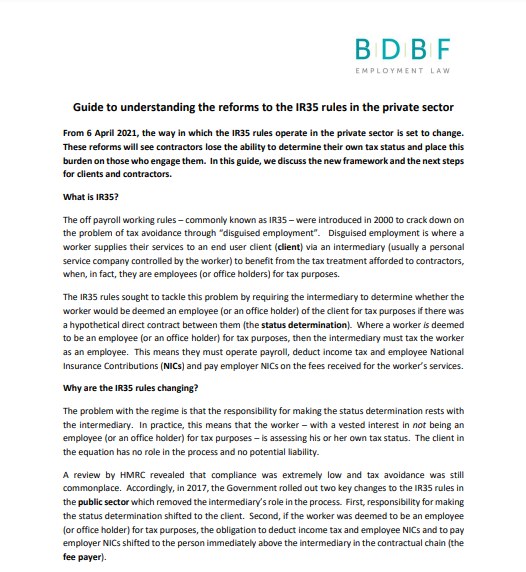
Understanding the reforms to the IR35 rules in the private sector

Understanding the reforms to the IR35 rules in the private sector

From 6 April 2020, the way in which the IR35 rules operate in the private sector is set to change.  These reforms will see contractors lose the ability to determine their own tax status and place this burden on those who engage them.  In this article, we discuss the new framework and the next steps for clients and contractors.

Please click the image below to view the information:

BDBF can help businesses and contractors prepare for the new regime.  Please contact Amanda Steadman or your usual BDBF contact for further advice.


BDBF seventh anniversary

[et_pb_section fb_built=”1″ _builder_version=”3.0.100″ background_image=”http://davidk423.sg-host.com/wp-content/uploads/2017/09/bdbf_final-stages-1-4-1.jpg” custom_padding=”|||” global_module=”2165″ saved_tabs=”all”][et_pb_row _builder_version=”3.25″ custom_padding=”|||”][et_pb_column type=”4_4″ _builder_version=”3.25″ custom_padding=”|||” custom_padding__hover=”|||”][et_pb_text _builder_version=”3.26.6″ background_layout=”dark” custom_margin=”0px|||” custom_padding=”0px|||”]

Employment Law News


[/et_pb_text][/et_pb_column][/et_pb_row][/et_pb_section][et_pb_section fb_built=”1″ admin_label=”section” _builder_version=”3.22.3″][et_pb_row column_structure=”3_4,1_4″ admin_label=”row” _builder_version=”3.25″ background_size=”initial” background_position=”top_left” background_repeat=”repeat”][et_pb_column type=”3_4″ _builder_version=”3.25″ custom_padding=”|||” custom_padding__hover=”|||”][et_pb_text _builder_version=”3.26.6″ text_orientation=”justified” use_border_color=”off”]


We are pleased to celebrate BDBF’s seventh anniversary of its founding on 1 November 2012.

We start the year having grown to a fantastic team of five partners , seven lawyers and a six strong practice team.

Excellence

Being a ‘go to’ senior executive firm was a founding ambition and we are proud to have achieved it. We are honoured to be ranked once again as a leading senior executive employment law firm in both Chambers and Partners and Legal 500 directories with four of our five partners being ranked or recognised. We were also delighted to be included in The Times newspaper top 200 UK law firms in 2019.

Legacy

We have achieved landmark case-law in whistleblowing and discrimination cases resulting in seven figure employment tribunal awards of compensation, and on a daily basis we have achieved hundreds of valuable outcomes for professionals with career and reputation-saving outcomes.

Using our collective experience we have informed and influenced changes to the law on NDAs, sexual harassment, whistleblowing and the impact of funding cuts on access to justice to the employment tribunal. We have also contributed to a number of government consultations on employment law.

Resilience

What sets us apart from many other law firms is that we have a majority in number of female equity partners in leadership and management roles, 100% retention rate of  lawyers returning from maternity leave, and of being promoted thereafter. It does seem strange that this is fairly exceptional when it should be the norm, but in our experience of the legal sector, and of dealing with countless maternity discrimination cases, it is something we feel able to be proud of.

Social Responsibility

Throughout the year we have participated in the Employment Law Association’s Employment Litigant In Person Scheme (ELIPS) by assisting claimants at the Employment Tribunal  on a pro bono basis. In June 2019, we participated in the London Legal Support Trust’s 10 km London Legal Walk raising vital funds for legal advice charities. In August 2019, we helped launch and were the first advisors on the U.K.’s pioneering workplace sexual harassment helpline managed by the charity, Rights of Women. We held a number of supporting events for City Giving Day in September 2019, including a quiz, bake-off and children’s clothes collection for the charity, Little Lives.

Thank you to all of our clients over the years, our colleagues, referrers and supporters, and our fantastic team at BDBF.

Gareth Brahams, Arpita Dutt and Ruth Gamble
BDBF’s Founding Partners
1 November 2019


[/et_pb_text][/et_pb_column][et_pb_column type=”1_4″ _builder_version=”3.25″ custom_padding=”|||” custom_padding__hover=”|||”][et_pb_sidebar orientation=”right” area=”sidebar-1″ _builder_version=”3.0.74″ remove_border=”off”][/et_pb_sidebar][/et_pb_column][/et_pb_row][/et_pb_section][et_pb_section fb_built=”1″ _builder_version=”3.26.6″][et_pb_row _builder_version=”3.26.6″][et_pb_column type=”4_4″ _builder_version=”3.26.6″][/et_pb_column][/et_pb_row][/et_pb_section]


Six months to go: is your business ready for the employment law reforms coming into force in April 2020?

[et_pb_section fb_built=”1″ _builder_version=”3.0.100″ background_image=”http://davidk423.sg-host.com/wp-content/uploads/2017/09/bdbf_final-stages-1-4-1.jpg” custom_padding=”|||” global_module=”2165″ saved_tabs=”all”][et_pb_row _builder_version=”3.25″ custom_padding=”|||”][et_pb_column type=”4_4″ _builder_version=”3.25″ custom_padding=”|||” custom_padding__hover=”|||”][et_pb_text _builder_version=”3.26.6″ background_layout=”dark” custom_margin=”0px|||” custom_padding=”0px|||”]

Employment Law News


[/et_pb_text][/et_pb_column][/et_pb_row][/et_pb_section][et_pb_section fb_built=”1″ admin_label=”section” _builder_version=”3.22.3″][et_pb_row column_structure=”3_4,1_4″ admin_label=”row” _builder_version=”3.25″ background_size=”initial” background_position=”top_left” background_repeat=”repeat”][et_pb_column type=”3_4″ _builder_version=”3.25″ custom_padding=”|||” custom_padding__hover=”|||”][et_pb_text _builder_version=”3.26.6″ text_orientation=”justified” use_border_color=”off”]

Six months to go: is your business ready for the employment law reforms coming into force in April 2020?

Change in the employment law sphere rarely slows down – even in the face of Brexit.  We are now only six months away from a host of employment law reforms, most of which are scheduled to come into force on 6 April 2020.  Below we outline the reforms and the preparatory steps for employers.

  1. Reform of the IR35 regime in the private sector

From 6 April 2020, large and medium-sized businesses in the private sector that engage independent contractors via a personal service company (PSC) will become responsible for assessing whether the off payroll working rules (known as IR35) apply.  The Government’s Check Employment Status Tool is designed to help with this assessment.  Once the end-user business has made its assessment it must notify the contractor and the PSC of its decision (and reasons) and provide them with the opportunity to challenge the assessment.  Assuming the end-user business is closest to the PSC in the contractual chain, it will also become responsible for deducting income tax and NICs at source through PAYE and paying employer NICs.

Next steps? Identify whether you engage any contractors via a PSC and determine whether the IR35 rules will apply to any such contracts.  Check whether your contract with the PSC permits the deduction of income tax and NICs and, if not, enter into revised contracts.  Ensure the necessary payroll arrangements are in place for 6 April 2020.

  1. Employment contracts

The right to a written statement of particulars of employment will be extended to all workers and must be given on the first day of work.   Significantly, the content of the statement will be enhanced.  In future, the statement must contain the existing “principal statement” particulars plus some of the existing “supplementary statement” particulars.  Further, new particulars relating to working time, paid leave, benefits and probationary periods must also be incorporated into the statement.    Only a very limited amount of information may be given separately within two months of starting work, including a brand new requirement to provide particulars of training entitlements.

Next steps? Identify any workers who will need a statement and begin updating template contracts to capture the new requirements in readiness for 6 April 2020.

  1. Calculating holiday pay

There will be a change to the reference period used to calculate holiday pay for certain types of workers.  Where a worker has variable pay because they have either: (i) no normal working hours; or (ii) normal working hours but pay that varies with the amount of work done or the time the work is done, then the reference period will increase from 12 weeks to 52 weeks.  The exception to this is where the worker has been engaged for fewer than 52 weeks.  In such cases, the reference period will be the number of weeks that the worker has been engaged.  This reform does not apply to workers who have normal working hours and non-variable pay (i.e. most salaried workers).

Next steps? Ensure that internal policies are updated to reflect this change where necessary and the new calculation model is adopted from 6 April 2020.

  1. Taxation of termination payments

Employer class 1A NICs will become payable on termination payments above £30,000 (which are currently only subject to income tax).  Termination payments will remain completely exempt from employee NICs.  This reform was initially due to come into force in 2018, but was delayed first to 6 April 2019 and then again to 6 April 2020.

Next steps? Although there are no immediate steps to take, remember to factor in this extra cost when negotiating settlements with departing employees.

  1. Better rights for agency workers

The provision which exempts agency workers from the right to pay parity with permanent employees until they have 12 weeks’ service (known as the “Swedish derogation”) will be repealed on 6 April 2020.  Agencies must notify agency workers of their right to have the same conditions as those employed directly by the hirer and confirm that the Swedish derogation no longer applies.  Agency workers will also become entitled to receive a “Key Facts” statement before starting a placement, which sets out core information relating to the proposed placement.

Next steps? Assess whether you engage any agency workers on Swedish derogation contracts and calculate the additional cost to the business of paying them in line with comparable permanent staff.  Be prepared to enter into new terms with the agency supplying the affected agency workers.

  1. Information and consultation of employees

The percentage of employees required to make a valid request to start negotiating an agreement on informing and consulting employees (under the Information and Consultation of Employees Regulations 2004 (ICE Regs)) will be lowered from 10% to 2% (subject to a minimum of 15 employees).

Next steps? Familiarise yourself with the negotiation procedure in the ICE Regs given the higher chance of receiving a request to negotiate.

  1. New right to parental bereavement leave

From April 2020 (implementation date to be confirmed), employees who suffer the loss of a child below the age of 18 will become entitled to 2 weeks’ statutory leave to be taken within 56 days of the date of death.  The right to parental bereavement leave will be a stand-alone right and will not affect rights to take other relevant forms of leave such as dependant emergency leave.  Employees with 26 weeks’ service will also be entitled to receive 2 weeks’ statutory pay.

Next steps? Consider whether you will enhance the statutory right – both in terms of leave and pay.  Put in place an appropriate bereavement policy, outlining the right and any other forms of support available to bereaved employees.

BDBF can help your business navigate these changes. If you would like to discuss any of the issues raised in this article, please contact Amanda Steadman on 020 3828 0363 or email amandasteadman@bdbf.co.uk.


[/et_pb_text][/et_pb_column][et_pb_column type=”1_4″ _builder_version=”3.25″ custom_padding=”|||” custom_padding__hover=”|||”][et_pb_sidebar orientation=”right” area=”sidebar-1″ _builder_version=”3.0.74″ remove_border=”off”][/et_pb_sidebar][/et_pb_column][/et_pb_row][/et_pb_section]


NEW ACAS GUIDANCE ON NEURODIVERSITY IN THE WORKPLACE

[et_pb_section fb_built=”1″ fullwidth=”on” custom_padding_last_edited=”on|desktop” _builder_version=”3.0.99″ background_color=”#ffffff” custom_padding=”|||” custom_padding_tablet=”50px|0|50px|0″ transparent_background=”off” padding_mobile=”off” global_module=”136″][et_pb_fullwidth_header title=”Employment Law News” admin_label=”Fullwidth Header” _builder_version=”3.21.1″ title_font=”||||||||” subhead_font=”||||||||” background_color=”rgba(255, 255, 255, 0)” background_image=”http://davidk423.sg-host.com/wp-content/uploads/2017/09/bdbf_final-stages-1-4-1.jpg” button_one_text_size__hover_enabled=”off” button_one_text_size__hover=”null” button_two_text_size__hover_enabled=”off” button_two_text_size__hover=”null” button_one_text_color__hover_enabled=”off” button_one_text_color__hover=”null” button_two_text_color__hover_enabled=”off” button_two_text_color__hover=”null” button_one_border_width__hover_enabled=”off” button_one_border_width__hover=”null” button_two_border_width__hover_enabled=”off” button_two_border_width__hover=”null” button_one_border_color__hover_enabled=”off” button_one_border_color__hover=”null” button_two_border_color__hover_enabled=”off” button_two_border_color__hover=”null” button_one_border_radius__hover_enabled=”off” button_one_border_radius__hover=”null” button_two_border_radius__hover_enabled=”off” button_two_border_radius__hover=”null” button_one_letter_spacing__hover_enabled=”off” button_one_letter_spacing__hover=”null” button_two_letter_spacing__hover_enabled=”off” button_two_letter_spacing__hover=”null” button_one_bg_color__hover_enabled=”off” button_one_bg_color__hover=”null” button_two_bg_color__hover_enabled=”off” button_two_bg_color__hover=”null”][/et_pb_fullwidth_header][/et_pb_section][et_pb_section fb_built=”1″ admin_label=”section” _builder_version=”3.0.47″][et_pb_row admin_label=”row” _builder_version=”3.0.47″ background_size=”initial” background_position=”top_left” background_repeat=”repeat”][et_pb_column type=”3_4″ _builder_version=”3.0.47″][et_pb_text _builder_version=”3.21.1″ use_border_color=”off” border_color=”#ffffff” border_style=”solid”]

NEW ACAS GUIDANCE ON NEURODIVERSITY IN THE WORKPLACE

Acas has published new guidance on handling neurodiversity in the workplace. Neurodiversity refers to different ways the brain can use and interpret information. This includes attention deficit disorder, autism, dyslexia, dyspraxia etc.  The guidance explains what neurodiversity is and highlights the different types of neurodivergence as well as the unique difficulties they may bring. It also explains the importance of employers taking steps to support neurodiversity in the workplace. Employers should note that they may be obliged to treat certain types of neurodivergence as a disability and make necessary reasonable adjustments.


[/et_pb_text][/et_pb_column][et_pb_column type=”1_4″ _builder_version=”3.0.47″][et_pb_sidebar orientation=”right” area=”sidebar-1″ _builder_version=”3.0.74″ remove_border=”off”][/et_pb_sidebar][/et_pb_column][/et_pb_row][/et_pb_section]


A DISABLED EMPLOYEE COULD NOT RELY ON HER MISTAKEN BELIEF ABOUT WHAT ADJUSTMENTS NEED TO BE MADE

[et_pb_section fb_built=”1″ fullwidth=”on” custom_padding_last_edited=”on|desktop” _builder_version=”3.0.99″ background_color=”#ffffff” custom_padding=”|||” custom_padding_tablet=”50px|0|50px|0″ transparent_background=”off” padding_mobile=”off” global_module=”136″][et_pb_fullwidth_header title=”Employment Law News” admin_label=”Fullwidth Header” _builder_version=”3.21.1″ title_font=”||||||||” subhead_font=”||||||||” background_color=”rgba(255, 255, 255, 0)” background_image=”http://davidk423.sg-host.com/wp-content/uploads/2017/09/bdbf_final-stages-1-4-1.jpg” button_one_text_size__hover_enabled=”off” button_one_text_size__hover=”null” button_two_text_size__hover_enabled=”off” button_two_text_size__hover=”null” button_one_text_color__hover_enabled=”off” button_one_text_color__hover=”null” button_two_text_color__hover_enabled=”off” button_two_text_color__hover=”null” button_one_border_width__hover_enabled=”off” button_one_border_width__hover=”null” button_two_border_width__hover_enabled=”off” button_two_border_width__hover=”null” button_one_border_color__hover_enabled=”off” button_one_border_color__hover=”null” button_two_border_color__hover_enabled=”off” button_two_border_color__hover=”null” button_one_border_radius__hover_enabled=”off” button_one_border_radius__hover=”null” button_two_border_radius__hover_enabled=”off” button_two_border_radius__hover=”null” button_one_letter_spacing__hover_enabled=”off” button_one_letter_spacing__hover=”null” button_two_letter_spacing__hover_enabled=”off” button_two_letter_spacing__hover=”null” button_one_bg_color__hover_enabled=”off” button_one_bg_color__hover=”null” button_two_bg_color__hover_enabled=”off” button_two_bg_color__hover=”null”][/et_pb_fullwidth_header][/et_pb_section][et_pb_section fb_built=”1″ admin_label=”section” _builder_version=”3.0.47″][et_pb_row admin_label=”row” _builder_version=”3.0.47″ background_size=”initial” background_position=”top_left” background_repeat=”repeat”][et_pb_column type=”3_4″ _builder_version=”3.0.47″][et_pb_text _builder_version=”3.21.1″ use_border_color=”off” border_color=”#ffffff” border_style=”solid”]

A DISABLED EMPLOYEE COULD NOT RELY ON HER MISTAKEN BELIEF ABOUT WHAT ADJUSTMENTS NEED TO BE MADE

Ms Wood worked for iforce Ltd, a logistics company, at one of its warehouses packing items at a fixed workbench. She had osteoarthritis, a degenerative condition and a disability, which worsened in damp, cold weather. In 2016, the company changed its working practices so that Ms Wood would need to move between benches and “follow the work”, rather than stay at one bench throughout.

Ms Wood, however, refused to work at the end benches near the loading doors as she believed that it would be colder and damper there; hence, making her condition worse. Yet, following intensive investigations by iForce, it was found that there was no material difference in temperature, humidity or wind chill factor throughout the warehouse. The company concluded that Ms Wood’s refusal to follow instructions was unreasonable and issued her with a final written warning (downgraded on appeal to a written warning).

Ms Wood issued proceedings in the employment tribunal, complaining of disability discrimination. The EAT held that in order for her to succeed there had to be some causal connection between the refusal to work at benches near the loading doors and her disability. That connection had not been established. The tribunal had not found that that iForce was requiring Ms Wood to work in colder and damper conditions that might impact upon her disability. In fact, it had found that Ms Wood was mistaken in her belief of this. The tribunal’s reasoning had found no basis for finding a causal connection between Ms Woods’ disability and the erroneous belief that had led to her to refuse instructions.

iForce Ltd v Wood UKEAT/0167/18

[/et_pb_text][/et_pb_column][et_pb_column type=”1_4″ _builder_version=”3.0.47″][et_pb_sidebar orientation=”right” area=”sidebar-1″ _builder_version=”3.0.74″ remove_border=”off”][/et_pb_sidebar][/et_pb_column][/et_pb_row][/et_pb_section]


DISABLED EMPLOYEE SHOULD HAVE BEEN OFFERED A DEDICATED PARKING SPACE

[et_pb_section fb_built=”1″ fullwidth=”on” custom_padding_last_edited=”on|desktop” _builder_version=”3.0.99″ background_color=”#ffffff” custom_padding=”|||” custom_padding_tablet=”50px|0|50px|0″ transparent_background=”off” padding_mobile=”off” global_module=”136″][et_pb_fullwidth_header title=”Employment Law News” admin_label=”Fullwidth Header” _builder_version=”3.21.1″ title_font=”||||||||” subhead_font=”||||||||” background_color=”rgba(255, 255, 255, 0)” background_image=”http://davidk423.sg-host.com/wp-content/uploads/2017/09/bdbf_final-stages-1-4-1.jpg” button_one_text_size__hover_enabled=”off” button_one_text_size__hover=”null” button_two_text_size__hover_enabled=”off” button_two_text_size__hover=”null” button_one_text_color__hover_enabled=”off” button_one_text_color__hover=”null” button_two_text_color__hover_enabled=”off” button_two_text_color__hover=”null” button_one_border_width__hover_enabled=”off” button_one_border_width__hover=”null” button_two_border_width__hover_enabled=”off” button_two_border_width__hover=”null” button_one_border_color__hover_enabled=”off” button_one_border_color__hover=”null” button_two_border_color__hover_enabled=”off” button_two_border_color__hover=”null” button_one_border_radius__hover_enabled=”off” button_one_border_radius__hover=”null” button_two_border_radius__hover_enabled=”off” button_two_border_radius__hover=”null” button_one_letter_spacing__hover_enabled=”off” button_one_letter_spacing__hover=”null” button_two_letter_spacing__hover_enabled=”off” button_two_letter_spacing__hover=”null” button_one_bg_color__hover_enabled=”off” button_one_bg_color__hover=”null” button_two_bg_color__hover_enabled=”off” button_two_bg_color__hover=”null”][/et_pb_fullwidth_header][/et_pb_section][et_pb_section fb_built=”1″ admin_label=”section” _builder_version=”3.0.47″][et_pb_row admin_label=”row” _builder_version=”3.0.47″ background_size=”initial” background_position=”top_left” background_repeat=”repeat”][et_pb_column type=”3_4″ _builder_version=”3.0.47″][et_pb_text _builder_version=”3.21.1″ use_border_color=”off” border_color=”#ffffff” border_style=”solid”]

DISABLED EMPLOYEE SHOULD HAVE BEEN OFFERED A DEDICATED PARKING SPACE

The Claimant, Ms Linsley, had ulcerative colitis, which is classified as a disability. The condition can make individuals need to go to the toilet urgently, flare up and be aggravated by stress.

Ms Linsley worked at the HMRC and drove to and from work in her own car. HMRC has a national policy on the use of its car parks. Priority is provided to staff who require a parking space as a reasonable adjustment, whether or not they are blue badge holders.

Throughout the years, Ms Linsley underwent various occupational health assessments that stated she would benefit from a dedicated parking space which she was provided with for a number of years at various HMRC sites since 2012. In November 2016, she moved to a new site in a different role and requested a dedicated parking space. However, instead, she was offered a parking space near the toilets if she failed to get a parking space near the building (and toilets) on a first come, first served basis. Alternatively, she could park in an unauthorised zone, incurring a small sanction which the employer would ensure would not apply to her, but she would also be required to move her vehicle later.

Ms Linsley was aggrieved that she did not receive a dedicated parking space and in early 2017 went off sick with stress. Reports from Occupational Health highlighted that stress was a trigger for her symptoms and as HMRC had not put in place the recommendations, this exacerbated her symptoms.

Ms Linley subsequently brought a claim for disability discrimination alleging that HMRC had failed to make reasonable adjustments. The EAT upheld her claim concluding that HMRC had failed to apply its own policy and it appeared that the relevant managers had acted in ignorance of it, which was not a good reason for failing to apply the policy. HMRC should have been aware that from around 2012 looking for a parking space was a source of stress. Employers are unlikely to be able to show that they have discharged their duty to make reasonable adjustments if they fail to follow their own policies unless they had a cogent reason for not doing so.

Mrs M Linsley v Commissioners for her Majesty’s Revenue and Custom: UKEAT/0150/18/JOJ


[/et_pb_text][/et_pb_column][et_pb_column type=”1_4″ _builder_version=”3.0.47″][et_pb_sidebar orientation=”right” area=”sidebar-1″ _builder_version=”3.0.74″ remove_border=”off”][/et_pb_sidebar][/et_pb_column][/et_pb_row][/et_pb_section]


Employment Law Changes To Look Out For In April 2019

[et_pb_section fb_built=”1″ fullwidth=”on” custom_padding_last_edited=”on|desktop” _builder_version=”3.0.99″ background_color=”#ffffff” custom_padding=”|||” custom_padding_tablet=”50px|0|50px|0″ transparent_background=”off” padding_mobile=”off” global_module=”136″][et_pb_fullwidth_header title=”Employment Law News” admin_label=”Fullwidth Header” _builder_version=”3.16″ title_font=”||||||||” subhead_font=”||||||||” background_color=”rgba(255, 255, 255, 0)” background_image=”http://davidk423.sg-host.com/wp-content/uploads/2017/09/bdbf_final-stages-1-4-1.jpg” button_one_text_size__hover_enabled=”off” button_one_text_size__hover=”null” button_two_text_size__hover_enabled=”off” button_two_text_size__hover=”null” button_one_text_color__hover_enabled=”off” button_one_text_color__hover=”null” button_two_text_color__hover_enabled=”off” button_two_text_color__hover=”null” button_one_border_width__hover_enabled=”off” button_one_border_width__hover=”null” button_two_border_width__hover_enabled=”off” button_two_border_width__hover=”null” button_one_border_color__hover_enabled=”off” button_one_border_color__hover=”null” button_two_border_color__hover_enabled=”off” button_two_border_color__hover=”null” button_one_border_radius__hover_enabled=”off” button_one_border_radius__hover=”null” button_two_border_radius__hover_enabled=”off” button_two_border_radius__hover=”null” button_one_letter_spacing__hover_enabled=”off” button_one_letter_spacing__hover=”null” button_two_letter_spacing__hover_enabled=”off” button_two_letter_spacing__hover=”null” button_one_bg_color__hover_enabled=”off” button_one_bg_color__hover=”null” button_two_bg_color__hover_enabled=”off” button_two_bg_color__hover=”null”][/et_pb_fullwidth_header][/et_pb_section][et_pb_section fb_built=”1″ admin_label=”section” _builder_version=”3.0.47″][et_pb_row admin_label=”row” _builder_version=”3.0.47″ background_size=”initial” background_position=”top_left” background_repeat=”repeat”][et_pb_column type=”3_4″ _builder_version=”3.0.47″][et_pb_text _builder_version=”3.21.1″ use_border_color=”off” border_color=”#ffffff” border_style=”solid”]

Employment Law Changes To Look Out For In April 2019

April 2019 is set to be an eventful month, one where the UK may or may not leave the European Union, tens of thousands will line up to run the London Marathon, and most of us will look forward to a much-needed break at Easter.  There are also several employment law changes HR directors and employers need to prepare for.  They are as follows:

Employment Tribunal compensation limit change

The limit on the amount of compensation awarded by the Employment Tribunal for unfair dismissal will rise from £83,682 to £86,444.  The upper limit which can be paid out will be either £86,444 or 52-weeks’ actual pay if that is less than the statutory cap.

The maximum statutory redundancy payment (and basic award for unfair dismissal) will increase to £15,750.

The National Living Wage to increase

On 1 April 2019 the National Living Wage (formally known as the National Minimum Wage) will increase by 4.9% for all age groups, calculated at.

  • £8.21 per hour for workers aged 25 and over (up from £7.83).
  • £7.70 per hour for workers aged 21 to 24 (up from £7.38).
  • £6.15 per hour for workers aged 18 to 20 (up from £5.90).
  • £4.35 per hour for workers aged under 18 (up from £4.20).
  • £3.90 per hour for apprentices (up from £3.70).

Failure to pay the National Living Wage can result in being publicly named and shamed and a maximum penalty of £20,000 being imposed.  Most employers do not intentionally pay less than the minimum wage, but laxities in HR systems can mean employees’ birthdays are missed and therefore their wage does not increase when they reach an age where the amount paid should change.  Other common reasons for failing to pay the National Living Wage include; not classifying workers correctly (i.e. registering them as self-employed instead of employed) or not counting the entire time the employee spends working (for example, locking up the premises).  It is imperative that business owners ensure their HR policies and procedures are up-to-date and alive to changes in employee circumstances which may trigger a change in the amount they should be paid.

Gender pay gap reporting deadline

Private companies with more than 250 employees must publish their reports regarding gender pay gaps on 4 April 2019.

The gender pay gap in 2018 was found to be 8.6%.  

To comply with gender pay gap reporting obligations, you must publish your organisation’s report in an accessible place on your website and ensure it remains in place for at least three years. Gender pay gap results should also be uploaded to the Government’s reporting website. 

Workers entitled to itemised pay statements

From 6 April 2019 those classified as ‘workers’ will be legally entitled to receive an itemised pay statement.  These were previously only required for employees.

Furthermore, if a staff member’s renumeration varies depending on the number of hours worked, their payslip must clearly set out those extra hours.  An example of this is where a worker or employee is paid a fixed salary but can work overtime on an ad-hoc basis at an hourly rate.  In such a case, the overtime worked needs to be shown on the pay statement.  This change is aimed at making renumeration transparent and provides an ability to quickly check the total number of hours work should a worker dispute their pay statement.

Certain statutory pay amounts increase

Statutory maternity, paternity, adoption, and shared parental pay increases to £148.68 per week from 7 April 2019.  And from 6 April 2019, statutory sick pay increases to £94.25 per week.

Changes to statutory redundancy

Any employees made redundant must pay those with two years’ service an amount based on the employee’s weekly pay, length of service and age.  The maximum amount the weekly pay is subject to will be £508 from 6 April 2019.

Start preparing for the end of freedom of movement

If / when the UK leaves the European Union, employers who wish to recruit talent from an EU country will need to be aware that prospective employees will be subject to similar restrictions that are currently in place for non-EEA nationals.

If you have any EU citizens employed in your organisation, they should be made aware that if they meet certain conditions, they can apply for Settled Status, which will allow them to live and work in the UK indefinitely.

If you have any questions regarding how these new changes may affect your business, please do not hesitate to call us on 020 3828 0350.

BDBF are employment law specialists in the insurance and financial services sectors. 


[/et_pb_text][/et_pb_column][et_pb_column type=”1_4″ _builder_version=”3.0.47″][et_pb_sidebar orientation=”right” area=”sidebar-1″ _builder_version=”3.0.74″ remove_border=”off”][/et_pb_sidebar][/et_pb_column][/et_pb_row][/et_pb_section]


TRIBUNAL RULES THAT STANCE ON SCOTTISH INDEPENDENCE IS “PHILOSOPHICAL BELIEF” FOR DISCRIMINATION PURPOSES

[et_pb_section bb_built=”1″ background_color=”#ffffff” fullwidth=”on” custom_padding_last_edited=”on|desktop” _builder_version=”3.0.99″ custom_padding_tablet=”50px|0|50px|0″ transparent_background=”off” padding_mobile=”off” custom_padding=”|||” next_background_color=”#000000″ global_module=”136″][et_pb_fullwidth_header global_parent=”136″ title=”Employment Law News” _builder_version=”3.0.99″ background_image=”http://davidk423.sg-host.com/wp-content/uploads/2017/09/bdbf_final-stages-1-4-1.jpg” background_layout=”dark” title_font=”||||||||” subhead_font=”||||||||” background_color=”rgba(255, 255, 255, 0)” button_one_text_size__hover_enabled=”off” button_one_text_size__hover=”null” button_two_text_size__hover_enabled=”off” button_two_text_size__hover=”null” button_one_text_color__hover_enabled=”off” button_one_text_color__hover=”null” button_two_text_color__hover_enabled=”off” button_two_text_color__hover=”null” button_one_border_width__hover_enabled=”off” button_one_border_width__hover=”null” button_two_border_width__hover_enabled=”off” button_two_border_width__hover=”null” button_one_border_color__hover_enabled=”off” button_one_border_color__hover=”null” button_two_border_color__hover_enabled=”off” button_two_border_color__hover=”null” button_one_border_radius__hover_enabled=”off” button_one_border_radius__hover=”null” button_two_border_radius__hover_enabled=”off” button_two_border_radius__hover=”null” button_one_letter_spacing__hover_enabled=”off” button_one_letter_spacing__hover=”null” button_two_letter_spacing__hover_enabled=”off” button_two_letter_spacing__hover=”null” button_one_bg_color__hover_enabled=”off” button_one_bg_color__hover=”null” button_two_bg_color__hover_enabled=”off” button_two_bg_color__hover=”null” /][/et_pb_section][et_pb_section bb_built=”1″ admin_label=”section” prev_background_color=”#000000″][et_pb_row admin_label=”row” background_position=”top_left” background_repeat=”repeat” background_size=”initial”][et_pb_column type=”3_4″][et_pb_text use_border_color=”off” border_color=”#ffffff” border_style=”solid” _builder_version=”3.17.6″]

TRIBUNAL RULES THAT STANCE ON SCOTTISH INDEPENDENCE IS “PHILOSOPHICAL BELIEF” FOR DISCRIMINATION PURPOSES 

An employment tribunal has held that a Councillor’s belief in Scottish Independence can amount to a “philosophical belief” for the purposes of the Equality Act 2010. 

SNP leader, Chris McEleny, brought a discrimination case against the Ministry of Defence in 2018 claiming that he had been unfairly targeted due to his views on Scottish Independence. He claimed that he had had his security clearance revoked after national security officials had interviewed him about these views together with his opposition to the Trident nuclear system and his mental health.

In a written statement, the Judge held that Mr McEleny’s situation met the legal requirements to constitute a philosophical belief. The judge was persuaded that the Claimant’s belief that Scotland, rather than any other Country, should be independent was of sufficient weight and importance to human life and behaviour to be philosophical in nature. 

By the same analogy, one could view Brexit as a belief that Britain should be independent of the EU and equally the reverse that Britain should remain in the EU. 

[/et_pb_text][/et_pb_column][et_pb_column type=”1_4″][et_pb_sidebar orientation=”right” area=”sidebar-1″ background_layout=”light” remove_border=”off” show_border=”on” /][/et_pb_column][/et_pb_row][/et_pb_section]


PERSONAL INJURY DAMAGES PAYABLE FOR FAILURE TO PROVIDE REST BREAKS UNDER THE WORKING TIME REGULATIONS 1998

[et_pb_section bb_built=”1″ background_color=”#ffffff” fullwidth=”on” custom_padding_last_edited=”on|desktop” _builder_version=”3.0.99″ custom_padding_tablet=”50px|0|50px|0″ transparent_background=”off” padding_mobile=”off” custom_padding=”|||” next_background_color=”#000000″ global_module=”136″][et_pb_fullwidth_header global_parent=”136″ title=”Employment Law News” _builder_version=”3.0.99″ background_image=”http://davidk423.sg-host.com/wp-content/uploads/2017/09/bdbf_final-stages-1-4-1.jpg” background_layout=”dark” title_font=”||||||||” subhead_font=”||||||||” background_color=”rgba(255, 255, 255, 0)” button_one_text_size__hover_enabled=”off” button_one_text_size__hover=”null” button_two_text_size__hover_enabled=”off” button_two_text_size__hover=”null” button_one_text_color__hover_enabled=”off” button_one_text_color__hover=”null” button_two_text_color__hover_enabled=”off” button_two_text_color__hover=”null” button_one_border_width__hover_enabled=”off” button_one_border_width__hover=”null” button_two_border_width__hover_enabled=”off” button_two_border_width__hover=”null” button_one_border_color__hover_enabled=”off” button_one_border_color__hover=”null” button_two_border_color__hover_enabled=”off” button_two_border_color__hover=”null” button_one_border_radius__hover_enabled=”off” button_one_border_radius__hover=”null” button_two_border_radius__hover_enabled=”off” button_two_border_radius__hover=”null” button_one_letter_spacing__hover_enabled=”off” button_one_letter_spacing__hover=”null” button_two_letter_spacing__hover_enabled=”off” button_two_letter_spacing__hover=”null” button_one_bg_color__hover_enabled=”off” button_one_bg_color__hover=”null” button_two_bg_color__hover_enabled=”off” button_two_bg_color__hover=”null” /][/et_pb_section][et_pb_section bb_built=”1″ admin_label=”section” prev_background_color=”#000000″][et_pb_row admin_label=”row” background_position=”top_left” background_repeat=”repeat” background_size=”initial”][et_pb_column type=”3_4″][et_pb_text use_border_color=”off” border_color=”#ffffff” border_style=”solid” _builder_version=”3.17.6″]

PERSONAL INJURY DAMAGES PAYABLE FOR FAILURE TO PROVIDE REST BREAKS UNDER THE WORKING TIME REGULATIONS 1998

The Employment Appeal Tribunal (EAT) has held that personal injury compensation is available for a failure to provide rest breaks under the Working Time Regulations 1998.

The Claimant, Mr Grange, was employed as a bus driver and then as a worker who monitored and regulated bus services. The Claimant brought a claim in the employment tribunal claiming that his employer had refused to permit him to exercise his entitlement to a rest break throughout various periods of his employment. 

On appeal, the EAT found that as a matter of law the employer’s refusal did not have to amount to an active response to a positive request. Denial of the right could take place through the arrangement of the working day. The tribunal had found that there were 14 days where the employer had been in breach and the Claimant gave evidence stating that the lack of rest breaks amounted to more than discomfort due to a bowel condition and he was therefore awarded £750 compensation.

It was held that tribunals are authorised to award damages for personal injury under the Working Time Regulations. The EAT considered previous case law in this area and highlighted the difference between awards for injury to feelings (which did not apply) and personal injury damages. It was clear from EU authority that the objective of the regulations is to protect the health and safety of workers, and it would be natural for them to allow such awards. A formal approach was not required for assessment of damages.  The tribunal was held to be empowered to deal with low-value cases on a common-sense approach without the need for medical evidence.

Grange v Abellio London Ltd EAT/0304/17

[/et_pb_text][/et_pb_column][et_pb_column type=”1_4″][et_pb_sidebar orientation=”right” area=”sidebar-1″ background_layout=”light” remove_border=”off” show_border=”on” /][/et_pb_column][/et_pb_row][/et_pb_section]