LUNCHTIME WEBINAR – Employment law developments in 2023: past, present and yet to come

LUNCHTIME WEBINAR – 18 JULY 2023

2023 has already been a busy year for employers. Our lunchtime webinar will quickly bring you up to speed on the key cases and developments from the first half of the year and round up what lies ahead in the coming months.

We will cover the following areas:

  • Recent cases on settlement negotiations and agreements, disability discrimination and flexible working.
  • New laws passed on neonatal leave, carer’s leave and pregnancy and redundancy.
  • New guidance for employers on adjustments for mental health, managing stress at work and menopause and menstrual health in the workplace.
  • Looking ahead: proposals to reform the law on employee competition, working time and holidays, TUPE consultation and whistleblowing.


Date: Tuesday, 18 July 2023

Time: 12.00pm-12.50pm


Click here to register


BDBF Partners recognised in 12th edition of the Best Lawyers in the United Kingdom

BDBF Partners Gareth Brahams, Claire Dawson, Nick Wilcox and Polly Rodway have been recognised in the 12th edition of the Best Lawyers in the United Kingdom for Employment Law. We are delighted to see Claire, Nick and Polly newly ranked this year for their expertise in this field. Gareth has been recognised consecutively every year since 2009.

Congratulations to our colleagues in the employment law world who have also been ranked this year. 


Gareth Brahams speaking at 4th IFSEA Annual International Conference

On 20 June 2023, BDBF Managing Partner Gareth Brahams is chairing a session on “The Executive Whistleblower” at the 4th IFSEA Annual International Conference on Risk, Reward, Regulatory and Reputation Management Issues for Senior Executives & Founders. Register here.


BDBF announces promotion of Samantha Prosser to Managing Associate

Congratulations! BDBF is pleased to announce the promotion of Samantha Prosser to Managing Associate, effective 1 June, 2023. Her promotion supports the continued growth of BDBF as a top-ranked employment firm. Since joining the firm seven years ago, Samantha has built her practice focusing on advising private and NHS consultants from leading hospitals on whistleblowing and discrimination claims, raising grievances, bullying, harassment and contractual claims. Samantha also acts for clients in other sectors, particularly in relation to sex and disability discrimination and whistleblowing claims, and is an experienced employment law litigator.

Gareth Brahams, Managing Partner said, “Samantha is a compassionate and capable lawyer with real inner steel. We are delighted to announce her promotion which is so well deserved.”


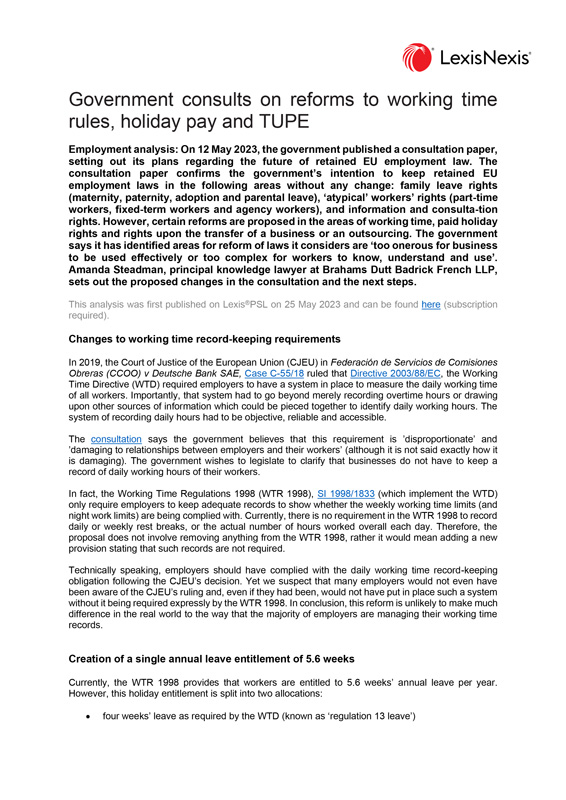
LexisNexis: Government consults on reforms to working time rules, holiday pay and TUPE

In a recent LexisNexis article, BDBF’s Principal Knowledge Lawyer Amanda Steadman discusses the UK government’s consultation on retained EU employment law following publication of the “Smarter regulation to grow the economy” policy paper. The consultation asks for views on proposed reforms affecting the calculation of holiday pay, working time rules, and TUPE.

Please click the image below to view the PDF:


Brahams Dutt Badrick French LLP are a leading specialist employment law firm based at Bank in the City. If you would like to discuss any issues relating to the content of this article, please contact Amanda Steadman (AmandaSteadman@bdbf.co.uk) or your usual BDBF contact.


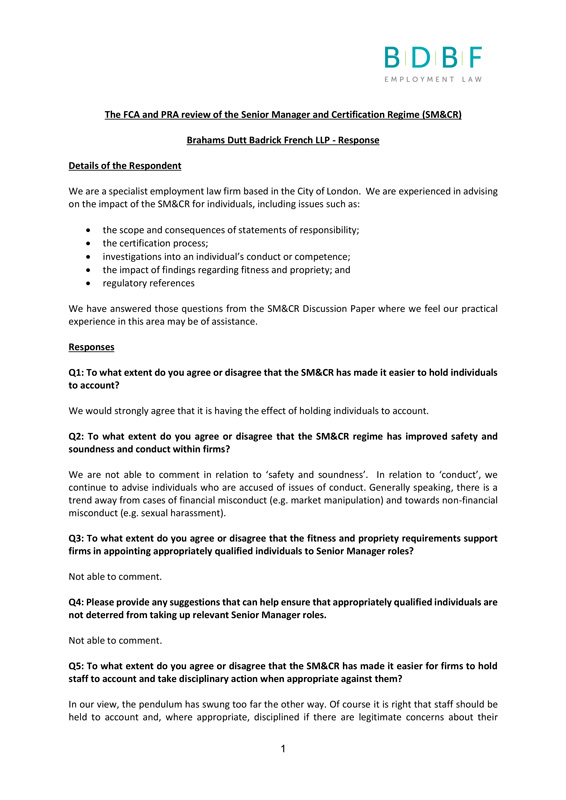
The FCA and PRA review of the Senior Managers and Certification Regime (SM&CR) – BDBF Response

On 30 March 2023, the Financial Conduct Authority (FCA) and UK Prudential Regulation Authority (PRA) published a joint discussion paper on the review of the Senior Managers and Certification Regime (SM&CR), inviting responses by 1 June 2023.

The FCA and PRA are seeking views on the effectiveness, scope and proportionality of the SM&CR, and potential improvements to the regime. Of particular interest is how the regime is operating in practice (we include comments from the employee perspective).

You can read our full response in the PDF below:


If you need advice on the Senior Managers and Certification Regime (SM&CR), please contact Nick Wilcox (nickwilcox@bdbf.co.uk) or your usual BDBF contact.


Gareth Brahams recognised as one of the “best employment lawyers for senior executives” by Spear’s 2023

BDBF Partner Gareth Brahams is listed as one of the best employment lawyers for senior executives in the Spear’s Magazine Employment Lawyers Index 2023. He is praised for his specialism in tackling discrimination and whistleblowing cases, as well as working on sexual harassment cases, severances and retirement packages. He is recognised as someone who advises an array of high-net-worth clients, predominantly highly paid bankers, investors, law firm partners, accountancy outfits and entrepreneurs. Read more here.


Waiver of future claims in a settlement agreement was effective resulting in the strike out of disability discrimination claims

In Clifford v IBM UK Ltd an Employment Tribunal Judge has ruled that a waiver of future claims contained in a settlement agreement was effective, meaning that the claimant’s claims were struck out.

What happened in this case?

The claimant, Mr Clifford, started working for IBM in 2001.  He was disabled and began a period of extended sick leave in 2008.   In 2012, he raised a grievance about the fact that IBM had not increased his salary or paid holiday pay to him during his sickness absence.  He said this amounted to disability discrimination and he asked to be moved onto IBM’s disability plan (the Plan). Under the Plan, Mr Clifford would be paid 75% of his former salary until the earlier of recovery, retirement or death.  

In 2013, Mr Clifford and IBM entered into a settlement agreement under which IBM agreed to:

  • pay £8,685 to settle the complaint about the unpaid holiday pay, however, no payment was to be made in respect of the unawarded pay rises;
  • place Mr Clifford on the Plan, under which he would receive around £54,000 per year until retirement (and the terms of the Plan stipulated that any pay increases were to be at IBM’s discretion); and
  • pay employer pension contributions based upon his full salary of around £72,000.

In exchange, Mr Clifford agreed: 

  • to waive his rights to bring claims about the matters raised in his grievance or any other claims that he had against IBM; 
  • to waive his rights to bring a long list of other possible claims;
  • not to raise any further grievances where such grievances were “substantially similar” to the original grievance; and
  • to waive his rights to bring any future claims connected to the matters set out in the grievance or the transfer to the Plan. 

Yet, in 2022, Mr Clifford brought claims against IBM, alleging that it was discriminatory (and also a breach of working time rules) to have paid only 75% of his previous salary to him throughout the year.  He said he was entitled to 100% of pay in respect of periods of annual leave, which meant that IBM owed him around £69,000.  He also claimed that it was discriminatory not to have awarded pay increases to him while he was on the Plan.  He argued that the Plan was intended to give security to disabled employees, but inflation had reduced the real value of the benefit.  

IBM applied to have the claims struck out arguing, amongst other things, that they were precluded by the waivers contained in the settlement agreement, which extended to future claims concerning similar matters raised in the grievance or the transfer to the Plan.  Mr Clifford sought to resist the strike out, pointing to the recent EAT decision in Bathgate v Technip UK Ltd, which said that settlement agreements cannot settle future claims which had not arisen at the date of the agreement and that both blanket waivers (which purport to waive all and any claims) and kitchen sink waivers (which purport to waive all claims set out in a long list of claims) were ineffective.  Therefore, Mr Clifford said that the waivers in the settlement agreement were invalid and did not prevent him from pursuing the claims.

What was decided?

The Employment Tribunal Judge struck out the claims, concluding that they had no reasonable prospect of success. 

As far as the claims concerning holiday pay were concerned, the transfer of Mr Clifford to the Plan amounted to a consensual variation of contract, under which all the normal features of the employment contract disappeared, and he only had the right to be paid 75% of his previous salary throughout the entire year.  Therefore, pay for any holidays would have been at the rate that he was actually paid.   

As to the claim concerning the failure to award a pay increase, the Employment Judge said that, properly understood, this was a complaint that the benefit was not generous enough.  The Plan conferred no right to a pay increase, only a discretion to award an increase.  However, Mr Clifford had not sought to argue that IBM had exercised its discretion in a capricious or arbitrary way – his only claim was for disability discrimination.  The Judge said that the terms of something which is only given as a benefit to disabled workers, and not to non-disabled workers, cannot amount to less favourable treatment related to disability.  Rather, it is more favourable treatment.

In any event, future claims about holiday pay and pay increases had been expressly waived in the settlement agreement and that waiver was effective.  The Judge distinguished the decision in Bathgate, which was directed at future claims which had not yet arisen and were truly unknowable.  By contrast, in this case, the issues of holiday pay and pay increases were known about at the time of entering into the settlement agreement and had been raised in Mr Clifford’s grievance and subsequent appeal.  The settlement agreement was clear that he could not bring future claims arising out of similar matters to those that had been settled. 

What are the learning points for employers?

It is worth noting that the Judge did not go as far as saying that all types of future claims could be waived in settlement agreements.  Indeed, he said that whether or not future claims could be settled as a matter of principle was an “academic dispute” in the context of this claim.  Here the “future claims” which were held to have been validly waived arose out of matters which were well known to the parties and had been the subject of a grievance, appeal and settlement agreement.  This put them in a different category to claims concerning matters which had not yet arisen, and which were truly unknown.  

The Judge also sought to introduce public policy considerations into the debate.  He drew a distinction between settling a future holiday pay claim and settling a future sexual harassment claim.  There was every reason of public policy for the settlement of past holiday pay claims to extend to future claims on the same issue, otherwise the employer would be compelled to litigate rather than settle.  By contrast, it would “inevitably be contrary to public policy” if a claimant settling a sexual harassment claim was prevented from bringing a future sexual harassment claim, since this would doom them to suffer future harassment without remedy. 

Where does this leave employers entering into settlement agreements? 

  • Actual claims and complaints can settled and must be identified in the settlement agreement either by a description of the claim or reference to the relevant statutory provision.

  • Future claims that are known and in existence at the point of settlement (but about which no complaint had been raised) may be settled, provided that a description of the claim or the relevant statutory provision is included in the settlement agreement.

  • The recent decision of the Court of Appeal in Arvunescu v Quick Release (Automotive) Ltd suggests that future claims that are unknown but in existence at the point of settlement may also be settled.  However, that case concerned settlement by way of a COT3 agreement, where blanket waivers are permitted.    You can read more about the Arvunescu decision here.

  • This latest decision suggests that future claims that are a known risk but not in existence may also be settled provided that they are expressly addressed in the settlement agreement and there are no public policy reasons why that should not be the case.  However, this is a first instance decision and does not bind other Tribunals so it is possible that a case with similar facts would be decided differently by another Tribunal.

  • Claims which are unknown and not in existence are truly unknowable and may not be settled according to the decision in Bathgate.

BDBF is a leading law firm based at Bank in the City of London specialising in employment law. If you would like to discuss any issues relating to the content of this article, please contact Amanda Steadman (AmandaSteadman@bdbf.co.uk) or your usual BDBF contact.

Clifford v IBM UK Ltd


Some further details published on proposal to limit non-compete clauses to three months

On 12 May 2023, the Government released some further details about its plans to limit the use of non-compete clauses in employment contracts.  In this briefing, we round up the key points to note. 

On 10 May 2023, the Government announced plans to legislate to limit the use of non-compete restrictions in employment contracts to three months.  You can read our detailed briefing on that announcement here, where we outlined a number of “known unknowns” about the proposals.  Since then, the Government has published its response to the consultation on reform of non-competes (Response), which closed on 26 February 2021.  The Response provides more information about the proposals and answers some, but not all, of the known unknowns.

The Response confirms the following points:

  • The proposed reforms will apply to workers engaged under a worker contract.  The initial announcement referred to “employment contracts” and “employees” only and made no reference to individuals classified as “workers” who worked under a contract to work or perform services for the employer.   The Response confirms that the proposed reforms will apply to worker contracts.  

  • The proposed reforms will not apply to wider types of workplace contracts.  It was unclear whether the proposed reforms would apply to other types of agreements connected to the workplace e.g. LLP agreements, shareholders’ agreements or long-term incentive plans.  The Response confirms that the limitation will not apply to non-compete clauses used in such agreements, on the basis that the bargaining power between the parties is different.  However, it is worth noting that the Response is silent about whether the limitation will apply to a non-compete restriction contained in a settlement agreement.  The Response also appears to overlook the fact that LLP members can be classified as workers depending on the circumstances. 

  • The proposed reforms will apply to non-compete clauses only and not to other types of covenants.  The initial announcement suggested that the limitation would not apply to other types of post-termination restriction, such as non-solicitation, non-dealing or non-poaching clauses.  The Response clarifies that this is the case. Therefore, other types of post-termination restriction may run for longer than three months and will be upheld provided that they are reasonable and go no further than necessary to protect the employer’s legitimate business interests.  The logic for this distinction is that such restrictions do not have such a significant impact on an individual’s ability to earn a living in their chosen profession.

  • Guidance to be published.  The Response also states that the Government plans to enhance transparency by producing guidance on the use of non-competes and the law underpinning them.

However, there are still a number of questions yet to be answered:

  • Will the law apply to existing employment contracts? It is still not clear whether the new law will apply retrospectively or only to new contracts.  In the event that it applies retrospectively, will an existing non-compete restriction which is in excess of three months be deemed to be void in its entirety? Or will it be potentially enforceable, but only up to the three-month cap?  If it would be deemed void, employers will either need to agree changes to the employment contracts of affected employees or accept the loss of the non-compete protection.  

  • How will the new law work alongside garden leave clauses? The initial announcement says that the reforms will not affect an employer’s ability to use paid notice periods or place employees on garden leave.  However, the risk is that employers will respond to the loss of longer non-competes by extending periods of notice in order to place the employee on garden leave and keep them out of the market that way.  Further information about the interplay between non-competes and garden leave is awaited.

  • When will the reforms come into force? The Government has said the legislation will be introduced “when Parliamentary time allows”.  At the time of writing, no timeline for the introduction of the new law has been given.   With a General Election looming, it remains to be seen whether the proposal will ever make its way on to the statute books.

BDBF is a law firm based at Bank in the City of London specialising in employment law.  If you would like to discuss any issues relating to the content of this article, please contact Managing Associate Tom McLaughlin (tommclaughlin@bdbf.co.uk), Principal Knowledge Lawyer Amanda Steadman (amandasteadman@bdbf.co.uk) or your usual BDBF contact.


Non-compete clauses: Response to the Government consultation on measures to reform post-termination non-compete clauses in contracts of employment – 12 May 2023


Gareth Brahams speaking at 2023 ELA Annual Conference

On 25 May 2023, BDBF Managing Partner Gareth Brahams is speaking on remedies at the ELA Annual Conference, alongside Gavin Mansfield KC, Littleton. Look out for their session: “Remedy decisions in high value cases: why when the case has been decided there is still everything to play for.”


Government changes approach to discarding EU laws and announces plans to reform the Working Time Regulations 1998 and TUPE

The Government has backtracked on its pledge to discard all retained EU laws at the end of year.  Instead, around 600 pieces of legislation will be revoked, including some relatively niche employment laws.  The rest will remain on the statute books but may be reformed over time.  In connection with this, the Government has already announced plans to reform the Working Time Regulations 1998 and the Transfer of Undertakings (Protection of Employment) Regulations 2006. 

What is the Retained EU Law Bill?

A large proportion of the UK’s legal framework – including its employment law framework – was underpinned by the law of the European Union as follows:

  • EU “directives” had to be implemented into UK law, either as an Act of Parliament or a statutory instrument.
  • Certain other forms of EU law were directly applicable in the UK without the need for any implementing laws.
  • Decisions of the Court of Justice of the European Union were also binding on the UK.


Brexit required changes to be made to this legal framework.  Acts of Parliament which implemented EU directives (e.g. the Equality Act 2010) remained in place.  However, all the relevant statutory instruments would have automatically fallen away upon Brexit.  To avoid legal chaos when Brexit happened, the Government decided to keep these statutory instruments and transfer them into UK law.  It also chose to keep directly applicable EU law and decisions of the Court of Justice of the European Union made on or before 31 December 2020.  Together, all these laws and decisions became known as “retained EU law”. 

In September 2022, the Government decided that the time was right to look again at whether retained EU law should be kept or repealed.  The Government published the Retained EU Law (Revocation and Reform) Bill (the Bill), which is aimed at removing the presence and influence of retained EU law within UK law.  Initially, the Bill provided that all retained EU law contained in statutory instruments would automatically expire on 31 December 2023 unless a positive decision was made to keep it after this date.  This was referred to as the “sunset” provision.

How has the Government changed its approach?

On 10 May 2023 the Government performed a surprise U-turn on the sunset provision.  The Government announced that it would table an amendment to the Bill which would scrap the sunset provision and replace it with a list of around 600 pieces of retained EU law to be revoked on 31 December 2023.  Any piece of retained EU law which was notincluded in that list would stay on the statute books (for now at least – it may be revoked or reformed at a later date).  

Why did the Government change its approach?  It had become clear that civil servants would simply not have enough time to assess which retained EU laws should be kept, reformed or discarded before the sunset date.  If the sunset provision had stayed, the concern was that we would be left with a legal vacuum on 1 January 2024 – including in the field of employment law.  

Will any retained EU employment laws be revoked on 31 December 2023?

Yes.  The Government’s list of retained EU law to be revoked contains the following employment laws:

  • The Posted Workers (Enforcement of Employment Rights) Regulations 2016.
  • The Posted Workers (Agency Workers) Regulations 2020.
  • The European Cooperative Society (Involvement of Employees) Regulations 2006.


The concepts of a “posted worker” and a “European Cooperative Society” do not apply to the UK as they did when we were members of the EU.  The consultation says the revocation of these rules should be regarded as a “tidying up of the statute book”.  

Will any retained EU employment laws be kept or reformed after 31 December 2023?

Yes.  On 12 May 2023, the Government published a consultation paper, setting out its plans regarding the future of retained EU employment law.  The consultation confirms the Government’s intention to keep retained EU employment laws in the following areas without any change:

  • Family leave rights (maternity, paternity, adoption and parental leave).
  • “Atypical” workers’ rights (part-time workers, fixed-term workers and agency workers).
  • Information and consultation rights.

However, some reforms are proposed to the Working Time Regulations 1998 (WTR) and the Transfer of Undertakings (Protection of Employment) Regulations 2006 (TUPE) namely:

  • Changes to working time record-keeping requirements.
  • Changes to annual leave entitlements.
  • Introduction of “rolled up” holiday pay.
  • Changes to the consultation requirements under TUPE.


You can read our detailed briefing on the proposed changes here.

What are the next steps?

The Bill has completed its passage through the House of Commons and is currently at the report stage in the House of Lords (meaning it has almost completed its passage there).  There will then be a consideration of amendments before the Bill passes into law.  Assuming that the Bill passes in its revised format, the employment laws concerning posted workers and European Co-operative Societies will be revoked on 31 December 2023.

The consultation seeking views on the proposed reforms to the WTR and TUPE closes on 7 July 2023.  The Government will need to consider the responses and decide what changes, if any, it wishes to make to the law.  Its position will be set out in a response paper, which we would expect to be published by the end of 2023.  Legislation will then need to be passed, meaning that the reforms to the WTR and TUPE are unlikely to take effect before the latter part of 2024 at the earliest.  However, we will continue to monitor this development and keep you updated.

BDBF is a law firm based at Bank in the City of London specialising in employment law.  If you would like to discuss any issues relating to the content of this article, please contact Principal Knowledge Lawyer Amanda Steadman (amandasteadman@bdbf.co.uk) or your usual BDBF contact.



Government consults on reforms to working time rules, holiday pay and TUPE

On 12 May 2023, the Government published a consultation paper, setting out its plans regarding the future of retained EU employment law.  

The consultation paper confirms the Government’s intention to keep retained EU employment laws in the following areas without any change:

  • Family leave rights (maternity, paternity, adoption and parental leave).
  • “Atypical” workers’ rights (part-time workers, fixed-term workers and agency workers).
  • Information and consultation rights. 

However, certain reforms are proposed in the areas of working time, paid holiday rights and rights upon the transfer of a business or an outsourcing.  The Government says it has identified areas for reform of laws it considers are “too onerous for business to be used effectively or too complex for workers to know, understand and use”.   

It is seeking views on the following changes.

Changes to working time record-keeping requirements

In 2019, the ECJ ruled that the Working Time Directive (WTD) required employers to have a system in place to measure the daily working time of all workers.  Importantly, that system had to go beyond merely recording overtime hours or drawing upon other sources of information which could be pieced together to identify daily working hours. The system of recording daily hours had to be objective, reliable and accessible.  

The consultation says the Government believes that this requirement is “disproportionate” and “damaging to relationships between employers and their workers” (although it is not said exactly how it is damaging).  The Government wishes to legislate to clarify that businesses do not have to keep a record of daily working hours of their workers.

In fact, the Working Time Regulations 1998 (WTR) (which implement the WTD) only require employers to keep adequate records to show whether the weekly working time limits (and night work limits) are being complied with. Currently, there is no requirement in the WTR to record daily or weekly rest breaks, or the actual number of hours worked overall each day.  Therefore, the proposal does not involve removing anything from the WTR, rather it would mean adding a new provision stating that such records are not required.

Technically speaking, employers should have complied with the daily working time record-keeping obligation following the ECJ’s decision.  Yet we suspect that many employers would not even have been aware of the ECJ’s ruling and, even if they had been, would not have put in place such a system without it being required expressly by the WTR.  In conclusion, this reform is unlikely to make much difference in the real world to the way that the majority of employers are managing their working time records.

Creation of a single annual leave entitlement of 5.6 weeks

Currently, the WTR provides that workers are entitled to 5.6 weeks’ annual leave per year.  However, this holiday entitlement is split into two allocations:

  • 4 weeks’ leave as required by the WTD (known as “regulation 13 leave”); and
  • 1.6 weeks’ leave which was granted by the UK Government on top of the minimum WTD requirement (known as “regulation 13A leave”).

Different rules about pay apply to regulation 13 leave and regulation 13A leave.  Workers should be paid their “normal pay” for regulation 13 leave, which may include things like commission, bonuses, allowances and some types of overtime payment.  In contrast, workers are only entitled to be paid basic pay for regulation 13A leave.   

The consultation says having these two types of leave causes administrative hassle for employers and confusion for workers.  The proposal is to replace regulation 13 leave and regulation 13A leave with a new regulation creating a single statutory annual leave entitlement of 5.6 weeks.  Therefore, the amount of leave per year will not increase or decrease, rather this is a “behind the scenes” change to make the management of such leave more straightforward.

In terms of pay for the new single pot of annual leave, the consultation says that the new regulation would set out the minimum rate of holiday pay.  The consultation seeks views on what that rate of pay should be.   Ultimately, if the Government decided that only basic pay should be paid for the whole 5.6 weeks this will represent a cut to the holiday pay of workers who are normally in receipt of additional elements of pay such as commission and overtime.  

Additional changes are also proposed in relation to the accrual and carry-over of annual leave.  

On the accrual of leave the proposal is that workers should accrue their annual leave entitlement at the end of each “pay period” (rather than each month as is currently the case) until the end of the first year of their employment.   The aim is to provide workers with a steady amount of holiday entitlement as they work and to simplify the calculation of holiday entitlement for employers.

On the carry-over of unused leave the proposal is to remove the regulations which permitted workers to carry over their regulation 13 leave into the following two annual leave years where it was not reasonably practicable to take it during the coronavirus pandemic.  The consultation notes that these regulations are no longer needed.   Apart from this change, the rules on carry-over would not change (i.e. 4 weeks’ annual leave could not be carried over unless the worker was unable to take it in certain scenarios and 1.6 weeks’ annual leave could be carried over where there was a written agreement between the worker and employer).

Introduction of rolled-up holiday pay

“Rolled-up” holiday pay is a system where no holiday pay is paid when a worker actually takes annual leave, but, instead, an additional amount of pay is added to their pay for periods of work.  In other words, the additional pay represents a payment in lieu of holiday pay.  In 2006, the ECJ ruled that the practice of rolled-up holiday pay was unlawful and that workers should be paid holiday pay at the time that the annual leave is taken.  The UK Government did not amend the WTR in line with the ECJ’s ruling, however, it updated non-statutory guidance to provide that rolled-up holiday was not permitted.

The consultation proposes that rolled-up holiday pay be introduced as an option for all workers.    Employers could choose between paying holiday pay when the worker takes the annual leave or “rolling up” holiday pay with wages and not paying anything during periods of annual leave.  It is said that this system would make life simple for employers as the calculation of holiday pay would be a straightforward enhancement to every pay slip.  The consultation proposes that the default enhancement rate is 12.07% of the worker’s pay (which is the result of 5.6 weeks’ annual leave divided by 46.4 working weeks of the year).  

This reform will be welcomed by employers of workers who work irregular hours or part-year arrangements as it will simplify the calculation of holiday pay significantly.  

Changes to TUPE consultation requirements

The Transfer of Undertakings (Protection of Employment) Regulations 2006 (TUPE) protect employees’ rights when the business or undertaking for which they work transfers to a new employer, either when the business changes owner or a service transfers to a new provider.  Currently, before such a transfer, the outgoing employer must inform and consult with representatives of the affected employees.  These can be existing representatives (e.g. trade union representatives) or ones that are elected just for this purpose.  However, outgoing employers with up to nine employees may inform and consult with affected employees directly if there are no existing representatives in place.  

The consultation proposes that the option of consulting with affected employees directly should be extended to businesses:

  • with up to 49 employees; and 
  • with any number of employees where a transfer of up to nine employees is proposed.   

However, this option would only be available where there were no existing representatives.  The aim is to help businesses avoid the administrative burden of holding elections for employee representatives.  This reform will be welcomed by employers – albeit that consulting with, say, 40 employees may be more challenging than consulting with just three or four representatives.   

What are the next steps?

The consultation closes on 7 July 2023.  The Government will need to consider the responses and decide what changes, if any, it wishes to make to the law.  Its position will be set out in a response paper, which we would expect to be published by the end of 2023.   Legislation will then need to be passed, meaning that the reforms are unlikely to take effect before the latter part of 2024 at the earliest.  However, we will continue to monitor this development and keep you updated.

BDBF is a law firm based at Bank in the City of London specialising in employment law.  If you would like to discuss any issues relating to the content of this article, please contact Principal Knowledge Lawyer Amanda Steadman (amandasteadman@bdbf.co.uk) or your usual BDBF contact.