Reflecting on employment law cases and developments in 2021

[et_pb_section fb_built=”1″ _builder_version=”3.0.100″ background_image=”http://davidk423.sg-host.com/wp-content/uploads/2017/09/bdbf_final-stages-1-4-1.jpg” custom_padding=”|||” global_module=”2165″ saved_tabs=”all” global_colors_info=”{}”][et_pb_row _builder_version=”4.7.4″ min_height=”66.4px” custom_padding=”50px||||false|false” global_colors_info=”{}”][et_pb_column type=”4_4″ _builder_version=”3.25″ custom_padding=”|||” global_colors_info=”{}” custom_padding__hover=”|||”][et_pb_text _builder_version=”4.7.4″ _dynamic_attributes=”content” text_font=”|700|||||||” text_font_size=”27px” background_layout=”dark” custom_margin=”0px|||” custom_padding=”0px|||” global_colors_info=”{}”]@ET-DC@eyJkeW5hbWljIjp0cnVlLCJjb250ZW50IjoicG9zdF90aXRsZSIsInNldHRpbmdzIjp7ImJlZm9yZSI6IiIsImFmdGVyIjoiIn19@[/et_pb_text][et_pb_text _builder_version=”4.7.4″ _dynamic_attributes=”content” _module_preset=”default” background_layout=”dark” global_colors_info=”{}”]@ET-DC@eyJkeW5hbWljIjp0cnVlLCJjb250ZW50IjoicG9zdF9kYXRlIiwic2V0dGluZ3MiOnsiYmVmb3JlIjoiIiwiYWZ0ZXIiOiIiLCJkYXRlX2Zvcm1hdCI6ImRlZmF1bHQiLCJjdXN0b21fZGF0ZV9mb3JtYXQiOiIifX0=@[/et_pb_text][/et_pb_column][/et_pb_row][/et_pb_section][et_pb_section fb_built=”1″ admin_label=”section” _builder_version=”3.22.3″ global_colors_info=”{}”][et_pb_row admin_label=”row” _builder_version=”4.7.4″ background_size=”initial” background_position=”top_left” background_repeat=”repeat” global_colors_info=”{}”][et_pb_column type=”4_4″ _builder_version=”3.25″ custom_padding=”|||” global_colors_info=”{}” custom_padding__hover=”|||”][et_pb_text _builder_version=”4.14.2″ text_orientation=”justified” hover_enabled=”0″ use_border_color=”off” global_colors_info=”{}” sticky_enabled=”0″]

What are the employment law highlights from the last 12 months?   We’ve picked out some of the most interesting cases and other developments from 2021 for employers to reflect on as the year draws to a close. 

COVID-19

  • Vaccines and the workforce: employers had to grapple with the tricky issue of whether to require staff to be vaccinated against COVID-19. Introducing such a requirement raises the risk of unfair dismissal and discrimination claims, as well as raising a number of practical issues such as allowing time off to be vaccinated, how post-vaccination sickness is treated and the data protection implications of holding vaccination status information.  You can read more about all of these issues in our two-part series of briefings here and here.  You can also catch up on our “No Jab, No Job?” webinar here.
  • COVID-related dismissals: claims of unfair dismissal for COVID-related reasons began to appear for the first time, with the Employment Tribunals taking a relatively robust approach.  For example, in Kubilius v Kent Foods Limited the Tribunal held that an employee had been fairly dismissed for refusing to wear a face mask when attending a client’s premises.  You can read more about that decision here.  Also, in Rodgers v Leeds Laser Cutting Ltd the Tribunal decided that an employee had been fairly dismissed for refusing to attend work because he was worried about catching the virus and giving it to his children.  You can read more about that decision in our briefing here.   
  • Furlough scheme extended and closed: the furlough scheme was due to close at the end of April.  Yet, in late March, the Chancellor announced that the scheme would be extended by five months and close on 30 September 2021. Throughout this extended period, furloughed employees remained entitled to be paid 80% of their normal wages for any furloughed hours, subject to the maximum cap of £2,500 per month.  It is not yet known whether the scheme would be resurrected in the event of further national lockdowns in 2022.  You can remind yourself of how the scheme operated and the impact of its closure in our guide to the scheme here.
  • Hybrid working here to stay: as restrictions lifted on “Freedom Day” on 19 July 2021, many employers began to return staff to the workplace over the Summer and Autumn months. However, a full-time return was not on the cards, with the majority of employers preferring some form of hybrid working. This was recognised by Acas, who issued new guidance for employers on implementing hybrid working.  You can read more about this in our briefing here We also published some FAQs about the return to work and hybrid working here.   In the last few weeks, the CIPD has published its own practical guidance on hybrid working, which you can view here.
  • The arrival of Omicron: just as life had begun to return to some semblance of normality, the virus mutated yet again, with the Omicron variant being identified as a cause for concern. You can read our initial briefing on what Omicron meant for office-based employers here (as the situation is fast-moving please do get in touch with us for advice on the latest position).

Equality

  • Harassment: in the harassment sphere there were a couple of important decisions for employers to note this year. First, in the case of Driscoll v V&P Global Ltd and another, the EAT held for the first time that where an employee resigns in response to repudiatory conduct which constitutes or includes unlawful harassment under the Equality Act 2010, then the constructive dismissal itself is capable of amounting to an unlawful act of harassment.  You can read the EAT’s decision here.  Second, in the case of Allay (UK) Ltd v Gehlen the EAT held that an employer’s failure to provide regular and effective equality training meant that they could not rely on the “reasonable steps” defence to a race harassment claim.  You can read more about this decision in our briefing here.
  • Sexual harassment: a report from the Fawcett Society revealed the continued prevalence of sexual harassment at work, despite the rise in hybrid working. You can read more about this report in our briefing here.  The Government also announced plans to reform sexual harassment laws to introduce a positive duty on employers to take all reasonable steps to prevent sexual harassment and reintroduce protection from third party harassment at work (e.g. harassment by a client or a contractor).  You can read more about these reforms in our briefing here.
     
  • Sex discrimination and flexible working: this year we saw a spate of discrimination cases arising out of the refusal of flexible working patterns requested by working mothers.  In the case of Dobson v North Cumbria Integrated Care NHS Foundation Trust an employee and mother of three (including two disabled children) brought a discrimination claim after she was dismissed for refusing to work occasional weekends.  The EAT ruled that Tribunals must accept as fact that women still bear the primary burden of childcare responsibilities and this hinders their ability to work certain hours.  You can read more about this decision in our briefing here.  In the case of Keating v WH Smith Holdings Ltd the imposition of a Saturday working requirement on a single mother was held to be discriminatory and in Thomson v Scancrown Ltd t/a Manors a refusal to make modest adjustments to a maternity returner’s working hours was also said to be discriminatory.  You can read more about these decisions in our briefings here and here.
  • Associative indirect disability discrimination: in another case concerning refusal of a flexible working pattern, an Employment Tribunal upheld a claim of associative indirect discrimination for the first time. In the case of Follows v Nationwide Building Society an employee refused to move from a hybrid working arrangement to an office-based working arrangement as she had caring responsibilities for her disabled mother.  Her refusal led to her dismissal.  The Tribunal held the requirement to work in the office full-time indirectly discriminated against the employee because of her association with a disabled person, even though she was not disabled herself.  You can read the Employment Tribunal’s decision here.
  • Sex discrimination claims brought by men: 2021 saw two notable sex discrimination claims brought by men – with differing results. In the case of Price v Powys Council, the EAT held that it was not discriminatory to enhance pay for a female employee on adoption leave and not to do so for a male employee on shared parental leave.  You can find out why in our briefing here.   The male claimants in the case of Bayfield and Jenner v Wunderman Thompson (UK) Ltd were more successful.  Here, the Tribunal decided that the dismissal of two senior male employees amounted to sex discrimination, where the dismissals had followed the announcement of the employer’s high gender pay gap figures and a radical new approach to diversity within the business.  You can read more about this decision in our briefing here and you can also read Gareth Braham’s article in the ELA Briefing on this topic here.
  • Gender critical beliefs are protected: in the high-profile case of Forstater v CGD Europe and others, the EAT held that gender critical beliefs, including beliefs that biological sex cannot be changed and is different to gender identity, are protected beliefs.Although the beliefs may be offensive to some and could even result in the harassment of trans persons in certain circumstances, they were protected under the right to freedom of thought, conscience and religion under the European Convention of Human Rights and as philosophical beliefs under the Equality Act 2010.  You can read more about this decision in our briefing here.
  • Menopause and the workplace: the impact of the menopause on workers has been a hot topic this year. Two Parliamentary Inquiries were launched, with a view to introducing better legal protections for affected workers.  Further, a new report highlighted the severe impact of the menopause on those working in the financial services sector.  You can read more about these developments in our briefings here and here.   We also saw the second ever appellate decision on a claim concerning the menopause.  In the case of Rooney v Leicester City Council, the EAT held that an Employment Tribunal had been wrong to say that a woman suffering from a wide range of menopausal symptoms which affected her day to day life was not disabled for employment law purposes.  You can read more about this decision here.   If you would like a deep dive on menopause and the workplace, you can also listen to the podcast we recorded for Daniel Barnett’s “Employment Law Matters” podcast.
  • Equal pay: the supermarket chain equal pay litigation continued in 2021, with David overcoming Goliath in two notable decisions. In Asda Stores Ltd v Brierley and ors the Supreme Court upheld a decision that a group of female retail store workers could compare themselves to a group of male distribution centre workers for the purposes of an equal pay claim, even though they worked at separate establishments.  In Tesco Stores Ltd v Element and ors, the EAT upheld an order for the employer to disclose documents and provide information relating to the alleged pay comparators’ contracts, job descriptions and pay.  It rejected the employer’s argument that the specific disclosure request amounted to a “fishing expedition”.   Both decisions will help claimants get equal pay claims off the ground.  You can read the decisions here and here.
  • Pay reporting: having been suspended in 2020 due to the pandemic, gender pay gap reporting resumed in 2021, albeit that the reporting date was postponed from April to October.  You can read more about this in our briefing here Analysis by PwC of the most recent round of reports shows a small decline in the average median pay gap from 14.2% in 2017/8 to 13.1% in 2020/21.  By contrast, proposals to introduce ethnicity pay gap reporting appear to have stalled.  The Government consulted on the issue in 2019 but, to date, has failed to publish its response.  To mark this year’s Race Equality Week in February, we published a briefing summarising where things currently stand.

Employment status, contracts and policies

  • Who is a worker? In Uber BV v Aslam, the Supreme Court upheld a decision that drivers working for Uber were workers and not self-employed contractors.   This decision is important for employers engaging contractors as it highlights the continued willingness of the Courts and Tribunals to scrutinise the way a relationship works in practice, regardless of contractual labels.  You can read more about this decision in our briefing here  
  • Reform of the IR35 regime: the way in which the IR35 rules operate in the private sector changed on 6 April 2021.  These reforms saw contractors lose the ability to determine their own tax status and placed the burden on those who engage them (often the end user).  You can remind yourself of the new framework and the action points for clients and contractors in our guide to the regime here.
  • Changing terms and conditions: a survey conducted by the CIPD this year revealed that 22% of employers have made changes to their employees’ terms and conditions since the start of the COVID-19 pandemic, including to terms relating to place of work, hours of work and pay. Acas has published new guidance for employers on how to navigate changes to terms and conditions and they caution against the use of “fire and rehire” strategies. You can read more about this guidance in our briefing here.
  • Holiday pay: in the case of Smith v Pimlico Plumbers the EAT decided that workers do not have a right to carry over holiday pay where they had taken unpaid annual leave. This contrasts with an earlier European Court decision where it was decided that workers are entitled to carry over unlimited annual leave which had not been taken because it was unpaid.  You can read the EAT’s decision here.   This decision is of importance for organisations who engage people they think of as independent contractors who may, in fact, have worker status.  It should be noted that this decision has been appealed to the Court of Appeal, with judgment expected in 2022.
  • Flexible working reform: the Government published a consultation seeking views on proposals to expand and improve the flexible working framework.  The consultation looks at a range of proposals including whether the right to request flexible working should become a “Day 1” employment right and whether employers should be required to show they have considered alternatives before rejecting a flexible working request. The consultation closed on 1 December 2021 and the Government’s response is expected in 2022.  You can read more about the proposals in our briefing here.
  • New right to carer’s leave: the Government announced that a new right for employees to take up to one week of unpaid carer’s leave per year will be introduced when Parliamentary time allows.  The right will be a “Day 1” employment right and employees will be able to take the leave to care for and/or make arrangements to provide care for a dependant who has a long-term care need. In due course, employers should put in place a policy to outline the new right and how staff can take such leave.  You can read more about the new right in our briefing here.

Whistleblowing

  • New EU Whistleblowing Directive: the EU’s new Whistleblowing Directive is due to be implemented by EU Member States by 17 December 2021. Legislation must be introduced which, amongst other things, requires private employers with 50+ workers to establish internal reporting channels, keep a whistleblower’s identity confidential, confirm receipt of a whistleblower’s report within seven days, and provide a response within a reasonable period which should generally not exceed three months.  Post Brexit, the UK does not need to implement the Directive, however, it may elect to enhance whistleblowing laws to keep pace with the EU.  You can read more about the Directive in our briefing here.
  • World Whistleblowers Day and tips for employers: World Whistleblowers Day fell on 23 June 2021 and looked at how best to support the mental wellbeing of whistleblowers.  What can employers do to empower staff to speak up about malpractice and protect whistleblowers from reprisals?  In our briefing here, we considered five actions employers could take to support whistleblowers within their business.
  • Dismissing whistleblowers: in the case of Kong v Gulf International Bank (UK) Ltd the EAT handed down an employer-friendly decision, holding that in whistleblowing dismissal claims, it will rarely be the case that an employer will be fixed with the motives of anyone other than the person/s making the decision about whether to dismiss. The EAT also held that if a whistleblower is dismissed for the manner in which they conveyed or pursued their concern, this is genuinely separable from the raising of the concern itself and, as such, will not be automatically unfair.  We understand this decision is to be appealed to the Court of Appeal.  You can read the EAT’s decision here.
  • Interim relief hearings should be heard in public: in the case of Queensgate Investments LLP v Millet the EAT ruled that applications for interim relief should be heard in public, save where an order is made to restrict publicity.  Interim relief is a powerful remedy open to claimants in a small number of specific claims for automatic unfair dismissal and is most commonly sought in whistleblowing dismissal claims.  This is the first appellant authority on this point, with BDBF acting for the successful respondent to the appeal.  You can read more about the EAT’s decision in our briefing here.

Termination

  • Constructive unfair dismissal: in the case of Flatman v Essex County Council, the EAT held that a Tribunal misapplied the law by failing to identify whether a fundamental breach of contract occurred at any point up to the employee’s resignation. In so doing, it reaffirmed the principle that once a fundamental breach has been committed, it cannot be cured. You can read more about this decision in our briefing here.
  • Misconduct: in the case of Daley v Vodafone Automotive Ltd an employee was dismissed for gross misconduct for behaving in an offensive, threatening and intimidating manner towards a colleague. During the disciplinary investigation, the employee disclosed that he took medication for depression which caused side effects including anger and frustration. The employer took no action in response to this information and went on to dismiss.  The EAT held that the Employment Tribunal should have considered whether the employer’s failure to probe the impact of the employee’s depression and medication rendered the dismissal process unfair.  You can read more about this decision in our briefing here.
  • Redundancy and appeals: in the case of Gwynedd Council v Barratt the Court of Appeal confirmed that, on its own, the absence of a right to appeal against dismissal for redundancy does not make it unfair. However, it is one of the factors to be considered when determining the overall fairness of the dismissal. You can read more about this decision in our briefing here.
  • Post-termination restrictions: the Government launched a consultation about regulating the use of non-compete restrictions in employment contracts.  Views were sought on proposals including requiring employers to pay compensation for the duration of non-compete restrictions or banning their use altogether.  The consultation closed on 26 February 2021 and the Government’s response is awaited. You can read BDBF’s response to the consultation here.

If you would like to know more about any of these developments please contact Amanda Steadman (amandasteadman@bdbf.co.uk) or your usual BDBF contact.

[/et_pb_text][/et_pb_column][/et_pb_row][/et_pb_section][et_pb_section fb_built=”1″ _builder_version=”3.26.6″ global_colors_info=”{}”][et_pb_row _builder_version=”3.26.6″ global_colors_info=”{}”][et_pb_column type=”4_4″ _builder_version=”3.26.6″ global_colors_info=”{}”][/et_pb_column][/et_pb_row][/et_pb_section]


New right for employees to take carer’s leave to be introduced

[et_pb_section fb_built=”1″ _builder_version=”3.0.100″ background_image=”http://davidk423.sg-host.com/wp-content/uploads/2017/09/bdbf_final-stages-1-4-1.jpg” custom_padding=”|||” global_module=”2165″ saved_tabs=”all” global_colors_info=”{}”][et_pb_row _builder_version=”4.7.4″ min_height=”66.4px” custom_padding=”50px||||false|false” global_colors_info=”{}”][et_pb_column type=”4_4″ _builder_version=”3.25″ custom_padding=”|||” global_colors_info=”{}” custom_padding__hover=”|||”][et_pb_text _builder_version=”4.7.4″ _dynamic_attributes=”content” text_font=”|700|||||||” text_font_size=”27px” background_layout=”dark” custom_margin=”0px|||” custom_padding=”0px|||” global_colors_info=”{}”]@ET-DC@eyJkeW5hbWljIjp0cnVlLCJjb250ZW50IjoicG9zdF90aXRsZSIsInNldHRpbmdzIjp7ImJlZm9yZSI6IiIsImFmdGVyIjoiIn19@[/et_pb_text][et_pb_text _builder_version=”4.7.4″ _dynamic_attributes=”content” _module_preset=”default” background_layout=”dark” global_colors_info=”{}”]@ET-DC@eyJkeW5hbWljIjp0cnVlLCJjb250ZW50IjoicG9zdF9kYXRlIiwic2V0dGluZ3MiOnsiYmVmb3JlIjoiIiwiYWZ0ZXIiOiIiLCJkYXRlX2Zvcm1hdCI6ImRlZmF1bHQiLCJjdXN0b21fZGF0ZV9mb3JtYXQiOiIifX0=@[/et_pb_text][/et_pb_column][/et_pb_row][/et_pb_section][et_pb_section fb_built=”1″ admin_label=”section” _builder_version=”3.22.3″ global_colors_info=”{}”][et_pb_row admin_label=”row” _builder_version=”4.7.4″ background_size=”initial” background_position=”top_left” background_repeat=”repeat” global_colors_info=”{}”][et_pb_column type=”4_4″ _builder_version=”3.25″ custom_padding=”|||” global_colors_info=”{}” custom_padding__hover=”|||”][et_pb_text _builder_version=”4.10.7″ text_orientation=”justified” hover_enabled=”0″ use_border_color=”off” global_colors_info=”{}” sticky_enabled=”0″]

The Government has announced that a new right for employees to take up to one week of unpaid carer’s leave per year will be introduced when Parliamentary time allows.  In this briefing we explain how the new right will work and what steps employers should take to prepare.

Background

Plans to introduce a new right to carer’s leave were first raised almost two years ago.  The Queen’s Speech in December 2019 outlined the Government’s intention to bring forward an Employment Bill  which would introduce a new right to unpaid carer’s leave.  Unsurprisingly, given the onset of the pandemic, the Employment Bill did not materialise.  However, the Government did open a public consultation on the proposal – that consultation closed on 3 August 2020.  Just over a year later, on 23 September 2021, the Government published its response to the consultation and has confirmed that the right will be introduced as soon as Parliamentary time allows.  It is estimated that this right will benefit almost 2.5 million employees who have caring responsibilities.

Who will be able to take carer’s leave?

All employees in England, Wales and Scotland will be entitled to take carer’s leave from Day 1 of their employment. They will be entitled to take the leave to care for and/or make arrangements to provide care for a “dependant” who has a “long-term care need”. 

It is anticipated that the meaning of “dependant” here will align with its meaning in the context of other employment rights and will cover the following people:

  • spouse / partner / civil partner (including same sex partners);
  • child;
  • parent;
  • a person living with the employee as part of their household; and
  • a person who relies on the employee for care.

In this context, a “long-term care need” will mean:

  • a long-term physical or mental illness or injury;
  • a disability under the Equality Act 2010; and/or
  • care needs relating old age.

How may carer’s leave be taken?

The entitlement is to one week’s unpaid leave per year. 

The one week’s leave may be taken flexibly, for example as half days, full days or in a single block of one week.  It is hoped that such flexibility will better meet the needs of those with caring responsibilities.  In theory, this means that employers could have to deal with a higher number of leave requests than would be the case if the leave had to be taken in a single block.  However, we suspect that, in practice, many carers wishing to take shorter blocks of leave (such as half days) will be in a position to plan in advance when they will need to take the leave and be able to make a block booking.

The right is to unpaid leave only.  Although some respondents to the consultation were in favour of prescribing paid leave, the Government rejected this option on the basis that it wanted to ensure a “proportionate impact” on employers.   However, employers may choose to offer paid leave if they wish.

What are the requirements for booking carer’s leave?

An employee wishing to take carer’s leave must give notice to their employer at least twice the length of the leave requested, plus one day.  For example, if an employee wished to take Friday afternoon off as carer’s leave, they would need to give notice by no later than the preceding Wednesday.   An employer may refuse a particular request to take carer’s leave where they consider this would unduly disrupt their business.  However, the employee must be allowed to take the leave at another time.

There will be no requirement for employees to provide their employer with evidence of the need to take carer’s leave – they will be able to self-certify.  Should an employee falsely claim the leave then this would be a disciplinary matter (and, as a dishonesty offence, would probably justify immediate dismissal).  Employers could introduce their own requirement for evidence to be provided, but consideration would have to be given to compliance with data protection laws (since the evidence may involve the disclosure of medical information relating to a third party).

Do eligible employees have any other rights?

Employees will be protected from detriment and/or dismissal for taking, or seeking to take, carer’s leave.  A dismissal for a reason connected to exercising the right to carer’s leave will be automatically unfair.

Where eligible, employees taking carer’s leave will remain entitled to take other relevant forms of leave such as unpaid time off for dependant emergencies or unpaid parental leave.  Eligible employees may also be able to request flexible working arrangements (and proposals to make this a Day 1 employment right are currently under consultation). 

What are the next steps?

The new right to carer’s leave will be introduced when Parliamentary time allows.  It is not yet clear when that will be, but we anticipate that it will be in 2022. 

In due course, employers should consider putting in place a written policy explaining what the right is and how employees may request leave.  Consideration should be given to whether evidence of eligibility will be required and whether the right will be enhanced, for example, by offering additional and/or paid leave.  Where a decision is made to offer paid leave, then this is information which must form part of the particulars of employment to be given to an employee on Day 1 of their employment (either in the employment contract or another document such as a Staff Handbook).  Consideration should also be given to providing training to line managers, so that they understand how to respond to requests and how to avoid responding in a way which may be viewed as detrimental.

Carer’s leave consultation: Government response

If you would like to discuss how to implement carer’s leave within your organisation please contact Amanda Steadman (amandasteadman@bdbf.co.uk) or your usual BDBF contact.

[/et_pb_text][/et_pb_column][/et_pb_row][/et_pb_section][et_pb_section fb_built=”1″ _builder_version=”3.26.6″ global_colors_info=”{}”][et_pb_row _builder_version=”3.26.6″ global_colors_info=”{}”][et_pb_column type=”4_4″ _builder_version=”3.26.6″ global_colors_info=”{}”][/et_pb_column][/et_pb_row][/et_pb_section]

BDBF’S 2021 employment law tracker

[et_pb_section fb_built=”1″ _builder_version=”3.0.100″ background_image=”http://davidk423.sg-host.com/wp-content/uploads/2017/09/bdbf_final-stages-1-4-1.jpg” custom_padding=”|||” global_module=”2165″ saved_tabs=”all”][et_pb_row _builder_version=”4.7.4″ min_height=”66.4px” custom_padding=”50px||||false|false”][et_pb_column type=”4_4″ _builder_version=”3.25″ custom_padding=”|||” custom_padding__hover=”|||”][et_pb_text _builder_version=”4.7.4″ _dynamic_attributes=”content” text_font=”|700|||||||” text_font_size=”27px” background_layout=”dark” custom_margin=”0px|||” custom_padding=”0px|||”]@ET-DC@eyJkeW5hbWljIjp0cnVlLCJjb250ZW50IjoicG9zdF90aXRsZSIsInNldHRpbmdzIjp7ImJlZm9yZSI6IiIsImFmdGVyIjoiIn19@[/et_pb_text][et_pb_text _builder_version=”4.7.4″ _dynamic_attributes=”content” _module_preset=”default” background_layout=”dark”]@ET-DC@eyJkeW5hbWljIjp0cnVlLCJjb250ZW50IjoicG9zdF9kYXRlIiwic2V0dGluZ3MiOnsiYmVmb3JlIjoiIiwiYWZ0ZXIiOiIiLCJkYXRlX2Zvcm1hdCI6ImRlZmF1bHQiLCJjdXN0b21fZGF0ZV9mb3JtYXQiOiIifX0=@[/et_pb_text][/et_pb_column][/et_pb_row][/et_pb_section][et_pb_section fb_built=”1″ admin_label=”section” _builder_version=”3.22.3″][et_pb_row admin_label=”row” _builder_version=”3.25″ background_size=”initial” background_position=”top_left” background_repeat=”repeat”][et_pb_column type=”4_4″ _builder_version=”3.25″ custom_padding=”|||” custom_padding__hover=”|||”][et_pb_text _builder_version=”4.7.4″ text_orientation=”justified” use_border_color=”off”]

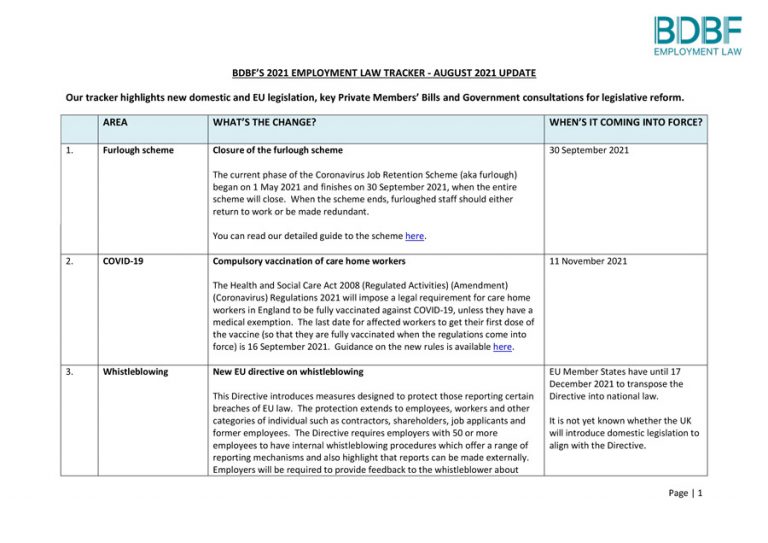
Summer’s over and that ‘back to school’ feeling is upon us.  You can make sure you are top of the HR class by reading BDBF’s updated 2021 employment law tracker.  The tracker will bring you up to date on all the key pieces of UK and EU employment legislation on the horizon, as well as relevant Government consultations.

Please click on the image below to open the PDF guide:

[/et_pb_text][et_pb_image src=”http://davidk423.sg-host.com/wp-content/uploads/2021/08/August-Newsletter-2021-Employment-Law-Tracker-updated-August-2021-1.jpg” title_text=”August-Newsletter-2021-Employment-Law-Tracker-(updated-August-2021)-1″ url=”http://davidk423.sg-host.com/wp-content/uploads/2021/08/August-Newsletter-2021-Employment-Law-Tracker-updated-August-2021.pdf” align=”center” _builder_version=”4.7.4″ _module_preset=”default” border_width_all=”2px” border_color_all=”#1D7078″][/et_pb_image][et_pb_text _builder_version=”4.7.4″ text_orientation=”justified” use_border_color=”off”]

If you or your business needs advice please contact Amanda Steadman (amandasteadman@bdbf.co.uk) or your usual BDBF contact.

[/et_pb_text][/et_pb_column][/et_pb_row][/et_pb_section][et_pb_section fb_built=”1″ _builder_version=”3.26.6″][et_pb_row _builder_version=”3.26.6″][et_pb_column type=”4_4″ _builder_version=”3.26.6″][/et_pb_column][/et_pb_row][/et_pb_section]


What does the Queen’s Speech mean for employment law?

[et_pb_section fb_built=”1″ _builder_version=”3.0.100″ background_image=”http://davidk423.sg-host.com/wp-content/uploads/2017/09/bdbf_final-stages-1-4-1.jpg” custom_padding=”|||” global_module=”2165″ saved_tabs=”all”][et_pb_row _builder_version=”4.7.4″ min_height=”66.4px” custom_padding=”50px||||false|false”][et_pb_column type=”4_4″ _builder_version=”3.25″ custom_padding=”|||” custom_padding__hover=”|||”][et_pb_text _builder_version=”4.7.4″ _dynamic_attributes=”content” text_font=”|700|||||||” text_font_size=”27px” background_layout=”dark” custom_margin=”0px|||” custom_padding=”0px|||”]@ET-DC@eyJkeW5hbWljIjp0cnVlLCJjb250ZW50IjoicG9zdF90aXRsZSIsInNldHRpbmdzIjp7ImJlZm9yZSI6IiIsImFmdGVyIjoiIn19@[/et_pb_text][et_pb_text _builder_version=”4.7.4″ _dynamic_attributes=”content” _module_preset=”default” background_layout=”dark”]@ET-DC@eyJkeW5hbWljIjp0cnVlLCJjb250ZW50IjoicG9zdF9kYXRlIiwic2V0dGluZ3MiOnsiYmVmb3JlIjoiIiwiYWZ0ZXIiOiIiLCJkYXRlX2Zvcm1hdCI6ImRlZmF1bHQiLCJjdXN0b21fZGF0ZV9mb3JtYXQiOiIifX0=@[/et_pb_text][/et_pb_column][/et_pb_row][/et_pb_section][et_pb_section fb_built=”1″ admin_label=”section” _builder_version=”3.22.3″][et_pb_row admin_label=”row” _builder_version=”3.25″ background_size=”initial” background_position=”top_left” background_repeat=”repeat”][et_pb_column type=”4_4″ _builder_version=”3.25″ custom_padding=”|||” custom_padding__hover=”|||”][et_pb_text _builder_version=”4.7.4″ text_orientation=”justified” use_border_color=”off”]

The 2021 Queen’s Speech was delivered on 11 May 2021.  In this briefing, we take stock of what it had to say about employment law reform.

The Queen’s Speech in December 2019 outlined the Government’s intention to bring forward an Employment Bill delivering change in a number of areas of employment law including:

  • The right for workers to request a more “predictable contract”.
  • Extending redundancy protection to pregnant women and returners from family leave.
  • Making flexible working the default for all jobs.
  • A new right to unpaid carers’ leave.

You can read more about those plans in the BDBF’s 2021 employment law tracker.  Unsurprisingly, given the onset of the pandemic, the planned Employment Bill did not materialise in 2020.  There was no Queen’s Speech in 2020.

The 2021 Queen’s Speech was delivered on 11 May 2021, but the Employment Bill was conspicuous by its absence.  The background briefing notes to the Queen’s Speech also made no mention of the Bill and referred only to two employment law matters of interest.  First, the employment tribunal process will be aligned with that of other tribunals in the Unified Tribunals structure.  Second, there are plans to bring forward measures to address racial and ethnic disparities.  In connection with this, the Government is currently considering its response to the report published by the Commission on Race and Ethnic Disparities on 31 March 2021.

Yet it appears that the Employment Bill has not (yet) been abandoned.  Just a few days after the Queen’s Speech, the Government published its response to the Women and Equalities Committee (WEC) report on the gendered economic impact of COVID-19.  The Government’s response states that the Government is still committed to bringing forward the Employment Bill “when Parliamentary time allows”, but this will not be by the end of June 2021 (as the WEC report had recommended).  This was echoed on 25 May 2021 by Paul Scully MP, Parliamentary Under-Secretary of State for Business, Energy and Industrial Strategy, when he confirmed that he still intended to bring forward the Employment Bill when Parliamentary time allows.

It’s also worth noting that the Government’s response to the WEC report also specifically states that:

  • The Government will consider making the right to request flexible working a Day 1 employment right (currently, 26 weeks’ service is required) and it commits to making flexible working the default position, with a consultation to be published in due course.
  • The Government plans to extend redundancy protection to pregnant women and for six months after a mother has returned to work (with similar protection for those returning from adoption and shared parental leave).

Both of these are measures which were to be included in the Employment Bill.  The response also confirms that the Government still plans to respond on the consultation on ethnicity pay reporting (which closed on 11 January 2019).

Employers may be relieved to hear that they don’t have to grapple with a raft of employment law reforms at the same time as dealing with the recovery from the pandemic and the ongoing fall out from Brexit.  However, change is likely to come as part of the Government’s “levelling up” agenda and employers should watch out for further news.  BDBF will keep you updated on developments as they are reported.

If you would like to discuss any issues arising out of this briefing please contact Amanda Steadman (amandasteadman@bdbf.co.uk) or your usual BDBF contact.

[/et_pb_text][/et_pb_column][/et_pb_row][/et_pb_section][et_pb_section fb_built=”1″ _builder_version=”3.26.6″][et_pb_row _builder_version=”3.26.6″][et_pb_column type=”4_4″ _builder_version=”3.26.6″][/et_pb_column][/et_pb_row][/et_pb_section]

Quick recap of the employment law changes coming into force in April 2021

[et_pb_section fb_built=”1″ _builder_version=”3.0.100″ background_image=”http://davidk423.sg-host.com/wp-content/uploads/2017/09/bdbf_final-stages-1-4-1.jpg” custom_padding=”|||” global_module=”2165″ saved_tabs=”all”][et_pb_row _builder_version=”3.25″ custom_padding=”|||”][et_pb_column type=”4_4″ _builder_version=”3.25″ custom_padding=”|||” custom_padding__hover=”|||”][et_pb_text _builder_version=”3.27.4″ background_layout=”dark” custom_margin=”0px|||” custom_padding=”0px|||”]

Employment Law News


[/et_pb_text][/et_pb_column][/et_pb_row][/et_pb_section][et_pb_section fb_built=”1″ admin_label=”section” _builder_version=”3.22.3″][et_pb_row admin_label=”row” _builder_version=”3.25″ background_size=”initial” background_position=”top_left” background_repeat=”repeat”][et_pb_column type=”4_4″ _builder_version=”3.25″ custom_padding=”|||” custom_padding__hover=”|||”][et_pb_text _builder_version=”4.7.4″ text_orientation=”justified” hover_enabled=”0″ use_border_color=”off” sticky_enabled=”0″]

Quick recap of the employment law changes coming into force in April 2021

Although the deadline for gender pay gap reporting has been pushed back to 5 October 2021, employers still need to keep on top of other employment law changes coming into force in April. Here we round up the five key changes for employers to navigate.

  1. Contractors: changes to the IR35 rules in the private sector – 6 April 2021

The way in which the IR35 rules operate in the private sector will change on 6 April 2021.  These reforms will see contractors lose the ability to determine their own tax status and place this burden on those who engage them.  Large and medium-sized businesses in the private sector that engage independent contractors via an intermediary (usually a personal service company) will become responsible for assessing whether the IR35 rules apply.  Once the business has made its assessment, it must notify certain parties of its decision and provide them with the opportunity to challenge it.

If a business determines that a contractor is an employee for tax purposes, then the party that pays the fee to the intermediary must deduct tax and National Insurance Contributions (NICs).   In a simple contractual chain (i.e. individual > intermediary > end user business), the end user business is the fee payer and would have to deduct tax and NICs.  By contrast, in a four-party chain (e.g. individual > intermediary > agency > end user business), the agency is the fee payer and would have to do that job.

Action point? Our detailed guide to the new regime sets out a range of different action points for affected employers.

  1. Statutory pay: increase to statutory family leave pay and sickness payments – 4 April 2021

It is expected that statutory family leave and sickness payments will increase as follows on 4 April 2021 (this date is yet to be confirmed):

  • Statutory Maternity Pay, Maternity Allowance, Statutory Paternity Pay, Statutory Adoption Pay, Statutory Shared Parental Pay: £151.97 per week (up from £151.20).
  • Statutory Sick Pay: £96.35 per week (up from £95.85).

Action point? Employers should ensure that the correct rates are paid to affected employees and that any policies and template letters that refer to the statutory rates of pay are updated.

  1. National minimum wage: change to the age threshold and rates increase – 1 April 2021

The minimum age threshold for entitlement to the National Living Wage will decrease from 25 to 23 years of age.  In addition, the hourly rates will increase as follows:

  • National Living Wage – age 23+: £8.91 (up from £8.72).
  • Standard adult rate – age 21+: £8.36 (up from £8.20).
  • Development rate – age 18+: £6.56 (up from £6.45).
  • Youth rate – age 16+: £4.62 (up from £4.55).
  • Apprentice rate: £4.30 (up from £4.15).
  • Accommodation offset – maximum daily deduction: £8.36 (up from £8.20).

Action point? Employers must ensure that staff are paid at least the minimum wage (at the applicable rate) for the hours they work.

  1. Termination payments: changes to the PENP calculation rules – 6 April 2021

An alternative formula for calculating post-employment notice pay (PENP) will be introduced for use in situations where an employee is paid monthly but their contractual notice period isn’t a whole number of months.  If you require advice on the alternative formula, please get in touch.

The new rules will also introduce changes to ensure that non-residents who receive PENP are taxed fairly.  The tax treatment of PENP for individuals who are non-resident in the year of termination of their UK employment will be the same as for UK residents.  Both changes will apply where the termination payment is received on or after 6 April 2021.

Action point? Employers should familiarise themselves with the new rules and apply them in relevant cases.

  1. Employment Tribunal awards: increase to certain limits – 6 April 2021

The limits on certain Employment Tribunal awards will increase as follows:

  • The ceiling on “a week’s pay” for calculating redundancy payments, the basic award for unfair dismissal and various other statutory rights: £544 (up from £538).
  • Maximum compensatory award for unfair dismissal claims: £89,493 (up from £88,519).

In dismissal claims, these figures will apply to claims where the effective date of termination falls on or after 6 April 2021.

Action point? Employers should ensure that statutory redundancy calculations made in respect of redundancies taking place on or after 6 April 2021 are calculated using the new weekly rate of pay.

If your business needs advice on preparing for any of these changes please contact Amanda Steadman (amandasteadman@bdbf.co.uk) or your usual BDBF contact.

[/et_pb_text][/et_pb_column][/et_pb_row][/et_pb_section][et_pb_section fb_built=”1″ _builder_version=”3.26.6″][et_pb_row _builder_version=”3.26.6″][et_pb_column type=”4_4″ _builder_version=”3.26.6″][/et_pb_column][/et_pb_row][/et_pb_section]


Furlough scheme extended to 30 September 2021 and other key employment news from the Spring 2021 Budget

[et_pb_section fb_built=”1″ _builder_version=”3.0.100″ background_image=”http://davidk423.sg-host.com/wp-content/uploads/2017/09/bdbf_final-stages-1-4-1.jpg” custom_padding=”|||” global_module=”2165″ saved_tabs=”all”][et_pb_row _builder_version=”3.25″ custom_padding=”|||”][et_pb_column type=”4_4″ _builder_version=”3.25″ custom_padding=”|||” custom_padding__hover=”|||”][et_pb_text _builder_version=”3.27.4″ background_layout=”dark” custom_margin=”0px|||” custom_padding=”0px|||”]

Employment Law News


[/et_pb_text][/et_pb_column][/et_pb_row][/et_pb_section][et_pb_section fb_built=”1″ admin_label=”section” _builder_version=”3.22.3″][et_pb_row admin_label=”row” _builder_version=”3.25″ background_size=”initial” background_position=”top_left” background_repeat=”repeat”][et_pb_column type=”4_4″ _builder_version=”3.25″ custom_padding=”|||” custom_padding__hover=”|||”][et_pb_text _builder_version=”4.7.4″ text_orientation=”justified” hover_enabled=”0″ use_border_color=”off” sticky_enabled=”0″]

Furlough scheme extended to 30 September 2021 and other key employment news from the Spring 2021 Budget

On 3 March 2021, the Chancellor of the Exchequer, Rishi Sunak MP, delivered the Spring 2021 Budget.  Here we round up the key employment law announcements for employers to note including the five-month extension to the furlough scheme.

Furlough scheme

The furlough scheme had been due to close on 30 April 2021.  The Chancellor announced that the scheme will be extended by five months and will close on 30 September 2021, meaning the scheme will have been in place for 19 months overall.  Throughout this extended period, furloughed employees will remain entitled to be paid 80% of their normal wages for any furloughed hours (subject to the maximum cap of £2,500 per month).

Employers will not be required to contribute to furloughed employees’ wages for unworked hours during either May or June 2021.  During this period, employers will only have to pay employer National Insurance Contributions (NICs) and pension contributions, plus wages for any worked hours.  However, from July 2021, when the economy will start to reopen in earnest, employers must contribute to the wage costs of furloughed hours.  In July 2021, employers must pay 10% of the wage costs and in August and September 2021, employers must pay 20% of the wage costs.  We expect a new Treasury Direction and guidance on this next phase of the scheme to be published shortly.  Once this becomes available, we will update the BDBF guide for employers on the scheme.

Separately, the Chancellor also announced that the Government will invest over £100 million in combating fraud within the Government’s COVID-19 support packages, including the furlough scheme.

Statutory sick pay (SSP) rebate scheme

In response to the pandemic, the Government introduced a temporary SSP rebate scheme under which eligible employers with fewer than 250 employees could reclaim up to two weeks’ worth of SSP for an employee’s COVID-19-related sickness absence.  The Chancellor announced that this scheme will continue while sickness absence levels remain high but will close in due course.  However, no date for closure has been set.

COVID-19 tests and home office expenses

The Chancellor announced that neither income tax nor NICs will be payable on COVID-19 tests which are reimbursed by employers in either the 2020-21 or 2021-22 tax years.  This supplements the existing exemption for COVID-19 tests which have been provided to the employee by the employer.

A similar income tax and NICs exemption exists for reimbursed expenses of home office equipment.  It was announced that this exemption will be extended into the 2021-22 tax year.

National minimum wage

On 1 April 2021 the minimum age threshold for entitlement to the top rate of the national minimum wage (known as the National Living Wage (NLW)) will decrease from 25 to 23 years of age and the hourly rate will rise to £8.91 per hour.  The national minimum wage rates for other age groups will also increase on the same date.  Last year, the Government announced plans to extend the NLW to workers aged 21 and over and increase the rate to two-thirds of median earnings by 2024.  In 2020, the sum for median weekly earnings in the UK was £586 per week, meaning the median hourly rate (based on a standard 35-hour working week) was £16.74 per hour.  Accordingly, if the NLW were set at two thirds of the 2020 median hourly pay rate then it would need to increase to around £11.16 per hour(and, of course, this figure may be higher by 2024).

The Chancellor announced that he has asked the Low Pay Commission to recommend how the NLW and other national minimum wage rates should rise next year in order to be on track to meet the 2024 target.

Traineeships and apprenticeships

Employers who create new traineeship opportunities between 1 September 2020 and 31 July 2021 are entitled to apply for a cash payment of £1,000 per trainee (up to a maximum of ten).  The Chancellor announced that employers will continue to be able to claim the £1,000 payment in the 2021-22 academic year (i.e. up to 31 July 2022).

Currently, employers who hire new apprentices are entitled to apply for a cash payment of £2,000 for each apprentice aged under 25 and £1,500 for those aged 25 or over.  The Chancellor announced that these payments would be extended and increased.  From 1 April 2021, employers who hire new apprentices before 30 September 2021 may claim £3,000 per apprentice.

From July 2021, the Government will also invest £7 million in developing a “portable apprenticeship” scheme and employers will be invited to put forward relevant proposals.

If your business needs advice on the furlough scheme or any of these changes please contact Amanda Steadman (amandasteadman@bdbf.co.uk) or your usual BDBF contact.

[/et_pb_text][/et_pb_column][/et_pb_row][/et_pb_section][et_pb_section fb_built=”1″ _builder_version=”3.26.6″][et_pb_row _builder_version=”3.26.6″][et_pb_column type=”4_4″ _builder_version=”3.26.6″][/et_pb_column][/et_pb_row][/et_pb_section]


Webinar: 10 things for employers to know about in 2021

Employment Law News

BDBF’S Webinar: 10 things for employers to know about in 2021

On 25 January 2021, we held a webinar looking at the top 10 things for employers to know about in 2021.  Here you can access the recording of that webinar, together with the slide presentation used on the day.  Also on our website, you can access the BDBF 2021 Roadmap for HR, which covers the key actions points from the webinar.

To view the PDF webinar slides please click on the image below, or view the recording of the webinar:

BDBF can help businesses and employers prepare for the future. Please contact Amanda Steadman (amandasteadman@bdbf.co.uk), or your usual BDBF contact, for further advice.


BDBF’S 2021 ROADMAP FOR HR

[et_pb_section fb_built=”1″ _builder_version=”3.0.100″ background_image=”http://davidk423.sg-host.com/wp-content/uploads/2017/09/bdbf_final-stages-1-4-1.jpg” custom_padding=”|||” global_module=”2165″ saved_tabs=”all”][et_pb_row _builder_version=”3.25″ custom_padding=”|||”][et_pb_column type=”4_4″ _builder_version=”3.25″ custom_padding=”|||” custom_padding__hover=”|||”][et_pb_text _builder_version=”3.27.4″ background_layout=”dark” custom_margin=”0px|||” custom_padding=”0px|||”]

Employment Law News


[/et_pb_text][/et_pb_column][/et_pb_row][/et_pb_section][et_pb_section fb_built=”1″ admin_label=”section” _builder_version=”3.22.3″][et_pb_row admin_label=”row” _builder_version=”3.25″ background_size=”initial” background_position=”top_left” background_repeat=”repeat”][et_pb_column type=”4_4″ _builder_version=”3.25″ custom_padding=”|||” custom_padding__hover=”|||”][et_pb_text _builder_version=”4.7.4″ text_orientation=”justified” hover_enabled=”0″ use_border_color=”off” sticky_enabled=”0″]

 BDBF’S 2021 Roadmap for HR 

On 25 January 2021, we held a webinar looking at the top 10 things for employers to know about in 2021.  Here you can access the BDBF 2021 Roadmap for HR, which covers the key actions points from the webinar.  Each action point has been given a “red, amber, green” rating to help you prioritise your activities for the year ahead.

To view the PDF guide please click on the image below:

[/et_pb_text][et_pb_image src=”http://davidk423.sg-host.com/wp-content/uploads/2021/01/BDBFs-2021-Roadmap-for-HR-PDF-1.jpg” title_text=”BDBF’s-2021-Roadmap-for-HR-(PDF)-1″ url=”http://davidk423.sg-host.com/wp-content/uploads/2021/01/BDBFs-2021-Roadmap-for-HR-PDF.pdf” url_new_window=”on” align=”center” _builder_version=”4.7.4″ _module_preset=”default” hover_enabled=”0″ border_width_all=”2px” border_color_all=”#008395″ sticky_enabled=”0″][/et_pb_image][et_pb_text _builder_version=”4.7.4″ text_orientation=”justified” hover_enabled=”0″ use_border_color=”off” sticky_enabled=”0″]

BDBF can help businesses and employers prepare for the future. Please contact Amanda Steadman (amandasteadman@bdbf.co.uk), or your usual BDBF contact, for further advice.

[/et_pb_text][/et_pb_column][/et_pb_row][/et_pb_section][et_pb_section fb_built=”1″ _builder_version=”3.26.6″][et_pb_row _builder_version=”3.26.6″][et_pb_column type=”4_4″ _builder_version=”3.26.6″][/et_pb_column][/et_pb_row][/et_pb_section]


https://www.youtube.com/watch?v=VNrVPZEsz0I


The Coronavirus Job Retention Scheme from 1 November 2020 onwards – a guide for employers

[et_pb_section fb_built=”1″ _builder_version=”3.0.100″ background_image=”http://davidk423.sg-host.com/wp-content/uploads/2017/09/bdbf_final-stages-1-4-1.jpg” custom_padding=”|||” global_module=”2165″ saved_tabs=”all”][et_pb_row _builder_version=”3.25″ custom_padding=”|||”][et_pb_column type=”4_4″ _builder_version=”3.25″ custom_padding=”|||” custom_padding__hover=”|||”][et_pb_text _builder_version=”3.27.4″ background_layout=”dark” custom_margin=”0px|||” custom_padding=”0px|||”]

Employment Law News


[/et_pb_text][/et_pb_column][/et_pb_row][/et_pb_section][et_pb_section fb_built=”1″ admin_label=”section” _builder_version=”3.22.3″][et_pb_row admin_label=”row” _builder_version=”3.25″ background_size=”initial” background_position=”top_left” background_repeat=”repeat”][et_pb_column type=”4_4″ _builder_version=”3.25″ custom_padding=”|||” custom_padding__hover=”|||”][et_pb_text _builder_version=”4.7.4″ text_orientation=”justified” use_border_color=”off”]

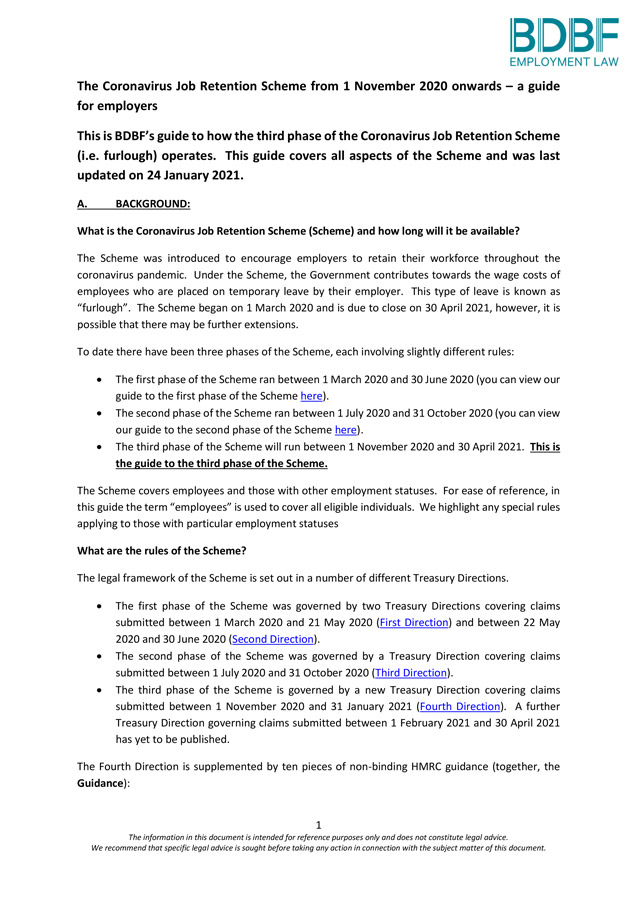
 The Coronavirus Job Retention Scheme from 1 November 2020 onwards – a guide for employers 

This is BDBF’s guide to how the third phase of the Coronavirus Job Retention Scheme (i.e. furlough) operates.  This guide covers all aspects of the Scheme and was last updated on 24 January 2021.

To view the PDF guide please click on the image below:

[/et_pb_text][et_pb_image src=”http://davidk423.sg-host.com/wp-content/uploads/2021/01/Guide-to-the-COVID-19-Job-Retention-Scheme-from-1-November-2020-24-January-2021-1.jpg” title_text=”Guide-to-the-COVID-19-Job-Retention-Scheme-from-1-November-2020-(24-January-2021)-1″ url=”http://davidk423.sg-host.com/wp-content/uploads/2021/01/Guide-to-the-COVID-19-Job-Retention-Scheme-from-1-November-2020-24-January-2021.pdf” url_new_window=”on” align=”center” _builder_version=”4.7.4″ _module_preset=”default” hover_enabled=”0″ border_width_all=”2px” border_color_all=”#008395″ sticky_enabled=”0″][/et_pb_image][et_pb_text _builder_version=”4.7.4″ text_orientation=”justified” use_border_color=”off”]

BDBF is currently advising many employers and employees on the challenges presented by the coronavirus.  If you or your business needs advice on furlough or other coronavirus-related matter please contact Amanda Steadman (amandasteadman@bdbf.co.uk) or your usual BDBF contact.

[/et_pb_text][/et_pb_column][/et_pb_row][/et_pb_section][et_pb_section fb_built=”1″ _builder_version=”3.26.6″][et_pb_row _builder_version=”3.26.6″][et_pb_column type=”4_4″ _builder_version=”3.26.6″][/et_pb_column][/et_pb_row][/et_pb_section]


Guide to understanding the reforms to the IR35 rules in the private sector

Guide to understanding the reforms to the IR35 rules in the private sector

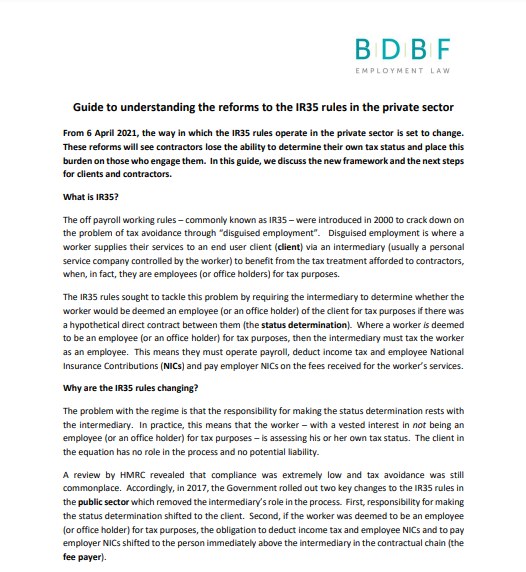
From 6 April 2021, the way in which the IR35 rules operate in the private sector is set to change.  These reforms will see contractors lose the ability to determine their own tax status and place this burden on those who engage them.  In this guide, we discuss the new framework and the next steps for clients and contractors.

To view the PDF guide please click on the image below:

"/

BDBF can help businesses and contractors prepare for the new regime. Please contact Amanda Steadman (amandasteadman@bdbf.co.uk), or your usual BDBF contact, for further advice.


Getting ready for employment law reform in 2021: 10 things employers really need to know

[et_pb_section fb_built=”1″ _builder_version=”3.0.100″ background_image=”http://davidk423.sg-host.com/wp-content/uploads/2017/09/bdbf_final-stages-1-4-1.jpg” custom_padding=”|||” global_module=”2165″ saved_tabs=”all”][et_pb_row _builder_version=”3.25″ custom_padding=”|||”][et_pb_column type=”4_4″ _builder_version=”3.25″ custom_padding=”|||” custom_padding__hover=”|||”][et_pb_text _builder_version=”3.27.4″ background_layout=”dark” custom_margin=”0px|||” custom_padding=”0px|||”]

Employment Law News


[/et_pb_text][/et_pb_column][/et_pb_row][/et_pb_section][et_pb_section fb_built=”1″ admin_label=”section” _builder_version=”3.22.3″][et_pb_row admin_label=”row” _builder_version=”3.25″ background_size=”initial” background_position=”top_left” background_repeat=”repeat”][et_pb_column type=”4_4″ _builder_version=”3.25″ custom_padding=”|||” custom_padding__hover=”|||”][et_pb_text _builder_version=”4.7.4″ text_orientation=”justified” use_border_color=”off”]

Getting ready for employment law reform in 2021: 10 things employers really need to know

It’s been said that death and taxes are the only certainties in life, but employers may wish to add a third – changes to employment law.  Both caused by Brexit and the pandemic, and independent of them, reforms haven’t ceased.  In this article, we round up the top 10 changes for people with responsibility for HR to watch out for in 2021.

  1. Recruiting EEA nationals is about to get a lot more complicated…

The new year brings new headaches for employers wishing to recruit EEA nationals.  From 1 January 2021, EEA nationals will lose their automatic right to live and work in the UK.  For those based in the UK before this date, the solution is to apply for either Settled Status or Pre-Settled Status before 30 June 2021.  Either status will give the individual the right to continue to live and work in the UK.  Successful applicants will usually be given a “share code” to provide to their employers to prove their right to work in the UK.  Employers will need to establish a system of checking the share codes of affected employees after 30 June 2021.

From 1 January 2021, EEA nationals wishing to come to the UK to work will need to be sponsored by a UK employer under the new points-based based immigration system.  Employers wishing to sponsor workers will need a licence to do so.  Employers will need to make sure the sponsor licence is in place in good time (licence applications can take between 3 to 6 weeks to process).  Further guidance on the points-based immigration system is available here.

  1. …and so is engaging contractors

The way in which the off-payroll working rules (known as “IR35”) operate in the private sector is set to change on 6 April 2021.  The reforms were due to come into force on 6 April 2020 but were deferred in the light of the coronavirus pandemic

These reforms will see contractors lose the ability to determine their own tax status and place this burden on those who engage them.  Large and medium-sized businesses in the private sector that engage independent contractors via an intermediary (usually a personal service company) will become responsible for assessing whether the IR35 rules apply – this is known as the “status determination”.  The determination process is notoriously difficult, and you may well need to take legal advice.

Once the status determination has been made, the business must notify various parties of its decision and provide an opportunity to challenge the assessment.

On top of this, where a business contracts directly with the intermediary (i.e. it is the fee payer), it will also become responsible for deducting income tax and NICs and paying employer’s NICs.

Those running the payroll will need to be ready to implement these changes from April 2021.  You can read more about the IR35 reforms in our detailed note on the new regime here.

  1. Be prepared for new limits on how you draft your employment contracts…

After jumping the hurdle of recruitment, employers also need to be ready for changes affecting their onboarding arrangements.

Currently, the Government is consulting on two areas which may affect the drafting of employment contracts.

Views are sought on proposals to restrict the use of non-compete restrictions.  It’s possible that non-compete clauses could be made unenforceable altogether, meaning employers would not be able to include them in employment contracts at all.  Alternatively, they may be permissible for a prescribed period of time and only where the employer provides compensation during the term of the clause.  Either change would see employers having to amend existing employment contracts and update template documents.  You can read our further thoughts on this consultation and also find out how to feedback your thoughts to the Government here.

The Government is also seeking views on extending the ban on exclusivity clauses in employment contracts to prevent employers from restricting low-paid employees (i.e. those earning below £120 per week) from working for another employer.  Currently, the ban only applies to those working under zero-hours contracts.  If the ban is extended, affected contracts will need to be amended.

Both consultations close on 26 February 2021 and new laws could be in place later this year.

4…and standby to overhaul your family-friendly policies

And it’s not just employment contracts that may need a rewrite in 2021.  Employers may need a cold towel at the ready when it comes to overhauling family-friendly policies as there are a raft of changes in the offing.

The Pregnancy and Maternity (Redundancy) Protection Bill 2019-21 is on its passage through Parliament, with the next stage of the Bill taking place on 12 March 2021.  If passed, it will prohibit redundancy during pregnancy and maternity leave and for the six months after the return to work, save in limited circumstances.

The Government has also consulted on several proposals to update family leave rights including reforming the system of parental leave and pay; introducing a new right to neonatal leave and pay; and requiring employers to publish their family leave and flexible working policies.  Although still at the proposal stage, it would be wise for employers to make sure that family leave and flexible working policies are kept up to date, particularly as the publication requirement could be introduced fairly swiftly.

There are also plans afoot to introduce a new right for workers with caring responsibilities to take one week’s unpaid leave.  This new form of leave would supplement other relevant forms of leave such as parental leave or time off for dependant emergencies.

  1. Wave goodbye to the furlough scheme…

The furlough scheme is currently set to change on 1 February 2021, with a likely reduction in the Government’s contribution to the wages of furloughed employees.  The scheme is then due to close for good on 31 March 2021 and is likely to be replaced with a less generous form of wage support.  You can read more about the furlough scheme in our detailed guide here.

Payroll teams dealing with furloughed employees will need to ensure that final claims are made to HMRC in good time.  At the same time, employers need to have a strategy in place for what happens next: will furloughed staff be brought back to work or made redundant?  If redundancies are needed, will time-consuming collective consultation be triggered?  If so, when will that consultation process begin?

6.…and say hello to a flurry of flexible working requests

The roll out of the Covid-19 vaccine in 2021 signals the hope of return to normal life, including in the world of work.  But after a year or more of working from home, will staff be prepared to return to commuting five days per week? Some will, but employers should get ready for an influx of flexible working requests from staff who have got used to the benefits of working from home.

This could range from requests to work from home on a flexi-basis or 1 or 2 fixed days per week, through to requests for permanent home working.  Employers should consider now whether they are willing to continue with home working and, if not, the grounds for refusing such requests.  Rejecting requests will be harder where the employee can demonstrate that they have worked effectively from home for a long period of time.

It’s also worth bearing in mind that the Government intends to put its weight behind flexible working for all jobs.  There are plans for a new Employment Bill which would make flexible working the default for all job roles, meaning that jobs should be advertised as open to flexible working.   This will represent a big change for employers – a recent survey revealed that 78% of job ads did not mention flexible working at all and, of those that did, the majority offered it only on a temporary basis to cope with the Covid-19 pandemic.

  1. Pay equality issues will be back in the spotlight…

HR and payroll teams at large employers had a reprieve from crunching their gender pay gap numbers in 2020, after the Government paused publication in the light of the Covid-19 pandemic.  As far as we know, reporting is back on the agenda in 2021, with a deadline for private sector employers of 4 April 2021.

However, there are some unanswered questions about what needs to be reported. It’s not yet clear whether businesses will have to report the missing 2019/20 figures at the same time as their 2020/21 figures.  It’s also not clear whether staff who were on furlough on the snapshot date of 5 April 2020 should be included in the 2020/21 figures.  And if they are to be included, is their pay their normal rate of pay or the reduced furlough rate of pay?   HR and payroll teams will need to watch out for further guidance from the Government and be ready to adjust their calculations and accompanying narrative.

Businesses outside of the gender pay gap reporting regime will escape these headaches for now – but employers should note that there are plans to reduce the reporting threshold to employers with 100 or more employees.  The Equal Pay (Information and Claims) Bill 2019-21 is on its passage through Parliament and aims to reduce the threshold for gender pay gap reporting and bring in ethnicity pay reporting for employers at the same threshold.  The next stage of the Bill is scheduled to take place on 15 January 2021.  Although these changes are unlikely to come into force in 2021, they would involve a great deal of preparatory work for affected businesses and so employers are advised to keep a close eye on this development.

In addition, the Bill seeks to reform equal pay law and, among other things, would introduce a right for employees to know what their colleagues are paid.  This could shine a light on pay disparities and trigger equal pay disputes on an individual or group basis.  With the Supreme Court’s decision in the high-profile Asda equal pay dispute expected any day now, pay inequality issues will be firmly back in the public eye in 2021.

8.….and holiday pay headaches will rumble on

It’s hard to believe but holiday pay issues continue to rumble on, many years after the wave of cases which looked at which components of pay must be included in holiday pay.  In June 2021, the Supreme Court will consider whether voluntary overtime payments should be included in the calculation of holiday pay and whether a “series” of unlawful deductions from holiday pay is only present where the deductions are not more than three months apart.  Both decisions could have a big impact for employers’ holiday pay liability and employers should monitor the outcome.

And when it comes to holiday requests, don’t forget that special rules were introduced to allow staff to roll over any holiday that they were unable to take due to the Covid-19 pandemic.  Where this is the case, the unused holiday may be carried forward and taken over the next two leave years.  This may mean that some employees have higher than usual holiday entitlements in 2021 and possibly into 2022.

  1. Protection for whistleblowers is on track to be strengthened

Protection for those blowing the whistle looks likely to be enhanced in 2021.  At EU level, a new Directive introduces protection for those reporting certain breaches of EU law.  EU Member States have until 17 December 2021 to implement the Directive into national law.  It’s not yet clear whether the UK will be obliged to introduce such legislation. This will depend on the terms of any post-Brexit relationship agreed between the UK and the EU.  However, employers with operations in EU Member States will have to comply with the new rules in those jurisdictions and may wish to take a uniform approach across their business, including in the UK.

The Directive requires employers with 50 or more employees to have internal whistleblowing procedures which offer a range of reporting mechanisms.  UK employers are not currently required to have such procedures in place, save in certain regulated sectors.  Employers will also be required to provide feedback to whistleblowers about their internal investigation.  Employers should be poised to prepare such procedures and roll out relevant training to staff.

There are also efforts underway in the UK to enhance whistleblower protection, with two Private Members’ Bill currently on their passage through Parliament.  The Public Interest Disclosure (Protection) Bill 2019-21 and the Office of the Whistleblower Bill 2019-21 are both aimed at strengthening protection for whistleblowers.   The next stage of the Public Interest Disclosure (Protection) Bill 2019-21 is scheduled to take place on 26 February 2021.

  1. And finally, when parting ways with employees watch out for new rules affecting terminations

When parting ways with employees in 2021, employers should take note of the Government’s commitment to introduce new laws as soon as possible to restrict the use of non-disclosure agreements (NDAs) in settlement agreements where there has been an allegation of harassment or discrimination.  The new rules will mean that:

  • NDAs must not prevent someone from making a disclosure to the police, regulated health and care professionals or legal professionals;
  • the limitations of an NDA must be made clear to those signing them; and
  • new enforcement measures will be introduced for non-compliant clauses.

Employers will need to amend template settlement agreements in due course to comply with these new rules.

You can find out more about these and other developments on the horizon in BDBF’s 2021 Employment Law Tracker.  If your business needs advice on preparing for any of these changes please contact Amanda Steadman (amandasteadman@bdbf.co.uk) or your usual BDBF contact.

[/et_pb_text][/et_pb_column][/et_pb_row][/et_pb_section][et_pb_section fb_built=”1″ _builder_version=”3.26.6″][et_pb_row _builder_version=”3.26.6″][et_pb_column type=”4_4″ _builder_version=”3.26.6″][/et_pb_column][/et_pb_row][/et_pb_section]


BDBF’S 2021 Employment Law Tracker

[et_pb_section fb_built=”1″ _builder_version=”3.0.100″ background_image=”http://davidk423.sg-host.com/wp-content/uploads/2017/09/bdbf_final-stages-1-4-1.jpg” custom_padding=”|||” global_module=”2165″ saved_tabs=”all”][et_pb_row _builder_version=”3.25″ custom_padding=”|||”][et_pb_column type=”4_4″ _builder_version=”3.25″ custom_padding=”|||” custom_padding__hover=”|||”][et_pb_text _builder_version=”3.27.4″ background_layout=”dark” custom_margin=”0px|||” custom_padding=”0px|||”]

Employment Law News

[/et_pb_text][/et_pb_column][/et_pb_row][/et_pb_section][et_pb_section fb_built=”1″ admin_label=”section” _builder_version=”3.22.3″][et_pb_row admin_label=”row” _builder_version=”3.25″ background_size=”initial” background_position=”top_left” background_repeat=”repeat”][et_pb_column type=”4_4″ _builder_version=”3.25″ custom_padding=”|||” custom_padding__hover=”|||”][et_pb_text _builder_version=”4.7.4″ text_orientation=”justified” hover_enabled=”0″ use_border_color=”off” sticky_enabled=”0″]

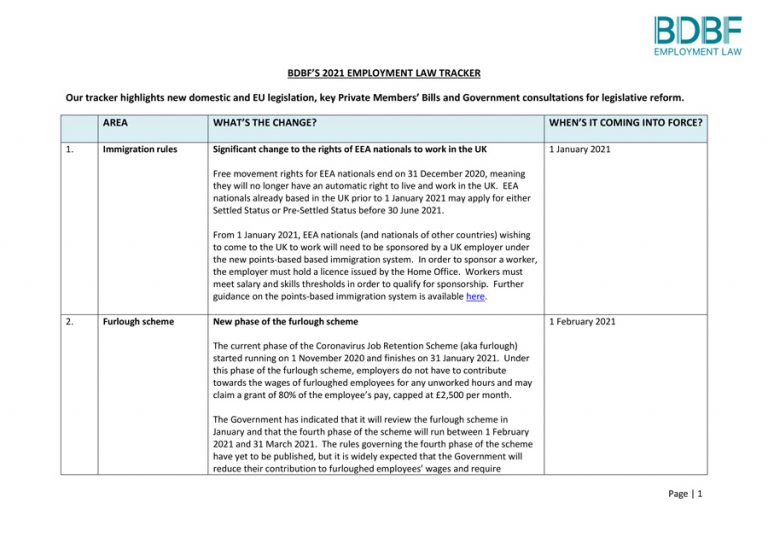
Our tracker highlights new domestic and EU legislation, key Private Members’ Bills and Government consultations for legislative reform. 

[/et_pb_text][et_pb_image src=”http://davidk423.sg-host.com/wp-content/uploads/2020/12/2021-Employment-Law-Tracker-PDF-FINAL-1.jpg” title_text=”2021-Employment-Law-Tracker-PDF-(FINAL)-1″ url=”http://davidk423.sg-host.com/wp-content/uploads/2020/12/2021-Employment-Law-Tracker-PDF-FINAL.pdf” url_new_window=”on” _builder_version=”4.7.4″ _module_preset=”default” hover_enabled=”0″ border_width_all=”1px” border_color_all=”#159687″ align=”center” sticky_enabled=”0″][/et_pb_image][et_pb_text _builder_version=”4.7.4″ text_orientation=”justified” use_border_color=”off”]

If your business needs advice on preparing for any of these changes please contact Amanda Steadman (amandasteadman@bdbf.co.uk) or your usual BDBF contact.

[/et_pb_text][/et_pb_column][/et_pb_row][/et_pb_section][et_pb_section fb_built=”1″ _builder_version=”3.26.6″][et_pb_row _builder_version=”3.26.6″][et_pb_column type=”4_4″ _builder_version=”3.26.6″][/et_pb_column][/et_pb_row][/et_pb_section]