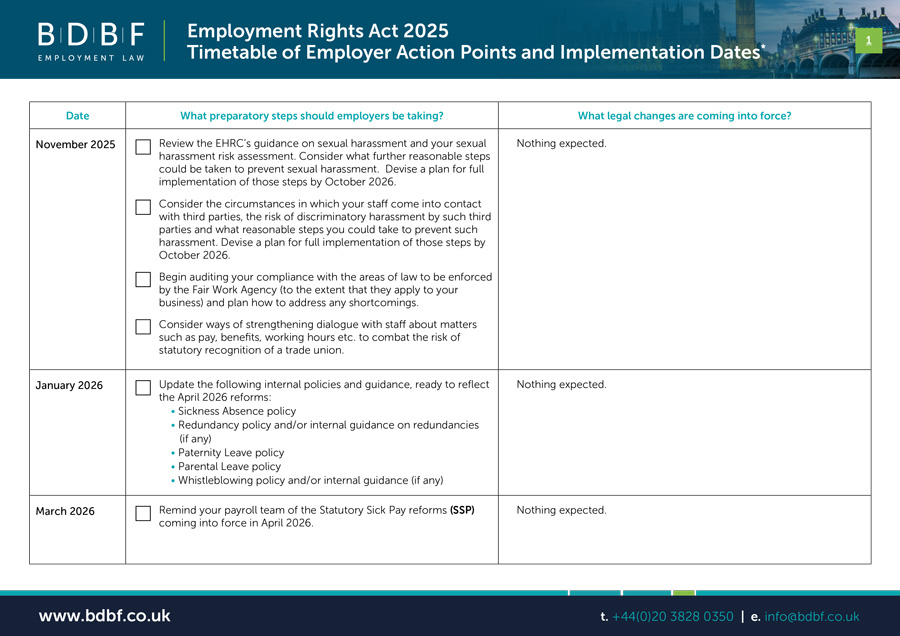
Employment Rights Act 2025. Timetable of Employer Action Points and Implementation Dates

The Employment Rights Act 2025 is due to receive Royal Assent on 18 December 2025 and represents one of the most significant reforms to UK employment law in recent years. The Act introduces wide-ranging new worker protections, including the expansion of unfair dismissal rights, changes to Employment Tribunal time limits, broader access to family leave, and enhanced protections against harassment and discrimination. These reforms will have direct and lasting implications for employers’ policies, procedures, and workforce management.

Most of the Act’s key provisions will be introduced in stages over the next two years, making early awareness and forward planning essential. In this practical guide, we set out the anticipated implementation timetable and identify what actions employers need to take – and when – to ensure compliance, minimise risk, and adapt to the new regulatory landscape.

Click the image below to download the calendar.


If you would like to discuss how BDBF can help your organisation comply with this new law, please contact Amanda Steadman (AmandaSteadman@bdbf.co.uk), Rose Lim (RoseLim@bdbf.co.uk) or your usual BDBF contact.


Employment law highlights from 2025

In this briefing, we look back at the key developments that took place in this significant year for employment law, reflecting on the most interesting cases and legal changes to be aware of as 2025 draws to a close.

Success at BDBF

This year at BDBF, we celebrated 13 years of excellence and 30 years of expertise and were proud to be the only firm in our category with all six of our partners top ranked by Chambers UK and by Legal 500. We were also featured as one of The Times Best Law Firms 2026 for employment law, as endorsed by our peers, and were honoured to be awarded Senior Executive Team of the Year at the International Employment Lawyer Awards 2025.   

Our partners continued to share their expertise far and wide, speaking at a White Paper Conference, the International Forum of Senior Executive Advisers Forum, the ELA Annual Conference 2025, the ABA International Labor and Employment Law Committee Midyear Meeting, and the International Employment Lawyer’s Spring European Employment Summit in Paris (to name a few). They were also individually recognised in the Spears Employment Lawyers Index and Lexology Index, and developed groundbreaking case law in cases such as Lapinski.

In 2025, we also welcomed new Managing Associate Jamie Barton, Senior Associate Leigh Janes, Associates Edward Duthie, Esmat Faiz and Knowledge Lawyer Rose Lim. In recognition of their exceptional talent, we also promoted three of our outstanding employment lawyers (Blair Wassman, Theo Nicou and Connie Berry) and welcomed Samantha Prosser to the partnership.

Employment Rights Act 2025

The year has been a whirlwind of legal developments, primarily due to the proposals under the landmark Employment Rights Bill (the Bill).

The Bill completed its passage through Parliament on 16 December 2025 and is expected to receive Royal Assent in the coming days, turning the Bill into the Employment Rights Act 2025 (the Act). The Act will mean significant changes for day-to-day employment practices and Employment Tribunal claims. The latter will also be impacted by the increase to maximum ACAS early conciliation period from six to twelve weeks, which came into effect on 1 December 2025. Although there had been suggestion that they might do so, the Government has confirmed that they will not be reintroducing fees for bringing a case in the Tribunal.

In our October webinar and prior briefings, we covered the major changes expected under the Bill, including extension of Tribunal time limits, restrictions on ‘fire and rehire’ practices, expanded whistleblowing protections and a new prohibition on non-disclosure agreements for discrimination and harassment.

No doubt the biggest concern for many employers had been the Bill’s promise of ‘Day 1’ unfair dismissal rights, which would have removed the current two-year time limit for bringing claims altogether. However, the Government dropped this proposal following considerable pushback from the House of Lords.  In exchange, claims for unfair dismissal will be available after six months’ employment and the cap on the compensation for unfair dismissal will be removed.  You can read our article on what the removal of the compensation cap means for employers here.

The first consultations on the proposed new rights were also launched this year. In particular, we looked at the requirements to engage with trade union rights and expanding protections for pregnant women and new mothers, which will impact all employers when they come into force.

Whistleblowing

  • Innocent decision-makers: In Henderson v GCRM Ltd & Ors, the Employment Appeal Tribunal (EAT) decided that an ‘innocent’ decision-maker cannot be found personally liable for the detriment of dismissal. They concluded that unlike the way in which a state of mind can be attributed to the employer because of a tainted or manipulated decision-making process, it would not be correct to impute such knowledge in a way that exposes the innocent decision-maker to unlimited liability.

  • Consultants as agents: In Handa v Station Hotel (Newcastle) Ltd and others, the EAT concluded that independent HR consultants could (in theory) be viewed as agents for the employer and liable for detrimental treatment of a whistleblower, if they are contracted to make the decision to dismiss or run a process closely related to the employment relationship.

  • Protection for job applicants: In Sullivan v Isle of Wight Council, the Court of Appeal determined that whistleblowing protection for job applicants remains very limited. Unlike workers or applicants for NHS posts, who are protected by the specific whistleblowing detriment provisions, general job applicants who believe they have made a protected disclosure will not be protected (save for where their treatment amounts to discrimination based on a protected characteristic under the Equality Act 2010).

  • Judicial proceedings immunity: In Rogerson v Erhard-Jensen Ontological/Phenomenological Initiative Limited, the Court of Appeal decided that judicial proceedings immunity did not apply to the initiation of arbitration abroad, and doing so could therefore constitute unlawful whistleblowing detriment. The Court considered that only statements made within litigation are protected (e.g. witness’ evidence), rather than the act of commencing proceedings based on a protected disclosure.

For more information regarding planned reform to whistleblowing legislation, please watch our October webinar on the Employment Rights Bill.  In December it was also announced that the Government intends to review the UK’s whistleblowing framework by the end of 2027.

Sexual Harassment, Equality and Discrimination

  • Beyond the workplace: In AB v Grafters Group Ltd, the EAT found that an employer’s liability for sexual harassment may extend to situations where the employee is ‘off the clock’. Actions can occur ‘in the course of employment’ even if they are not on work premises or during working hours, such as at work parties or during work-related travel.  For more information regarding planned reform to the duty to prevent sexual harassment, please see our article on how employers can prepare for the changes expected under the Bill.

  • Neurodiversity: In Halstead v JD Wetherspoons plc, the Tribunal assessed the powerful impact of making reasonable adjustments in the workplace for neurodivergent employees, and set out a list of ‘exemplary’ suggestions for employers to consider. The Tribunal took a dim view of the harsh way in which a ‘zero-tolerance’ policy had been applied to a colleague whose condition affected his ability to understand its requirements and agreed that his employer had failed to make reasonable adjustments when applying its standard disciplinary procedures. This year also saw new guidance from ACAS on embracing neurodiversity in the workplace, which encourages support, understanding and adjustments to processes. The requirement to make adjustments will, however, have its limits; in Duncan v Fujitsu Services, the EAT agreed with the Tribunal that a disabled employee’s use of abusive and offensive language remained sufficient grounds to justify dismissal, despite his arguments that his behaviour resulted from neurodiversity.

  • Expressing beliefs: In our April webinar, we explored the potential for conflicts and legal challenges surrounding controversial topics such as the war in Gaza and LGBTQ+ issues. This year saw the significant decision of For Women Scotland Ltd v The Scottish Ministers, which determined that ‘sex’ in the Equality Act 2010 refers to biological sex only and not to acquired sex or gender under a Gender Recognition Certificate. This area of law continues to generate considerable debate, and both employers and service providers eagerly await the new Code of Practice due to be published by the Equality and Human Rights Commission. In the meantime, there have been several other significant decisions on trans issues, including:

  • The Court of Appeal considered in Higgs v Farmor’s School that the dismissal of a school pastoral administrator for gender-critical social media posts had been directly discriminatory. The employee’s posts were found to have reflected her protected belief, and dismissal had been a disproportionate response in circumstances where the language used had not been grossly offensive or intended to incite hatred.

  • In Kelly v Leonardo UK Limited, the Tribunal decided that an employer’s policy of permitting trans women to access female facilities did not constitute harassment or either direct or indirect discrimination against female employees, as it did not place them at a significant disadvantage compared to male staff.

  • Most recently in Peggie v Fife Health Board and another, the Tribunal determined that the employer had unlawfully harassed a female employee by failing to revoke permission, temporarily, for a trans colleague to use women’s changing rooms after her complaint (until replacement rotas could take effect) and by taking too long to investigate that complaint, as well as by referencing irrelevant matters and giving inappropriate instructions as to confidentiality. However, the Tribunal dismissed all remaining allegations of discrimination and harassment, noting the careful balancing required between individuals’ protected characteristics and human rights. 

For our top tips on managing risks associated with expressing beliefs in the workplace, see our guidance note. 

  • Pregnancy and maternity: In our July webinar, we took a closer look at the legal risks in redundancy exercises affecting pregnant employees and those on maternity, adoption or shared parental leave. This year also saw the introduction of new rights to neonatal care leave and pay as well as the Government’s 18-month review of parental leave and pay entitlements, which aims to reconsider the complex legislative framework of family rights. For further information on the rights currently available, take a look at our coverage for National Work Life Week.

  • Equality reforms: Earlier in 2025, the Government published a call for evidence on proposed equality reforms including changes to equal pay, pay transparency, combined discrimination protection and clarity on sexual harassment at work. In addition, a consultation was launched on mandatory ethnicity and disability pay gap reporting for employers with 250 or more employees. Whilst some equality reforms are reflected in the Bill (see above), the response to these consultations is expected to predominantly shape the new Equality (Race and Disability) Bill.

  • Practicalities of bringing claims: This year also brought some helpful case law regarding more practical aspects of bringing discrimination (and related) claims. In HSBC Bank plc v Chevalier-Firescu, the Court of Appeal clarified that being unaware of a discriminatory motive could mean that it is just and equitable to allow a claim to proceed, even where it is outside of the statutory time limit. Additionally, in Kokomane v Boots Management Services Ltd, the EAT confirmed that workers can be protected against victimisation even if they do not expressly refer to having suffered discriminatory treatment; the key is what the employer can have reasonably understood the worker to mean in the context.

Dismissals and HR practices

  • Importance of proper disciplinary process: In Alom v Financial Conduct Authority, the EAT expressed their concerns over the extent to which HR had framed a pre-prepared disciplinary script that ultimately led to dismissal. Although they found that the employee’s dismissal had been fair and non-discriminatory in all the circumstances, the EAT agreed with the submission that this had been inappropriate, particularly where the script seemed to state the decision-maker’s opinion as to the nature of the conduct. Additionally, in Woodhead v WTTV Limited and anor, the High Court concluded that an employer had breached their duty of care not to expose an employee to a risk of psychiatric injury during an investigation and disciplinary process into allegations against him of sexual harassment. The Court noted significant failings from the employer to take account of the employee’s pre-existing conditions, as well as general inadequacy in the process which had caused considerable distress.

  • Constructive dismissal: In Kinch v Compassion in World Farming, the EAT considered that an employee had not necessarily affirmed her contract by extending her notice period several times. The employer argued that by continuing to work for eight months after her resignation (including two extensions which they said she had requested), pursing a grievance and negotiating sick pay, the employee had clearly not been constructively dismissed and that the claim should be struck out. The EAT disagreed and said that this was not necessarily the case, and remitted the case for a full hearing. Delay in an employee’s leaving was also considered in Barry v Upper Thames Medical Group and others, where the EAT held that a six-month delay in resigning did not mean the employee had affirmed their contract, in circumstances where she had been seeking to resolve the dispute that eventually led to her departure.

  • Parent company relationships: In Fasano v Reckitt Benckiser Group plc and anor, the Court of Appeal found that an agency relationship did not exist between a parent company and subsidiary, as there was no basis to say that the employing subsidiary had authorised the parent entity to act on its behalf (or otherwise had control). The employee, a senior executive, had missed out on a valuable long-term incentive plan award when the rules were amended by the parent company of his employer, which he said constituted age discrimination. The Court disagreed and said that, even if the agency relationship had existed, the change would not have been discriminatory as it was a proportionate means of achieving the legitimate aim of retaining staff.

  • Competing for talent: In September 2025, the Competition and Markets Authority published guidance for employers on staff recruitment, pay and other working conditions. This outlined how competition law may apply in the workplace, the potential consequences of anti-competitive practices (e.g. wage-fixing or sharing competitively sensitive information), and guidance as to what may constitute ‘risky’ behaviour.

  • Sickness absence: In Kitching v University Hospitals of Morecambe Bay NHS Foundation Trust, the Tribunal held that an employee who had been dismissed for 406 days of sickness absence in four years had been discriminated against and unfairly dismissed. The Tribunal considered that the employer had failed to accommodate her disability when applying its absence policies, failed to make reasonable adjustments, and in dismissing the employee had failed to evaluate her current and future capability to work with reasonable adjustments in place.

  • Directors’ duties: In Cheshire Estate & Legal Limited v Blanchfield & Ors, the Court of Appeal confirmed that alleged breaches of statutory and fiduciary duties will be highly fact-sensitive. In this case, the Court considered that the directors had not crossed the line into breaching their fiduciary duties by planning to set up a competing firm prior to resigning from their roles, as they had continued to serve their firm faithfully and had factored in a delay between their resignation and the new firm opening.

  • Be careful what you say: Several cases this year highlighted the importance of making accurate statements and promises, including during Tribunal proceedings:

  • In Dixon v GlobalData Plc, an employer had provided verbal assurances regarding an employee’s ability to exercise share options post-termination, and had entered into ambiguous settlement terms which incorporated those assurances. The High Court determined that the employer was bound by these assurances as a result of proprietary estoppel, emphasising the importance of checking share plan rules and exercising caution when drafting any explanations or settlement terms.

  • In Wainwright v Cennox plc, the EAT agreed with an employee that she had suffered a repudiatory breach of contract due to misleading statements made by her employer.  The employee, who was on sick leave for cancer treatment, was informed that she had been replaced on a temporary basis; in fact, the new colleague had been appointed permanently, and other alterations had been made to the employee’s role and responsibilities. The EAT agreed that providing untrue statements could be a contractual breach and that this should have been addressed by the Tribunal, therefore remitting the case for reconsideration.

  • In Easton v Secretary of State for the Home Department (Border Force), the EAT considered that an employer had acted reasonably in dismissing an employee who had omitted details of a prior dismissal and a three-month employment gap on his application form. Particular attention was paid to the fact that the employer had thoroughly investigated the omissions and concluded that the employee had been dishonest in withholding this information.

  • In Commerzbank AG v Ajao, the High Court found an employee to have been in serious contempt of court for having made false statements of truth and giving false evidence in an Employment Tribunal claim. The employee had pursued a claim against his former employer and several former colleagues, alleging (among other matters) discrimination, sexual harassment (including assault), harassment and victimisation. Following an application by his employer, the High Court found that he had knowingly made false accusations which were designed to, and did, interfere with the administration of justice. The employee has been sentenced to 20 months’ imprisonment and ordered to pay £150,000 towards his employer’s legal costs.

  • Legal privilege: In Shawcross v SMG Europe Holdings Ltd and others, the EAT found that the ‘iniquity’ exception did not apply to emails between the employer and their solicitors prior to dismissal of the employee, and therefore they were subject to legal privilege. The employee, who had been inadvertently copied into such a chain, argued that privilege could not apply where the emails showed her dismissal to be a sham and were evidence of iniquitous conduct. The EAT disagreed, finding that the emails were the sort of advice that employment lawyers would often offer around the risks of dismissal, and they were therefore privileged. The importance of careful handling of privileged materials was also considered in Sinclair Pharmaceuticals Ltd v Burrell, where a without notice injunction obtained by the employer regarding the treatment of inadvertently disclosed materials was set aside by the High Court, who considered that the Employment Tribunal was best placed to decide whether (among other things) the documents were disclosable.

  • Non-disclosure agreements (NDAs): The Victims & Prisoners Act 2024 came into force on 1 October 2025, meaning that NDAs cannot be used to prevent victims of crime from making ‘permitted disclosures’ (such as to regulated professionals, victim support services or family members). Shortly afterwards, the Government announced that this Act will be amended in due course to enable victims to speak to anyone for any purpose, including (for instance) the press. These changes sit alongside the planned prohibition under the Bill on NDAs preventing disclosure of discrimination and harassment.

  • Senior Managers & Certification Regime (SMCR): Over the summer, the Treasury launched a consultation paper looking for views on changing the legal framework underpinning the SMCR to reduce the burden on the financial services sector. The Financial Conduct Authority (FCA) and Prudential Regulatory Authority similarly launched consultations on the same date. These consultations closed on 7 October 2025, and firms await the outcome to determine any reforms that will take place.

  • Non-financial misconduct: In July 2025, the FCA’s new rules on non-financial misconduct were published, setting out amendments to their Code of Conduct to empower firms to tackle serious misconduct such as bullying, harassment and violence. These will come into force in September 2026, and from then onwards all SMCR firms will be required to assess whether incidents of non-financial misconduct constitute breaches of the FCA conduct rules.

  • Non-compete clauses: In November 2025, the Government published a working paper on options for reforming non-compete clauses in employment contracts. This paper, which is due to close on 18 February 2026, considers options such as limiting the length of non-competes on a blanket basis, limiting the length based on company size, banning such clauses altogether (or based on annual salary), or a combination of these suggestions.  

  • Redundancy notifications: From 1 December 2025, the Government moved to a digital-only platform for advance notification of redundancies. The HR1 form, which could previously be submitted by email, must now be completed online.

BDBF is a leading employment law firm based at Bank in the City of London. If you would like to discuss any issues relating to the content of this article, please contact Rose Lim (RoseLim@bdbf.co.uk), Amanda Steadman (AmandaSteadman@bdbf.co.uk) or your usual BDBF contact


Uncapped unfair dismissal – a game changer for employers

The Employment Rights Bill completed its passage through Parliament on 16 December 2025 and is expected to receive Royal Assent in the coming days. Controversially, the Bill was amended at a late stage to abandon Labour’s flagship manifesto pledge to make unfair dismissal a Day 1 right.  In its place came a six-month qualifying period and the abolition of the statutory cap on compensation for unfair dismissal.  In this briefing we consider the impact of lifting the cap on compensation for employers.

A shift in the types of claims brought

The removal of the cap on compensation for ordinary unfair dismissal means the risk profile of many employment disputes will change dramatically. While unfair dismissal will not become identical to discrimination or whistleblowing claims, the financial exposure could be very similar. For HR, this means more expensive claims, more complex cases, and far greater scrutiny of dismissal decisions.

Claimants may increasingly rely on straightforward unfair dismissal claims rather than bolting on weaker discrimination or whistleblowing allegations. These claims are cheaper, simpler, and will be potentially much more valuable.

Some dismissal scenarios will also take on a new seriousness. Cases involving an employee’s personal beliefs or expression, for example, may involve arguments about freedom of speech under human rights law. With uncapped compensation at stake, tribunals will expect employers to clearly justify any dismissal in these areas.  Legal advice is likely to be needed at an early stage.

Higher earners: expect more claims and bigger numbers

Removing the cap opens the door to very substantial awards for employees with high salaries or valuable benefits such as bonuses, LTIPs, share options, carried interest, or final salary pensions. Once tribunals can award full financial loss, the numbers escalate fast – especially if the employee takes time to find a new job.

Expect to see larger and more sophisticated claims for financial loss, regular use of expert evidence and longer and more complex remedy hearings.

Multi-year loss claims on the table

With no cap on future loss, some claimants will push for multi-year or even career-long compensation. These may include:

  • Older workers struggling to re-enter the labour market.
  • Disabled workers whose prospects are limited (but where the case isn’t a discrimination claim).
  • Regulated professionals whose dismissal harms their ability to continue in their profession.

HR teams will need to gather strong evidence on mitigation and future employability to challenge these claims.

Tribunals will come under greater pressure

More complex, higher-value claims will stretch limited tribunal resources even further. HR should expect:

  • More prescriptive case management.
  • Longer waits for hearings (which, turn, may adversely affect witness evidence).
  • Increased use of experts.
  • Longer hearings at both liability and remedy stages.

This may affect access to justice for lower-income workers and may also prolong litigation for employers.

Settlement dynamics will change

Without a cap, claimants may feel they have more leverage, and some may push for very high settlements, or refuse to negotiate at all.  Expect higher claimant expectations and tougher negotiations.

Employers will need to rely more heavily on tools like contributory fault, failure to mitigate, and Polkey reductions to reduce compensation risk.

Employer behaviour will need to change

Procedural mistakes could become far more costly, meaning that HR teams will need to tighten up dismissal processes significantly. Key changes should include:

  • Longer and more strictly monitored probation periods.
  • More terminations before the new 6-month qualifying period.
  • Greater procedural rigour in performance and conduct cases.
  • Much closer attention to the Acas Code (since uplifts could be huge in uncapped cases).

Next steps and final thoughts

As yet, it is unclear exactly when the cap will be removed.  Although the Act contains the provision to abolish the cap, separate regulations are needed to bring that provision into effect.  Separately, the Government has stated that it intends the new six-month qualifying period to come into force on 1 January 2027, but it has not said whether the compensation cap will be removed at the same time.  For now, we think it would be sensible for employers to work on the assumption that it will be removed on 1 January 2027. 

When the cap goes, ordinary unfair dismissal stops being a mid-range statutory claim and becomes a major financial threat on par with discrimination and whistleblowing in many cases. For HR, this means more careful planning, more documentation, more robust processes, and more strategic decision-making from the very start of any dismissal.  This is the biggest shift in dismissal risk for employers in decades – HR leaders will need to adapt quickly.

BDBF is a leading employment law firm based at Bank in the City of London. If you would like to discuss any issues relating to the content of this article, please contact Amanda Steadman (AmandaSteadman@bdbf.co.uk) or your usual BDBF contact.

Non-compete restrictions in employment contracts under the spotlight once again

On 26 November 2025 the Government published a working paper setting out options for the reform of non-compete clauses in employment contracts. 

What is the background to this proposal?

Non-compete restrictions in employment contracts have come under intense scrutiny over the last decade, with repeated calls for restricting their use.  

In May 2016, David Cameron’s Government launched a Call for Evidence which sought views on whether non-compete clauses stifled innovation and unfairly hindered workers from moving freely between employers.  The responses to that consultation were fairly polarised with established businesses favouring the current law but new ones looking for more flexibility.  However, further work in this area was ultimately shelved in the wake of the Brexit vote.

Yet it was back on the table again just a few years later.  In December 2020, Boris Johnson’s Government launched a consultation on proposals for limiting, or potentially even banning, the use of non-compete clauses in employment contracts.  The consultation put forward two proposals.  The first was that non-competes should only be enforceable where the employer compensated the employee for the length of the restriction, potentially combined with a maximum length of three, six or 12 months.  The second was to ban non-competes altogether.  However, the proposals were moth-balled, with no response to the consultation ever published by the Government.

Then in May 2023 Rishi Sunak’s Government announced that it intended to legislate to limit the length of non-competes in employment contracts to three months (with no requirement to compensate the employee for the length of the restriction).  However, the change of Government in 2024 meant this proposal never made it onto the statute books.

Given the Labour Government’s focus on the wide-ranging employment law reforms contained in the Employment Rights Bill, many assumed that non-compete reform was a distant memory. It, therefore, came as a surprise to learn that reform of non-competes, is once again, back on the table.  On 26 November 2025, the Government published a Working Paper inviting views on options to reform non-compete clauses in employment contracts.

What is proposed in the Working Paper?

The Government’s stated aims in reforming non-competes is to advance the following objectives:

  • Boosting labour market dynamism by making it easier for workers to move jobs or start their own business.

  • Reducing barriers to recruitment so that businesses (particularly those scaling-up) can access the talent they need.

  • Promoting competition and innovation by maximizing opportunities for innovators, experts and entrepreneurs.

  • Protecting workers so that they do not have to face extended periods of time out of the labour market in their area of expertise.

The Working Paper goes on to set out five possible options for reform of non-compete clauses:

  • Option 1: Introduce a statutory limit on the length of non-compete clauses: it is said that a statutory limit would protect workers by limiting the time they are unable to work in their area of expertise.  However, the Government does not indicate what that statutory limit should be.  Although arguments supporting a three-month limit are acknowledged, the Government expresses concern that it would leave some lower-paid workers facing the prospect of three months out of work in their chosen area.  Concern is also expressed that a statutory limit of any sort could be interpreted as an “industry standard” and lead to an assumption that non-competes of that length would be enforceable in all cases.  The Government underlines that this is not the intention – the existing principles would continue to apply, namely that where the restraint of trade doctrine applied, a clause in restraint of trade will be unenforceable unless the employer can demonstrate it is reasonable.

  • Option 2: Introduce a statutory limit on the length of non-compete clauses according to company size: as a variation on Option 1, it is suggested that the Government could apply different statutory limits according to company size – with lower limits (e.g. three months) for large companies and higher limits (e.g. six months) for smaller companies.  It is said that this approach would aim to promote competition by making it easier for those working in large companies to move to competitors or start a competing business. This would also give smaller organisations an advantage over larger companies in that they could utilise longer non-compete restrictions.  On the other hand, the downside of this approach is that it leaves those working in smaller companies, especially those in lower paid sectors, exposed to longer non-competes.

  • Option 3: Ban non-compete clauses: a more radical suggestion is to ban the use of non-compete clauses in employment contracts altogether.  The Working Paper says this would have the dual benefit of supporting worker mobility and boosting labour market dynamism. Further, employers might respond to a ban by offering positive incentives to retain staff (such as increased pay, bonuses or greater flexibility) which would benefit workers further.  Alternatively, employers might deploy garden leave as an alternative to non-competes, which would also benefit workers since they would be paid.  Concern is expressed about the possibility of employers strengthening their use of other restrictive covenants, and confidentiality and intellectual property clauses.  The Government said it would need to ensure that other restrictions were not used in a way that would have a similar effect to a non-compete clause.

  • Option 4: Ban non-compete clauses below a salary threshold: a more moderate version of Option 3 would be to permit the use of non-competes only where a worker earns over a certain salary threshold.  This Working Paper highlights there is international precedent for this approach, for example, the Washington State ban on non-competes for workers earning below approximately £93,000.   It is said the impact of the policy would vary depending on the level at which the threshold was set – with a suggestion of aligning it with the additional rate tax threshold of £125,140 being mooted.  A partial ban such as this would achieve some of the benefits of an outright ban and provide greater protection to lower paid workers.  Yet this proposal has several drawbacks including difficulties in calculating pay (and the potential for satellite litigation about what should and should not be included in pay calculations) and the risk of creating certain incentives and cliff edges around pay levels that might lead to unintended consequences.  It would also leave higher-paid and higher-skilled workers out of scope of the ban.

  • Option 5: Combining a ban below a salary threshold with a statutory limit: a final option would be to combine Options 1 and 4, namely a ban below a salary threshold, with non-competes up to a maximum of three months allowed for those earning above the threshold.  This would eliminate non-competes for lower paid workers while ensuring that non-competes could be deployed for higher paid workers in a limited way.

Finally, the Working Paper highlights that the Government is interested in hearing views and evidence on whether the threat of high legal costs presents obstacles to workers in contesting the enforceability of restrictive covenants.  It is also interested in suggestions for how the Government might tackle this issue.

What don’t we know?

There are a number of important points not made clear in the Working Paper:

  • What is an “employment contract” for these purposes?  Will the proposals apply to contracts of employment only or also to other agreements which are collateral to the employment relationship e.g. shareholders’ agreements, long term incentive plans (LTIP) or carried interest agreements?In Duarte v Black & Decker Corp  EWHC 2720 (QB), the High Court held that restrictive covenants contained in an LTIP agreement separate from the employment contract was no bar to the LTIP agreement being treated as an “individual employment contract” for the purposes of deciding the governing law.  It is possible that a similar approach will be taken in the new legislation.  The Working Paper is also silent on whether settlement agreements between employer and employee are within scope.

  • Will “workers” be covered? The Working Paper refers reforming non-competes in “employment contracts”, yet in the body of the part it refers in places to “employees” and in other places to “workers”.  Therefore, it is unclear whether the intention is to capture workers as well as employees.  If the proposals do not extend to workers then this would mean that longer non-competes could still be used for certain independent contractors or LLP members.

  • Will the law apply to existing employment contracts? It is not clear whether the proposals would apply retrospectively or only to new contracts.  In the event that it applied retrospectively, employers would potentially need to renegotiate non-compete restrictions (depending on which proposals are taken forward).  Thought should also be given to strengthening other terms to offset the reduction in the non-compete restriction.  For example, notice periods, non-solicit and non-dealing covenants.  However, in order to ensure the enforceability of any revised terms some form of “consideration” would need to be given to the employee in return for their agreement.  

  • How will the new law work alongside garden leave clauses?  As the Working Paper recognises, the risk is that employers will respond to the loss of non-competes by extending periods of notice in order to place the employee on garden leave and keep them out of the market that way.  This would undermine the stated intention of the proposals and so it seems likely that the interplay of garden leave and non-competes will need to be addressed.   In our anecdotal experience, employers in some sectors responded to the  Federal Trade Commission’s (now abandoned) rule banning non-competes by seeking to significantly increase employee’s notice periods.

Next steps?

Responses to the Working Paper must be submitted by 18 February 2026.  It is said that the responses will inform the Government’s engagement with relevant stakeholders before a decision is made about which proposals (if any) are taken forward. 

No indication is given about when any such proposals might be implemented but given that a further programme of stakeholder engagement is envisaged before the Government settles on a policy, it seems unlikely that any legislation would come into force in the course of 2026.

Working paper on options for reform of non-compete clauses in employment contracts

BDBF is a leading employment law firm based at Bank in the City of London. If you would like to discuss any issues relating to the content of this article, please contact Amanda Steadman (AmandaSteadman@bdbf.co.uk), Tom McLaughlin (TomMcLaughlin@bdbf.co.uk) or your usual BDBF contact.