Newsflash: Government abandons Day 1 unfair dismissal rights in favour of 6-month qualifying period

Following several rounds of debate between the House of Commons and the House of Lords on the Employment Rights Bill (Bill), the Government announced in a press release published on Thursday 27 November 2025 that it intends to drop its commitment to giving employees unfair dismissal rights from Day 1.

Instead, the Government has confirmed that they will implement the six-month qualifying period proposed by the House of Lords. The press release also announced that the compensation cap for unfair dismissal will be lifted, and the six-month period will only be able to be varied in future by primary legislation. The Government states that this is now intended to be a “workable package”.

This move follows considerable pushback from the Lords on the proposal for Day 1 rights in their latest debate on 17 November 2025, in which they expressed concern over the potential impact on employment rates and the Employment Tribunal system.

The question of Day 1 unfair dismissal rights has been a key sticking point for finalisation of the Bill, and this development therefore brings the Bill significantly closer to being passed. The House of Commons is due to consider the Lords’ message on 8 December 2025.

BDBF is a leading employment law firm based at Bank in the City of London. If you would like to discuss any issues relating to the content of this article, please contact Rose Lim (RoseLim@bdbf.co.uk), Amanda Steadman (AmandaSteadman@bdbf.co.uk) or your usual BDBF contact.


Employers continue to be vicariously liable for “detriment of dismissal” claims brought by employee whistleblowers, for now, at least

The Court of Appeal has ruled that Timis and Sage v Osipov binds Employment Tribunals to permit claims brought by employee whistleblowers for the “detriment of dismissal” against co-workers and also against employers on a vicarious liability basis but only on the basis of precedent. They disagreed with the reasoning in Osipov and the question may now go to the Supreme Court. For now though this means employees complaining that they have been dismissed for whistleblowing only have to meet a lower legal threshold to succeed and can sue managers in an individual capacity.

What protections do whistleblowers have in the workplace?

Since 1998, whistleblowers at work have been protected from dismissal (employees only) and detrimental treatment (employees and workers). When the law was first introduced, only detrimental treatment meted out by the employer was covered.  Further, if the detrimental treatment in question amounted to a dismissal, an exclusion clause in the law meant that employees (but not workers) could not frame it as a detriment claim.  Instead, they had to pursue an unfair dismissal claim.   

This was significant not least because the threshold for succeeding in a detriment claim is lower than in a dismissal claim.  In other words it was harder for a claimant to complain about being dismissed than otherwise being treated unfavourably for being a whistleblower.

In 2013, detriment protection was expanded to cover detrimental treatment committed by co-workers.  This change meant that a co-worker could be personally liable, and the employer could be vicariously liable for the actions of the co-worker (although the employer had a defence if it could show that it had taken “all reasonable steps” to prevent the detrimental treatment).  However, the exclusion clause which prevented employees from bringing detriment claims about dismissal was left unchanged. 

In 2018, in the landmark case of Timis and Sage v Osipov (Osipov) in which BDBF acted for the successful Claimant, the Court of Appeal considered whether an employee was entitled to bring a whistleblowing detriment claim against a co-worker, where the detriment was the dismissal, and where the compensation sought included loss of earnings flowing from the dismissal.  In that case the employee did not claim that the employer was vicariously liable for that detriment because the employer was in administration.

The Court of Appeal, agreeing with the Employment Appeal Tribunal (EAT) and the Employment Tribunal, ruled that the purpose of the law was to protect whistleblowers, and, therefore, it was appropriate to construe the exclusion clause in such a way as to provide protection rather than deny it. 

The Court said the exclusion clause only prevented employees from bringing direct detriment of dismissal claims against an employer.  However, it did not prevent detriment of dismissal claims against co-workers.  Nor did it prevent the employer from being vicariously liable for such a claim (albeit that this was not a live issue before the Court because the employer in that case was insolvent).  The Court concluded that if employees were prevented from bringing such claims by the exclusion clause, this would lead to an unsatisfactory situation where workers (e.g. independent contractors or LLP members) could bring such claims, but employees could not and that the employee who was treated badly at work but not dismissed had a lower legal threshold to meet than the employee who had suffered the ultimate form of retaliation: dismissal.

The Court acknowledged that its interpretation did not produce “a particularly elegant result” insofar as it meant that a dismissed whistleblower who was an employee could claim the employer was directly liable for their dismissal under the unfair dismissal provisions and vicariously liable for the detriment of dismissal under the detriment provisions.  The inelegance was inherent in the fact that the causation test differs between the two claims (being higher in unfair dismissal claims), as does the possible compensation (with no injury to feelings award available in an unfair dismissal claim).  However, the Court said these “awkwardnesses” were insufficient to justify a construction that would result in more serious anomalies, and which would be contrary to the underlying policy of the law.

What happened in these cases?

The key facts of Rice v Wicked Vision Ltd (Rice) and Barton Turns Developments Ltd v Treadwell (Treadwell) are the same.  Both claimants were dismissed allegedly after having blown the whistle.  Both brought unfair dismissal claims against the employer.  As the litigation unfolded, both sought to amend their claims, arguing that they had been subjected to the detriment of dismissal by their co-workers and that their employers were vicariously liable for such detriments.  In neither case did the claimants seek to bring the detriment of dismissal claim against the co-workers as individual respondents.  The aim of the amendment in each case was presumably to benefit from the lower threshold for liability in detriment claims. In Rice, the employer opposed the amendment on the basis that a vicarious liability claim for detriment of dismissal could not proceed where no claim had been made against the co-worker.

Decisions of the Employment Tribunal

In Rice, the Tribunal took a wide view of Osipov, holding that it permitted the amendment.  It also held that it was not necessary for a detriment of dismissal claim to have been brought against a co-worker in order to bring to bring the vicarious liability claim against the employer.

In Treadwell, the Tribunal refused the amendment on the basis that the exclusion clause meant that a detriment claim against an employer had to be about something other than a dismissal.  The Tribunal’s view was that the decision in Osipov was confined to the potential liability of individuals only and the exclusion clause prevented a claim that the employer was vicariously liable for the detriment of dismissal.  As such, the Tribunal took a narrower view of Osipov than the Tribunal in Rice.

Decisions of the EAT

In Rice, the employer appealed to the EAT, again arguing that the claim could not proceed without a concurrent claim against the co-worker.  The EAT considered that it was not necessary to bring a detriment claim against the co-worker.  However, the EAT overturned the decision of the Tribunal, concluding that the exclusion clause prevented the vicarious liability claim against the employer.  Notably, the EAT said it would be odd if Parliament had banned detriment of dismissal claims directly against employers but, at the same time, allowed them to be vicariously liable for the detriment of dismissal by a co-worker, since in virtually every case a dismissal has to be executed by a co-worker.  As such, the EAT took a narrow view of Osipov, holding that it only determined that detriment of dismissal claims may be brought against co-workers.

In Treadwell, the EAT allowed the employee’s appeal, taking a wide view of Osipov as meaning that detriment of dismissal claims could be brought against co-workers and against employers on a vicarious liability basis.  It held that the exclusion clause only excluded direct detriment of dismissal claims against employers.

Unsurprisingly, both decisions were appealed to the Court of Appeal, and the appeals were heard together.

What did the Court of Appeal decide?

Delivering a unanimous judgment, the Court of Appeal ruled that Osipov was binding authority for the proposition that employers could be vicariously liable for detriment of dismissal claims.  Accordingly, the Court ruled that the amendments should have been allowed in both claims.  However, the Court reached this decision with a great deal of reluctance, suggesting that a further appeal to the Supreme Court may lie ahead.   

The meaning of the exclusion clause

The Court’s reluctance was rooted in the fact that it considered the exclusion clause was unambiguous in preventing detriment claims about dismissal.  Where a detriment amounts to a dismissal within the meaning of the legislation, the exclusion clause disapplied the entire detriment provision, meaning that detriment of dismissal claims are not possible against anyone, whether employer or co-worker.

The Court rejected the argument that “dismissal” only covers dismissals by the employer, and that there exists the possibility of a dismissal by a co-worker, which would sit outside the exclusion clause (because it would not be a “dismissal” within the meaning of the legislation).  The Court rejected this approach for three reasons:

  • First, the Court rejected the argument that the exclusion clause only applied to dismissals by the employer as meaningless because it said a dismissal is always the act of the employer – it ends the contract between the employer and employee.  Where the employer is a limited company the dismissal can only ever be effected by a co-worker, and the Court did not accept there was a relevant legal distinction between a dismissal by the employer and a dismissal by a co-worker. 
  • Second, the Court observed that under the vicarious liability provisions anything done by a co-worker is treated as having been done by the employer.  The legal effect of this is that the employee is, therefore, dismissed by the employer and, in turn, that act will “amount to a dismissal” within the meaning of the legislation and so the exclusion clause applies.
  • Third, the question is not about primary or vicarious liability, the correct question is simply: what does the act amount to? If it amounts to a dismissal then the employer is liable for it and all detriment claims about the dismissal are barred, including against a co-worker.

The decision in Osipov

Although it considered the exclusion clause was abundantly clear, the Court had to grapple with the decision in Osipov, which had permitted detriment of dismissal claims.  The Court disagreed with the decision in Osipov for several reasons including:

  • It ignored the clear and unambiguous statutory wording and improperly downplayed the statutory text in favour of a perceived purpose. 
  • It wrongly assumed that Parliament or the draftsman made mistakes.
  • It misconstrued the statutory purpose and ignored the fact that Parliament deliberately chose to have distinct remedial schemes for employees and workers.
  • It wrongly treated dismissal by a co-worker as distinct from dismissal by an employer.
  • Its conclusion that the exclusion clause only barred direct detriment of dismissal claims against an employer because the “identical remedy” of unfair dismissal was available was fundamentally flawed.

However, the Court said that, despite its own construction of the legislation, it was bound by the decision in Osipov.  Importantly, it concluded that Osipov had ruled that detriment of dismissal claims are permissible against co-workers and that employers may be vicariously liability for such claims (thus taking a wide view of the decision unlike the Tribunal in Treadwell or the EAT in Rice).  The Court said it was bound by the doctrine of precedent to give the same interpretation to the exclusion clause as was given in Osipov, even though the context in the present cases was slightly different.

Accordingly, despite the Court’s own view of the meaning of the law, it ruled that the exclusion clause did not prevent detriment of dismissal claims against the employer on a vicarious liability basis.  Therefore, the employees succeeded, and their claims were allowed to proceed.

The Court observed that it was “plainly unsatisfactory” that the construction of the legislation had produced conflicting decisions at three levels of court, but noted that this could only be resolved by the Supreme Court or through a change to the legislation.

What does this decision mean for whistleblowers and employers?

This decision underlines the impact and importance of Osipov, for now at least.  It continues to bind Tribunals to permit detriment of dismissal claims against co-workers and against employers on a vicarious liability basis.  The exclusion clause does not bite to prevent either type of claim.  Further, as the Court identified in this case, no concurrent claim against a co-worker is needed in order to bring a vicarious liability claim.

Of course, the Court of Appeal has fired a warning shot about the validity of the decision in Osipov. In light of the Court’s profound misgivings about Osipov, it seems likely that permission to appeal to the Supreme Court would be given if sought.  Whether there will be a further appeal remains to be seen (and it should be noted that Wicked Vision Ltd is currently in administration).   However, even if there is no further appeal in this case, it seems inevitable that the point will arise in another case in due course.  And when it does, there is a good chance that we will see a “leapfrog appeal” from the EAT to the Supreme Court, given that the remedies available to whistleblowers is a matter of general public importance. 

In the meantime, it is business as usual for whistleblowers and employers.  Employees who are dismissed for having blown the whistle should continue to bring unfair dismissal claims against their employer and should always explore the possibility of detriment of dismissal claims as well, pleading them where appropriate. 

Employers wishing to avoid vicarious liability for such claims should take all reasonable steps to prevent such detriment.  In practice, this will mean taking steps to ensure that anyone involved in the dismissal of a whistleblower is not materially influenced by the whistleblowing (essentially, the causation test in detriment claims).  Codes of conduct should set out the standards expected from managers and emphasise the importance of honest and ethical behaviour in all dealings, and the consequences of failure.  Ideally, a programme of whistleblowing training should support and reinforce this.  In some sectors, relevant training may be mandatory.  For example, the FCA requires financial services firms to provide tailored whistleblowing training to various stakeholders, including managers, which should explain that victimisation of whistleblowers is prohibited. 

(1) Rice v Wicked Vision Ltd (Protect Intervening); (2) Barton Turns Developments Ltd v Treadwell

BDBF is a leading employment law firm based at Bank in the City of London. If you would like to discuss any issues relating to the content of this article, please contact Amanda Steadman (AmandaSteadman@bdbf.co.uk) or your usual BDBF contact.


Employment Rights Bill: First Consultations Launched on Trade Union Rights

On 23 October 2025, the UK Government launched the first of their consultations on the new rights set out in the Employment Rights Bill (Bill), which is expected to be passed into law imminently.

The Bill provides the framework for numerous changes to employment law but much of the substance of the new rights will be set out in regulations. As promised earlier this year, the Government has now published a series of consultations to help shape those regulations and determine exactly how the Bill’s provisions will be implemented. 

Below we will briefly cover two of the consultations which look at changes to trade union rights, each of which is due to close on 18 December 2025. These changes are vital for all employers to understand as, even if their workforce is not currently unionised, they will nevertheless be impacted by the new duties.

Duty to Notify

The Bill introduces a new duty on employers to give their employees a written statement of their right to join a trade union from October 2026. The consultation paper is said to be aimed at ensuring the duty is effective, proportionate and workable for workers and employers.

The key questions considered as part of the consultation are:

  • Content: What information needs to be included in the statement, and whether the statement should be drafted by the employer (in line with any minimum content requirements) or be based on a government standard.
  • Manner: Whether information needs to be given directly or indirectly, and whether this should be different for new workers compared to existing workers.
  • Timing: How often the information needs to be given, and whether this standard should be the same for all organisations regardless of sector or size.

Right of Access

The Bill sets out that trade unions will have a new right to access workplaces and engage with workers for the purpose of meeting, recruiting, supporting, representing or organising them, as well as for facilitating collective bargaining. This is expected to take effect in October 2026.

Access for these purposes means both physical access and digital communications.

Under the Bill’s framework, unions and employers are expected to work together to voluntarily agree access arrangements, which will then be recorded by the Central Arbitration Committee (CAC). Where they are unable to agree, either the union or the employer can make a referral to the CAC to determine whether (and how) access should be granted. The CAC will also have the power to enforce agreements in line with the five ‘access principles’ set out in the Bill, with the ability to issue fines for non-compliance.

The substantive questions asked by the consultation are as follows:

  • How access requests need to be made, including whether they should follow a standard government template (provided via a new Code of Practice on Trade Union Right of Access), and the level of information that must be included in the request and employer’s response.
  • How notification should be made to the CAC of successful agreements and any variations.
  • The appropriate length of response and negotiation periods, and the maximum duration of an access agreement. The government proposes a relatively short initial 5 working day period for the employer to respond to a union’s request, a 15 working day period to negotiate, and a maximum of 25 days from the request for a referral to be made to the CAC. The latter requirement is said to be aimed to ensure that employers are not left in a position of uncertainty about whether a referral will be made. Once an agreement is in place, the government proposes a maximum duration of two years.
  • Whether small employers with fewer than 21 workers should be exempt.
  • What factors the CAC will consider when assessing a request, with the government proposing that requests are likely to be unreasonable if there is already a recognised union, it would use a disproportionate level of resource, or if it would give the employer less than 5 working days to prepare. For the terms of agreements, the government suggests that weekly access may be reasonable, with a minimum of two working days’ notice required.

Views are also being sought on the proposed £75,000 maximum standard cap on fines from the CAC, with a higher amount of £150,000 for repeated breaches, as well as the factors that the CAC should consider when assessing the fine.

BDBF is a leading employment law firm based at Bank in the City of London. If you would like to discuss any issues relating to the content of this article, please contact Rose Lim (RoseLim@bdbf.co.uk), Amanda Steadman (AmandaSteadman@bdbf.co.uk) or your usual BDBF contact.


Employment Rights Bill: Consultation on expanding protection from dismissal for pregnant women and new mothers

Last month, the Government opened a consultation on enhancing protection from dismissal for pregnant women and new mothers during a protected period.  At its most restrictive, the proposed protection would ban capability and SOSR dismissals altogether, permit redundancy dismissals only where a business is closing and allow conduct or illegality dismissals in very limited circumstances.   

What is the current legal position and what did the Employment Rights Bill propose?

In the UK, there is already extensive protection from dismissal for pregnant women, new mothers and other parents.  It is unlawful to:

  • treat an employee unfavourably because of her pregnancy or maternity leave during the “protected period” (which begins when a woman becomes pregnant and ends when she returns from maternity leave);

  • treat an employee less favourably than a male comparator for reasons to do with her pregnancy or maternity leave outside the protected period;

  • dismiss an employee for a reason connected to her pregnancy or maternity leave (or to certain types of other family leave including adoption, shared parental and neonatal care leave);

  • make an employee redundant during pregnancy or maternity leave (or adoption leave, shared parental leave or neonatal care leave) where there is a suitable alternative vacancy available; or

  • make an employee redundant who has recently returned to work from a period of maternity leave (or adoption leave, shared parental leave or neonatal care leave) where there is a suitable alternative vacancy available.

Despite this wide protection, the Government is concerned that pregnant women and new mothers remain especially vulnerable to mistreatment and dismissal.  This is supported by a 2016 report from the Equality and Human Rights Commission which indicated that up to 54,000 mothers leave their jobs each year, including approximately 4,100 dismissals.

Accordingly, the Employment Rights Bill (the Bill) (currently on its passage through Parliament) provided that regulations would be introduced to allow enhanced protection from dismissal during pregnancy, maternity leave and following the return from maternity leave.  This would mean that such employees could not be fairly dismissed at all, save where the law allowed for an exception.  The Bill does not specify how long the protection would apply following the return from leave, however, the Government has said it should be at least six months.

The Bill also proposed extending the enhanced protection to those returning from certain other forms of extended family leave, namely, adoption leave, shared parental leave, neonatal care leave and bereaved partner’s paternity leave (the latter of which is not yet in force). 

What does the consultation paper propose?

On 23 October 2025, the Government published a consultation paper entitled Enhanced dismissal protections for pregnant women and new mothers”, seeking views on how the enhanced dismissal protection should work in practice.   The Government says it wishes to strike a fair balance between strengthening the protection for employees and preserving the ability to dismiss “…in cases where continuing employment would have serious consequences for the employer or other staff”.  It is also concerned to avoid unintended consequences, such as employers becoming hesitant to hire women of child-bearing age if the protections are overly restrictive.

The consultation proposes two broad options:

  • Option 1 – Introduce a stricter fairness test: one option is to introduce a stricter test to assess the fairness of such dismissals for any of the existing five fair reasons for dismissal (i.e. conduct, capability, redundancy, illegality or some other substantial reason (SOSR)). 

  • Option 2 – Narrow the five fair reasons for dismissal: an alternative option is to narrow the existing five fair reasons for dismissal (and/or potentially remove some of them entirely) when applied to pregnant women or new mothers.  The proposals to narrow down the scope of each reason are as follows:

  • Conduct: the options put forward range from permitting conduct dismissals only where the employee commits gross misconduct (as defined by the employer), to allowing dismissal only for a much narrower band of serious misconduct where continuing employment would either (i) pose a health and safety risk to a third party, (ii) have a serious negative impact on the wellbeing of others, or (iii) cause significant harm to the business.

  • Capability (covering both performance and ill-heath): again, various options are put forward, ranging from permitting capability dismissals only if there is no suitable alternative role available (or where one was offered and refused), to allowing dismissal only for a much narrower band of incapability where continuing employment would either (i) pose a health and safety risk to a third party, (ii) have a serious negative impact on the wellbeing of others, or (iii) seriously harm the business.  An even more restrictive proposal of banning capability dismissals altogether is also given.

  • Redundancy: two options are proposed. First, permitting redundancy dismissals only where there is no suitable alternative vacancy available and where termination would mitigate any financial difficulties that were affecting (or likely to affect in the immediate future) the employer’s ability to continue the business.  The second and more restrictive option is to permit redundancy dismissals only where the business ceases to exist (and where any suitable alternative vacancy that is available has been offered).

  • Illegality: only one possible change is put forward: to allow dismissal for illegality only if there is no suitable alternative role available (or where one was offered and refused).

  • SOSR: various options are put forward, ranging from permitting SOSR dismissals only where there is no suitable alternative role available (or where one was offered and refused), to allowing SOSR dismissals only for a much narrower band of dismissals where continuing employment would either (i) pose a health and safety risk to a third party, (ii) have a serious negative impact on the wellbeing of others, or (iii) seriously harm the business.  An even more restrictive proposal of banning SOSR dismissals altogether is given.

Additionally, in each of the above cases, the option of either making no changes to the law, or of making some other type of unspecified change are given (and in the latter case, the respondent is asked to set out what change they think should be made).

When should the protection start and end?

The existing dismissal protections for pregnant women and new mothers are all “Day 1” employment rights.  The consultation paper asks whether an employee should also be entitled to benefit from the proposed enhanced protections from Day 1 of employment.   Set against that, it is acknowledged that this could require an employer to retain and pay an employee throughout pregnancy, maternity leave and for at least six months thereafter, and that this might be considered an unreasonable burden on employers especially in respect of new employees who may not have demonstrated their capability for the role.  Therefore, the consultation gives the alternative option of only affording these rights to women who have completed a qualifying period of employment of somewhere between three to nine months.  It is said that such a qualifying period could help to mitigate unintended consequences, such as reluctance to hire women of childbearing age. 

In terms of when the enhanced protection should end, the consultation paper proposes either 18 months from the birth of the child (which has the benefit of aligning with the redundancy priority rules) or six months after the return to work from maternity leave, whenever that is.  The first option would mean that all new mothers would have an 18-month window of protection – regardless of when they returned to work.  The second option would mean that women taking less than 12 months maternity leave would have a shorter overall window of protection.  However, it would be simpler for employers to navigate, since they would know that all returners have six months protection after their return from maternity leave.  No individual calculations would be needed.

Should the enhanced protection be available where certain other types of family leave are taken?

The consultation paper goes on to seek information and views on the extent to which parents taking either adoption, shared parental or neonatal care leave are subjected to unfair treatment, including dismissal.  It goes on to ask whether the proposed enhanced dismissal protections should be extended to employees taking these forms of leave (and also bereaved partner’s paternity leave) and, if so, when the protection should start and end.  For adoption leave, it is proposed that the protection should end 18 months after the birth of the child or placement for adoption.  For the other three types of leave, it is proposed that the protection should end either on the last day of the leave (where less than six weeks of continuous leave was taken), or 18 months from the birth or adoption placement (where more than six weeks of continuous leave was taken).

Other points and next steps

The consultation paper asks whether various unintended consequences could arise from the enhanced protection including increased discrimination, delaying dismissal decisions and unrealistic asks of small businesses.  Finally, the consultation asks what the main causes of pregnancy and maternity discrimination are and what more the Government should be doing to tackle it.

The consultation closes on 15 January 2026, after which the Government’s response and final position will be published.  The measures are due to be implemented some time in 2027.

Consultation paper – Enhanced dismissal protections for pregnant women and new mothers

BDBF is a leading employment law firm based at Bank in the City of London. If you would like to discuss any issues relating to the content of this article, please contact Amanda Steadman (AmandaSteadman@bdbf.co.uk) or your usual BDBF contact.


Tribunal considers reasonable adjustments to standard processes and the application of “zero tolerance” policies for neurodivergent employees

In Halstead v JD Wetherspoons plc, the Employment Tribunal has considered whether an employer failed to make reasonable adjustments to their processes and the way in which they applied a “zero tolerance” policy to an employee with autism, and whether that failure amounted to disability-related harassment.

What happened in Halstead?

Facts

Mr Halstead started his employment with Wetherspoons as a kitchen porter in late 2018 in Berkhamsted. Although he left for a short period, he returned to work for the same branch in May 2019 and later, in 2021, moved to the Wetherspoons in Trowbridge. He had been diagnosed with autism at the age of two and had informed the Berkhamsted branch of this, however this information was not shared with Trowbridge at the time of his transfer.  

In August 2023, Mr Halstead and his mother went for a family meal at a Wetherspoons pub along with five visiting family members. Mr Halstead, assisted by his mother, place the order through the Wetherspoons app and ticked the box to confirm that he accepted the employee discount policy and privacy policy. As a result, Mr Halstead’s employee discount of 20% was applied to the entire order, even though the policy said the discount was only permitted to be used for groups of up to four people.

Mr Halstead was investigated and subjected to a disciplinary process in relation to his use of the discount and potential breaches of Wetherspoons’ data protection and confidentiality policies (because he permitted his mother to access the app). During the investigation, the impact of Mr Halstead’s autism on his day-to-day activities was discussed, including a requirement that someone directs him to read necessary documents (ideally sitting him down to go through any document with him). They explained that delay would highly impact his anxiety and that the process was causing him significant distress. Despite this, Wetherspoons did not make any adjustments to the disciplinary process.

Mr Halstead subsequently went off sick from work, and a long-term sickness meeting was arranged prior to obtaining the outcome of his occupational health referral. The occupational health report set out clear adjustments that should be made.  These included giving 1-2-1 explanations of important documents, and confirming the extent to which his mother needed to be involved in his meetings and day-to-day tasks. It also emphasised the need for additional notice and other adjustments to meetings.

Contrary to the occupational health advice, no adjustments were made to the meeting for Mr Halstead’s grievance, which he had raised about his treatment. An adjusted meeting was eventually arranged, following his mother’s objections. There had also been no update on the disciplinary process, Mr Halstead had not been having his appraisals, and had not been paid correctly, all of which contributed to his anxiety.

In December 2023, Wetherspoons invited Mr Halstead to a “some other substantial reason” (SOSR) hearing to discuss what they asserted was a breakdown in the employment relationship and his apparent failure to attend meetings about his long-term sickness and his grievance. For this hearing, Wetherspoons offered numerous adjustments including the questions being sent in advance, an option for written submissions, an option to change the meeting time and location, confirmation of his mother’s eligibility as companion and an open invitation to suggest any other adjustments in advance. This meeting was successful and in January 2024, Wetherspoons ended the SOSR process and instead invited Mr Halstead to an informal meeting to enable his return to work. In March 2024, Mr Halstead returned to work with several practical adjustments to support him.

Mr Halstead had approached ACAS for early conciliation during his grievance process and, whilst he had successfully returned to work, Wetherspoons had declined to offer him any financial compensation for the prior treatment. He therefore brought a claim under the Equality Act 2010 (EqA) for a failure to make reasonable adjustments (Section 20 and 21) and disability-related harassment (Section 26). It was accepted that his condition amounted to a disability under Section 6 EqA, and that Wetherspoons had known about it at the relevant time.

Tribunal’s Decision

The Tribunal upheld Mr Halstead’s claim of a failure to make reasonable adjustments, but did not find that Wetherspoons’ actions had amounted to harassment. Their key observations were as follows:

  • Wetherspoons had failed to adjust its investigation, disciplinary, grievance and long-term sickness processes to accommodate Mr Halstead’s needs as an autistic person. In each case they had applied their standard process, including standard notice periods, template letters and options of companion at meetings, and had not permitted the Claimant’s mother to attend the majority of the meetings with him. They had also applied their standard categorisation of the breach as gross misconduct and suspended him during investigation, despite there being no apparent risk to the company of him working.
  • In the disciplinary letter, Wetherspoons had also referred to Mr Halstead’s conduct as “dishonesty” and “abuse”, which had caused Mr Halstead undue distress. They remarked that this was notable given that a typical feature of autism was a strong desire to adhere to rules, and that there was no evidence of dishonesty; Mr Halstead had admitted to the breach, had explained the misunderstanding, and had confirmed it would not happen again now that he understood the rule.
  • Mr Halstead had therefore been placed at a substantial disadvantage in these procedures compared to someone without his condition. The Tribunal considered that once it had been established that the breach had been caused by his condition, the matter should have been dealt with informally and not as a disciplinary matter at all.
  • From December 2023 onwards, it was clear that the company had taken on board their positive duty to make adjustments.  The Tribunal described their approach from this point on as “exemplary”.
  • Whilst it had clearly been distressing for Mr Halstead, the Tribunal did not consider that Wetherspoons’ conduct had amounted to harassment. The company had addressed the conduct in a standard manner which was inherently stressful and challenging for those involved, but this did not meet the threshold of intimidation (otherwise employers would never be able to conduct performance management).

Mr Halstead was awarded £25,412, the majority of the award being made for injury to feelings.

What can employers learn from this case?

The decision in Halstead offers a clear demonstration of the positive impact that making reasonable adjustments can have and, conversely, the negative impact that a failure to make them can have on a neurodivergent employee’s wellbeing and their ability to participate in standard processes.

Given the Tribunal’s commentary regarding the “exemplary” nature of the approach taken by Wetherspoons from December 2023 onwards, the judgment can serve as a helpful guide for employers as to the type of adjustments which can be made to support neurodivergent employees. Examples include:

  • Providing longer notice periods for meetings, including investigation meetings. If notice would not usually be given for fact-finding meetings, consider whether this can be adjusted to allow them sufficient time to prepare without compromising the investigation.
  • Giving clear explanations of the purpose of meetings, allegations made and the potential consequences (including agendas for meetings, where possible). Ensure that the employee understands the nature of the meeting and (if applicable) the seriousness, including the next steps after the meeting and potential outcomes.
  • Allowing flexibility with the options of who can accompany the employee to meetings. This may require the employer to go beyond the standard categories of trade union or colleague companions.
  • Minimising delays as much as possible and offering regular updates.
  • Carefully wording allegations to ensure that they do not inappropriately presume guilt, dishonesty or cause unnecessary distress.
  • Remaining open to any other adjustments suggested by occupational health providers or the employee themselves, and implementing them unless there is a very good reason not to.

Adjustments should also be considered more widely during employment to ensure that neurodivergent employees are placed on an equal footing with their colleagues. Employers should ensure that, where they know an employee has a condition that affects them at work, this is tracked through their employment journey and information is shared (with their consent) to enable proper support. This will be particularly relevant for employees whose conditions may lead to challenges in asking for support.

In addition, this case highlights for employers the danger of enforcing “zero tolerance” policies. The Tribunal was critical of such policies, suggesting that they can be problematic if applied on a blanket basis because they fail to consider the diverse needs of employees. Whilst the employer may consider a policy breach to be serious enough for suspension and potentially dismissal, they may nevertheless need to consider adjusting the standard applied to employees whose conditions may affect their understanding of the relevant policy or ability to comply with it. This may be surprising to some employers, as the concept of reasonable adjustments is commonly thought of in terms of processes rather than substantive expectations. However, it is clear from this case that applying policies in a one-size-fits-all manner could result in a failure to make necessary adjustments for disabled employees.

Finally, employers should note that it will not always be sufficient to rely on a contractual requirement to abide by all of their policies. They need to take active steps to ensure their policies are understood: this could include training, written communication and, where necessary, individual explanation.

Halstead v JD Wetherspoons plc

BDBF is a leading employment law firm based at Bank in the City of London. If you would like to discuss any issues relating to the content of this article, please contact Rose Lim (RoseLim@bdbf.co.uk), Amanda Steadman (AmandaSteadman@bdbf.co.uk) or your usual BDBF contact.


On Equal Pay Day 2025, the legal sector’s gender pay gap is double the average

According to recent statistics published by Law360, male employees at the UK’s top law firms are considerably out-earning their female counterparts, with a typical 26% differential in pay.  And just in time for Equal Pay Day, which took place on 22 November 2025 this year, the Bar Council published a report which demonstrates that women are earning less than men across all experience levels at the self-employed Bar. 

What is equal pay and how does it relate to the gender pay gap?

The principle of equal pay refers to the concept that men and women should receive equal pay for equal work, a principle which has been enshrined in UK law for more than five decades.  Concerns regarding equal pay arise where there is a disparity between what men and women earn for doing the same/similar work or work of equal value.  This can be between two individuals who have the same title or substantive role or do work of equal value or by reference to groups of male and female employees who have comparable roles or who argue that they do work of equal value.   There have been several high-profile cases in the retail sector where mainly female shop-floor workers have argued that their work is of equal value to higher paid mainly male warehouse workers.  For further detail on those cases, see our previous briefing here

The gender pay gap refers to the gap between the average rates of pay for all men and women in the labour market, regardless of job role. The gender pay gap in the UK as a whole in April 2025, as reported by the Office of National Statistics, was 12.8%, down slightly from 13.1% in 2024.  However, the gender pay gap differs quite significantly by sector. 

Since 2017, all private and voluntary sector employers with 250 or more employees have been obliged to report statistics related to their organisation’s gender pay gap. These reports have tended to show the underrepresentation of women at the most senior and highly paid levels within organisations. The aim of such reporting is to shine a light on the disparity and to encourage employers to close these gaps, such as by taking proactive steps to improve progression of women to senior levels. For further information on gender pay reporting, see our more in-depth briefing here.

What is Equal Pay Day?

Equal Pay Day marks the point in the calendar when, as a result of the average gender pay gap, women are no longer earning compared to men. Each year, it is calculated by the Fawcett Society based on data obtained from the Office for National Statistics.

How does the gender pay gap affect law firms, and why?

The gender pay gap in UK law firms stands at an average of 26%. The figures and conclusions published by Law360 follow their review of gender pay gap reports from over 100 law firms, which show wide variation within the legal sector.  The data is taken from mandatory pay gap reports for employees, as well as voluntary partnership pay gap reports provided by 51 of the 100 firms (there being no legal obligation to report on partnership pay gaps). 

Notably, the analysis shows that many firms report far greater pay equality at the junior level, with the median employee gender pay gap varying between 1.9% and 65.3%, but with the majority of firms’ figures sitting between 20 – 30%. This is significant compared to partner-level roles, where nearly one third of the reporting firms had partnership pay gaps of over 30%, with the highest reported gap of over 100%. 

Where partner figures are included within a firm’s overall figure this leads to a stark increase in their median pay gap; the highest combined employee and partner pay gap reported was 48%, and even firms whose employee gap was as low as 2.4% reported a much higher combined pay gap of 27.7%.

Statistics for the gender bonus gap also varied significantly, with eight firms reporting a 0% difference but over 20 firms reporting a gap of at least 40%.

Putting the very wide-ranging variations between law firms to one side, it is clear that the overall pay gap within law firms is considerably higher than the current UK average pay gap of 12.8%. So why is the legal sector lagging so far behind when it comes to pay equality?  

Law360’s analysis suggests several key factors that may be contributing to this.

Lack of leadership representation

While improvements are slowly being made, law firms have historically been (and largely remain) male-dominated at the senior levels. This can, in itself, be a factor that deters women from seeking promotion, as they are less likely to see themselves taking on those roles in future. Equally, it may contribute to attrition away from male-dominated firms towards firms that already have a strong female leadership presence, or even towards other industries that are seen as offering more opportunities for advancement. It is worth noting that smaller firms are not required to produce gender pay gap reports (although many do voluntarily), and, therefore, the available figures are skewed towards larger firms where the senior leadership has been dominated by men.

Law360’s analysis notes that women in leadership positions are more likely to encourage enhancements to benefits and policies, such as parental leave and flexible working. The lack of representation at decision-making levels may mean slower improvements to those benefits which may directly impact the ability or motivation of women to remain at certain firms long enough to reach a senior role and access the highest levels of pay.  This is a problem across many sectors but the slow speed of change in the legal profession may mean that its impact is more pronounced.

Unique promotion cycle

The slow rate of progress to improve the gender pay gap within law firms may also be impacted by the difference between many firms’ partnership processes and traditional promotion paths in other sectors. Partnership processes in larger firms are often only run annually, with opportunities in many cases depending on the retirement or departure of another partner. There is often fierce competition between candidates (including external candidates) for only a few potential roles and, depending on business demand, in some years there may be no opportunities available at all.

A considerable amount of work is often required to prepare a business case to join a partnership and, as noted by those interviewed by Law360, the timing of partnership will often coincide with motherhood.   Periods of time spent on maternity leave at this crucial career juncture may mean a candidate is “out of sight and out of mind” and/or their business case appears less compelling.  Undoubtedly, the fact that women still bear a higher proportion of responsibility for childcare within families – and may work part-time as a result – has an impact too.  While many law firms have taken steps to address the impact on candidates for partnership, it remains a factor.  Could an uptick in men taking longer periods of shared parental leave and assuming greater childcare responsibilities level the playing field? 

Or are these just attempts to explain away systemic discrimination and the general undervaluing of what women do? 

As noted by the Financial Times, men are more likely to be optimistic about their client book, which can lead to them being more successful in landing available roles, as well as demanding higher compensation, particularly when moving firms.

And becoming a partner is only the starting point: remuneration between partners within a practice area or more widely across a firm continues to vary greatly. 

Practice area disparities

Differences in the level of fees earned across practice areas can be stark.  This can disproportionately benefit men, who are both more likely to be hired into the most profitable practices within firms, and more likely to stay in those areas long-term. As published by the Financial Times, 80% of partners hired between 2019 and 2024 into corporate and finance practices (often the highest-billing departments in commercial law firms) were male. By contrast, employment and private client practice areas were closer to 50/50 in terms of partners hired but higher billing practices such as private equity had a significant majority of male compared to female partnership hires.

It is clear that lack of participation in these more lucrative practice areas has an impact on women’s ability to achieve the highest levels of remuneration. At the employee level, this is particularly notable when it comes to bonuses.  As Law360 noted, even objective factors such as billing targets can indirectly disadvantage women. Such targets tend to favour the highest-billing (and most likely male-dominated) teams, where there is generally a steady demand for long hours of work or a lot of ebb and flow of work with periods of time when exceptionally long hours are required (on deals for example).  Women (especially mothers) may face more practical challenges in reaching their targets if they are juggling the competing demands of caring responsibilities.  

In addition, discretionary bonuses  have a big impact on overall pay which can be difficult to unravel, particularly where there is a culture of avoiding pay transparency and colleagues are discouraged from comparing remuneration. This can make it harder for women to identify any disparities, to advocate for themselves and call out unequal treatment. We know that any difference in pay early in a lawyer’s career is likely to compound over time and affect the starting point for any pay or bonus negotiations in subsequent years and on moving firms.

Not just law firms: the gender pay gap at the Bar

It is not only women working in law firms who are affected by the legal sector’s gender pay gap.  The Bar Council’s recent report found that:

  • Women were earning less than men across all experience levels at the self-employed Bar.
  • Junior women were earning 76% of what junior men were earning.
  • Women silks were earning on average 72% of their male colleagues’ median gross earnings.
  • Earnings gaps persist across every level of seniority at the Bar: the highest earning men were consistently earning more than the highest earning women.
  • There were earnings gaps in every area of practice. The widest gaps were in commercial and Chancery practice, where women at 11-15 years PQE were earning 63% of their male colleagues’ median fee income.
  • During the previous 4 years (2021-2024), median earnings at the Bar increased for both men and women. However, women’s earnings increased by less than men’s. This means the gap is still increasing.

There is always a temptation to speculate about the “reasons” for the gender pay gap, but where it is so significant and persistent, is it not reasonable to assume that it arises from a difference in value assigned to work depending on whether it is done by a man or a woman – the very evil that equal pay law has been attempting to address for over five decades?

How does gender pay reporting help?

In addition to revealing the limited level of progress made in closing the gender pay gap within UK law firms, Law360’s analysis  of law firm pay gaps reveals an element of scepticism within firms towards gender pay reporting. They note that gender pay gap reporting can be seen as a “blunt tool” incapable of fixing a complex and historic cultural problem for firms, and a sense that statistics can be too easily skewed.

Reporting is seen by some as a ‘tick box’ exercise rather than an active commitment towards closing the gender pay gap. On International Women’s Day this year, the Law Society Gazette noted a report from 2022 by the ‘Next 100 Years Project’ which revealed that while 92% of legal professionals agreed that the gender pay gap is a concern, 62% said that fixing it is not a priority for their firm’s senior management. This report also noted that 84% of female lawyers believed they would not see true gender pay equality in their working life and that, at the current rate of change, the legal sector remained 86 years away from achieving pay equity.

This lack of faith in the effectiveness of gender pay reports is particularly interesting in the context of the Government’s plans to expand pay reporting obligations even further. Under the Equality (Race and Disability) Bill, employers will be required to report on their ethnicity and disability pay gaps as well as their gender pay gap. Whilst some firms have already made such reports voluntarily, it appears that most are unprepared and there are significant concerns around firms’ abilities to obtain the required data. In addition, through the Employment Rights Bill a new obligation will be introduced to produce gender equality plans to explain what steps are being taken to address the gender pay gap, as well as simply reporting it.

While there is scepticism about the value of gender pay gap reports, it is clear that the current Government sees pay gap reporting as a mechanism to drive pay equity: shining a light on the problem in the hope that what gets measured gets managed. 

BDBF is a leading employment law firm based at Bank in the City of London. If you would like to discuss any issues relating to the content of this article, please contact Claire Dawson (ClaireDawson@bdbf.co.uk), Rose Lim (RoseLim@bdbf.co.uk) or your usual BDBF contact.


BDBF wins Senior Executive Team of the Year at IEL Awards 2025

BDBF has been named Senior Executive Team of the Year at the prestigious International Employment Lawyer (IEL) Awards 2025.

These annual awards celebrate the very best private practice and in-house legal teams from across the globe, honouring excellence, innovation and outstanding contributions to the field of employment law.

This recognition underscores our unwavering commitment to delivering powerhouse results in high-stakes employment disputes, and we are grateful to our dedicated team and valued clients.


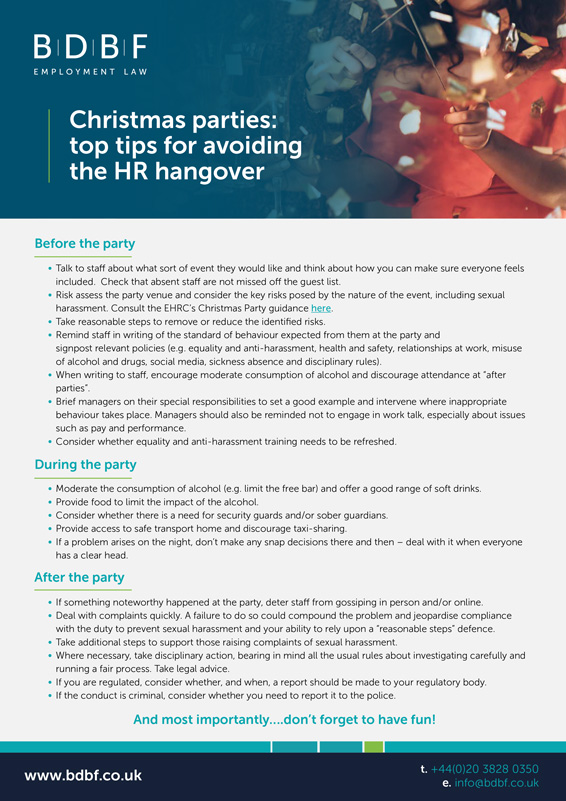
Christmas parties: Top tips for avoiding the HR hangover 2025

The party season is here, and it’s time to celebrate. But before the mulled wine flows and the dance floor calls… ho-ho-how do you keep the festivities merry, bright and free of the dreaded HR hangover?

Unwrap our tips here.


BDBF double milestone: 13 years of excellence and 30 years of expertise

This month, BDBF celebrates its 13th anniversary – thirteen years of delivering outstanding results for senior executives, partners and employers in the highest-stakes employment disputes.

BDBF has been independently top ranked by Chambers and Partners and Legal 500 year after year throughout its existence. We are proud to be the only firm in its category with all six of our partners individually ranked as employment law experts for Employment: Senior Executives. We were also featured as one of The Times Best Law Firms 2026 for employment law, as endorsed by our peers and have been shortlisted by the International Employment Lawyer as Senior Executive Team of the Year 2026.

Over the past 13 years, BDBF has secured precedent-setting judgments, negotiated life-changing exits and protected reputations in the most complex and sensitive cases. We treat every client as if their career depends on it, because it does. We know that clients come to us in a time of acute need, and it is a privilege to be able to help them.

Whilst we still settle the vast majority of the cases we deal with discreetly and elegantly, we do have a market leading track record in litigation. For example, recently, BDBF represented Sebastian Lapinski in a high-stakes disability discrimination claim against Triton Investment Advisers LLP and Swedish respondents. Overcoming jurisdictional disputes, BDBF secured a Tribunal victory and EAT appeal dismissal, reinforcing employee rights under the Equality Act 2010 and Brussels Regulation. BDBF also successfully represented Rob Gagliardi in the first employment anti-suit injunction obtained under the new jurisdictional regime that applies post-Brexit. This injunction halted his former employer, Evolution, from pursuing claims against him in New York, setting a precedent in employment law. In a recent high-profile case against Facebook, BDBF’s client alleged that Facebook inflated advertising product performance metrics, misleading customers and investors, and attempted to conceal this by integrating the flawed metric into its standard products. After receiving a poor appraisal, they were terminated, prompting them to seek interim relief in the Employment Tribunal. The case garnered widespread attention, including coverage in the Financial Times. You can read more about BDBF’s client successes here.

As of today, BDBF has 23 employment lawyers in our team (comprising six partners in addition to 17 other lawyers) supported by our eight-strong practice team that is wholly dedicated to client service.

BDBF has recently bolstered its team with the promotion of senior associates Blair Wassman and Theo Nicou to managing associates, and associate Connie Berry to senior associate. We further strengthened our leadership by promoting Samantha Prosser to partner level in spring 2025, bringing fresh perspectives to our dynamic practice. We were delighted to welcome the return of managing associate Jamie Barton, and to welcome Rose Lim as our new Knowledge Lawyer and senior associate Leigh Janes.

Adding a special layer to this year’s celebration, BDBF’s Managing Partner, Gareth Brahams, marks 30 years post-qualification experience (PQE) this month. Gareth’s unparalleled expertise and visionary leadership have been instrumental in shaping BDBF from its inception, guiding us through complex disputes and fostering a culture of excellence. On reaching this milestone, Gareth comments that “the great privilege of being a solicitor is that you come into people’s lives at the critical moments, whether it is because they are starting or selling their business, buying a house, have suffered a catastrophic personal injury, been accused of a crime, getting divorced or, yes, in my case, helping people whom after a stellar career have often hit the first bump in the road in their work lives. These amazingly successful and talented people have turned to us for help, and it is a privilege to help them. If we ever forget that, and ever do anything less than our best for them, then we pull the thread that pulls the whole thing apart.”

As BDBF steps into its 14th year, our founding goal endures – delivering outstanding outcomes for clients with brilliance, integrity and openness.

A heartfelt thanks to our colleagues, peers and above all, our clients, for the trust you place in us every day.

Here’s to the next chapter.


Maximum ACAS Early Conciliation period to double from six to twelve weeks from 1 December 2025

From 1 December 2025, the maximum period for ACAS Early Conciliation will increase from six to twelve weeks. The Government’s stated aim is to ease the growing pressure on ACAS and allow parties greater scope to resolve workplace disputes before they reach the Employment Tribunal.

What is ACAS Early Conciliation?

Before most claims can be brought in the Employment Tribunal, prospective claimants must first notify ACAS (the Advisory, Conciliation and Arbitration Service). ACAS acts as an independent conciliator, helping parties explore whether their dispute can be settled without the need for litigation.

The process begins when the claimant (or respondent) submits an early conciliation form online or provides details by telephone. ACAS will then allocate a conciliator who contacts the claimant or their representative to discuss the issues in dispute and the potential for settlement. If both sides agree, ACAS will facilitate discussions aimed at resolving the dispute.  ACAS will issue a certificate at the end of the conciliation period (or before if settlement is not possible) which enables the claimant to proceed with an Employment Tribunal claim.

At present, the conciliation process can last for up to six weeks, though it can (and often does) end earlier if either party wishes.  Importantly, this conciliation period “stops the clock” on the usual limitation deadline for bringing a claim (but only where the claimant has instigated the process). While the calculation of the new limitation date can be complex, claimants will always have at least one month from the date of the certificate to present their claim.

What is changing and why?

On 3 November 2025, new regulations were unexpectedly introduced to extend the maximum early conciliation period to twelve weeks.  The regulations are due to come into force on 1 December 2025.

According to the accompanying Explanatory Memorandum, the policy objective is to reduce strain on ACAS and allow parties to make fuller use of the opportunity to settle disputes. The Government has cited rising demand and increasing case complexity as the key drivers of this change. With the Employment Rights Bill expected to introduce a wave of new employment rights, demand is likely to rise further.

The regulations have been laid before Parliament and are expected to come into force automatically on 1 December 2025 (unless rejected, which is unlikely). Where early conciliation is started before this date the current six-week conciliation period will apply.  The regulations make no other changes to the ACAS early conciliation process, so it remains the case that either party may end the process at any time. 

Potential implications for employers and claimants

Although this appears to be a straightforward procedural change, it could have a number of practical effects:

  • Greater scope for settlement: A twelve-week window may make it easier to resolve complex disputes that would otherwise proceed to litigation. This could, in turn, help reduce the existing backlog of Employment Tribunal claims.

  • Reduced pressure on ACAS: The longer period should give ACAS more time to allocate conciliators and manage workloads, albeit that some complex cases may occupy conciliators for twelve rather than six weeks.

  • Shift in negotiating dynamics: Claimants may gain leverage in settlement discussions since the longer window prolongs the uncertainty for employers, leaving them with litigation hanging over their heads for longer periods of time. 

  • Impact on limitation periods: Where the full twelve weeks are used, the limitation period for issuing a claim could be extended considerably.  Given that it can already take a year or more to reach a final hearing, this extension could make managing evidence and witnesses more challenging for employers.

Next steps

The Government has confirmed it will review the change in October 2026 to determine whether the twelve-week period should remain in place.

The Employment Tribunals (Early Conciliation: Exemptions and Rules of Procedure) (Amendment) Regulations 2025

BDBF is a leading employment law firm based at Bank in the City of London. If you would like to discuss any issues relating to the content of this article, please contact Amanda Steadman (AmandaSteadman@bdbf.co.uk) or your usual BDBF contact.


Innocent decision-makers cannot be personally liable for the detriment of dismissing a whistleblower

In Henderson v GCRM Ltd & Ors, the Employment Appeal Tribunal has considered whether it is possible to hold an “innocent” decision-maker liable for the detriment of dismissing a whistleblower, in circumstances where another individual has manipulated or tainted the process motivated by the whistleblower’s actions.

Background

Under the Employment Rights Act 1996 (ERA), whistleblowers are protected in the following key ways:

  • It is automatically unfair to dismiss them if the reason or principal reason is that they made a protected disclosure (Section 103A).

  • It is unlawful for their employer to subject them to any detriment through any act (or deliberate failure to act) on the ground that they made a protected disclosure (Section 47B(1)). This claim is not available against the employer where the detriment is dismissal, as the remedy is an automatic unfair dismissal complaint under Section 103A (Section 47B(2)). Nevertheless, the employee may have a claim for detriment for any other actions taken by their employer leading up to the dismissal. 

  • It is unlawful for any co-worker or agent to subject them, in the course of that co-worker’s employment (or agency), to any detriment through any act (or deliberate failure to act) on the ground that they made a protected disclosure (Section 47B(1A)). Under Timis v Osipov [2018] EWCA Civ 2321, this claim is available against an individual even where the detriment is dismissal, and the employer can become vicariously liable for the actions of that individual.  The employer may have a defence if they took all reasonable steps to prevent the co-worker’s actions. For further information, please see our briefing on Osipov here.

Under the previous case of Royal Mail Ltd v Jhuti, the Supreme Court found that a protected disclosure can still be the principal reason for an employee’s dismissal even if the disclosure was hidden from the dismissing officer, and therefore a claim under Section 103A can succeed on that basis. Unlike in earlier cases where only the motivations of the decision-maker were said to be relevant, the Supreme Court in Jhuti confirmed that if the decision-maker is given false reasons to dismiss by someone who is themselves motivated by the fact that the employee has blown the whistle, the Tribunal can look past those false reasons to establish the underlying motivation. In effect, if the underlying motivation to dismiss the employee is the protected disclosure, employers cannot evade liability by hiding that fact from a good faith disciplinary decision-maker.

For further information on the Jhuti case, please see our prior briefing here.

What happened in this case?

Ms Henderson was employed as an embryologist by GCRM Limited, a regulated clinic based in Glasgow providing fertility services and care, following a transfer under TUPE from Nuffield Hospital in Glasgow in September 2018.

Following the transfer, in March 2019 Ms Henderson began to raise concerns on several occasions regarding issues impacting the standard of patient care at GCRM. In particular, she was concerned regarding the low levels of available staff and inadequacy of training, which she felt was leading to excessive pressure for both nurses and the laboratory staff. Ms Henderson considered that patients were experiencing poor success rates and that there was a likelihood of errors and reportable incidents, and that patients were being misled about the standard of service. She continued to express concerns into August 2021 and raised a grievance in September 2021 on the basis that she felt singled out and unfairly treated. The grievance was not upheld, and an appeal submitted by Ms Henderson was not heard.

In October 2021, Ms Henderson was informed of disciplinary allegations relating to a reportable regulatory incident and an alleged failure to follow reasonable management requests. She was told that such concerns could amount to “serious negligence/gross misconduct and/or lead to a loss of trust and confidence in your ability to perform your role” and was suspended from her role.

The original disciplinary manager was set to be Mr Tomnay, who was Ms Henderson’s line manager and who was therefore aware of her complaints. It was later changed to Ms Tracey, the Managing Director – UK, who had recently joined the group by the time of the disciplinary hearing in January 2022 and was employed by a separate entity. Ms Henderson was ultimately dismissed by Ms Tracey in February 2022 for “numerous and collective examples of poor performance and leadership in fulfilling the duties of [her] role”, and received payment in lieu of notice. An appeal against the decision was unsuccessful.   

Ms Henderson pursued a claim of: (i) automatic unfair dismissal against GCRM; and (ii) for the detriment of dismissal against GCRM and each of Mr Tomnay and Ms Tracey individually.

Employment Tribunal’s decision

In the first instance decision, the Employment Tribunal determined that the disclosures made by Ms Henderson relating to staffing levels were protected under Sections 43A and 43B ERA, as she had genuinely believed that they tended to show breaches of legal obligation that were in the public interest (and that belief was objectively reasonable).

The Tribunal concluded that Mr Tomnay and the HR representative, Ms Young, had been motivated to initiate and conduct a disciplinary investigation against Ms Henderson because of her protected disclosures. Further, they found that Ms Tracey was extensively informed and guided in the disciplinary process by Mr Tomnay and Ms Young; the decision to instigate disciplinary proceedings had been Mr Tomnay’s, and the process had only been handed over to Ms Tracey as he was no longer available to manage it. Ms Tracey admitted having little to know knowledge of the disciplinary allegations, which had been decided by Mr Tomnay and the HR representative, admitted that she had relied on them for shaping the process and providing information, and confirmed that she had spoken to Mr Tomnay during adjournment of the disciplinary hearing.

Having made the above findings of fact, the Tribunal’s judgment was that:

  • Under Jhuti, Ms Tracey could be ‘imputed’ with the knowledge of Mr Tomnay and Ms Young, as they had influenced her to a significant degree. The protected disclosures had therefore had a material influence on Ms Henderson’s dismissal, and the claim against Ms Tracey for detriment based on Ms Henderson’s dismissal therefore succeeded (Section 47B(1A)). As she was an agent of GCRM, GCRM were also liable for her actions (Section 47B(1B)). 

  • It was not possible to claim directly against GCRM for detriment based on protected disclosures where the detriment alleged was dismissal.

  • Whilst the protected disclosures had been a material influence, they had not been the sole or principal reason for the dismissal and therefore the dismissal was not automatically unfair under Section 103A. It was nevertheless unfair under ordinary unfair dismissal principles, as there had been significant procedural failings and substantive issues with the findings and sanction.

  • Mr Tomnay did not subject Ms Henderson to the detriment of dismissal, as he had only had an indirect influence, therefore the claim against him could not succeed.

EAT’s decision

Both Ms Henderson and GCRM appealed against the Tribunal’s findings.

Ms Henderson’s Appeal

Ms Henderson alleged that the Tribunal had failed to properly consider the reason for the dismissal for her automatic unfair dismissal claim (Section 103A).

The EAT agreed with this, and confirmed that once Jhuti had been raised by Ms Henderson, the Tribunal should have made clear findings about whether or not Mr Tomnay had improperly manipulated Ms Tracey or created a false pretext which he induced Ms Tracey to adopt. If it was found that he did manipulate or intervene in the process, the Tribunal should then have considered what part that ultimately played in Ms Tracey’s decision to dismiss. Ms Henderson’s automatic unfair dismissal claim was therefore remitted to the same Tribunal to consider those questions, as it was not an inevitable conclusion that the dismissal would have been automatically unfair.

Ms Henderson also attempted to argue that Mr Tomnay could be held responsible for her dismissal as a result of his involvement, on the basis that the term “dismissed” should include actions causing or contributing to dismissal. The EAT did not agree with this, as this would blur the line between pre-dismissal detriment and the detriment of dismissal itself. No pre-dismissal detriment by Mr Tomnay had been alleged, and he had not dismissed Ms Henderson, therefore the complaint could not succeed.

GCRM’s Appeal

GCRM argued that the Tribunal had erred in concluding that Osipov and Jhuti meant that Ms Tracey, an “innocent” dismissing manager, could be found personally liable under Section 47B(1A) and therefore make the employer also liable under Section 47B(1B).

The EAT agreed with this, noting that Jhuti had only been concerned with an employer’s liability for automatic unfair dismissal under Section 103A and the state of mind that can be attributed to the employer. The EAT considered that there was no reason to extend this analysis of a “composite approach” to liability to personal liability under Section 47B(1A), in particular because it could not have been the intention of Parliament to impose unlimited liability on individuals who have not been personally motivated by the making of protected disclosures. Both Jhuti and Osipov had taken a purposive approach to legislation in order to provide the claimant with an effective remedy, but without liability being imposed on an innocent party.

The EAT therefore set aside the judgment against Ms Tracey for detriment consequently the judgment against GCRM for detriment.

What does this mean for employers?

The judgment in Henderson has offered some helpful clarification as to the circumstances in which decision-makers can be imputed with the knowledge or motivations of others in the context of whistleblowing. In particular:

  • For an automatic unfair dismissal claim under Section 103A, it is possible for the Tribunal to look at whether or not the decision-maker may have been manipulated or influenced in a way that means that, even if they were not personally aware of the protected disclosures, it was still the sole or principal reason for dismissal.

  • For detriment claims against individuals under Section 47B(1A) (and consequent liability for employers under Section 47B(1B)), the Tribunal should not impute knowledge to otherwise ‘innocent’ decision-makers in a way that makes them personally liable (and their employer vicariously liable) for whistleblowing detriment.

Henderson v GCRM Ltd & Ors [2025] EAT 13

BDBF is a leading employment law firm based at Bank in the City of London. If you would like to discuss any issues relating to the content of this article, please contact Rose Lim (RoseLim@bdbf.co.uk) or your usual BDBF contact.


Not on the clock but still on the hook? EAT considers employer’s liability for sexual harassment.

The EAT’s recent decision in AB v Grafters Group Ltd reminds HR teams that employer responsibility for harassment may extend beyond the workplace.

What happened in this case?

The Claimant worked for a hospitality recruitment agency.  On 1 November 2021, the Claimant mistakenly believed that she was due to work at an event taking place at Hereford Racecourse.  She arrived late to her employer’s office and thought she had missed the transport to Hereford.   A colleague who had just finished work (CD) offered to give her a lift.  She agreed.

CD had previously sent sexually suggestive messages to the Claimant, including in the early hours of 1 November 2021 when he was at work.  During the journey, the Claimant learnt that she was not, in fact, required to work that day and she asked CD to take her home.  However, CD drove her to a golf course, where he subjected her to sexual harassment. 

The Claimant claimed that her employer was vicariously liable for the sexual harassment.  The Employment Tribunal found that CD had sexually harassed the Claimant.  However, it held that the employer was not vicariously liable because CD was not acting “in the course of his employment” at the time of the incident. The Tribunal determined that CD was not working at the time, the incident did not occur in the workplace, nor was the transport arrangement part of his work duties or otherwise approved by the employer.  It also concluded that CD’s motive in offering the lift was not linked to his employment.

The Claimant appealed to the EAT.

What was decided?

The appeal focused on whether CD’s actions were “in the course of employment”.  The EAT found that the Tribunal was entitled to conclude that the harassment occurred outside of CD’s working hours and not while he was performing his work duties.  However, it had failed to consider whether a sufficient nexus or connection with work was present, such that the lift and subsequent conduct could be deemed an extension of his employment. The EAT held that this step was required by case law, and the Tribunal had failed to carry out the necessary “second question” analysis. 

The EAT also considered whether the Tribunal had failed to consider three relevant factors, namely:

  • the sexual messages that CD had been sent during his working hours;

  • whether the harassment in the car was part of a continuous course of conduct starting when CD was at work; and

  • the connection between CD’s job, previous arrangements for lifts between colleagues, and the reason why the Claimant was in his car. 

The EAT concluded that the Tribunal’s failure to address these factors made its legal reasoning incomplete, because they were all directly relevant to the analysis of whether a sufficient nexus or connection with work existed. 

The EAT also considered whether the Tribunal had given weight to two irrelevant factors, namely:

  • CD’s “motive” for giving the lift, asking if it was because of a requirement linked to his employment; and

  • whether the employer had knowledge of, or sanctioned, CD giving a lift to the Claimant. 

The EAT considered that CD’s motive in offering the lift was immaterial to whether the acts were “in the course of employment.”  However, the question of whether the employer knew or approved of the general arrangement could be relevant to the analysis of whether an act was in the course of employment.

The appeal was upheld, and the case was remitted to the same Tribunal for reconsideration.

What does this mean for employers?

Employers may be held liable for harassment committed by workers in the course of their employment.  However, as previous caselaw has made clear, the meaning of “in the course of employment” is wider than just those actions occurring during working hours in the workplace.  It is possible that conduct off the premises and out of normal working hours may be considered an “extension of employment”, for example, at a colleague’s leaving party, or during work-related travel. However, in all cases the decision is for the Tribunal to reach on the particular facts.  This decision reminds us of this nuanced approach needed, although it remains to be seen whether the harassment which took place in this case will meet the threshold.

The decision also underlines the need for employers to give careful consideration to the reasonable steps it can take to prevent sexual harassment.  If the actions are held to be within the course of employment, the employer may still avoid liability if it can show that it took all reasonable steps to prevent sexual harassment occurring.  This will include things like having an appropriate policy in place and providing training to staff.  In this case, it could potentially include steps like empowering staff to call a taxi at the employer’s expense to reach the workplace or return home where they have missed the arranged transport and feel vulnerable. 

The taking of reasonable steps is also necessary to discharge the statutory duty on employers to prevent sexual harassment at work.   At present, the duty requires employers to take some, but not all, reasonable steps.  From October 2026, the duty will be upgraded to require all reasonable steps to be taken (aligning it with the reasonable steps defence).  A failure to discharge the duty gives rise to an uplift to compensation in relevant claims of up to 25% and could provoke an investigation by the Equality and Human Rights Commission.

AB v Grafters Group Ltd t/a CSI Catering Services International

BDBF is a leading employment law firm based at Bank in the City of London. If you would like to discuss any issues relating to the content of this article, please contact Amanda Steadman (AmandaSteadman@bdbf.co.uk) or your usual BDBF contact.