On 26 May 2023, BDBF Partner Polly Rodway will be presenting a webinar entitled “Maternity & Pregnancy Rights Update – Case Law, Legislation & Future Developments” in conjunction with MBL Seminars. In this session, Polly will discuss recent maternity and pregnancy discrimination claims, legislative changes and research and campaigns which may influence change in the future.
Polly Rodway presenting at “Maternity & Pregnancy Rights Update – Case Law, Legislation & Future Developments” webinar
The King’s Coronation bank holiday: are workers entitled to have the day off work?
A national bank holiday will take place on Monday, 8 May 2023 to mark the Coronation of King Charles III. Do workers have the right to have the day off work? If so, does it need to be paid? The short answer is: it depends on what the employer’s contracts and policies say.
What does the law say?
- The Working Time Regulations 1998 entitle workers to a minimum of 5.6 weeks’ paid leave per year. For full-time workers, this equates to 28 days’ paid leave per year.
- Contrary to widespread belief, bank holidays do not have special status and there is no statutory entitlement to time off work for bank holidays. However, employers may choose to include bank holidays as part of a worker’s overall leave entitlement.
- When drafting employment contracts employers have freedom in how the minimum annual leave entitlement is distributed – this can be done in several ways with different consequences.
What do the contracts and policies say?
As a starting point, employers should check the drafting of relevant policies and contracts. This will determine whether workers are entitled to leave, and pay, for this additional bank holiday.
Some possibilities of how the contract might set out the 5.6 weeks’ annual holiday entitlement include:
- “Four weeks plus eight standard bank holidays” (and in some cases, the bank holidays may even be specified). In this scenario, there would be no automatic entitlement to have the Coronation bank holiday as an additional day off, but if the worker had some of their annual leave entitlement remaining then they may request to take it as a day’s leave in the normal way.
- “Four weeks plus all bank holidays”. This wider drafting suggests that workers would be entitled to have the Coronation bank holiday as an additional day off. This means that full-time workers would get a minimum of 29 days’ paid leave this year instead of 28. If the employer needed the worker to work on the Coronation bank holiday it could offer the worker a day off in lieu at a later date instead.
- “5.6 weeks inclusive of the eight standard bank holidays”. This drafting means that there is no entitlement to have the Coronation bank holiday as an additional day off, since the leave entitlement is ultimately capped at 28 days for a full-time worker (i.e. a full-time worker would not get a 29th day of paid annual leave). However, as above, if the worker had some of their annual leave entitlement remaining then they may request to take it as a day’s leave in the normal way.
- “5.6 weeks inclusive of all bank holidays”. There would be no entitlement to have the Coronation bank holiday as an additional day off. Again, this drafting means the leave entitlement is ultimately capped at 28 days for a full-time worker. However, the worker could ask to take it off in the normal way. Further, this drafting would, in fact, allow employer to require that the day be taken as a day’s leave (whether the worker wants to or not) out of their usual paid leave entitlement.
What practical issues should employers consider?
In addition to checking what contracts and policies say, employers should also think about the optics of their decision – both internally, in terms of impact on staff morale, as well as externally. Many workers will be expecting to have the day off, regardless of the strict legal position. Indeed, the Government has said that the Coronation bank holiday would “give people across the United Kingdom the opportunity to come together as families and communities to welcome His Majesty to the throne as we mark this important day in our nation’s long history”.
It should also be remembered that schools will close on the Coronation bank holiday, and this will have a direct impact on workers with children. Employment Tribunals continue to recognise that decisions impacting childcare have a disproportionate impact on women. Employers should be mindful of indirectly discriminating against mothers with childcare responsibilities. Where a worker’s contract does not entitle them to have the Coronation bank holiday off, and the employer needs them to work, it should consider allowing parents of school age children to either:
- work from home on the day;
- take the day off and make up the lost working hours later in the week;
- take paid annual leave on the day (assuming they have paid leave entitlement available);
- take unpaid parental leave on the day; or
- take unpaid time off to provide emergency care for dependants on the day (whether or not this type of leave is engaged will depend on the circumstances).
Employers should also consider what to do if a worker makes a request to have the day off where they have already used up their paid annual leave entitlement. Would you be prepared to let them take it as unpaid leave?
Some workers may actually prefer to work on the Coronation bank holiday. Can employers force workers to take the day off, and take the leave out of their annual entitlement? Can workers ask to take a different day off at some other time? Again, the answers will be found in the employment contract and relevant policies.
BDBF is a law firm based at Bank in the City of London specialising in employment law. If you would like to discuss any issues relating to the content of this article, please contact Principal Knowledge Lawyer Amanda Steadman (amandasteadman@bdbf.co.uk) or your usual BDBF contact.
What can employers do to provide a more inclusive work environment for Muslim staff?
Employment Law News
What can employers do to provide a more inclusive work environment for Muslim staff?
With Ramadan starting this evening, BDBF Senior Associate, Theo Nicou considers the Muslim Council of Britain’s Ramadan Guide which provides recommendations on what employers can do to provide a more inclusive work environment for Muslim staff.
What adaptations can employers implement for Ramadan?
- Be open to having a discussion with employees who are fasting but don’t assume that all employees want to be treated differently because they are fasting.
- Consider letting staff finish earlier if they are working through any break times.
- Be accommodating to annual leave requests, in particular for employees wanting time off to celebrate Eid ul Fitr festival, marking the end of the holy month of Ramadan.
- Be flexible in allowing employees to have breaks for afternoon prayers and, if possible, provide a prayer or quiet space.
What cultural considerations should employers be aware of and what everyday adaptations can they make?
- Employers should be aware of cultural differences around handshaking and direct eye contact. The placing of a hand on heart (instead of a handshake between genders) in greeting is practiced in many Muslim communities and seen as a highly respectful act, as is Muslim men lowering their gaze when interacting with women, another marker of utmost respect and means of maintaining a modest disposition.
- Take into consideration how dress codes and uniforms can incorporate headscarves should a Muslim member of staff wear it and provide hair nets or masks if there are health and safety considerations regarding beards.
- Look into including halal and/or kosher (as it is also permissible for Muslims to eat) food and vegetarian dishes in canteens or whenever food or snacks are provided for staff.
- Offer a range of activities designed to appeal to everyone, dedicated to building rapport between staff from different backgrounds. Muslim staff may not socialise in pubs, for example, so consider events in the social calendar that will accommodate for this difference in sensibilities.
Closing thoughts
Inclusivity is key to ensuring a happy and productive workforce. A number of the above practical changes are easy to implement but could go a long way to foster a more welcoming work environment for Muslim staff.
BDBF is a leading law firm based at Bank in the City of London specialising in employment law. If you would like to discuss any issues relating to the content of this article, please contact Theo Nicou (theonicou@bdbf.co.uk) or your usual BDBF contact.
[/et_pb_text][/et_pb_column][/et_pb_row][/et_pb_section][et_pb_section fb_built=”1″ _builder_version=”3.26.6″][et_pb_row _builder_version=”3.26.6″][et_pb_column type=”4_4″ _builder_version=”3.26.6″][/et_pb_column][/et_pb_row][/et_pb_section]
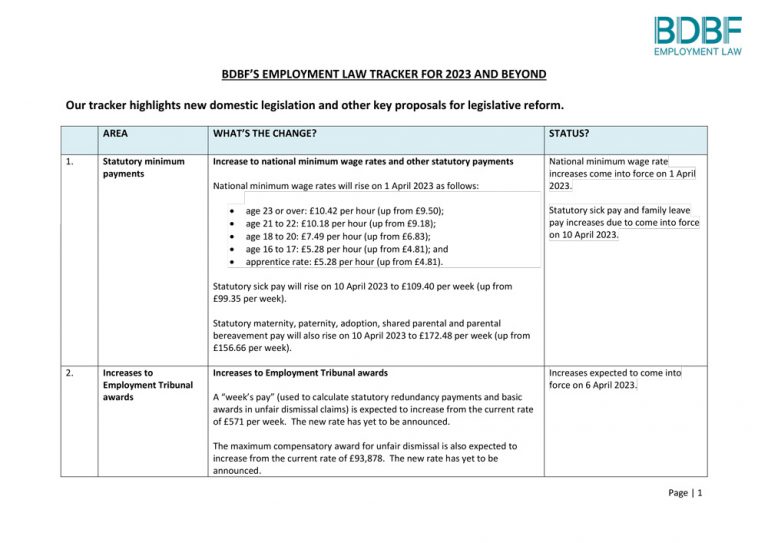
BDBF’S EMPLOYMENT LAW TRACKER FOR 2023 AND BEYOND
[et_pb_section fb_built=”1″ _builder_version=”3.0.100″ background_image=”http://davidk423.sg-host.com/wp-content/uploads/2017/09/bdbf_final-stages-1-4-1.jpg” custom_padding=”|||” global_module=”2165″ saved_tabs=”all” global_colors_info=”{}”][et_pb_row _builder_version=”4.16″ min_height=”66.4px” custom_padding=”50px||||false|false” global_colors_info=”{}”][et_pb_column type=”4_4″ _builder_version=”4.16″ custom_padding=”|||” global_colors_info=”{}” custom_padding__hover=”|||”][et_pb_text _builder_version=”4.16″ _dynamic_attributes=”content” text_font=”|700|||||||” text_font_size=”27px” background_layout=”dark” custom_margin=”0px|||” custom_padding=”0px|||” global_colors_info=”{}”]@ET-DC@eyJkeW5hbWljIjp0cnVlLCJjb250ZW50IjoicG9zdF90aXRsZSIsInNldHRpbmdzIjp7ImJlZm9yZSI6IiIsImFmdGVyIjoiIn19@[/et_pb_text][et_pb_text _builder_version=”4.16″ _dynamic_attributes=”content” _module_preset=”default” text_text_color=”#FFFFFF” global_colors_info=”{}”]@ET-DC@eyJkeW5hbWljIjp0cnVlLCJjb250ZW50IjoicG9zdF9kYXRlIiwic2V0dGluZ3MiOnsiYmVmb3JlIjoiIiwiYWZ0ZXIiOiIiLCJkYXRlX2Zvcm1hdCI6ImRlZmF1bHQiLCJjdXN0b21fZGF0ZV9mb3JtYXQiOiIifX0=@[/et_pb_text][/et_pb_column][/et_pb_row][/et_pb_section][et_pb_section fb_built=”1″ admin_label=”section” _builder_version=”4.16″ global_colors_info=”{}”][et_pb_row admin_label=”row” _builder_version=”4.16″ background_size=”initial” background_position=”top_left” background_repeat=”repeat” global_colors_info=”{}”][et_pb_column type=”4_4″ _builder_version=”4.16″ custom_padding=”|||” global_colors_info=”{}” custom_padding__hover=”|||”][et_pb_text _builder_version=”4.19.1″ text_orientation=”justified” hover_enabled=”0″ use_border_color=”off” global_colors_info=”{}” sticky_enabled=”0″]
Our tracker highlights new domestic legislation and other key proposals for legislative reform.
Please click the image below to view the full tracker document:
[/et_pb_text][et_pb_image src=”http://davidk423.sg-host.com/wp-content/uploads/2022/12/2023-Employment-Law-Tracker-FINAL.jpg” title_text=”2023-Employment-Law-Tracker-(FINAL)” url=”http://davidk423.sg-host.com/wp-content/uploads/2022/12/December-newsletter-2023-Employment-Law-Tracker-FINAL.pdf” _builder_version=”4.19.1″ _module_preset=”default” border_width_all=”1px” border_color_all=”#1c6f7a” global_colors_info=”{}”][/et_pb_image][et_pb_text _builder_version=”4.19.1″ text_orientation=”justified” use_border_color=”off” global_colors_info=”{}”]
If you would like further information, or to discuss how to prepare for any of these changes, please contact Amanda Steadman (amandasteadman@bdbf.co.uk) or your usual BDBF contact.
[/et_pb_text][/et_pb_column][/et_pb_row][/et_pb_section][et_pb_section fb_built=”1″ _builder_version=”4.16″ global_colors_info=”{}”][et_pb_row _builder_version=”4.16″ global_colors_info=”{}”][et_pb_column type=”4_4″ _builder_version=”4.16″ global_colors_info=”{}”][/et_pb_column][/et_pb_row][/et_pb_section]
Reflecting on the employment law highlights from 2022
[et_pb_section fb_built=”1″ _builder_version=”3.0.100″ background_image=”http://davidk423.sg-host.com/wp-content/uploads/2017/09/bdbf_final-stages-1-4-1.jpg” custom_padding=”|||” global_module=”2165″ saved_tabs=”all” global_colors_info=”{}”][et_pb_row _builder_version=”4.16″ min_height=”66.4px” custom_padding=”50px||||false|false” global_colors_info=”{}”][et_pb_column type=”4_4″ _builder_version=”4.16″ custom_padding=”|||” global_colors_info=”{}” custom_padding__hover=”|||”][et_pb_text _builder_version=”4.16″ _dynamic_attributes=”content” text_font=”|700|||||||” text_font_size=”27px” background_layout=”dark” custom_margin=”0px|||” custom_padding=”0px|||” global_colors_info=”{}”]@ET-DC@eyJkeW5hbWljIjp0cnVlLCJjb250ZW50IjoicG9zdF90aXRsZSIsInNldHRpbmdzIjp7ImJlZm9yZSI6IiIsImFmdGVyIjoiIn19@[/et_pb_text][et_pb_text _builder_version=”4.16″ _dynamic_attributes=”content” _module_preset=”default” text_text_color=”#FFFFFF” global_colors_info=”{}”]@ET-DC@eyJkeW5hbWljIjp0cnVlLCJjb250ZW50IjoicG9zdF9kYXRlIiwic2V0dGluZ3MiOnsiYmVmb3JlIjoiIiwiYWZ0ZXIiOiIiLCJkYXRlX2Zvcm1hdCI6ImRlZmF1bHQiLCJjdXN0b21fZGF0ZV9mb3JtYXQiOiIifX0=@[/et_pb_text][/et_pb_column][/et_pb_row][/et_pb_section][et_pb_section fb_built=”1″ admin_label=”section” _builder_version=”4.16″ global_colors_info=”{}”][et_pb_row admin_label=”row” _builder_version=”4.16″ background_size=”initial” background_position=”top_left” background_repeat=”repeat” global_colors_info=”{}”][et_pb_column type=”4_4″ _builder_version=”4.16″ custom_padding=”|||” global_colors_info=”{}” custom_padding__hover=”|||”][et_pb_text _builder_version=”4.19.1″ text_orientation=”justified” hover_enabled=”0″ use_border_color=”off” global_colors_info=”{}” sticky_enabled=”0″]
What are the employment law highlights from the last 12 months? In this briefing, we reflect on some of the most interesting and important cases and developments for employers to remember as the year draws to a close.
COVID-19
- Employers learnt to live with Covid: on 1 April 2022 the last Covid-related restrictions were withdrawn, and the Government moved to the next phase of the pandemic – “living with Covid”. In this briefing, we discussed the impact of changes affecting the workplace, including the end of free Covid testing and the removal of the self-isolation requirements and special health and safety rules.
- Dealing with reluctant returners: as employers learnt to live with Covid, the focus quickly shifted to getting staff back into the workplace. On 26 April 2022, we held a webinar looking at how employers should deal with staff who were reluctant to return to the workplace after working from home during the pandemic. You can access both the recording of that webinar, together with the slide presentation used on the day, here.
- The emergence of “Long Covid”: with an estimated 1.8 million people in the UK now suffering with Long Covid, employers also had to learn how to manage staff with the condition. In this briefing, we considered when Long Covid may qualify as a disability and the steps that employers may need to take as a result. We also looked at Burke v Turning Point Scotland, where it was decided that an employee who had suffered with Covid symptoms for around nine months was That decision can be contrasted with the outcome in Quinn v Sense Scotland, where it was decided that an employee who was dismissed shortly after contracting Covid was not disabled, even though she did eventually develop Long Covid.
- Disputes from the height of the pandemic reached the Employment Tribunals: we considered the case of X v Y, where an Employment Tribunal decided that a claimant’s fear of catching Covid, and her belief that she needed to protect herself and her partner from catching it, was not a protected belief for the purposes of discrimination law. We also looked at the case of Rodgers v Leeds Laser Cutting Ltd, where the EAT upheld a decision that it had not been unfair to dismiss an employee who refused to attend work because he was worried about catching Covid and giving it to his vulnerable children. This decision was appealed, and the Court of Appeal’s decision is expected soon.
Equality
- Disability and secondments: we discussed the case of Judd v Cabinet Office where the EAT upheld a decision that an employer’s withdrawal of an overseas secondment opportunity on health and safety grounds was not disability discrimination. The appeal turned on whether the employer had acted disproportionately in withdrawing the opportunity, and the EAT decided that there had been no viable alternatives available to the employer.
- Breastfeeding, baldness and sex-related harassment: in Mellor v MFG Academies Trust an Employment Tribunal held that a woman suffered harassment related to sex when her employer failed to provide a private room for her to express breastmilk. The employee was forced to express milk in the toilets or her car, which had the effect of creating an unwanted, degrading or humiliating environment for her. In Finn v The British Bung Manufacturing Company Limited an Employment Tribunal held that calling a male employee “bald” on just one occasion was harassment related to sex.
- Gender critical belief discrimination: in the long-running and high-profile case of Forstater v CGD Europe and others an Employment Tribunal ruled that an employer directly discriminated against and victimised a worker who lost her role after she had made straightforward statements of her gender critical beliefs on Twitter and in the workplace. In our briefing we outlined the practical steps that employers could take to manage a potential clash of rights between gender critical and trans workers within the workplace.
- Sham redundancy was discriminatory and subject to Acas Code: we considered the decision in Coulson v Rentplus Ltd, where the EAT upheld a decision that the Acas Code of Practice on Disciplinary and Grievance Procedures applied to a sham redundancy dismissal that had been tainted by discrimination. The Code had been completely disregarded, meaning that a maximum 25% uplift to the compensation was justified.
- Employer ordered to conduct and publish an equal pay audit: in Macken v BNP Paribas London Branch – for the first time – the Employment Tribunal ordered an employer who had lost an equal pay claim to conduct, and publish the findings of, an equal pay audit showing whether it was paying men and women equally where required. The employer was also ordered to pay compensation of over £2 million to the female banker who brought the claim.
- Pay reporting developments: pay reporting was back in the spotlight this year. In this briefing from March, we looked at the announcement that mandatory ethnicity pay reporting would not be introduced and, instead, that employers would be encouraged to report voluntarily on ethnicity pay. In April, the latest round of gender pay gap reports were published (following a hiatus during the pandemic) and in this briefing we looked at what the latest figures revealed and what the future holds.
General HR issues
- Recruitment and CV lies: in R v Andrewes the Supreme Court ordered the confiscation of almost £100,000 from a senior executive who committed “CV fraud” by making false representations and failing to disclose the truth about his qualifications and experience when he applied for and secured several senior posts.
- Holiday pay: in the case of Smith v Pimlico Plumbers, the Court of Appeal held that a worker was entitled to claim compensation for unpaid holiday covering the entire period of his engagement. This included both holiday that he did not take, as well as holiday that he did take but which had been unpaid. And in Harpur Trust v Brazel the Supreme Court ruled that permanent part-year workers (such as term-time workers) were entitled to 5.6 weeks’ holiday per year, regardless of how many weeks they actually worked per year. Further, if they worked irregular hours, their holiday pay must be calculated as an average of pay earned over a reference period – any other method of calculation is not permitted.
- Sick pay and malingering: in a decision which highlights the perils of jumping the gun, the EAT decided in Singh v Metroline West Limited that an employer had committed a fundamental breach of contract when it withheld company sick pay from an employee who was suspected of malingering, but where no investigation had been undertaken into whether this was the case.
- Safety at work and practical jokes: in a welcome decision for employers, the Court of Appeal decided in Chell v Tarmac Cement and Lime, that an employer was not liable for an employee’s practical joke which injured a contractor working at its site. The Court decided that the prank had not been done “in the course of employment” and it was not realistic to expect employers to take steps to prevent horseplay in the workplace.
- Suspending staff: the Advisory, Conciliation and Arbitration Service published new guidance for employers on how to handle staff suspensions. In particular, it focuses on suspension during investigations. We outline the key points in this briefing and consider when suspension is appropriate, what alternatives might exist and what employers should do to support suspended workers.
- Non-compete restrictions: unusually, in the case of Law by Design v Ali, the High Court upheld a one-year non-compete restriction preventing a solicitor from going to work for a competitor. The employer’s position was helped by the fact that it had issued the Service Agreement containing the covenant at the same time as awarding a pay rise. This demonstrated that payment was made in exchange for the employee’s acceptance of the new covenant.
Termination
- Dismissal for conduct related to whistleblowing: in a decision helpful to employers, the Court of Appeal decided in Kong v Gulf International Bank (UK) Ltd that the dismissal of a whistleblower for conduct closely related to her whistleblowing disclosure was “genuinely separable” from the disclosure itself and, therefore, was not automatically unfair.
- Dismissal for raising multiple grievances: in the case of Hope v British Medical Association the EAT upheld a decision that it had been fair to dismiss an employee who had raised multiple informal grievances and refused to progress them or attend a grievance hearing. Importantly, the EAT noted that the proper purpose of grievance procedures is to resolve concerns, not to act as a repository for complaints to be left unresolved and resurrected at will. The decision has been appealed and is due to be heard by the Court of Appeal in 2023.
- Using a PILON clause to bring forward termination date: in the case of Fentem v Outform EMEA Ltd it was decided that an employer’s use of a PILON clause to bring forward an employee’s termination date after he had resigned did not amount to a dismissal and so the employee’s unfair dismissal claim could not proceed. However, the Judge reached this decision reluctantly and only because the EAT was bound by previous authority on the point. The decision has been appealed and is due to be heard by the Court of Appeal in early February 2023.
- When to start redundancy consultation: in Mogane v Bradford Teaching Hospitals NHS Foundation Trust and anor the EAT held that redundancy consultation must commence at the formative stage of the process in order to be meaningful. Using an arbitrary selection criterion to place an employee into a redundancy pool of one was unfair and meant that consultation about the dismissal was futile, as it was inevitable that she would dismissed.
- Voluntary redundancy and unfair dismissal: the decision to make employees redundant is never easy and care needs to be taken to follow a lawful process in order to avoid the risks and costs of potential claims, particularly unfair dismissal. Offering voluntary redundancy can be a useful tool for employers, however, as the decision in White v H-C One Oval Ltd highlighted, it will not necessarily avoid the risk of an unfair dismissal claim.
- Dismissal for persistent lateness: in Tijani v The House of Commons Commission, the EAT upheld an Employment Tribunal’s decision that it was fair to dismiss an employee for being persistently late to work, even though sometimes this was by just two or three minutes. The EAT agreed that employees must be ready to start work from the time that they are paid, and employers are not required to show they have suffered any problems as a result of an employee’s lateness before moving to dismiss.
- Successful appeal meant dismissal vanished: in Marangakis v Iceland Food Ltd, the EAT held that the dismissal of an employee “vanished” as a consequence of her successful internal appeal of a dismissal decision. In turn, this meant she could not proceed with her claim for unfair dismissal. To avoid this outcome, the employee should have withdrawn her appeal in no uncertain terms. Merely stating that she did not wish to return to work was not enough to constitute the retraction of an appeal.
- Waiving claims in settlement agreements: employers should take note of the EAT’s decision in Bathgate v Technip UK Ltd and others, in which it was held that employees cannot waive the right to pursue claims which are unknown at the time of signing a settlement agreement. Attempts to secure a release from all potential claims by way of blanket or “kitchen sink” style waivers are also not effective.
Employment law reforms
- Select Committee called for robust new menopause laws: in September, the Women and Equalities Select Committee called for major reforms of the law on menopause and the workplace, including making menopause the tenth protected characteristic in the Equality Act 2010. We took stock of the recommendations in this briefing. Also in September, we delivered a webinar where we took a deep dive into menopause and the workplace. You can access both the recording of that webinar, together with the slide presentation used on the day, here.
- Countdown to bonfire of EU employment rights: on 22 September 2022, the Government published the Retained EU Law (Revocation and Reform) Bill. The purpose of the Bill is to remove the presence and influence of EU law within UK law. This will affect all areas of law, including employment law, and could lead to a significant downgrading of workers’ rights by the end of 2023. We considered what the Bill could mean for employment law in this briefing.
- Pregnant employees and new parents to be protected in redundancy situations: in this briefing we discussed the Government-backed Private Members’ Bill which plans to expand special protection in redundancy situations to pregnant employees and those returning from maternity, adoption and shared parental leave. We also considered what the changes would mean for employers in practice.
- Significant reform on the way for the law on harassment at work: in this briefing we looked at plans to extend the liability of employers for harassment at work. Under the proposals, employers will have a mandatory duty to take all reasonable steps to prevent sexual harassment at work and may also be found liable for all forms of harassment (not just sexual harassment) committed by third parties.
- More employment law reforms ahead: with no sign of the Employment Bill promised in 2019, the Government has decided to pursue its reforms of the employment law landscape by way of support for a series of Private Members’ Bills covering flexible working, carer’s leave, neonatal leave and tipping practices. We explained the proposals in this briefing. Since writing this briefing, the Government has published its response to an earlier consultation on flexible working and confirmed that the right to request flexible working will also be made a “Day 1” employment right.
Brahams Dutt Badrick French LLP are a leading specialist employment law firm based at Bank in the City. If you would like to discuss any issues relating to the content of this article, please contact Amanda Steadman (AmandaSteadman@bdbf.co.uk) or your usual BDBF contact.
[/et_pb_text][/et_pb_column][/et_pb_row][/et_pb_section][et_pb_section fb_built=”1″ _builder_version=”4.16″ global_colors_info=”{}”][et_pb_row _builder_version=”4.16″ global_colors_info=”{}”][et_pb_column type=”4_4″ _builder_version=”4.16″ global_colors_info=”{}”][/et_pb_column][/et_pb_row][/et_pb_section]
More employment law reforms ahead
[et_pb_section fb_built=”1″ _builder_version=”3.0.100″ background_image=”http://davidk423.sg-host.com/wp-content/uploads/2017/09/bdbf_final-stages-1-4-1.jpg” custom_padding=”|||” global_module=”2165″ saved_tabs=”all” global_colors_info=”{}”][et_pb_row _builder_version=”4.16″ min_height=”66.4px” custom_padding=”50px||||false|false” global_colors_info=”{}”][et_pb_column type=”4_4″ _builder_version=”4.16″ custom_padding=”|||” global_colors_info=”{}” custom_padding__hover=”|||”][et_pb_text _builder_version=”4.16″ _dynamic_attributes=”content” text_font=”|700|||||||” text_font_size=”27px” background_layout=”dark” custom_margin=”0px|||” custom_padding=”0px|||” global_colors_info=”{}”]@ET-DC@eyJkeW5hbWljIjp0cnVlLCJjb250ZW50IjoicG9zdF90aXRsZSIsInNldHRpbmdzIjp7ImJlZm9yZSI6IiIsImFmdGVyIjoiIn19@[/et_pb_text][et_pb_text _builder_version=”4.16″ _dynamic_attributes=”content” _module_preset=”default” text_text_color=”#FFFFFF” global_colors_info=”{}”]@ET-DC@eyJkeW5hbWljIjp0cnVlLCJjb250ZW50IjoicG9zdF9kYXRlIiwic2V0dGluZ3MiOnsiYmVmb3JlIjoiIiwiYWZ0ZXIiOiIiLCJkYXRlX2Zvcm1hdCI6ImRlZmF1bHQiLCJjdXN0b21fZGF0ZV9mb3JtYXQiOiIifX0=@[/et_pb_text][/et_pb_column][/et_pb_row][/et_pb_section][et_pb_section fb_built=”1″ admin_label=”section” _builder_version=”4.16″ global_colors_info=”{}”][et_pb_row admin_label=”row” _builder_version=”4.16″ background_size=”initial” background_position=”top_left” background_repeat=”repeat” global_colors_info=”{}”][et_pb_column type=”4_4″ _builder_version=”4.16″ custom_padding=”|||” global_colors_info=”{}” custom_padding__hover=”|||”][et_pb_text _builder_version=”4.19.1″ text_orientation=”justified” use_border_color=”off” global_colors_info=”{}”]
With no sign of the Employment Bill promised in 2019, the Government has decided to pursue its reforms of the employment law landscape by way of support for a series of Private Members’ Bills covering flexible working, carer’s leave, neonatal leave and tipping practices
In 2019, the Government promised a new Employment Bill which would make various changes to the employment law framework in the UK. That Bill appears to have fallen by the wayside and, instead, the Government is backing a series of Private Members’ Bills that seek to bring about some of the reforms. We discuss four of the new Bills in brief below. You can also read our detailed briefings on the Bills seeking to reform harassment law and redundancy protection for certain employees here and here.
Changes to the flexible working framework
In September 2021, the Government published a consultation setting out its proposals for change to the flexible working framework. In particular, views were sought on whether the right to request flexible working should become a Day 1 employment right (currently, 26 weeks’ service is required before a statutory request can be made). You can read our detailed briefing on the consultation here.
The consultation closed on 1 December 2021 and, almost a year later, the Government has still not published a response. Instead, the Government is backing a Private Members’ Bill sponsored by the Labour MP, Yasmin Quereshi, which seeks to make modest reforms to the flexible working framework. The Employment Relations (Flexible Working) Bill 2022-23, would amend the law:
- to remove the requirement for employees to explain in their request what effect they think it will have on their employer;
- to allow employees to make two flexible working requests per year rather than one;
- to require employers to consult with the employee before refusing a request; and
- to reduce the deadline for an employer’s decision on a flexible working request from three months to two months.
However, the Bill would not take forward the Government’s proposal of making the right to request flexible working a Day 1 right. Overall, the proposals would make the process slightly easier for employees and slightly more onerous for employers. The Bill passed its second reading on 28 October 2022 and will now progress to the Committee stage for detailed scrutiny. It is not clear when the reforms will come into force if the Bill eventually passes, but it is unlikely that it would be before the first quarter of 2024 at the earliest.
New right to carer’s leave
In September 2021, the Government published its response to a public consultation on proposals for a new right to carer’s leave. It confirmed that a Day 1 employment right to one week’s unpaid carer’s leave would be introduced “as soon as Parliamentary time allowed”. You can read our detailed briefing on the proposals set out in the response here.
Over a year later the legislation has not materialised. Once again, a Private Members’ Bill is attempting to plug the gap. The Carer’s Leave Bill, sponsored by the Liberal Democrat MP Wendy Chamberlain, seeks to amend the Employment Rights Act 1996 to allow regulations to be made which would entitle employees to take leave from Day 1 of their employment in order to provide or arrange care for a dependant with a long-term care need. This would cover anyone caring for a spouse, partner, child, parent or other dependant who needs care because of a disability, old age or illness or injury likely to require at least three months of care.
Where eligible, employees taking carer’s leave will remain entitled to take other relevant forms of leave such as unpaid time off for dependant emergencies or unpaid parental leave. Eligible employees may also be able to request for temporary (or permanent) flexible working arrangements.
The precise scope and mechanics of the new right would be set out in the regulations, but the Bill provides that the right would be to at least one week’s unpaid leave per year. Employees will be protected from detriment and dismissal as a result of having taken carer’s leave. Employees will also be able to bring claims for compensation against employers who unreasonably postpone or prevent the taking of carer’s leave.
The Bill has passed the Committee stage and will now progress the Report stage and third reading on 3 February 2023, before moving to the House of Lords. If the Bill passes, it is expected that the related regulations will come into force some time in 2024.
New right to neonatal leave and pay
In 2019, the Government consulted on proposals to introduce new rights to neonatal leave and pay. In March 2020, the Government responded to the consultation and committed to introducing these rights. In what is a bit of running theme, over two and a half years later no further steps have been taken by the Government.
The Neonatal Care (Leave and Pay) Bill, a Private Members Bill sponsored by the Scottish National Party MP Stuart C McDonald, intends to make these commitments a reality. The Bill seeks to amend the Employment Rights Act 1996 to allow regulations to be made which would allow employees to take leave from Day 1 of their employment where they are the parent of a baby in neonatal care. Employees with at least 26 weeks’ continuous service would also be entitled to be paid statutory neonatal pay.
Again, the precise scope and mechanics of the leave rights would be set out in the regulations, but the Bill provides that the right would be to take at least one week’s leave within 68 weeks of the child’s birth. The level and duration of statutory neonatal pay will also be dealt with in the regulations.
The Bill has passed the Committee Stage and will now progress to the Report stage and third reading on 3 February 2023, before moving to the House of Lords. If the Bill passes, it is expected that the related regulations will come into force some time in 2024 or early 2025.
Tips, gratuities and service charges to be paid to workers in full
Finally, a proposal of relevance to employers operating in the hospitality sector. The Employment (Allocation of Tips) Bill, a Private Members Bill sponsored by the Conservative MP, Dean Russell, would require employers to ensure that all tips, gratuities and service charges that it receives, or exercises control over, must be paid to workers in full without deductions by the end of the following month. The Bill would not cover tips paid directly to workers in cash, where those tips are kept by them.
The Bill would also introduce obligations to ensure the fairness of arrangements to distribute tips among workers, either by the employer or an independent tronc arrangement. A new Code of Practice on Tipping will provide guidance on how tips should be distributed, and employers will also need to have a written policy on how tips are dealt with in their business. Workers would have the right to bring a claim against employers who failed to comply with the new rules.
The Bill has passed the Committee Stage and will now progress the Report stage and third reading on 20 January 2023, before moving to the House of Lords. If the Bill passes, it is expected that the changes will come into force some time in 2024.
What do employers need to do now?
There are no immediate changes for employers given that all of these Bills have some way to go before completing their passage through Parliament. However, it would be sensible to work on the assumption that the Bills will pass into law given that they have the Government’s backing. In due course, employers will need to:
- update flexible working policies, practices and training to reflect the changes;
- familiarise themselves with the new carer’s leave and neonatal leave frameworks and prepare policies and deliver training to HR and managers;
- consider whether to enhance the right to carer’s leave and/or neonatal leave, for example, by permitting longer periods of leave and offering enhanced pay; and
- where relevant, familiarise themselves with the new tipping framework and Code of Practice and prepare a policy on company practices on tipping.
We will keep you updated on the progress of all of these Bills.
Employment Relations (Flexible Working) Bill 2022-23
Neonatal Care (Leave and Pay) Bill 2022-23
Employment (Allocation of Tips) Bill 2022-23
Brahams Dutt Badrick French LLP are a leading specialist employment law firm based at Bank in the City. If you would like to discuss any issues relating to the content of this article, please contact Amanda Steadman (AmandaSteadman@bdbf.co.uk) or your usual BDBF contact.
[/et_pb_text][/et_pb_column][/et_pb_row][/et_pb_section][et_pb_section fb_built=”1″ _builder_version=”4.16″ global_colors_info=”{}”][et_pb_row _builder_version=”4.16″ global_colors_info=”{}”][et_pb_column type=”4_4″ _builder_version=”4.16″ global_colors_info=”{}”][/et_pb_column][/et_pb_row][/et_pb_section]
What does the Chancellor’s “mini budget” mean for employers?
[et_pb_section fb_built=”1″ _builder_version=”3.0.100″ background_image=”http://davidk423.sg-host.com/wp-content/uploads/2017/09/bdbf_final-stages-1-4-1.jpg” custom_padding=”|||” global_module=”2165″ saved_tabs=”all” global_colors_info=”{}”][et_pb_row _builder_version=”4.16″ min_height=”66.4px” custom_padding=”50px||||false|false” global_colors_info=”{}”][et_pb_column type=”4_4″ _builder_version=”4.16″ custom_padding=”|||” global_colors_info=”{}” custom_padding__hover=”|||”][et_pb_text _builder_version=”4.16″ _dynamic_attributes=”content” text_font=”|700|||||||” text_font_size=”27px” background_layout=”dark” custom_margin=”0px|||” custom_padding=”0px|||” global_colors_info=”{}”]@ET-DC@eyJkeW5hbWljIjp0cnVlLCJjb250ZW50IjoicG9zdF90aXRsZSIsInNldHRpbmdzIjp7ImJlZm9yZSI6IiIsImFmdGVyIjoiIn19@[/et_pb_text][et_pb_text _builder_version=”4.16″ _dynamic_attributes=”content” _module_preset=”default” text_text_color=”#FFFFFF” global_colors_info=”{}”]@ET-DC@eyJkeW5hbWljIjp0cnVlLCJjb250ZW50IjoicG9zdF9kYXRlIiwic2V0dGluZ3MiOnsiYmVmb3JlIjoiIiwiYWZ0ZXIiOiIiLCJkYXRlX2Zvcm1hdCI6ImRlZmF1bHQiLCJjdXN0b21fZGF0ZV9mb3JtYXQiOiIifX0=@[/et_pb_text][/et_pb_column][/et_pb_row][/et_pb_section][et_pb_section fb_built=”1″ admin_label=”section” _builder_version=”4.16″ global_colors_info=”{}”][et_pb_row admin_label=”row” _builder_version=”4.16″ background_size=”initial” background_position=”top_left” background_repeat=”repeat” global_colors_info=”{}”][et_pb_column type=”4_4″ _builder_version=”4.16″ custom_padding=”|||” global_colors_info=”{}” custom_padding__hover=”|||”][et_pb_text _builder_version=”4.17.4″ text_orientation=”justified” use_border_color=”off” global_colors_info=”{}”]
On 23 September 2022, the Chancellor of the Exchequer, Kwasi Kwarteng, delivered the Autumn Statement – dubbed the “mini budget” – to Parliament. In this briefing, we take stock of the key points of interest for employers.
The Chancellor’s mini budget outlined proposals to grow the economy at a rate of 2.5% in the medium term and put an end to the weak economic growth seen over recent months. The “Growth Plan 2022” contains several key employment and employment tax measures that will have an impact on employers.
Repeal of the recent IR35 reforms
One of the most significant and surprising announcements concerned the changes to the IR35 regime. The off payroll working rules – commonly known as “IR35” – were introduced in 2000 to crack down on the problem of tax avoidance through “disguised employment”. Disguised employment is where a worker supplies their services to an end user client via an intermediary (usually a personal service company controlled by the worker) to benefit from the tax treatment afforded to contractors, when, in reality, the relationship is more akin to one of employment.
The IR35 rules sought to tackle this problem by requiring the intermediary to determine whether the worker would be deemed an employee (or an office holder) of the client for tax purposes if there was a hypothetical direct contract between them (the status determination). Where a worker was deemed to be an employee for tax purposes, then the intermediary was obliged to tax the worker as an employee. The problem was that the responsibility for making the status determination rested with the intermediary. In practice, this meant that the worker – with a vested interest in not being an employee for tax purposes – was assessing his or her own tax status. The client in the equation had no role in the process and no potential liability.
To address this problem, the rules were reformed in 2017 (in the public sector) and 2021 (in the private sector), to remove the intermediary’s role in the process. Responsibility for making the status determination shifted to the client. If the worker was deemed to be an employee for tax purposes, the obligation to deduct income tax and employee National Insurance Contributions (NICs), and to pay employer NICs, shifted to the entity sitting immediately above the intermediary in the contractual chain. You can read more about these reforms here.
However, from 6 April 2023, the reforms made to the IR35 regime in 2017 and 2021 will be repealed. This means that intermediaries will once again become responsible for assessing their own tax status and paying tax and NICs, despite the previous concerns about tax avoidance.
Removal of the cap on bankers’ bonuses
A cap on bankers’ bonuses has been in place since 2014 and limits bonus payments to either 100% of fixed pay or 200% of fixed pay provided shareholder approval is given, as part of EU-wide regulatory measures put in place following the credit crunch. The Chancellor announced that this cap would be removed on the basis that it either leads to the inflation of fixed pay or drives banking activity outside the EU. Further, the Government’s view is that pay in the form of bonuses aligns the incentives of the individual with those of the bank, which, in turn, will support the growth of the UK economy. However, a return to the days of eye-watering bonus awards may yet herald a rise in disputes about the amount of bonus awarded, as well as sex discrimination or equal pay disputes.
There has been no suggestion that other limitations on remuneration in the financial services sector will be removed, namely the rules on deferrals, malus and clawback.
Cuts to income tax and national insurance
The basic rate of income tax will decrease from 20% to 19% in April 2023. The additional rate of income tax of 45% charged on taxable income over £150,000 will be abolished in April 2023. This means that the higher rate of income tax of 40% (which is unchanged) will apply to all income above £50,270. In addition, the 1.25% increase to the taxation of income earned from dividends will be reversed from 6 April 2023. Income tax thresholds will remain frozen until April 2026.
The temporary 1.25% increase in NICs rates that took effect in April 2022 will be reversed on 6 November 2022. Further, the 1.25% Health and Social Care Levy which was due to replace the temporary NICs increase from April 2023 will be cancelled.
Expansion of company share option plans
Company share option plans (CSOPs) are tax-advantaged discretionary share option plans under which employers may grant options to employees. Currently, the maximum value of options that may be granted under a CSOP is £30,000. From April 2023, qualifying companies will be entitled to grant options up to a value of £60,000. Further, the qualification rules will be relaxed to widen access to CSOPs.
Introduction of “investment zones”
Discussions are underway with 38 local authorities to create special “investment zones” across England where businesses will, amongst other things, benefit from zero rate employer NICs on earnings up to £50,270 for all new employees who work in the zone at least 60% of the time. No timescale for introducing the investment zones has been provided.
New limits on industrial action
In response to the train and tube strikes seen over the Summer, the Chancellor announced that new legislation will be introduced to ensure that minimum service levels are in place for transport services. The aim is to limit the impact that industrial action has on travel. Further, new laws will be introduced to require trade unions to put pay offers from employers to a members’ vote, with the result that strike action can only be taken if that offer is rejected by members.
Abolition of the Office of Tax Simplification
The Office of Tax Simplification is to be abolished and instead the Treasury and HMRC will be tasked with simplifying the tax system. We understand that the OTS will continue with its review into hybrid and remote working arrangements, which is due to be published next year.
HM Treasury – The Growth Plan 2022
[/et_pb_text][/et_pb_column][/et_pb_row][/et_pb_section][et_pb_section fb_built=”1″ _builder_version=”4.16″ global_colors_info=”{}”][et_pb_row _builder_version=”4.16″ global_colors_info=”{}”][et_pb_column type=”4_4″ _builder_version=”4.16″ global_colors_info=”{}”][/et_pb_column][/et_pb_row][/et_pb_section]
Webinar: Menopause and the workplace: what employers need to know
In this 50-minute webinar, BDBF’s Principal Knowledge Lawyer Amanda Steadman and Senior Associate Blair Wassman consider the hot topic of menopause and the workplace. This webinar was originally delivered on 7 September 2022 and reflects our understanding as of that date. Do get in contact with either of the speakers if you would like to discuss any of the issues raised.
To view the PDF webinar slides please click on the image below, or view the recording of the webinar:
Please contact Amanda Steadman (amandasteadman@bdbf.co.uk), Blair Wassman (blairwassman@bdbf.co.uk), or your usual BDBF contact, for further advice.
Supreme Court decision on the paid holiday entitlement of part-year workers
[et_pb_section fb_built=”1″ _builder_version=”3.0.100″ background_image=”http://davidk423.sg-host.com/wp-content/uploads/2017/09/bdbf_final-stages-1-4-1.jpg” custom_padding=”|||” global_module=”2165″ saved_tabs=”all” global_colors_info=”{}”][et_pb_row _builder_version=”4.16″ min_height=”66.4px” custom_padding=”50px||||false|false” global_colors_info=”{}”][et_pb_column type=”4_4″ _builder_version=”4.16″ custom_padding=”|||” global_colors_info=”{}” custom_padding__hover=”|||”][et_pb_text _builder_version=”4.16″ _dynamic_attributes=”content” text_font=”|700|||||||” text_font_size=”27px” background_layout=”dark” custom_margin=”0px|||” custom_padding=”0px|||” global_colors_info=”{}”]@ET-DC@eyJkeW5hbWljIjp0cnVlLCJjb250ZW50IjoicG9zdF90aXRsZSIsInNldHRpbmdzIjp7ImJlZm9yZSI6IiIsImFmdGVyIjoiIn19@[/et_pb_text][et_pb_text _builder_version=”4.16″ _dynamic_attributes=”content” _module_preset=”default” text_text_color=”#FFFFFF” global_colors_info=”{}”]@ET-DC@eyJkeW5hbWljIjp0cnVlLCJjb250ZW50IjoicG9zdF9kYXRlIiwic2V0dGluZ3MiOnsiYmVmb3JlIjoiIiwiYWZ0ZXIiOiIiLCJkYXRlX2Zvcm1hdCI6ImRlZmF1bHQiLCJjdXN0b21fZGF0ZV9mb3JtYXQiOiIifX0=@[/et_pb_text][/et_pb_column][/et_pb_row][/et_pb_section][et_pb_section fb_built=”1″ admin_label=”section” _builder_version=”4.16″ global_colors_info=”{}”][et_pb_row admin_label=”row” _builder_version=”4.16″ background_size=”initial” background_position=”top_left” background_repeat=”repeat” global_colors_info=”{}”][et_pb_column type=”4_4″ _builder_version=”4.16″ custom_padding=”|||” global_colors_info=”{}” custom_padding__hover=”|||”][et_pb_text _builder_version=”4.17.4″ text_orientation=”justified” hover_enabled=”0″ use_border_color=”off” global_colors_info=”{}” sticky_enabled=”0″]
The Supreme Court has ruled that permanent part-year workers are entitled to 5.6 weeks’ holiday per year, regardless of how many weeks they actually work. Further, if they work irregular hours, their holiday pay must be calculated as an average of pay earned over a reference period – any other method of calculation is not permitted.
What happened in this case?
Mrs Brazel was employed by the Harpur Trust as a visiting music teacher. She had a permanent “zero hours” employment contract. She only worked during term-time (which amounted to between 32 to 35 weeks per year) when she would typically work between 10 to 15 hours per week. She was paid an hourly rate for her work and was paid monthly in arrears. During the school holidays she remained employed by the Trust but received no pay as she had performed no work.
Mrs Brazel was entitled to 5.6 weeks’ paid holiday per year. The Trust required her to take holiday outside of term time when schools were closed during April, August, and December. Relying upon Acas guidance, the Trust calculated her holiday pay by multiplying her earnings for the previous term by 12.07% (this multiplier was obtained as follows: 5.6 weeks / (52 weeks – 5.6 weeks)). The end result was that she received less than 5.6 weeks’ worth of holiday and holiday pay.
Mrs Brazel said this method of calculating her holiday pay was incorrect and resulted in an underpayment. She said that the law required the Trust to calculate it by reference to her average earnings over a reference period of the preceding 12 weeks, which would have given her a higher amount of holiday pay. This method of calculation is more time-consuming since it requires the employer to look back over the previous 12 weeks’ earnings (discounting any weeks where no pay was received and looking back to earlier weeks if necessary).
The Employment Tribunal rejected Ms Brazel’s claim, concluding that where a worker worked for fewer than 46.4 weeks per year, it was permissible to base holiday pay on 12.07% of hours worked. However, the Employment Appeal Tribunal overturned this decision, agreeing with Mrs Brazel that the correct method was to base holiday pay on an average of the hours worked in the previous 12 weeks. The Court of Appeal agreed with the EAT. The Trust appealed to the Supreme Court.
What was decided?
The Trust argued that the paid annual leave entitlement for those who work only part of the year should be pro-rated to reflect to reflect the amount of work actually performed.
The Supreme Court dismissed the Trust’s appeal. It held that all workers – including part-year workers – are entitled to 5.6 weeks’ paid holiday per year (and this entitlement applies from the beginning of each leave year rather than accruing throughout the year). Therefore, a worker who works for 35 weeks per year is entitled to the same amount of paid holiday as a worker who works for 52 weeks per year. The working time legislation does not permit the pro-rating of the annual leave entitlement, apart from when a worker starts or leaves employment part-way through the leave year.
The Court also held that holiday pay for workers without normal working hours had to be calculated by averaging pay over a reference period. In Ms Brazel’s case the relevant reference period was 12 weeks, but this has since been increased to 52 weeks. Any weeks in the reference period where no pay was received are discounted and the employer should look back to earlier weeks if necessary (and if the worker has been employed for fewer than 52 weeks, the averaging should be based on the number of complete weeks that the worker has been employed). The reference period method was the one adopted by Government and no other method of calculation, including the 12.07% method, was permissible. In the case of part year workers, this may mean counting back further than the reference period in order to discount any weeks not actually worked.
The Court acknowledged that the end result was that part-year workers would have a more favourable holiday entitlement than full-year workers.
What does it mean for employers?
This decision means that holiday pay for permanent part-year workers is 5.6 weeks’ paid holiday per year, no matter how many weeks they actually work per year. This means that they will get proportionately more paid holiday than those who work throughout the whole year. A failure to provide this would entitle a worker to bring a claim for unlawful deductions from wages (which can cover deductions going back for up to two years).
The decision also means that holiday pay for workers with irregular hours must always be calculated by reference to an average of hours worked in previous weeks. In Mrs Brazel’s case, the averaging had to be conducted over a 12-week period as this was the reference period in force at the time. On 6 April 2020, the reference period was changed from 12 to 52 weeks, which should result in fairer outcomes all round, as such workers will not benefit from the fact that they have taken holiday after a period of more work (and, equally, they will not be disadvantaged for taking holiday after a period of little or no work).
Although this decision is of most relevance to employers within the education sector, it is relevant to any employer who has workers engaged on flexible working arrangements which mean that they are employed for the whole year but have periods of no work. It is also relevant to all employers who have workers who work irregular hours, since it underlines the correct method of calculating holiday pay.
BDBF is a law firm based at Bank in the City of London specialising in employment law. If you would like to discuss any issues relating to the content of this article, please contact Principal Knowledge Lawyer Amanda Steadman (amandasteadman@bdbf.co.uk) or your usual BDBF contact.
[/et_pb_text][/et_pb_column][/et_pb_row][/et_pb_section][et_pb_section fb_built=”1″ _builder_version=”4.16″ global_colors_info=”{}”][et_pb_row _builder_version=”4.16″ global_colors_info=”{}”][et_pb_column type=”4_4″ _builder_version=”4.16″ global_colors_info=”{}”][/et_pb_column][/et_pb_row][/et_pb_section]
Menopause reforms: Government ducks major change
[et_pb_section fb_built=”1″ _builder_version=”3.0.100″ background_image=”http://davidk423.sg-host.com/wp-content/uploads/2017/09/bdbf_final-stages-1-4-1.jpg” custom_padding=”|||” global_module=”2165″ saved_tabs=”all” global_colors_info=”{}”][et_pb_row _builder_version=”4.16″ min_height=”66.4px” custom_padding=”50px||||false|false” global_colors_info=”{}”][et_pb_column type=”4_4″ _builder_version=”4.16″ custom_padding=”|||” global_colors_info=”{}” custom_padding__hover=”|||”][et_pb_text _builder_version=”4.16″ _dynamic_attributes=”content” text_font=”|700|||||||” text_font_size=”27px” background_layout=”dark” custom_margin=”0px|||” custom_padding=”0px|||” global_colors_info=”{}”]@ET-DC@eyJkeW5hbWljIjp0cnVlLCJjb250ZW50IjoicG9zdF90aXRsZSIsInNldHRpbmdzIjp7ImJlZm9yZSI6IiIsImFmdGVyIjoiIn19@[/et_pb_text][et_pb_text _builder_version=”4.16″ _dynamic_attributes=”content” _module_preset=”default” text_text_color=”#FFFFFF” global_colors_info=”{}”]@ET-DC@eyJkeW5hbWljIjp0cnVlLCJjb250ZW50IjoicG9zdF9kYXRlIiwic2V0dGluZ3MiOnsiYmVmb3JlIjoiIiwiYWZ0ZXIiOiIiLCJkYXRlX2Zvcm1hdCI6ImRlZmF1bHQiLCJjdXN0b21fZGF0ZV9mb3JtYXQiOiIifX0=@[/et_pb_text][/et_pb_column][/et_pb_row][/et_pb_section][et_pb_section fb_built=”1″ admin_label=”section” _builder_version=”4.16″ global_colors_info=”{}”][et_pb_row admin_label=”row” _builder_version=”4.16″ background_size=”initial” background_position=”top_left” background_repeat=”repeat” global_colors_info=”{}”][et_pb_column type=”4_4″ _builder_version=”4.16″ custom_padding=”|||” global_colors_info=”{}” custom_padding__hover=”|||”][et_pb_text _builder_version=”4.17.4″ text_orientation=”justified” hover_enabled=”0″ use_border_color=”off” global_colors_info=”{}” sticky_enabled=”0″]
In July 2021, the Minister for Employment asked members of a “Roundtable of Older Workers” to look at the issue of menopause and employment in light of the impact that menopause can have on women’s working lives. The Roundtable members published their report on 25 November 2021 (the Report). The Report set out recommendations for Government, employers and wider societal and financial change. On 18 July 2022, the Government published its response to those recommendations (the Response). In this briefing we discuss the recommendations of most interest to employers.
Enact the dual discrimination provisions of the Equality Act 2010
The Report recommended that the Government enact the dual discrimination provisions set out in the Equality Act 2010. These provisions would entitle a worker to complain of discrimination arising out of the combination of two protected characteristics, rather than one as is presently the case. This change would help menopausal workers who have typically found it difficult to succeed with complaints based on a single protected characteristic (e.g. disability, age or sex).
However, the Government has declined to enact these provisions. In its view, the existing scheme provides sufficient protection and further changes are not needed. The Response states that “this is borne out by recent cases which show that employees have scope within the Act to challenge discriminatory treatment – claiming under one or more the three relevant characteristics”. This statement is somewhat surprising given that there have been so few menopause-related claims in the last five years (62 out of over 90,000) and even fewer successful claims (seven out of 62).
Launch a collaborative and Government-backed employer-led campaign
The Report recommended the launch of an employer-led campaign covering:
- the importance of open conversations about the menopause in the workplace;
- the importance of training line managers;
- the importance of awareness-raising and action to combat bias and harassment;
- the need for workplace adjustments;
- the value of support groups and specialist support;
- sick leave and performance management procedures;
- flexible working rights; and
- returner programmes to include and highlight post-menopausal opportunities.
The Government’s Response agrees that employers play a critical role in the effectiveness of menopause communications. Therefore, the Government supports this recommendation and has committed to appointing “Menopause Employment Champions” to work with business to spearhead a campaign outlining the benefits of recruiting and retaining menopausal workers.
The Government will also use its existing links and partnerships with business to increase the reach of menopause communications. It will also encourage the development of support within organisations by providing links to advice, guidance and case studies.
Larger employers to put in place workplace awareness, training and support via Employee Assistance Programmes
The Report recommended that large employers put in place workplace awareness, training and support via Employee Assistance Programmes (EAP) (or via a “menopause champion” where there is no EAP).
The Government’s Response says that it will encourage larger employers to ensure that menopause forms part of the EAP offering. Beyond this, it says that the Government is exploring options for additional support for women’s reproductive health issues within the workplace, including menopause.
What does this mean for employers?
These commitments do not compel employers to make any changes for menopausal workers and nor do they offer such workers any greater form of legal protection. However, the emphasis on raising awareness through better communications, offering training and providing support all contribute to the growing momentum around menopause as a workplace issue.
The Response is not the end of the matter. We are awaiting the recommendations of inquiries conducted by the Women and Equalities Committee and the All-Party Parliamentary Group on Menopause. That said, given the Government’s Response to this Report it seems unlikely that there will be changes to the law any time soon.
However, the focus on this issue, and the pressure to improve the position for menopausal workers, is unlikely to go away. Employers who wish to be considered employers of choice should take steps to support workers now, rather than wait to be forced to do so. If you would like to know more about how your business can support menopausal workers, please join our lunchtime webinar on this topic 7 September 2022. You can find out more about the webinar, and how to register, here.
BDBF is a law firm based at Bank in the City of London specialising in employment law. If you would like to discuss any issues relating to the content of this article, please contact Principal Knowledge Lawyer Amanda Steadman (amandasteadman@bdbf.co.uk) or your usual BDBF contact.
[/et_pb_text][/et_pb_column][/et_pb_row][/et_pb_section][et_pb_section fb_built=”1″ _builder_version=”4.16″ global_colors_info=”{}”][et_pb_row _builder_version=”4.16″ global_colors_info=”{}”][et_pb_column type=”4_4″ _builder_version=”4.16″ global_colors_info=”{}”][/et_pb_column][/et_pb_row][/et_pb_section]
What to do with your workers in a heatwave?
[et_pb_section fb_built=”1″ _builder_version=”3.0.100″ background_image=”http://davidk423.sg-host.com/wp-content/uploads/2017/09/bdbf_final-stages-1-4-1.jpg” custom_padding=”|||” global_module=”2165″ saved_tabs=”all” global_colors_info=”{}”][et_pb_row _builder_version=”4.16″ min_height=”66.4px” custom_padding=”50px||||false|false” global_colors_info=”{}”][et_pb_column type=”4_4″ _builder_version=”4.16″ custom_padding=”|||” global_colors_info=”{}” custom_padding__hover=”|||”][et_pb_text _builder_version=”4.16″ _dynamic_attributes=”content” text_font=”|700|||||||” text_font_size=”27px” background_layout=”dark” custom_margin=”0px|||” custom_padding=”0px|||” global_colors_info=”{}”]@ET-DC@eyJkeW5hbWljIjp0cnVlLCJjb250ZW50IjoicG9zdF90aXRsZSIsInNldHRpbmdzIjp7ImJlZm9yZSI6IiIsImFmdGVyIjoiIn19@[/et_pb_text][et_pb_text _builder_version=”4.16″ _dynamic_attributes=”content” _module_preset=”default” text_text_color=”#FFFFFF” global_colors_info=”{}”]@ET-DC@eyJkeW5hbWljIjp0cnVlLCJjb250ZW50IjoicG9zdF9kYXRlIiwic2V0dGluZ3MiOnsiYmVmb3JlIjoiIiwiYWZ0ZXIiOiIiLCJkYXRlX2Zvcm1hdCI6ImRlZmF1bHQiLCJjdXN0b21fZGF0ZV9mb3JtYXQiOiIifX0=@[/et_pb_text][/et_pb_column][/et_pb_row][/et_pb_section][et_pb_section fb_built=”1″ admin_label=”section” _builder_version=”4.16″ global_colors_info=”{}”][et_pb_row admin_label=”row” _builder_version=”4.16″ background_size=”initial” background_position=”top_left” background_repeat=”repeat” global_colors_info=”{}”][et_pb_column type=”4_4″ _builder_version=”4.16″ custom_padding=”|||” global_colors_info=”{}” custom_padding__hover=”|||”][et_pb_text _builder_version=”4.17.4″ text_orientation=”justified” hover_enabled=”0″ use_border_color=”off” global_colors_info=”{}” sticky_enabled=”0″]
The 40-degree heatwave may be over for now, but as global warming causes temperatures to rise, meteorologists predict warmer temperatures will be a regular event in the UK. What does this mean for the workplace?
What is the law currently on temperature at work?
At the moment, employers must make sure indoor workplaces remain at a reasonable temperature and manage the risk of working outdoors in hot environments, for the “thermal comfort” (whether someone feels too hot or cold) of its employees. However, there is currently no maximum temperature beyond which it is not legal for workers to work in.
What is a “reasonable” temperature will vary depending on the nature of the individual workplace. For example, some outdoor workers may need to have their working hours varied so that they can work in cooler temperatures, and office staff may need to work from home or have the air conditioning regularly checked.
What should employers do?
If employees have to come into work, then you should think about what common sense alterations you could do to make the environment more comfortable for them. For example:
- using fans;
- regulating the air conditioning;
- closing blinds/curtains if possible;
- providing access to cold water;
- relaxing any dress code;
- changing working hours; and/or
- allowing flexibility in travelling.
Indeed, if there are potential health and safety risks at the workplace or in travelling to the workplace then working from home should be considered although for many staff it may be overall more comfortable to work in an air-conditioned workplace than to work from home.
Legal issues for employers
Some of these alterations could potentially be viewed as a reasonable adjustment for a disabled employee. A failure to make a reasonable adjustment will be discriminatory.
Employers should also be keeping an eye on workers who are more susceptible to heat stress, such as pregnant and menopausal workers. As above, it could be discriminatory if alterations are not made to how they work during a heatwave.
It is also important for employers to note that if the temperature presents a health and safety risk, then, in certain circumstances, an employee may be entitled to stay away from (or leave) the workplace.
Employers are under a duty to make a suitable assessment of risks to the health and safety of their employees. It would be wise to review any assessment before a heatwave to ensure you are equipped in such circumstances. This should assist in helping to mitigate any potential legal claim.
Is there going to be a change in the law in the future?
A number of MPs have recently backed a call for a maximum workplace temperature via an early day motion, and the GMB union and the TUC have also called for a maximum workplace temperature to be set to protect the health and safety of workers in heatwaves.
Despite this, there does not appear to be an appetite from the Health and Safety Executive to regulate this more formally. They say there is no maximum temperature because workplaces with hot processes (such as bakeries, glass works or foundries) would not be able to comply with such requirements.
As temperatures are only set to rise in the coming years, it looks like this is going to become a hot topic, with the possibility of stricter regulation in future.
BDBF is a law firm based at Bank in the City of London specialising in employment law. If you would like to discuss any issues relating to the content of this article, please contact Associate Hannah Lynn, Principal Knowledge Lawyer Amanda Steadman (amandasteadman@bdbf.co.uk) or your usual BDBF contact.
[/et_pb_text][/et_pb_column][/et_pb_row][/et_pb_section][et_pb_section fb_built=”1″ _builder_version=”4.16″ global_colors_info=”{}”][et_pb_row _builder_version=”4.16″ global_colors_info=”{}”][et_pb_column type=”4_4″ _builder_version=”4.16″ global_colors_info=”{}”][/et_pb_column][/et_pb_row][/et_pb_section]
Reflecting on employment law cases and developments in 2021
[et_pb_section fb_built=”1″ _builder_version=”3.0.100″ background_image=”http://davidk423.sg-host.com/wp-content/uploads/2017/09/bdbf_final-stages-1-4-1.jpg” custom_padding=”|||” global_module=”2165″ saved_tabs=”all” global_colors_info=”{}”][et_pb_row _builder_version=”4.7.4″ min_height=”66.4px” custom_padding=”50px||||false|false” global_colors_info=”{}”][et_pb_column type=”4_4″ _builder_version=”3.25″ custom_padding=”|||” global_colors_info=”{}” custom_padding__hover=”|||”][et_pb_text _builder_version=”4.7.4″ _dynamic_attributes=”content” text_font=”|700|||||||” text_font_size=”27px” background_layout=”dark” custom_margin=”0px|||” custom_padding=”0px|||” global_colors_info=”{}”]@ET-DC@eyJkeW5hbWljIjp0cnVlLCJjb250ZW50IjoicG9zdF90aXRsZSIsInNldHRpbmdzIjp7ImJlZm9yZSI6IiIsImFmdGVyIjoiIn19@[/et_pb_text][et_pb_text _builder_version=”4.7.4″ _dynamic_attributes=”content” _module_preset=”default” background_layout=”dark” global_colors_info=”{}”]@ET-DC@eyJkeW5hbWljIjp0cnVlLCJjb250ZW50IjoicG9zdF9kYXRlIiwic2V0dGluZ3MiOnsiYmVmb3JlIjoiIiwiYWZ0ZXIiOiIiLCJkYXRlX2Zvcm1hdCI6ImRlZmF1bHQiLCJjdXN0b21fZGF0ZV9mb3JtYXQiOiIifX0=@[/et_pb_text][/et_pb_column][/et_pb_row][/et_pb_section][et_pb_section fb_built=”1″ admin_label=”section” _builder_version=”3.22.3″ global_colors_info=”{}”][et_pb_row admin_label=”row” _builder_version=”4.7.4″ background_size=”initial” background_position=”top_left” background_repeat=”repeat” global_colors_info=”{}”][et_pb_column type=”4_4″ _builder_version=”3.25″ custom_padding=”|||” global_colors_info=”{}” custom_padding__hover=”|||”][et_pb_text _builder_version=”4.14.2″ text_orientation=”justified” hover_enabled=”0″ use_border_color=”off” global_colors_info=”{}” sticky_enabled=”0″]
What are the employment law highlights from the last 12 months? We’ve picked out some of the most interesting cases and other developments from 2021 for employers to reflect on as the year draws to a close.
COVID-19
- Vaccines and the workforce: employers had to grapple with the tricky issue of whether to require staff to be vaccinated against COVID-19. Introducing such a requirement raises the risk of unfair dismissal and discrimination claims, as well as raising a number of practical issues such as allowing time off to be vaccinated, how post-vaccination sickness is treated and the data protection implications of holding vaccination status information. You can read more about all of these issues in our two-part series of briefings here and here. You can also catch up on our “No Jab, No Job?” webinar here.
- COVID-related dismissals: claims of unfair dismissal for COVID-related reasons began to appear for the first time, with the Employment Tribunals taking a relatively robust approach. For example, in Kubilius v Kent Foods Limited the Tribunal held that an employee had been fairly dismissed for refusing to wear a face mask when attending a client’s premises. You can read more about that decision here. Also, in Rodgers v Leeds Laser Cutting Ltd the Tribunal decided that an employee had been fairly dismissed for refusing to attend work because he was worried about catching the virus and giving it to his children. You can read more about that decision in our briefing here.
- Furlough scheme extended and closed: the furlough scheme was due to close at the end of April. Yet, in late March, the Chancellor announced that the scheme would be extended by five months and close on 30 September 2021. Throughout this extended period, furloughed employees remained entitled to be paid 80% of their normal wages for any furloughed hours, subject to the maximum cap of £2,500 per month. It is not yet known whether the scheme would be resurrected in the event of further national lockdowns in 2022. You can remind yourself of how the scheme operated and the impact of its closure in our guide to the scheme here.
- Hybrid working here to stay: as restrictions lifted on “Freedom Day” on 19 July 2021, many employers began to return staff to the workplace over the Summer and Autumn months. However, a full-time return was not on the cards, with the majority of employers preferring some form of hybrid working. This was recognised by Acas, who issued new guidance for employers on implementing hybrid working. You can read more about this in our briefing here. We also published some FAQs about the return to work and hybrid working here. In the last few weeks, the CIPD has published its own practical guidance on hybrid working, which you can view here.
- The arrival of Omicron: just as life had begun to return to some semblance of normality, the virus mutated yet again, with the Omicron variant being identified as a cause for concern. You can read our initial briefing on what Omicron meant for office-based employers here (as the situation is fast-moving please do get in touch with us for advice on the latest position).
Equality
- Harassment: in the harassment sphere there were a couple of important decisions for employers to note this year. First, in the case of Driscoll v V&P Global Ltd and another, the EAT held for the first time that where an employee resigns in response to repudiatory conduct which constitutes or includes unlawful harassment under the Equality Act 2010, then the constructive dismissal itself is capable of amounting to an unlawful act of harassment. You can read the EAT’s decision here. Second, in the case of Allay (UK) Ltd v Gehlen the EAT held that an employer’s failure to provide regular and effective equality training meant that they could not rely on the “reasonable steps” defence to a race harassment claim. You can read more about this decision in our briefing here.
- Sexual harassment: a report from the Fawcett Society revealed the continued prevalence of sexual harassment at work, despite the rise in hybrid working. You can read more about this report in our briefing here. The Government also announced plans to reform sexual harassment laws to introduce a positive duty on employers to take all reasonable steps to prevent sexual harassment and reintroduce protection from third party harassment at work (e.g. harassment by a client or a contractor). You can read more about these reforms in our briefing here.
- Sex discrimination and flexible working: this year we saw a spate of discrimination cases arising out of the refusal of flexible working patterns requested by working mothers. In the case of Dobson v North Cumbria Integrated Care NHS Foundation Trust an employee and mother of three (including two disabled children) brought a discrimination claim after she was dismissed for refusing to work occasional weekends. The EAT ruled that Tribunals must accept as fact that women still bear the primary burden of childcare responsibilities and this hinders their ability to work certain hours. You can read more about this decision in our briefing here. In the case of Keating v WH Smith Holdings Ltd the imposition of a Saturday working requirement on a single mother was held to be discriminatory and in Thomson v Scancrown Ltd t/a Manors a refusal to make modest adjustments to a maternity returner’s working hours was also said to be discriminatory. You can read more about these decisions in our briefings here and here.
- Associative indirect disability discrimination: in another case concerning refusal of a flexible working pattern, an Employment Tribunal upheld a claim of associative indirect discrimination for the first time. In the case of Follows v Nationwide Building Society an employee refused to move from a hybrid working arrangement to an office-based working arrangement as she had caring responsibilities for her disabled mother. Her refusal led to her dismissal. The Tribunal held the requirement to work in the office full-time indirectly discriminated against the employee because of her association with a disabled person, even though she was not disabled herself. You can read the Employment Tribunal’s decision here.
- Sex discrimination claims brought by men: 2021 saw two notable sex discrimination claims brought by men – with differing results. In the case of Price v Powys Council, the EAT held that it was not discriminatory to enhance pay for a female employee on adoption leave and not to do so for a male employee on shared parental leave. You can find out why in our briefing here. The male claimants in the case of Bayfield and Jenner v Wunderman Thompson (UK) Ltd were more successful. Here, the Tribunal decided that the dismissal of two senior male employees amounted to sex discrimination, where the dismissals had followed the announcement of the employer’s high gender pay gap figures and a radical new approach to diversity within the business. You can read more about this decision in our briefing here and you can also read Gareth Braham’s article in the ELA Briefing on this topic here.
- Gender critical beliefs are protected: in the high-profile case of Forstater v CGD Europe and others, the EAT held that gender critical beliefs, including beliefs that biological sex cannot be changed and is different to gender identity, are protected beliefs.Although the beliefs may be offensive to some and could even result in the harassment of trans persons in certain circumstances, they were protected under the right to freedom of thought, conscience and religion under the European Convention of Human Rights and as philosophical beliefs under the Equality Act 2010. You can read more about this decision in our briefing here.
- Menopause and the workplace: the impact of the menopause on workers has been a hot topic this year. Two Parliamentary Inquiries were launched, with a view to introducing better legal protections for affected workers. Further, a new report highlighted the severe impact of the menopause on those working in the financial services sector. You can read more about these developments in our briefings here and here. We also saw the second ever appellate decision on a claim concerning the menopause. In the case of Rooney v Leicester City Council, the EAT held that an Employment Tribunal had been wrong to say that a woman suffering from a wide range of menopausal symptoms which affected her day to day life was not disabled for employment law purposes. You can read more about this decision here. If you would like a deep dive on menopause and the workplace, you can also listen to the podcast we recorded for Daniel Barnett’s “Employment Law Matters” podcast.
- Equal pay: the supermarket chain equal pay litigation continued in 2021, with David overcoming Goliath in two notable decisions. In Asda Stores Ltd v Brierley and ors the Supreme Court upheld a decision that a group of female retail store workers could compare themselves to a group of male distribution centre workers for the purposes of an equal pay claim, even though they worked at separate establishments. In Tesco Stores Ltd v Element and ors, the EAT upheld an order for the employer to disclose documents and provide information relating to the alleged pay comparators’ contracts, job descriptions and pay. It rejected the employer’s argument that the specific disclosure request amounted to a “fishing expedition”. Both decisions will help claimants get equal pay claims off the ground. You can read the decisions here and here.
- Pay reporting: having been suspended in 2020 due to the pandemic, gender pay gap reporting resumed in 2021, albeit that the reporting date was postponed from April to October. You can read more about this in our briefing here. Analysis by PwC of the most recent round of reports shows a small decline in the average median pay gap from 14.2% in 2017/8 to 13.1% in 2020/21. By contrast, proposals to introduce ethnicity pay gap reporting appear to have stalled. The Government consulted on the issue in 2019 but, to date, has failed to publish its response. To mark this year’s Race Equality Week in February, we published a briefing summarising where things currently stand.
Employment status, contracts and policies
- Who is a worker? In Uber BV v Aslam, the Supreme Court upheld a decision that drivers working for Uber were workers and not self-employed contractors. This decision is important for employers engaging contractors as it highlights the continued willingness of the Courts and Tribunals to scrutinise the way a relationship works in practice, regardless of contractual labels. You can read more about this decision in our briefing here.
- Reform of the IR35 regime: the way in which the IR35 rules operate in the private sector changed on 6 April 2021. These reforms saw contractors lose the ability to determine their own tax status and placed the burden on those who engage them (often the end user). You can remind yourself of the new framework and the action points for clients and contractors in our guide to the regime here.
- Changing terms and conditions: a survey conducted by the CIPD this year revealed that 22% of employers have made changes to their employees’ terms and conditions since the start of the COVID-19 pandemic, including to terms relating to place of work, hours of work and pay. Acas has published new guidance for employers on how to navigate changes to terms and conditions and they caution against the use of “fire and rehire” strategies. You can read more about this guidance in our briefing here.
- Holiday pay: in the case of Smith v Pimlico Plumbers the EAT decided that workers do not have a right to carry over holiday pay where they had taken unpaid annual leave. This contrasts with an earlier European Court decision where it was decided that workers are entitled to carry over unlimited annual leave which had not been taken because it was unpaid. You can read the EAT’s decision here. This decision is of importance for organisations who engage people they think of as independent contractors who may, in fact, have worker status. It should be noted that this decision has been appealed to the Court of Appeal, with judgment expected in 2022.
- Flexible working reform: the Government published a consultation seeking views on proposals to expand and improve the flexible working framework. The consultation looks at a range of proposals including whether the right to request flexible working should become a “Day 1” employment right and whether employers should be required to show they have considered alternatives before rejecting a flexible working request. The consultation closed on 1 December 2021 and the Government’s response is expected in 2022. You can read more about the proposals in our briefing here.
- New right to carer’s leave: the Government announced that a new right for employees to take up to one week of unpaid carer’s leave per year will be introduced when Parliamentary time allows. The right will be a “Day 1” employment right and employees will be able to take the leave to care for and/or make arrangements to provide care for a dependant who has a long-term care need. In due course, employers should put in place a policy to outline the new right and how staff can take such leave. You can read more about the new right in our briefing here.
Whistleblowing
- New EU Whistleblowing Directive: the EU’s new Whistleblowing Directive is due to be implemented by EU Member States by 17 December 2021. Legislation must be introduced which, amongst other things, requires private employers with 50+ workers to establish internal reporting channels, keep a whistleblower’s identity confidential, confirm receipt of a whistleblower’s report within seven days, and provide a response within a reasonable period which should generally not exceed three months. Post Brexit, the UK does not need to implement the Directive, however, it may elect to enhance whistleblowing laws to keep pace with the EU. You can read more about the Directive in our briefing here.
- World Whistleblowers Day and tips for employers: World Whistleblowers Day fell on 23 June 2021 and looked at how best to support the mental wellbeing of whistleblowers. What can employers do to empower staff to speak up about malpractice and protect whistleblowers from reprisals? In our briefing here, we considered five actions employers could take to support whistleblowers within their business.
- Dismissing whistleblowers: in the case of Kong v Gulf International Bank (UK) Ltd the EAT handed down an employer-friendly decision, holding that in whistleblowing dismissal claims, it will rarely be the case that an employer will be fixed with the motives of anyone other than the person/s making the decision about whether to dismiss. The EAT also held that if a whistleblower is dismissed for the manner in which they conveyed or pursued their concern, this is genuinely separable from the raising of the concern itself and, as such, will not be automatically unfair. We understand this decision is to be appealed to the Court of Appeal. You can read the EAT’s decision here.
- Interim relief hearings should be heard in public: in the case of Queensgate Investments LLP v Millet the EAT ruled that applications for interim relief should be heard in public, save where an order is made to restrict publicity. Interim relief is a powerful remedy open to claimants in a small number of specific claims for automatic unfair dismissal and is most commonly sought in whistleblowing dismissal claims. This is the first appellant authority on this point, with BDBF acting for the successful respondent to the appeal. You can read more about the EAT’s decision in our briefing here.
Termination
- Constructive unfair dismissal: in the case of Flatman v Essex County Council, the EAT held that a Tribunal misapplied the law by failing to identify whether a fundamental breach of contract occurred at any point up to the employee’s resignation. In so doing, it reaffirmed the principle that once a fundamental breach has been committed, it cannot be cured. You can read more about this decision in our briefing here.
- Misconduct: in the case of Daley v Vodafone Automotive Ltd an employee was dismissed for gross misconduct for behaving in an offensive, threatening and intimidating manner towards a colleague. During the disciplinary investigation, the employee disclosed that he took medication for depression which caused side effects including anger and frustration. The employer took no action in response to this information and went on to dismiss. The EAT held that the Employment Tribunal should have considered whether the employer’s failure to probe the impact of the employee’s depression and medication rendered the dismissal process unfair. You can read more about this decision in our briefing here.
- Redundancy and appeals: in the case of Gwynedd Council v Barratt the Court of Appeal confirmed that, on its own, the absence of a right to appeal against dismissal for redundancy does not make it unfair. However, it is one of the factors to be considered when determining the overall fairness of the dismissal. You can read more about this decision in our briefing here.
- Post-termination restrictions: the Government launched a consultation about regulating the use of non-compete restrictions in employment contracts. Views were sought on proposals including requiring employers to pay compensation for the duration of non-compete restrictions or banning their use altogether. The consultation closed on 26 February 2021 and the Government’s response is awaited. You can read BDBF’s response to the consultation here.
If you would like to know more about any of these developments please contact Amanda Steadman (amandasteadman@bdbf.co.uk) or your usual BDBF contact.
[/et_pb_text][/et_pb_column][/et_pb_row][/et_pb_section][et_pb_section fb_built=”1″ _builder_version=”3.26.6″ global_colors_info=”{}”][et_pb_row _builder_version=”3.26.6″ global_colors_info=”{}”][et_pb_column type=”4_4″ _builder_version=”3.26.6″ global_colors_info=”{}”][/et_pb_column][/et_pb_row][/et_pb_section]